

- Industry Size (2026)
- USD 16.0 Bn
- Forecast (2036)
- USD 28.5 Bn
- CAGR (2026 to 2036)
- 5.4%
Demand for Soft Drinks Concentrates in USA Forecast and Outlook 2026 to 2036
Demand for soft drink concentrates in the USA is projected to grow from USD 16.0 billion in 2026 to USD 28.5 billion in 2036, reflecting a 5.4% CAGR. West USA leads with a 6.2% CAGR, driven by its strong consumer base and high demand for innovative, health-conscious beverages. South USA follows with a 5.6% CAGR, supported by its large, diverse population and expanding food and beverage production sector, particularly in Texas, Florida, and Georgia. Northeast USA shows a 5.0% CAGR, with a well-established beverage manufacturing industry, while Midwest USA experiences moderate growth at 4.3%, driven by an established carbonated beverage sector and rising demand for non-carbonated and functional drinks.
Quick Stats of the Demand for Soft Drinks Concentrates in USA
- Demand for Soft Drinks Concentrates in USA Value (2026): USD 16.0 billion
- Demand for Soft Drinks Concentrates in USA Forecast Value (2036): USD 28.5 billion
- Demand for Soft Drinks Concentrates in USA Forecast CAGR (2026-2036): 5.4%
- Demand for Soft Drinks Concentrates in USA Leading Product Type: Carbonated
- Demand for Soft Drinks Concentrates in USA Key Growth Regions: West USA, South USA, Northeast USA, Midwest USA
- Demand for Soft Drinks Concentrates in USA Top Players: Beverage Corp, The Coca-Cola Company, PepsiCo Inc., Cott Corporation, Kraft Foods
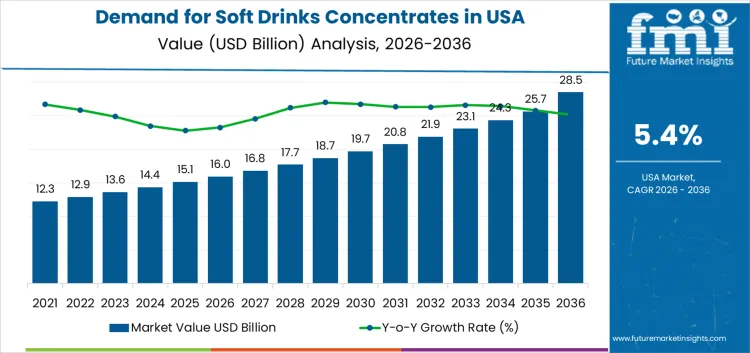
Segment-wise, carbonated concentrates account for 35% of the demand, reflecting the continued popularity of sodas across various demographics. These concentrates are essential in producing fizzy drinks that remain staples in the American beverage industry. Supermarkets lead the distribution channels, accounting for 55% of the demand, driven by their ability to offer a wide range of products in bulk and at competitive prices. The packaging format is dominated by bottles and cans, aligning with consumer preferences for convenient, ready-to-consume beverages. The rising interest in healthier alternatives, such as non-carbonated concentrates and low-calorie options, is fueling demand for product diversification. With evolving trends towards functional and specialty beverages, soft drink concentrates are positioned for steady growth across all regions, particularly in the West and South USA, where innovation and health-consciousness are driving consumption patterns.
Demand for Soft Drinks Concentrates in USA Key Takeaways
| Metric | Value |
|---|---|
| Demand for Soft Drinks Concentrates in USA Value (2026) | USD 16.0 billion |
| Demand for Soft Drinks Concentrates in USA Forecast Value (2036) | USD 28.5 billion |
| Demand for Soft Drinks Concentrates in USA Forecast CAGR (2026-2036) | 5.4% |
Why is the Demand for Soft Drinks Concentrates in USA Growing?
Demand for soft drink concentrates in the USA is growing due to the increasing consumption of carbonated and non-carbonated beverages, with consumers seeking convenient and customizable options. Soft drink concentrates are popular among beverage manufacturers as they provide a cost-effective and efficient solution for producing a wide variety of drinks. The trend of on-the-go consumption and the rising demand for ready-to-drink (RTD) beverages are driving the need for soft drink concentrates. The growing preference for lower-calorie, reduced-sugar, and functional drinks is pushing manufacturers to use concentrates as a base for new product innovations that align with consumer health-conscious trends.
Key drivers for this growth include the ongoing shift towards healthier and more natural beverage options, such as fruit-based and plant-based soft drinks, which often use concentrates for flavor and color. The demand for convenient beverage solutions that require minimal preparation and storage space, especially in the foodservice and vending sectors, is also boosting the need for soft drink concentrates. Advancements in concentrate formulations, such as those offering enhanced flavor profiles and the ability to cater to specific dietary preferences, are fueling the adoption of concentrates in the beverage industry.
The expansion of e-commerce platforms for beverage sales and the increasing presence of soft drink concentrate products in international markets are also contributing to this growth. Despite challenges such as fluctuating raw material prices and the competition from fresh juice and other non-concentrate alternatives, the continued demand for convenience and variety in beverage offerings is expected to drive steady growth in the demand for soft drink concentrates in the USA through 2036.
What is the Segment-Wise Analysis of Demand for Soft Drink Concentrates in USA?
Demand for soft drink concentrates in the USA is segmented by product type, distribution channel types, packaging, and region. By product type, carbonated concentrates lead with 35% of the demand, followed by non-carbonated concentrates, frozen products, baking ingredients & mixes, and breakfast cereals. In terms of distribution channels, supermarkets account for 55% of the demand, with convenience stores and online retail stores contributing to the remainder. Regarding packaging, bottles and cans are the primary forms used. Regionally, demand is distributed across West USA, South USA, Northeast USA, and Midwest USA.
How Does Carbonated Product Type Lead the Demand for Soft Drink Concentrates in USA?
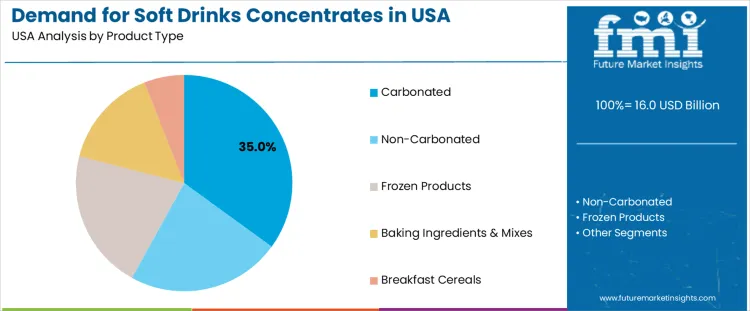
Carbonated soft drink concentrates account for 35% of the demand in the USA, driven by the continued popularity of carbonated beverages. These concentrates are used to produce a wide variety of sodas, which remain a staple in the American beverage market. Carbonated concentrates are favored for their versatility and ability to create refreshing, fizzy drinks that appeal to a broad consumer base. The demand for these concentrates is further fueled by the increasing consumption of ready-to-drink carbonated beverages across multiple age groups and demographics. As consumer preferences continue to favor sparkling drinks, particularly in social and leisure settings, carbonated soft drink concentrates are expected to maintain a significant share of the industry. Innovations in flavor profiles and lower-calorie options continue to enhance the demand for carbonated concentrates, solidifying their position in the industry.
How Does Supermarkets Distribution Channel Lead the Demand for Soft Drink Concentrates in USA?
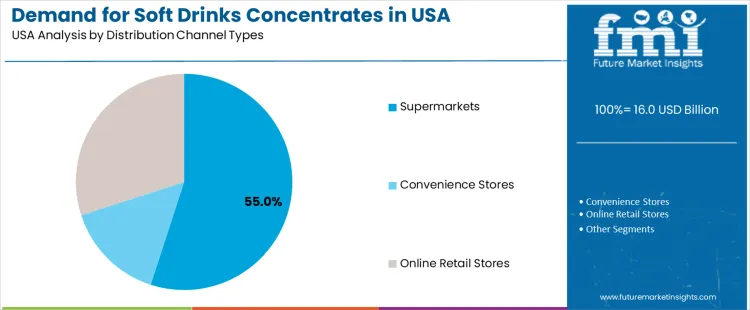
Supermarkets account for 55% of the demand for soft drink concentrates in the USA, driven by their ability to offer a wide variety of products in convenient, bulk quantities. Supermarkets are the primary retail channel for soft drink concentrates, catering to both individual consumers and larger-scale buyers. The extensive reach of supermarkets, combined with their diverse selection of soft drink concentrates from different brands, makes them the dominant sales channel. Supermarkets frequently offer promotions and discounts on soft drink concentrates, encouraging repeat purchases. As the demand for convenient, cost-effective beverage solutions grows, supermarkets continue to play a critical role in meeting consumer needs. As soft drink concentrates remain a key component in the preparation of both carbonated and non-carbonated beverages, the demand through supermarkets is expected to continue to lead the industry.
What are the Key Trends, Drivers and Restraints in Demand for Soft Drinks Concentrates in USA?
Demand for soft drinks concentrates in the USA is growing as beverage manufacturers focus on cost efficiency, flavor variety, and customization. Trends include healthier formulations with reduced sugar, natural sweeteners, and functional ingredients such as vitamins or botanicals. Drivers include expansion of retail and foodservice channels, rising at‑home beverage preparations, and the popularity of flavored sparkling water and energy drinks. Restraints include health concerns about sugary drinks, regulatory scrutiny on added sugars, and competition from ready‑to‑drink alternatives that reduce reliance on concentrates.
Why is Demand for Soft Drinks Concentrates Growing in USA?
Demand for soft drinks concentrates in the USA is increasing because manufacturers and bottlers seek flexible production inputs to meet varied consumer tastes. Concentrates allow producers to adjust flavors, sweetness levels, and functional additives more easily than pre‑mixed products. Growth in craft beverage segments, private label brands, and seasonal flavors supports broader use. Foodservice establishments also rely on concentrates to serve fountain drinks efficiently and cost effectively. Rising consumption of flavored beverages and specialty sodas among younger demographics further stimulates demand. At‑home soda makers and beverage mixers use concentrates for convenience and customization.
How are Technological and Industry Innovations Driving Soft Drinks Concentrate Demand in USA?
Advances in natural flavor extraction, clean label sweeteners, and process optimization enable producers to create concentrates with better taste profiles and nutritional positioning. Improved packaging solutions, such as aseptic bags and concentrated liquid formats, reduce waste and shipping costs. Digital formulation tools allow faster development of new flavors and quicker response to consumer trends. Innovation in sensory science and functional ingredient blending supports healthier variants like low‑sugar, probiotic, and antioxidant‑enhanced options. These enhancements make concentrates more appealing to beverage developers and end consumers, expanding their use across categories.
What are the Key Challenges and Risks That Could Limit Soft Drinks Concentrate Demand in USA?
Increasing health concerns over sugar content and artificial additives reduce demand for traditional soda flavors, pushing consumers toward water, tea, or functional drinks that may not use typical concentrates. Regulatory pressures on sugar reduction and labeling requirements could force reformulation, increasing costs. Competition from ready‑to‑drink beverages and single‑serve formats may reduce usage of concentrates, especially in on‑the‑go consumption. Raw material price volatility, especially for natural flavors and sweeteners, can impact cost structures. Shifting consumer preferences toward premium, craft, or niche beverages may prioritize unique formulations that do not rely on standard concentrate platforms.
What is the Regional Demand Outlook for Soft Drinks Concentrates in USA?
| Region | CAGR (%) |
|---|---|
| West USA | 6.2% |
| South USA | 5.6% |
| Northeast USA | 5.0% |
| Midwest USA | 4.3% |
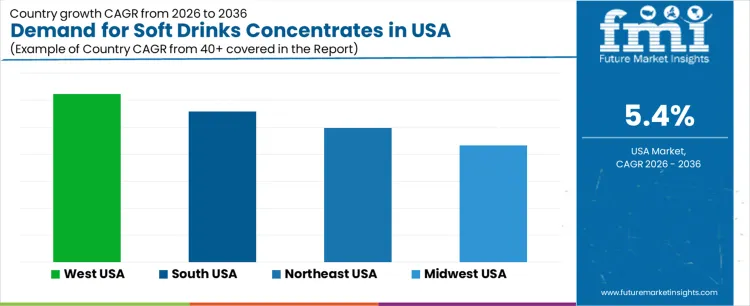
Demand for soft drink concentrates in the USA is growing steadily, with West USA leading at a 6.2% CAGR, driven by strong consumer demand for innovative and health-conscious beverages. South USA follows with a 5.6% CAGR, supported by a large and diverse population and expanding beverage production sectors. Northeast USA shows a 5.0% CAGR, fueled by a well-developed beverage manufacturing industry and evolving consumer preferences for healthier and premium drinks. Midwest USA experiences a 4.3% CAGR, with moderate growth driven by an established beverage industry and rising demand for functional and low-sugar beverages.
How is Demand for Soft Drinks Concentrates Growing in West USA?
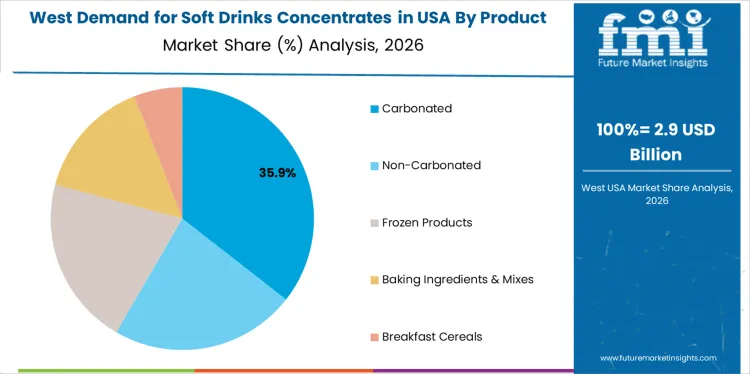
West USA leads the demand for soft drinks concentrates, growing at a 6.2% CAGR. The region’s strong consumer base and high demand for innovative beverage products are key factors driving this growth. States like California, Oregon, and Washington have a significant presence of both established and emerging beverage companies that rely on soft drink concentrates for creating a variety of beverages. The growing focus on healthier and lower-sugar alternatives, as well as organic and functional beverages, is fueling the demand for concentrates that offer a wide range of flavors and formulations. The West’s highly developed distribution networks and increasing interest in premium and sustainable beverage options further contribute to the growing need for soft drink concentrates. With the region’s diverse and health-conscious population, the demand for these concentrates is expected to continue expanding, particularly as the industry for non-traditional and innovative drinks continues to rise.
Why is Demand for Soft Drinks Concentrates Rising in South USA?
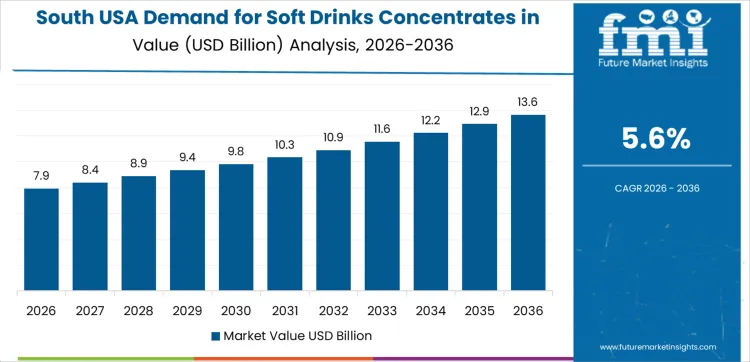
South USA is experiencing steady demand for soft drinks concentrates, with a 5.6% CAGR. The region’s large and diverse population, combined with its strong food and beverage sector, is driving this demand. States like Texas, Florida, and Georgia are major hubs for beverage production, where soft drink concentrates are widely used in the manufacturing of carbonated and non-carbonated beverages. The growing preference for flavored and functional drinks, as well as low-calorie and sugar-free options, is further contributing to the rise in concentrate demand. The South's expanding retail and distribution networks also support the growth of the industry. As consumer preferences evolve and interest in new beverage categories increases, such as energy drinks and ready-to-drink (RTD) beverages, the need for soft drink concentrates to meet these demands will continue to rise. With a growing beverage industry and shifting consumer trends, demand for soft drink concentrates in the South will remain strong.
How is Demand for Soft Drinks Concentrates Expanding in Northeast USA?
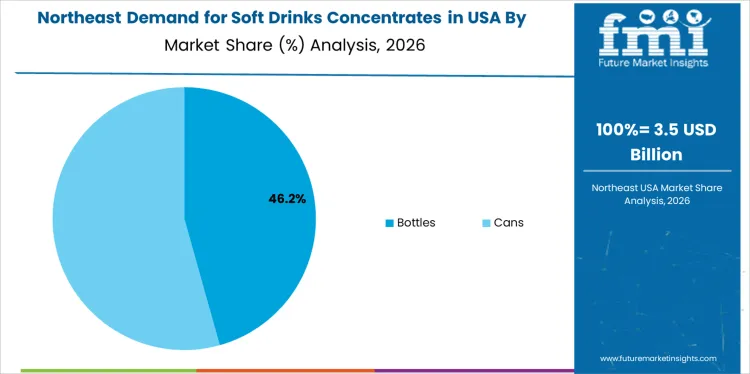
Northeast USA is seeing steady demand for soft drinks concentrates, with a 5.0% CAGR. The region’s large urban population, coupled with its well-developed beverage manufacturing sector, is contributing to the increasing use of soft drink concentrates in the production of a variety of beverages. States like New York, Pennsylvania, and Massachusetts are home to numerous beverage companies that use concentrates for soft drinks, energy drinks, and functional beverages. The growing demand for healthier alternatives, such as organic and low-sugar drinks, is further boosting the need for concentrates that offer versatile flavor solutions. The Northeast’s commitment to innovation and premium product offerings also fuels the demand for high-quality, specialized concentrates. As the region continues to experience an evolving beverage industry with a focus on sustainability and better-for-you drinks, the demand for soft drink concentrates is expected to continue growing steadily, catering to both traditional and emerging consumer preferences.
How is Demand for Soft Drinks Concentrates Growing in Midwest USA?
Midwest USA is experiencing moderate demand for soft drinks concentrates, with a 4.3% CAGR. The region’s well-established beverage manufacturing industry, particularly in states like Illinois, Michigan, and Ohio, is contributing to the steady growth of concentrate usage. Soft drink concentrates are widely used in the Midwest’s carbonated beverage industry, and with a growing demand for non-carbonated beverages, functional drinks, and energy beverages, the need for diverse and innovative concentrates is also increasing. Midwest’s expanding retail and distribution infrastructure is helping drive the accessibility of these products across the region. As consumer preferences evolve toward healthier alternatives, and as demand for organic, low-sugar, and natural drinks increases, the need for soft drink concentrates to cater to these trends will rise. With steady growth in the beverage sector and the region’s focus on meeting changing consumer needs, the demand for soft drink concentrates is expected to continue expanding.
What is the Competitive Landscape of Soft Drinks Concentrates Demand in USA?
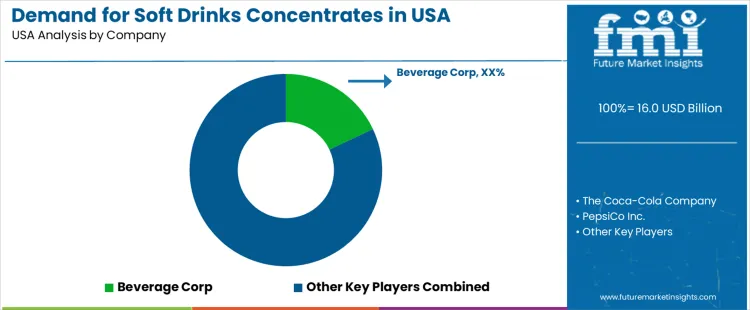
Demand for soft drink concentrates in the USA continues to rise, driven by the increasing popularity of both traditional and innovative beverage options. Soft drink concentrates serve as the foundational ingredient for the production of a variety of drinks, ranging from sodas to energy drinks, and are in demand as beverage manufacturers seek to streamline production while maintaining consistent taste, quality, and cost-efficiency. With evolving consumer preferences toward lower-sugar, functional, and zero-calorie beverages, the concentrate industry is adapting to meet the growing demand for healthier and more diverse options.
The Coca-Cola Company dominates the soft drink concentrate industry in the USA, offering a broad range of concentrate products for its iconic sodas, juices, and energy drinks. Coca-Cola’s strategy focuses on innovation, offering concentrates for both traditional and health-conscious beverages, and strengthening its presence through partnerships with bottling companies. The company’s ability to adapt its product portfolio to meet shifting consumer preferences has helped it maintain its strong position in the competitive landscape.
PepsiCo Inc. is another major player in the soft drink concentrate industry, competing closely with Coca-Cola. PepsiCo offers a diverse range of concentrates for its soft drink brands, including Pepsi, Mountain Dew, and Gatorade. The company focuses on expanding its portfolio to include more functional beverages, such as electrolyte-rich drinks and lower-sugar options, to cater to evolving health trends. Other key players like Beverage Corp, Cott Corporation, and Kraft Foods also contribute to the industry, with Cott specializing in both soft drink concentrates and private-label products, and Kraft Foods expanding its range with beverage concentrates that appeal to both mainstream and niche industrys.
Key Players in USA Soft Drinks Concentrates Demand
- Beverage Corp
- The Coca-Cola Company
- PepsiCo Inc.
- Cott Corporation
- Kraft Foods
Scope of Report
| Items | Values |
|---|---|
| Quantitative Units (2026) | USD billion |
| Key Segments | Carbonated, Non-Carbonated, Frozen Products, Baking Ingredients & Mixes, Breakfast Cereals |
| Distribution Channel Types | Supermarkets, Convenience Stores, Online Retail Stores |
| Packaging | Bottles, Cans |
| Key Country | USA |
| Region | West USA, South USA, Northeast USA, Midwest USA |
| Key Players Profiled | Beverage Corp, The Coca-Cola Company, PepsiCo Inc., Cott Corporation, Kraft Foods |
| Additional Attributes | Dollar sales by product type, distribution channel, and packaging; regional CAGR and growth trends in soft drinks concentrates in the USA |
USA Soft Drinks Concentrates Demand by Key Segments
Product Type:
- Carbonated
- Non-Carbonated
- Frozen Products
- Baking Ingredients & Mixes
- Breakfast Cereals
Distribution Channel Types:
- Supermarkets
- Convenience Stores
- Online Retail Stores
Packaging:
- Bottles
- Cans
Region:
- West USA
- South USA
- Northeast USA
- Midwest USA
Frequently Asked Questions
How big is the demand for soft drinks concentrates in USA in 2026?
The demand for soft drinks concentrates in USA is estimated to be valued at USD 16.0 billion in 2026.
What will be the size of soft drinks concentrates in USA in 2036?
The market size for the soft drinks concentrates in USA is projected to reach USD 28.5 billion by 2036.
How much will be the demand for soft drinks concentrates in USA growth between 2026 and 2036?
The demand for soft drinks concentrates in USA is expected to grow at a 5.4% CAGR between 2026 and 2036.
What are the key product types in the soft drinks concentrates in USA?
The key product types in soft drinks concentrates in USA are carbonated, non-carbonated, frozen products, baking ingredients & mixes and breakfast cereals.
Which packaging segment is expected to contribute significant share in the soft drinks concentrates in USA in 2026?
In terms of packaging, bottles segment is expected to command 45.0% share in the soft drinks concentrates in USA in 2026.
Preview the report firsthand - request a free sample
Get SampleGet the brochure for pricing and purchase details.
Get PDFTable of Content
- Executive Summary
- USA Market Outlook
- Demand-side Trends
- Supply-side Trends
- Technology Roadmap Analysis
- Analysis and Recommendations
- Market Overview
- Market Coverage / Taxonomy
- Market Definition / Scope / Limitations
- Market Background
- Market Dynamics
- Drivers
- Restraints
- Opportunity
- Trends
- Scenario Forecast
- Demand in Optimistic Scenario
- Demand in Likely Scenario
- Demand in Conservative Scenario
- Opportunity Map Analysis
- Product Life Cycle Analysis
- Supply Chain Analysis
- Investment Feasibility Matrix
- Value Chain Analysis
- PESTLE and Porter’s Analysis
- Regulatory Landscape
- Regional Parent Market Outlook
- Production and Consumption Statistics
- Import and Export Statistics
- Market Dynamics
- USA Market Analysis 2020 to 2024 and Forecast, 2025 to 2035
- Historical Market Size Value (USD Million) Analysis, 2020 to 2024
- Current and Future Market Size Value (USD Million) Projections, 2025 to 2035
- Y-o-Y Growth Trend Analysis
- Absolute $ Opportunity Analysis
- USA Market Pricing Analysis 2020 to 2024 and Forecast 2025 to 2035
- USA Market Analysis 2020 to 2024 and Forecast 2025 to 2035, By Product Type
- Introduction / Key Findings
- Historical Market Size Value (USD Million) Analysis By Product Type , 2020 to 2024
- Current and Future Market Size Value (USD Million) Analysis and Forecast By Product Type , 2025 to 2035
- Carbonated
- Non-Carbonated
- Frozen Products
- Baking Ingredients & Mixes
- Breakfast Cereals
- Y-o-Y Growth Trend Analysis By Product Type , 2020 to 2024
- Absolute $ Opportunity Analysis By Product Type , 2025 to 2035
- USA Market Analysis 2020 to 2024 and Forecast 2025 to 2035, By Packaging
- Introduction / Key Findings
- Historical Market Size Value (USD Million) Analysis By Packaging, 2020 to 2024
- Current and Future Market Size Value (USD Million) Analysis and Forecast By Packaging, 2025 to 2035
- Bottles
- Cans
- Y-o-Y Growth Trend Analysis By Packaging, 2020 to 2024
- Absolute $ Opportunity Analysis By Packaging, 2025 to 2035
- USA Market Analysis 2020 to 2024 and Forecast 2025 to 2035, By Distribution Channel Types
- Introduction / Key Findings
- Historical Market Size Value (USD Million) Analysis By Distribution Channel Types, 2020 to 2024
- Current and Future Market Size Value (USD Million) Analysis and Forecast By Distribution Channel Types, 2025 to 2035
- Supermarkets
- Convenience Stores
- Online Retail Stores
- Y-o-Y Growth Trend Analysis By Distribution Channel Types, 2020 to 2024
- Absolute $ Opportunity Analysis By Distribution Channel Types, 2025 to 2035
- Market Structure Analysis
- Competition Dashboard
- Competition Benchmarking
- Market Share Analysis of Top Players
- By Regional
- By Product Type
- By Packaging
- By Distribution Channel Types
- Competition Analysis
- Competition Deep Dive
- Beverage Corp
- Overview
- Product Portfolio
- Profitability by Market Segments (Product/Age /Sales Channel/Region)
- Sales Footprint
- Strategy Overview
- Marketing Strategy
- Product Strategy
- Channel Strategy
- The Coca-Cola Company
- PepsiCo Inc.
- Cott Corporation
- Kraft Foods
- Beverage Corp
- Competition Deep Dive
- Assumptions & Acronyms Used
- Research Methodology


