

- Industry Size (2026)
- USD 40.04 Bn
- Forecast (2036)
- USD 69.91 Bn
- CAGR (2026 to 2036)
- 5.7%
Soft Drinks Concentrates Market Size and Share Forecast Outlook 2026 to 2036
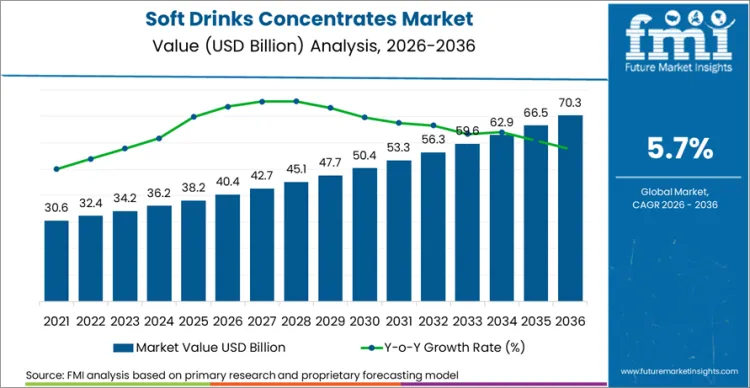
The global soft drinks concentrates market is on track to achieve a valuation of USD 69.91 Billion by 2036, accelerating from USD 40.04 Billion in 2026 at a CAGR of 5.7%. As per Future Market Insights, expansion is structurally underpinned by the global reformulation wave driven by sugar taxes, the parallel growth of functional and energy drink concentrate categories, and the expansion of quick-service restaurant and fountain channels in emerging markets. The World Health Organization reiterated in its 2024 global nutrition guidelines the recommendation to limit free sugar intake to below 10% of total energy, a position that sustains regulatory pressure on concentrate formulation. This compels manufacturers to invest in alternative sweetener systems and natural flavor technologies that can deliver consumer-acceptable taste profiles under reduced-sugar constraints. Simultaneously the competitive environment is shifting from commodity syrup supply to differentiated concentrate platforms where functional ingredients, brand exclusivity, and regional taste customization determine contract wins.
Tim Cofer, CEO of Keurig Dr Pepper, stated: 'Today\'s announcement marks a transformational moment in the beverage industry, as we build on KDP\'s disruptive legacy by creating two winning companies.' FMI opines that this reflects a broader structural shift where major concentrate and beverage companies are restructuring through mega-acquisitions and corporate splits to sharpen focus on high-growth functional and premium beverage categories.
The operational reality for soft drinks concentrate producers is defined by the convergence of reformulation mandates, functional ingredient integration, and geographic expansion of fountain and mixing channels. PepsiCo inaugurated a new storage and innovation center at its concentrate plant in Colonia, Uruguay in September 2025, a USD 100 million modernization project that now exports to 23 countries using 100% renewable energy. Keurig Dr Pepper announced the acquisition of JDE Peet\'s and a subsequent corporate split in 2025, a restructuring designed to create focused entities for its coffee and refreshment beverage concentrate operations. Coca-Cola continued to expand its zero-sugar portfolio globally in 2025, with zero-sugar variants accounting for a growing share of total concentrate shipments. As per FMI, these moves confirm that the soft drinks concentrates sector is entering a phase of portfolio restructuring where producers are splitting, acquiring, and reformulating to concentrate resources on the highest-growth categories while meeting tightening sugar-reduction mandates.
Summary of Soft Drinks Concentrates Market
What Is Growth Outlook for Soft Drinks Concentrates Market as per Future Market Insights Projection?
Future Market Insights projects the soft drinks concentrates market to expand at a CAGR of 5.7% from 2026 to 2036, increasing from USD 40.04 Billion in 2026 to USD 69.91 Billion by 2036.
FMI Research Approach: FMI proprietary forecasting model based on QSR outlet growth and per capita soft drink consumption correlation.
How Do FMI Analysts Perceive Soft Drinks Concentrates Market to Evolve?
FMI analysts perceive the market evolving toward differentiated concentrate platforms where zero-sugar formulation, functional ingredient integration, and regional taste customization replace commodity syrup supply as the primary competitive differentiator.
FMI Research Approach: WHO nutrition guideline tracking and sugar tax implementation mapping.
Which Country Holds Largest Share in Global Soft Drinks Concentrates Market?
The United States holds a significant share of the global soft drinks concentrates market by value, supported by the largest quick-service restaurant and fountain distribution network and a dominant position of US-headquartered concentrate companies.
FMI Research Approach: FMI country-level revenue modelling by QSR outlet density and per capita carbonated soft drink consumption.
How Large Will Soft Drinks Concentrates Market Be by 2036?
The global soft drinks concentrates market is projected to reach USD 69.91 Billion by 2036.
FMI Research Approach: FMI long-term revenue forecast derived from beverage industry restructuring analysis and sugar-reduction mandate projections.
What Is Definition of Soft Drinks Concentrates Market?
The soft drinks concentrates market includes revenue generated from the production and sale of flavored syrups, powder mixes, and liquid concentrates used to produce carbonated soft drinks, non-carbonated beverages, and fountain drinks at bottling plants, QSR outlets, and consumer mixing applications.
FMI Research Approach: FMI market taxonomy and inclusion-exclusion framework.
What Are Globally Unique Trends Shaping Soft Drinks Concentrates Market?
Globally unique trends include the accelerating shift to zero-sugar and stevia-based concentrate formulations in response to sugar taxes, the integration of functional ingredients such as electrolytes and vitamins into concentrate platforms, and the expansion of modern concentrate plants with 100% renewable energy and 4IR manufacturing technology.
FMI Research Approach: Sugar tax implementation tracking and QSR channel expansion analysis.
Soft Drinks Concentrates Market Key Takeaways
| Metric | Details |
|---|---|
| Industry Size (2026) | USD 40.04 Billion |
| Industry Value (2036) | USD 69.91 Billion |
| CAGR (2026 to 2036) | 5.7% |
Source: Future Market Insights (FMI) analysis, based on proprietary forecasting model and primary research
Category-wise Insights
Carbonated Dominates Soft Drinks Concentrates Market
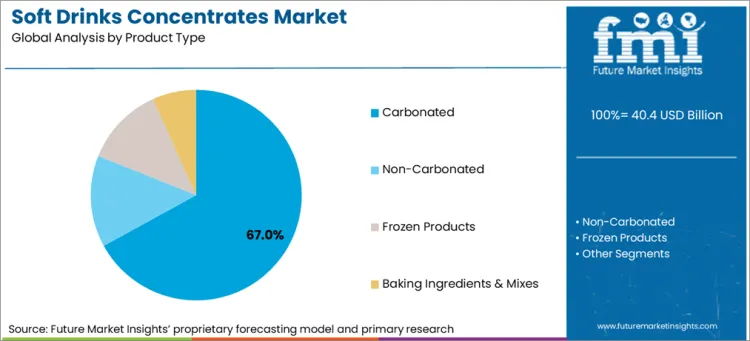
| Segment | Value Share (2026) |
|---|---|
| Carbonated (Product Type) | 67% |
The market for carbonated concentrates will be driven by the increasing popularity of carbonated soft drinks. Customers continue to favor carbonated drinks like colas lemonades and sparkling waters because of their delicious flavor and accessibility. Since carbonated concentrates are essential components in the production of these drinks their ongoing popularity guarantees a steady market.
The segments expansion is also aided by the well-established presence of major brands and their effective marketing strategies. Although non-carbonated and healthier options are becoming more popular carbonated drinks are still a staple in many people’s diets which ensures that there will always be a need for carbonated concentrates. Therefore, it is anticipated that consumer preferences and market trends will propel additional segment growth.
Bottles Rule Soft Drinks Concentrates Drives Market Growth
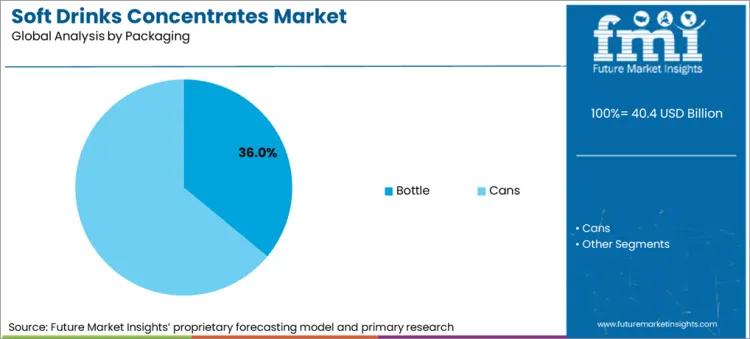
| Segment | Value Share (2026) |
|---|---|
| Bottle (Packaging) | 36% |
Due to its liquid nature, bottles are the most convenient packaging option. With attractive labels, bottles are ruling the soft drinks concentrates industry by packaging. It is expected to have 36% market share in the Industry.
Key Industry Highlights
Demand for Organic Soft Drink is Driving Market Growth
The market for organic soft drinks has expanded as a result of growing consumer awareness of the advantages of eating organic. Fresh organic fruits or vegetables grown on farms free of pesticides and insecticides non-ionizing radiation products and a wide range of food additives are used to make organic soft drinks. Nonetheless it has a high nutritional content few calories and natural sweetening agents.
Traditional soft drinks remain popular but the category has changed due to the holistic health and wellness movement negative press about hospitalizations and deaths from soft drink consumption and awareness of excessive caffeine intake.
The USDA reports that the market has seen a rise in the consumption of organic soft drinks and companies are creating these drinks using natural and/or organic ingredients because they are thought to be a superior option. In order to draw customers and fuel market expansion companies are marketing their products as clean labels which include clean organic natural and healthy drinks in addition to functional ingredient claims.
Cost Efficiency is Driving the Market Growth
The foodservice sector which includes cafes restaurants and fast-food chains can save a lot of money and time by using soft drink concentrates. Since concentrates take up less space than pre-mixed beverages they eliminate the need for large storage facilities. They are perfect for large-scale beverage production in commercial settings because they are also simple to mix and transport. Businesses with a large customer base will especially benefit from this cost-efficiency.
Additionally, foodservice operators find it appealing that they can use soft drink concentrates to create customized beverages that accommodate a variety of customer preferences. As a result, the foodservice sector has begun using soft drink concentrates more frequently.
2021 to 2025 Global Soft Drinks Concentrates Sales Analysis Compared to Demand Forecasts for 2026 to 2036
During the period 2021 to 2025, the sales grew at a CAGR of 3.3%, and it is predicted to continue to grow at a CAGR of 5.7% during the forecast period of 2026 to 2036.
Due to consumers preference for premium foods with high nutritional content the market has expanded. Soft drink sales are predicted to rise globally as major industry players focus on creating distinctive products that entice consumers to buy their goods.
Additionally, the growing variety of soft drink concentrate has sped up market expansion. Regardless of the taste or nutritional value of the product consumers desire for processed foods is what propels the soft drink industry.
Market Concentration
Tier 1 companies includes industry leaders acquiring a 70% share in the global business market. These leaders are distinguished by their extensive product portfolio and high production capacity. These industry leaders stand out due to their broad geographic reach, in-depth knowledge of manufacturing and reconditioning across various formats and strong customer base. They offer a variety of services and manufacturing with the newest technology while adhering to legal requirements for the best quality.
Tier 2 companies comprises of mid-size players having a presence in some regions and highly influencing the local commerce and has a market share of 20%. These are distinguished by their robust global presence and solid business acumen. These industry participants may not have cutting-edge technology or a broad global reach but they do have good technology and guarantee regulatory compliance.
Tier 3 companies includes mostly of small-scale businesses serving niche economies and operating at the local presence having a market share of 10%. Due to their notable focus on meeting local needs these businesses are categorized as belonging to the tier 3 share segment, they are minor players with a constrained geographic scope. As an unorganized ecosystem Tier 3 in this context refers to a sector that in contrast to its organized competitors, lacks extensive structure and formalization.
Country wise Insights
The following table shows the forecasted growth rates of the significant three geographies revenues. USA, Germany and China come under the exhibit of high consumption, recording CAGRs of 6.5%, 5.3% and 6.7%, respectively, through 2036.
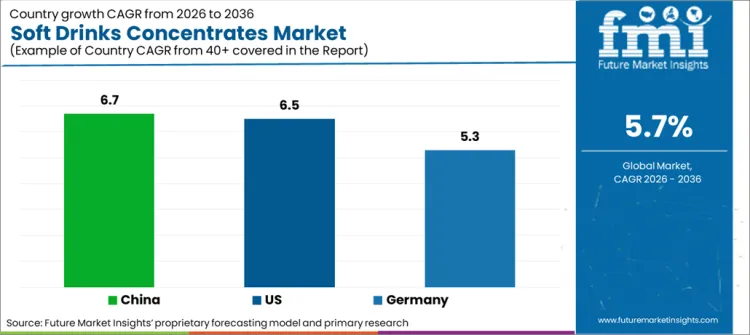
| Countries | CAGR, 2026 to 2036 |
|---|---|
| United States | 6.5% |
| Germany | 5.3% |
| China | 6.7% |
USA Dominates the North America Soft Drinks Concentrates Market
The USA will continue to be the most profitable markets for energy drinks. Throughout the forecast period USA is anticipated to dominate the soft drink concentrate market due to peoples growing concerns about health issues including obesity. Consumers now prefer natural energy drinks or diet beverages without alcohol over the regions widely consumed alcohol because they are calorie- sugar- and sugar-free.
China Contributes to the Soft Drinks Concentrates Market Growth
The use of natural ingredients such as vitamins minerals amino acids herbs and other raw fruits or vegetables in the production of soft drinks is growing. Customers in this area are drawn to these functional beverages due to growing awareness of their health advantages. The product lifecycle (PLC) positioning of China points to significant market growth prospects.
Germany Emerges in Soft Drinks Concentrates Market
Germany contributes to the soft drinks concentrates market demand. It is expected to grow at a CAGR of 5.3%. There are multiple interconnected factors that contribute to this dominance. First the boom in soft drink consumption among Germans is a result of a number of factors including urbanization fast-paced lifestyles and rising disposable income. Second the German market offers an incredibly broad selection of soft drink concentrates.
Competition Outlook
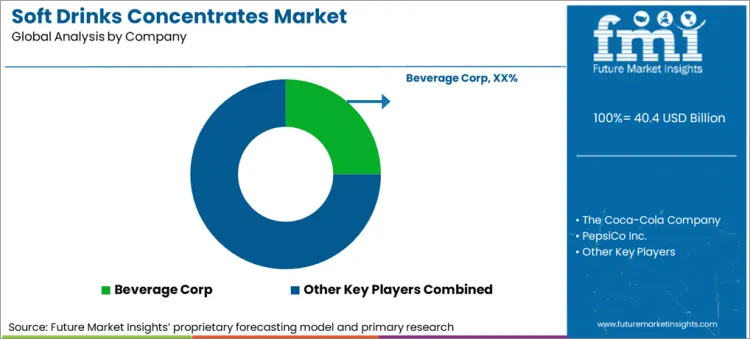
Energy drinks ready-to-drink (RTD) teas and coffees bottled water and functional beverages like protein shakes and plant-based drinks are all fierce rivals to the soft drink market. Drinks that are seen as healthier substitutes for conventional soft drinks are becoming more popular as consumers grow more health conscious.
For example, infused waters and RTD teas are becoming more and more popular because they are frequently promoted as being made with natural ingredients and having fewer calories. This change in consumer preferences threatens the market expansion of soft drink concentrates since it faces competition from a wide variety of beverage options that appeal to consumers who are health-conscious.
Recent Developments:
- In September 2025, PepsiCo inaugurated a new storage and innovation center at its concentrate plant in Colonia, Uruguay, as part of a USD 100 million modernization project that now exports to 23 countries using 100% renewable energy.
- In 2025, Keurig Dr Pepper announced the acquisition of JDE Peet\'s and a subsequent corporate split, creating focused entities for its coffee and refreshment beverage concentrate operations.
- In 2025, Coca-Cola continued to expand its zero-sugar portfolio globally, with zero-sugar variants accounting for a growing share of total concentrate shipments in response to tightening sugar-reduction mandates.
Leading Manufacturers
- Beverage Corp
- The Coca-Cola Company
- PepsiCo Inc.
- Cott Corporation
- Kraft Foods
- Dohler Group
- Dr. Pepper Snapple Group
Market Definition
The soft drinks concentrates market represents revenue generated from the production and sale of flavored syrups, powder mixes, and liquid concentrates used to produce carbonated soft drinks, non-carbonated beverages, and fountain drinks. The market measures the value of concentrates sold to bottlers, quick-service restaurants, institutional foodservice operators, and consumer retail channels.
Inclusions cover cola, citrus, fruit-flavored, and energy drink concentrates in liquid and powder form. It includes zero-sugar and reduced-calorie formulations, functional concentrate blends with added vitamins or electrolytes, and proprietary fountain syrup systems. Concentrate packaging (bag-in-box, drums, pouches) is also included.
Exclusions include finished ready-to-drink beverages sold to consumers, fruit juice not-from-concentrate products, alcoholic beverage concentrates, and water treatment chemicals. Bottling plant equipment, fountain dispensing machines, and retail refrigeration are outside the scope.
Key Segments of the Report
By Product Type:
By product type, industry has been categorized into Carbonated and non-carbonated
By Packaging:
By packaging industry has been categorized into Bottles & Cans.
By Distribution Channel Types:
By distribution channel industry has been categorized into Supermarkets, Convenience Stores and Online Retail Stores
By Region:
Industry analysis has been carried out in key countries of North America; Europe, Middle East, Africa, ASEAN, South Asia, Asia, New Zealand and Australia
Bibliography
- PepsiCo. (2025, September). Concentrate plant modernization in Colonia, Uruguay. PepsiCo corporate disclosure.
- Keurig Dr Pepper. (2025). Acquisition of JDE Peet\'s and corporate split announcement. KDP investor relations.
- World Health Organization. (2024). Global nutrition guidelines on sugar intake. WHO.
Frequently Asked Questions
What is the current global market size for the Soft Drinks Concentrates Market?
The market is valued at USD 40.04 Billion in 2026, driven by the global reformulation wave driven by sugar taxes combined with growing demand for functional and energy drink concentrate categories.
What is the projected Compound Annual Growth Rate (CAGR) for the market over the next 10 years?
The market is projected to grow at a CAGR of 5.7% from 2026 to 2036.
Which regions are experiencing the fastest expansion?
Asia Pacific leads with the highest growth rate, driven by QSR channel expansion in India and Southeast Asia, followed by Latin America and North America.
What are the primary market drivers?
Sugar-reduction mandates driving concentrate reformulation, the growth of functional and energy drink categories, and QSR channel expansion in emerging markets are the primary drivers.
Who are the leading companies in the industry?
Coca-Cola, PepsiCo, Keurig Dr Pepper, and Britvic are key players, differentiating through zero-sugar formulation platforms, functional ingredient integration, and global fountain distribution networks.
Preview the report firsthand - request a free sample
Get SampleGet the brochure for pricing and purchase details.
Get PDFTable of Content
- Executive Summary
- Global Market Outlook
- Demand-side Trends
- Supply-side Trends
- Technology Roadmap Analysis
- Analysis and Recommendations
- Market Overview
- Market Coverage / Taxonomy
- Market Definition / Scope / Limitations
- Research Methodology
- Chapter Orientation
- Analytical Lens and Working Hypotheses
- Market Structure, Signals, and Trend Drivers
- Benchmarking and Cross-market Comparability
- Market Sizing, Forecasting, and Opportunity Mapping
- Research Design and Evidence Framework
- Desk Research Programme (Secondary Evidence)
- Company Annual and Sustainability Reports
- Peer-reviewed Journals and Academic Literature
- Corporate Websites, Product Literature, and Technical Notes
- Earnings Decks and Investor Briefings
- Statutory Filings and Regulatory Disclosures
- Technical White Papers and Standards Notes
- Trade Journals, Industry Magazines, and Analyst Briefs
- Conference Proceedings, Webinars, and Seminar Materials
- Government Statistics Portals and Public Data Releases
- Press Releases and Reputable Media Coverage
- Specialist Newsletters and Curated Briefings
- Sector Databases and Reference Repositories
- FMI Internal Proprietary Databases and Historical Market Datasets
- Subscription Datasets and Paid Sources
- Social Channels, Communities, and Digital Listening Inputs
- Additional Desk Sources
- Expert Input and Fieldwork (Primary Evidence)
- Primary Modes
- Qualitative Interviews and Expert Elicitation
- Quantitative Surveys and Structured Data Capture
- Blended Approach
- Why Primary Evidence is Used
- Field Techniques
- Interviews
- Surveys
- Focus Groups
- Observational and In-context Research
- Social and Community Interactions
- Stakeholder Universe Engaged
- C-suite Leaders
- Board Members
- Presidents and Vice Presidents
- R&D and Innovation Heads
- Technical Specialists
- Domain Subject-matter Experts
- Scientists
- Physicians and Other Healthcare Professionals
- Governance, Ethics, and Data Stewardship
- Research Ethics
- Data Integrity and Handling
- Primary Modes
- Tooling, Models, and Reference Databases
- Desk Research Programme (Secondary Evidence)
- Data Engineering and Model Build
- Data Acquisition and Ingestion
- Cleaning, Normalisation, and Verification
- Synthesis, Triangulation, and Analysis
- Quality Assurance and Audit Trail
- Market Background
- Market Dynamics
- Drivers
- Restraints
- Opportunity
- Trends
- Scenario Forecast
- Demand in Optimistic Scenario
- Demand in Likely Scenario
- Demand in Conservative Scenario
- Opportunity Map Analysis
- Product Life Cycle Analysis
- Supply Chain Analysis
- Investment Feasibility Matrix
- Value Chain Analysis
- PESTLE and Porter’s Analysis
- Regulatory Landscape
- Regional Parent Market Outlook
- Production and Consumption Statistics
- Import and Export Statistics
- Market Dynamics
- Global Market Analysis 2021 to 2025 and Forecast, 2026 to 2036
- Historical Market Size Value (USD Million) Analysis, 2021 to 2025
- Current and Future Market Size Value (USD Million) Projections, 2026 to 2036
- Y-o-Y Growth Trend Analysis
- Absolute $ Opportunity Analysis
- Global Market Pricing Analysis 2021 to 2025 and Forecast 2026 to 2036
- Global Market Analysis 2021 to 2025 and Forecast 2026 to 2036, By Product Type
- Introduction / Key Findings
- Historical Market Size Value (USD Million) Analysis By Product Type , 2021 to 2025
- Current and Future Market Size Value (USD Million) Analysis and Forecast By Product Type , 2026 to 2036
- Carbonated
- Non-Carbonated
- Frozen Products
- Baking Ingredients & Mixes
- Carbonated
- Y-o-Y Growth Trend Analysis By Product Type , 2021 to 2025
- Absolute $ Opportunity Analysis By Product Type , 2026 to 2036
- Global Market Analysis 2021 to 2025 and Forecast 2026 to 2036, By Packaging
- Introduction / Key Findings
- Historical Market Size Value (USD Million) Analysis By Packaging, 2021 to 2025
- Current and Future Market Size Value (USD Million) Analysis and Forecast By Packaging, 2026 to 2036
- Bottle
- Cans
- Bottle
- Y-o-Y Growth Trend Analysis By Packaging, 2021 to 2025
- Absolute $ Opportunity Analysis By Packaging, 2026 to 2036
- Global Market Analysis 2021 to 2025 and Forecast 2026 to 2036, By Region
- Introduction
- Historical Market Size Value (USD Million) Analysis By Region, 2021 to 2025
- Current Market Size Value (USD Million) Analysis and Forecast By Region, 2026 to 2036
- North America
- Latin America
- Western Europe
- Eastern Europe
- East Asia
- South Asia and Pacific
- Middle East & Africa
- Market Attractiveness Analysis By Region
- North America Market Analysis 2021 to 2025 and Forecast 2026 to 2036, By Country
- Historical Market Size Value (USD Million) Trend Analysis By Market Taxonomy, 2021 to 2025
- Market Size Value (USD Million) Forecast By Market Taxonomy, 2026 to 2036
- By Country
- USA
- Canada
- Mexico
- By Product Type
- By Packaging
- By Country
- Market Attractiveness Analysis
- By Country
- By Product Type
- By Packaging
- Key Takeaways
- Latin America Market Analysis 2021 to 2025 and Forecast 2026 to 2036, By Country
- Historical Market Size Value (USD Million) Trend Analysis By Market Taxonomy, 2021 to 2025
- Market Size Value (USD Million) Forecast By Market Taxonomy, 2026 to 2036
- By Country
- Brazil
- Chile
- Rest of Latin America
- By Product Type
- By Packaging
- By Country
- Market Attractiveness Analysis
- By Country
- By Product Type
- By Packaging
- Key Takeaways
- Western Europe Market Analysis 2021 to 2025 and Forecast 2026 to 2036, By Country
- Historical Market Size Value (USD Million) Trend Analysis By Market Taxonomy, 2021 to 2025
- Market Size Value (USD Million) Forecast By Market Taxonomy, 2026 to 2036
- By Country
- Germany
- UK
- Italy
- Spain
- France
- Nordic
- BENELUX
- Rest of Western Europe
- By Product Type
- By Packaging
- By Country
- Market Attractiveness Analysis
- By Country
- By Product Type
- By Packaging
- Key Takeaways
- Eastern Europe Market Analysis 2021 to 2025 and Forecast 2026 to 2036, By Country
- Historical Market Size Value (USD Million) Trend Analysis By Market Taxonomy, 2021 to 2025
- Market Size Value (USD Million) Forecast By Market Taxonomy, 2026 to 2036
- By Country
- Russia
- Poland
- Hungary
- Balkan & Baltic
- Rest of Eastern Europe
- By Product Type
- By Packaging
- By Country
- Market Attractiveness Analysis
- By Country
- By Product Type
- By Packaging
- Key Takeaways
- East Asia Market Analysis 2021 to 2025 and Forecast 2026 to 2036, By Country
- Historical Market Size Value (USD Million) Trend Analysis By Market Taxonomy, 2021 to 2025
- Market Size Value (USD Million) Forecast By Market Taxonomy, 2026 to 2036
- By Country
- China
- Japan
- South Korea
- By Product Type
- By Packaging
- By Country
- Market Attractiveness Analysis
- By Country
- By Product Type
- By Packaging
- Key Takeaways
- South Asia and Pacific Market Analysis 2021 to 2025 and Forecast 2026 to 2036, By Country
- Historical Market Size Value (USD Million) Trend Analysis By Market Taxonomy, 2021 to 2025
- Market Size Value (USD Million) Forecast By Market Taxonomy, 2026 to 2036
- By Country
- India
- ASEAN
- Australia & New Zealand
- Rest of South Asia and Pacific
- By Product Type
- By Packaging
- By Country
- Market Attractiveness Analysis
- By Country
- By Product Type
- By Packaging
- Key Takeaways
- Middle East & Africa Market Analysis 2021 to 2025 and Forecast 2026 to 2036, By Country
- Historical Market Size Value (USD Million) Trend Analysis By Market Taxonomy, 2021 to 2025
- Market Size Value (USD Million) Forecast By Market Taxonomy, 2026 to 2036
- By Country
- Kingdom of Saudi Arabia
- Other GCC Countries
- Turkiye
- South Africa
- Other African Union
- Rest of Middle East & Africa
- By Product Type
- By Packaging
- By Country
- Market Attractiveness Analysis
- By Country
- By Product Type
- By Packaging
- Key Takeaways
- Key Countries Market Analysis
- USA
- Pricing Analysis
- Market Share Analysis, 2025
- By Product Type
- By Packaging
- Canada
- Pricing Analysis
- Market Share Analysis, 2025
- By Product Type
- By Packaging
- Mexico
- Pricing Analysis
- Market Share Analysis, 2025
- By Product Type
- By Packaging
- Brazil
- Pricing Analysis
- Market Share Analysis, 2025
- By Product Type
- By Packaging
- Chile
- Pricing Analysis
- Market Share Analysis, 2025
- By Product Type
- By Packaging
- Germany
- Pricing Analysis
- Market Share Analysis, 2025
- By Product Type
- By Packaging
- UK
- Pricing Analysis
- Market Share Analysis, 2025
- By Product Type
- By Packaging
- Italy
- Pricing Analysis
- Market Share Analysis, 2025
- By Product Type
- By Packaging
- Spain
- Pricing Analysis
- Market Share Analysis, 2025
- By Product Type
- By Packaging
- France
- Pricing Analysis
- Market Share Analysis, 2025
- By Product Type
- By Packaging
- India
- Pricing Analysis
- Market Share Analysis, 2025
- By Product Type
- By Packaging
- ASEAN
- Pricing Analysis
- Market Share Analysis, 2025
- By Product Type
- By Packaging
- Australia & New Zealand
- Pricing Analysis
- Market Share Analysis, 2025
- By Product Type
- By Packaging
- China
- Pricing Analysis
- Market Share Analysis, 2025
- By Product Type
- By Packaging
- Japan
- Pricing Analysis
- Market Share Analysis, 2025
- By Product Type
- By Packaging
- South Korea
- Pricing Analysis
- Market Share Analysis, 2025
- By Product Type
- By Packaging
- Russia
- Pricing Analysis
- Market Share Analysis, 2025
- By Product Type
- By Packaging
- Poland
- Pricing Analysis
- Market Share Analysis, 2025
- By Product Type
- By Packaging
- Hungary
- Pricing Analysis
- Market Share Analysis, 2025
- By Product Type
- By Packaging
- Kingdom of Saudi Arabia
- Pricing Analysis
- Market Share Analysis, 2025
- By Product Type
- By Packaging
- Turkiye
- Pricing Analysis
- Market Share Analysis, 2025
- By Product Type
- By Packaging
- South Africa
- Pricing Analysis
- Market Share Analysis, 2025
- By Product Type
- By Packaging
- USA
- Market Structure Analysis
- Competition Dashboard
- Competition Benchmarking
- Market Share Analysis of Top Players
- By Regional
- By Product Type
- By Packaging
- Competition Analysis
- Competition Deep Dive
- Beverage Corp
- Overview
- Product Portfolio
- Profitability by Market Segments (Product/Age /Sales Channel/Region)
- Sales Footprint
- Strategy Overview
- Marketing Strategy
- Product Strategy
- Channel Strategy
- The Coca-Cola Company
- PepsiCo Inc.
- Beverage Corp
- Competition Deep Dive
- Assumptions & Acronyms Used


