

- Industry Size (2026)
- USD 3.4 Bn
- Forecast (2036)
- USD 67.4 Bn
- CAGR (2026 to 2036)
- 34.80%
Soft Micro Robots Market Forecast and Outlook 2026 to 2036
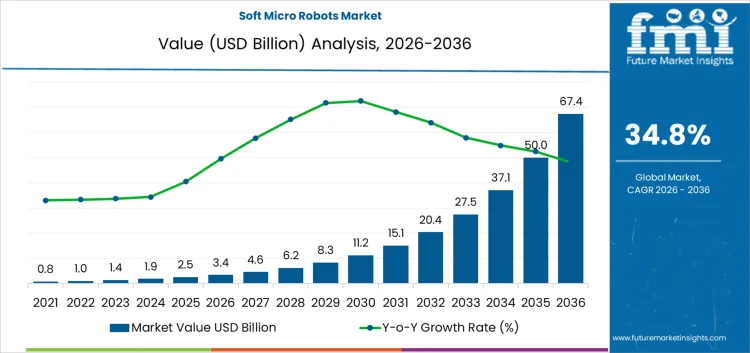
The soft micro robots market is projected to reach USD 3.4 billion in 2026 and USD 67.4 billion by 2036, registering a CAGR of 34.8% across the forecast period. Capital inflow into this sector is accelerating, yet investment is concentrated in R&D-heavy segments with delayed monetization timelines. Most product platforms remain in prototype or clinical validation stages, requiring staged funding across design, testing, and regulatory clearance cycles. Returns are often deferred, as commercialization in medical and industrial applications depends on cross-disciplinary collaboration and functional proof at micro scales.
High capital intensity is evident in materials development, actuation systems, and micro-fabrication facilities, with additional costs tied to integration with diagnostics, imaging, and control platforms. Investors favor entities that combine academic IP with defined commercialization pathways and co-development partners. Selectivity is increasing, with capital favoring startups backed by translational research, strong regulatory strategies, and modular product architecture. Between 2026 and 2036, disciplined capital allocation will determine which ventures scale sustainably in this emerging field.
Quick Stats for Soft Micro Robots Market
- Soft Micro Robots Market Value (2026): USD 3.4 Billion
- Soft Micro Robots Market Forecast Value (2036): USD 67.4 Billion
- Soft Micro Robots Market Forecast CAGR 2026 to 2036: 34.80%
- Leading Product Type in Soft Micro Robots Market: Soft Grippers
- Leading Application in Soft Micro Robots Market: Medical & Healthcare
- Key Growth Regions in Soft Micro Robots Market: Asia Pacific, North America, Europe
- Top Key Players in Soft Micro Robots Market: Soft Robotics Inc.; Festo AG; Ekso Bionics Holdings Inc.; Universal Robots (Teradyne, Inc.); Boston Dynamics; RightHand Robotics Inc.; Yaskawa Electric Corporation; Miso Robotics; Kawada Robotics Corporation; F&P Robotics AG
Soft Micro Robots Market Key Takeaways
| Metric | Value |
|---|---|
| Soft Micro Robots Market Value (2026) | USD 3.4 Billion |
| Soft Micro Robots Market Forecast Value (2036) | USD 67.4 Billion |
| Soft Micro Robots Market Forecast CAGR 2026 to 2036 | 34.80% |
Why is the Soft Micro Robots Market Experiencing Rapid Expansion?
The soft micro robots market is expanding rapidly due to increasing applications in biomedical, healthcare, and industrial sectors. These robots, made from flexible and soft materials, are capable of navigating constrained environments, enabling minimally invasive procedures and precision tasks. Their use in targeted drug delivery, microsurgery, and diagnostics is increasing adoption among hospitals, research labs, and pharmaceutical companies, supporting strong market growth.
Technological advancements are driving growth in the soft micro robots market. Developments in soft actuators, bio-compatible materials, and microfabrication techniques are enhancing robot functionality, precision, and safety. Integration with sensors, imaging systems, and AI-based navigation enables complex operations within the human body and confined industrial spaces. This is making soft micro robots increasingly practical and efficient for both clinical and manufacturing applications.
Rising investments and research initiatives are reinforcing expansion in the soft micro robots market. Governments, academic institutions, and private companies are funding innovation to address healthcare challenges, including targeted therapies and minimally invasive solutions. Growing demand for automation in microscale assembly and inspection tasks in electronics and microfluidics is also boosting market adoption. Combined, technological progress, application diversification, and research funding are driving the market’s high CAGR over the forecast period.
What Does The Segment Overview Indicate About The Soft Micro Robots Market?
The soft micro robots market is segmented by type and application, revealing functional diversity and sector-specific deployment. Soft grippers lead the type segment with an estimated 34% share, favored for their flexible manipulation of delicate objects. Inflatable robots, wearables, and exoskeletons support applications in healthcare, logistics, and mobility systems. Medical and healthcare lead the application segment with approximately 30% share, driven by increasing use in minimally invasive surgery, drug delivery, and rehabilitation devices. Other segments such as food handling, automotive assembly, and agriculture adopt micro-robotics for precision tasks, reflecting expanding adoption across controlled and variable environments.
Why Do Soft Grippers Hold The Leading Type Share In The Soft Micro Robots Market?
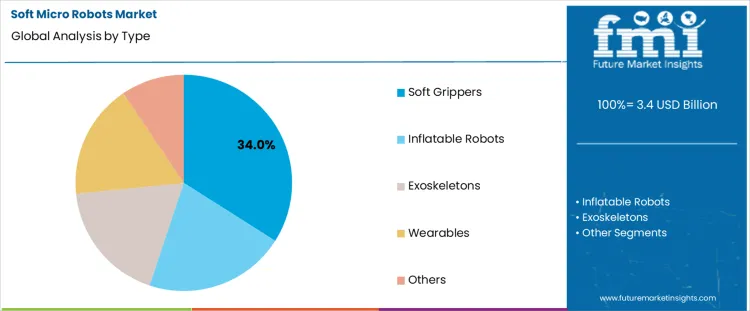
Soft grippers account for the largest 34% share in the soft micro robots market due to their effectiveness in handling fragile and irregularly shaped objects without damaging them. These grippers are widely used in food processing, biomedical manipulation, and electronics assembly, where rigid robotic end-effectors are unsuitable. Their compliance and adaptability allow for safe interaction with human tissue, soft materials, and unpredictable shapes. In healthcare, they support microsurgical tools and delicate therapeutic procedures. In manufacturing, they enhance efficiency in tasks like packing and sorting. Segment variation is shaped by actuator material, grip strength, and environmental conditions. Ongoing research in bio-inspired materials and pneumatic control systems continues to strengthen this segment’s dominance.
How Does Medical And Healthcare Drive Application Demand In The Soft Micro Robots Market?
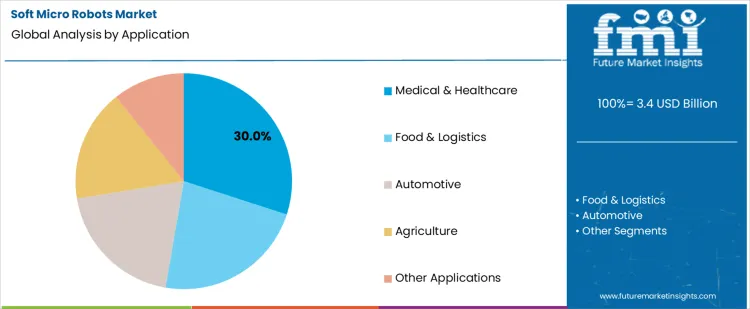
Medical and healthcare applications lead demand in the soft micro robots market with an estimated 30% share, driven by a rising need for minimally invasive devices, soft-tissue-safe tools, and robotic rehabilitation systems. Soft robots are employed in surgical support, drug delivery mechanisms, diagnostic microbots, and prosthetic integration due to their ability to conform to anatomical structures and reduce trauma. Hospitals and research centers prefer micro-scale actuators for navigating narrow biological pathways, enhancing treatment precision. Adoption is also supported by aging populations and chronic disease prevalence, creating sustained demand for robotic assistive technologies. Regulatory pathways and safety standards guide deployment across global healthcare systems, influencing growth rates by region and application type.
What Key Forces Are Driving Growth in the Soft Micro Robots Market?
Growth in the soft micro robots market is being shaped by the need for precision tools in medical, biological, and micro-engineering applications. Soft structures made from elastomers and hydrogels enable controlled motion in sensitive environments without causing mechanical damage. Increasing demand for targeted therapy, minimally invasive procedures, and tissue-compatible devices is pushing academic and industrial investment. Innovations in stimuli-responsive materials, wireless actuation, and bio-hybrid systems are improving functionality and expanding potential use cases. Research programs focused on micro-robotic drug delivery, in-vivo diagnostics, and soft surgical tools are further supporting development. These systems offer safer alternatives to rigid micro-actuators in living and fluidic environments.
Why Are Hospitals and Research Institutions Adopting Soft Micro Robots?
Adoption in the soft micro robots market is led by hospitals, research labs, and biotech developers that require gentle manipulation of biological matter. In medical settings, soft robots are being tested for tasks like non-invasive drug delivery, microsurgery in constrained anatomical spaces, and motion within blood vessels or gastrointestinal tracts. In research, they enable high-precision operations such as cell sorting, organ-on-chip testing, and real-time biological observation. Actuation systems based on magnetic fields, light, and fluidic pressure are favored for their remote controllability. Integration with microfluidics, imaging tools, and sensor platforms is improving functionality and making them viable tools in advanced life sciences.
What Factors Are Hindering Commercialization in the Soft Micro Robots Market?
Several constraints are affecting large-scale adoption across the soft micro robots market. Technical hurdles include maintaining directional control and actuation reliability in variable operating environments. Many robots still operate in lab settings with limited portability and require specialized external fields for motion. Power supply integration and real-time feedback mechanisms remain underdeveloped at small scales. Fabrication techniques are often customized and not suited to mass production. Materials used must meet biocompatibility, sterility, and durability standards, which adds regulatory complexity. In medical applications, clinical trials, approvals, and post-market validation extend commercialization timelines and increase development costs for new entrants.
What is the Country-Wise Growth Outlook for the Soft Micro Robots Market?
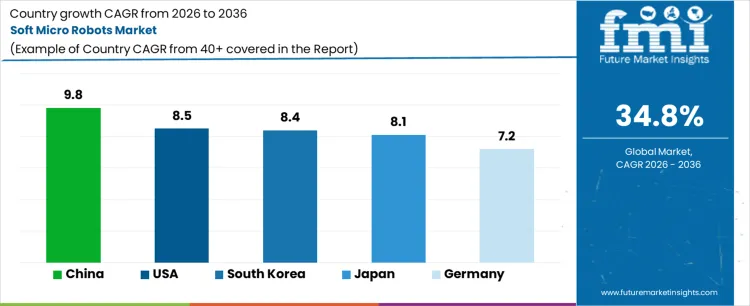
The soft micro robots market is expanding steadily as countries invest in next-generation medical, diagnostic, and micro-manipulation technologies. China leads the global outlook with a CAGR of 9.8%, supported by rapid advancements in micro-scale materials and high research-commercial integration. The USA follows at 8.5% CAGR, driven by cross-disciplinary research, NIH-funded labs, and early-stage clinical exploration. South Korea grows at 8.4% CAGR due to strong government R&D funding and technology transfer into wearable and diagnostic devices. Japan records an 8.1% CAGR through precision medical robotics and aging-focused innovation. Germany grows at 7.2% CAGR, with structured engineering adoption and application in diagnostics, flexible microgrippers, and bio-manufacturing.
| Country | CAGR |
|---|---|
| China | 9.8% |
| USA | 8.5% |
| South Korea | 8.4% |
| Japan | 8.1% |
| Germany | 7.2% |
Why is China leading growth in the soft micro robots market?
Demand for the soft micro robots market in China is expanding at a CAGR of 9.8%, supported by high investment in micro-scale medical technologies, flexible electronics, and robotics integration in precision applications. Research institutes and industrial robotics clusters continue to explore soft micro-actuation for minimally invasive diagnostics, drug delivery, and micro-manipulation tasks. Sales are supported by academic-industry collaboration, government-backed research programs, and early-stage clinical validation of bio-compatible soft robotic components. China’s strong capabilities in materials engineering and nano-fabrication enable rapid prototyping and scaling of experimental platforms. Additional momentum comes from electronics firms integrating soft robotic modules into wearable sensors and adaptive interfaces. As soft micro robots gain traction in surgical planning, organ-on-chip devices, and microfluidic systems, demand for application-specific design and material customization increases. These trends make China the most dynamic growth contributor within the global soft micro robots market during the forecast period.
What is driving adoption of soft micro robots in the USA?
Sales for the soft micro robots in the USA are growing at a CAGR of 8.5%, driven by high research output, robust university-hospital partnerships, and early adoption in bioengineering fields. Soft robotic platforms are under active development in surgical simulation, drug encapsulation systems, and smart catheter technologies. Demand arises from cross-disciplinary labs funded by institutions like NIH and NSF, promoting convergence of materials science, biomedical engineering, and control systems. Sales are also supported by early-stage commercialization of untethered soft robots used in imaging, sampling, and site-targeted therapeutic delivery. USA-based startups are innovating around soft microgrippers, adaptive flow devices, and magnetically steered robotic materials. Medical device OEMs partner with research labs to evaluate integration of soft robotics in next-gen tools. These drivers collectively position the USA as a stable, innovation-rich region within the soft micro robots market.
How is South Korea supporting growth in the soft micro robots market?
Demand for the soft micro robots in South Korea is advancing at a CAGR of 8.4%, led by strong public investment in micro-robotics R&D and a technology ecosystem focused on miniaturized medical tools and diagnostic platforms. University research centers in Seoul and Daejeon focus on magnetically actuated and thermally responsive micro-robot systems suited for tissue-level applications. Startups collaborate with hospitals to co-develop devices for precision dosing, wound repair, and controlled microfluidics. Demand also arises from flexible electronics labs using soft robotic materials to build shape-adaptive interfaces and wearable biomedical components. Government innovation funds support long-term commercialization pathways for micro-robotic solutions in imaging, sensing, and responsive drug systems. Academic conferences and journal output strengthen South Korea’s visibility in global micro-robotics research. These coordinated efforts place South Korea among the fastest-growing national contributors to the soft micro robots market.
Why is Japan showing strong interest in soft micro robotic applications?
Sales for the soft micro robots in Japan are increasing at a CAGR of 8.1%, supported by application-focused research in biomedical micro-systems and soft robotics for healthcare. Leading universities and industrial research labs are developing soft actuator platforms for intravascular navigation, bio-hybrid assembly, and surgical simulation. Japan’s strength in precision robotics and miniaturization supports demand for micro-scale systems that conform to biological constraints. National R&D programs encourage convergence between robotics, life sciences, and advanced materials. Medical device manufacturers collaborate with universities to evaluate soft robotic integration into diagnostic catheters, micro-tools, and implantable mechanisms. Projects also explore self-folding robots and hydrogel-based actuation under physiological conditions. Although clinical use remains early-stage, Japan's research rigor and aging population support ongoing development of soft robotics in therapeutic settings. These factors drive steady growth in adoption of soft micro robotic solutions across clinical and academic domains.
What supports Germany’s progress in soft micro robotic innovation?
Demand for the soft micro robots in Germany is growing at a CAGR of 7.2%, led by engineering-driven adoption in bio-manufacturing, diagnostics, and soft actuator testing. Technical universities and Fraunhofer institutes conduct structured research on functional microgrippers, micro-swimmers, and self-assembling components. German precision engineering culture supports interest in scalable manufacturing of polymeric, elastomeric, and hydrogel-based systems. Startups and lab groups collaborate on devices that integrate soft robots with microfluidic chips and lab-on-a-chip diagnostic systems. Demand is also driven by research into targeted sensing platforms and micro-cargo transport inside lab environments. Industrial automation companies explore soft micro elements for inspection and responsive handling tasks in electronics and biomedical production. These factors sustain Germany’s gradual but well-structured expansion in soft micro robotic innovation and application development.
How are leading companies competing and differentiating in the soft micro robots market?
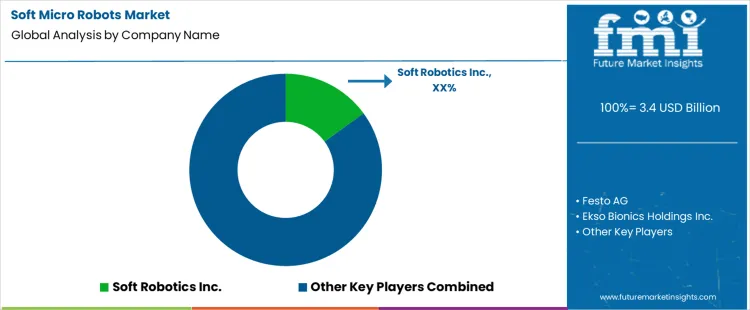
Competition in the soft micro robots market is being shaped by dexterity, adaptability, and precision control. Soft Robotics Inc. is being positioned around grippers and manipulation technology for fragile objects, with product brochures highlighting compliant actuators, miniaturized control systems, and rapid response for high-throughput operations. Festo AG is being differentiated through biomimetic soft actuators, fluidic motion replication, and versatile micro-robotic platforms, emphasizing integration into industrial workflows and laboratory automation.
Medical and rehabilitation applications are being leveraged by Ekso Bionics Holdings Inc. and F&P Robotics AG. Ekso Bionics focuses on wearable micro-robotic devices that support human mobility, stressing safety, repeatable motion, and ergonomic design. F&P Robotics AG promotes soft micro-robotic solutions for surgical and clinical procedures, highlighting precision, compliance, and patient safety in brochures. Universal Robots (Teradyne, Inc.) positions collaborative micro-robotic arms for light industrial tasks, emphasizing easy programming, small footprint, and human interaction safety.
Logistics, automation, and adaptive handling are driving differentiation for Boston Dynamics, RightHand Robotics Inc., Miso Robotics, Kawada Robotics Corporation, and Yaskawa Electric Corporation. Boston Dynamics integrates soft micro-robotic modules for mobility and pick-and-place applications, stressing terrain adaptability and system intelligence. RightHand Robotics focuses on robotic picking with adaptive grippers and vision systems. Miso Robotics markets compact kitchen and service robots with soft manipulators for repetitive tasks. Kawada Robotics and Yaskawa Electric Corporation promote system-level micro-robotic integration, highlighting modularity, reliability, and energy efficiency. Across the market, competition is being framed by precision, safe interaction, and application-specific adaptability, with product brochures translating features into operational confidence.
Key Players in Soft Micro Robots Market
- Soft Robotics Inc.
- Festo AG
- Ekso Bionics Holdings Inc.
- Universal Robots (Teradyne, Inc.)
- Boston Dynamics
- RightHand Robotics Inc.
- Yaskawa Electric Corporation
- Miso Robotics
- Kawada Robotics Corporation
- F&P Robotics AG
Scope of Report
| Attributes | Description |
|---|---|
| Quantitative Unit | USD Billion |
| aType | Soft Grippers, Inflatable Robots, Exoskeletons, Wearables, Others |
| Application | Medical & Healthcare, Food & Logistics, Automotive, Agriculture, Other Applications |
| Regions Covered | Asia Pacific, Europe, North America, Latin America, Middle East & Africa |
| Countries Covered | China, Japan, South Korea, India, Australia & New Zealand, ASEAN, Rest of Asia Pacific, Germany, United Kingdom, France, Italy, Spain, Nordic, BENELUX, Rest of Europe, United States, Canada, Mexico, Brazil, Chile, Rest of Latin America, Kingdom of Saudi Arabia, Other GCC Countries, Turkey, South Africa, Other African Union, Rest of Middle East & Africa |
| Key Companies Profiled | Soft Robotics Inc., Festo AG, Ekso Bionics Holdings Inc., Universal Robots (Teradyne, Inc.), Boston Dynamics, RightHand Robotics Inc., Yaskawa Electric Corporation, Miso Robotics, Kawada Robotics Corporation, F&P Robotics AG |
| Additional Attributes | Dollar sales by robot type and application; regional adoption trends for soft grippers and exoskeletons; medical vs industrial usage analysis; evaluation of wearable robotics adoption in healthcare and logistics; assessment of emerging markets and regulatory influence; forecasted revenue contribution by type and application for 2026–2036. |
Soft Micro Robots Market by Key Segments
Type
- Soft Grippers
- Inflatable Robots
- Exoskeletons
- Wearables
- Others
Application
- Medical & Healthcare
- Food & Logistics
- Automotive
- Agriculture
- Other Applications
Region:
- Asia Pacific
- China
- Japan
- South Korea
- India
- Australia & New Zealand
- ASEAN
- Rest of Asia Pacific
- Europe
- Germany
- United Kingdom
- France
- Italy
- Spain
- Nordic
- BENELUX
- Rest of Europe
- North America
- United States
- Canada
- Mexico
- Latin America
- Brazil
- Chile
- Rest of Latin America
- Middle East & Africa
- Kingdom of Saudi Arabia
- Other GCC Countries
- Turkey
- South Africa
- Other African Union
- Rest of Middle East & Africa
Bibliography
- Cianchetti, M., Laschi, C., Mazzolai, B., & Dario, P. (2023). Soft robotics for biomedical applications: Current status and future perspectives. Nature Reviews Materials.
- Ekso Bionics Holdings, Inc. (2024). Wearable robotic and soft exoskeleton technologies for rehabilitation.
- Li, J., de Ávila, B. E. F., Gao, W., Zhang, L., & Wang, J. (2024). Micro/nanorobots for biomedicine: Delivery, surgery, sensing, and detoxification. Science Robotics.
- National Institutes of Health. (2024). Soft robotic systems for minimally invasive medical devices.
- Soft Robotics Inc. (2024). Soft robotic grippers and compliant automation solutions.
Frequently Asked Questions
How big is the soft micro robots market in 2026?
The global soft micro robots market is estimated to be valued at USD 3.4 billion in 2026.
What will be the size of soft micro robots market in 2036?
The market size for the soft micro robots market is projected to reach USD 67.4 billion by 2036.
How much will be the soft micro robots market growth between 2026 and 2036?
The soft micro robots market is expected to grow at a 34.8% CAGR between 2026 and 2036.
What are the key product types in the soft micro robots market?
The key product types in soft micro robots market are soft grippers, inflatable robots, exoskeletons, wearables and others.
Which application segment to contribute significant share in the soft micro robots market in 2026?
In terms of application, medical & healthcare segment to command 30.0% share in the soft micro robots market in 2026.
Preview the report firsthand - request a free sample
Get SampleGet the brochure for pricing and purchase details.
Get PDFTable of Content
- Executive Summary
- Global Market Outlook
- Demand-side Trends
- Supply-side Trends
- Technology Roadmap Analysis
- Analysis and Recommendations
- Market Overview
- Market Coverage / Taxonomy
- Market Definition / Scope / Limitations
- Market Background
- Market Dynamics
- Drivers
- Restraints
- Opportunity
- Trends
- Scenario Forecast
- Demand in Optimistic Scenario
- Demand in Likely Scenario
- Demand in Conservative Scenario
- Opportunity Map Analysis
- Product Life Cycle Analysis
- Supply Chain Analysis
- Investment Feasibility Matrix
- Value Chain Analysis
- PESTLE and Porter’s Analysis
- Regulatory Landscape
- Regional Parent Market Outlook
- Production and Consumption Statistics
- Import and Export Statistics
- Market Dynamics
- Global Market Analysis 2021 to 2025 and Forecast, 2026 to 2036
- Historical Market Size Value (USD Million) Analysis, 2021 to 2025
- Current and Future Market Size Value (USD Million) Projections, 2026 to 2036
- Y-o-Y Growth Trend Analysis
- Absolute $ Opportunity Analysis
- Global Market Pricing Analysis 2021 to 2025 and Forecast 2026 to 2036
- Global Market Analysis 2021 to 2025 and Forecast 2026 to 2036, By Type
- Introduction / Key Findings
- Historical Market Size Value (USD Million) Analysis By Type , 2021 to 2025
- Current and Future Market Size Value (USD Million) Analysis and Forecast By Type , 2026 to 2036
- Soft Grippers
- Inflatable Robots
- Exoskeletons
- Wearables
- Others
- Soft Grippers
- Y-o-Y Growth Trend Analysis By Type , 2021 to 2025
- Absolute $ Opportunity Analysis By Type , 2026 to 2036
- Global Market Analysis 2021 to 2025 and Forecast 2026 to 2036, By Application
- Introduction / Key Findings
- Historical Market Size Value (USD Million) Analysis By Application, 2021 to 2025
- Current and Future Market Size Value (USD Million) Analysis and Forecast By Application, 2026 to 2036
- Medical & Healthcare
- Food & Logistics
- Automotive
- Agriculture
- Other Applications
- Medical & Healthcare
- Y-o-Y Growth Trend Analysis By Application, 2021 to 2025
- Absolute $ Opportunity Analysis By Application, 2026 to 2036
- Global Market Analysis 2021 to 2025 and Forecast 2026 to 2036, By Region
- Introduction
- Historical Market Size Value (USD Million) Analysis By Region, 2021 to 2025
- Current Market Size Value (USD Million) Analysis and Forecast By Region, 2026 to 2036
- North America
- Latin America
- Western Europe
- Eastern Europe
- East Asia
- South Asia and Pacific
- Middle East & Africa
- Market Attractiveness Analysis By Region
- North America Market Analysis 2021 to 2025 and Forecast 2026 to 2036, By Country
- Historical Market Size Value (USD Million) Trend Analysis By Market Taxonomy, 2021 to 2025
- Market Size Value (USD Million) Forecast By Market Taxonomy, 2026 to 2036
- By Country
- USA
- Canada
- Mexico
- By Type
- By Application
- By Country
- Market Attractiveness Analysis
- By Country
- By Type
- By Application
- Key Takeaways
- Latin America Market Analysis 2021 to 2025 and Forecast 2026 to 2036, By Country
- Historical Market Size Value (USD Million) Trend Analysis By Market Taxonomy, 2021 to 2025
- Market Size Value (USD Million) Forecast By Market Taxonomy, 2026 to 2036
- By Country
- Brazil
- Chile
- Rest of Latin America
- By Type
- By Application
- By Country
- Market Attractiveness Analysis
- By Country
- By Type
- By Application
- Key Takeaways
- Western Europe Market Analysis 2021 to 2025 and Forecast 2026 to 2036, By Country
- Historical Market Size Value (USD Million) Trend Analysis By Market Taxonomy, 2021 to 2025
- Market Size Value (USD Million) Forecast By Market Taxonomy, 2026 to 2036
- By Country
- Germany
- UK
- Italy
- Spain
- France
- Nordic
- BENELUX
- Rest of Western Europe
- By Type
- By Application
- By Country
- Market Attractiveness Analysis
- By Country
- By Type
- By Application
- Key Takeaways
- Eastern Europe Market Analysis 2021 to 2025 and Forecast 2026 to 2036, By Country
- Historical Market Size Value (USD Million) Trend Analysis By Market Taxonomy, 2021 to 2025
- Market Size Value (USD Million) Forecast By Market Taxonomy, 2026 to 2036
- By Country
- Russia
- Poland
- Hungary
- Balkan & Baltic
- Rest of Eastern Europe
- By Type
- By Application
- By Country
- Market Attractiveness Analysis
- By Country
- By Type
- By Application
- Key Takeaways
- East Asia Market Analysis 2021 to 2025 and Forecast 2026 to 2036, By Country
- Historical Market Size Value (USD Million) Trend Analysis By Market Taxonomy, 2021 to 2025
- Market Size Value (USD Million) Forecast By Market Taxonomy, 2026 to 2036
- By Country
- China
- Japan
- South Korea
- By Type
- By Application
- By Country
- Market Attractiveness Analysis
- By Country
- By Type
- By Application
- Key Takeaways
- South Asia and Pacific Market Analysis 2021 to 2025 and Forecast 2026 to 2036, By Country
- Historical Market Size Value (USD Million) Trend Analysis By Market Taxonomy, 2021 to 2025
- Market Size Value (USD Million) Forecast By Market Taxonomy, 2026 to 2036
- By Country
- India
- ASEAN
- Australia & New Zealand
- Rest of South Asia and Pacific
- By Type
- By Application
- By Country
- Market Attractiveness Analysis
- By Country
- By Type
- By Application
- Key Takeaways
- Middle East & Africa Market Analysis 2021 to 2025 and Forecast 2026 to 2036, By Country
- Historical Market Size Value (USD Million) Trend Analysis By Market Taxonomy, 2021 to 2025
- Market Size Value (USD Million) Forecast By Market Taxonomy, 2026 to 2036
- By Country
- Kingdom of Saudi Arabia
- Other GCC Countries
- Turkiye
- South Africa
- Other African Union
- Rest of Middle East & Africa
- By Type
- By Application
- By Country
- Market Attractiveness Analysis
- By Country
- By Type
- By Application
- Key Takeaways
- Key Countries Market Analysis
- USA
- Pricing Analysis
- Market Share Analysis, 2025
- By Type
- By Application
- Canada
- Pricing Analysis
- Market Share Analysis, 2025
- By Type
- By Application
- Mexico
- Pricing Analysis
- Market Share Analysis, 2025
- By Type
- By Application
- Brazil
- Pricing Analysis
- Market Share Analysis, 2025
- By Type
- By Application
- Chile
- Pricing Analysis
- Market Share Analysis, 2025
- By Type
- By Application
- Germany
- Pricing Analysis
- Market Share Analysis, 2025
- By Type
- By Application
- UK
- Pricing Analysis
- Market Share Analysis, 2025
- By Type
- By Application
- Italy
- Pricing Analysis
- Market Share Analysis, 2025
- By Type
- By Application
- Spain
- Pricing Analysis
- Market Share Analysis, 2025
- By Type
- By Application
- France
- Pricing Analysis
- Market Share Analysis, 2025
- By Type
- By Application
- India
- Pricing Analysis
- Market Share Analysis, 2025
- By Type
- By Application
- ASEAN
- Pricing Analysis
- Market Share Analysis, 2025
- By Type
- By Application
- Australia & New Zealand
- Pricing Analysis
- Market Share Analysis, 2025
- By Type
- By Application
- China
- Pricing Analysis
- Market Share Analysis, 2025
- By Type
- By Application
- Japan
- Pricing Analysis
- Market Share Analysis, 2025
- By Type
- By Application
- South Korea
- Pricing Analysis
- Market Share Analysis, 2025
- By Type
- By Application
- Russia
- Pricing Analysis
- Market Share Analysis, 2025
- By Type
- By Application
- Poland
- Pricing Analysis
- Market Share Analysis, 2025
- By Type
- By Application
- Hungary
- Pricing Analysis
- Market Share Analysis, 2025
- By Type
- By Application
- Kingdom of Saudi Arabia
- Pricing Analysis
- Market Share Analysis, 2025
- By Type
- By Application
- Turkiye
- Pricing Analysis
- Market Share Analysis, 2025
- By Type
- By Application
- South Africa
- Pricing Analysis
- Market Share Analysis, 2025
- By Type
- By Application
- USA
- Market Structure Analysis
- Competition Dashboard
- Competition Benchmarking
- Market Share Analysis of Top Players
- By Regional
- By Type
- By Application
- Competition Analysis
- Competition Deep Dive
- Soft Robotics Inc.
- Overview
- Product Portfolio
- Profitability by Market Segments (Product/Age /Sales Channel/Region)
- Sales Footprint
- Strategy Overview
- Marketing Strategy
- Product Strategy
- Channel Strategy
- Festo AG
- Ekso Bionics Holdings Inc.
- Universal Robots (Teradyne, Inc.)
- Boston Dynamics
- RightHand Robotics Inc.
- Yaskawa Electric Corporation
- Miso Robotics
- Kawada Robotics Corporation
- F&P Robotics AG
- Soft Robotics Inc.
- Competition Deep Dive
- Assumptions & Acronyms Used
- Research Methodology


