

- Industry Size (2026)
- USD 620.5 Mn
- Forecast (2036)
- USD 1859.4 Mn
- CAGR (2026 to 2036)
- 11.6%
Sugar-Reduction Mouthfeel Recovery Additives Market Forecast and Outlook (2026-2036)
The sugar-reduction mouthfeel recovery additives market is valued at USD 620.5 million in 2026 and is forecasted to reach USD 1,859.4 million by 2036, registering a CAGR of 11.6%. Performance through this period is governed by how effectively additive systems replace the structural role of sucrose rather than by the pace of sugar reduction alone. Sugar historically delivers bulk, viscosity, lubrication, and flavor carry, making its removal a formulation risk rather than a simple nutritional adjustment. Value concentrates around additive platforms that restore these functions predictably across processing conditions, allowing manufacturers to protect legacy products while meeting reformulation mandates. Cost structures favor solutions that reduce iterative trials, limit sensory failure, and shorten reformulation timelines, since each failed launch carries brand and distribution penalties.
Buyer behavior remains cautious and technically anchored. Food and beverage manufacturers prioritize additives with validated performance across multiple matrices, since switching costs rise once a reduced-sugar formula is commercialized at scale. Procurement decisions reflect aversion to texture instability, phase separation, or inconsistent sweetness perception over shelf life. Clean-label constraints further narrow acceptable options, reinforcing reliance on suppliers with strong documentation, regulatory coverage, and application support. Margin strength accrues to systems that integrate bulking, viscosity, and sweetness modulation within a single platform, reducing formulation complexity. Growth quality between 2026 and 2036 is shaped by disciplined purchasing, reformulation risk management, and the ability of suppliers to deliver repeatable mouthfeel outcomes under commercial production pressures, rather than by experimental ingredient adoption or short-term cost minimization.
Quick Stats for Sugar-Reduction Mouthfeel Recovery Additives Market
- Sugar-Reduction Mouthfeel Recovery Additives Market Value (2026): USD 620.5 million
- Sugar-Reduction Mouthfeel Recovery Additives Market Forecast Value (2036): USD 1,859.4 million
- Sugar-Reduction Mouthfeel Recovery Additives Market Forecast CAGR (2026–2036): 11.6%
- Leading Application Segment in Global Demand: Dairy
- Fastest-Growing Countries: China, USA, Netherlands, Germany
- Key Players in Global Demand: Tate & Lyle, Ingredion, Kerry, IFF, DSM-Firmenich, Cargill
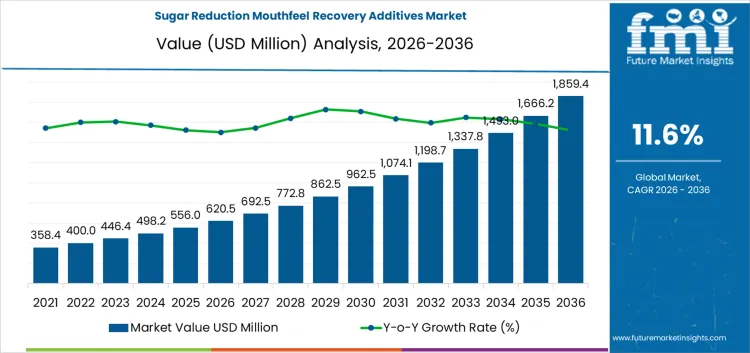
Sugar-Reduction Mouthfeel Recovery Additives Market Key Takeaways
| Metric | Value |
|---|---|
| Market Value (2026) | USD 620.5 million |
| Market Forecast Value (2036) | USD 1,859.4 million |
| Forecast CAGR (2026-2036) | 11.6% |
Why is the Demand for Sugar-Reduction Mouthfeel Recovery Additives Market Growing?
Demand for sugar-reduction mouthfeel recovery additives is growing globally due to rising consumer preference for lower sugar foods and beverages that maintain desirable texture, body, and flavor perception. Reducing sugar often leads to undesirable changes in mouthfeel, including thin texture, lack of creaminess, and reduced flavor delivery, which drives formulators to adopt functional additives that recover sensory qualities without adding sweetness or calories. Food and beverage manufacturers integrate mouthfeel recovery systems in products such as reduced sugar yogurts, beverages, baked goods, confections, and dairy alternatives, enabling familiar sensory profiles while meeting public health and diet preferences.
Regulatory frameworks in multiple regions encourage sugar reduction through labeling targets, sugar taxes, and nutrient profiling, which strengthens procurement of additives that maintain consumer acceptance. Advances in hydrocolloid technology, fiber-based systems, and flavor modulators improve viscosity, emulsion stability, and palate coating effects without compromising reduced sugar content. Growth in clean-label and natural ingredient trends reinforces adoption of solutions derived from recognizable sources that align with safety and ingredient transparency requirements. Retail expansion through mass, specialty, and online channels increases accessibility for reduced sugar formats enhanced with mouthfeel recovery additives. Continued focus on balanced nutrition and sensory experience supports adoption of these systems in global food and beverage portfolios.
How Is the Global Sugar-Reduction Mouthfeel Recovery Additives Market Structured?
The global sugar-reduction mouthfeel recovery additives market addresses a core formulation challenge created by aggressive sugar reduction across food and beverage categories. Removal or reduction of sucrose negatively affects viscosity, body, sweetness perception, and flavor release, often leading to thin or unbalanced products. Mouthfeel recovery additives are designed to rebuild texture, roundness, and temporal sweetness perception without reintroducing caloric sugars. Adoption is driven by regulatory sugar targets, reformulation of legacy products, and sustained consumer preference for reduced-sugar offerings that do not compromise sensory quality. Demand is concentrated in categories where sugar historically played a structural and functional role rather than only sweetness delivery.
Which Application Segment Accounts for the Largest Share of Global Demand?
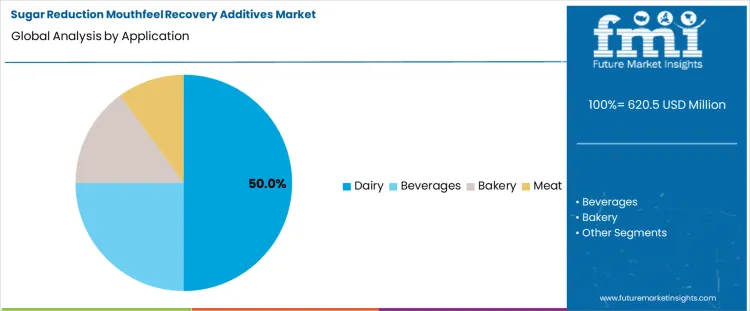
Dairy applications represent the largest share at 50.0%, reflecting extensive sugar reduction across flavored milk, yogurts, drinkable dairy products, and dairy alternatives. In these products, sugar contributes to viscosity, mouth-coating behavior, and flavor balance, making mouthfeel recovery additives essential to maintain product integrity after reformulation. Beverages account for 25.0% of global demand, driven by reduced-sugar soft drinks, protein beverages, flavored waters, and functional drinks where sugar removal causes sharp drops in body and sweetness persistence. Bakery applications hold a 15.0% share, as sugar reduction alters crumb softness, moisture retention, and perceived richness in cakes, fillings, and sweet baked goods. Meat applications account for 10.0%, mainly in processed and cured products where sugar reduction affects flavor masking, surface browning, and overall palatability.
Key Takeaways:
- Dairy leads due to high sensory dependence on sugar-derived body
- Beverages require mouthfeel rebuilders for reduced-sugar stability
- Bakery and meat reflect more targeted functional use
Which Sweetener Type Is Most Widely Used for Mouthfeel Recovery Globally?
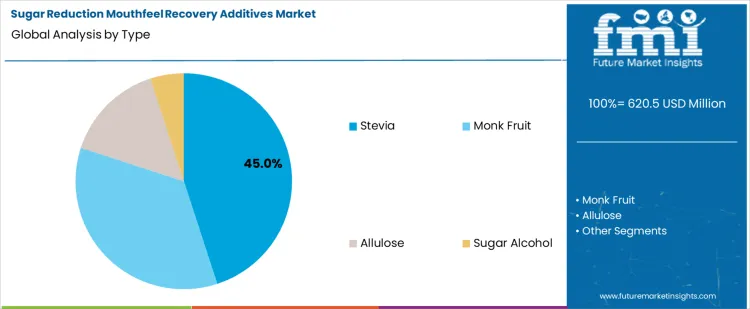
Stevia-based systems lead with a 45.0% share, supported by widespread regulatory acceptance, strong sweetness potency, and compatibility with multi-component mouthfeel recovery systems. While stevia alone can introduce bitterness or delayed sweetness, it is frequently paired with bulking agents, fibers, or modulators that restore body and smoothness. Monk fruit-based systems follow at 35.0%, benefiting from cleaner sweetness profiles and lower bitterness risk, especially in beverages and dairy products. Allulose accounts for 15.0% of demand, valued for its sugar-like mouthfeel and browning properties, although cost and regulatory variation limit broader adoption. Sugar alcohols represent 5.0%, reflecting declining use due to digestive tolerance concerns and labeling sensitivity.
Key Takeaways:
- Stevia dominates due to scalability and regulatory familiarity
- Monk fruit gains share in premium and clean-label formulations
- Allulose supports structure but faces cost and approval constraints
Which Distribution Channel Controls the Majority of Global Supply?
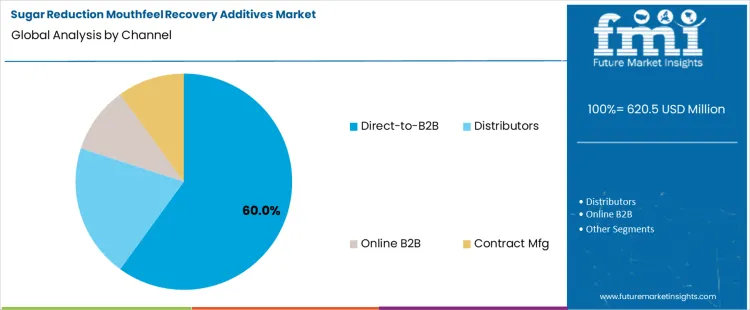
Direct-to-B2B channels account for 60.0% of global distribution, reflecting the formulation-intensive nature of mouthfeel recovery additives. Manufacturers typically require customized blends tuned to specific sugar reduction levels, processing conditions, and sensory targets, which favors direct supplier engagement. Distributors hold a 20.0% share, serving standardized additive systems for mid-sized processors and regional brands. Online B2B platforms contribute 10.0%, mainly supporting early-stage brands and pilot-scale reformulation projects seeking rapid ingredient access. Contract manufacturing represents the remaining 10.0%, where mouthfeel recovery additives are embedded into customized premix solutions or finished formulation systems supplied under private-label or co-development arrangements.
Key Takeaways:
- Direct B2B dominates due to customization and sensory calibration needs
- Distributors support standardized, repeatable formulations
- Online and contract channels enable innovation-stage adoption
What are the Key Dynamics in the Sugar-Reduction Mouthfeel Recovery Additives Market?
Global demand rises as food and beverage manufacturers adopt mouthfeel recovery additives designed to compensate for textural and sensory changes in sugar-reduced products. These additives enhance body, creaminess, sweetness perception, and overall mouthfeel in reduced-sugar beverages, confectionery, dairy analogs, and bakery items. Adoption aligns with rising consumer preference for lower sugar intake, public health initiatives targeting sugar reduction, and regulatory encouragement of nutrition reformulation across North America, Europe, Asia-Pacific, and Latin America. Usage spans mainstream, premium, and performance nutrition segments seeking balanced taste and sensory experience.
How do consumer health trends and formulation performance requirements shape adoption?
Consumers increasingly seek products with lower sugar content without compromise to taste and texture. Food developers integrate mouthfeel recovery additives such as fibers, polyols, protein derivatives or tailored carbohydrate blends that restore sensory attributes lost during sugar reduction. Beverage formulators focus on mouthcoating and sweetness modulation to maintain palatability in reduced-sugar soft drinks and functional beverages. In bakery and dairy categories additives support moisture retention, body, and richness that traditional sugar contributes. Retailers emphasize sugar-reduction claims combined with satisfying sensory performance to meet health-oriented purchase drivers. Performance benchmarks include stability under thermal processes, minimal off-flavor impact, and consistency across production batches.
How do cost factors, ingredient interactions, and regulatory frameworks influence market scalability?
Sugar-reduction mouthfeel recovery additives often command premium pricing relative to conventional sweeteners or bulking agents, affecting formulation costs and product pricing strategies. Complex ingredient interactions require careful formulation design to avoid adverse effects such as gelation, syneresis or texture variability. Integration with existing processing regimes and sensory profiles demands iterative testing and quality control. Regulatory definitions of permissible additive classes, labeling requirements, and claims for sugar reduction vary across jurisdictions, shaping compliance strategies for global products. Availability and pricing of high-performing additives fluctuate with supply chain dynamics for fibers, proteins and specialty carbohydrates. Long-term growth depends on continued innovation in cost-effective, sensory-driven additive systems and harmonized regulatory criteria that support broad adoption of sugar-reduced products with compelling mouthfeel worldwide.
How Is Demand for Sugar-Reduction Mouthfeel Recovery Additives Evolving Globally?
Demand for sugar-reduction mouthfeel recovery additives is increasing globally due to reformulation pressure, regulatory sugar reduction targets, and consumer resistance to texture loss in reduced-sugar foods and beverages. China leads with a 12.3% CAGR, supported by large-scale reformulation across beverages and dairy alternatives. USA follows at 11.6%, driven by sugar taxation, labeling scrutiny, and demand for sensory parity. Netherlands records 11.4%, reflecting leadership in food ingredient innovation and reformulation science. Germany posts 11.1%, shaped by regulatory discipline and quality expectations. Growth reflects rising adoption of additives that restore viscosity, body, and creaminess without increasing sugar or caloric load.
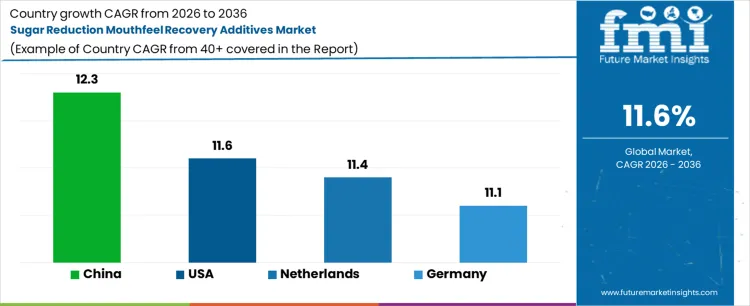
| Country | CAGR (%) |
|---|---|
| China | 12.3% |
| USA | 11.6% |
| Netherlands | 11.4% |
| Germany | 11.1% |
What is driving strong growth of mouthfeel recovery additives in China?
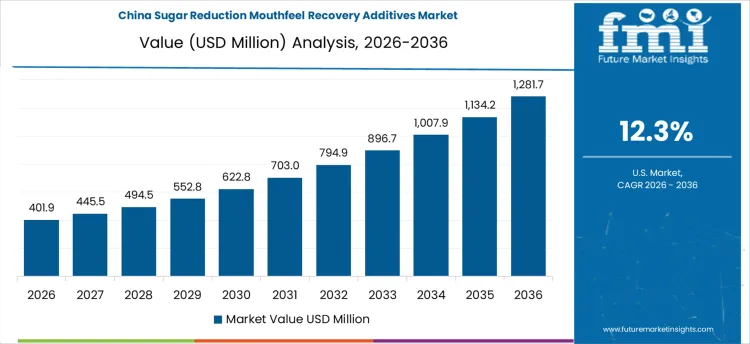
China demand is driven by widespread sugar reduction across beverages, dairy drinks, and functional foods. CAGR of 12.3% reflects adoption of additives that compensate for loss of bulk, viscosity, and sweetness-associated mouthfeel. Manufacturers reformulate large product portfolios while maintaining familiar sensory profiles. High-volume processing environments require stable, cost-efficient solutions. Government health initiatives influence sugar reduction targets. Domestic ingredient suppliers expand portfolios of fibers, hydrocolloids, and functional carbohydrates. Growth remains scale-driven and formulation-focused, aligned with public health objectives and mass-market product continuity.
- Large-scale beverage and dairy reformulation
- Need to restore body and viscosity after sugar removal
- Influence of national health and nutrition policies
- Expansion of functional carbohydrate and fiber systems
How is the USA sustaining demand growth for sugar-reduction mouthfeel recovery solutions?
USA demand is shaped by calorie reduction mandates, front-of-pack labeling, and consumer expectations for unchanged texture. CAGR of 11.6% reflects increased use of mouthfeel recovery additives in soft drinks, flavored waters, yogurts, and nutritional beverages. Brands focus on maintaining creaminess and fullness in reduced-sugar formulations. Product developers rely on hydrocolloids, fibers, and protein-based systems to restore sensory balance. Regulatory clarity supports adoption of approved clean-label solutions. Growth remains brand-led and compliance-driven, aligned with reformulation cycles and competitive differentiation.
- Sugar taxation and labeling pressure
- Consumer sensitivity to texture and mouthfeel changes
- Use across beverages, dairy, and nutrition products
- Preference for compliant and scalable ingredient systems
What supports the Netherlands’ steady expansion in mouthfeel recovery additive adoption?
Netherlands demand reflects strong ingredient innovation capabilities and leadership in sugar-reduction science. CAGR of 11.4% is supported by development and adoption of advanced mouthfeel-modulating systems used globally. Food manufacturers apply these additives to maintain sensory quality in reduced-sugar dairy, desserts, and beverages. Research-driven formulation emphasizes balance between viscosity, lubrication, and flavor release. Export-oriented ingredient suppliers drive demand through international reformulation projects. Growth remains innovation-led and technology-focused, aligned with Netherlands’ role as a hub for food ingredient development.
- Leadership in sugar-reduction ingredient innovation
- Research-driven sensory optimization strategies
- Application across dairy and beverage categories
- Export-oriented formulation and development activity
Why is Germany showing consistent growth in sugar-reduction mouthfeel recovery additives?
Germany demand reflects regulatory rigor, strong clean-label culture, and high consumer expectations for product quality. CAGR of 11.1% is supported by adoption of mouthfeel recovery additives in bakery, dairy, and beverage reformulation. Manufacturers prioritize texture integrity while reducing sugar content. Ingredient selection focuses on functional reliability and compliance. Technical formulation teams apply precise dosing to maintain sensory consistency. Domestic and regional suppliers support tailored applications. Growth remains quality-driven and regulation-aligned, supported by disciplined reformulation practices and consumer trust.
- Regulatory focus on sugar reduction compliance
- Emphasis on texture preservation in reformulation
- Use across bakery, dairy, and beverage products
- Preference for reliable and compliant ingredient systems
What is the competitive landscape of demand for sugar-reduction mouthfeel recovery additives?
sugar-reduction-mouthfeel-recovery-additives-market-analysis-by-company
Demand for sugar-reduction mouthfeel recovery additives is driven by reformulation pressure to lower added sugars without compromising texture, body, and sweetness perception. Beverage, dairy, bakery, and confectionery applications require solutions that restore viscosity, roundness, and temporal sweetness lost during sugar reduction. Buyers evaluate bulking efficiency, interaction with high-intensity sweeteners, stability under thermal processing, and impact on flavor release. Procurement teams prioritize suppliers offering clean-label options, regulatory acceptance across regions, and application support tailored to specific matrices. Trend in the global market reflects accelerating sugar reduction targets, taxation impacts, and growing reliance on ingredient systems that replicate sucrose functionality rather than sweetness alone.
Tate & Lyle holds leading positioning through specialty fibers, texturants, and sweetness modulation systems designed to rebuild mouthfeel in reduced-sugar formulations. Ingredion supports demand with functional starches, fibers, and texture systems applied across beverages and foods. Kerry contributes integrated taste and texture platforms combining mouthfeel recovery with flavor optimization. IFF provides hydrocolloids and texturizing solutions supported by sensory science capabilities. DSM-Firmenich participates through ingredient systems linking sweetness modulation, texture, and nutrition performance. Competitive differentiation depends on mouthfeel fidelity, formulation flexibility, clean-label alignment, and ability to deliver consistent sensory outcomes at scale.
Key Players in the Sugar-Reduction Mouthfeel Recovery Additives Market
- Tate & Lyle
- Ingredion
- Kerry
- IFF
- DSM-Firmenich
- Cargill
Scope of the Report
| Items | Values |
|---|---|
| Quantitative Units | USD million |
| Application | Dairy; Beverages; Bakery; Meat |
| Type | Stevia; Monk Fruit; Allulose; Sugar Alcohol |
| Channel | Direct-to-B2B; Distributors; Online B2B; Contract Mfg |
| Regions Covered | Asia Pacific, Europe, North America, Latin America, Middle East & Africa |
| Countries Covered | China, USA, Netherlands, Germany, and 40+ countries |
| Key Companies Profiled | Tate & Lyle; Ingredion; Kerry; IFF; DSM-Firmenich; Cargill |
| Additional Attributes | Dollar sales by application and type; adoption trends for mouthfeel recovery systems supporting reduced-sugar formulations; texture rebuilding, sweetness onset, and aftertaste masking performance metrics; compatibility with dairy, beverage, bakery, and meat matrices under thermal and shear processing; interactions with high-intensity sweeteners and bulk replacers; regulatory compliance, labeling constraints, and clean-label considerations influencing additive selection. |
Sugar-Reduction Mouthfeel Recovery Additives Market by Segment
Application:
- Dairy
- Beverages
- Bakery
- Meat
Type:
- Stevia
- Monk Fruit
- Allulose
- Sugar Alcohol
Channel:
- Direct-to-B2B
- Distributors
- Online B2B
- Contract Mfg
Region:
- Asia Pacific
- China
- Japan
- South Korea
- India
- Australia & New Zealand
- ASEAN
- Rest of Asia Pacific
- Europe
- Germany
- United Kingdom
- France
- Italy
- Spain
- Nordic
- BENELUX
- Rest of Europe
- North America
- United States
- Canada
- Mexico
- Latin America
- Brazil
- Chile
- Rest of Latin America
- Middle East & Africa
- Kingdom of Saudi Arabia
- Other GCC Countries
- Turkey
- South Africa
- Other African Union
- Rest of Middle East & Africa
Frequently Asked Questions
How big is the sugar reduction mouthfeel recovery additives market in 2026?
The global sugar reduction mouthfeel recovery additives market is estimated to be valued at USD 620.5 million in 2026.
What will be the size of sugar reduction mouthfeel recovery additives market in 2036?
The market size for the sugar reduction mouthfeel recovery additives market is projected to reach USD 1,859.4 million by 2036.
How much will be the sugar reduction mouthfeel recovery additives market growth between 2026 and 2036?
The sugar reduction mouthfeel recovery additives market is expected to grow at a 11.6% CAGR between 2026 and 2036.
What are the key application types in the sugar reduction mouthfeel recovery additives market?
The key application types in sugar reduction mouthfeel recovery additives market are dairy, beverages, bakery and meat.
Which type segment will contribute significant share in the sugar reduction mouthfeel recovery additives market in 2026?
In terms of type, stevia segment to command 45.0% share in the sugar reduction mouthfeel recovery additives market in 2026.
Preview the report firsthand - request a free sample
Get SampleGet the brochure for pricing and purchase details.
Get PDFTable of Content
- Executive Summary
- Global Market Outlook
- Demand-side Trends
- Supply-side Trends
- Technology Roadmap Analysis
- Analysis and Recommendations
- Market Overview
- Market Coverage / Taxonomy
- Market Definition / Scope / Limitations
- Market Background
- Market Dynamics
- Drivers
- Restraints
- Opportunity
- Trends
- Scenario Forecast
- Demand in Optimistic Scenario
- Demand in Likely Scenario
- Demand in Conservative Scenario
- Opportunity Map Analysis
- Product Life Cycle Analysis
- Supply Chain Analysis
- Investment Feasibility Matrix
- Value Chain Analysis
- PESTLE and Porter’s Analysis
- Regulatory Landscape
- Regional Parent Market Outlook
- Production and Consumption Statistics
- Import and Export Statistics
- Market Dynamics
- Global Market Analysis 2021 to 2025 and Forecast, 2026 to 2036
- Historical Market Size Value (USD Million) Analysis, 2021 to 2025
- Current and Future Market Size Value (USD Million) Projections, 2026 to 2036
- Y-o-Y Growth Trend Analysis
- Absolute $ Opportunity Analysis
- Global Market Pricing Analysis 2021 to 2025 and Forecast 2026 to 2036
- Global Market Analysis 2021 to 2025 and Forecast 2026 to 2036, By Application
- Introduction / Key Findings
- Historical Market Size Value (USD Million) Analysis By Application , 2021 to 2025
- Current and Future Market Size Value (USD Million) Analysis and Forecast By Application , 2026 to 2036
- Dairy
- Beverages
- Bakery
- Meat
- Dairy
- Y-o-Y Growth Trend Analysis By Application , 2021 to 2025
- Absolute $ Opportunity Analysis By Application , 2026 to 2036
- Global Market Analysis 2021 to 2025 and Forecast 2026 to 2036, By Type
- Introduction / Key Findings
- Historical Market Size Value (USD Million) Analysis By Type, 2021 to 2025
- Current and Future Market Size Value (USD Million) Analysis and Forecast By Type, 2026 to 2036
- Stevia
- Monk Fruit
- Allulose
- Sugar Alcohol
- Stevia
- Y-o-Y Growth Trend Analysis By Type, 2021 to 2025
- Absolute $ Opportunity Analysis By Type, 2026 to 2036
- Global Market Analysis 2021 to 2025 and Forecast 2026 to 2036, By Channel
- Introduction / Key Findings
- Historical Market Size Value (USD Million) Analysis By Channel, 2021 to 2025
- Current and Future Market Size Value (USD Million) Analysis and Forecast By Channel, 2026 to 2036
- Direct-to-B2B
- Distributors
- Online B2B
- Contract Mfg
- Direct-to-B2B
- Y-o-Y Growth Trend Analysis By Channel, 2021 to 2025
- Absolute $ Opportunity Analysis By Channel, 2026 to 2036
- Global Market Analysis 2021 to 2025 and Forecast 2026 to 2036, By Region
- Introduction
- Historical Market Size Value (USD Million) Analysis By Region, 2021 to 2025
- Current Market Size Value (USD Million) Analysis and Forecast By Region, 2026 to 2036
- North America
- Latin America
- Western Europe
- Eastern Europe
- East Asia
- South Asia and Pacific
- Middle East & Africa
- Market Attractiveness Analysis By Region
- North America Market Analysis 2021 to 2025 and Forecast 2026 to 2036, By Country
- Historical Market Size Value (USD Million) Trend Analysis By Market Taxonomy, 2021 to 2025
- Market Size Value (USD Million) Forecast By Market Taxonomy, 2026 to 2036
- By Country
- USA
- Canada
- Mexico
- By Application
- By Type
- By Channel
- By Country
- Market Attractiveness Analysis
- By Country
- By Application
- By Type
- By Channel
- Key Takeaways
- Latin America Market Analysis 2021 to 2025 and Forecast 2026 to 2036, By Country
- Historical Market Size Value (USD Million) Trend Analysis By Market Taxonomy, 2021 to 2025
- Market Size Value (USD Million) Forecast By Market Taxonomy, 2026 to 2036
- By Country
- Brazil
- Chile
- Rest of Latin America
- By Application
- By Type
- By Channel
- By Country
- Market Attractiveness Analysis
- By Country
- By Application
- By Type
- By Channel
- Key Takeaways
- Western Europe Market Analysis 2021 to 2025 and Forecast 2026 to 2036, By Country
- Historical Market Size Value (USD Million) Trend Analysis By Market Taxonomy, 2021 to 2025
- Market Size Value (USD Million) Forecast By Market Taxonomy, 2026 to 2036
- By Country
- Germany
- UK
- Italy
- Spain
- France
- Nordic
- BENELUX
- Rest of Western Europe
- By Application
- By Type
- By Channel
- By Country
- Market Attractiveness Analysis
- By Country
- By Application
- By Type
- By Channel
- Key Takeaways
- Eastern Europe Market Analysis 2021 to 2025 and Forecast 2026 to 2036, By Country
- Historical Market Size Value (USD Million) Trend Analysis By Market Taxonomy, 2021 to 2025
- Market Size Value (USD Million) Forecast By Market Taxonomy, 2026 to 2036
- By Country
- Russia
- Poland
- Hungary
- Balkan & Baltic
- Rest of Eastern Europe
- By Application
- By Type
- By Channel
- By Country
- Market Attractiveness Analysis
- By Country
- By Application
- By Type
- By Channel
- Key Takeaways
- East Asia Market Analysis 2021 to 2025 and Forecast 2026 to 2036, By Country
- Historical Market Size Value (USD Million) Trend Analysis By Market Taxonomy, 2021 to 2025
- Market Size Value (USD Million) Forecast By Market Taxonomy, 2026 to 2036
- By Country
- China
- Japan
- South Korea
- By Application
- By Type
- By Channel
- By Country
- Market Attractiveness Analysis
- By Country
- By Application
- By Type
- By Channel
- Key Takeaways
- South Asia and Pacific Market Analysis 2021 to 2025 and Forecast 2026 to 2036, By Country
- Historical Market Size Value (USD Million) Trend Analysis By Market Taxonomy, 2021 to 2025
- Market Size Value (USD Million) Forecast By Market Taxonomy, 2026 to 2036
- By Country
- India
- ASEAN
- Australia & New Zealand
- Rest of South Asia and Pacific
- By Application
- By Type
- By Channel
- By Country
- Market Attractiveness Analysis
- By Country
- By Application
- By Type
- By Channel
- Key Takeaways
- Middle East & Africa Market Analysis 2021 to 2025 and Forecast 2026 to 2036, By Country
- Historical Market Size Value (USD Million) Trend Analysis By Market Taxonomy, 2021 to 2025
- Market Size Value (USD Million) Forecast By Market Taxonomy, 2026 to 2036
- By Country
- Kingdom of Saudi Arabia
- Other GCC Countries
- Turkiye
- South Africa
- Other African Union
- Rest of Middle East & Africa
- By Application
- By Type
- By Channel
- By Country
- Market Attractiveness Analysis
- By Country
- By Application
- By Type
- By Channel
- Key Takeaways
- Key Countries Market Analysis
- USA
- Pricing Analysis
- Market Share Analysis, 2025
- By Application
- By Type
- By Channel
- Canada
- Pricing Analysis
- Market Share Analysis, 2025
- By Application
- By Type
- By Channel
- Mexico
- Pricing Analysis
- Market Share Analysis, 2025
- By Application
- By Type
- By Channel
- Brazil
- Pricing Analysis
- Market Share Analysis, 2025
- By Application
- By Type
- By Channel
- Chile
- Pricing Analysis
- Market Share Analysis, 2025
- By Application
- By Type
- By Channel
- Germany
- Pricing Analysis
- Market Share Analysis, 2025
- By Application
- By Type
- By Channel
- UK
- Pricing Analysis
- Market Share Analysis, 2025
- By Application
- By Type
- By Channel
- Italy
- Pricing Analysis
- Market Share Analysis, 2025
- By Application
- By Type
- By Channel
- Spain
- Pricing Analysis
- Market Share Analysis, 2025
- By Application
- By Type
- By Channel
- France
- Pricing Analysis
- Market Share Analysis, 2025
- By Application
- By Type
- By Channel
- India
- Pricing Analysis
- Market Share Analysis, 2025
- By Application
- By Type
- By Channel
- ASEAN
- Pricing Analysis
- Market Share Analysis, 2025
- By Application
- By Type
- By Channel
- Australia & New Zealand
- Pricing Analysis
- Market Share Analysis, 2025
- By Application
- By Type
- By Channel
- China
- Pricing Analysis
- Market Share Analysis, 2025
- By Application
- By Type
- By Channel
- Japan
- Pricing Analysis
- Market Share Analysis, 2025
- By Application
- By Type
- By Channel
- South Korea
- Pricing Analysis
- Market Share Analysis, 2025
- By Application
- By Type
- By Channel
- Russia
- Pricing Analysis
- Market Share Analysis, 2025
- By Application
- By Type
- By Channel
- Poland
- Pricing Analysis
- Market Share Analysis, 2025
- By Application
- By Type
- By Channel
- Hungary
- Pricing Analysis
- Market Share Analysis, 2025
- By Application
- By Type
- By Channel
- Kingdom of Saudi Arabia
- Pricing Analysis
- Market Share Analysis, 2025
- By Application
- By Type
- By Channel
- Turkiye
- Pricing Analysis
- Market Share Analysis, 2025
- By Application
- By Type
- By Channel
- South Africa
- Pricing Analysis
- Market Share Analysis, 2025
- By Application
- By Type
- By Channel
- USA
- Market Structure Analysis
- Competition Dashboard
- Competition Benchmarking
- Market Share Analysis of Top Players
- By Regional
- By Application
- By Type
- By Channel
- Competition Analysis
- Competition Deep Dive
- Tate & Lyle
- Overview
- Product Portfolio
- Profitability by Market Segments (Product/Age /Sales Channel/Region)
- Sales Footprint
- Strategy Overview
- Marketing Strategy
- Product Strategy
- Channel Strategy
- Ingredion
- Kerry
- IFF
- DSM-Firmenich
- Cargill
- Tate & Lyle
- Competition Deep Dive
- Assumptions & Acronyms Used
- Research Methodology


