

- Industry Size (2026)
- USD 230.8 Mn
- Forecast (2036)
- USD 593.5 Mn
- CAGR (2026 to 2036)
- 9.9%
Sugar-Cane Composite Tubes Market Forecast and Outlook 2026 to 2036
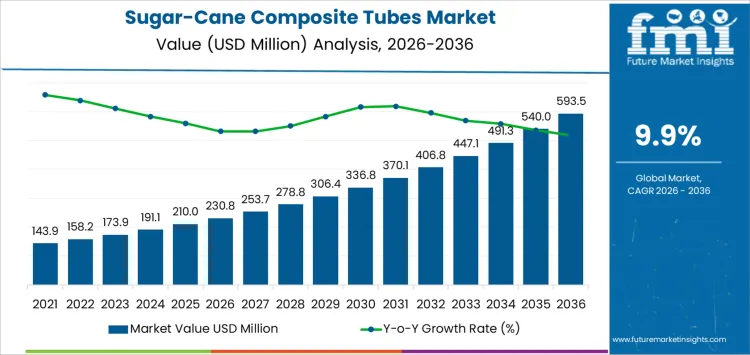
In 2026, the sugAR-cane composite tubes market is valued at USD 230.8 million and is projected to reach USD 593.5 million by 2036, growing at a CAGR of 9.9%. Momentum in the early phase from 2026 to 2031 builds steadily as annual additions rise from about USD 22.8 million to nearly USD 36.0 million. This acceleration reflects increasing alignment between brand packaging strategies and bio-based material adoption. Momentum is reinforced by cosmetics and personal care segments, where product line conversions occur in sequential waves rather than single-step transitions.
From 2031 onward, growth momentum strengthens further as yearly absolute gains widen consistently, carrying the market from roughly USD 370.0 million to USD 593.5 million by 2036. This period shows sustained acceleration rather than volatility, indicating stable demand reinforcement across multiple end uses. Expansion into food and household applications adds incremental pull, while manufacturing scale and standardized tube specifications support repeat ordering. Momentum during this stage is volume-driven and structurally embedded, signaling durable growth supported by recurring procurement rather than short-cycle adoption effects.
Quick Stats of the Sugar Cane Composite Tubes Market
- Sugar Cane Composite Tubes Market Value (2026): USD 230.8 million
- Sugar Cane Composite Tubes Market Forecast Value (2036): USD 593.5 million
- Sugar Cane Composite Tubes Market Forecast CAGR (2026-2036): 9.9%
- Leading End Use: Cosmetics (45%)
- Sugar Cane Composite Tubes Market Key Growth Regions: India, China, Brazil, USA, Germany, Japan
- Sugar Cane Composite Tubes Market Top Players: Braskem, Aptar, Huhtamaki, Amcor, UFlex, Toppan
What is the Growth Forecast for the Sugar-Cane Composite Tubes Market through 2036?
From 2026 to 2031, the sugAR-cane composite tubes market moves from USD 230.8 million to around USD 336.7 million, representing a climb from an early adoption trough toward a mid-cycle stabilization point. The initial years reflect recovery from limited scale deployment, where uptake was constrained by supply consistency and qualification cycles. As tube performance becomes validated across personal care, cosmetics, and specialty packaging, demand rises steadily without sharp volatility. This phase shows a narrowing gap between low baseline adoption and operational viability, marking the transition from early trough conditions to stable commercial acceptance.
Between 2031 and 2036, the market advances from approximately USD 336.7 million to USD 593.5 million, reaching a clear peak phase characterized by sustained momentum rather than short-term spikes. Growth during this interval reflects expansion across mass-market packaging, higher fill-line compatibility, and repeat procurement at scale. Unlike the earlier recovery phase, this period shows no meaningful retracement, indicating that the market peak is supported by structural demand rather than cyclical swings. The peak is defined by higher absolute value creation, broader end-use penetration, and reduced sensitivity to input or adoption shocks, signaling maturity-driven stability rather than volatility.
Sugar Cane Composite Tubes Market Key Takeaways
| Metric | Value |
|---|---|
| Market Value (2026) | USD 230.8 million |
| Forecast Value (2036) | USD 593.5 million |
| Forecast CAGR (2026-2036) | 9.9% |
How Are Fiber-Based Packaging Shifts Driving the Sugar-Cane Composite Tubes Market from 2026 to 2036?
Sugar-cane composite tubes gained attention as packaging producers explored alternatives to petroleum-based rigid tubes. Personal care, cosmetics, and dry food brands adopted these tubes for creams, powders, and semi-solid products where structural integrity and branding mattered. Historical demand reflected availability of bagasse fiber as a by-product of sugar processing and its suitability for molded tube formats. Manufacturers valued consistent fiber quality, print compatibility, and rigidity comparable to paperboard tubes. Adoption aligned with packaging redesign initiatives that aimed to reduce reliance on virgin wood pulp while maintaining shelf presence and functional performance.
From 2026 to 2036 demand is expected to expand with broader acceptance of agricultural residue-based materials in consumer packaging. Brands seek composite tubes that combine sugAR-cane fiber with thin barrier layers to improve moisture and oil resistance. Growth aligns with premium personal care packaging, gift sets, and specialty food containers that emphasize material origin transparency. Producers focus on improving dimensional consistency, surface smoothness, and closure compatibility. Buyers assess tube strength, filling line compatibility, and end-of-life handling within existing recycling or composting systems. Demand reflects packaging innovation cycles and growing confidence in non-wood fiber composites.
What Is the Demand for the Sugar-Cane Composite Tubes Market by End Use and Packaging Format for 2026 to 2036?
From 2026 to 2036, the sugAR-cane composite tubes market advances as packaging strategies emphasize material substitution without altering consumer experience. Cosmetics account for 45% of end-use demand as tubes remain the preferred format for creams, gels, and semi-viscous formulations. Bio-composite tubes hold 48% of packaging format share because they integrate renewable feedstock within conventional tube architectures. Demand reflects a preference for incremental material change that preserves dispensing accuracy, shelf presence, and filling efficiency across high-volume product lines.
Why do cosmetics account for 45% of demand in the sugAR-cane composite tubes market by end use from 2026 to 2036?
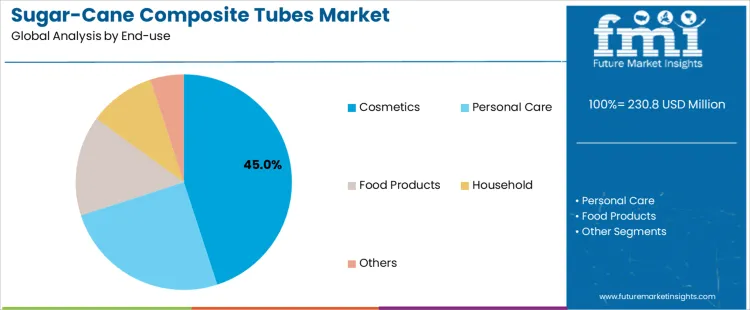
Cosmetics account for 45% of demand because tube packaging supports precise dosing, portability, and hygienic use across daily routines. Consumption intensity remains high in skincare, color cosmetics, and treatment categories where packaging feel and finish influence brand perception. Usage stays consistent as sugAR-cane composite tubes mirror the stiffness and surface quality of conventional plastic tubes. Procurement decisions prioritize compatibility with existing filling equipment and decoration processes. Buyers favor tubes that maintain barrier integrity against oxygen and moisture. Price sensitivity remains moderate since packaging contributes to product positioning. Specification control emphasizes seam strength, wall uniformity, and resistance to deformation during storage. Demand remains stable through 2036 as cosmetic brands standardize composite tubes across core ranges.
Cosmetic brands continue adopting composite tubes to align packaging narratives with material transition goals. Usage remains predictable as refill cycles and new product launches sustain steady tube consumption. Procurement favors suppliers offering consistent resin sourcing and quality control. Specification focus extends to color stability, gloss retention, and tactile feel. Demand persists as composite tubes support branding differentiation without altering consumer habits.
Why do bio-composite tubes represent 48% of demand in the sugAR-cane composite tubes market by packaging format from 2026 to 2036?
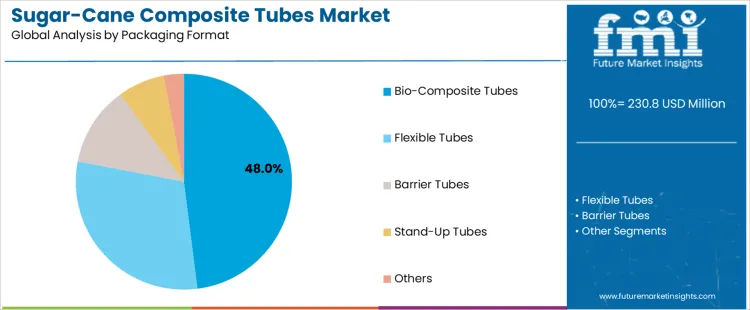
Bio-composite tubes represent 48% of demand because they retain multilayer tube construction while replacing a portion of fossil-based polymers. Consumption is strong across cosmetics, personal care, and select food products requiring controlled squeeze behavior. Usage remains steady as composite tubes perform consistently across repeated dispensing cycles. Procurement decisions emphasize compatibility with standard caps, shoulders, and sealing systems. Buyers prioritize formats that avoid line modification or process downtime. Price sensitivity stays moderate since composite tubes typically sit close to conventional tube cost bands. Specification control focuses on interlayer adhesion, dimensional stability, and crack resistance. Demand remains firm through 2036 as brands seek scalable material transitions.
Bio-composite formats continue gaining preference because they reduce material risk during scale-up. Usage patterns align with existing inventory and logistics practices. Procurement favors suppliers with proven composite extrusion capability. Specification attention includes recyclability alignment and print performance. Demand stays resilient as bio-composite tubes become an accepted mainstream option rather than a niche format.
How Are Sugar Cane Composite Tubes Being Adopted Within Packaging and Product Delivery Formats?
Use emerges in packaging systems that require rigid cylindrical formats without reliance on conventional plastic or metal tubes. Personal care brands apply composite tubes for creams and balms that need structural stability during dispensing. Dry food producers use them for powdered mixes and snack portions where moisture resistance is necessary. Promotional packaging suppliers adopt composite tubes for gift items that require shelf presence and durability. These applications reflect material substitution choices shaped by form factor needs, handling strength, and compatibility with existing filling processes rather than short term packaging trends.
What Material and Manufacturing Considerations Support Use of Sugar Cane Composite Tubes?
Selection aligns with requirements for stiffness, printability, and controlled barrier performance. Manufacturers value fiber composites derived from sugar cane residue for their uniform pulp quality and forming consistency. Packaging converters use these tubes to achieve smooth surfaces suitable for branding and labeling. Filling lines favor composites that maintain shape under pressure during sealing. Brands seeking lightweight yet rigid packaging formats specify composite tubes to balance protection and material efficiency. These considerations arise from production practicality, material performance, and design flexibility within established packaging workflows.
Which Practical Factors Influence Limits on Wider Adoption of Sugar Cane Composite Tubes?
Moisture sensitivity affects suitability for products with high water content or long shelf lives. Barrier performance may not meet requirements for highly reactive formulations. Cost varies depending on pulp sourcing and regional processing capacity. Recycling outcomes depend on local infrastructure and composite separation capability. Tube forming equipment availability limits adoption among smaller converters. Print and coating compatibility also require careful specification. These factors result in selective use where product characteristics, processing capability, and end of life handling align with composite tube performance.
What is the Demand for Sugar Cane Composite Tubes by Country?
| Country | CAGR (%) |
|---|---|
| Brazil | 9.0% |
| USA | 6.8% |
| Germany | 6.5% |
| China | 10.8% |
| India | 11.5% |
| Japan | 4.8% |
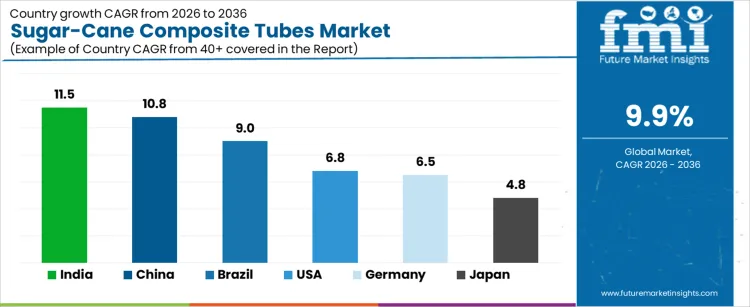
The demand for sugar cane composite tubes varies across countries due to differences in packaging material adoption, personal care production, and paper based tube usage. India leads with an 11.5% CAGR, supported by growing demand for tube packaging in cosmetics and personal care products. China follows at 10.8%, driven by large scale consumer goods manufacturing and rising use of composite tubes. Brazil records 9.0%, reflecting local availability of sugar cane feedstock and established paper packaging industries. The USA grows at 6.8%, supported by steady adoption among branded products. Germany posts 6.5%, shaped by mature packaging standards, while Japan grows at 4.8%, reflecting stable demand and limited format transitions.
How Is Bio Based Packaging Adoption Supporting Growth in Brazil?
Brazil is seeing steady expansion in the Sugar Cane Composite Tubes Market at a CAGR of 9% through 2035, driven by abundant sugar cane feedstock availability and rising use of plant based packaging across consumer goods. Personal care, cosmetics, and food brands are adopting composite tubes to replace conventional plastic formats in selected product lines. Demand benefits from domestic agro industrial integration and established pulp processing capacity supporting material supply continuity. Local packaging converters are expanding tube manufacturing using fiber reinforced composites suited to mass production. Stable agricultural output and consistent packaged goods manufacturing volumes are sustaining predictable procurement across brand owners and contract manufacturers nationwide.
- Sugar cane availability supports raw material access.
- Personal care packaging anchors primary tube demand.
- Domestic converters expand composite tube capacity.
How Is Packaging Substitution Influencing Demand in the United States?
The United States is experiencing measured growth in the Sugar Cane Composite Tubes Market at a CAGR of 6.8% through 2035, supported by packaging substitution across personal care and selected food products. Brands are introducing composite tubes to adjust material composition and improve recyclability alignment. Demand is concentrated in toothpaste, skincare, and specialty food packaging formats. Domestic converters collaborate with material suppliers to ensure consistent tube performance and dimensional reliability. Stable brand portfolios, repeat product cycles, and established retail distribution are sustaining predictable procurement across major packaging customers nationwide.
- Packaging substitution supports composite tube adoption.
- Oral care and skincare products drive usage.
- Domestic converters ensure supply consistency.
How Do Structured Packaging Standards Shape Demand in Germany?
Germany continues to record steady expansion in the Sugar Cane Composite Tubes Market at a CAGR of 6.5% through 2035, supported by structured packaging standards and focus on material efficiency. Manufacturers are integrating composite tubes within personal care and pharmaceutical packaging operations where consistency and performance remain priorities. Demand is centered on toothpaste, dermatological products, and specialty creams. Technical expertise in fiber processing supports reliable tube quality and controlled specifications. Stable demand from established brands and compliance driven procurement practices are sustaining measured adoption across domestic packaging facilities nationwide.
- Packaging standards support composite tube usage.
- Dental and skincare products anchor demand.
- Fiber processing expertise ensures quality consistency.
How Is Consumer Goods Manufacturing Accelerating Adoption in China?
In China, revenue from the Sugar Cane Composite Tubes Market is growing at a CAGR of 10.8% through 2035, driven by expansion of consumer goods manufacturing and adoption of alternative packaging materials. Personal care and household product producers are incorporating composite tubes to diversify material sourcing and improve packaging performance. Demand is strong across mass market skincare and oral care products distributed through modern retail channels. Domestic manufacturers are scaling composite tube production through integrated material supply chains. High output volumes and structured procurement practices are sustaining rapid adoption nationwide.
- Consumer goods manufacturing growth drives tube demand.
- Oral care packaging supports high volume usage.
- Integrated supply chains improve production efficiency.
How Is Organized Manufacturing Supporting Growth in India?
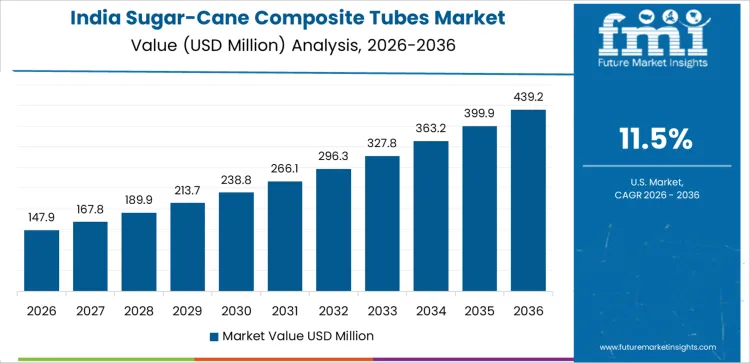
India is witnessing strong expansion in the Sugar Cane Composite Tubes Market at a CAGR of 11.5% through 2035, supported by growth in organized personal care manufacturing and rising use of plant based packaging inputs. Brands are adopting composite tubes to improve affordability and local material sourcing. Demand is rising across toothpaste, creams, and cosmetic products serving urban and semi urban consumers. Domestic converters are expanding tube production using agricultural fiber inputs. Expanding retail penetration and increasing packaged goods consumption are sustaining robust procurement across manufacturing centers nationwide.
- Organized manufacturing drives composite tube adoption.
- Oral care products remain primary applications.
- Domestic fiber sourcing supports cost alignment.
How Does Mature Packaging Demand Influence Stability in Japan?
Japan is maintaining measured growth in the Sugar Cane Composite Tubes Market at a CAGR of 4.8% through 2035, supported by mature packaging demand and preference for material consistency. Brands apply composite tubes selectively across personal care and specialty product categories. Demand remains focused on quality performance, dimensional accuracy, and dispensing reliability. Domestic packaging suppliers emphasize precision manufacturing and material uniformity aligned with established standards. Stable consumption patterns and replacement driven purchasing are sustaining predictable procurement across established packaging operations nationwide.
- Mature markets support selective composite tube usage.
- Quality consistency drives material selection.
- Domestic suppliers ensure reliable specifications.
What Is Supporting the Uptake of Sugar Cane Composite Tubes and Which Packaging Suppliers Are Driving Commercial Use?
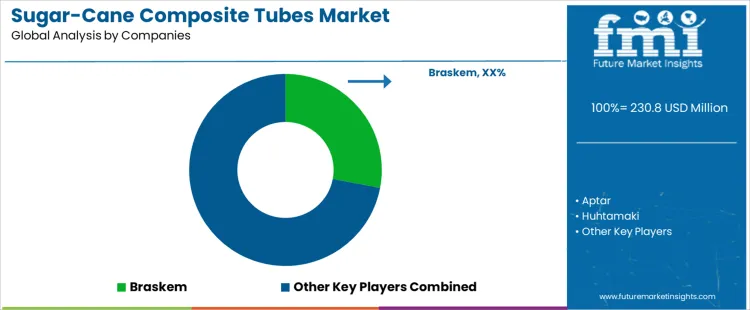
Interest in sugar cane composite tubes is increasing as consumer brands look for renewable material options that fit established tube packaging formats. Oral care, skincare, and cosmetic products are primary users, as these categories require squeezable packs with strong shelf presence. Braskem underpins supply through bio based polyethylene sourced from sugar cane, which replaces conventional fossil feedstock in tube layers and closures. Huhtamaki develops composite tube constructions that combine paperboard shells with bio polymer inner linings for creams and pastes. Amcor supports adoption through engineered multilayer tube solutions adapted for renewable resin integration. Aptar enables functionality by supplying dispensing systems designed to work reliably with bio based tube bodies.
Adoption decisions depend on barrier integrity, print definition, squeeze feel, and compatibility with existing filling equipment. UFlex addresses high volume personal care needs through laminated composite tubes positioned for cost controlled applications. Toppan contributes through advanced printing and tube forming capabilities that preserve brand aesthetics while incorporating renewable materials. Brand owners focus on clear renewable material communication without compromising product protection. Use cases include toothpaste, lotions, sunscreens, and dermatological products. Demand momentum reflects wider bio polymer availability, packaging redesign programs, and continued movement toward renewable feedstocks in consumer packaging systems.
Key Players in the Sugar Cane Composite Tubes Market
- Braskem
- Aptar
- Huhtamaki
- Amcor
- UFlex
- Toppan
Scope of the Report
| Items | Values |
|---|---|
| Quantitative Units (2026) | USD million |
| End Use | Cosmetics; Personal Care; Food Products; Household; Other End Uses |
| Packaging Format | Bio-Composite Tubes; Flexible Tubes; Barrier Tubes; Stand-Up Tubes; Other Formats |
| Material | Sugar-cane PE; Hybrid Bio-Polymers; Bio-EVOH; Bio-HDPE; Other Materials |
| Technology | Extrusion Blow Molding; Multi-Layer Coextrusion; Barrier Lamination; High-speed Extrusion; Other Technologies |
| Regions Covered | Asia Pacific; Europe; North America; Latin America; Middle East & Africa |
| Countries Covered | China; Japan; South Korea; India; Australia & New Zealand; ASEAN; Germany; United Kingdom; France; Italy; Spain; Nordic; BENELUX; United States; Canada; Mexico; Brazil; Chile; Kingdom of Saudi Arabia; Turkey; South Africa; plus additional countries across Asia Pacific, Europe, Latin America, and Middle East & Africa |
| Key Companies Profiled | Braskem; Aptar; Huhtamaki; Amcor; UFlex; Toppan |
| Additional Attributes | Dollar by sales across end use segments and packaging formats; role of sugAR-cane based polymers and fiber composites in rigid tube packaging substitution; importance of tube stiffness, squeeze performance, and surface finish in cosmetics and personal care applications; integration of composite tubes with standard filling, sealing, and capping equipment; influence of bio polymer availability on large scale tube manufacturing; adoption of composite tubes in oral care, skincare, and specialty food packaging; impact of print compatibility and branding requirements on composite tube specification; considerations around moisture resistance, barrier performance, and end-of-life handling for composite tube structures |
Sugar Cane Composite Tubes Market Segmentation
End-use
- Cosmetics
- Personal Care
- Food Products
- Household
- Others
Packaging Format
- Bio-Composite Tubes
- Flexible Tubes
- Barrier Tubes
- Stand-Up Tubes
- Others
Material
- Sugar-cane PE
- Hybrid Bio-Polymers
- Bio-EVOH
- Bio-HDPE
- Others
Technology
- Extrusion Blow Molding
- Multi-Layer Coextrusion
- Barrier Lamination
- High-speed Extrusion
- Others
Region
- Asia Pacific
- China
- Japan
- South Korea
- India
- Australia & New Zealand
- ASEAN
- Rest of Asia Pacific
- Europe
- Germany
- United Kingdom
- France
- Italy
- Spain
- Nordic
- BENELUX
- Rest of Europe
- North America
- United States
- Canada
- Mexico
- Latin America
- Brazil
- Chile
- Rest of Latin America
- Middle East & Africa
- Kingdom of Saudi Arabia
- Other GCC Countries
- Turkey
- South Africa
- Other African Union
- Rest of Middle East & Africa
Frequently Asked Questions
How big is the sugAR-cane composite tubes market in 2026?
The global sugAR-cane composite tubes market is estimated to be valued at USD 230.8 million in 2026.
What will be the size of sugAR-cane composite tubes market in 2036?
The market size for the sugAR-cane composite tubes market is projected to reach USD 593.5 million by 2036.
How much will be the sugAR-cane composite tubes market growth between 2026 and 2036?
The sugAR-cane composite tubes market is expected to grow at a 9.9% CAGR between 2026 and 2036.
What are the key product types in the sugAR-cane composite tubes market?
The key product types in sugAR-cane composite tubes market are cosmetics, personal care, food products, household and others.
Which packaging format segment to contribute significant share in the sugAR-cane composite tubes market in 2026?
In terms of packaging format, bio-composite tubes segment to command 48.0% share in the sugAR-cane composite tubes market in 2026.
Preview the report firsthand - request a free sample
Get SampleGet the brochure for pricing and purchase details.
Get PDFTable of Content
- Executive Summary
- Global Market Outlook
- Demand-side Trends
- Supply-side Trends
- Technology Roadmap Analysis
- Analysis and Recommendations
- Market Overview
- Market Coverage / Taxonomy
- Market Definition / Scope / Limitations
- Market Background
- Market Dynamics
- Drivers
- Restraints
- Opportunity
- Trends
- Scenario Forecast
- Demand in Optimistic Scenario
- Demand in Likely Scenario
- Demand in Conservative Scenario
- Opportunity Map Analysis
- Product Life Cycle Analysis
- Supply Chain Analysis
- Investment Feasibility Matrix
- Value Chain Analysis
- PESTLE and Porter’s Analysis
- Regulatory Landscape
- Regional Parent Market Outlook
- Production and Consumption Statistics
- Import and Export Statistics
- Market Dynamics
- Global Market Analysis 2021 to 2025 and Forecast, 2026 to 2036
- Historical Market Size Value (USD Million) Analysis, 2021 to 2025
- Current and Future Market Size Value (USD Million) Projections, 2026 to 2036
- Y-o-Y Growth Trend Analysis
- Absolute $ Opportunity Analysis
- Global Market Pricing Analysis 2021 to 2025 and Forecast 2026 to 2036
- Global Market Analysis 2021 to 2025 and Forecast 2026 to 2036, By End-use
- Introduction / Key Findings
- Historical Market Size Value (USD Million) Analysis By End-use , 2021 to 2025
- Current and Future Market Size Value (USD Million) Analysis and Forecast By End-use , 2026 to 2036
- Cosmetics
- Personal Care
- Food Products
- Household
- Others
- Y-o-Y Growth Trend Analysis By End-use , 2021 to 2025
- Absolute $ Opportunity Analysis By End-use , 2026 to 2036
- Global Market Analysis 2021 to 2025 and Forecast 2026 to 2036, By Packaging Format
- Introduction / Key Findings
- Historical Market Size Value (USD Million) Analysis By Packaging Format, 2021 to 2025
- Current and Future Market Size Value (USD Million) Analysis and Forecast By Packaging Format, 2026 to 2036
- Bio-Composite Tubes
- Flexible Tubes
- Barrier Tubes
- Stand-Up Tubes
- Others
- Y-o-Y Growth Trend Analysis By Packaging Format, 2021 to 2025
- Absolute $ Opportunity Analysis By Packaging Format, 2026 to 2036
- Global Market Analysis 2021 to 2025 and Forecast 2026 to 2036, By Material
- Introduction / Key Findings
- Historical Market Size Value (USD Million) Analysis By Material, 2021 to 2025
- Current and Future Market Size Value (USD Million) Analysis and Forecast By Material, 2026 to 2036
- Sugar-cane PE
- Hybrid Bio-Polymers
- Bio-EVOH
- Bio-HDPE
- Others
- Y-o-Y Growth Trend Analysis By Material, 2021 to 2025
- Absolute $ Opportunity Analysis By Material, 2026 to 2036
- Global Market Analysis 2021 to 2025 and Forecast 2026 to 2036, By Technology
- Introduction / Key Findings
- Historical Market Size Value (USD Million) Analysis By Technology, 2021 to 2025
- Current and Future Market Size Value (USD Million) Analysis and Forecast By Technology, 2026 to 2036
- Extrusion Blow Molding
- Multi-Layer Coextrusion
- Barrier Lamination
- High-speed Extrusion
- Others
- Y-o-Y Growth Trend Analysis By Technology, 2021 to 2025
- Absolute $ Opportunity Analysis By Technology, 2026 to 2036
- Global Market Analysis 2021 to 2025 and Forecast 2026 to 2036, By Region
- Introduction
- Historical Market Size Value (USD Million) Analysis By Region, 2021 to 2025
- Current Market Size Value (USD Million) Analysis and Forecast By Region, 2026 to 2036
- North America
- Latin America
- Western Europe
- Eastern Europe
- East Asia
- South Asia and Pacific
- Middle East & Africa
- Market Attractiveness Analysis By Region
- North America Market Analysis 2021 to 2025 and Forecast 2026 to 2036, By Country
- Historical Market Size Value (USD Million) Trend Analysis By Market Taxonomy, 2021 to 2025
- Market Size Value (USD Million) Forecast By Market Taxonomy, 2026 to 2036
- By Country
- USA
- Canada
- Mexico
- By End-use
- By Packaging Format
- By Material
- By Technology
- By Country
- Market Attractiveness Analysis
- By Country
- By End-use
- By Packaging Format
- By Material
- By Technology
- Key Takeaways
- Latin America Market Analysis 2021 to 2025 and Forecast 2026 to 2036, By Country
- Historical Market Size Value (USD Million) Trend Analysis By Market Taxonomy, 2021 to 2025
- Market Size Value (USD Million) Forecast By Market Taxonomy, 2026 to 2036
- By Country
- Brazil
- Chile
- Rest of Latin America
- By End-use
- By Packaging Format
- By Material
- By Technology
- By Country
- Market Attractiveness Analysis
- By Country
- By End-use
- By Packaging Format
- By Material
- By Technology
- Key Takeaways
- Western Europe Market Analysis 2021 to 2025 and Forecast 2026 to 2036, By Country
- Historical Market Size Value (USD Million) Trend Analysis By Market Taxonomy, 2021 to 2025
- Market Size Value (USD Million) Forecast By Market Taxonomy, 2026 to 2036
- By Country
- Germany
- UK
- Italy
- Spain
- France
- Nordic
- BENELUX
- Rest of Western Europe
- By End-use
- By Packaging Format
- By Material
- By Technology
- By Country
- Market Attractiveness Analysis
- By Country
- By End-use
- By Packaging Format
- By Material
- By Technology
- Key Takeaways
- Eastern Europe Market Analysis 2021 to 2025 and Forecast 2026 to 2036, By Country
- Historical Market Size Value (USD Million) Trend Analysis By Market Taxonomy, 2021 to 2025
- Market Size Value (USD Million) Forecast By Market Taxonomy, 2026 to 2036
- By Country
- Russia
- Poland
- Hungary
- Balkan & Baltic
- Rest of Eastern Europe
- By End-use
- By Packaging Format
- By Material
- By Technology
- By Country
- Market Attractiveness Analysis
- By Country
- By End-use
- By Packaging Format
- By Material
- By Technology
- Key Takeaways
- East Asia Market Analysis 2021 to 2025 and Forecast 2026 to 2036, By Country
- Historical Market Size Value (USD Million) Trend Analysis By Market Taxonomy, 2021 to 2025
- Market Size Value (USD Million) Forecast By Market Taxonomy, 2026 to 2036
- By Country
- China
- Japan
- South Korea
- By End-use
- By Packaging Format
- By Material
- By Technology
- By Country
- Market Attractiveness Analysis
- By Country
- By End-use
- By Packaging Format
- By Material
- By Technology
- Key Takeaways
- South Asia and Pacific Market Analysis 2021 to 2025 and Forecast 2026 to 2036, By Country
- Historical Market Size Value (USD Million) Trend Analysis By Market Taxonomy, 2021 to 2025
- Market Size Value (USD Million) Forecast By Market Taxonomy, 2026 to 2036
- By Country
- India
- ASEAN
- Australia & New Zealand
- Rest of South Asia and Pacific
- By End-use
- By Packaging Format
- By Material
- By Technology
- By Country
- Market Attractiveness Analysis
- By Country
- By End-use
- By Packaging Format
- By Material
- By Technology
- Key Takeaways
- Middle East & Africa Market Analysis 2021 to 2025 and Forecast 2026 to 2036, By Country
- Historical Market Size Value (USD Million) Trend Analysis By Market Taxonomy, 2021 to 2025
- Market Size Value (USD Million) Forecast By Market Taxonomy, 2026 to 2036
- By Country
- Kingdom of Saudi Arabia
- Other GCC Countries
- Turkiye
- South Africa
- Other African Union
- Rest of Middle East & Africa
- By End-use
- By Packaging Format
- By Material
- By Technology
- By Country
- Market Attractiveness Analysis
- By Country
- By End-use
- By Packaging Format
- By Material
- By Technology
- Key Takeaways
- Key Countries Market Analysis
- USA
- Pricing Analysis
- Market Share Analysis, 2025
- By End-use
- By Packaging Format
- By Material
- By Technology
- Canada
- Pricing Analysis
- Market Share Analysis, 2025
- By End-use
- By Packaging Format
- By Material
- By Technology
- Mexico
- Pricing Analysis
- Market Share Analysis, 2025
- By End-use
- By Packaging Format
- By Material
- By Technology
- Brazil
- Pricing Analysis
- Market Share Analysis, 2025
- By End-use
- By Packaging Format
- By Material
- By Technology
- Chile
- Pricing Analysis
- Market Share Analysis, 2025
- By End-use
- By Packaging Format
- By Material
- By Technology
- Germany
- Pricing Analysis
- Market Share Analysis, 2025
- By End-use
- By Packaging Format
- By Material
- By Technology
- UK
- Pricing Analysis
- Market Share Analysis, 2025
- By End-use
- By Packaging Format
- By Material
- By Technology
- Italy
- Pricing Analysis
- Market Share Analysis, 2025
- By End-use
- By Packaging Format
- By Material
- By Technology
- Spain
- Pricing Analysis
- Market Share Analysis, 2025
- By End-use
- By Packaging Format
- By Material
- By Technology
- France
- Pricing Analysis
- Market Share Analysis, 2025
- By End-use
- By Packaging Format
- By Material
- By Technology
- India
- Pricing Analysis
- Market Share Analysis, 2025
- By End-use
- By Packaging Format
- By Material
- By Technology
- ASEAN
- Pricing Analysis
- Market Share Analysis, 2025
- By End-use
- By Packaging Format
- By Material
- By Technology
- Australia & New Zealand
- Pricing Analysis
- Market Share Analysis, 2025
- By End-use
- By Packaging Format
- By Material
- By Technology
- China
- Pricing Analysis
- Market Share Analysis, 2025
- By End-use
- By Packaging Format
- By Material
- By Technology
- Japan
- Pricing Analysis
- Market Share Analysis, 2025
- By End-use
- By Packaging Format
- By Material
- By Technology
- South Korea
- Pricing Analysis
- Market Share Analysis, 2025
- By End-use
- By Packaging Format
- By Material
- By Technology
- Russia
- Pricing Analysis
- Market Share Analysis, 2025
- By End-use
- By Packaging Format
- By Material
- By Technology
- Poland
- Pricing Analysis
- Market Share Analysis, 2025
- By End-use
- By Packaging Format
- By Material
- By Technology
- Hungary
- Pricing Analysis
- Market Share Analysis, 2025
- By End-use
- By Packaging Format
- By Material
- By Technology
- Kingdom of Saudi Arabia
- Pricing Analysis
- Market Share Analysis, 2025
- By End-use
- By Packaging Format
- By Material
- By Technology
- Turkiye
- Pricing Analysis
- Market Share Analysis, 2025
- By End-use
- By Packaging Format
- By Material
- By Technology
- South Africa
- Pricing Analysis
- Market Share Analysis, 2025
- By End-use
- By Packaging Format
- By Material
- By Technology
- USA
- Market Structure Analysis
- Competition Dashboard
- Competition Benchmarking
- Market Share Analysis of Top Players
- By Regional
- By End-use
- By Packaging Format
- By Material
- By Technology
- Competition Analysis
- Competition Deep Dive
- Braskem
- Overview
- Product Portfolio
- Profitability by Market Segments (Product/Age /Sales Channel/Region)
- Sales Footprint
- Strategy Overview
- Marketing Strategy
- Product Strategy
- Channel Strategy
- Aptar
- Huhtamaki
- Amcor
- UFlex
- Toppan
- Braskem
- Competition Deep Dive
- Assumptions & Acronyms Used
- Research Methodology


