

- Industry Size (2026)
- USD 1760.0 Mn
- Forecast (2036)
- USD 3729.9 Mn
- CAGR (2026 to 2036)
- 7.8%
Mouthfeel Enhancers Market Forecast and Outlook 2026 to 2036
The mouthfeel enhancers market is forecasted to be valued at USD 1,760.0 million in 2026, is projected to reach USD 3,729.9 million by 2036, and at a CAGR of 7.8% during the forecast period. Demand growth is closely linked to reformulation activity across beverages, dairy alternatives, bakery products, and reduced-calorie desserts where traditional fat and sugar removal weakens texture perception. Manufacturers increasingly rely on mouthfeel enhancers to restore creaminess, viscosity, and lubrication that consumers associate with indulgent products. Plant-based beverages, protein shakes, and flavored waters depend on these systems to avoid thin or watery sensory impressions. In snacks and nutrition bars, fiber and protein enrichment often creates dryness or grittiness, prompting formulators to incorporate enhancers that rebalance chew and cohesion without altering nutritional positioning.
Adoption is further reinforced by expansion of functional nutrition and adult nutrition products, where texture directly influences repeat consumption and compliance. High-protein drinks, meal replacements, and fortified foods require controlled mouthfeel to offset chalky or astringent sensations introduced by minerals and amino acids. Ingredient suppliers focus on hydrocolloid, starch, and protein-based solutions engineered to perform under heat treatment, shear stress, and pH variation common in industrial processing. Sensory science plays a central role, with texture profiling and rheology testing used to fine-tune inclusion levels across liquid and solid matrices. Regulatory scrutiny around labeling and clean-label expectations shapes selection toward multifunctional systems that deliver body and smoothness at low usage rates. As reformulation depth increases across mainstream portfolios, mouthfeel enhancers remain integral to texture recovery rather than optional formulation aids.
Quick Stats for Mouthfeel Enhancers Market
- Mouthfeel Enhancers Market Value (2026): USD 1,760.0 million
- Mouthfeel Enhancers Market Forecast Value (2036): USD 3,729.9 million
- Mouthfeel Enhancers Market Forecast CAGR (2026 to 2036): 7.8%
- Leading Product Type by Demand Share: Hydrocolloids
- Fastest-Growing Countries: India, China, Brazil, USA, UK
- Top Players in Global Demand: Ingredion, Tate & Lyle, Cargill, ADM, DSM-Firmenich
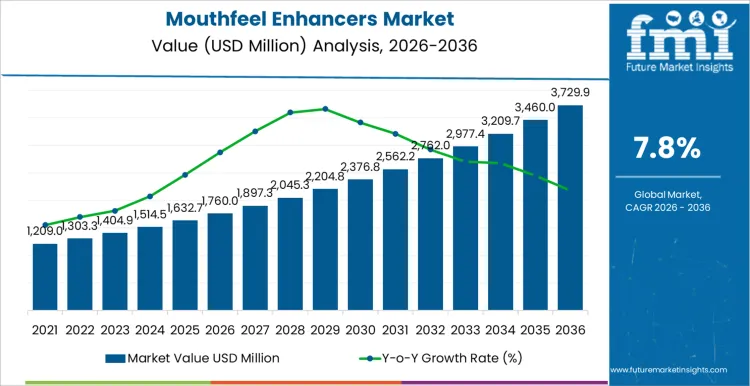
Mouthfeel Enhancers Market Key Takeaways
| Metric | Value |
|---|---|
| Market Value (2026) | USD 1,760.0 million |
| Market Forecast Value (2036) | USD 3,729.9 million |
| Forecast CAGR 2026 to 2036 | 7.8% |
Why is the Demand for Mouthfeel Enhancers Growing?
Demand for mouthfeel enhancers is rising as food and beverage developers seek ways to improve texture and sensory appeal in reduced fat and reduced sugar products. Formulators creating low fat dairy alternatives, plant based beverages, and reduced calorie desserts rely on mouthfeel enhancers to replicate creamy, smooth sensations that traditional ingredients provided. Consumers evaluating labels for health attributes expect texture quality that does not feel thin, gritty, or watery. Beverage producers use mouthfeel enhancers to build body in flavored waters and ready to drink teas that contain minimal calories. Snack formulators employ these technologies in extruded products and bars where fiber enrichment can create coarse or dry perceptions without enhancement.
Procurement activity in processed foods and adult nutrition segments supports growth because high protein and fiber fortified products carry intrinsic challenges in achieving pleasant texture. Mouthfeel enhancers help balance chewiness, viscosity, and lubrication in formulations where functional ingredients affect sensory experience. Ingredient suppliers develop polymeric and carbohydrate based solutions that withstand processing conditions typical of high shear mixing, heat, and varying pH. Sensory laboratories conduct texture profiling to calibrate enhancer levels that align with target mouthfeel benchmarks across categories with distinct consumption occasions.
How Is the Mouthfeel Enhancers Industry Segmented by Product Type, Form, and Application?
Demand for mouthfeel enhancers is shaped by sugar and fat reduction initiatives, texture optimization needs, and clean-label formulation priorities. Food and health product manufacturers focus on restoring body, creaminess, and viscosity lost during reformulation. Adoption varies by processing method, stability requirements, and sensory targets across liquid and solid products. Selection decisions emphasize functionality at low inclusion levels, compatibility with other flavours of mouthfeel enhancers or ingredients, and regulatory acceptance across food and pharmaceutical formulations.
Which Product Type Accounts for the Largest Share in Mouthfeel Enhancers?
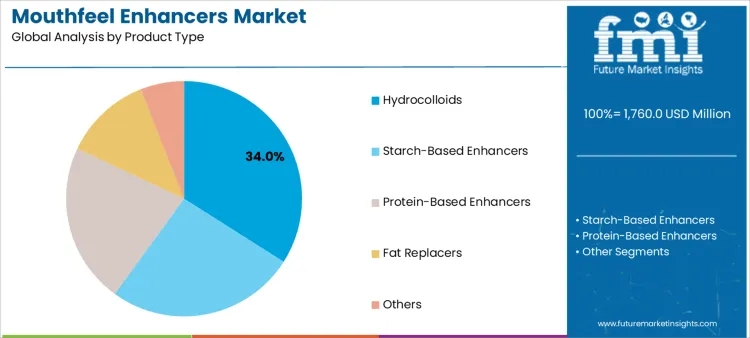
Hydrocolloids hold 34.0%, reflecting extensive use in viscosity building, suspension stability, and texture enhancement across multiple formulations. These ingredients provide controlled thickness and smoothness in reduced-sugar and reduced-fat products. Starch-based enhancers represent 26.0%, supporting bulk, body, and process tolerance in bakery and processed foods. Protein-based enhancers at 22.0% improve creaminess and structure, particularly in dairy and nutritional products. Fat replacers account for 12.0%, addressing mouth-coating effects in low-fat formulations. Other enhancers at 6.0% serve specialized sensory requirements. Product segmentation reflects reliance on hydrocolloid functionality balanced with cost and label considerations.
Key Points:
- Food hydrocolloids deliver viscosity and texture control.
- Starch systems support bulk and processing stability.
- Protein ingredients enhance creaminess and structure.
Which Form Dominates Utilization of Mouthfeel Enhancers?
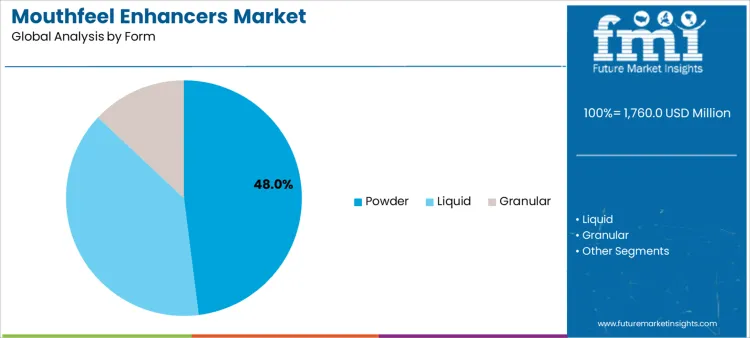
Powder forms account for 48.0%, reflecting ease of storage, long shelf life, and compatibility with dry blending operations. These formats integrate efficiently into bakery mixes, nutritional powders, and processed food systems. Liquid forms represent 39.0%, supporting rapid dispersion and precise dosing in beverage and dairy processing. Granular forms at 13.0% are selected where controlled handling and reduced dusting are required. Form-based segmentation indicates preference driven by manufacturing workflow, dosing accuracy, and logistical efficiency across different production environments.
Key Points:
- Powders suit dry processing and extended storage.
- Liquids enable rapid dispersion in wet systems.
- Granular formats support controlled material handling.
How Do Application Areas Influence Demand for Mouthfeel Enhancers?
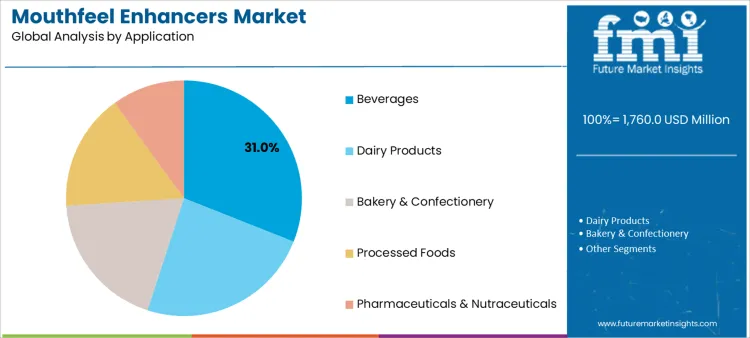
Beverages represent 31.0%, driven by need to improve body and smoothness in low-sugar and functional drinks. Dairy products account for 24.0%, focusing on creaminess and viscosity in yogurts and flavored milk. Bakery and confectionery applications at 19.0% rely on enhancers for moisture retention and texture consistency. Processed foods at 16.0% apply enhancers to sauces, soups, and ready meals. Pharmaceuticals and nutraceuticals at 10.0% use mouthfeel enhancers to improve oral acceptability. Application segmentation highlights stronger usage where sensory perception directly affects product acceptance.
Key Points:
- Beverages require body and smoothness restoration.
- Dairy products emphasize creaminess and thickness.
- Health products focus on oral acceptability.
What are the Key Dynamics in the Mouthfeel Enhancers Market?
Demand in the mouthfeel enhancers market is shaped by the need to improve sensory texture in low-fat, reduced-sugar, and plant-based food and beverage products where ingredient changes alter the expected tactile experience. Activity focuses on manufacturers seeking to deliver creamy, smooth, or rich mouthfeel without traditional fat or sugar levels. Value is defined by an agent’s ability to provide targeted rheological properties in finished products. Procurement choices reflect performance under processing conditions, cost per functional unit, and alignment with clean label positioning in specific food categories.
How do formulation texture requirements in reduced-nutrient products influence adoption?
Adoption of mouthfeel enhancers increases where reformulation efforts diminish textural quality because of nutrient reduction goals. Beverage producers working with low-fat milks, dairy alternatives, and ready-to-drink teas require agents that deliver viscosity, body, and a balanced coating sensation absent in reformulated recipes. Bakery and confection producers apply mouthfeel enhancers to support softness, chewiness, or moisture perception lost when sugar and fat are reduced or replaced with alternative bulking ingredients. Meat analog developers use these agents to mimic succulence and juiciness found in traditional protein sources, supporting sensory alignment with consumer expectations. Ingredient systems that maintain functionality through pasteurization, extrusion, baking, or freezing operations enable formulators to retain target textural profiles across processing regimes while meeting nutritional targets set by product developers.
How do regulatory frameworks and ingredient interaction constraints influence market scalability?
Market scalability is shaped by divergent regulatory acceptance criteria and technical interaction challenges tied to specific application matrices. Regions differ in how mouthfeel enhancers are classified, permitted use levels, and required labeling, influencing where and how they are deployed in global product lines. Technical limitations arise when certain agents lose efficacy at extreme pH, elevated temperatures, or in the presence of high salt or alcohol, requiring tailored selection and iterative development work to achieve desired tactile outcomes. Cost considerations surface when complex systems or multiple components are needed to achieve acceptable mouthfeel in challenging products such as reduced-calorie frozen desserts or high-protein bars. Sensory characterization demands trained panels and repeat testing, extending development cycles for products that depend on nuanced textural quality to drive repeat purchase behavior.
How Is Demand for the Mouthfeel Enhancers Market Evolving Globally?
Global demand for mouthfeel enhancers is increasing as food and beverage manufacturers reformulate products to reduce sugar, fat, and salt while maintaining texture and sensory satisfaction. Growth reflects rising formulation complexity across beverages, dairy alternatives, bakery, and functional nutrition. Demand expansion remains tied to clean label positioning, cost control, and consumer expectations for indulgent texture in reduced-ingredient products. India records 9.3% CAGR, China records 9.0% CAGR, Brazil records 8.6% CAGR, USA records 7.4% CAGR, and UK records 7.2% CAGR. Adoption intensity is driven by reformulation depth and sensory performance requirements rather than consumption volume growth.
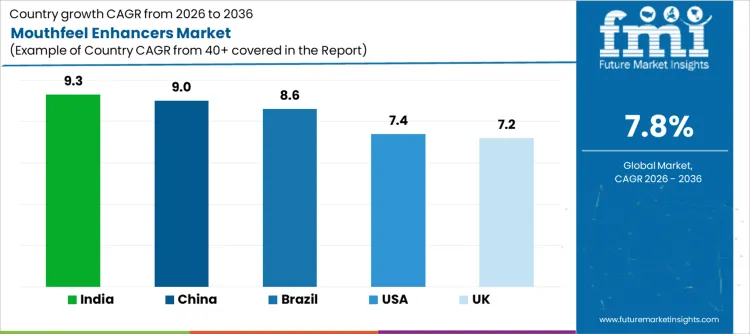
| Country | CAGR (%) |
|---|---|
| India | 9.3% |
| China | 9.0% |
| Brazil | 8.6% |
| USA | 7.4% |
| UK | 7.2% |
What is driving growth of mouthfeel enhancers demand in India?
Demand for mouthfeel enhancers in India is expanding as packaged food, beverage, and nutraceutical manufacturers reformulate products with reduced sugar and fat content. Growth at 9.3% CAGR reflects strong activity in dairy beverages, flavored milk, syrups, and functional drinks. Texture loss caused by sugar reduction creates demand for mouthfeel systems that restore body and smoothness. Cost sensitivity drives preference for enhancers that deliver viscosity and creaminess at low inclusion rates. Domestic formulation teams prioritize heat-stable solutions compatible with mass-market processing conditions. Demand remains concentrated within urban-focused health beverages and fortified food categories.
- Sugar reduction driven texture challenges
- Expansion of functional beverages
- Cost-efficient texture optimization
- Growth of fortified food formulations
Why is China seeing expansion in mouthfeel enhancers adoption?
Mouthfeel enhancers demand in China is rising as industrial food processors reformulate products aligned with nutrition and sugar intake guidance. Growth at 9.0% CAGR reflects strong usage in ready-to-drink beverages, yogurt drinks, and nutritional powders. High-volume manufacturing requires consistent texture delivery across large batch production. Reduced sugar and protein fortification create thin mouthfeel issues requiring targeted enhancement. Domestic ingredient suppliers scale hydrocolloid and fermentation-derived solutions for beverage and dairy systems. Demand concentration remains within industrial processing environments supplying modern retail channels.
- High-volume beverage reformulation
- Texture correction in protein-rich products
- Industrial consistency requirements
- Expansion of functional dairy drinks
What factors are shaping mouthfeel enhancers sales in Brazil?
Sales of mouthfeel enhancers in Brazil are increasing as beverage and food manufacturers respond to nutrition labeling rules and sugar disclosure requirements. Growth at 8.6% CAGR reflects reformulation across carbonated drinks, juices, and dairy-based beverages. Tropical flavor systems magnify texture loss under reduced sugar formulations, increasing reliance on mouthfeel solutions. Local producers focus on restoring body, roundness, and drinking experience. Demand remains strongest in mass-market beverages serving price-sensitive consumers. Enhancer selection emphasizes stability under ambient storage conditions.
- Nutrition labeling driven reformulation
- Beverage-dominated application demand
- Texture restoration in reduced sugar products
- Focus on mass-market sensory acceptance
How is the USA supporting growth of mouthfeel enhancers demand?
Mouthfeel enhancers market demand in the USA is advancing as manufacturers execute portfolio-wide reformulation programs. Growth at 7.4% CAGR reflects strong adoption in protein beverages, plant-based dairy alternatives, and reduced sugar snacks. Texture degradation caused by sugar and fat removal increases reliance on mouthfeel systems. Ingredient strategies prioritize clean label compatibility and functional performance. Large brands specify enhancers that maintain established product sensory profiles across reformulated SKUs. Demand is driven by taste and texture risk mitigation rather than new category creation.
- Growth of plant-based and protein beverages
- Sugar and fat reduction reformulation
- Clean label texture solutions
- Focus on sensory profile protection
What is driving expansion of mouthfeel enhancers demand in the UK?
Demand for mouthfeel enhancers in the UK is rising as sugar taxation and public health targets reshape formulation approaches. Growth at 7.2% CAGR reflects reformulation across beverages, dairy alternatives, and bakery fillings. Texture preservation becomes critical when sugar and fat levels are reduced. Retail nutritional standards accelerate adoption of mouthfeel solutions that maintain consumer acceptance. Ingredient selection emphasizes regulatory approval and label simplicity. Demand remains tied to compliance-driven reformulation cycles rather than changes in overall food consumption.
- Sugar levy driven reformulation
- Expansion of dairy alternative products
- Retail texture quality requirements
- Clean label formulation priorities
What is the competitive landscape of demand for the mouthfeel enhancers market globally?
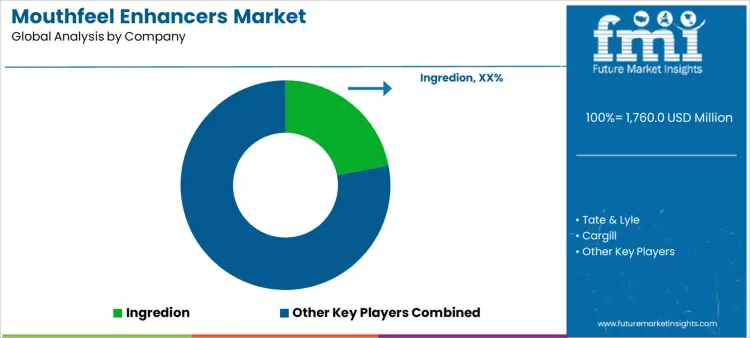
Demand for mouthfeel enhancers is driven by reformulation activity, fat reduction initiatives, and texture optimization needs across food and beverage categories. Product developers evaluate viscosity contribution, creaminess perception, lubrication effect, and stability under thermal and shear processing conditions. Buyer assessment includes clean label suitability, compatibility with sweeteners or proteins, performance across beverage, dairy, and bakery matrices, and consistency at low inclusion rates. Procurement behavior reflects long-term reformulation programs, reliance on application trials, and preference for suppliers providing sensory and texture validation. Trend in the mouthfeel enhancers market reflects increasing focus on texture restoration in reduced sugar, reduced fat, and plant based formulations.
Ingredion leads competitive positioning through mouthfeel solutions integrated with starches, fibers, and texturizing systems supporting broad formulation flexibility. Tate and Lyle competes by offering fiber-based and carbohydrate-driven mouthfeel enhancers aligned with clean label strategies. Cargill supports demand by combining mouthfeel enhancement with texture and stabilization systems across packaged food portfolios. ADM maintains relevance through formulation expertise and ingredient systems supporting consistency and scalability. DSM-Firmenich participates with mouthfeel technologies backed by sensory science and co-development capabilities. Competitive differentiation centers on texture authenticity, formulation adaptability, regulatory acceptance, and depth of customer collaboration.
Key Players in the Mouthfeel Enhancers Market
- Ingredion
- Tate & Lyle
- Cargill
- ADM
- DSM-Firmenich
- Others
Scope of the Report
| Items | Values |
|---|---|
| Quantitative Units | USD million |
| Product Type | Hydrocolloids; Starch-Based Enhancers; Protein-Based Enhancers; Fat Replacers; Others |
| Form | Powder; Liquid; Granular |
| Application | Beverages; Dairy Products; Bakery & Confectionery; Processed Foods; Pharmaceuticals & Nutraceuticals |
| Regions Covered | Asia Pacific, Europe, North America, Latin America, Middle East & Africa |
| Countries Covered | India, China, Brazil, USA, UK, and 40+ countries |
| Key Companies Profiled | Ingredion; Tate & Lyle; Cargill; ADM; DSM-Firmenich; Others |
| Additional Attributes | Dollar sales by product type, form, and application; texture modification efficiency delivering creaminess, viscosity, and body in reduced-sugar or reduced-fat formulations; performance differences among hydrocolloid, starch, protein, and fat replacer systems; stability under heat, shear, and pH variation; compatibility with clean-label formulation goals; procurement dynamics influenced by large-scale food processing, reformulation programs, and long-term ingredient supply partnerships. |
Mouthfeel Enhancers Market by Segment
Product Type:
- Hydrocolloids
- Starch-Based Enhancers
- Protein-Based Enhancers
- Fat Replacers
- Others
Form:
- Powder
- Liquid
- Granular
Application:
- Beverages
- Dairy Products
- Bakery & Confectionery
- Processed Foods
- Pharmaceuticals & Nutraceuticals
Region:
- Asia Pacific
- China
- Japan
- South Korea
- India
- Australia & New Zealand
- ASEAN
- Rest of Asia Pacific
- Europe
- Germany
- United Kingdom
- France
- Italy
- Spain
- Nordic
- BENELUX
- Rest of Europe
- North America
- United States
- Canada
- Mexico
- Latin America
- Brazil
- Chile
- Rest of Latin America
- Middle East & Africa
- Kingdom of Saudi Arabia
- Other GCC Countries
- Turkey
- South Africa
- Other African Union
- Rest of Middle East & Africa
Bibliography
- Food and Agriculture Organization of the United Nations. (2023). Texturizing agents in food reformulation: Role in fat and sugar reduction strategies. Food and Agriculture Organization of the United Nations.
- World Health Organization. (2023). Guideline on non-sugar sweeteners and reformulation impacts on texture and mouthfeel. World Health Organization.
- Codex Alimentarius Commission. (2023). General Standard for Food Additives (GSFA): Provisions relevant to thickeners, stabilizers, and texturizing agents. FAO/WHO.
- United States Food and Drug Administration. (2024). Regulatory status and functional classification of food additives used as texture and mouthfeel enhancers. U.S. Department of Health and Human Services.
- European Commission. (2024). Guidance document on the application of EU food law to thickeners, stabilizers, and fat replacers in reformulated foods. European Union.
- International Organization for Standardization. (2023). ISO 11036: Sensory analysis – Methodology for texture profile evaluation. ISO.
Frequently Asked Questions
How big is the mouthfeel enhancers market in 2026?
The global mouthfeel enhancers market is estimated to be valued at USD 1,760.0 million in 2026.
What will be the size of mouthfeel enhancers market in 2036?
The market size for the mouthfeel enhancers market is projected to reach USD 3,729.9 million by 2036.
How much will be the mouthfeel enhancers market growth between 2026 and 2036?
The mouthfeel enhancers market is expected to grow at a 7.8% CAGR between 2026 and 2036.
What are the key product types in the mouthfeel enhancers market?
The key product types in mouthfeel enhancers market are hydrocolloids, starch-based enhancers, protein-based enhancers, fat replacers and others.
Which form segment to contribute significant share in the mouthfeel enhancers market in 2026?
In terms of form, powder segment to command 48.0% share in the mouthfeel enhancers market in 2026.
Preview the report firsthand - request a free sample
Get SampleGet the brochure for pricing and purchase details.
Get PDFTable of Content
- Executive Summary
- Global Market Outlook
- Demand-side Trends
- Supply-side Trends
- Technology Roadmap Analysis
- Analysis and Recommendations
- Market Overview
- Market Coverage / Taxonomy
- Market Definition / Scope / Limitations
- Market Background
- Market Dynamics
- Drivers
- Restraints
- Opportunity
- Trends
- Scenario Forecast
- Demand in Optimistic Scenario
- Demand in Likely Scenario
- Demand in Conservative Scenario
- Opportunity Map Analysis
- Product Life Cycle Analysis
- Supply Chain Analysis
- Investment Feasibility Matrix
- Value Chain Analysis
- PESTLE and Porter’s Analysis
- Regulatory Landscape
- Regional Parent Market Outlook
- Production and Consumption Statistics
- Import and Export Statistics
- Market Dynamics
- Global Market Analysis 2021 to 2025 and Forecast, 2026 to 2036
- Historical Market Size Value (USD Million) Analysis, 2021 to 2025
- Current and Future Market Size Value (USD Million) Projections, 2026 to 2036
- Y-o-Y Growth Trend Analysis
- Absolute $ Opportunity Analysis
- Global Market Pricing Analysis 2021 to 2025 and Forecast 2026 to 2036
- Global Market Analysis 2021 to 2025 and Forecast 2026 to 2036, By Product Type
- Introduction / Key Findings
- Historical Market Size Value (USD Million) Analysis By Product Type , 2021 to 2025
- Current and Future Market Size Value (USD Million) Analysis and Forecast By Product Type , 2026 to 2036
- Hydrocolloids
- Starch-Based Enhancers
- Protein-Based Enhancers
- Fat Replacers
- Others
- Hydrocolloids
- Y-o-Y Growth Trend Analysis By Product Type , 2021 to 2025
- Absolute $ Opportunity Analysis By Product Type , 2026 to 2036
- Global Market Analysis 2021 to 2025 and Forecast 2026 to 2036, By Form
- Introduction / Key Findings
- Historical Market Size Value (USD Million) Analysis By Form, 2021 to 2025
- Current and Future Market Size Value (USD Million) Analysis and Forecast By Form, 2026 to 2036
- Powder
- Liquid
- Granular
- Powder
- Y-o-Y Growth Trend Analysis By Form, 2021 to 2025
- Absolute $ Opportunity Analysis By Form, 2026 to 2036
- Global Market Analysis 2021 to 2025 and Forecast 2026 to 2036, By Application
- Introduction / Key Findings
- Historical Market Size Value (USD Million) Analysis By Application, 2021 to 2025
- Current and Future Market Size Value (USD Million) Analysis and Forecast By Application, 2026 to 2036
- Beverages
- Dairy Products
- Bakery & Confectionery
- Processed Foods
- Pharmaceuticals & Nutraceuticals
- Beverages
- Y-o-Y Growth Trend Analysis By Application, 2021 to 2025
- Absolute $ Opportunity Analysis By Application, 2026 to 2036
- Global Market Analysis 2021 to 2025 and Forecast 2026 to 2036, By Region
- Introduction
- Historical Market Size Value (USD Million) Analysis By Region, 2021 to 2025
- Current Market Size Value (USD Million) Analysis and Forecast By Region, 2026 to 2036
- North America
- Latin America
- Western Europe
- Eastern Europe
- East Asia
- South Asia and Pacific
- Middle East & Africa
- Market Attractiveness Analysis By Region
- North America Market Analysis 2021 to 2025 and Forecast 2026 to 2036, By Country
- Historical Market Size Value (USD Million) Trend Analysis By Market Taxonomy, 2021 to 2025
- Market Size Value (USD Million) Forecast By Market Taxonomy, 2026 to 2036
- By Country
- USA
- Canada
- Mexico
- By Product Type
- By Form
- By Application
- By Country
- Market Attractiveness Analysis
- By Country
- By Product Type
- By Form
- By Application
- Key Takeaways
- Latin America Market Analysis 2021 to 2025 and Forecast 2026 to 2036, By Country
- Historical Market Size Value (USD Million) Trend Analysis By Market Taxonomy, 2021 to 2025
- Market Size Value (USD Million) Forecast By Market Taxonomy, 2026 to 2036
- By Country
- Brazil
- Chile
- Rest of Latin America
- By Product Type
- By Form
- By Application
- By Country
- Market Attractiveness Analysis
- By Country
- By Product Type
- By Form
- By Application
- Key Takeaways
- Western Europe Market Analysis 2021 to 2025 and Forecast 2026 to 2036, By Country
- Historical Market Size Value (USD Million) Trend Analysis By Market Taxonomy, 2021 to 2025
- Market Size Value (USD Million) Forecast By Market Taxonomy, 2026 to 2036
- By Country
- Germany
- UK
- Italy
- Spain
- France
- Nordic
- BENELUX
- Rest of Western Europe
- By Product Type
- By Form
- By Application
- By Country
- Market Attractiveness Analysis
- By Country
- By Product Type
- By Form
- By Application
- Key Takeaways
- Eastern Europe Market Analysis 2021 to 2025 and Forecast 2026 to 2036, By Country
- Historical Market Size Value (USD Million) Trend Analysis By Market Taxonomy, 2021 to 2025
- Market Size Value (USD Million) Forecast By Market Taxonomy, 2026 to 2036
- By Country
- Russia
- Poland
- Hungary
- Balkan & Baltic
- Rest of Eastern Europe
- By Product Type
- By Form
- By Application
- By Country
- Market Attractiveness Analysis
- By Country
- By Product Type
- By Form
- By Application
- Key Takeaways
- East Asia Market Analysis 2021 to 2025 and Forecast 2026 to 2036, By Country
- Historical Market Size Value (USD Million) Trend Analysis By Market Taxonomy, 2021 to 2025
- Market Size Value (USD Million) Forecast By Market Taxonomy, 2026 to 2036
- By Country
- China
- Japan
- South Korea
- By Product Type
- By Form
- By Application
- By Country
- Market Attractiveness Analysis
- By Country
- By Product Type
- By Form
- By Application
- Key Takeaways
- South Asia and Pacific Market Analysis 2021 to 2025 and Forecast 2026 to 2036, By Country
- Historical Market Size Value (USD Million) Trend Analysis By Market Taxonomy, 2021 to 2025
- Market Size Value (USD Million) Forecast By Market Taxonomy, 2026 to 2036
- By Country
- India
- ASEAN
- Australia & New Zealand
- Rest of South Asia and Pacific
- By Product Type
- By Form
- By Application
- By Country
- Market Attractiveness Analysis
- By Country
- By Product Type
- By Form
- By Application
- Key Takeaways
- Middle East & Africa Market Analysis 2021 to 2025 and Forecast 2026 to 2036, By Country
- Historical Market Size Value (USD Million) Trend Analysis By Market Taxonomy, 2021 to 2025
- Market Size Value (USD Million) Forecast By Market Taxonomy, 2026 to 2036
- By Country
- Kingdom of Saudi Arabia
- Other GCC Countries
- Turkiye
- South Africa
- Other African Union
- Rest of Middle East & Africa
- By Product Type
- By Form
- By Application
- By Country
- Market Attractiveness Analysis
- By Country
- By Product Type
- By Form
- By Application
- Key Takeaways
- Key Countries Market Analysis
- USA
- Pricing Analysis
- Market Share Analysis, 2025
- By Product Type
- By Form
- By Application
- Canada
- Pricing Analysis
- Market Share Analysis, 2025
- By Product Type
- By Form
- By Application
- Mexico
- Pricing Analysis
- Market Share Analysis, 2025
- By Product Type
- By Form
- By Application
- Brazil
- Pricing Analysis
- Market Share Analysis, 2025
- By Product Type
- By Form
- By Application
- Chile
- Pricing Analysis
- Market Share Analysis, 2025
- By Product Type
- By Form
- By Application
- Germany
- Pricing Analysis
- Market Share Analysis, 2025
- By Product Type
- By Form
- By Application
- UK
- Pricing Analysis
- Market Share Analysis, 2025
- By Product Type
- By Form
- By Application
- Italy
- Pricing Analysis
- Market Share Analysis, 2025
- By Product Type
- By Form
- By Application
- Spain
- Pricing Analysis
- Market Share Analysis, 2025
- By Product Type
- By Form
- By Application
- France
- Pricing Analysis
- Market Share Analysis, 2025
- By Product Type
- By Form
- By Application
- India
- Pricing Analysis
- Market Share Analysis, 2025
- By Product Type
- By Form
- By Application
- ASEAN
- Pricing Analysis
- Market Share Analysis, 2025
- By Product Type
- By Form
- By Application
- Australia & New Zealand
- Pricing Analysis
- Market Share Analysis, 2025
- By Product Type
- By Form
- By Application
- China
- Pricing Analysis
- Market Share Analysis, 2025
- By Product Type
- By Form
- By Application
- Japan
- Pricing Analysis
- Market Share Analysis, 2025
- By Product Type
- By Form
- By Application
- South Korea
- Pricing Analysis
- Market Share Analysis, 2025
- By Product Type
- By Form
- By Application
- Russia
- Pricing Analysis
- Market Share Analysis, 2025
- By Product Type
- By Form
- By Application
- Poland
- Pricing Analysis
- Market Share Analysis, 2025
- By Product Type
- By Form
- By Application
- Hungary
- Pricing Analysis
- Market Share Analysis, 2025
- By Product Type
- By Form
- By Application
- Kingdom of Saudi Arabia
- Pricing Analysis
- Market Share Analysis, 2025
- By Product Type
- By Form
- By Application
- Turkiye
- Pricing Analysis
- Market Share Analysis, 2025
- By Product Type
- By Form
- By Application
- South Africa
- Pricing Analysis
- Market Share Analysis, 2025
- By Product Type
- By Form
- By Application
- USA
- Market Structure Analysis
- Competition Dashboard
- Competition Benchmarking
- Market Share Analysis of Top Players
- By Regional
- By Product Type
- By Form
- By Application
- Competition Analysis
- Competition Deep Dive
- Ingredion
- Overview
- Product Portfolio
- Profitability by Market Segments (Product/Age /Sales Channel/Region)
- Sales Footprint
- Strategy Overview
- Marketing Strategy
- Product Strategy
- Channel Strategy
- Tate & Lyle
- Cargill
- ADM
- DSM-Firmenich
- Others
- Ingredion
- Competition Deep Dive
- Assumptions & Acronyms Used
- Research Methodology


