

- Industry Size (2026)
- USD 2140.0 Mn
- Forecast (2036)
- USD 4577.5 Mn
- CAGR (2026 to 2036)
- 7.9%
Sweetness Enhancers Market Forecast and Outlook 2026 to 2036
The sweetness enhancers market is projected to be valued at USD 2,140.0 million in 2026, is set to reach USD 4,577.5 million by 2036, and advances at a 7.9% CAGR over the forecast period. Demand growth reflects sustained reformulation activity across beverages, dairy products, confectionery, and baked goods as manufacturers reduce added sugar while protecting established taste profiles. Sweetness enhancers are applied to amplify perceived sweetness intensity and improve temporal taste balance when bulk sugar levels are lowered. Beverage producers rely on these systems to maintain sweetness onset and roundness in carbonated drinks, flavored waters, and functional beverages formulated with high-intensity sweeteners. Bakery and snack manufacturers apply enhancers to offset flavor dilution that emerges when sucrose reduction alters browning, aroma release, and overall sweetness perception.
Expansion is further supported by functional food, nutraceutical, and fortified product categories where protein isolates, minerals, and botanical ingredients suppress sweetness or introduce bitterness. Sweetness enhancers enable formulators to align sensory outcomes with consumer expectations without increasing caloric contribution or sweetener loading. Ingredient developers focus on enhancer chemistries that perform consistently under varied pH, thermal processing, and shelf-life conditions common in industrial manufacturing. Sensory evaluation and application testing guide precise dosage calibration to ensure compatibility with texture, mouthfeel, and flavor systems. Regulatory emphasis on added sugar disclosure and portfolio-wide reformulation strategies continues to reinforce adoption, positioning sweetness enhancers as formulation tools central to taste recovery rather than optional flavor modifiers.
Quick Stats for Sweetness Enhancers Market
- Sweetness Enhancers Market Value (2026): USD 2,140.0 million
- Sweetness Enhancers Market Forecast Value (2036): USD 4,577.5 million
- Sweetness Enhancers Market Forecast CAGR (2026 to 2036): 7.9%
- Leading Product Type by Demand Share: High-intensity sweetness enhancers
- Fastest-Growing Countries: India, China, Brazil, USA, UK
- Top Players in Global Demand: Ingredion, Tate & Lyle, Cargill, ADM, DSM-Firmenich
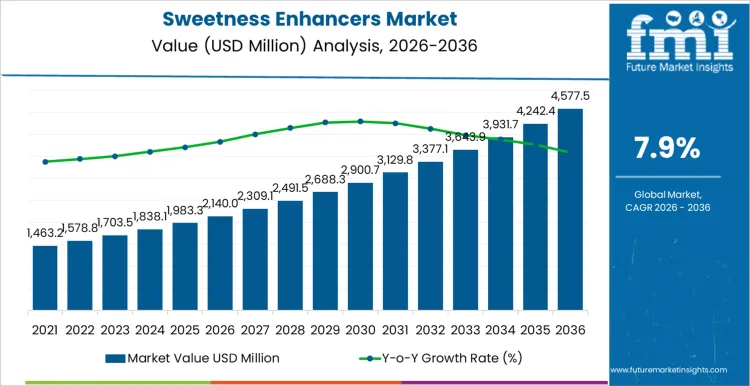
Sweetness Enhancers Market Key Takeaways
| Metric | Value |
|---|---|
| Market Value (2026) | USD 2,140.0 million |
| Market Forecast Value (2036) | USD 4,577.5 million |
| Forecast CAGR 2026 to 2036 | 7.9% |
Why is the Demand for Sweetness Enhancers Growing?
Demand for sweetness enhancers is increasing as food and beverage manufacturers respond to widespread initiatives aimed at reducing added sugar content in products while maintaining desirable taste profiles. Reformulation efforts in categories such as beverages, dairy snacks, confectionery and baked goods rely on sweetness enhancers to strengthen perceived sweetness without contributing significant calories. This need is intensified by public health guidelines and labeling frameworks that draw consumer attention to sugar levels and encourage lower sugar options. Beverage developers launch reduced sugar variants that depend on enhancer technologies to sustain familiar flavor experiences in carbonated and still drinks. Snack and dairy formulators apply sweetness enhancers to balance taste when sugar reduction exposes underlying flavors that may be flat or off-putting.
Demand from functional food and nutraceutical segments supports market growth because many high protein and fortified products carry inherent bitterness or muted sweetness due to their base ingredients. Sweetness enhancers help align sensory attributes with consumer expectations in products that emphasize health benefits, contributing to repeat purchase behavior. Ingredient specialists innovate enhancer chemistries that perform reliably across temperature, pH and processing conditions typical of industrial food production. Sensory professionals conduct rigorous flavor mapping to determine optimal application levels that match texture and mouthfeel goals in diverse formulations.
How Is the Sweetness Enhancers Industry Segmented by Product Type, Application, and Form?
Demand for sweetness enhancers is driven by sugar reduction mandates, calorie control objectives, and taste optimization requirements across food and health-focused formulations. Manufacturers evaluate enhancer performance based on sweetness amplification efficiency, aftertaste profile, and formulation compatibility. Adoption varies by product category depending on processing temperature, pH stability, and labeling expectations. Utilization also reflects reformulation activity in beverages, bakery, and dairy categories. Segmentation explains how enhancer type, end-use application, and physical format influence integration across formulation and production environments.
Which Product Type Holds the Largest Share in Sweetness Enhancers?
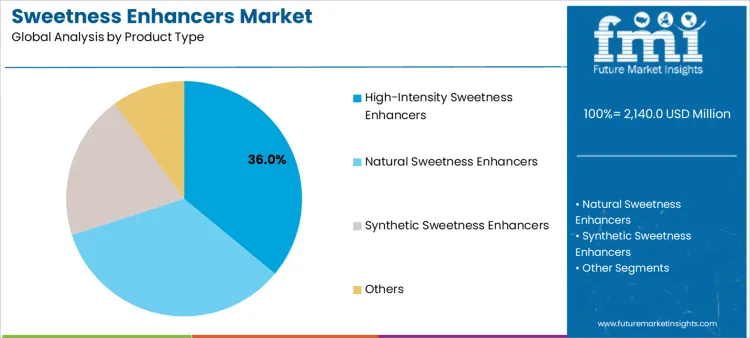
High-intensity sweetness enhancers hold 36.0%, reflecting their effectiveness at low inclusion levels in sugar-reduced formulations. These enhancers amplify perceived sweetness without directly contributing bulk or calories. Natural sweetness enhancers at 34.0% are selected where clean-label positioning and plant-based sourcing influence formulation strategy. Synthetic sweetness enhancers account for 20.0%, supporting cost efficiency and consistent performance across large-scale production. Other enhancer types at 10.0% address niche sensory challenges and specialized formulations. Product-type segmentation indicates balanced demand between performance-driven solutions and label-conscious alternatives.
Key Points
- High-intensity enhancers support low-dosage sweetness amplification.
- Natural options align with clean-label formulation priorities.
- Synthetic enhancers deliver cost and performance consistency.
How Do Application Areas Shape Demand for Sweetness Enhancers?
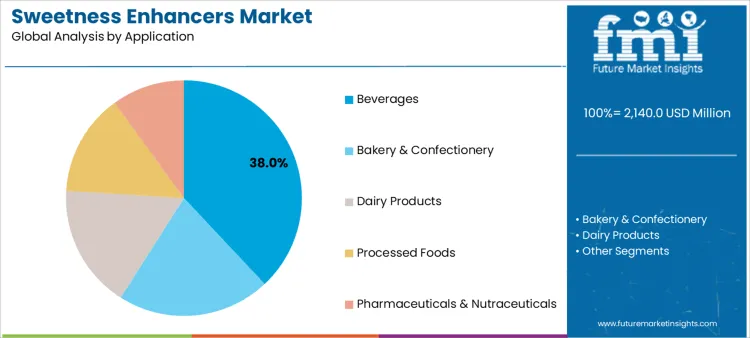
Beverages represent 38.0%, driven by reformulation of soft drinks, flavored waters, and functional beverages targeting reduced sugar content. Bakery and confectionery applications at 21.0% require enhancers that withstand thermal processing while maintaining sweetness perception. Dairy products account for 17.0%, focusing on flavor balance in yogurts and flavored milk. Processed foods at 14.0% apply enhancers to sauces, snacks, and ready meals. Pharmaceuticals and nutraceuticals at 10.0% use enhancers to improve palatability of bitter actives. Application segmentation highlights stronger adoption where sweetness perception directly affects consumer acceptance.
Key Points
- Beverages lead due to aggressive sugar reduction activity.
- Bakery formulations require heat-stable sweetness enhancement.
- Health products prioritize palatability improvement.
Which Form Is Most Commonly Used for Sweetness Enhancers?
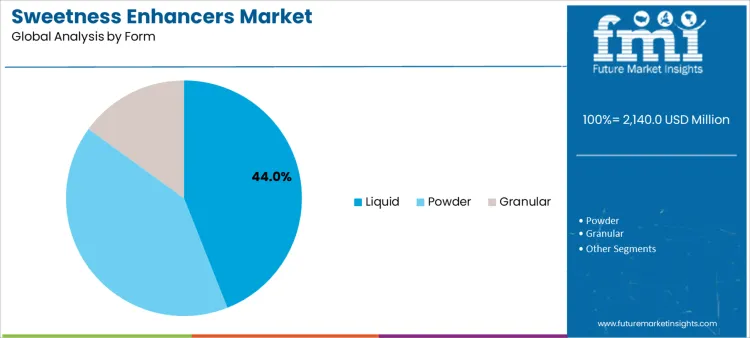
Liquid forms account for 44.0%, reflecting ease of dosing, rapid dispersion, and suitability for beverage and liquid systems. These formats support precise sweetness adjustment during processing. Powder forms represent 41.0%, favored for dry mixes, bakery applications, and shelf-stable products. Granular forms at 15.0% are applied where controlled handling or release characteristics are required. Form-based segmentation shows selection driven by manufacturing process, dosing accuracy, and storage considerations across different production environments.
Key Points
- Liquids enable precise control in beverage processing.
- Powders support dry and baked product applications.
- Granular formats serve specialized formulation needs.
What are the Key Dynamics in the Sweetness Enhancers Market?
Demand in the sweetness enhancers market is shaped by food and beverage manufacturers’ efforts to improve perceived sweetness while lowering added sugar content. Market activity is concentrated in applications such as carbonated drinks, confectionery, dairy desserts, and reduced-calorie snacks, where sensory quality directly affects consumer acceptance. Value derives from the ability of enhancers to amplify sweetness intensity without substantial caloric impact or undesirable taste effects. Ingredient selection, supplier reliability, and formulation compatibility influence procurement decisions in product lines that aim to balance taste with nutritional positioning.
How do sugar reduction initiatives and sensory expectations shape adoption?
Demand for sweetness enhancers grows where formulators face challenges in reformulating products with lower sugar while maintaining the expected level of sweetness and mouthfeel. Beverage producers aiming to reduce sugar content often pair sweetness enhancers with high-intensity sweeteners to achieve target flavor profiles without creating off-tastes. In dairy and confectionery applications, sweetness enhancers support retention of familiar flavor attributes when traditional sugar levels are reduced, helping maintain product equity with consumers. Manufacturers addressing consumer trends toward better-for-you products rely on enhancers that perform consistently across temperature ranges and pH conditions common to processing and storage. Formulators evaluate sweetness intensity, onset, and lingering perception of enhancers to ensure alignment with product positioning, especially in segments where taste drives repeat purchase behavior.
How do regulatory frameworks and application constraints influence market scalability?
Market scalability is influenced by regulatory frameworks that govern the approval, permitted use levels, and labeling requirements of sweetness enhancers across regions and product categories. Differences in regulatory acceptance for certain enhancer chemistries require manufacturers to adjust formulations for specific markets, affecting global product strategy. Technical constraints such as interactions with other ingredients, sensitivity to processing conditions, or potential aftertaste effects can limit use in certain matrices, necessitating trial work to achieve acceptable sensory outcomes. Cost pressure arises when multi-component strategies are needed to balance sweetness quality with label requirements, affecting price points in competitive categories. Sensory testing requirements add development time and resource expenditure, shaping decisions about where and how extensively to apply sweetness enhancers in reformulated products.
How Is Demand for the Sweetness Enhancers Market Evolving Globally?
Global demand for sweetness enhancers is rising as food and beverage manufacturers pursue sugar reduction without compromising sweetness intensity or onset. Growth reflects reformulation pressure across beverages, confectionery, dairy, and functional nutrition categories. Ingredient strategies increasingly rely on enhancers to improve efficiency of high-intensity sweeteners and manage cost volatility. Demand expansion aligns with regulatory focus on added sugars and portfolio-wide taste consistency goals. India records 9.4% CAGR, China records 9.1% CAGR, Brazil records 8.7% CAGR, USA records 7.6% CAGR, and UK records 7.4% CAGR. Adoption remains driven by reformulation depth rather than finished food volume growth.
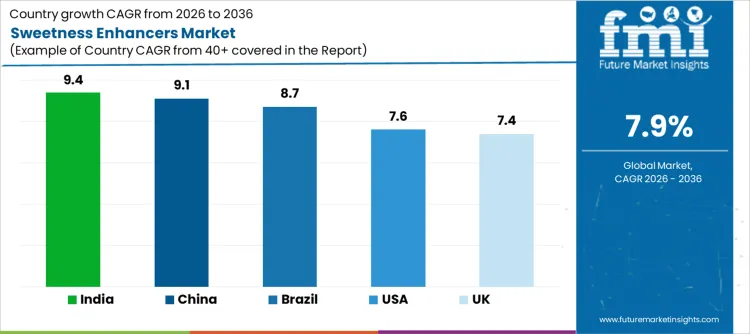
| Country | CAGR (%) |
|---|---|
| India | 9.4% |
| China | 9.1% |
| Brazil | 8.7% |
| USA | 7.6% |
| UK | 7.4% |
What is driving growth of sweetness enhancers demand in India?
Demand for sweetness enhancers in India is expanding as packaged food, beverage, and nutraceutical producers accelerate sugar reduction programs. Growth at 9.4% CAGR reflects high reformulation activity in beverages, flavored dairy, syrups, and fortified foods. Cost sensitivity encourages use of enhancers that improve sweetness perception at lower sweetener dosages. Stevia, sucralose, and aspartame systems require enhancers to address delayed onset and lingering bitterness. Urban consumption patterns and health positioning increase reliance on sweetness optimization rather than sweetness replacement. Domestic formulation centers prioritize enhancers compatible with heat processing and mass-market pricing structures.
- High reformulation intensity in beverages
- Cost optimization of sweetener systems
- Rising use of stevia-based blends
- Growth of fortified and nutraceutical foods
Why is China seeing expansion in sweetness enhancers adoption?
Sweetness enhancers demand in China is rising as large food processors reformulate products aligned with national sugar intake guidance. Growth at 9.1% CAGR reflects strong activity across ready-to-drink beverages, yogurt, and nutritional drinks. High-volume manufacturing requires enhancers that deliver consistent sweetness perception across production batches. Usage increases where high-intensity sweeteners create flat or metallic taste profiles. Domestic ingredient suppliers scale enhancer technologies for beverage and dairy applications. Demand concentration remains within industrial food processing rather than artisanal segments, supported by centralized manufacturing and modern retail distribution.
- Sugar intake guidance compliance
- High-volume beverage reformulation
- Industrial consistency requirements
- Expansion of functional dairy products
What factors are shaping sweetness enhancers sales in Brazil?
Sales of sweetness enhancers in Brazil are increasing as manufacturers respond to nutrition labeling and sugar disclosure rules. Growth at 8.7% CAGR reflects reformulation across carbonated drinks, juices, and powdered beverage mixes. Tropical flavor systems require enhancers to maintain sweetness intensity under reduced sugar conditions. Local producers focus on mouthfeel preservation and sweetness roundness to protect consumer acceptance. Demand remains strongest in mass-market beverages serving price-sensitive consumers. Enhancer selection emphasizes compatibility with regional flavor profiles and shelf-stable formulations.
- Nutrition labeling driven reformulation
- High dependence on beverage categories
- Preservation of sweetness intensity
- Mass-market taste acceptance focus
How is the USA supporting growth of sweetness enhancers demand?
Sweetness enhancers market demand in the USA is advancing as manufacturers execute portfolio-wide sugar reduction strategies. Growth at 7.6% CAGR reflects widespread use in soft drinks, snacks, protein beverages, and functional nutrition products. Enhancers improve sweetness efficiency of stevia, monk fruit, and blended sweetener systems. Regulatory emphasis on added sugar disclosure shapes ingredient selection. Large brands prioritize enhancers that protect established flavor profiles during reformulation. Demand remains driven by brand risk management and taste consistency across reformulated SKUs.
- Added sugar disclosure influence
- High adoption of natural sweeteners
- Large-scale reformulation programs
- Focus on flavor profile preservation
What is driving expansion of sweetness enhancers demand in the UK?
Demand for sweetness enhancers in the UK is rising as sugar taxation and public health frameworks reshape formulation strategies. Growth at 7.4% CAGR reflects sustained reformulation across beverages, bakery, and dairy alternatives. Enhancers enable sugar reduction while maintaining sweetness onset and balance. Retailer nutritional standards accelerate adoption across private label and branded products. Ingredient selection emphasizes regulatory approval and clean label compatibility. Demand remains linked to compliance-driven reformulation cycles rather than changes in consumption volumes.
- Sugar levy compliance pressure
- Retail nutritional standard enforcement
- Expansion of dairy alternative products
- Clean label formulation requirements
What is the competitive landscape of demand for the sweetness enhancers market globally?
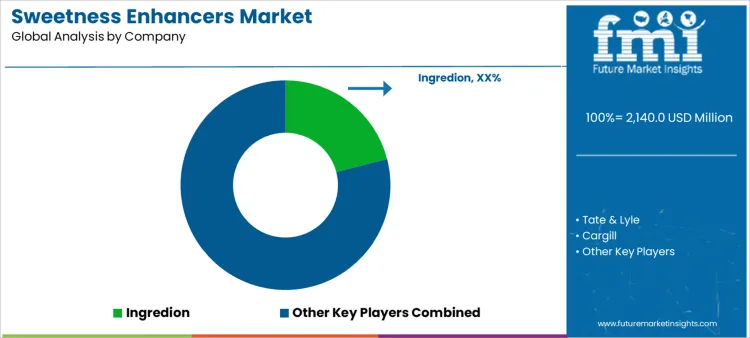
Demand for sweetness enhancers is shaped by sugar reduction targets, calorie labeling pressure, and taste parity requirements. Food and beverage formulators assess enhancement efficiency, temporal sweetness profile control, stability across processing conditions, and interaction with high-intensity sweeteners. Buyer assessment includes clean label positioning, regulatory clearance across regions, dosage efficiency, and performance consistency in beverages, dairy, and bakery products. Procurement behavior reflects long-term reformulation programs, reliance on application laboratories, and preference for suppliers supporting sensory validation. Trend in the sweetness enhancers market reflects accelerated reformulation activity as manufacturers seek sweetness recovery without increasing sugar content.
Ingredion leads competitive positioning through sweetness enhancer systems integrated with starches and specialty carbohydrates for formulation flexibility. Tate and Lyle competes by supplying enhancers aligned with fiber-based and reduced-sugar formulation strategies. Cargill supports demand by combining sweetness enhancement with texture and flavor systems across packaged food portfolios. ADM maintains relevance through formulation expertise and broad customer relationships in global food manufacturing. DSM-Firmenich participates with sweetness technologies supported by sensory science and co-development capabilities. Competitive differentiation centers on sensory reliability, regulatory coverage, formulation adaptability, and depth of technical collaboration with product developers.
Key Players in the Sweetness Enhancers Market
- Ingredion
- Tate & Lyle
- Cargill
- ADM
- DSM-Firmenich
- Others
Scope of the Report
| Items | Values |
|---|---|
| Quantitative Units | USD million |
| Product Type | High-Intensity Sweetness Enhancers; Natural Sweetness Enhancers; Synthetic Sweetness Enhancers; Others |
| Application | Beverages; Bakery & Confectionery; Dairy Products; Processed Foods; Pharmaceuticals & Nutraceuticals |
| Form | Liquid; Powder; Granular |
| Regions Covered | Asia Pacific, Europe, North America, Latin America, Middle East & Africa |
| Countries Covered | India, China, Brazil, USA, UK, and 40+ countries |
| Key Companies Profiled | Ingredion; Tate & Lyle; Cargill; ADM; DSM-Firmenich; Others |
| Additional Attributes | Dollar sales by product type, application, and form; sweetness amplification efficiency enabling sugar reduction without sensory trade-offs; interaction with bulk sweeteners and flavor systems across beverage, dairy, and bakery matrices; stability and solubility performance in liquid and dry formulations; regulatory acceptance and clean-label positioning shaping formulation strategies; procurement dynamics driven by large-scale food processing demand and long-term supplier collaborations. |
Sweetness Enhancers Market by Segment
Product Type:
- High-Intensity Sweetness Enhancers
- Natural Sweetness Enhancers
- Synthetic Sweetness Enhancers
- Others
Application:
- Beverages
- Bakery & Confectionery
- Dairy Products
- Processed Foods
- Pharmaceuticals & Nutraceuticals
Form:
- Liquid
- Powder
- Granular
Region:
- Asia Pacific
- China
- Japan
- South Korea
- India
- Australia & New Zealand
- ASEAN
- Rest of Asia Pacific
- Europe
- Germany
- United Kingdom
- France
- Italy
- Spain
- Nordic
- BENELUX
- Rest of Europe
- North America
- United States
- Canada
- Mexico
- Latin America
- Brazil
- Chile
- Rest of Latin America
- Middle East & Africa
- Kingdom of Saudi Arabia
- Other GCC Countries
- Turkey
- South Africa
- Other African Union
- Rest of Middle East & Africa
Bibliography
- World Health Organization. (2023). Guideline on non-sugar sweeteners: Public health relevance, sensory impact, and reformulation implications. World Health Organization.
- Food and Agriculture Organization of the United Nations. (2023). Food reformulation strategies: Use of sweeteners, sweetness enhancers, and flavour modifiers. Food and Agriculture Organization of the United Nations.
- Codex Alimentarius Commission. (2023). General Standard for Food Additives (GSFA): Provisions applicable to sweeteners and flavour-enhancing substances. FAO/WHO.
- United States Food and Drug Administration. (2024). Food additive regulatory status of sweeteners and sweetness-enhancing ingredients. U.S. Department of Health and Human Services.
- European Commission. (2024). Guidance on the application of EU food law to sweeteners and sweetness-enhancing ingredients in reduced-sugar foods. European Union.
- International Organization for Standardization. (2023). ISO 5492: Sensory analysis – Vocabulary. ISO.
Frequently Asked Questions
How big is the sweetness enhancers market in 2026?
The global sweetness enhancers market is estimated to be valued at USD 2,140.0 million in 2026.
What will be the size of sweetness enhancers market in 2036?
The market size for the sweetness enhancers market is projected to reach USD 4,577.5 million by 2036.
How much will be the sweetness enhancers market growth between 2026 and 2036?
The sweetness enhancers market is expected to grow at a 7.9% CAGR between 2026 and 2036.
What are the key product types in the sweetness enhancers market?
The key product types in sweetness enhancers market are high-intensity sweetness enhancers, natural sweetness enhancers, synthetic sweetness enhancers and others.
Which application segment to contribute significant share in the sweetness enhancers market in 2026?
In terms of application, beverages segment to command 38.0% share in the sweetness enhancers market in 2026.
Preview the report firsthand - request a free sample
Get SampleGet the brochure for pricing and purchase details.
Get PDFTable of Content
- Executive Summary
- Global Market Outlook
- Demand-side Trends
- Supply-side Trends
- Technology Roadmap Analysis
- Analysis and Recommendations
- Market Overview
- Market Coverage / Taxonomy
- Market Definition / Scope / Limitations
- Market Background
- Market Dynamics
- Drivers
- Restraints
- Opportunity
- Trends
- Scenario Forecast
- Demand in Optimistic Scenario
- Demand in Likely Scenario
- Demand in Conservative Scenario
- Opportunity Map Analysis
- Product Life Cycle Analysis
- Supply Chain Analysis
- Investment Feasibility Matrix
- Value Chain Analysis
- PESTLE and Porter’s Analysis
- Regulatory Landscape
- Regional Parent Market Outlook
- Production and Consumption Statistics
- Import and Export Statistics
- Market Dynamics
- Global Market Analysis 2021 to 2025 and Forecast, 2026 to 2036
- Historical Market Size Value (USD Million) Analysis, 2021 to 2025
- Current and Future Market Size Value (USD Million) Projections, 2026 to 2036
- Y-o-Y Growth Trend Analysis
- Absolute $ Opportunity Analysis
- Global Market Pricing Analysis 2021 to 2025 and Forecast 2026 to 2036
- Global Market Analysis 2021 to 2025 and Forecast 2026 to 2036, By Product Type
- Introduction / Key Findings
- Historical Market Size Value (USD Million) Analysis By Product Type , 2021 to 2025
- Current and Future Market Size Value (USD Million) Analysis and Forecast By Product Type , 2026 to 2036
- High-Intensity Sweetness Enhancers
- Natural Sweetness Enhancers
- Synthetic Sweetness Enhancers
- Others
- High-Intensity Sweetness Enhancers
- Y-o-Y Growth Trend Analysis By Product Type , 2021 to 2025
- Absolute $ Opportunity Analysis By Product Type , 2026 to 2036
- Global Market Analysis 2021 to 2025 and Forecast 2026 to 2036, By Application
- Introduction / Key Findings
- Historical Market Size Value (USD Million) Analysis By Application, 2021 to 2025
- Current and Future Market Size Value (USD Million) Analysis and Forecast By Application, 2026 to 2036
- Beverages
- Bakery & Confectionery
- Dairy Products
- Processed Foods
- Pharmaceuticals & Nutraceuticals
- Beverages
- Y-o-Y Growth Trend Analysis By Application, 2021 to 2025
- Absolute $ Opportunity Analysis By Application, 2026 to 2036
- Global Market Analysis 2021 to 2025 and Forecast 2026 to 2036, By Form
- Introduction / Key Findings
- Historical Market Size Value (USD Million) Analysis By Form, 2021 to 2025
- Current and Future Market Size Value (USD Million) Analysis and Forecast By Form, 2026 to 2036
- Liquid
- Powder
- Granular
- Liquid
- Y-o-Y Growth Trend Analysis By Form, 2021 to 2025
- Absolute $ Opportunity Analysis By Form, 2026 to 2036
- Global Market Analysis 2021 to 2025 and Forecast 2026 to 2036, By Region
- Introduction
- Historical Market Size Value (USD Million) Analysis By Region, 2021 to 2025
- Current Market Size Value (USD Million) Analysis and Forecast By Region, 2026 to 2036
- North America
- Latin America
- Western Europe
- Eastern Europe
- East Asia
- South Asia and Pacific
- Middle East & Africa
- Market Attractiveness Analysis By Region
- North America Market Analysis 2021 to 2025 and Forecast 2026 to 2036, By Country
- Historical Market Size Value (USD Million) Trend Analysis By Market Taxonomy, 2021 to 2025
- Market Size Value (USD Million) Forecast By Market Taxonomy, 2026 to 2036
- By Country
- USA
- Canada
- Mexico
- By Product Type
- By Application
- By Form
- By Country
- Market Attractiveness Analysis
- By Country
- By Product Type
- By Application
- By Form
- Key Takeaways
- Latin America Market Analysis 2021 to 2025 and Forecast 2026 to 2036, By Country
- Historical Market Size Value (USD Million) Trend Analysis By Market Taxonomy, 2021 to 2025
- Market Size Value (USD Million) Forecast By Market Taxonomy, 2026 to 2036
- By Country
- Brazil
- Chile
- Rest of Latin America
- By Product Type
- By Application
- By Form
- By Country
- Market Attractiveness Analysis
- By Country
- By Product Type
- By Application
- By Form
- Key Takeaways
- Western Europe Market Analysis 2021 to 2025 and Forecast 2026 to 2036, By Country
- Historical Market Size Value (USD Million) Trend Analysis By Market Taxonomy, 2021 to 2025
- Market Size Value (USD Million) Forecast By Market Taxonomy, 2026 to 2036
- By Country
- Germany
- UK
- Italy
- Spain
- France
- Nordic
- BENELUX
- Rest of Western Europe
- By Product Type
- By Application
- By Form
- By Country
- Market Attractiveness Analysis
- By Country
- By Product Type
- By Application
- By Form
- Key Takeaways
- Eastern Europe Market Analysis 2021 to 2025 and Forecast 2026 to 2036, By Country
- Historical Market Size Value (USD Million) Trend Analysis By Market Taxonomy, 2021 to 2025
- Market Size Value (USD Million) Forecast By Market Taxonomy, 2026 to 2036
- By Country
- Russia
- Poland
- Hungary
- Balkan & Baltic
- Rest of Eastern Europe
- By Product Type
- By Application
- By Form
- By Country
- Market Attractiveness Analysis
- By Country
- By Product Type
- By Application
- By Form
- Key Takeaways
- East Asia Market Analysis 2021 to 2025 and Forecast 2026 to 2036, By Country
- Historical Market Size Value (USD Million) Trend Analysis By Market Taxonomy, 2021 to 2025
- Market Size Value (USD Million) Forecast By Market Taxonomy, 2026 to 2036
- By Country
- China
- Japan
- South Korea
- By Product Type
- By Application
- By Form
- By Country
- Market Attractiveness Analysis
- By Country
- By Product Type
- By Application
- By Form
- Key Takeaways
- South Asia and Pacific Market Analysis 2021 to 2025 and Forecast 2026 to 2036, By Country
- Historical Market Size Value (USD Million) Trend Analysis By Market Taxonomy, 2021 to 2025
- Market Size Value (USD Million) Forecast By Market Taxonomy, 2026 to 2036
- By Country
- India
- ASEAN
- Australia & New Zealand
- Rest of South Asia and Pacific
- By Product Type
- By Application
- By Form
- By Country
- Market Attractiveness Analysis
- By Country
- By Product Type
- By Application
- By Form
- Key Takeaways
- Middle East & Africa Market Analysis 2021 to 2025 and Forecast 2026 to 2036, By Country
- Historical Market Size Value (USD Million) Trend Analysis By Market Taxonomy, 2021 to 2025
- Market Size Value (USD Million) Forecast By Market Taxonomy, 2026 to 2036
- By Country
- Kingdom of Saudi Arabia
- Other GCC Countries
- Turkiye
- South Africa
- Other African Union
- Rest of Middle East & Africa
- By Product Type
- By Application
- By Form
- By Country
- Market Attractiveness Analysis
- By Country
- By Product Type
- By Application
- By Form
- Key Takeaways
- Key Countries Market Analysis
- USA
- Pricing Analysis
- Market Share Analysis, 2025
- By Product Type
- By Application
- By Form
- Canada
- Pricing Analysis
- Market Share Analysis, 2025
- By Product Type
- By Application
- By Form
- Mexico
- Pricing Analysis
- Market Share Analysis, 2025
- By Product Type
- By Application
- By Form
- Brazil
- Pricing Analysis
- Market Share Analysis, 2025
- By Product Type
- By Application
- By Form
- Chile
- Pricing Analysis
- Market Share Analysis, 2025
- By Product Type
- By Application
- By Form
- Germany
- Pricing Analysis
- Market Share Analysis, 2025
- By Product Type
- By Application
- By Form
- UK
- Pricing Analysis
- Market Share Analysis, 2025
- By Product Type
- By Application
- By Form
- Italy
- Pricing Analysis
- Market Share Analysis, 2025
- By Product Type
- By Application
- By Form
- Spain
- Pricing Analysis
- Market Share Analysis, 2025
- By Product Type
- By Application
- By Form
- France
- Pricing Analysis
- Market Share Analysis, 2025
- By Product Type
- By Application
- By Form
- India
- Pricing Analysis
- Market Share Analysis, 2025
- By Product Type
- By Application
- By Form
- ASEAN
- Pricing Analysis
- Market Share Analysis, 2025
- By Product Type
- By Application
- By Form
- Australia & New Zealand
- Pricing Analysis
- Market Share Analysis, 2025
- By Product Type
- By Application
- By Form
- China
- Pricing Analysis
- Market Share Analysis, 2025
- By Product Type
- By Application
- By Form
- Japan
- Pricing Analysis
- Market Share Analysis, 2025
- By Product Type
- By Application
- By Form
- South Korea
- Pricing Analysis
- Market Share Analysis, 2025
- By Product Type
- By Application
- By Form
- Russia
- Pricing Analysis
- Market Share Analysis, 2025
- By Product Type
- By Application
- By Form
- Poland
- Pricing Analysis
- Market Share Analysis, 2025
- By Product Type
- By Application
- By Form
- Hungary
- Pricing Analysis
- Market Share Analysis, 2025
- By Product Type
- By Application
- By Form
- Kingdom of Saudi Arabia
- Pricing Analysis
- Market Share Analysis, 2025
- By Product Type
- By Application
- By Form
- Turkiye
- Pricing Analysis
- Market Share Analysis, 2025
- By Product Type
- By Application
- By Form
- South Africa
- Pricing Analysis
- Market Share Analysis, 2025
- By Product Type
- By Application
- By Form
- USA
- Market Structure Analysis
- Competition Dashboard
- Competition Benchmarking
- Market Share Analysis of Top Players
- By Regional
- By Product Type
- By Application
- By Form
- Competition Analysis
- Competition Deep Dive
- Ingredion
- Overview
- Product Portfolio
- Profitability by Market Segments (Product/Age /Sales Channel/Region)
- Sales Footprint
- Strategy Overview
- Marketing Strategy
- Product Strategy
- Channel Strategy
- Tate & Lyle
- Cargill
- ADM
- DSM-Firmenich
- Others
- Ingredion
- Competition Deep Dive
- Assumptions & Acronyms Used
- Research Methodology


