

- Industry Size (2026)
- USD 4.0 Bn
- Forecast (2036)
- USD 5.9 Bn
- CAGR (2026 to 2036)
- 3.80%
Feed Palatability Enhancers Market Size, Market Forecast and Outlook By FMI
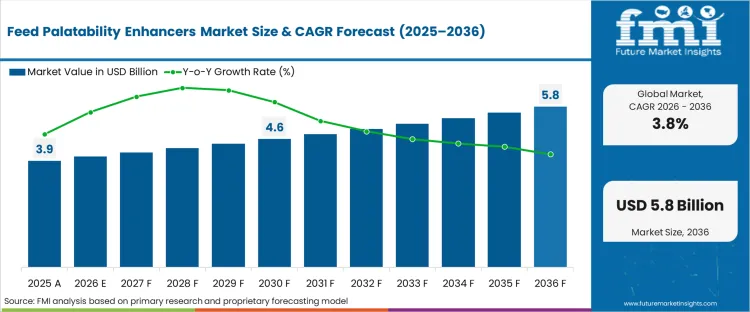
The feed palatability enhancers market was valued at USD 3.8 billion in 2025. The industry is set to reach USD 4.0 billion in 2026 at a CAGR of 3.80% during the forecast period. Sustained investment propels the total valuation to USD 5.9 billion through 2036 as livestock producers transition from volume-based feeding to metabolic efficiency models that require guaranteed voluntary feed intake.
Livestock producers are currently being forced to decide between maintaining traditional high-inclusion rations or adopting precision nutrition systems that rely on sensory triggers to overcome the bitterness of functional additives. This shift is about the commercial stakes of early weaning and metabolic recovery in high-output animals. Delaying the integration of animal feed additives leads to inconsistent daily gain and higher susceptibility to weaning stress, which erodes the margin benefits of specialty feed. FMI analysis suggests that the sensory environment of the trough is becoming as critical as the nutrient density of the pellet in modern precision farming.
Summary of Feed Palatability Enhancers Market
- Market Definition:
- Feed palatability enhancers are sensory agents that modify the olfactory and gustatory characteristics of animal feed to ensure maximum intake and overcome animal neophobia.
- Demand Drivers in the Market:
- High-protein metabolic demands force commercial swine producers to include bitter-tasting functional amino acids that require flavor masking.
- The increasing global pet population and humanization trend drive pet food manufacturers to invest in premium aromatic profiles.
- Rising pressure on antibiotic reduction obligates veterinarians to use palatable additives to ensure sick animals consume medicated water or feed consistently.
- Key Segments Analyzed in the FMI Report:
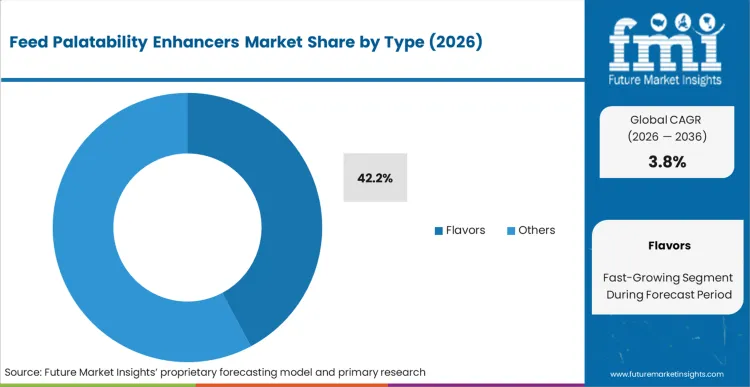
- Flavors: Projected to hold 42.2% share in 2026, flavors provide the primary masking mechanism for plant-based proteins in swine and poultry diets.
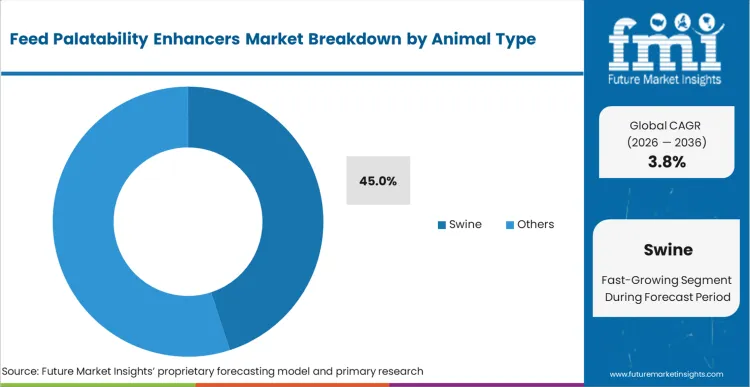
- Swine: Expected to lead by animal type through 2036, driven by the critical need for intake stabilization during post-weaning transitions.
- Natural Sources: Gaining share as regulatory scrutiny on synthetic additives increases in mature Western markets.
- China: Tracks 5.4% CAGR, reflecting the rapid industrialization of its domestic pork production sector.
- Analyst Opinion at FMI:
- Nandini Roy Choudhury, Principal Analyst, Food and Beverage, at FMI, opines, "The market is moving past the sugar-and-spice era and into a phase of neuro-nutrition. We are seeing a practitioner paradox where producers believe any sweetener will work, but the reality is that the neuro-sensory feedback loop in a lactating sow is highly specific. The true value lies not in making feed taste good, but in using flavor as a metabolic signal that primes the animal's digestive system before the first bite is even swallowed."
- Strategic Implications / Executive Takeaways:
- Integrations and feed mills must prioritize heat-stable encapsulation technologies to ensure aroma profiles survive the pelleting process.
- Specialty additive formulators should develop species-specific umami profiles for aquaculture to support the transition toward fishmeal alternatives.
- Procurement directors face a tightening supply of natural extracts, requiring long-term sourcing agreements to maintain clean label status in premium pet food lines.
- Methodology:
- Primary Research: Interviews with senior nutritionists and livestock operations heads to map decision-making pathways.
- Data Foundations: Anchored to global compound feed tonnage and species-specific intake models.
- Validation: Cross-referenced with the financial filings of major animal nutrition players.
- Update: Iterative modeling based on regional livestock inventory shifts and regulatory changes.
The structural gate for this market is the widespread adoption of least-cost formulation software that accounts for intake variability. Once nutritionists can reliably model the correlation between specific aroma profiles and neuro-sensory feedback loops, the next unit of adoption becomes significantly easier. This transition is being triggered by large-scale commercial integrations that view intake as a controllable variable rather than a biological uncertainty, shifting the sensory additives category from a luxury corrective to a baseline optimization tool.
China is set to expand at 5.4% compound, followed by India at 5.1%, while Brazil and the United States are projected to register 4.4% and 3.8% respectively. Germany is anticipated to track 2.9%, with the United Kingdom at 2.4% and Japan garnering 2.1%. This geographic divergence reflects a transition where emerging markets focus on basic intake stabilization for expanding swine herds, whereas mature markets prioritize aromatic complexity to facilitate high-protein, functional diets.
Feed Palatability Enhancers Market Key Takeaways
| Metric | Details |
|---|---|
| Industry Size (2026) | USD 4.0 billion |
| Industry Value (2036) | USD 5.9 billion |
| CAGR (2026-2036) | 3.80% |
Source: Future Market Insights (FMI) analysis, based on proprietary forecasting model and primary research
Feed Palatability Enhancers Market Definition
The feed palatability enhancers market comprises sensory additives designed to improve the taste, smell, and overall appeal of animal feed. These substances are structurally necessary to mask the unpleasant flavors of essential minerals, medications, and bypass proteins that animals would otherwise reject. By stimulating the trigeminal and olfactory systems, these enhancers ensure consistent voluntary consumption, which is the foundational requirement for predictable animal growth and health.
Feed Palatability Enhancers Market Inclusions
This market includes chemical and natural flavoring agents, high-intensity sweeteners, and aromatic masking agents. Also included are feed attractants formulated for specific species, such as fruit-based flavors for swine and umami profiles for aquaculture. The scope covers various delivery formats including powders, liquids, and encapsulated granules designed to survive the high-temperature pelleting process.
Feed Palatability Enhancers Market Exclusions
The market excludes base nutritional components like grains and oilseeds, as well as purely functional additives such as enzymes, probiotics, or vitamins that do not possess sensory-enhancing properties. Furthermore, human-grade food flavorings and wild animal attractants are outside the scope. These exclusions are maintained because the regulatory pathways and stability requirements for livestock feed additives differ fundamentally from human food segments.
Feed Palatability Enhancers Market Research Methodology
- Primary Research: FMI conducted interviews with Chief Nutritionists at global feed mills, Livestock Production Managers at swine integrations, and R&D Directors at specialty firms.
- Desk Research: Data was aggregated from the European Food Safety Authority (EFSA) additive registries, USDA databases, and global livestock inventory filings.
- Market-Sizing and Forecasting: The baseline anchors to the global compound feed production tonnage, specifically correlating sensory additive inclusion rates with current inventory cycles.
- Data Validation and Update Cycle: Forecasts were cross-validated against financial filings of major animal nutrition companies and triangulated with regional feed mill expansion data.
Segmental Analysis
Feed Palatability Enhancers Market Analysis by Type
The displacement of traditional molasses-based sweeteners is occurring as producers realize simple sweetness cannot mask the metallic bitterness of modern vitamin-mineral premixes. Nutritionists are moving toward advanced feed flavors that offer targeted aromatic masking. FMI analysts opine that feed flavors are no longer optional toppings but are becoming structural components of the diet. This shift is driven by the need to maintain feed intake during environmental stress, such as heat waves, where animals naturally reduce their consumption. The decision to invest in high-fidelity flavor systems is often a hedge against the loss of gain during seasonal fluctuations.
- Flavors (42.2% share): The flavor segment is expected to hold a 42.2% share in 2026, serving as the dominant type due to its critical role in stimulating voluntary consumption through olfactory cues.
- Masking Potency: High-intensity sweeteners provide a baseline of acceptability that allows for the inclusion of low-cost, high-nutrient ingredients that animals would typically reject. Least-cost formulators use this potency to maintain performance while fluctuating ingredient sources.
- Encapsulated Stability: Specialized delivery systems protect delicate aroma molecules from the heat of the pellet mill, ensuring the sensory profile remains intact at the trough. This stability validates the investment during the rigorous manufacturing qualification phase.
Feed Palatability Enhancers Market Analysis by Animal Type
According to FMI's assessment, swine feed enhancers are critical for the economic viability of early-weaning systems. The structural reason swine holds its dominant position comes down to the biological sensitivity of the species and the industrial scale of production. Pigs possess significantly more taste buds than poultry or cattle, making them hyper-sensitive to feed changes. The transition from milk to solid feed is the single most dangerous point in a pig's lifecycle, and palatability enhancers are the primary tool used to navigate this threshold. Large-scale integrations treat intake as a predictable KPI that can be modulated through pet food flavor enhancers or livestock-specific equivalents.
- Swine (Dominant Animal Type): Swine production is expected to lead with a share of 45% by animal type through 2036, as the sector accounts for a significant portion of the total market share due to the hyper-sensitivity of the species.
- Lactation Support: Enhancing the palatability of sow rations during lactation prevents body condition loss and improves subsequent reproductive cycles. The cost economics of this segment originate in the reduction of non-productive sow days across the herd.
- Adoption Sequence: Creep feed and starter pellets require the highest inclusion rates of sweeteners to encourage the earliest possible independent feeding. This sequence begins with the most expensive rations and eventually moves toward grower-finisher diets as margins allow.
Feed Palatability Enhancers Market Analysis by Source
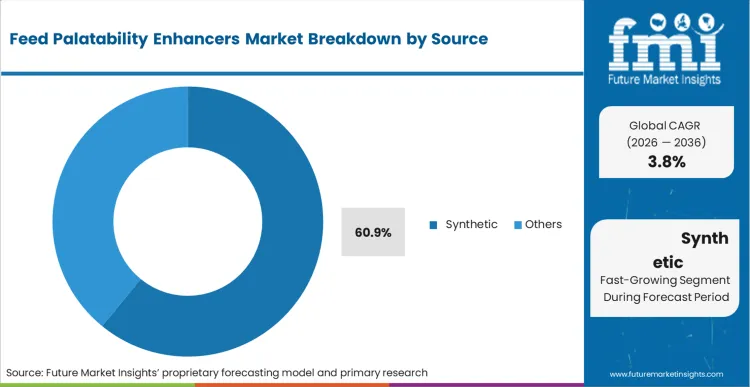
The consequence of tightening regulatory scrutiny on synthetic additives in European markets is a structural pivot toward botanical extracts. While synthetic sources currently dominate the animal feed additives market share analysis, natural-origin palatants are becoming the requirement for premium pet food and organic livestock certifications. Buyers are increasingly forced to evaluate the shelf-stability of essential oils versus the standardized potency of chemical aroma compounds.
- Synthetic (60.9% share): Synthetic sources are projected to account for a 60.9% share in 2026, maintaining dominance due to cost-efficiency and standardized potency required for high-volume commercial feed.
- Regulatory Alignment: Natural sources often benefit from faster approval pathways in mature markets where synthetic sweeteners face safety re-evaluations. This validates the choice for manufacturers aiming for a global product launch.
- Sourcing Resilience: The supply chain for natural extracts is more volatile than industrial chemical synthesis, requiring vendors to maintain deeper raw material reserves. Large integrators mitigate this risk through long-term off-take agreements with botanical producers.
Feed Palatability Enhancers Market Drivers, Restraints, and Opportunities
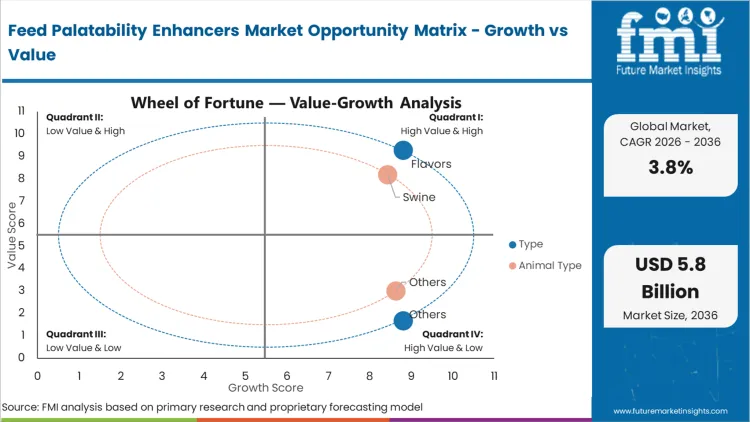
The move toward antibiotic-free production is a major structural driver, as it forces producers to use alternative gut-health additives like organic acids, which are notoriously bitter. To maintain intake, nutritionists must use enhancers to balance the sensory profile. According to FMI's projection, animal nutrition strategies are increasingly centered on nutri-vigilance, where demand for animal feed additives is monitored as an early warning sign of health issues. When feed is consistently palatable, any drop in intake is a clear clinical signal, rather than a reaction to a bad batch of feed.
The primary structural restraint is the length of the internal qualification cycle within large-scale feed integrations. Unlike commodity ingredients, sensory additives require species-specific trials to prove that a change in aroma actually translates to a change in the meat-to-feed ratio. This organizational friction slows adoption even when producers want to move toward premium additives. The barrier is not the cost of the flavor itself, but the labor and facility time required to validate a new sensory profile across thousands of animals without disrupting established production flows.
Opportunities in the Feed Palatability Enhancers Market
- Aquaculture Umami Profiles: The shift toward plant-based fishmeal requires specific savory triggers to entice carnivorous species to consume soy-heavy pellets. Fish farmers who capture this aquafeed additives opportunity can significantly reduce their dependence on fish oil.
- Natural Sweetener Transition: As regulatory bodies move toward restricting certain synthetic sweeteners, a massive opportunity exists for stevia and botanical extracts in premium organic feed lines. Sourcing directors can capture market share by securing these natural supply chains ahead of the competition.
- Heat-stress Aromatics: Designing aroma profiles that remain effective at high ambient temperatures allows producers in tropical climates to maintain herd performance during summer months. This operational outcome clears the bottleneck of seasonal production slumps in emerging markets.
Regional Analysis
Based on the regional analysis, the Feed Palatability Enhancers market is segmented into North America and Latin America, Europe, and Asia Pacific across 40 plus countries.
.webp "Top Country Growth Comparison Feed Palatability Enhancers Market Cagr (2026 2036)")
| Country | CAGR (2026 to 2036) |
|---|---|
| China | 5.4% |
| India | 5.1% |
| Brazil | 4.4% |
| United States | 3.8% |
| Germany | 2.9% |
| United Kingdom | 2.4% |
| Japan | 2.1% |
Source: Future Market Insights (FMI) analysis, based on proprietary forecasting model and primary research
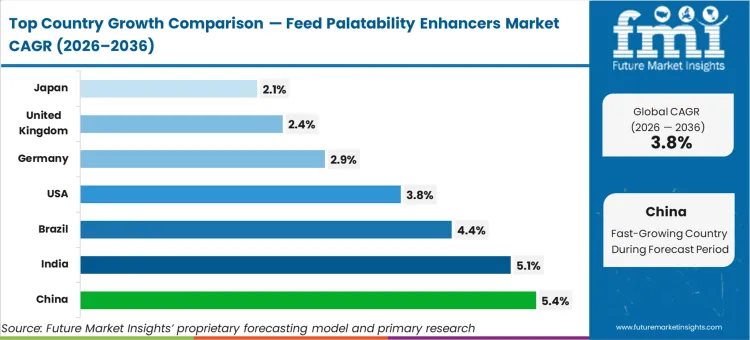
Asia Pacific Feed Palatability Enhancers Market Analysis
High economic growth and a significantly rising demand for animal protein have led to substantial growth in both the livestock and aquaculture industries across the region. FMI analysts suggest that the centralization of pork production in key markets has transformed pet food palatants and livestock additive procurement into a high-volume, strategic decision. This dominance is primarily driven by massive livestock populations and escalating protein needs in expanding economies like China and India. Ongoing government modernization programs, combined with continuous investment in animal nutrition research, ensure the region remains a leader in global sales.
- China: China’s sector is witnessing a 5.4% CAGR through 2036, where the structural shift toward industrialized swine hotels necessitates feed that remains attractive despite long-distance pneumatic transport. Chinese producers who move first capture significant cost-of-gain advantages in a market where margins are under constant pressure from global corn prices.
- India: Growing at a CAGR of 5.1% between 2026 and 2036, India's poultry sector acts as a primary engine of growth as producers shift toward high-quality compound feed. This operational outcome simplifies the management of high-yielding herds and clears metabolic energy deficit bottlenecks in early lactation.
- Japan: Reflecting a specialized focus on the premium pork sector and meat quality manipulation through aromatic profiles, demand for enhancers in Japan is set for a 2.1% CAGR through 2036. This trajectory positions Japanese producers as leaders in high-value, niche sensory nutrition that avoids the commodity race.
FMI's report includes additional coverage of markets such as Vietnam and Thailand. These regions show a structural pattern where the professionalization of the local feed mill industry is pushing the market toward asean animal feed additives that prioritize intake reliability.
North America and Latin America Feed Palatability Enhancers Market Analysis
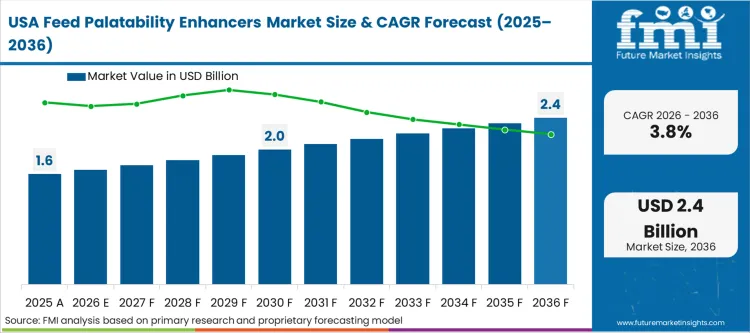
Regional dynamics are heavily influenced by changing dietary patterns and urban migration, leading to increased meat and dairy consumption that requires enhanced feed efficiency. Large-scale poultry and cattle integrations in these regions prioritize data-backed metabolic efficiency over simple intake volume to maintain high productivity. FMI’s assessment indicates that nutritionists here are the most likely to use palatability enhancers as corrective measures for unpalatable by-product ingredients. Rising awareness among pet owners regarding quality products and clean-label chemicals further drives the adoption of premium Latin America aqua feed additives and pet palatants.
- United States: The united states animal feed additives sector is forecast to register a CAGR of 3.8% through 2036, specifically as the cattle industry increases the use of enhancers in backgrounding operations for calves. Procurement practices in the U.S. favor large-volume contracts with established giants that can provide rigorous safety and stability data.
- Brazil: Brazil's poultry and pork sectors benefit from record-level export shipments and abundant domestic grain supplies, registering a CAGR of 4.4% through 2036. Double-cropping practices in central states reduce weather risks and secure grain availability for integrators, reinforcing the country's global competitiveness in protein production.
FMI's report includes additional coverage of markets such as Canada and Mexico. These regions show a structural pattern where pet food premiumization and the industrialization of the beef supply chain are pushing the market toward specialized Latin America animal feed additives for maximum efficiency.
Europe Feed Palatability Enhancers Market Analysis
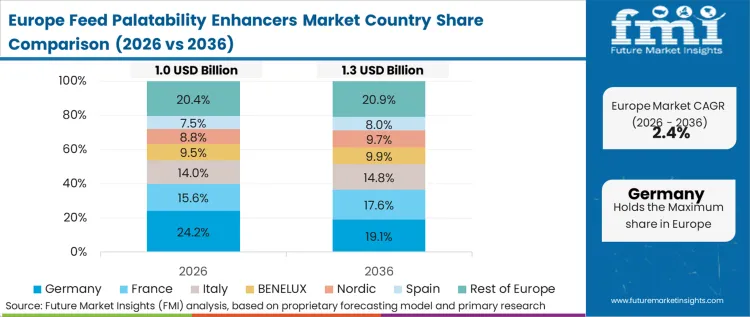
Europe's robust infrastructure and early technology adoption drive the integration of microencapsulation to optimize feed conversion under intensive production models. Stricter regulatory environments and a push for sustainable, clean-label solutions are moving the market toward natural-origin extracts. Structural tailwinds stem from the push for antibiotic-free livestock, which forces producers to maintain intake through sensory appeal rather than pharmaceutical stimulation. As animal welfare concerns rise, European formulators are increasingly turning to specialized Europe aqua feed additives to ensure consistent nutrient uptake.
- Germany: The region prioritizes sustainable ingredients and technological advances in flavor formulation, propelling Germany's market at a 2.9% CAGR through 2036. This adoption reflects a broader Europe animal feed additives shift toward natural-source enhancers to align with increasing consumer preference for transparent food sourcing practices.
- United Kingdom: Sales of enhancers in the uk animal feed additives sector are poised for a 2.4% CAGR between 2026 and 2036, driven by rising demand for high-quality animal protein and urbanization. Increasing awareness among livestock farmers to maximize production yields while reducing feed waste is further promoting market growth in the region.
FMI's report includes additional coverage of markets such as France and Italy. These regions show a structural pattern where pet food humanization and intensifying global demand for protein are pushing the market toward high-fidelity sensory solutions.
Competitive Aligners for Market Players
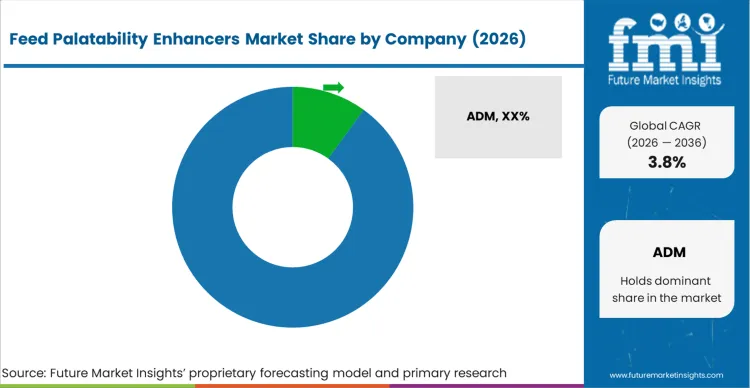
The Feed Palatability Enhancers Market is moderately concentrated, with global nutrition giants holding the majority of IP for high-stability encapsulation. Buyers select vendors primarily based on stability-at-pelleting, the ability of a flavor to survive a 90°C steam-conditioning process without losing its aromatic profile. Leading companies like ADM, Cargill, Kemin Industries, Inc., and Alltech maintain their position not just through chemical variety, but through the technical service teams they embed with feed mills to optimize inclusion rates. Nutreco N.V. and Adisseo further distinguish themselves by integrating sensory additives into broader animal feed additives portfolios, ensuring that palatability supports metabolic performance.
Incumbents hold a significant structural advantage in the form of species-specific sensory libraries that have been validated over decades of clinical trials. For a challenger to replicate this, they must build not just a lab, but a global network of trial farms to prove preference indices across different environmental conditions. Kerry Group, Symrise, and IFF (International Flavors & Fragrances) have used their human food expertise to cross-pollinate into the animal sector, providing a level of aromatic complexity that traditional chemical manufacturers struggle to match. Specialized players like Palital Feed Additives B.V. and Tanke International Group leverage this high-fidelity approach to capture niche segments where species-specific olfactory cues are paramount.
The competitive trajectory toward 2036 is defined by the tension between natural labeling and cost-efficiency. While large integrators like Associated British Foods plc (ABF) prefer the low inclusion rates of synthetic sweeteners, the consumer-facing brands they supply are demanding phytobiotics palatants. This will likely lead to a divergence where the market for pet food and premium organic livestock becomes highly fragmented among specialized extract providers, while the commodity swine and poultry segments remain dominated by the large-scale synthetic manufacturers.
Key Players in Feed Palatability Enhancers Market
- ADM
- Cargill
- Kemin Industries, Inc.
- Kerry Group
- IFF (International Flavors & Fragrances)
- Alltech
- Nutreco N.V.
- Symrise
- Adisseo
- Associated British Foods plc (ABF)
- Palital Feed Additives B.V.
- Tanke International Group
Scope of the Report
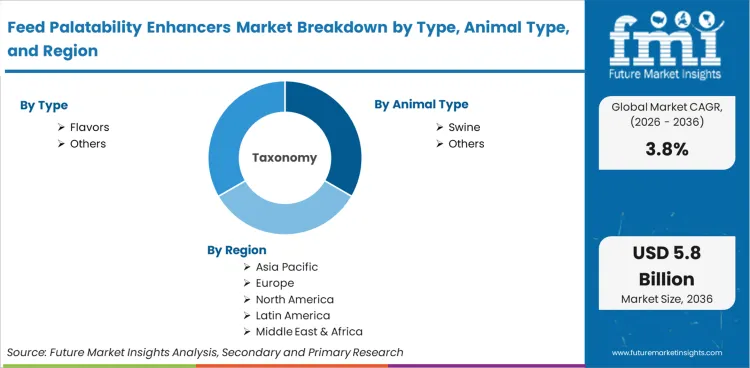
| Metric | Value |
|---|---|
| Quantitative Units | USD 4.0 billion in 2026 to USD 5.9 billion by 2036, at a CAGR of 3.80% |
| Market Definition | The market covers sensory additives including flavors, sweeteners, and aroma enhancers used in commercial animal feed to improve voluntary intake and mask bitter functional ingredients. |
| Type Segmentation | Flavors, Sweeteners, Aroma Enhancers |
| Source Segmentation | Natural, Synthetic |
| Animal Type Segmentation | Swine, Poultry, Cattle, Aquaculture, Pets |
| Regions Covered | North America, Latin America, Europe, East Asia, South Asia, Oceania, Middle East and Africa |
| Countries Covered | China, India, Brazil, United States, Germany, United Kingdom, Japan, and 40 plus countries |
| Key Companies Profiled | ADM, Cargill, Kemin Industries, Inc., Kerry Group, IFF, Alltech, Nutreco N.V., Symrise, Adisseo, ABF |
| Forecast Period | 2026 to 2036 |
| Approach | FMI utilized a species-specific consumption model correlating livestock inventory with additive inclusion rates. Forecasts were validated through technical trials and interviews. |
Source: Future Market Insights (FMI) analysis, based on proprietary forecasting model and primary research
Feed Palatability Enhancers Market Analysis by Segments
Type:
- Flavors
- Sweeteners
- Aroma Enhancers
Source:
- Natural
- Synthetic
Animal Type:
- Swine
- Poultry
- Cattle
- Aquaculture
- Pets
Region:
- North America
- United States
- Canada
- Latin America
- Brazil
- Mexico
- Europe
- Germany
- United Kingdom
- France
- East Asia
- China
- Japan
- South Asia
- India
- Vietnam
- Oceania
- Australia
- Middle East and Africa
Bibliography
- EFSA. (2024, February). Safety and efficacy of a feed additive consisting of an essential oil derived from leaves and terminal branchlets of Melaleuca alternifolia. EFSA Journal.
- MDPI. (2025, August). Modern Palatant Strategies in Dry and Wet Pet Food: Formulation Technologies, Patent Innovations, and Market Evolution. MDPI Animals.
- BSI. (2024, May). BS EN ISO 30024:2024 Animal feeding stuffs. Determination of phytase activity. British Standards Institution.
- USDA ERS. (2024, July). Feed Outlook: July 2024. Economic Research Service.
- FEFAC. (2024, September). Code of Practice for Labelling. European Feed Manufacturers' Federation.
- FAO. (2024, April). Animal Feed Resources Information System. Food and Agriculture Organization.
This bibliography is provided for reader reference. The full FMI report contains the complete reference list with primary source documentation.
This Report Addresses
- Market intelligence to support strategic decision making across flavoring agents, aromatic masking systems, and high-intensity sweeteners.
- Market size estimation and 10-year revenue forecasts from 2026 to 2036, supported by a species-specific metabolic intake model.
- Growth opportunity mapping across swine, poultry, and aquaculture with emphasis on structural transitions to antibiotic-free production.
- Segment and regional revenue forecasts covering natural versus synthetic sources across professionalized feed mill environments in China and the U.S.
- Competition strategy assessment including encapsulation stability, species-specific sensory libraries, and technical service embedding.
- Product/Technology/Capability development tracking including heat-stable micro-encapsulation, neuro-sensory feedback loops, and botanical extract supply chains.
- Market access analysis covering EFSA additive registration pathways and industry labeling requirements in export-heavy regions.
- Market report delivery in PDF, Excel, PPT, and interactive dashboard formats for executive strategy, nutritional formulation, and operational benchmarking use.
Frequently Asked Questions
How large is the Feed Palatability Enhancers Market in 2025?
The market was valued at USD 3.8 billion in 2025. This figure reflects the critical baseline of sensory additives required to maintain livestock performance across global industrial production hubs where involuntary feed rejection represents a significant margin risk.
What will the market be valued at by 2036?
The industry is projected to cross USD 5.9 billion by 2036. This trajectory is anchored to the rising inclusion of unpalatable functional ingredients-such as gut-health enzymes and bypass proteins—that necessitate high-fidelity masking agents to remain viable.
What CAGR is projected for the Feed Palatability Enhancers Market?
The market is expected to expand at a 3.80% CAGR between 2026 and 2036. This rate signals a transition where sensory additives move from luxury corrective tools to mandatory structural components of precision nutrition software models.
Which Type segment leads the market?
Flavors lead with a 42.2% share in 2026. This dominance is driven by the neuro-sensory mechanism where aromatic cues trigger the cephalic phase of digestion, preparing the animal’s enzymatic system for nutrient absorption before the first bite is swallowed.
Which Animal Type segment leads the industry?
Swine remains the dominant animal type through 2036 due to the hyper-sensitivity of the species and the industrial requirement for intake stabilization during the post-weaning transition. Producers treat palatability as a controllable KPI to avoid the dangerous post-weaning weight dip.
Which Source segment is growing faster?
Natural-source enhancers are growing faster in terms of premium market penetration, though synthetic sources remain the volume leaders. The shift is accelerated by regulatory pressure in Europe and the humanization of pet food where owners demand transparent, clean-label ingredients.
What drives rapid growth in the feed palatability sector?
The reduction of sub-therapeutic antibiotics is the primary structural driver. As producers switch to bitter gut-health alternatives like organic acids, they must use palatability enhancers to ensure animals consume the modified rations consistently.
What is the primary restraint for market adoption?
Internal qualification cycles at large-scale feed integrations act as the primary structural friction. Validating a new flavor system requires extensive, species-specific trials to prove that a change in aroma translates to a verifiable improvement in meat-to-feed ratios.
Which country is growing the fastest in this market?
China is the fastest-growing market with a 5.4% CAGR. This pace reflects the rapid industrialization of China's domestic pork production, where standardized sensory profiles are required to maintain performance in high-density facility environments.
How does neuro-sensory feedback influence market development?
Modern enhancers are shifting from simple sweeteners to neuro-nutrition tools that prime the animal's metabolism. By using flavor as a signal rather than just a taste, formulators can improve nutrient absorption efficiency, which is a higher-value outcome than mere intake.
What is the significance of heat-stable encapsulation?
Fragile aroma molecules can be destroyed by the extreme heat and pressure of the pelleting process. Technical leaders differentiate themselves by providing encapsulation that ensures the sensory profile remains active at the trough, justifying the investment for the mill operator.
How does the aquaculture segment utilize umami triggers?
As the industry moves away from fishmeal toward plant-based soy, carnivorous species often reject the new feed. Umami-based enhancers are the structural gate that makes the transition to sustainable aquaculture commercially viable by ensuring high intake of soy-heavy pellets.
Why is the practitioner paradox relevant in this market?
The paradox is the common belief that any sweetener will suffice, while clinical reality shows that species like lactating sows require highly specific aromatic profiles to sustain appetite. FMI analysis suggests that moving past this paradox is the key to unlocking metabolic potential.
How does pet food humanization drive flavor complexity?
Pet food owners often judge food quality by its aroma upon opening, leading to a demand for human-grade aromatic profiles. This forces manufacturers to invest in complex sensory systems that satisfy both the purchasing owner and the consuming pet.
What is neophobia in livestock management?
Neophobia is the natural biological resistance of young animals to new feed textures and smells. Palatability enhancers provide a consistent sensory bridge that masks these changes, preventing growth slumps during critical nursery transitions.
How do enhancers support medicated feed intake?
Sick animals naturally lose their appetite, making it difficult to deliver necessary medications through water or feed. High-potency enhancers are used as a delivery aid to ensure the consistent voluntary intake required for pharmaceutical efficacy in antibiotic-free systems.
What is the relationship between least-cost formulation and palatability?
Least-cost software picks the cheapest ingredients, which are often the most bitter or unpalatable. Palatability enhancers allow nutritionists to use these lower-cost ingredients without risking feed rejection, directly optimizing the producer's margin.
How does heat stress impact the demand for aroma enhancers?
Animals naturally reduce intake during heat waves to lower their metabolic heat production. Cool-toned or high-intensity aromatics are used to stimulate voluntary consumption during these periods, preventing seasonal production bottlenecks in tropical regions.
What is the role of masking agents in cattle rations?
Cattle are often fed nitrogen sources like urea or bypass fats that have strong metallic or off-tastes. Masking agents allow these high-energy components to be integrated into total mixed rations without causing the animals to sort through and reject portions of the feed.
What changes are expected in the market by 2036?
By 2036, sensory nutrition will be a dynamic part of precision farming. Instead of static inclusion rates, enhancers will be modulated in real-time based on data from barn sensors, making intake a fully controllable industrial variable.
Preview the report firsthand - request a free sample
Get SampleGet the brochure for pricing and purchase details.
Get PDFTable of Content
- Executive Summary
- Global Market Outlook
- Demand-side Trends
- Supply-side Trends
- Technology Roadmap Analysis
- Analysis and Recommendations
- Market Overview
- Market Coverage / Taxonomy
- Market Definition / Scope / Limitations
- Research Methodology
- Chapter Orientation
- Analytical Lens and Working Hypotheses
- Market Structure, Signals, and Trend Drivers
- Benchmarking and Cross-market Comparability
- Market Sizing, Forecasting, and Opportunity Mapping
- Research Design and Evidence Framework
- Desk Research Programme (Secondary Evidence)
- Company Annual and Sustainability Reports
- Peer-reviewed Journals and Academic Literature
- Corporate Websites, Product Literature, and Technical Notes
- Earnings Decks and Investor Briefings
- Statutory Filings and Regulatory Disclosures
- Technical White Papers and Standards Notes
- Trade Journals, Industry Magazines, and Analyst Briefs
- Conference Proceedings, Webinars, and Seminar Materials
- Government Statistics Portals and Public Data Releases
- Press Releases and Reputable Media Coverage
- Specialist Newsletters and Curated Briefings
- Sector Databases and Reference Repositories
- FMI Internal Proprietary Databases and Historical Market Datasets
- Subscription Datasets and Paid Sources
- Social Channels, Communities, and Digital Listening Inputs
- Additional Desk Sources
- Expert Input and Fieldwork (Primary Evidence)
- Primary Modes
- Qualitative Interviews and Expert Elicitation
- Quantitative Surveys and Structured Data Capture
- Blended Approach
- Why Primary Evidence is Used
- Field Techniques
- Interviews
- Surveys
- Focus Groups
- Observational and In-context Research
- Social and Community Interactions
- Stakeholder Universe Engaged
- C-suite Leaders
- Board Members
- Presidents and Vice Presidents
- R&D and Innovation Heads
- Technical Specialists
- Domain Subject-matter Experts
- Scientists
- Physicians and Other Healthcare Professionals
- Governance, Ethics, and Data Stewardship
- Research Ethics
- Data Integrity and Handling
- Primary Modes
- Tooling, Models, and Reference Databases
- Desk Research Programme (Secondary Evidence)
- Data Engineering and Model Build
- Data Acquisition and Ingestion
- Cleaning, Normalisation, and Verification
- Synthesis, Triangulation, and Analysis
- Quality Assurance and Audit Trail
- Market Background
- Market Dynamics
- Drivers
- Restraints
- Opportunity
- Trends
- Scenario Forecast
- Demand in Optimistic Scenario
- Demand in Likely Scenario
- Demand in Conservative Scenario
- Opportunity Map Analysis
- Product Life Cycle Analysis
- Supply Chain Analysis
- Investment Feasibility Matrix
- Value Chain Analysis
- PESTLE and Porter’s Analysis
- Regulatory Landscape
- Regional Parent Market Outlook
- Production and Consumption Statistics
- Import and Export Statistics
- Market Dynamics
- Global Market Analysis 2021 to 2025 and Forecast, 2026 to 2036
- Historical Market Size Value (USD Million) Analysis, 2021 to 2025
- Current and Future Market Size Value (USD Million) Projections, 2026 to 2036
- Y-o-Y Growth Trend Analysis
- Absolute $ Opportunity Analysis
- Global Market Pricing Analysis 2021 to 2025 and Forecast 2026 to 2036
- Global Market Analysis 2021 to 2025 and Forecast 2026 to 2036, By Type
- Introduction / Key Findings
- Historical Market Size Value (USD Million) Analysis By Type , 2021 to 2025
- Current and Future Market Size Value (USD Million) Analysis and Forecast By Type , 2026 to 2036
- Flavors
- Others
- Flavors
- Y-o-Y Growth Trend Analysis By Type , 2021 to 2025
- Absolute $ Opportunity Analysis By Type , 2026 to 2036
- Global Market Analysis 2021 to 2025 and Forecast 2026 to 2036, By Animal Type
- Introduction / Key Findings
- Historical Market Size Value (USD Million) Analysis By Animal Type, 2021 to 2025
- Current and Future Market Size Value (USD Million) Analysis and Forecast By Animal Type, 2026 to 2036
- Swine
- Others
- Swine
- Y-o-Y Growth Trend Analysis By Animal Type, 2021 to 2025
- Absolute $ Opportunity Analysis By Animal Type, 2026 to 2036
- Global Market Analysis 2021 to 2025 and Forecast 2026 to 2036, By Source
- Introduction / Key Findings
- Historical Market Size Value (USD Million) Analysis By Source, 2021 to 2025
- Current and Future Market Size Value (USD Million) Analysis and Forecast By Source, 2026 to 2036
- Synthetic
- Others
- Synthetic
- Y-o-Y Growth Trend Analysis By Source, 2021 to 2025
- Absolute $ Opportunity Analysis By Source, 2026 to 2036
- Global Market Analysis 2021 to 2025 and Forecast 2026 to 2036, By Region
- Introduction
- Historical Market Size Value (USD Million) Analysis By Region, 2021 to 2025
- Current Market Size Value (USD Million) Analysis and Forecast By Region, 2026 to 2036
- North America
- Latin America
- Western Europe
- Eastern Europe
- East Asia
- South Asia and Pacific
- Middle East & Africa
- Market Attractiveness Analysis By Region
- North America Market Analysis 2021 to 2025 and Forecast 2026 to 2036, By Country
- Historical Market Size Value (USD Million) Trend Analysis By Market Taxonomy, 2021 to 2025
- Market Size Value (USD Million) Forecast By Market Taxonomy, 2026 to 2036
- By Country
- USA
- Canada
- Mexico
- By Type
- By Animal Type
- By Source
- By Country
- Market Attractiveness Analysis
- By Country
- By Type
- By Animal Type
- By Source
- Key Takeaways
- Latin America Market Analysis 2021 to 2025 and Forecast 2026 to 2036, By Country
- Historical Market Size Value (USD Million) Trend Analysis By Market Taxonomy, 2021 to 2025
- Market Size Value (USD Million) Forecast By Market Taxonomy, 2026 to 2036
- By Country
- Brazil
- Chile
- Rest of Latin America
- By Type
- By Animal Type
- By Source
- By Country
- Market Attractiveness Analysis
- By Country
- By Type
- By Animal Type
- By Source
- Key Takeaways
- Western Europe Market Analysis 2021 to 2025 and Forecast 2026 to 2036, By Country
- Historical Market Size Value (USD Million) Trend Analysis By Market Taxonomy, 2021 to 2025
- Market Size Value (USD Million) Forecast By Market Taxonomy, 2026 to 2036
- By Country
- Germany
- UK
- Italy
- Spain
- France
- Nordic
- BENELUX
- Rest of Western Europe
- By Type
- By Animal Type
- By Source
- By Country
- Market Attractiveness Analysis
- By Country
- By Type
- By Animal Type
- By Source
- Key Takeaways
- Eastern Europe Market Analysis 2021 to 2025 and Forecast 2026 to 2036, By Country
- Historical Market Size Value (USD Million) Trend Analysis By Market Taxonomy, 2021 to 2025
- Market Size Value (USD Million) Forecast By Market Taxonomy, 2026 to 2036
- By Country
- Russia
- Poland
- Hungary
- Balkan & Baltic
- Rest of Eastern Europe
- By Type
- By Animal Type
- By Source
- By Country
- Market Attractiveness Analysis
- By Country
- By Type
- By Animal Type
- By Source
- Key Takeaways
- East Asia Market Analysis 2021 to 2025 and Forecast 2026 to 2036, By Country
- Historical Market Size Value (USD Million) Trend Analysis By Market Taxonomy, 2021 to 2025
- Market Size Value (USD Million) Forecast By Market Taxonomy, 2026 to 2036
- By Country
- China
- Japan
- South Korea
- By Type
- By Animal Type
- By Source
- By Country
- Market Attractiveness Analysis
- By Country
- By Type
- By Animal Type
- By Source
- Key Takeaways
- South Asia and Pacific Market Analysis 2021 to 2025 and Forecast 2026 to 2036, By Country
- Historical Market Size Value (USD Million) Trend Analysis By Market Taxonomy, 2021 to 2025
- Market Size Value (USD Million) Forecast By Market Taxonomy, 2026 to 2036
- By Country
- India
- ASEAN
- Australia & New Zealand
- Rest of South Asia and Pacific
- By Type
- By Animal Type
- By Source
- By Country
- Market Attractiveness Analysis
- By Country
- By Type
- By Animal Type
- By Source
- Key Takeaways
- Middle East & Africa Market Analysis 2021 to 2025 and Forecast 2026 to 2036, By Country
- Historical Market Size Value (USD Million) Trend Analysis By Market Taxonomy, 2021 to 2025
- Market Size Value (USD Million) Forecast By Market Taxonomy, 2026 to 2036
- By Country
- Kingdom of Saudi Arabia
- Other GCC Countries
- Turkiye
- South Africa
- Other African Union
- Rest of Middle East & Africa
- By Type
- By Animal Type
- By Source
- By Country
- Market Attractiveness Analysis
- By Country
- By Type
- By Animal Type
- By Source
- Key Takeaways
- Key Countries Market Analysis
- USA
- Pricing Analysis
- Market Share Analysis, 2025
- By Type
- By Animal Type
- By Source
- Canada
- Pricing Analysis
- Market Share Analysis, 2025
- By Type
- By Animal Type
- By Source
- Mexico
- Pricing Analysis
- Market Share Analysis, 2025
- By Type
- By Animal Type
- By Source
- Brazil
- Pricing Analysis
- Market Share Analysis, 2025
- By Type
- By Animal Type
- By Source
- Chile
- Pricing Analysis
- Market Share Analysis, 2025
- By Type
- By Animal Type
- By Source
- Germany
- Pricing Analysis
- Market Share Analysis, 2025
- By Type
- By Animal Type
- By Source
- UK
- Pricing Analysis
- Market Share Analysis, 2025
- By Type
- By Animal Type
- By Source
- Italy
- Pricing Analysis
- Market Share Analysis, 2025
- By Type
- By Animal Type
- By Source
- Spain
- Pricing Analysis
- Market Share Analysis, 2025
- By Type
- By Animal Type
- By Source
- France
- Pricing Analysis
- Market Share Analysis, 2025
- By Type
- By Animal Type
- By Source
- India
- Pricing Analysis
- Market Share Analysis, 2025
- By Type
- By Animal Type
- By Source
- ASEAN
- Pricing Analysis
- Market Share Analysis, 2025
- By Type
- By Animal Type
- By Source
- Australia & New Zealand
- Pricing Analysis
- Market Share Analysis, 2025
- By Type
- By Animal Type
- By Source
- China
- Pricing Analysis
- Market Share Analysis, 2025
- By Type
- By Animal Type
- By Source
- Japan
- Pricing Analysis
- Market Share Analysis, 2025
- By Type
- By Animal Type
- By Source
- South Korea
- Pricing Analysis
- Market Share Analysis, 2025
- By Type
- By Animal Type
- By Source
- Russia
- Pricing Analysis
- Market Share Analysis, 2025
- By Type
- By Animal Type
- By Source
- Poland
- Pricing Analysis
- Market Share Analysis, 2025
- By Type
- By Animal Type
- By Source
- Hungary
- Pricing Analysis
- Market Share Analysis, 2025
- By Type
- By Animal Type
- By Source
- Kingdom of Saudi Arabia
- Pricing Analysis
- Market Share Analysis, 2025
- By Type
- By Animal Type
- By Source
- Turkiye
- Pricing Analysis
- Market Share Analysis, 2025
- By Type
- By Animal Type
- By Source
- South Africa
- Pricing Analysis
- Market Share Analysis, 2025
- By Type
- By Animal Type
- By Source
- USA
- Market Structure Analysis
- Competition Dashboard
- Competition Benchmarking
- Market Share Analysis of Top Players
- By Regional
- By Type
- By Animal Type
- By Source
- Competition Analysis
- Competition Deep Dive
- ADM
- Overview
- Product Portfolio
- Profitability by Market Segments (Product/Age /Sales Channel/Region)
- Sales Footprint
- Strategy Overview
- Marketing Strategy
- Product Strategy
- Channel Strategy
- Cargill
- Kemin Industries, Inc.
- Kerry Group
- IFF(InternationalFlavor & Fragrances)
- Alltech
- Nutreco N.V.
- ADM
- Competition Deep Dive
- Assumptions & Acronyms Used


