

- Industry Size (2026)
- USD 3.5 Bn
- Forecast (2036)
- USD 5.8 Bn
- CAGR (2026 to 2036)
- 5.2%
Feed Taste Modulators Market Size, Market Forecast and Outlook By FMI
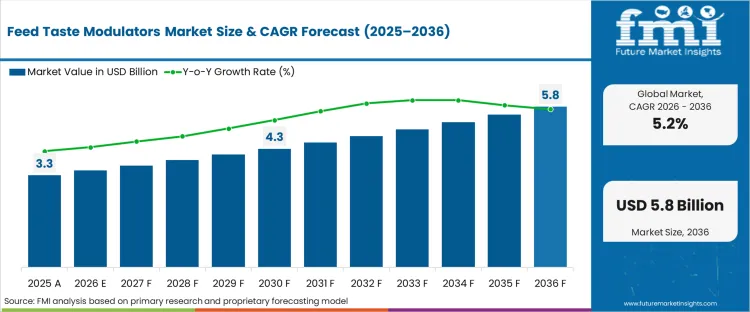
The feed taste modulators market was valued at USD 3.3 billion in 2025 and is projected to reach USD 3.5 billion in 2026, reflecting a CAGR of 5.2%. Industry value is expected to rise to USD 5.8 billion by 2036, driven by the shift away from antibiotic growth promoters. This transition requires the use of alternative functional ingredients that can negatively impact feed intake unless supported by effective sensory masking solutions.
Feed mill operators are currently being forced to shift their purchasing rationale from basic sensory enhancement to critical intake insurance. The removal of traditional growth promoters requires the inclusion of organic acids and concentrated phytogenics, which carry highly aversive flavor profiles for monogastric animals. Integrators who fail to mask these functional additives face immediate intake depression during critical early-weaning phases, leading directly to higher mortality and compromised feed conversion ratios. This shift is deeply connected to sensory additive integration, where palatability dictates maximum inclusion rates. The primary decision matrix now centers entirely on whether a modulator can successfully mask aggressive gut-health protocols without destabilizing the core nutritional matrix.
Summary of Feed Taste Modulators Market
- Feed Taste Modulators Definition:
- The feed taste modulators consist of sensory compounds engineered to stimulate feed intake and mask astringent functional ingredients in commercial animal diets. Its structural boundary separates sensory intervention tools from primary metabolic or antimicrobial additives, defining products chosen specifically to manage the animal's feeding behavior.
- Demand Drivers in the Market:
- Stringent antibiotic removal mandates force lead formulators to introduce highly unpalatable organic acids into diets.
- Variable raw material sourcing requires procurement managers to use standardized aromatics to prevent abrupt feed rejection during batch transitions.
- Compressed early-weaning protocols compel swine facility operators to deploy high-intensity sweeteners to transition piglets from liquid to solid feed without intake dips.
- Key Segments Analyzed in the FMI Report:
- Sweeteners: Sweeteners are projected to hold 45.2% share in 2026, driven structurally by their mandatory inclusion in swine and calf early-weaning protocols to mask bitter protein sources.
- Poultry: Poultry is estimated to grab 38.5% share in 2026, primarily due to the massive volume of pelletized diets required for high-density broiler operations globally.
- Dry/Powder: Dry/Powder is anticipated to account for 65.4% share in 2026, as this format integrates seamlessly into existing high-throughput dry mixing infrastructure at commercial feed mills.
- India: 7.1% compound growth, reflecting a structural transition from scavenging to centralized commercial compound feed within its rapidly modernizing poultry sector.
- Analyst Opinion at FMI:
- Nandini Roy Choudhury, Principal Analyst for Food and Beverage, opines, "The surface-level metric suggests operators buy these products to make feed taste better. The practitioner reality is entirely different. Procurement directors do not buy modulators for palatability; they buy them to insure the feed intake curve. When a commercial broiler operation introduces a new gut-health acidifier, a noticeable drop in daily feed intake destroys the margin on that flock. The modulator is purchased strictly as a risk mitigation tool against the astringency of modern functional diets."
- Strategic Implications / Executive Takeaways:
- Formulators must transition from liquid surface coatings to micro-encapsulated dry powders to survive aggressive thermal pelleting protocols.
- Additive manufacturers should prioritize masking efficacies for specific organic acids to align with integrators operating under zero-antibiotic frameworks.
- Feed mill operators face severe formulation constraints that require sensory standardization across highly variable, least-cost raw material sourcing strategies.
- Methodology:
- Primary Research: Procurement directors at tier-1 meat integrators, lead formulators at commercial feed mills.
- Desk Research: Feed additive registration databases, regional antibiotic restriction timelines.
- Market-Sizing and Forecasting: Baseline anchored to global commercial compound feed tonnage output.
- Data Validation and Update Cycle: Forecasts triangulated against regional meat consumption trajectories.
Before adoption scales fully across integrated operations, formulators must cross a specific thermal stability threshold. Modulator components must survive high-temperature steam conditioning and subsequent pelleting pressures without losing volatile aromatics or degrading their active sweetening compounds. Micro-encapsulation technology triggers this transition, allowing feed manufacturers to include precise modulator dosages in the mixer without over-indexing to compensate for anticipated heat losses.
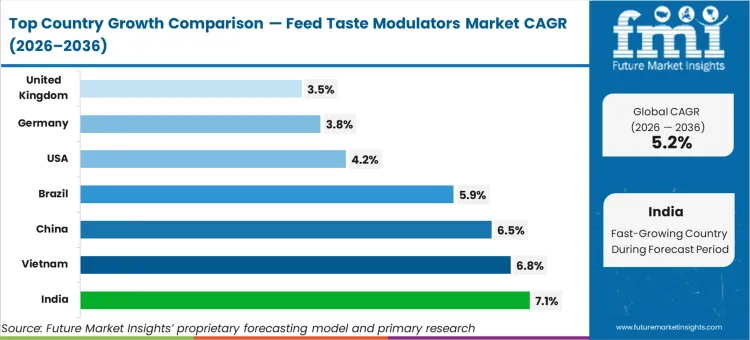
India is estimated to advance at 7.1%, followed by Vietnam tracking a 6.8% CAGR and China expected to record 6.5%. Brazil expands at 5.9%, while the United States is poised to grow at 4.2%. Germany and the United Kingdom follow with projected growth rates of 3.8% and 3.5%, respectively. The divergence across this geographic range reflects the exact stage of consolidation within each domestic meat production sector, separating markets actively replacing localized mixing with commercial compound feed from those optimizing already mature, highly specified nutritional regimes.
Feed Taste Modulators Market Key Takeaways
| Metric | Details |
|---|---|
| Industry Size (2026) | USD 3.5 Billion |
| Industry Value (2036) | USD 5.8 Billion |
| CAGR (2026 to 2036) | 5.2% |
Source: Future Market Insights (FMI) analysis, based on proprietary forecasting model and primary research
Feed Taste Modulators Market Definition
The feed taste modulators market encompasses specialized sensory additives engineered specifically to alter the olfactory and gustatory perception of animal feed. Functionally, these products are designed to mask aversive nutritional components, standardize intake across variable raw material batches, and stimulate consumption during periods of physiological stress. This market strictly covers compounds evaluated for their sensory impact on livestock and companion animals, distinct from baseline nutritional macros or direct metabolic modifiers.
Feed Taste Modulators Market Inclusions
Scope includes high-intensity artificial and natural sweeteners, micro-encapsulated aromatics, botanical flavor extracts, umami enhancers, and targeted bitterness masking agents. Formulations designed for inclusion in compound feed, therapeutic diets, mineral licks, and liquid milk replacers are fully covered. Products requiring sweetening compound profiles as a delivery vehicle fall within this boundary when their primary functional specification is sensory alteration rather than nutritional fortification.
Feed Taste Modulators Market Exclusions
Enzymes, organic acids, essential oils used strictly for antimicrobial purposes, and metabolic growth promoters are explicitly excluded. The functional reason for this exclusion is that while these ingredients may incidentally possess an odor or taste, their procurement specifications and operational inclusion metrics are calculated entirely on their metabolic or antimicrobial efficacy, not their sensory modulation capability. General molasses used primarily as a pellet binder or bulk energy source is also excluded.
Feed Taste Modulators Market Research Methodology
- Primary Research: Procurement directors at tier-1 meat integrators, lead formulators at commercial feed mills, and technical directors at specialized additive manufacturers.
- Desk Research: Feed additive registration databases, regional antibiotic restriction timelines, and technical dossiers from agricultural specification bodies.
- Market-Sizing and Forecasting: Baseline anchored to global commercial compound feed tonnage output segmented by specific livestock categories.
- Data Validation and Update Cycle: Forecasts triangulated against regional meat consumption trajectories and commercial farm consolidation rates.
Segmental Analysis
Feed Taste Modulators Market Analysis by Product Type
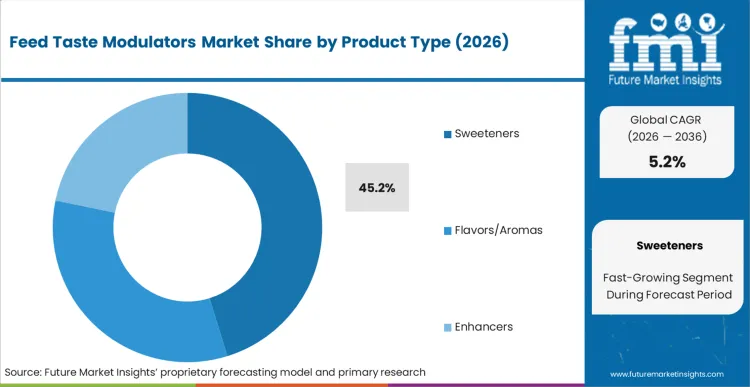
Formulators can no longer rely on basic molasses or generic sucrose to override the extreme bitterness of modern plant-based protein isolates. According to FMI's estimates, sweeteners hold a 45.2% share because commercial swine weaning protocols and ruminant transition diets depend entirely on masking these specialized nutritional inputs. When piglets are aggressively transitioned from sow milk to dry starter diets, the astringency of soybean meal triggers immediate feed aversion. Formulators deploy high-intensity saccharin and neohesperidin dihydrochalcone blends not as optional enhancements, but as biological necessities to prevent starvation-induced gut atrophy. This allows integrators to push earlier weaning dates, executing specialized swine weaning protocols and accelerating the entire production cycle. Facilities that fail to calibrate these sweetening thresholds accurately face severe mortality spikes during the critical transition window.
- Indispensability in starters: Early-weaning protocols physically require sweet profiles to mimic lactose markers. Formulators who utilize precise sweetener blends prevent fatal intake drops during the immediate post-weaning phase.
- Formulation flexibility: High-intensity sweeteners allow mills to utilize cheaper, highly astringent plant proteins without triggering rejection. Procurement teams capture significant margin by expanding their least-cost formulation boundaries.
- Thermal survivability: Saccharin-based compounds exhibit extreme stability under steam conditioning. Mill operators maintain accurate sensory profiles without having to over-dose raw materials prior to pelleting.
Feed Taste Modulators Market Analysis by Livestock
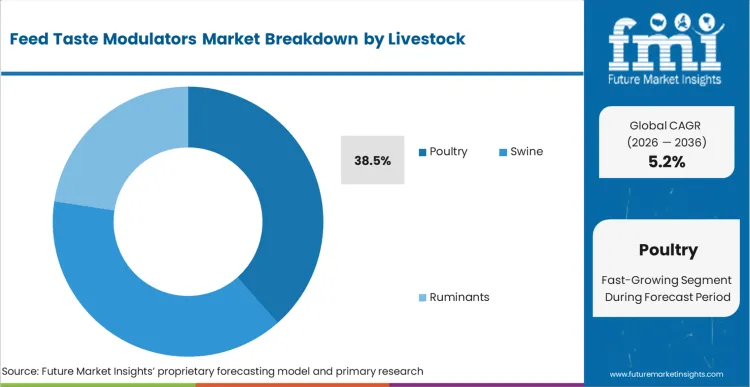
A commercial broiler has an exceptionally narrow timeframe to reach harvest weight; any disruption in the sensory consistency of the feed immediately depresses the daily intake curve, destroying flock margins. Integrators use flavor arrays to establish a uniform baseline that overrides the volatile natural odors of varying least-cost ingredients. FMI analysts opine that poultry operations command a 38.5% share in 2026 precisely because the absolute volume of pelletized broiler formulations required to sustain modern genetic lines demands constant sensory intervention. This standardizes feeding behavior regardless of what bulk grains were purchased that month. Operators who fail to normalize sensory profiles across batch transitions routinely miss narrow harvest weight windows, disrupting downstream processing schedules.
- Standardization capacity: Aromatic blends mask the variable odors of seasonal grain shifts. Integrators maintain consistent flock feeding behavior even when the underlying nutritional matrix changes dramatically.
- Acidifier masking: Zero-antibiotic poultry diets require highly aversive organic acids. Formulators deploy potent masking agents to ensure broilers do not reject these critical gut-health interventions.
- Pellet durability: Poultry feed must withstand aggressive physical processing. Feed mills require heavily encapsulated modulators that do not flash off during the high-friction extrusion process.
Feed Taste Modulators Market Analysis by Form
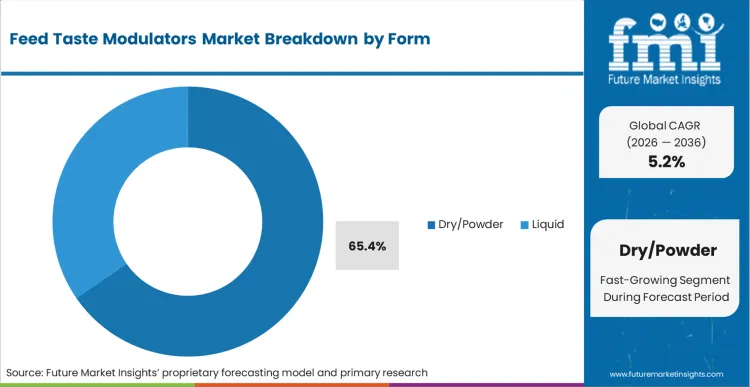
Based on FMI's assessment, Dry/Powder formats capture 65.4% share because they integrate without modification into the high-throughput micro-dosing systems that define modern feed manufacturing. While liquid applications offer theoretical post-pelleting advantages, they demand specialized spray infrastructure that actively fouls legacy processing lines. Liquid application requires specialized post-pellet spray infrastructure that many mid-tier mills simply do not possess. By utilizing dry encapsulated modulators, formulators blend sensory components directly into the core vitamin and mineral premix, ensuring homogenous distribution throughout the final pellet. This prevents the uneven application issues inherent in liquid coating, where fines absorb disproportionate amounts of flavor. Mill managers attempting to force liquid modulators through legacy dry infrastructure face constant machinery fouling and unacceptable downtime.
- Infrastructure compatibility: Dry powders flow seamlessly through existing micro-ingredient hoppers. Mill operators avoid the capital expenditure required to install specialized post-pellet liquid application manifolds.
- Premix integration: Powdered modulators blend perfectly with core nutritional macros. Formulators secure uniform sensory distribution across massive feed batches without secondary mixing phases.
- Encapsulation delivery: Dry formats accommodate advanced lipid-matrix encapsulation. Manufacturers ensure volatile aromatics survive extreme steam conditioning and release only upon ingestion.
Feed Taste Modulators Market Drivers, Restraints, and Opportunities
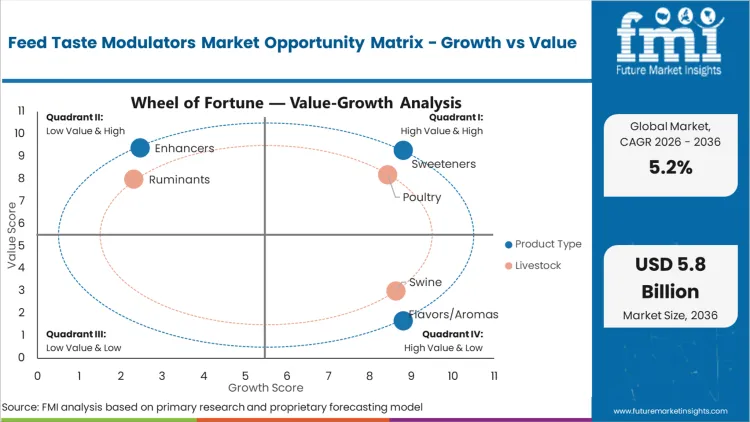
Extended producer responsibility regarding antibiotic resistance forces lead formulators to introduce highly unpalatable organic acids and phytogenics into monogastric diets. This shift compels procurement directors to view taste modulators not as luxury additives, but as mandatory intake-drivers required to make these aggressive gut-health protocols physically consumable by the animal. Without heavy sensory masking, flocks and herds immediately reject feeds loaded with short-chain fatty acids. The commercial stakes are absolute: integrators must either mask the astringency effectively or abandon the zero-antibiotic protocols demanded by their downstream retail buyers.
Extreme thermal degradation during the pelleting process forces formulators to over-index volatile compounds, inflating batch costs unpredictably. Demand outlook is hindered owing to the physical requirements of creating a durable feed pellet, combining high steam conditioning followed by immense mechanical pressure, are actively hostile to delicate aromatic molecules. While advanced lipid micro-encapsulation offers a partial solution, it adds significant unit cost and limits the total concentration of active flavor that can be delivered per gram, leaving cost-sensitive regional mills struggling to achieve consistent sensory outcomes.
Opportunities in the Feed Taste Modulators Market
- Phytogenic masking protocols: Zero-antibiotic mandates require astringent botanical extracts for gut health. Additive manufacturers who engineer specific masking agents for these exact botanicals capture exclusive contracts with tier-1 integrators.
- Aquafeed attractants: The transition away from marine fishmeal in aquaculture creates severe palatability deficits in fish feed diets. Formulators who develop targeted umami profiles for plant-based aquafeeds unlock a massive, underserved protein sector.
- Heat-stable aromatics: Legacy pelleting destroys unprotected flavor profiles. Technical directors who deploy proprietary cross-linked encapsulation survive high-temperature conditioning, eliminating the need for mills to expensively over-dose their mixers.
Regional Analysis
Based on the regional analysis, the feed taste modulators market is segmented into North America, Europe, Asia Pacific, Latin America, and Middle East & Africa across 40 plus countries.
.webp "Top Country Growth Comparison Feed Taste Modulators Market Cagr (2026 2036)")
| Country | CAGR (2026 to 2036) |
|---|---|
| India | 7.1% |
| Vietnam | 6.8% |
| China | 6.5% |
| Brazil | 5.9% |
| United States | 4.2% |
| Germany | 3.8% |
| United Kingdom | 3.5% |
Source: Future Market Insights (FMI) analysis, based on proprietary forecasting model and primary research
Asia Pacific Feed Taste Modulators Market Analysis
Infrastructure maturity rather than regulatory pressure drives the explosive growth curve across the Asia Pacific region. The fundamental transition from localized, farm-mixed mash feeds to commercially pelleted compound diets is occurring rapidly, fundamentally altering the nutritional delivery mechanism for millions of animals. As commercial feed mills come online, they require industrial-scale micro-ingredients that can survive modern processing equipment. In FMI's view, procurement heads in this region are rapidly upgrading from basic liquid molasses applications to sophisticated, encapsulated dry powders that can be managed through automated micro-dosing systems, entirely changing the vendor landscape across commercial compound diets.
- India: India's rapid shift away from backyard scavenging models toward centralized commercial poultry integration requires massive volumes of standardized pelleted feed. Formulators must mask highly variable, localized raw material inputs to keep broiler intake consistent across extreme seasonal temperature shifts. Demand for feed taste modulators in India is set to grow at 7.1%. Integrators who successfully implement thermal-stable aromatics stabilize their flock uniformity, capturing dominance in the consolidating domestic meat supply chain.
- Vietnam: Vietnam sector is poised to expand at 6.8%. The aggressive expansion of export-oriented aquaculture and swine facilities in Vietnam forces operators to adopt international feeding standards. Mill managers operate modern pelleting infrastructure that quickly degrades basic, unencapsulated local flavorings. Adopting advanced micro-encapsulated European modulators positions Vietnamese exporters to hit the precise feed conversion ratios necessary to compete globally against established South American producers.
- China: Massive, hyper-consolidated swine sector in the country demands immense volumes of standardized starter feeds to support its multi-story mega-farm infrastructure. Biosecurity protocols require highly processed, heavily acid-treated feeds that are innately unpalatable to early-weaned piglets. China is expected to see its sector grow at a compound annual rate of 6.5%. The structural trajectory indicates China integrators will soon bypass standalone modulators entirely, moving toward fully customized functional premixes from tier-1 global suppliers.
FMI's report includes Indonesia, Thailand, and the Philippines. The structural pattern here demonstrates that as soon as a country's commercial feed milling capacity crosses a specific tonnage threshold, the demand for encapsulated modulators spikes to support the new processing infrastructure.
Europe Feed Taste Modulators Market Analysis
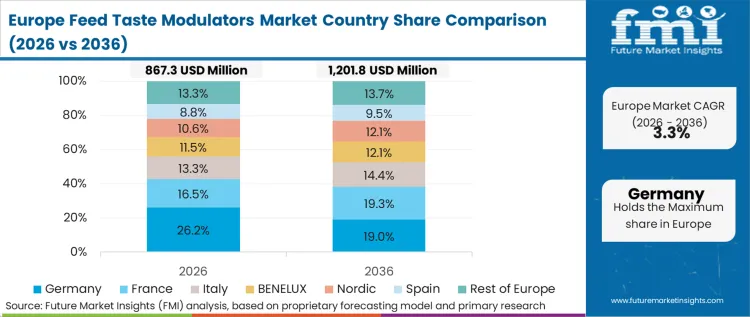
The regulatory environment in Europe structurally forces the adoption of complex masking agents by severely restricting traditional metabolic tools. European Food Safety Authority (EFSA) mandates regarding animal welfare and the total ban on prophylactic antibiotics mean formulators rely heavily on high-dose organic acids and specialized fibers to maintain gut integrity. These compliant diets are deeply aversive to livestock. As per FMI's projection, procurement directors across the EU cannot revert to traditional intake stimulators; they must navigate a highly restricted registry of approved sensory additives. This forces additive manufacturers to invest heavily in EFSA dossier generation simply to maintain market access, consolidating power among players who can afford the regulatory overhead.
- Germany: Stringent animal welfare protocols in Germany regarding weaning ages force swine operators to use exceptionally complex starter diets loaded with unpalatable functional fibers. Facility managers operate under zero-tolerance policies for early mortality, requiring high-intensity sweeteners to ensure immediate solid feed transition. FMI estimates the market in Germany to expand at an annual growth rate of 3.8%. Facility operators clinging to unverified legacy flavor profiles face catastrophic intake drops during early weaning cycles.
- United Kingdom: Procurement practices in the UK are heavily dictated by tier-1 retail supermarkets mandating specific welfare and antibiotic-free rearing standards. The UK landscape is set to achieve a CAGR of 3.5%. Mill operators face complex compliance audits that verify exactly what sensory agents are used to support these restricted diets. The practitioner reality is that UK formulators spend more time verifying the regulatory paperwork of a modulator than adjusting its physical inclusion rate in the mixer.
FMI's report includes analysis of France, Spain, and Italy. Across these markets, the adoption of specialized modulators strictly tracks the enforcement calendar of new nitrogen-reduction and welfare mandates affecting high-density farming zones.
North America Feed Taste Modulators Market Analysis
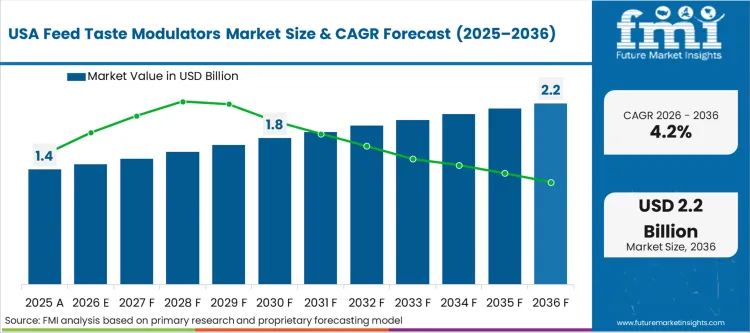
The intense consolidation of the American meat integration landscape dictates how sensory additives are purchased and deployed across the hemisphere. Instead of selling to thousands of independent farmers, modulator manufacturers must qualify their products through the rigorous, data-heavy procurement frameworks of massive corporate integrators. According to FMI's estimates, these integrators operate with incredibly tight margins, meaning modulators are specified solely on their ability to mathematically improve feed conversion ratios during weaning transitions. The environment is highly technical, demanding that any included flavor profile demonstrates absolute thermal stability across the region's high-speed, high-temperature pelleting networks.
- United States: The highly integrated swine and poultry sectors in United States mandate absolute sensory consistency across millions of tons of feed to ensure uniform harvest weights. The US market is anticipated to increase by a CAGR of 4.2%. Lead formulators in the US must standardize intake despite constantly shifting least-cost grain sourcing models. The practitioner reality is that procurement directors ignore generic palatability claims entirely, evaluating vendors strictly through blind, large-scale feed conversion audits.
- Brazil: Brazil's massive meat export engine relies on enormous throughput volumes where mill downtime destroys profitability. Feed mills here require powdered, heavily encapsulated forms that will not foul the high-speed processing infrastructure necessary to feed the nation's immense broiler flocks. Brazil expands at 5.9% through 2036. Integrators transitioning to dry micro-encapsulated formats eliminate the mechanical bottlenecks and cleanup delays previously caused by post-pellet liquid application systems.
FMI's report includes detailed assessments of Canada, Mexico, and Argentina. The structural pattern across these additional countries shows rapid alignment with major integrator standards, as cross-border supply chains harmonize their nutritional specifications to maintain export viability.
Competitive Aligners for Market Players
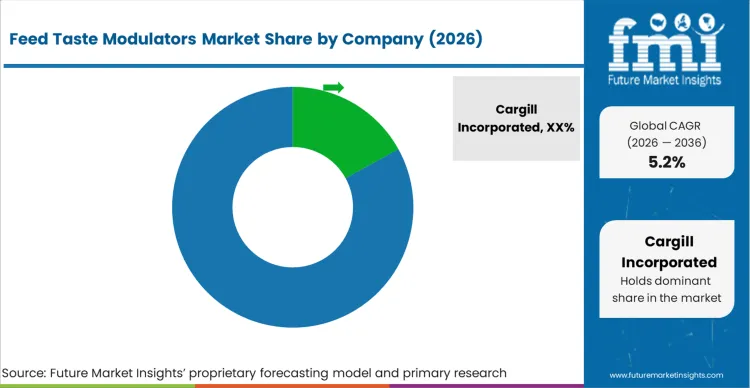
The competitive structure of this market is heavily concentrated precisely because the barriers to entry reside in physical manufacturing capabilities, not flavor chemistry. Leading companies like Nutreco, Kerry Group, and Kemin hold their positions because they have capitalized on micro-encapsulation infrastructure that can protect volatile compounds through extreme steam conditioning. Buyers do not distinguish vendors based on how pleasant a product smells in the sample jar; they evaluate qualification strictly through in-vivo intake trials and post-pelleting recovery analysis. Flavor houses lacking specialized high-temperature agricultural extrusion expertise cannot compete, regardless of their botanical portfolios.
Companies possessing these specialized encapsulation matrices maintain a structural advantage because feed mills actively resist switching validated formulations. Once a commercial mill qualifies a specific feed phytogenic and its corresponding masking agent, altering that protocol risks a catastrophic intake drop across millions of birds or swine. To replicate incumbent success, a challenger must build demonstrable pilot-scale pelleting data proving their thermal survivability matches the legacy product precisely. Without this, procurement directors will not risk the capital of a live animal trial.
Large integrators actively resist this vendor lock-in by demanding transparent, active-ingredient specifications rather than proprietary branded blends. The structural tension between tier-1 meat producers wanting commoditized, interchangeable sensory profiles and manufacturers protecting their high-margin intellectual property dictates relationship dynamics. Through 2036, the market becomes increasingly concentrated as the technical requirements for masking next-generation functional ingredients force smaller players into specialized regional niches, leaving global contracts to those with integrated premix capabilities.
Key Players in Feed Taste Modulators Market
- Cargill Incorporated
- ADM Animal Nutrition (Pancosma)
- Symrise AG
- Kemin Industries, Inc. (Nutriad)
- Nutreco N.V. (Trouw Nutrition)
- Kerry Group plc
- IFF (International Flavors & Fragrances)
- Adisseo France SAS
- Alltech Inc.
- Phytobiotics Futterzusatzstoffe GmbH
Scope of the Report
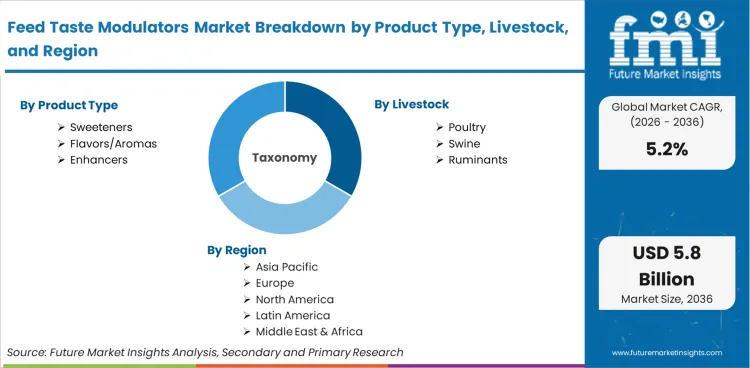
| Metric | Value |
|---|---|
| Quantitative Units | USD 3.5 Billion to USD 5.8 Billion, at a CAGR of 5.2% |
| Market Definition | Specialized sensory additives engineered to alter feed perception, mask astringent functional ingredients, standardize intake across variable raw materials, and stimulate consumption during physiological stress. |
| Product Type Segmentation | Sweeteners, Flavors/Aromas, Enhancers, Masking Agents |
| Livestock Segmentation | Poultry, Swine, Ruminants, Aquaculture, Pets |
| Form Segmentation | Dry/Powder, Liquid |
| Regions Covered | North America, Europe, Asia Pacific, Latin America, Middle East & Africa |
| Countries Covered | United States, China, Germany, Brazil, India, Vietnam, United Kingdom, and 40 plus countries |
| Key Companies Profiled | Cargill Incorporated, ADM Animal Nutrition (Pancosma), Symrise AG, Kemin Industries, Inc. (Nutriad), Nutreco N.V. (Trouw Nutrition), Kerry Group plc, IFF (International Flavors & Fragrances), Adisseo France SAS, Alltech Inc., Phytobiotics Futterzusatzstoffe GmbH |
| Forecast Period | 2026 to 2036 |
| Approach | Primary interviews conducted with feed mill formulators and integrator procurement directors. Baseline anchored to global commercial compound feed tonnage by livestock type. Forecasts validated against farm consolidation rates and antibiotic restriction implementation timelines. |
Source: Future Market Insights (FMI) analysis, based on proprietary forecasting model and primary research
Feed Taste Modulators Market Analysis by Segments
Product Type:
- Sweeteners
- Flavors/Aromas
- Enhancers
- Masking Agents
Livestock:
- Poultry
- Swine
- Ruminants
- Aquaculture
- Pets
Form:
- Dry/Powder
- Liquid
Region:
- North America
- United States
- Canada
- Mexico
- Europe
- Germany
- United Kingdom
- France
- Spain
- Italy
- Asia Pacific
- China
- India
- Vietnam
- Indonesia
- Thailand
- Latin America
- Brazil
- Argentina
- Mexico
- Middle East & Africa
- South Africa
- GCC
Bibliography
- European Food Safety Authority. (2024). Guidance on the assessment of the efficacy of feed additives. EFSA Journal, 22(7), e8856.
- European Medicines Agency. (2025). European sales and use of antimicrobials for veterinary medicine: Annual surveillance report for 2024.
- Food Standards Agency, & Food Standards Scotland. (2024, April 22). FSA/FSS risk management recommendations on 24 feed additive applications and one application for feed for particular nutritional purposes (PARNUT).
- UK Government. (2024, November 5). The Feed Additives (Authorisations) and Uses of Feed (England) Regulations 2024 (UKSI 2024/1101).
USA Department of Agriculture, Agricultural Research Service. (2025). Animal health (NP103) annual report for 2024.This bibliography is provided for reader reference. The full FMI report contains the complete reference list with primary source documentation.
This Report Addresses
- Market intelligence to support strategic decision making across Sweeteners, Flavors/Aromas, and Masking Agents categories
- Market size estimation and 10-year revenue forecasts from 2026 to 2036, supported by baseline anchoring to global commercial compound feed tonnage
- Growth opportunity mapping across Product Type, Livestock, and Form with emphasis on the thermal stability threshold required for pelleting survival
- Segment and regional revenue forecasts covering Dry/Powder formats across the stringent antibiotic-free European regulatory environment
- Competition strategy assessment including pilot-scale pelleting validation, micro-encapsulation intellectual property, and active-ingredient transparency demands
- Capability development tracking including high-intensity saccharin blends, EFSA registered novel masking compounds, and lipid-matrix encapsulation standards
- Market access analysis covering EFSA dossier generation protocols and tier-1 retail welfare qualification standards
- Market report delivery in PDF, Excel, PPT, and interactive dashboard formats for executive strategy, least-cost formulation planning, and operational benchmarking use
Frequently Asked Questions
How large is the feed taste modulators market in 2026?
The market is poised to reach USD 3.5 billion in 2026. This figure establishes the baseline capital that feed mills are dedicating not to raw nutrition, but specifically to intake insurance mechanisms required by modern functional diets.
What will it be valued at by 2036?
It is projected to hit USD 5.8 billion by 2036. This expansion reflects the permanent integration of sensory masking agents into global zero-antibiotic feed protocols, making them an unavoidable operating cost.
What CAGR is projected?
The market advances at a 5.2% CAGR. This rate is heavily constrained by the slow physical replacement cycle of legacy milling infrastructure, which limits how quickly advanced dry-encapsulated formulations can be adopted regionally.
Which Product Type segment leads?
Sweeteners lead the sector. They hold this position structurally because early-weaning protocols in commercial swine production biologically require intense sweet profiles to prevent fatal feed aversion when transitioning off sow milk.
Which Livestock segment leads?
Poultry commands the largest share. Broilers require massive volumes of pelleted feed and possess exceptionally narrow harvest windows; operators must use aromatics to override volatile seasonal grain odors and prevent intake dips.
Which Form segment leads?
Dry/Powder configurations dominate. They flow seamlessly through existing micro-ingredient hoppers, allowing mills to achieve uniform distribution within the core premix without purchasing specialized post-pellet liquid application manifolds.
What drives rapid growth?
The removal of legacy growth promoters forces formulators to rely on aggressive organic acids for gut health. Without potent masking agents, livestock immediately reject these astringent diets, collapsing commercial feed conversion metrics.
What is the primary restraint?
Extreme steam conditioning and high-pressure pelleting physically destroy delicate aromatic molecules. Mills must either pay a premium for advanced cross-linked encapsulation or accept wildly inconsistent sensory outcomes at the trough.
Which country grows fastest?
India advances at 7.1%, while Vietnam grows at 6.8%. India's trajectory reflects a fundamental structural upgrade from localized farm-mixing to centralized commercial compound feed, creating vast new demand for industrial-grade additives that Vietnam's mature export sector already utilizes.
How do EFSA regulations shape the European landscape?
European mandates ban prophylactic antibiotics and enforce strict welfare rules, requiring highly complex, unpalatable fiber diets. Procurement directors are restricted to a narrow registry of approved additives, consolidating vendor power.
Why is micro-encapsulation the defining technology in this space?
Legacy flavor liquids flash off instantly during extreme steam conditioning. Encapsulation physically protects the volatile active compounds until ingestion, allowing formulators to hit sensory targets without massively over-dosing the mixer.
How do large integrators resist vendor lock-in?
Tier-1 producers actively push back against proprietary branded blends by demanding transparent, active-ingredient specifications. They force manufacturers to commoditize their profiles to maintain interchangeable, multi-source vendor networks.
Why are masking agents growing faster than basic aromas?
Modern feed formulation is no longer about making generic grains smell appealing; it is entirely focused on neutralizing the severe bitterness of high-dose phytogenics and acidifiers required in antibiotic-free production.
What dictates procurement decisions in the United States?
US integrators operate on incredibly tight margins and evaluate modulators strictly through mathematical in-vivo feed conversion trials, ignoring generic palatability claims in favor of proven early-weaning intake stabilization.
Why does China demand massive volumes of sweeteners?
China's hyper-consolidated, multi-story swine infrastructure operates under intense biosecurity protocols using heavily acid-treated feeds. Sweeteners are biologically mandatory to force early-weaned piglets to consume these astringent preventative diets.
How does seasonality affect modulator inclusion rates?
Feed mills constantly alter their least-cost formulation models based on seasonal grain prices. Formulators must constantly adjust aromatic dosages to establish a uniform sensory baseline that hides these underlying nutritional matrix shifts from the animal.
What happens if an integrator fails to qualify a robust masking agent?
Flocks introduced to a new unmasked gut-health protocol routinely show immediate intake depression. In commercial broiler mathematics, this intake disruption directly destroys the margin on the entire flock.
Why are liquid modulators losing share to dry powders?
Liquid application requires complex post-pellet spray manifolds that foul easily and distribute unevenly across feed fines. Dry powders bypass this entirely by integrating directly into the primary micro-ingredient mixing phase.
What role do modulators play in aquafeed?
The structural transition from highly palatable marine fishmeal to sustainable plant-based proteins leaves a massive sensory deficit in aquafeeds. Targeted umami enhancers are necessary to trigger predatory feeding responses to these vegetable-based pellets.
How are therapeutic diets altering the companion animal segment?
Veterinary prescription diets often rely on highly hydrolyzed proteins that taste severely bitter. Premium pet food manufacturers must deploy advanced human-grade masking agents to ensure compliance, as pet owners will reject brands their animals refuse to eat.
How do botanical extracts complicate existing mill processing?
Plant-based active ingredients degrade much faster than synthetic analogues under pressure. Mill operators are discovering that without advanced lipid coating, up to forty percent of botanical aromatics volatilize during conditioning, destroying the return on investment.
What prevents smaller flavor houses from capturing integrator contracts?
Smaller manufacturers often formulate products based solely on olfactory appeal in a laboratory setting. Procurement teams reject these unverified products immediately because they lack the million-bird field data proving the flavor survives the physical extrusion realities of commercial milling.
Preview the report firsthand - request a free sample
Get SampleGet the brochure for pricing and purchase details.
Get PDFTable of Content
- Executive Summary
- Global Market Outlook
- Demand-side Trends
- Supply-side Trends
- Technology Roadmap Analysis
- Analysis and Recommendations
- Market Overview
- Market Coverage / Taxonomy
- Market Definition / Scope / Limitations
- Research Methodology
- Chapter Orientation
- Analytical Lens and Working Hypotheses
- Market Structure, Signals, and Trend Drivers
- Benchmarking and Cross-market Comparability
- Market Sizing, Forecasting, and Opportunity Mapping
- Research Design and Evidence Framework
- Desk Research Programme (Secondary Evidence)
- Company Annual and Sustainability Reports
- Peer-reviewed Journals and Academic Literature
- Corporate Websites, Product Literature, and Technical Notes
- Earnings Decks and Investor Briefings
- Statutory Filings and Regulatory Disclosures
- Technical White Papers and Standards Notes
- Trade Journals, Industry Magazines, and Analyst Briefs
- Conference Proceedings, Webinars, and Seminar Materials
- Government Statistics Portals and Public Data Releases
- Press Releases and Reputable Media Coverage
- Specialist Newsletters and Curated Briefings
- Sector Databases and Reference Repositories
- FMI Internal Proprietary Databases and Historical Market Datasets
- Subscription Datasets and Paid Sources
- Social Channels, Communities, and Digital Listening Inputs
- Additional Desk Sources
- Expert Input and Fieldwork (Primary Evidence)
- Primary Modes
- Qualitative Interviews and Expert Elicitation
- Quantitative Surveys and Structured Data Capture
- Blended Approach
- Why Primary Evidence is Used
- Field Techniques
- Interviews
- Surveys
- Focus Groups
- Observational and In-context Research
- Social and Community Interactions
- Stakeholder Universe Engaged
- C-suite Leaders
- Board Members
- Presidents and Vice Presidents
- R&D and Innovation Heads
- Technical Specialists
- Domain Subject-matter Experts
- Scientists
- Physicians and Other Healthcare Professionals
- Governance, Ethics, and Data Stewardship
- Research Ethics
- Data Integrity and Handling
- Primary Modes
- Tooling, Models, and Reference Databases
- Desk Research Programme (Secondary Evidence)
- Data Engineering and Model Build
- Data Acquisition and Ingestion
- Cleaning, Normalisation, and Verification
- Synthesis, Triangulation, and Analysis
- Quality Assurance and Audit Trail
- Market Background
- Market Dynamics
- Drivers
- Restraints
- Opportunity
- Trends
- Scenario Forecast
- Demand in Optimistic Scenario
- Demand in Likely Scenario
- Demand in Conservative Scenario
- Opportunity Map Analysis
- Product Life Cycle Analysis
- Supply Chain Analysis
- Investment Feasibility Matrix
- Value Chain Analysis
- PESTLE and Porter’s Analysis
- Regulatory Landscape
- Regional Parent Market Outlook
- Production and Consumption Statistics
- Import and Export Statistics
- Market Dynamics
- Global Market Analysis 2021 to 2025 and Forecast, 2026 to 2036
- Historical Market Size Value (USD Million) Analysis, 2021 to 2025
- Current and Future Market Size Value (USD Million) Projections, 2026 to 2036
- Y-o-Y Growth Trend Analysis
- Absolute $ Opportunity Analysis
- Global Market Pricing Analysis 2021 to 2025 and Forecast 2026 to 2036
- Global Market Analysis 2021 to 2025 and Forecast 2026 to 2036, By Product Type
- Introduction / Key Findings
- Historical Market Size Value (USD Million) Analysis By Product Type , 2021 to 2025
- Current and Future Market Size Value (USD Million) Analysis and Forecast By Product Type , 2026 to 2036
- Sweeteners
- Flavors/Aromas
- Enhancers
- Sweeteners
- Y-o-Y Growth Trend Analysis By Product Type , 2021 to 2025
- Absolute $ Opportunity Analysis By Product Type , 2026 to 2036
- Global Market Analysis 2021 to 2025 and Forecast 2026 to 2036, By Livestock
- Introduction / Key Findings
- Historical Market Size Value (USD Million) Analysis By Livestock, 2021 to 2025
- Current and Future Market Size Value (USD Million) Analysis and Forecast By Livestock, 2026 to 2036
- Poultry
- Swine
- Ruminants
- Poultry
- Y-o-Y Growth Trend Analysis By Livestock, 2021 to 2025
- Absolute $ Opportunity Analysis By Livestock, 2026 to 2036
- Global Market Analysis 2021 to 2025 and Forecast 2026 to 2036, By Form
- Introduction / Key Findings
- Historical Market Size Value (USD Million) Analysis By Form, 2021 to 2025
- Current and Future Market Size Value (USD Million) Analysis and Forecast By Form, 2026 to 2036
- Dry/Powder
- Liquid
- Dry/Powder
- Y-o-Y Growth Trend Analysis By Form, 2021 to 2025
- Absolute $ Opportunity Analysis By Form, 2026 to 2036
- Global Market Analysis 2021 to 2025 and Forecast 2026 to 2036, By Region
- Introduction
- Historical Market Size Value (USD Million) Analysis By Region, 2021 to 2025
- Current Market Size Value (USD Million) Analysis and Forecast By Region, 2026 to 2036
- North America
- Latin America
- Western Europe
- Eastern Europe
- East Asia
- South Asia and Pacific
- Middle East & Africa
- Market Attractiveness Analysis By Region
- North America Market Analysis 2021 to 2025 and Forecast 2026 to 2036, By Country
- Historical Market Size Value (USD Million) Trend Analysis By Market Taxonomy, 2021 to 2025
- Market Size Value (USD Million) Forecast By Market Taxonomy, 2026 to 2036
- By Country
- USA
- Canada
- Mexico
- By Product Type
- By Livestock
- By Form
- By Country
- Market Attractiveness Analysis
- By Country
- By Product Type
- By Livestock
- By Form
- Key Takeaways
- Latin America Market Analysis 2021 to 2025 and Forecast 2026 to 2036, By Country
- Historical Market Size Value (USD Million) Trend Analysis By Market Taxonomy, 2021 to 2025
- Market Size Value (USD Million) Forecast By Market Taxonomy, 2026 to 2036
- By Country
- Brazil
- Chile
- Rest of Latin America
- By Product Type
- By Livestock
- By Form
- By Country
- Market Attractiveness Analysis
- By Country
- By Product Type
- By Livestock
- By Form
- Key Takeaways
- Western Europe Market Analysis 2021 to 2025 and Forecast 2026 to 2036, By Country
- Historical Market Size Value (USD Million) Trend Analysis By Market Taxonomy, 2021 to 2025
- Market Size Value (USD Million) Forecast By Market Taxonomy, 2026 to 2036
- By Country
- Germany
- UK
- Italy
- Spain
- France
- Nordic
- BENELUX
- Rest of Western Europe
- By Product Type
- By Livestock
- By Form
- By Country
- Market Attractiveness Analysis
- By Country
- By Product Type
- By Livestock
- By Form
- Key Takeaways
- Eastern Europe Market Analysis 2021 to 2025 and Forecast 2026 to 2036, By Country
- Historical Market Size Value (USD Million) Trend Analysis By Market Taxonomy, 2021 to 2025
- Market Size Value (USD Million) Forecast By Market Taxonomy, 2026 to 2036
- By Country
- Russia
- Poland
- Hungary
- Balkan & Baltic
- Rest of Eastern Europe
- By Product Type
- By Livestock
- By Form
- By Country
- Market Attractiveness Analysis
- By Country
- By Product Type
- By Livestock
- By Form
- Key Takeaways
- East Asia Market Analysis 2021 to 2025 and Forecast 2026 to 2036, By Country
- Historical Market Size Value (USD Million) Trend Analysis By Market Taxonomy, 2021 to 2025
- Market Size Value (USD Million) Forecast By Market Taxonomy, 2026 to 2036
- By Country
- China
- Japan
- South Korea
- By Product Type
- By Livestock
- By Form
- By Country
- Market Attractiveness Analysis
- By Country
- By Product Type
- By Livestock
- By Form
- Key Takeaways
- South Asia and Pacific Market Analysis 2021 to 2025 and Forecast 2026 to 2036, By Country
- Historical Market Size Value (USD Million) Trend Analysis By Market Taxonomy, 2021 to 2025
- Market Size Value (USD Million) Forecast By Market Taxonomy, 2026 to 2036
- By Country
- India
- ASEAN
- Australia & New Zealand
- Rest of South Asia and Pacific
- By Product Type
- By Livestock
- By Form
- By Country
- Market Attractiveness Analysis
- By Country
- By Product Type
- By Livestock
- By Form
- Key Takeaways
- Middle East & Africa Market Analysis 2021 to 2025 and Forecast 2026 to 2036, By Country
- Historical Market Size Value (USD Million) Trend Analysis By Market Taxonomy, 2021 to 2025
- Market Size Value (USD Million) Forecast By Market Taxonomy, 2026 to 2036
- By Country
- Kingdom of Saudi Arabia
- Other GCC Countries
- Turkiye
- South Africa
- Other African Union
- Rest of Middle East & Africa
- By Product Type
- By Livestock
- By Form
- By Country
- Market Attractiveness Analysis
- By Country
- By Product Type
- By Livestock
- By Form
- Key Takeaways
- Key Countries Market Analysis
- USA
- Pricing Analysis
- Market Share Analysis, 2025
- By Product Type
- By Livestock
- By Form
- Canada
- Pricing Analysis
- Market Share Analysis, 2025
- By Product Type
- By Livestock
- By Form
- Mexico
- Pricing Analysis
- Market Share Analysis, 2025
- By Product Type
- By Livestock
- By Form
- Brazil
- Pricing Analysis
- Market Share Analysis, 2025
- By Product Type
- By Livestock
- By Form
- Chile
- Pricing Analysis
- Market Share Analysis, 2025
- By Product Type
- By Livestock
- By Form
- Germany
- Pricing Analysis
- Market Share Analysis, 2025
- By Product Type
- By Livestock
- By Form
- UK
- Pricing Analysis
- Market Share Analysis, 2025
- By Product Type
- By Livestock
- By Form
- Italy
- Pricing Analysis
- Market Share Analysis, 2025
- By Product Type
- By Livestock
- By Form
- Spain
- Pricing Analysis
- Market Share Analysis, 2025
- By Product Type
- By Livestock
- By Form
- France
- Pricing Analysis
- Market Share Analysis, 2025
- By Product Type
- By Livestock
- By Form
- India
- Pricing Analysis
- Market Share Analysis, 2025
- By Product Type
- By Livestock
- By Form
- ASEAN
- Pricing Analysis
- Market Share Analysis, 2025
- By Product Type
- By Livestock
- By Form
- Australia & New Zealand
- Pricing Analysis
- Market Share Analysis, 2025
- By Product Type
- By Livestock
- By Form
- China
- Pricing Analysis
- Market Share Analysis, 2025
- By Product Type
- By Livestock
- By Form
- Japan
- Pricing Analysis
- Market Share Analysis, 2025
- By Product Type
- By Livestock
- By Form
- South Korea
- Pricing Analysis
- Market Share Analysis, 2025
- By Product Type
- By Livestock
- By Form
- Russia
- Pricing Analysis
- Market Share Analysis, 2025
- By Product Type
- By Livestock
- By Form
- Poland
- Pricing Analysis
- Market Share Analysis, 2025
- By Product Type
- By Livestock
- By Form
- Hungary
- Pricing Analysis
- Market Share Analysis, 2025
- By Product Type
- By Livestock
- By Form
- Kingdom of Saudi Arabia
- Pricing Analysis
- Market Share Analysis, 2025
- By Product Type
- By Livestock
- By Form
- Turkiye
- Pricing Analysis
- Market Share Analysis, 2025
- By Product Type
- By Livestock
- By Form
- South Africa
- Pricing Analysis
- Market Share Analysis, 2025
- By Product Type
- By Livestock
- By Form
- USA
- Market Structure Analysis
- Competition Dashboard
- Competition Benchmarking
- Market Share Analysis of Top Players
- By Regional
- By Product Type
- By Livestock
- By Form
- Competition Analysis
- Competition Deep Dive
- Cargill Incorporated
- Overview
- Product Portfolio
- Profitability by Market Segments (Product/Age /Sales Channel/Region)
- Sales Footprint
- Strategy Overview
- Marketing Strategy
- Product Strategy
- Channel Strategy
- ADM Animal Nutrition (Pancosma)
- Symrise AG
- Kemin Industries, Inc. (Nutriad)
- Nutreco N.V. (Trouw Nutrition)
- Kerry Group plc
- IFF (International Flavors & Fragrances)
- Cargill Incorporated
- Competition Deep Dive
- Assumptions & Acronyms Used


