

- Market Size (2026)
- USD 92.5 Mn
- Forecast (2036)
- USD 134.3 Mn
- CAGR (2026 to 2036)
- 3.8%
How big is the sugar beet pectin market in 2026?
USD 92.5 million in 2026, reaching USD 134.3 million by 2036 at a 3.8% CAGR
The sugar beet pectin market was valued at USD 89.1 million in 2025. The market is set to reach USD 92.5 million by 2026-end and grow at a CAGR of 3.8% between 2026-2036 to reach USD 134.3 million by 2036. High Methoxyl Sugar Beet Pectin will dominate with a 50.0% share, while Food and Beverages will lead with a 60.0% share.
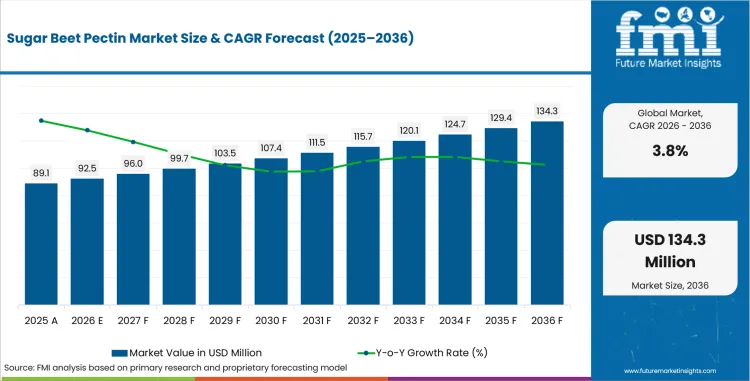
Key Takeaways, Market Size, and Forecast
- Sugar Beet Pectin Market Value (2025): USD 89.1 Mn
- Sugar Beet Pectin Market Forecast Value (2036): USD 134.3 Mn
- Sugar Beet Pectin Market CAGR (2026 TO 2036): 3.8%
- Sugar Beet Pectin Market Leading Product Segment: High Methoxyl Sugar Beet Pectin (50.0%)
- Sugar Beet Pectin Market Key Growth Regions: Japan, USA, EU, South Korea, UK
- Sugar Beet Pectin Market Key Players: DuPont, Cargill, Inc., Herbstreith & Fox GmbH, Naturex (Givaudan), Ingredion Incorporated, Other Companies (combined)
| Parameter | Details |
|---|---|
| Market Size in 2026 (Value) | USD 92.5 Mn |
| Market Forecast in 2036 (Value) | USD 134.3 Mn |
| CAGR (2026 to 2036) | 3.8% |
| Years Considered | 2021 to 2036 |
| Base Year | 2025 |
| Forecast Period | 2026 to 2036 |
| Units Considered | Value (USD Mn) |
| Leading Sub-Region | USA |
Summary of the Sugar Beet Pectin Market
- Demand and Growth Drivers
- Growing demand for clean-label food ingredients is driving adoption of sugar beet pectin as a natural gelling, stabilizing, and emulsifying agent in food and beverage formulations.
- Supply diversification away from citrus-derived pectin is creating interest in sugar beet pectin as an alternative source with different functional properties.
- Expansion of sugar beet processing byproduct utilization creates feedstock availability for pectin extraction that supplements traditional citrus peel sourcing.
- Product and Segment View
- High methoxyl sugar beet pectin accounts for 50.0% of product share, providing gelling functionality in high-sugar food applications including jams, confectionery, and fruit preparations.
- Food and beverages hold 60.0% of application share, as food manufacturers incorporate sugar beet pectin as a natural texturizer and stabilizer across product categories.
- Gelling agent functionality holds 30.0% share, reflecting the primary use of pectin in food applications where gel formation is required for product structure and texture.
- Geography and Competitive Outlook
- Japan leads at 4.2% CAGR, reflecting established food ingredient quality standards and food manufacturer demand for specialty pectin ingredients.
- The United States follows at 4.0% CAGR, supported by clean-label ingredient trends and food manufacturer reformulation toward natural texturizing agents.
- Companies with sugar beet pectin extraction technology and established food ingredient distribution are positioned to serve growing clean-label demand.
- Analyst Opinion
- Nandini Roy Choudhury, Principal Consultant at FMI says, 'Ingredient suppliers that can deliver consistent sugar beet pectin functionality across gelling, stabilizing, and emulsifying applications while maintaining competitive pricing are likely to expand their food manufacturer customer base over the forecast period.'
- The sugar beet pectin market is expanding as food manufacturers seek natural ingredient alternatives for texturizing and stabilizing applications.
- Adoption is increasing due to clean-label consumer preferences that favor recognizable, natural-source ingredients in processed food products.
- Demand is supported by sugar beet processing industry byproduct utilization that creates sustainable feedstock supply for pectin extraction.
- Growth is attributable to the unique emulsifying properties of sugar beet pectin that differentiate it from citrus and apple pectin in specific food formulations.
What is sugar beet pectin and what does the market cover?
Sugar-beet-derived pectin for gelling, stabilizing and emulsifying in food, pharmaceutical and personal care products
The sugar beet pectin market encompasses pectin ingredients extracted from sugar beet pulp for use as gelling, stabilizing, and emulsifying agents in food, pharmaceutical, and personal care applications. Products include high methoxyl, low methoxyl, and specialty sugar beet pectin grades in spray-dried, vacuum-dried, and freeze-dried forms from conventional and organic sources.
What is included in the sugar beet pectin market scope?
High methoxyl, low methoxyl and specialty sugar beet pectin grades, 2026 to 2036.
Market scope covers all commercially traded sugar beet pectin categorized by product (high methoxyl, low methoxyl, specialty sugar beet pectin), application (food and beverages, pharmaceuticals and nutraceuticals, personal care and cosmetics), functionality (gelling agent, stabilizer, emulsifier), end use (food processing industry, pharmaceutical industry, cosmetic industry), source (conventional, organic sugar beet pectin), processing method (spray drying, vacuum drying, freeze drying), and distribution channel (direct sales, indirect sales). Revenue is tracked from 2026 to 2036.
What is excluded from the sugar beet pectin market scope?
Citrus and apple-derived pectin, sugar beet fiber without pectin extraction, and synthetic gelling agents
The scope does not include citrus or apple-derived pectin products, sugar beet fiber products without pectin extraction, or synthetic gelling agents.
How was the sugar beet pectin market research conducted?
Primary interviews, desk research, bottom-up sizing, and quarterly validation
- Primary Research: FMI analysts conducted interviews with pectin manufacturers, food formulators, sugar beet processors, and food ingredient distributors across key markets.
- Desk Research: Combined data from food ingredient trade databases, sugar beet processing statistics, and manufacturer revenue disclosures.
- Market Sizing and Forecasting: Bottom-up aggregation of pectin sales across product types, applications, and geographic markets with clean-label ingredient trend projections.
- Data Validation: Cross-validated quarterly against food ingredient trade data, manufacturer production records, and food manufacturer procurement tracking.
Why is the sugar beet pectin market growing?
Rising clean-label demand for natural texturizers, gelling and emulsifying agents
- Interest in sugar beet pectin as a natural texturizer, gelling agent and emulsifier for food product formulation is increasing with the demand for clean-label food ingredients.
- The distinctive emulsifying properties of sugar beet pectin due to its acetyl and protein content differentiate it from citrus pectin in specific food applications.
- Japan is leading at 4.2% CAGR, owing to quality-driven demand for food ingredient procurement and food manufacturers' demand for specialty pectin with consistent functional performance.
Clean label ingredient trends and the functional differentiation of beet-based pectin from conventional citrus sources are driving demand for sugar beet pectin. High methoxyl sugar beet pectin holds 50.0% of product share, providing gel formation in high-sugar food applications requiring rapid set and firm texture. Sugar beet pectin has a specific composition with higher levels of acetyl and protein than citrus pectin and is valued for its emulsifying functionality in certain food formulations.
Food and beverage constitute 60.0% of application share, wherein sugar beet pectin is used in jam and preserve production, dairy desserts, confectionery, beverage stabilization, and fruit preparation applications by food manufacturers. The gelling agent functionality is expected to hold a 30.0% share, while the usage of stabilizer and emulsifier applications is projected to rise. Pectin is used as a pharmaceutical excipient and as an ingredient in dietary fiber supplements in pharmaceutical and nutraceutical applications.
Beet pulp, a byproduct of sugar processing, is utilized for extraction of sugar beet pectin and represents a sustainable feedstock pathway in line with food industry waste minimization and circular economy objectives. Production is mainly in Europe where the infrastructure for processing sugar beet supports the extraction of pectin. Multiple specialized pectin producers such as Herbstreith and Fox and food ingredient companies with diversified portfolios.
How is the sugar beet pectin market segmented?
By product, application, functionality, end use, source, processing method and distribution channel
- High methoxyl sugar beet pectin is the leader with a 50.0% product share, offering gelling functionality for high-sugar food applications such as jams and confectionery.
- Food and beverages account for 60.0% of application share, with pectin being used as a natural texturizer in jam, dairy, confectionery and beverage formulations.
- Functionality as a gelling agent accounts for 30.0% of the market, with stabilizer and emulsifier applications seeing increasing use for sugar beet pectin.
Why does high methoxyl sugar beet pectin lead the sugar beet pectin market?
It holds 50.0% share, led by sugar-and-acid gelling for jams and preserves
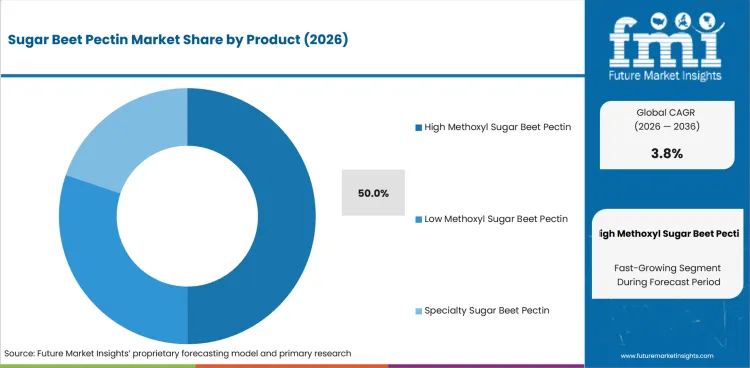
High methoxyl sugar beet pectin to capture 50.0% product share by 2026. This grade forms gels in the presence of sugar and acid, suitable for manufacturing traditional jam, jelly and fruit preparation. The methoxyl content and degree of esterification affect gel strength and setting characteristics.
Low methoxyl sugar beet pectin gels with calcium ions rather than sugar and can be used to form gels in low and no sugar foods. The grade meets the increasing demand for lower-sugar options while still providing texture and structure.
How big is the food and beverages segment in the sugar beet pectin market?
About 60.0% share, led by gelation in jams and preserves
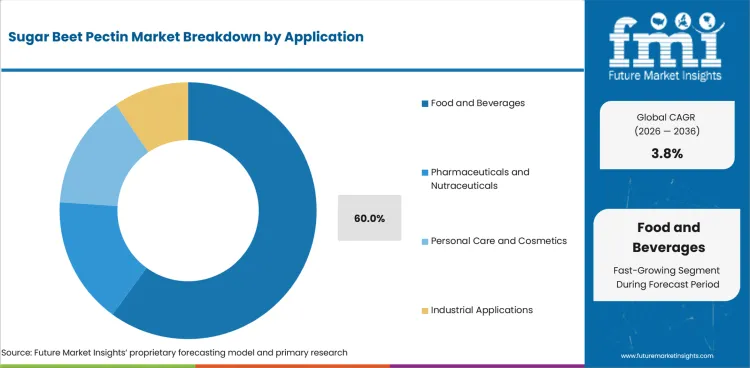
By application, food & beverages share is 60.0% by 2026. The traditional core application of pectin is in jam and preserve manufacture where the gelation provides the characteristic set texture. Other important applications are for stabilization of dairy desserts, gelling of confectionery and fruit preparation.
The emulsifying properties of sugar beet pectin provide unique opportunities for application in beverage stabilization, formulation of salad dressings and other oil water emulsion products where citrus pectin offers limited functionality. This differentiation supports the positioning of sugar beet pectin for specialty food applications.
What drives and restrains the sugar beet pectin market?
Driven by clean-label demand for natural texturizers; restrained by higher extraction costs versus citrus pectin
- Sugar beet pectin is projected to continue growing in food manufacturing applications due to the demand for natural texturizers and the clean label ingredient trend.
- Sugar beet pectin does not have the price competitiveness due to higher extraction costs and smaller scale of production than citrus pectin.
- Sugar beet pectin is a specialty application not served by citrus or apple pectin because of unique emulsifying functionality.
Moderate growth of the sugar beet pectin market is sustained by clean label trends, functional differentiation, and sustainable sourcing. Difficulties: Cost premiums and scale limitations in production. Opportunities: Emulsification functionality and clean-label positioning for niche markets.
What drives demand?
Reformulation toward recognizable, natural label-friendly ingredients
Food manufacturer reformulation to recognizable, natural ingredients that consumers can identify and trust drives demand. Sugar beet pectin is a clean-label texturizer and stabilizer that meets consumer and retailer demands for transparency of ingredients.
What constrains the market?
Higher production cost than citrus pectin from lower extraction yields
The higher cost of production of sugar beet pectin as compared to citrus pectin, owing to lower scale of production and more complicated extraction methods, limits its adoption. These price differentials limit sugar beet pectin penetration into price-sensitive commodity food applications.
What opportunity does emulsification offer?
Unique emulsifying properties not available from citrus or apple pectin
These results reflect the unique emulsifying properties of sugar beet pectin not available from citrus or apple pectin sources. This functional differentiation is appreciated by food manufacturers who formulate oil-water emulsion products such as beverages, dressings and sauces.
How does sustainability help?
Extraction from sugar-beet pulp byproduct supporting a sustainability story
The sustainable sourcing narrative of sugar beet pectin extraction from beet pulp processing byproduct also supports demand. This transformation of waste to value is in line with the circular economy targets of food industry and helps in making sustainability oriented ingredients procurement choices.
Which countries are growing fastest in the sugar beet pectin market?
Japan 4.2%, USA 4.0%, EU 3.9%, South Korea 3.8%, UK 3.7% through 2036
.webp "Top Country Growth Comparison Sugar Beet Pectin Market Cagr (2026 2036)")
| Country | CAGR |
|---|---|
| USA | 4.0% |
| UK | 3.7% |
| EU | 3.9% |
| Japan | 4.2% |
| South Korea | 3.8% |
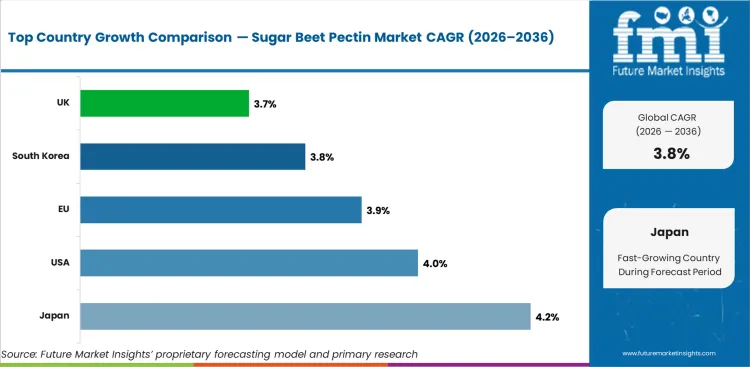
- Japan leads at 4.2% CAGR, reflecting strong demand drivers.
- USA follows at 4.0%, supported by expanding market activity.
- EU (3.9%) and South Korea (3.8%) sustain growth.
The global sugar beet pectin market is estimated to grow at 3.8% CAGR from 2026 to 2036. The study covers more than 30 countries, and the key markets are listed below.
How fast is the sugar beet pectin market growing in Japan?
4.2% CAGR through 2036, the fastest country-level market in the study
Japan leads at 4.2% CAGR through 2036. Quality-focused food ingredient procurement and specialty confectionery and dairy applications sustain demand.
- Japanese food manufacturers demand consistent, high-quality pectin with documented functional specifications for confectionery and dairy applications.
- Specialty food product development in Japan values the unique properties of sugar beet pectin for differentiated formulations.
- Import-dependent supply chain creates direct procurement relationships between Japanese food companies and European pectin producers.
What is the sugar beet pectin market outlook in the United States?
4.0% CAGR, driven by clean-label reformulation and food manufacturer interest in natural texturizers
The United States is expected to witness 4.0% CAGR till 2036. Demand is supported by clean-label reformulation and food manufacturer interest in natural texturizers.
- USA food manufacturers are reformulating products with clean-label ingredients, generating interest in sugar beet pectin as a natural texturizer.
- Jam, preserve and fruit preparation makers constitute the central domestic consumption base for sugar beet pectin.
- Food ingredient distributors supply US food manufacturers with imported sugar beet pectin from European production sources.
What is driving sugar beet pectin growth in the European Union?
3.9% CAGR, driven by Market activity
The European Union is projected to expand at a CAGR of 3.9% through 2036. Market activity is driven by production concentration in Europe and demand from established food manufacturers.
- European pectin producers like Herbstreith and Fox have sugar beet pectin extraction facilities near sugar processing infrastructure.
- European Union food producers have the longest experience of sugar beet pectin in confectionery, dairy and preserve applications.
- Demand for certified organic sugar beet pectin ingredients is up due to European clean-label and organic food trends.
How is the sugar beet pectin market performing in South Korea?
3.8% CAGR, driven by food ingredient quality standards and rising clean-label awareness
South Korea is expected to record a CAGR of 3.8% through 2036. Demand is supported by quality standards for food ingredients and an increasing awareness of clean labels.
- Korean food manufacturers are increasing specification of natural gelling and stabilizing ingredients in line with clean-label consumer preferences.
- European pectin producers supply Korea’s sugar beet pectin demand through import procurement.
- Confectionery and dairy product formulation applications create a concentrated demand for pectin ingredients with consistent gelling performance.
What is the sugar beet pectin market forecast for the United Kingdom?
3.7% CAGR, driven by established jam and preserve making traditions and clean-label trends
The United Kingdom is estimated to witness a CAGR of 3.7% through 2036. Demand is supported by the tradition of making jams and preserves and by clean label trends.
- Steady demand for gelling-grade products from traditional users of pectin ingredients in the UK jam and preserve sector.
- Reformulation of familiar natural ingredients such as sugar beet pectin driven by UK clean-label consumer trends.
- Post-Brexit regulations for importing food ingredients will lead to different procurement requirements for pectin products entering the UK market.
Who are the leading companies in the sugar beet pectin market?
DuPont, Cargill, Inc., Herbstreith & Fox GmbH, Naturex (Givaudan), and Ingredion Incorporated
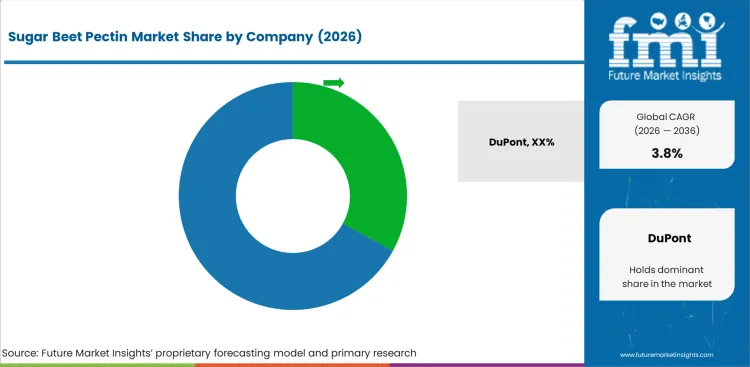
- Herbstreith and Fox GmbH leads through specialized pectin production including sugar beet extraction with established food manufacturer supply relationships across Europe and globally.
- DuPont and Cargill serve the pectin market through diversified food ingredient portfolios that include sugar beet pectin alongside citrus and specialty grades.
- Naturex (Givaudan) and Ingredion provide pectin ingredients as part of broader natural ingredient and food texturizer portfolios.
Who are the key players in the sugar beet pectin market?
DuPont, Cargill, Inc., Herbstreith & Fox GmbH, Naturex (Givaudan) and Ingredion Incorporated, plus regional players
Key global companies leading the sugar beet pectin market include:
- DuPont (USA), Cargill, Inc. (USA), Herbstreith and Fox GmbH (Germany), and Naturex/Givaudan (France) lead global sugar beet pectin markets through specialized pectin production capability, food ingredient distribution networks, and established food manufacturer customer relationships.
- Ingredion Incorporated (USA) holds a position through natural texturizer and food ingredient portfolio that includes pectin products.
- Additional food ingredient companies are evaluating sugar beet pectin extraction as clean-label demand growth creates market opportunity for alternative pectin sources.
How do top sugar beet pectin companies compare?
DuPont and Cargill, Inc. lead globally; Herbstreith & Fox GmbH, Naturex (Givaudan) and Ingredion Incorporated are regional specialists
| Company | Food Ingredient Portfolio | Pectin Technology | Food Manufacturer Network | Geographic Footprint |
|---|---|---|---|---|
| DuPont | High | High | Strong | Global |
| Cargill | High | Medium | Strong | Global |
| Herbstreith & Fox | High | High | Strong | Europe, Global |
| Naturex/Givaudan | Medium | Medium | Moderate | Global |
| Ingredion | Medium | Medium | Moderate | Global |
Source: Future Market Insights competitive analysis, 2026.
Key Developments in Sugar Beet Pectin Market
- In 2025, Cargill continued expanding its pectin innovation portfolio through its UniPECTINE® platform, introducing advanced low-sugar and label-friendly pectin solutions designed for fruit preparations, jams, bakery fillings, and clean-label food applications.
- In 2025, Herbstreith & Fox expanded its portfolio of specialized pectin solutions for reduced-sugar formulations, fruit preparations, cream fillings, and confectionery applications, reflecting growing industry demand for natural texturizing and stabilizing ingredients.
Key Players in the Sugar Beet Pectin Market
Major Global Players
- DuPont
- Cargill, Inc.
- Herbstreith & Fox GmbH
- Naturex (Givaudan)
- Ingredion Incorporated
Emerging Players/Startups
- Naturex (Givaudan)
- Ingredion Incorporated
Sugar Beet Pectin Market - Research Methodology
| Method | Description |
|---|---|
| Primary Research | FMI analysts conducted interviews with manufacturers, distributors, procurement specialists, and end-use operators across USA, UK, and EU to validate demand patterns and pricing structures for High Methoxyl Sugar Beet Pectin, and Low Methoxyl Sugar Beet Pectin and related product categories. |
| Desk Research | Combined trade statistics, regulatory filings, industry association data, and manufacturer disclosures to establish baseline parameters for Sugar Beet Pectin across product, application, functionality, end use, source, processing method, and distribution channel segments. |
| Market Sizing & Forecasting | Bottom-up aggregation across High Methoxyl Sugar Beet Pectin, Low Methoxyl Sugar Beet Pectin, and Specialty Sugar Beet Pectin product categories and Food and Beverages, Pharmaceuticals and Nutraceuticals, and Personal Care and Cosmetics application segments, triangulated with top-down macro indicators and regional adoption curves. |
| Data Validation | Cross-checked quarterly against production statistics, trade flow data, and manufacturer revenue disclosures for Sugar Beet Pectin products. |
What does the sugar beet pectin market report cover?
2016 to 2025 history and 2026 to 2036 forecasts across all segments and 30+ countries
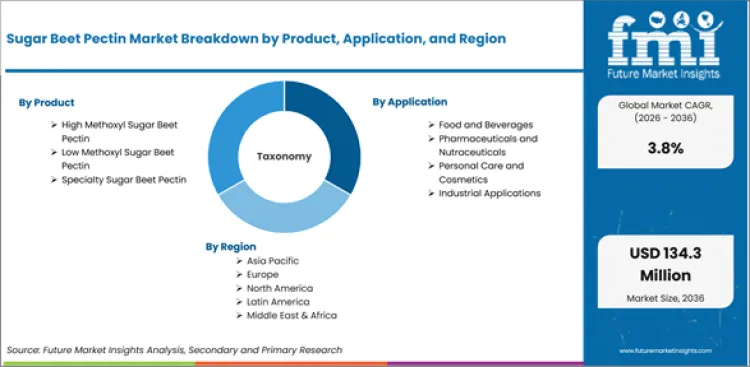
| Parameter | Details |
|---|---|
| Market size by 2036 | USD 134.3 Mn |
| Growth rate | 3.8% CAGR (2026 to 2036) |
| Forecast period | 2026 to 2036 |
| Base year value (2025) | USD 89.1 Mn |
| Key Segment Covered | Product, Application, Functionality, End Use, Source, Processing Method, Distribution Channel |
| Regions covered | North America, Latin America, Eastern Europe, Western Europe, East Asia, South Asia and Pacific, Middle East and Africa |
| Countries covered | USA, UK, EU, Japan, South Korea, 30 plus countries |
| Key companies profiled | DuPont, Cargill, Inc., Herbstreith & Fox GmbH, Naturex (Givaudan), Ingredion Incorporated |
| Approach | Hybrid bottom-up and top-down methodology starting with verified transaction data, projecting adoption velocity across segments and regions. |
Market Segmentation Analysis
Sugar Beet Pectin Market Segmented by Product:
- High Methoxyl Sugar Beet Pectin
- Conventional High Methoxyl Pectin
- Rapid Set Pectin
- Slow Set Pectin
- Application Specific High Methoxyl Pectin
- Jam and Jelly Grade
- Confectionery Grade
- Conventional High Methoxyl Pectin
- Low Methoxyl Sugar Beet Pectin
- Standard Low Methoxyl Pectin
- Calcium Reactive Pectin
- Low Sugar Applications
- Modified Low Methoxyl Pectin
- Amidated Pectin
- Controlled Gel Formation
- Standard Low Methoxyl Pectin
- Specialty Sugar Beet Pectin
- Organic Sugar Beet Pectin
- Certified Organic
- Clean Label Ingredients
- Functional Blends
- Customized Pectin Systems
- Application Specific Blends
- Organic Sugar Beet Pectin
Sugar Beet Pectin Market Segmented by Application:
- Food and Beverages
- Bakery and Confectionery
- Jams and Jellies
- Fruit Fillings
- Dairy and Beverages
- Yogurt and Dairy Drinks
- Plant Based Beverages
- Processed Foods
- Sauces and Dressings
- Ready To Eat Meals
- Bakery and Confectionery
- Pharmaceuticals and Nutraceuticals
- Drug Delivery Systems
- Controlled Release Formulations
- Encapsulation
- Dietary Supplements
- Fiber Supplements
- Functional Ingredients
- Drug Delivery Systems
- Personal Care and Cosmetics
- Skin Care Products
- Creams and Lotions
- Natural Formulations
- Hair Care Products
- Conditioners
- Scalp Treatments
- Skin Care Products
- Industrial Applications
- Adhesives and Coatings
- Paper Coating
- Industrial Adhesives
- Biodegradable Materials
- Packaging Materials
- Sustainable Solutions
- Adhesives and Coatings
Sugar Beet Pectin Market Segmented by Functionality:
- Gelling Agent
- High Sugar Gel Formation
- Jam and Jelly Applications
- Fruit Preparations
- Low Sugar Gel Formation
- Diet Products
- Reduced Sugar Foods
- High Sugar Gel Formation
- Stabilizer
- Emulsion Stabilization
- Dairy Beverages
- Plant Based Drinks
- Texture Stabilization
- Sauces and Dressings
- Bakery Fillings
- Emulsion Stabilization
- Emulsifier
- Oil Water Emulsification
- Beverages
- Dressings
- Fat Replacement
- Low Fat Foods
- Calorie Reduced Products
- Oil Water Emulsification
- Thickening Agent
- Viscosity Enhancement
- Soups and Sauces
- Desserts
- Texture Improvement
- Dairy Products
- Processed Foods
- Viscosity Enhancement
Sugar Beet Pectin Market Segmented by End Use:
- Food Processing Industry
- Large Scale Manufacturers
- Packaged Food Companies
- Beverage Companies
- Small and Medium Enterprises
- Artisan Producers
- Specialty Food Brands
- Large Scale Manufacturers
- Pharmaceutical Industry
- Drug Manufacturers
- Generic Drug Companies
- Innovative Drug Developers
- Nutraceutical Companies
- Supplement Brands
- Functional Food Companies
- Drug Manufacturers
- Cosmetic Industry
- Personal Care Brands
- Skincare Brands
- Haircare Brands
- Organic and Natural Brands
- Clean Beauty Brands
- Premium Cosmetic Brands
- Personal Care Brands
- Industrial Users
- Chemical Industry
- Adhesive Manufacturers
- Coating Companies
- Packaging Industry
- Biodegradable Packaging
- Sustainable Materials
- Chemical Industry
Sugar Beet Pectin Market Segmented by Source:
- Conventional Sugar Beet Pectin
- Standard Processing
- Industrial Extraction
- Mass Production
- Refined Processing
- High Purity Pectin
- Food Grade Quality
- Standard Processing
- Organic Sugar Beet Pectin
- Certified Organic Sources
- Non GMO Raw Material
- Sustainable Farming
- Clean Label Production
- Minimal Processing
- Eco Friendly Production
- Certified Organic Sources
Sugar Beet Pectin Market Segmented by Processing Method:
- Spray Drying
- Standard Spray Drying
- High Efficiency Production
- Bulk Manufacturing
- Advanced Spray Drying
- Particle Size Control
- Improved Solubility
- Standard Spray Drying
- Vacuum Drying
- Low Temperature Drying
- Quality Retention
- Nutrient Preservation
- Industrial Vacuum Drying
- Large Scale Production
- Consistent Output
- Low Temperature Drying
- Freeze Drying
- High Purity Processing
- Premium Applications
- Pharmaceutical Grade
- Advanced Freeze Drying
- Functional Optimization
- High Performance Products
- High Purity Processing
Sugar Beet Pectin Market Segmented by Distribution Channel:
- Direct Sales
- Manufacturer Contracts
- Food Companies
- Pharmaceutical Companies
- Bulk Supply Agreements
- Long Term Contracts
- Industrial Buyers
- Manufacturer Contracts
- Indirect Sales
- Distributors
- Ingredient Suppliers
- Regional Dealers
- Online Channels
- B2B Platforms
- Direct Procurement
- Distributors
Sugar Beet Pectin Market by Region:
- North America
- USA
- Canada
- Mexico
- Latin America
- Brazil
- Chile
- Rest of Latin America
- Western Europe
- Germany
- UK
- Italy
- Spain
- France
- Nordic
- BENELUX
- Rest of Western Europe
- Eastern Europe
- Russia
- Poland
- Hungary
- Balkan & Baltic
- Rest of Eastern Europe
- East Asia
- China
- Japan
- South Korea
- South Asia and Pacific
- India
- ASEAN
- Australia & New Zealand
- Rest of South Asia and Pacific
- Middle East & Africa
- Kingdom of Saudi Arabia
- Other GCC Countries
- Türkiye
- South Africa
- Other African Union
- Rest of Middle East & Africa
Research Sources and Bibliography
- Food and Agriculture Organization. (2025). FAO Food Additive Specifications: Pectin. FAO.
- European Commission. (2025). EU Food Additive Regulation: Pectin (E440). EC.
- International Pectin Producers Association. (2025). IPPA Pectin Industry Report. IPPA.
- USA Food and Drug Administration. (2025). FDA GRAS Assessment: Pectin Ingredients. FDA.
- International Organization for Standardization. (2025). ISO Standards for Food Hydrocolloid Testing. ISO.
This bibliography is provided for reader reference.
This Report Answers
- Estimating the size of the sugar beet pectin market and projected revenue from 2026 to 2036.
- Segmentation by product, application, functionality, end use, source, processing method, distribution channel.
- Insights about more than 30 regional markets.
- Analysis of key market dynamics including demand drivers, restraints, and emerging opportunities.
- Assessment of the competitive landscape and strategic positioning of leading companies.
- Identifying investment opportunities across key product segments and geographic markets.
- Supply chain and distribution channel analysis.
- Delivery of data in PDF and Excel formats.
Frequently Asked Questions
How big is the sugar beet pectin market in 2026?
The global sugar beet pectin market is estimated to be valued at USD 92.5 million in 2026.
What will be the size of the sugar beet pectin market in 2036?
The market size for the sugar beet pectin market is projected to reach USD 134.3 million by 2036.
How much will the sugar beet pectin market growth be between 2026 and 2036?
The sugar beet pectin market is expected to grow at a 3.8% CAGR between 2026 and 2036.
What are the key products in the sugar beet pectin market?
The key products in the sugar beet pectin market are High Methoxyl Sugar Beet Pectin, Low Methoxyl Sugar Beet Pectin and Specialty Sugar Beet Pectin.
Which application segment is expected to contribute a significant share in the sugar beet pectin market in 2026?
In terms of application, the food and beverages segment is expected to command 60.0% share in the sugar beet pectin market in 2026.
Preview the report firsthand - request a free sample
Get SampleGet the brochure for pricing and purchase details.
Get PDFTable of Content
- Key Takeaways
- Market Size and CAGR
- Top Growth Driver
- Fastest Growing Segment
- Leading Region
- Key Companies
- Emerging Opportunities
- Executive Summary
- Global Market Outlook
- Demand-side Trends
- Supply-side Trends
- Technology Roadmap Analysis
- Analysis and Recommendations
- Analyst Perspective (What is happening? Why now? What should investors know?)
- Key Questions Answered
- How large is the market?
- What is the CAGR?
- What are key trends?
- Which region dominates?
- Who are the leaders?
- Market Overview
- Market Coverage / Taxonomy
- Market Definition / Scope / Limitations
- Research Methodology
- Chapter Orientation
- Analytical Lens and Working Hypotheses
- Market Structure, Signals, and Trend Drivers
- Benchmarking and Cross-market Comparability
- Market Sizing, Forecasting, and Opportunity Mapping
- Research Design and Evidence Framework
- Desk Research Programme (Secondary Evidence)
- Expert Input and Fieldwork (Primary Evidence)
- Tooling, Models, and Reference Databases
- Data Engineering and Model Build
- Quality Assurance and Audit Trail
- Market Background
- Market Dynamics (Drivers, Restraints, Opportunity, Trends)
- Scenario Forecast (Optimistic, Likely, Conservative)
- Impact Analysis
- AI Impact
- Sustainability Impact
- Regulatory Impact
- Technology Impact
- Consumer / Buyer Analysis
- Purchase Drivers
- Adoption Barriers
- Buyer Journey
- Opportunity Map Analysis
- Product Life Cycle Analysis
- Supply Chain Analysis
- Investment Feasibility Matrix
- Value Chain Analysis
- PESTLE and Porter's Analysis
- Regulatory Landscape
- Regional Parent Market Outlook
- Production and Consumption Statistics
- Import and Export Statistics
- Global Market Analysis and Forecast, 2021 to 2036
- Historical Market Size Value (USD Million) Analysis, 2021 to 2025
- Current and Future Market Size Value (USD Million) Projections, 2026 to 2036
- Y-o-Y Growth Trend Analysis
- Absolute $ Opportunity Analysis
- Global Market Pricing Analysis, 2021 to 2036
- Global Market Analysis and Forecast, By Product, 2021 to 2036
- Introduction / Key Findings
- Historical Market Size Value (USD Million) Analysis By Product, 2021 to 2025
- Current and Future Market Size Value (USD Million) Analysis and Forecast By Product, 2026 to 2036
- High Methoxyl Sugar Beet Pectin
- Conventional High Methoxyl Pectin
- Application Specific High Methoxyl Pectin
- Low Methoxyl Sugar Beet Pectin
- Standard Low Methoxyl Pectin
- Modified Low Methoxyl Pectin
- Specialty Sugar Beet Pectin
- Organic Sugar Beet Pectin
- Functional Blends
- High Methoxyl Sugar Beet Pectin
- Y-o-Y Growth Trend Analysis By Product, 2021 to 2025
- Absolute $ Opportunity Analysis By Product, 2026 to 2036
- Global Market Analysis and Forecast, By Application, 2021 to 2036
- Introduction / Key Findings
- Historical Market Size Value (USD Million) Analysis By Application, 2021 to 2025
- Current and Future Market Size Value (USD Million) Analysis and Forecast By Application, 2026 to 2036
- Food and Beverages
- Bakery and Confectionery
- Dairy and Beverages
- Processed Foods
- Pharmaceuticals and Nutraceuticals
- Drug Delivery Systems
- Dietary Supplements
- Personal Care and Cosmetics
- Skin Care Products
- Hair Care Products
- Industrial Applications
- Adhesives and Coatings
- Biodegradable Materials
- Food and Beverages
- Y-o-Y Growth Trend Analysis By Application, 2021 to 2025
- Absolute $ Opportunity Analysis By Application, 2026 to 2036
- Global Market Analysis and Forecast, By Functionality, 2021 to 2036
- Introduction / Key Findings
- Historical Market Size Value (USD Million) Analysis By Functionality, 2021 to 2025
- Current and Future Market Size Value (USD Million) Analysis and Forecast By Functionality, 2026 to 2036
- Gelling Agent
- High Sugar Gel Formation
- Low Sugar Gel Formation
- Stabilizer
- Emulsion Stabilization
- Texture Stabilization
- Emulsifier
- Oil Water Emulsification
- Fat Replacement
- Thickening Agent
- Viscosity Enhancement
- Texture Improvement
- Gelling Agent
- Y-o-Y Growth Trend Analysis By Functionality, 2021 to 2025
- Absolute $ Opportunity Analysis By Functionality, 2026 to 2036
- Global Market Analysis and Forecast, By End Use, 2021 to 2036
- Introduction / Key Findings
- Historical Market Size Value (USD Million) Analysis By End Use, 2021 to 2025
- Current and Future Market Size Value (USD Million) Analysis and Forecast By End Use, 2026 to 2036
- Food Processing Industry
- Large Scale Manufacturers
- Small and Medium Enterprises
- Pharmaceutical Industry
- Drug Manufacturers
- Nutraceutical Companies
- Cosmetic Industry
- Personal Care Brands
- Organic and Natural Brands
- Industrial Users
- Chemical Industry
- Packaging Industry
- Food Processing Industry
- Y-o-Y Growth Trend Analysis By End Use, 2021 to 2025
- Absolute $ Opportunity Analysis By End Use, 2026 to 2036
- Global Market Analysis and Forecast, By Source, 2021 to 2036
- Introduction / Key Findings
- Historical Market Size Value (USD Million) Analysis By Source, 2021 to 2025
- Current and Future Market Size Value (USD Million) Analysis and Forecast By Source, 2026 to 2036
- Conventional Sugar Beet Pectin
- Standard Processing
- Refined Processing
- Organic Sugar Beet Pectin
- Certified Organic Sources
- Clean Label Production
- Conventional Sugar Beet Pectin
- Y-o-Y Growth Trend Analysis By Source, 2021 to 2025
- Absolute $ Opportunity Analysis By Source, 2026 to 2036
- Global Market Analysis and Forecast, By Processing Method
- Introduction / Key Findings
- Historical Market Size Value (USD Million) Analysis By Processing Method, 2021 to 2025
- Current and Future Market Size Value (USD Million) Analysis and Forecast By Processing Method, 2026 to 2036
- Spray Drying
- Standard Spray Drying
- Advanced Spray Drying
- Vacuum Drying
- Low Temperature Drying
- Industrial Vacuum Drying
- Freeze Drying
- High Purity Processing
- Advanced Freeze Drying
- Spray Drying
- Y-o-Y Growth Trend Analysis By Processing Method, 2021 to 2025
- Absolute $ Opportunity Analysis By Processing Method, 2026 to 2036
- Global Market Analysis and Forecast, By Distribution Channel
- Introduction / Key Findings
- Historical Market Size Value (USD Million) Analysis By Distribution Channel, 2021 to 2025
- Current and Future Market Size Value (USD Million) Analysis and Forecast By Distribution Channel, 2026 to 2036
- Direct Sales
- Manufacturer Contracts
- Bulk Supply Agreements
- Indirect Sales
- Distributors
- Online Channels
- Direct Sales
- Y-o-Y Growth Trend Analysis By Distribution Channel, 2021 to 2025
- Absolute $ Opportunity Analysis By Distribution Channel, 2026 to 2036
- Global Market Analysis and Forecast, By Region, 2021 to 2036
- Introduction
- Historical Market Size Value (USD Million) Analysis By Region, 2021 to 2025
- Current Market Size Value (USD Million) Analysis and Forecast By Region, 2026 to 2036
- North America
- Latin America
- Western Europe
- Eastern Europe
- East Asia
- South Asia and Pacific
- Middle East & Africa
- Market Attractiveness Analysis By Region
- North America Market Analysis and Forecast, By Country, 2021 to 2036
- Historical Market Size Value (USD Million) Trend Analysis By Market Taxonomy, 2021 to 2025
- Market Size Value (USD Million) Forecast By Market Taxonomy, 2026 to 2036
- By Country
- USA
- Canada
- Mexico
- By Product
- By Application
- By Functionality
- By End Use
- By Source
- By Processing Method
- By Distribution Channel
- By Country
- Market Attractiveness Analysis
- By Country
- By Product
- By Application
- By Functionality
- By End Use
- By Source
- By Processing Method
- By Distribution Channel
- Key Takeaways
- Latin America Market Analysis and Forecast, By Country
- Historical Market Size Value (USD Million) Trend Analysis By Market Taxonomy, 2021 to 2025
- Market Size Value (USD Million) Forecast By Market Taxonomy, 2026 to 2036
- By Country
- Brazil
- Chile
- Rest of Latin America
- By Product
- By Application
- By Functionality
- By End Use
- By Source
- By Processing Method
- By Distribution Channel
- By Country
- Market Attractiveness Analysis
- By Country
- By Product
- By Application
- By Functionality
- By End Use
- By Source
- By Processing Method
- By Distribution Channel
- Key Takeaways
- Western Europe Market Analysis and Forecast, By Country
- Historical Market Size Value (USD Million) Trend Analysis By Market Taxonomy, 2021 to 2025
- Market Size Value (USD Million) Forecast By Market Taxonomy, 2026 to 2036
- By Country
- Germany
- UK
- Italy
- Spain
- France
- Nordic
- BENELUX
- Rest of Western Europe
- By Product
- By Application
- By Functionality
- By End Use
- By Source
- By Processing Method
- By Distribution Channel
- By Country
- Market Attractiveness Analysis
- By Country
- By Product
- By Application
- By Functionality
- By End Use
- By Source
- By Processing Method
- By Distribution Channel
- Key Takeaways
- Eastern Europe Market Analysis and Forecast, By Country
- Historical Market Size Value (USD Million) Trend Analysis By Market Taxonomy, 2021 to 2025
- Market Size Value (USD Million) Forecast By Market Taxonomy, 2026 to 2036
- By Country
- Russia
- Poland
- Hungary
- Balkan & Baltic
- Rest of Eastern Europe
- By Product
- By Application
- By Functionality
- By End Use
- By Source
- By Processing Method
- By Distribution Channel
- By Country
- Market Attractiveness Analysis
- By Country
- By Product
- By Application
- By Functionality
- By End Use
- By Source
- By Processing Method
- By Distribution Channel
- Key Takeaways
- East Asia Market Analysis and Forecast, By Country
- Historical Market Size Value (USD Million) Trend Analysis By Market Taxonomy, 2021 to 2025
- Market Size Value (USD Million) Forecast By Market Taxonomy, 2026 to 2036
- By Country
- China
- Japan
- South Korea
- By Product
- By Application
- By Functionality
- By End Use
- By Source
- By Processing Method
- By Distribution Channel
- By Country
- Market Attractiveness Analysis
- By Country
- By Product
- By Application
- By Functionality
- By End Use
- By Source
- By Processing Method
- By Distribution Channel
- Key Takeaways
- South Asia and Pacific Market Analysis and Forecast, By Country
- Historical Market Size Value (USD Million) Trend Analysis By Market Taxonomy, 2021 to 2025
- Market Size Value (USD Million) Forecast By Market Taxonomy, 2026 to 2036
- By Country
- India
- ASEAN
- Australia & New Zealand
- Rest of South Asia and Pacific
- By Product
- By Application
- By Functionality
- By End Use
- By Source
- By Processing Method
- By Distribution Channel
- By Country
- Market Attractiveness Analysis
- By Country
- By Product
- By Application
- By Functionality
- By End Use
- By Source
- By Processing Method
- By Distribution Channel
- Key Takeaways
- Middle East & Africa Market Analysis and Forecast, By Country
- Historical Market Size Value (USD Million) Trend Analysis By Market Taxonomy, 2021 to 2025
- Market Size Value (USD Million) Forecast By Market Taxonomy, 2026 to 2036
- By Country
- Kingdom of Saudi Arabia
- Other GCC Countries
- Türkiye
- South Africa
- Other African Union
- Rest of Middle East & Africa
- By Product
- By Application
- By Functionality
- By End Use
- By Source
- By Processing Method
- By Distribution Channel
- By Country
- Market Attractiveness Analysis
- By Country
- By Product
- By Application
- By Functionality
- By End Use
- By Source
- By Processing Method
- By Distribution Channel
- Key Takeaways
- Key Countries Market Analysis
- USA
- Pricing Analysis
- Market Share Analysis, 2025
- By Product
- By Application
- By Functionality
- By End Use
- By Source
- By Processing Method
- By Distribution Channel
- Canada
- Pricing Analysis
- Market Share Analysis, 2025
- By Product
- By Application
- By Functionality
- By End Use
- By Source
- By Processing Method
- By Distribution Channel
- Mexico
- Pricing Analysis
- Market Share Analysis, 2025
- By Product
- By Application
- By Functionality
- By End Use
- By Source
- By Processing Method
- By Distribution Channel
- Brazil
- Pricing Analysis
- Market Share Analysis, 2025
- By Product
- By Application
- By Functionality
- By End Use
- By Source
- By Processing Method
- By Distribution Channel
- Chile
- Pricing Analysis
- Market Share Analysis, 2025
- By Product
- By Application
- By Functionality
- By End Use
- By Source
- By Processing Method
- By Distribution Channel
- Germany
- Pricing Analysis
- Market Share Analysis, 2025
- By Product
- By Application
- By Functionality
- By End Use
- By Source
- By Processing Method
- By Distribution Channel
- UK
- Pricing Analysis
- Market Share Analysis, 2025
- By Product
- By Application
- By Functionality
- By End Use
- By Source
- By Processing Method
- By Distribution Channel
- Italy
- Pricing Analysis
- Market Share Analysis, 2025
- By Product
- By Application
- By Functionality
- By End Use
- By Source
- By Processing Method
- By Distribution Channel
- Spain
- Pricing Analysis
- Market Share Analysis, 2025
- By Product
- By Application
- By Functionality
- By End Use
- By Source
- By Processing Method
- By Distribution Channel
- France
- Pricing Analysis
- Market Share Analysis, 2025
- By Product
- By Application
- By Functionality
- By End Use
- By Source
- By Processing Method
- By Distribution Channel
- India
- Pricing Analysis
- Market Share Analysis, 2025
- By Product
- By Application
- By Functionality
- By End Use
- By Source
- By Processing Method
- By Distribution Channel
- ASEAN
- Pricing Analysis
- Market Share Analysis, 2025
- By Product
- By Application
- By Functionality
- By End Use
- By Source
- By Processing Method
- By Distribution Channel
- Australia & New Zealand
- Pricing Analysis
- Market Share Analysis, 2025
- By Product
- By Application
- By Functionality
- By End Use
- By Source
- By Processing Method
- By Distribution Channel
- China
- Pricing Analysis
- Market Share Analysis, 2025
- By Product
- By Application
- By Functionality
- By End Use
- By Source
- By Processing Method
- By Distribution Channel
- Japan
- Pricing Analysis
- Market Share Analysis, 2025
- By Product
- By Application
- By Functionality
- By End Use
- By Source
- By Processing Method
- By Distribution Channel
- South Korea
- Pricing Analysis
- Market Share Analysis, 2025
- By Product
- By Application
- By Functionality
- By End Use
- By Source
- By Processing Method
- By Distribution Channel
- Russia
- Pricing Analysis
- Market Share Analysis, 2025
- By Product
- By Application
- By Functionality
- By End Use
- By Source
- By Processing Method
- By Distribution Channel
- Poland
- Pricing Analysis
- Market Share Analysis, 2025
- By Product
- By Application
- By Functionality
- By End Use
- By Source
- By Processing Method
- By Distribution Channel
- Hungary
- Pricing Analysis
- Market Share Analysis, 2025
- By Product
- By Application
- By Functionality
- By End Use
- By Source
- By Processing Method
- By Distribution Channel
- Kingdom of Saudi Arabia
- Pricing Analysis
- Market Share Analysis, 2025
- By Product
- By Application
- By Functionality
- By End Use
- By Source
- By Processing Method
- By Distribution Channel
- Türkiye
- Pricing Analysis
- Market Share Analysis, 2025
- By Product
- By Application
- By Functionality
- By End Use
- By Source
- By Processing Method
- By Distribution Channel
- South Africa
- Pricing Analysis
- Market Share Analysis, 2025
- By Product
- By Application
- By Functionality
- By End Use
- By Source
- By Processing Method
- By Distribution Channel
- USA
- Market Structure Analysis
- Competition Dashboard
- Competition Benchmarking
- Market Share Analysis of Top Players
- By Regional
- By Product
- By Application
- By Functionality
- By End Use
- By Source
- By Processing Method
- By Distribution Channel
- Emerging Startups
- Innovation Benchmarking
- Competition Analysis
- Competition Deep Dive
- DuPont
- Overview
- Product Portfolio
- Profitability by Market Segments (Product/Region/Sales Channel)
- Sales Footprint
- Strategy Overview
- Marketing Strategy
- Product Strategy
- Channel Strategy
- Cargill, Inc.
- Herbstreith & Fox GmbH
- Naturex (Givaudan)
- Ingredion Incorporated
- Other Companies (combined)
- DuPont
- Case Studies
- Success Stories
- Recent Developments
- Competition Deep Dive
- Assumptions & Acronyms Used


