

- Market Size (2026)
- USD 238.7 Bn
- Forecast (2036)
- USD 502.5 Bn
- CAGR (2026 to 2036)
- 7.7%
Ready-to-Drink Beverage Market Size, Market Forecast and Outlook By FMI
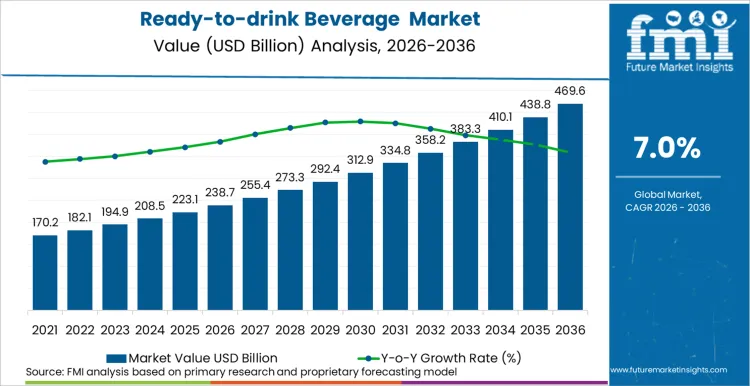
The ready-to-drink beverage market size stood at USD 221.6 billion in 2025. Industry is projected to cross USD 238.7 billion in 2026 at a CAGR of 7.7% during the forecast period. Demand buildup takes total industry valuation to USD 502.5 billion by 2036 as ready-packed drinks keep taking share from formats that need more preparation with weaker cold visibility, or less convenient handling.
Summary of Ready-to-Drink Beverage Market
- Market Snapshot
- The ready-to-drink beverage sector garnered USD 221.6 billion in 2025 and is projected to reach USD 502.5 billion by 2036.
- Industry value is expected to rise from USD 238.7 billion in 2026 at a CAGR of 7.7%, creating an incremental opportunity of USD 263.8 billion during the forecast period.
- Ready-to-drink beverages cover packaged drinks sold for immediate use across carbonated soft drinks, bottled and flavored water, RTD tea, and RTD coffee.
- Category structure also overlaps with non-alcoholic RTD beverages where pack convenience, shelf presence, and repeat purchase matter more than short-lived novelty.
- Demand and Growth Drivers
- Daily convenience remains the main growth force because ready-packed drinks remove preparation time and fit commuting, work, travel, and quick home replenishment.
- Hydration-led consumption keeps widening because adjacent demand in hydration supplements and electrolyte drinks has made everyday functional refreshment easier to understand.
- Energy, protein and satiety, and focus and cognition claims are adding new purchase moments beyond standard refreshment and widening the category's use through the day.
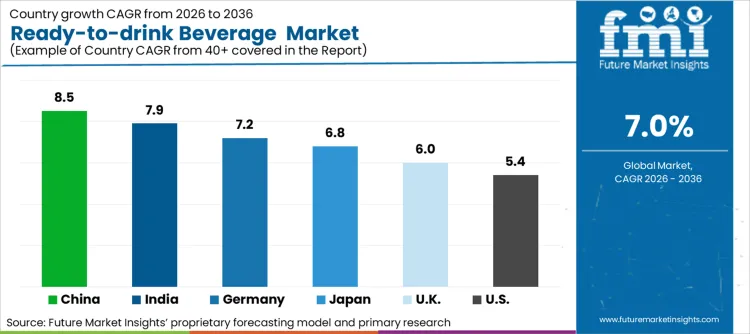
- China is set to lead the country at a projected 8.5%, seemingly followed by India at an anticipated 7.9%, Germany at 7.2%, Japan at 6.8%, the UK at 6.0%, and the USA at 5.4%, while the global average stands at 7.70% by 2036.
- Growth still faces moderation where beverage packaging costs, sugar scrutiny, and crowded shelf sets make launches harder to sustain.
- Product and Segment View
- Supermarkets and hypermarkets lead the distribution channel segment with an estimated 36.8% share in 2026, supported by higher shelf visibility, broader assortment, and stronger household replenishment behavior.
- Regular sugar beverages are projected to account for an expected 39.4% share in 2026 within the sugar and sweetener profile segment, as taste familiarity and easier large-scale formulation continue to support mainstream demand.
- Single-serve formats are poised to hold an estimated 57.2% share in 2026 in the pack size and serving size segment, reflecting strong on-the-go consumption and better fit across convenience, vending, and chilled retail formats.
- Mass or mainstream offerings are likely to secure a projected 61.7% share in 2026 within the price tier and positioning segment, as repeat purchase in ready-to-drink beverages remains closely tied to affordability, familiarity, and wide channel access.
- Carbonated Soft Drinks are poised to account for an anticipated 28.6% share of product type in 2026 because they keep the broadest distribution base and the clearest shelf recognition across mass retail.
- Hydration is poised to garner a predicted 24.8% of functionality / benefit claim in 2026, supported by frequent use and a simpler value message than more specialized benefit platforms.
- By packaging, cans are set to hold an expected 35.4% share in 2026 as portability, quick chill, and high visibility continue to suit immediate-use drinks.
- Pack logic in this segment also draws support from soft drink concentrates, aluminum cans, and other scalable beverage systems that favor line efficiency.
- Bottled and Flavored Water, RTD coffee, and iced tea keep the category balanced by serving hydration, caffeine, and lighter refreshment in different dayparts.
- Scope includes packaged drinks sold in cans, bottles, cartons, and pouches, but excludes fountain-only beverages, powder mixes, and freshly prepared café drinks.
- Geography and Competitive Outlook
- China and India remain the fastest-expanding named markets, while the USA stays a stable high-value base because the category already has deep retail and foodservice reach.
- Competition is shaped by route-to-market depth, refrigeration access, price discipline, and the ability to hold visibility across impulse and planned-purchase channels.
- Large groups such as Coca-Cola, PepsiCo, Nestlé, Danone, Keurig Dr Pepper, Red Bull, Monster Beverage, Suntory, and Asahi remain visible across multiple drink occasions, while regional brands keep pressure on local mix and pricing.
Key Takeaways, Market Size, and Forecast
- Ready-to-Drink Beverage Market is likely to grow from USD 238.7 billion in 2026 to USD 502.5 billion by 2036, at a CAGR of 7.7%.
- The ready-to-drink beverage market was valued at USD 221.6 billion in 2025.
- By 2036, the Ready-to-Drink Beverage Market is expected to be valued at USD 502.5 billion.
- From 2026 to 2036, the market is projected to advance at a CAGR of 7.7%.
- The market is expected to create an incremental opportunity of USD 263.8 billion during the forecast period.
- In 2026, Mass or Mainstream is anticipated to account for 61.7% of the price tier and positioning segment.
- China (8.5% CAGR) and India (7.9% CAGR) are predicted to be the fastest growing markets.
Shelf competition now centers on how easily a drink fits daily routines across sections for restocking. Brands are being pushed to choose whether they want to win through refreshment, or light functionality because each path changes formulation, pack shape, and channel placement. Products linked to functional beverages and zero sugar beverages are drawing more attention because buyers want a clearer reason to repurchase, yet taste consistency and pack-value balance still decide whether a trial purchase turns into habit.
A real step-up in demand appears when a brand secures steady chilled placement and fast replenishment across modern trade, convenience stores, and quick delivery channels. Usually achieved by distribution depth rather than by advertising alone. Once that happens, formats tied to ready-drink packaging and drink cans become easier to scale because display with stacking, and transport logic are already working in the brand's favor. As Greg Hughes, President & CEO, Suntory Global Spirits, stated, “Our aspiration is to be the #1 RTD company globally by enhancing our capabilities to quickly optimize taste and design for local markets. I am confident Davin will help us sharpen our focus on executing our RTD priorities, building momentum for our brands around the world and further strengthening our position in this critical category.” Highlighting the category’s consistent momentum driven by consumer demand for convenience, variety, and innovation.
China is expected to advance at 8.5% through 2036, followed by India at 7.9%, Germany at 7.2%, Japan at 6.8%, the UK at 6.0%, and the USA at 5.4%, against a global CAGR of 7.70%. Faster Asian growth reflects broader convenience access and wider daypart consumption, while mature Western demand moves at a slower pace because category penetration is already deep and shelf competition is heavier.
Segmental Analysis
Ready-to-Drink Beverage Market Analysis by Product Type
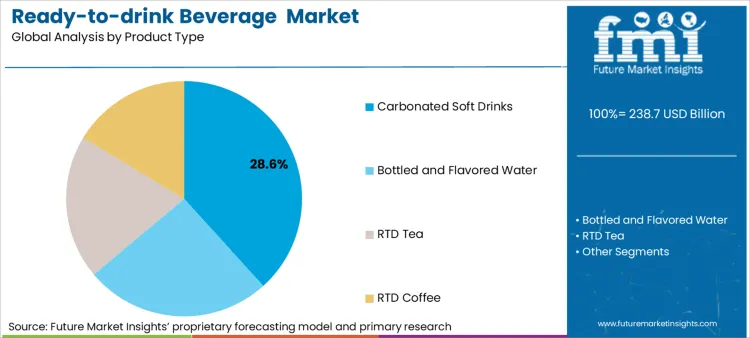
Carbonated soft drinks still set the pace in ready-to-drink beverage sales because they combine broad distribution, familiar taste profiles, and a strong fit with chilled impulse purchase. In 2026, this product type is poised to secure a projected 28.6% of total share as bottled and flavored water follows on the back of routine hydration needs, while RTD tea and RTD coffee stay relevant where buyers want lighter refreshment or caffeine with less preparation. Demand is also spreading toward low-calorie RTD beverages and bottled water as consumers rotate between indulgence, wellness, and convenience rather than staying inside one drink family.
- Distribution Depth: Carbonated formats move faster because they fit nearly every major retail shelf, cooler door, and vending touchpoint.
- Daypart Variation: Water, tea, and coffee each serve different consumption windows, which helps the broader category avoid dependence on one routine alone.
- Shelf Discipline: Product types that balance taste clarity, pack portability, and repeat affordability are more likely to hold space through seasonal resets.
Ready-to-Drink Beverage Market Analysis by Functionality/Benefit Claim
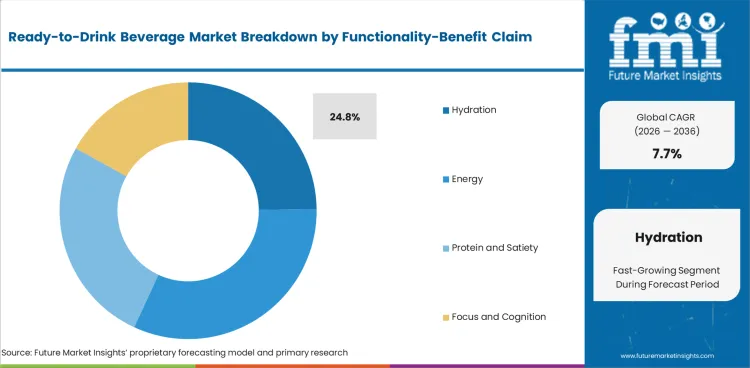
Benefit claims now do real commercial work in this category because they help explain where a drink belongs in daily use. Hydration is set to account for a predicted 24.8% of this segment in 2026 because it speaks to frequent use and does not rely on a specialist occasion. Energy remains a strong commercial block, while protein and satiety and focus and cognition create narrower but important demand pockets where consumers want a clearer use reason. Formats connected with water enhancers, and routine wellness are widening the space for functional language, yet repeat purchase still depends on taste and claim credibility.
- Routine Fit: Hydration wins because it supports everyday use and reaches a broader age mix than most other claims.
- Occasion Strength: Energy performs well in immediate-use settings where alertness and fast consumption matter more than extended satiety.
- Claim Discipline: Protein, satiety, and cognition-led products need clear flavor delivery and simple messaging or repeat purchase can soften quickly.
Ready-to-Drink Beverage Market Analysis by Packaging Format
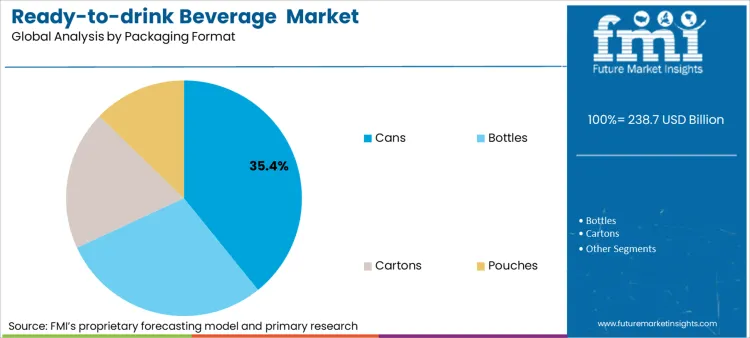
Packaging plays a larger role than simple product containment in the ready-to-drink beverage business. It influences how fast a drink chills, how it looks on shelf, how efficiently it moves through storage and transport, and how practical it remains once the consumer has opened it. Cans continue to fit carbonated drinks and energy-led formats particularly well because they chill quickly, stack efficiently, and support strong front-of-shelf visibility with their share garnered to reach an estimated 35.4% in 2026. Bottles remain relevant where resealability matters, especially for beverages consumed over more than one occasion. Cartons still work well in selected categories where ambient handling and value positioning carry weight. Pouches serve narrower convenience uses rather than the broad center of category demand. Beverage container choices linked to water packaging, grab-and-go use, and display efficiency keep gaining importance because purchase decisions in this category often depend on portability and easy shelf recognition at retail today.
- Impulse Conversion: Cans work well where chilled single-serve purchases drive the sale and visual impact at the cooler door matters.
- Extended Use: Bottles stay relevant for family packs, slower consumption occasions, and products where resealability adds practical value.
- Cost And Handling: Cartons and pouches win only when transport, storage, and pack-price logic are strong enough to offset lower shelf standout.
Ready-to-Drink Beverage Market Distribution Channel Analysis
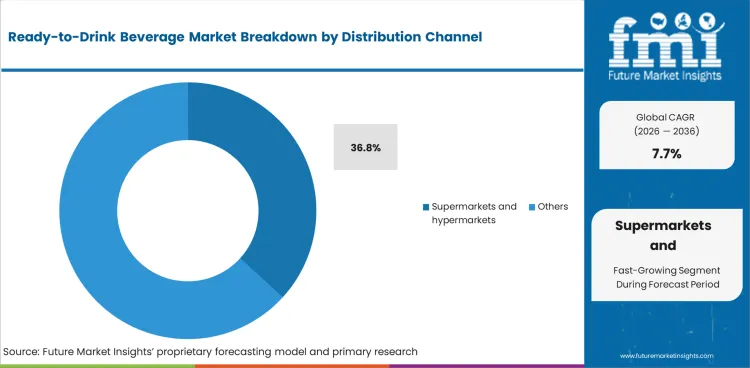
Large-format retail also supports the full mix of carbonated drinks with coffee and tea variations, and energy beverages in one location, which helps both routine replenishment and impulse add-on buying. Pack variety matters here. Single cans and bottles move through immediate-consumption demand, while cartons, multi-packs, and larger bottles support take-home purchasing. Promotional pricing also works better in this channel because shoppers can compare brands and pack sizes directly. Supermarkets and hypermarkets are ready to account for an expected 36.8% share in 2026 within the distribution channel segment because ready-to-drink beverages still rely heavily on visible shelf presence leading to high product turnover, and broad brand comparison at the point of purchase. Convenience retail remains important for chilled, immediate-use formats, yet supermarket and hypermarket networks continue to carry more volume because they combine scale, assortment width, and repeat weekly shopping behavior across urban and suburban demand centers.
- Assortment Depth: Wider shelf space allows mainstream, premium, functional, and value-positioned beverages to compete within the same retail setting.
- Volume Movement: Multi-pack buying and household replenishment support larger offtake than channels built mainly around single-occasion purchases.
- Promotional Efficiency: Discounts, bundle offers, and end-cap visibility strengthen repeat movement more effectively in organized retail.
Ready-to-Drink Beverage Market Sugar/Sweetener Profile Analysis
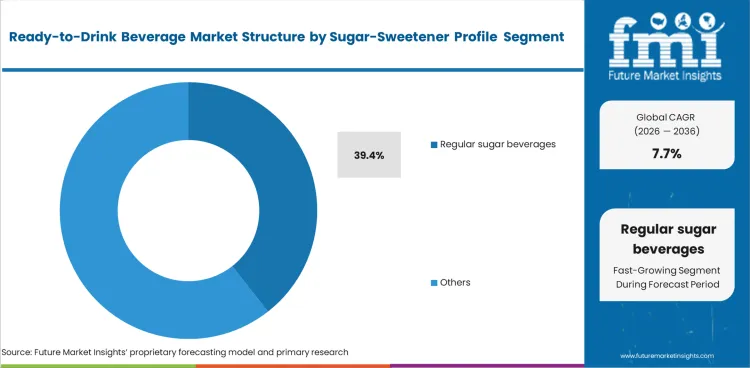
Regular sugar beverages are set to hold a projected 39.4% share in 2026 within the sugar and sweetener profile segment because mainstream carbonated drinks, and many RTD tea formats still depend on sugar for taste delivery and familiar consumer acceptance. Taste remains a commercial anchor in this category. Even with stronger movement toward zero-sugar and low-sugar positioning, large parts of the global market still buy beverages on flavor familiarity first. Especially in mass channels where price with taste consistency, and brand habit matter more than nutritional refinement alone. Unsweetened formats are important in bottled water and parts of RTD coffee and tea, but they do not yet outweigh the broader scale of sweetened volume across the total ready-to-drink beverage universe. Regular sugar formats continue to carry strong base demand because they remain easier to scale, position, and to repeat across wide consumer groups.
- Taste Familiarity: Sweetened beverages still convert more easily in mainstream retail because flavor acceptance is immediate and widely understood.
- Formulation Practicality: Standard sugar systems remain simpler to scale than some alternative sweetener combinations in large-volume beverage production.
- Category Spread: Carbonates, flavored drinks, and energy-led formats keep regular sugar relevant across multiple high-volume beverage types.
Ready-to-Drink Beverage Market Pack Size/Serving Size Analysis
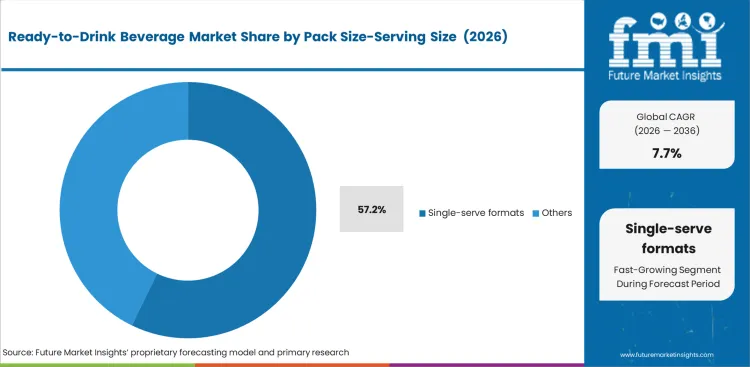
Ready-to-drink beverages are often purchased for immediate refreshment, or individual convenience across daily activities and leisure occasions. Such behavior supports cans, and grab-and-go packs more strongly than larger family-use formats. Single-serve packs also help brands manage pricing ladders across channels because they fit vending and convenience retail. Even chilled display units and impulse-led purchase zones are far better than bulky multi-serve packs. Multi-serve options remain important in household stocking and value-led shopping. Single-serve formats are likely to account for an estimated 57.2% share in 2026 within the pack size and serving size segment as it is still shaped heavily by portability and instant usability. Shelf space economics also favor single-serve lines because they turn faster, create stronger cold-case visibility, and support broader flavor and claim-based variety without forcing consumers into larger pack commitments.
- On-The-Go Fit: Immediate-use consumption keeps individual cans and bottles central to daily purchase behavior.
- Retail Compatibility: Chillers, checkout zones, vending units, and convenience shelves are designed around fast-moving single-serve packs.
- Price Accessibility: Smaller pack sizes lower entry cost and make trial easier across new flavors, brands, and functional claims.
Ready-to-Drink Beverage Market Price Tier/Positioning Analysis
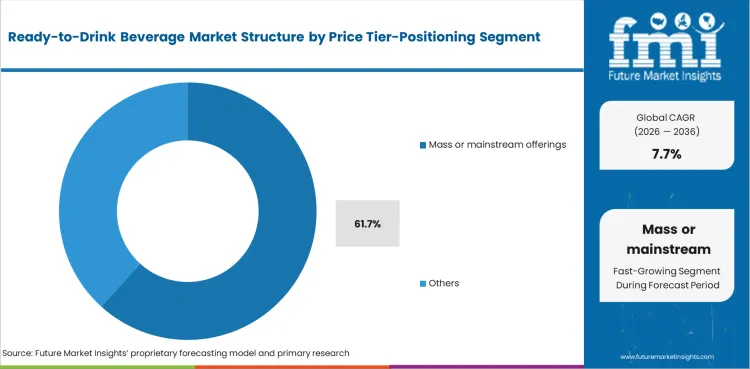
Mass or mainstream offerings are poised to project 61.7% share in 2026 within the price tier and positioning segment as ready-to-drink beverages remain a high-frequency category. Leading repeat purchase to depend more on affordability, and familiar taste than on premium storytelling alone. Mainstream pricing works because it holds the category close to everyday consumption. Large beverage brands also defend this tier effectively through broad route-to-market reach and multipack options. Steady promotional support across supermarkets or convenience stores and foodservice outlets are also contributing factors. Premium and super-premium products continue to perform in functional drinks, and wellness-led subcategories. Such areas still impact the wider market where value discipline matters. Consumers may trade up for added function or brand image. The center of gravity remains with products that balance acceptable pricing with recognizable taste and easy access. Such balance keeps mainstream positioning commercially stronger than narrower high-end formats.
- Repeat Purchase Strength: Everyday affordability supports higher consumption frequency than premium-led pricing across most beverage occasions.
- Channel Reach: Mainstream products gain wider shelf presence because they fit both modern retail and impulse-led sales environments.
- Portfolio Flexibility: Large brands can stretch the mass tier across flavors, pack sizes, and claims without losing broad consumer accessibility.
Ready-to-Drink Beverage Market Drivers, Restraints, and Opportunities
Convenience keeps this industry moving because ready-packed drinks remove preparation time and fit immediate consumption across commuting, work, travel, and home stocking. Retailers also favor formats that turn quickly by chilling well, and are easy to replenish. Providing an edge to products linked with sports drinks, functional beverages, and ready-drink packaging when they offer a clear use occasion instead of vague lifestyle language. Daily-use beverages also benefit when price points stay close enough to familiar alternatives that trial does not feel risky.
Category depth also creates pressure. Shelf space is finite with sugar scrutiny remaining active, and packaging inputs can weaken margins when costs move faster than consumer pricing. Mature markets already carry heavy brand clutter, so new entries must win with taste, or format logic rather than headline novelty. Products that overstate benefit claims or arrive in awkward packs often lose repeat purchase even when early sampling is strong. Pressure is sharper in segments that compete directly with zero sugar beverages, and other reformulated options.
- Hydration-Led Rotation: Daily-use drinks tied to hydration, light functionality, and reduced preparation effort have the widest room to add volume.
- Pack-Value Balance: Brands that match format size, price, and channel role more carefully can improve repeat purchase without leaning too hard on discount cycles.
- Emerging Market Headroom: Broader modern trade access in Asia and rising convenience habits create space for category expansion beyond mature Western demand.
Regional Analysis
Regional patterns in ready-to-drink beverages depend on how consumers buy drinks through the day and how retailers manage chilled and ambient space. Fast-growth markets are still building distribution depth, while mature ones defend share through pack mix, reformulation, and brand familiarity.
.webp "Top Country Growth Comparison Ready To Drink Beverage Market Cagr (2026 2036)")
| Country | CAGR (2026 to 2036) |
|---|---|
| China | 8.5% |
| India | 7.9% |
| Germany | 7.2% |
| Japan | 6.8% |
| UK | 6.0% |
| USA | 5.4% |
| Global average | 7.70% |
Source: Future Market Insights (FMI) analysis, based on proprietary forecasting model and primary research
North America Ready-to-Drink Beverage Market Analysis
North America remains one of the largest value pools for ready-to-drink beverages because convenience culture is already well established and chilled packaged drinks are deeply embedded in everyday retail. Product rotation is active, yet new demand often comes from mix shifts inside existing habits rather than from first-time category entry. Benefit claims, portion sizes, and price ladders matter because buyers compare familiar options quickly at shelf. Pressure also stays high because pack costs and sugar-related scrutiny can narrow the room for weaker formats.
- USA: Ready-to-drink beverage demand in the USA is poised to scale at an estimated CAGR of 5.4% through 2036. Growth sits below the global average because the category is already mature, yet scale remains hard to ignore. Strong convenience-store culture with large supermarket reach, and heavy cooler penetration keep packaged drinks in regular circulation. Pack changes with zero-sugar reformulation, and stronger positioning inside caffeinated beverages are likely to do more work than broad category expansion. Buyers in this market usually reward products that fit an existing routine without creating price or taste trade-offs.
FMI assesses, Canada and Mexico also shape the wider North American picture in FMI's full assessment. Canada tends to favor cleaner labeling and steady value growth, while Mexico keeps pressure on affordability and high-frequency purchase. Leaving North America commercially important even when headline growth rates trail faster Asian markets. Scale is still available here, but it usually comes from sharper positioning rather than from simple outlet expansion.
Europe Ready-to-Drink Beverage Market Analysis
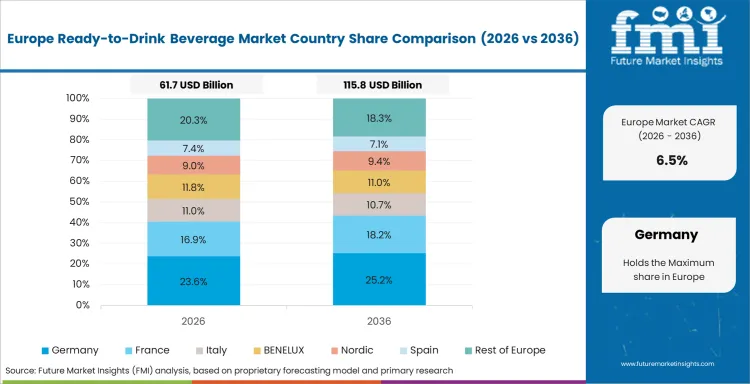
Europe stays commercially important because packaged beverage demand is broad, distribution is well organized, and retailer control over shelf space is strong. Category growth is steadier than in Asia, yet mix quality matters more because shoppers compare sugar content, benefit claims, and pack format closely. Regulatory pressure around labeling and packaging also shapes how quickly brands can widen distribution. Product success in this region often depends on whether the drink feels useful enough to justify space in a crowded fixture.
- Germany: Germany is projected to expand at a CAGR of 7.2% in ready-to-drink beverages by 2036, which keeps it above several other mature Western markets. Bottled water, carbonated drinks, and convenience-led caffeine products all benefit from strong retail execution and reliable pack handling. Buyers also tend to respond well to clear benefit language when it stays simple and believable. Competition is intense, so line extensions without a strong shelf role can struggle. Wider demand is likely to favor drinks that combine familiar taste with better functionality, cleaner sugar positioning, or easier grab-and-go use.
- UK: Growth is steady rather than fast because the consumers are already familiar across grocery, convenience, and foodservice. Reformulated soft drinks, ready coffee, and hydration-led products still find room when price points stay sensible and benefit claims are easy to read. Retail discipline matters because promotional intensity can quickly erode margin quality. Shelf competition is sharper in the UK, and ready-to-drink beverage demand is expected to advance at a CAGR of 6.0% by 2036. Products that fit daily purchase routines have a better chance of staying visible after the first listing cycle.
FMI's report also covers France, Italy, Spain, and other European markets where beverage demand is shaped by retail concentration, packaging rules, and category maturity. Western Europe usually rewards consistency, while Eastern Europe can add more room for frequency gains in selected formats. Growth in this region rarely comes from one segment alone. A better read is that pack logic, clearer claims, and disciplined channel fit decide which brands hold space.
Asia Pacific Ready-to-Drink Beverage Market Analysis
Asia Pacific carries the widest growth spread in this study because market maturity still differs sharply by country. Convenience retail is improving, quick delivery networks are widening, and daily packaged-drink use is still building in several urban markets. Beverage formats that match heat, mobility, and frequent small-ticket purchase tend to move faster here. Category expansion is also more visible because newer users are still entering the system alongside repeat buyers.
- China: China is expected to lead the named country set, with ready-to-drink beverage demand rising at a predicted CAGR of 8.5% by 2036. Urban convenience formats, broad digital ordering habits, and strong packaged-drink familiarity keep the category moving across multiple dayparts. Bottled water, tea, energy, and functional refreshment all benefit from a consumer base that is comfortable rotating between beverage types. Competition is broad, which raises the importance of shelf role and price architecture. Growth in China is likely to stay strongest where brands combine portability, quick use, and clear benefit cues without making the product feel overly specialized.
- India: Warm weather, growing urban mobility, and rising access to modern retail all support regular consumption of packaged drinks. Affordable formats matter here because price still shapes trial and repeat purchase more directly than in premium-heavy markets. Bottled water, carbonated refreshment, and emerging functional formats each have room when pack sizes fit everyday budgets. Convenience-led beverage demand is likely to rise steadily in India, where the market is forecast to expand at a CAGR of 7.9% by 2036. Expansion should stay healthy as long as distribution widens without pushing products into price bands that reduce purchase frequency.
- Japan: Mature beverage habits give Japan a different growth profile, and the country is set to grow at a projected CAGR of 6.8% during the forecast period. Vending density, convenience-store reach, and strong acceptance of ready tea and ready coffee keep the base large and stable. Buyers usually respond to precision in taste, portion, and use occasion, which leaves little room for loose positioning. Innovation still matters, though it tends to work best when it improves format fit or daypart relevance instead of simply adding another claim. Stability, execution, and habit strength remain the main reasons Japan stays important.
FMI observes, some markets still have room for first-wave penetration, while others already behave like mature packaged-drink systems. Asia Pacific therefore matters for two reasons at once: it adds volume and it tests which beverage ideas can scale beyond niche interest. Such combination keeps the region central to long-range category planning. Report includes South Korea, Southeast Asia, Australia, and additional Asia Pacific markets where convenience access and consumer routines continue to shape the category differently.
Competitive Aligners for Market Players
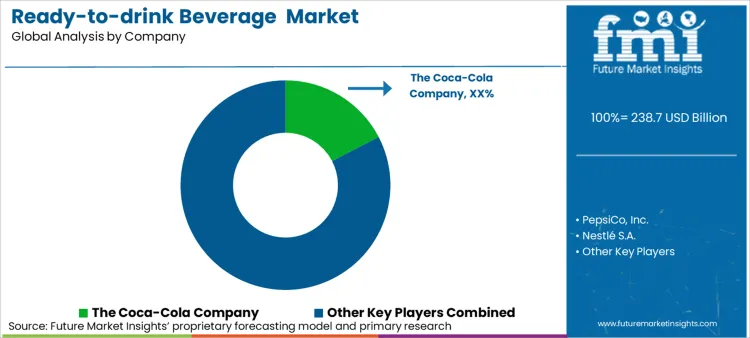
Market structure remains moderately concentrated because a handful of global groups control broad route-to-market access, cooler presence, and shelf recognition across multiple beverage occasions. Coca-Cola and PepsiCo are some significant players in the sector, while Nestlé, Danone, Keurig Dr Pepper, Red Bull, and Monster Beverage stay important where hydration, coffee, energy, or functional refreshment carry stronger weight. Buyers usually separate strong suppliers from weaker ones through availability, pack execution, and the ability to hold consistent taste across large retail networks. Brand equity still matters, yet it does not work alone. Scale is easier to defend when a company can keep the drink visible, easy to replenish, and clearly placed against direct substitutes.
Suntory, Asahi, Nongfu Spring, Tingyi, Ito En, and Otsuka remain relevant because they are tied to beverage habits that differ by country, pack format, and daypart. Unilever and Kraft Heinz appear in narrower ready-drink pockets, yet their presence shows how large food and beverage groups still look for space inside convenience-led refreshment. A challenger can enter this industry, but staying power depends on building distribution reliability, pack logic, and repeat purchase rather than relying on early curiosity. Such a pattern is visible across bottled water, water enhancers, and other adjacent formats where line extension is easier than long-term shelf retention.
Large retailers and foodservice buyers resist lock-in by keeping multiple beverage options inside the same cooler, shelf, or menu set. Such behavior limits how far any one supplier can push mix, pricing, or benefit language without risking substitution. Even so, leaders still hold an advantage because broad systems reduce out-of-stocks and make regional rollouts less disruptive. Competition through 2036 is likely to stay balanced between global scale and local fit rather than moving toward a closed winner-take-all structure.
Recent Developments
- In October 2024, Keurig Dr Pepper announced its agreement to acquire GHOST, saying the move would substantially strengthen its position in the energy drink category.
- In April 2025, Nestlé expanded Nescafé Ready-to-Drink cold coffee into India, the Middle East and North Africa, and Brazil, pointing to continued investment in convenient, on-the-go coffee formats for younger consumers.
- In March 2026, PepsiCo launched Gatorade Lower Sugar nationwide in the USA, adding a lower-sugar hydration offer with no artificial flavors, sweeteners, or colors.
Key Players in Ready-to-Drink Beverage Market
- The Coca-Cola Company
- PepsiCo, Inc.
- Nestlé S.A.
- Danone S.A.
- Keurig Dr Pepper Inc.
- Red Bull GmbH
- Monster Beverage Corporation
- Suntory Holdings Limited
- Asahi Group Holdings Ltd.
- Nongfu Spring Co., Ltd.
- Tingyi (Cayman Islands) Holding Corp.
- Ito En, Ltd.
- Otsuka Holdings Co., Ltd.
- Unilever PLC
- Kraft Heinz Company
Scope of the Report
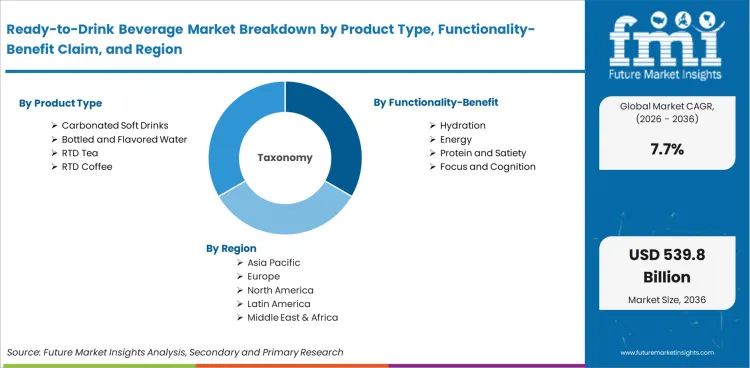
| Item | Value |
|---|---|
| Quantitative Units | Value in USD billion and growth in CAGR % for the forecast period. |
| Market Size (2025) | USD 221.6 billion |
| Industry Size (2026) | USD 238.7 billion |
| Forecast Value (2036) | USD 502.5 billion |
| CAGR (2026 to 2036) | 7.7% |
| Market Definition | Ready-to-drink beverages in this report refer to packaged drinks sold in finished form for immediate consumption. Coverage includes mainstream refreshment and benefit-led formats across carbonated soft drinks, bottled and flavored water, RTD tea, and RTD coffee, sold in cans, bottles, cartons, and pouches. The scope is limited to packaged ready-use products and excludes powder mixes, fountain-only beverages, and freshly prepared café drinks. |
| Product Type Segmentation | Carbonated Soft Drinks, Bottled and Flavored Water, RTD Tea, RTD Coffee |
| Functionality / Benefit Claim Segmentation | Hydration, Energy, Protein and Satiety, Focus and Cognition |
| Regions Covered | North America, Europe, Asia Pacific, Latin America, Middle East and Africa |
| Countries Covered | USA, China, India, Germany, Japan, UK, and additional countries across major regional clusters |
| Forecast Period | 2026 to 2036 |
| Approach | FMI combined primary research, proprietary forecasting, product mix assessment, packaging logic, and country-level demand analysis to build the forecast. |
Source: Future Market Insights (FMI) analysis, based on proprietary forecasting model and primary research
Ready-to-Drink Beverage Analysis by Segments
Product Type:
- Carbonated Soft Drinks
- Bottled and Flavored Water
- RTD Tea
- RTD Coffee
Functionality / Benefit Claim:
- Hydration
- Energy
- Protein and Satiety
- Focus and Cognition
Packaging Format:
- Cans
- Bottles
- Cartons
- Pouches
Region:
- North America
- USA
- Europe
- Germany
- UK
- Asia Pacific
- China
- India
- Japan
Bibliography
- PepsiCo. (2026, March 4). Gatorade Lower Sugar brings a new era of hydration with no artificial flavors, sweeteners or colors and 75% less sugar than Gatorade Thirst Quencher.
- Nestlé. (2025, April 2). Nescafé Ready-to-Drink expands its reach, captivating a new generation of coffee lovers.
- Keurig Dr Pepper. (2024, October 24). Keurig Dr Pepper to acquire disruptive energy drink business GHOST.
- The Coca-Cola Company. (2025, February 20). 10-K: Annual report pursuant to Section 13 and 15(d).
- PepsiCo, Inc. (2025). Annual Report 2024.
- Nestlé S.A. (2025). Annual Review 2024.
- Danone. (2025, March 11). Danone publishes its 2024 Universal Registration Document.
- Monster Beverage Corporation. (2025, February 27). Monster Beverage Reports 2024 Fourth Quarter and Full-Year Financial Results.
- Keurig Dr Pepper. (2025, February 25). Keurig Dr Pepper Reports Q4 and Full Year 2024 Results and Provides 2025 Outlook.
- USA Department of Agriculture, Economic Research Service. (2026, March 10). Food Dollar - Summary Findings.
- UNESDA Soft Drinks Europe. (2024). 2024 report - EU Code of Conduct on responsible food business and marketing practices.
- British Soft Drinks Association. (2024). 2024 Annual Report.
This bibliography is provided for reader reference. The full FMI report contains the complete reference list with primary source documentation.
This Report Addresses
- Market intelligence to support strategic decision making across carbonated soft drinks, bottled and flavored water, RTD tea, and RTD coffee.
- Market size estimation and long-range revenue forecasts from 2026 to 2036, supported by FMI's proprietary forecasting model and primary research.
- Growth opportunity mapping across product type, functionality / benefit claim, and packaging format with emphasis on repeat-use beverage occasions.
- Segment and regional revenue forecasts covering hydration, energy, protein and satiety, focus and cognition, and key country demand patterns.
- Competition strategy assessment including route-to-market depth, cooler visibility, pack execution, pricing discipline, and repeat purchase strength.
- Product development tracking across hydration-led positioning, caffeine-led convenience, reduced-sugar rotation, and portable single-serve formats.
- Market access analysis covering modern trade expansion, foodservice relevance, shelf pressure, and packaging format suitability in mature and emerging regions.
- Market report delivery in PDF, Excel, PPT, and interactive dashboard formats for executive planning, portfolio review, and operational benchmarking.
Frequently Asked Questions
How large is the industry in 2026?
The global ready-to-drink beverage market industry is expected to cross USD 238.7 billion in 2026 as ready-packed drinks keep widening their role in everyday refreshment and convenience-led consumption.
What value is projected by 2036?
The sector is projected to reach USD 502.5 billion by 2036 as frequency of packaged beverage use rises across hydration, caffeine, and impulse purchase occasions.
What CAGR is projected for 2026 to 2036?
The market is poised to expand at a predicted CAGR of 7.7% between 2026 and 2036, supported by wider convenience access and stronger repeat-use beverage habits.
Which product type leads in 2026?
Carbonated Soft Drinks are expected to lead product type with an anticipated 28.6% share in 2026 because they keep the widest distribution reach and shelf familiarity.
Which functionality claim stays in front?
Hydration is likely to lead functionality/benefit claim with a projected 24.8% share in 2026 because it fits frequent use better than narrower benefit platforms.
Which packaging format leads the mix?
Cans are set to account for an expected 35.4% share in 2026 as they suit portability, quick chilling, and strong cooler-door visibility.
What is supporting category expansion?
Convenience is doing most of the work because finished drinks remove preparation time and fit work, travel, home stocking, and impulse purchase routines.
What is the main restraint on faster adoption?
Shelf crowding and packaging cost pressure limit weaker launches, especially when benefit claims feel unclear or pricing drifts too far from familiar alternatives.
Which country grows fastest in this study?
China is poised to lead the named country set with a projected CAGR of 8.5% by 2036, helped by wide convenience access and strong packaged-drink rotation.
Why does China stay ahead of the USA?
China still has more room to widen convenience-led beverage use, while the USA already operates as a mature packaged-drink system with deeper penetration.
What keeps carbonated soft drinks in front?
Broad retail placement, familiar taste profiles, and strong impulse conversion keep carbonated soft drinks ahead of other product types in this category.
Why do cans remain ahead of other formats?
Cans work well for single-serve use because they chill fast, display clearly, travel easily, and fit carbonated and energy-led beverages especially well.
Where does bottled and flavored water fit in the mix?
Bottled and flavored water remains central to the category because it supports routine hydration and serves a broader set of daily consumption moments.
How important is RTD tea to category balance?
RTD tea helps balance the portfolio by serving lighter refreshment occasions where consumers want convenience without the sharper profile of energy drinks.
What role does RTD coffee play?
RTD coffee keeps the category relevant in caffeine-led dayparts where consumers want quick functionality with less preparation and stable pack convenience.
Why is hydration ahead of energy claims?
Hydration speaks to everyday use and a wider age mix, while energy usually depends on more specific consumption moments and stronger taste acceptance.
How does protein and satiety demand differ from hydration demand?
Protein and satiety demand is narrower because consumers expect a clearer functional payoff, whereas hydration can fit routine refreshment without much explanation.
What keeps Germany relevant in Europe?
Germany stays relevant because retail execution is strong, packaged beverage habits are established, and consumers respond well to clear benefit positioning.
Why does India remain one of the faster-growing markets?
India combines warm-weather consumption, rising urban mobility, and wider modern trade access, which together support more frequent packaged beverage purchase.
How should mature Western markets be read?
Mature Western markets still matter for value, but gains usually come from mix shifts, reformulation, and sharper pack logic rather than first-wave demand.
What does the competitive mix suggest?
Competition is broad rather than closed because large global groups lead shelf access, yet regional and local brands still matter across specific drink occasions.
What is included in the scope?
Scope includes packaged ready-to-drink beverages sold in cans, bottles, cartons, and pouches across carbonated, water, tea, coffee, and benefit-led formats.
What is excluded from the scope?
Fountain-only beverages, powder mixes, and freshly prepared café drinks are excluded because they do not follow the same packaged ready-use demand structure.
How was the forecast built?
The forecast was carried out using proprietary modelling, primary research, and category-level analysis of product mix, channel behavior, packaging logic, and country demand.
Preview the report firsthand - request a free sample
Get SampleGet the brochure for pricing and purchase details.
Get PDFTable of Content
- Executive Summary
- Global Market Outlook
- Demand-side Trends
- Supply-side Trends
- Technology Roadmap Analysis
- Analysis and Recommendations
- Market Overview
- Market Coverage / Taxonomy
- Market Definition / Scope / Limitations
- Research Methodology
- Chapter Orientation
- Analytical Lens and Working Hypotheses
- Market Structure, Signals, and Trend Drivers
- Benchmarking and Cross-market Comparability
- Market Sizing, Forecasting, and Opportunity Mapping
- Research Design and Evidence Framework
- Desk Research Programme (Secondary Evidence)
- Company Annual and Sustainability Reports
- Peer-reviewed Journals and Academic Literature
- Corporate Websites, Product Literature, and Technical Notes
- Earnings Decks and Investor Briefings
- Statutory Filings and Regulatory Disclosures
- Technical White Papers and Standards Notes
- Trade Journals, Industry Magazines, and Analyst Briefs
- Conference Proceedings, Webinars, and Seminar Materials
- Government Statistics Portals and Public Data Releases
- Press Releases and Reputable Media Coverage
- Specialist Newsletters and Curated Briefings
- Sector Databases and Reference Repositories
- FMI Internal Proprietary Databases and Historical Market Datasets
- Subscription Datasets and Paid Sources
- Social Channels, Communities, and Digital Listening Inputs
- Additional Desk Sources
- Expert Input and Fieldwork (Primary Evidence)
- Primary Modes
- Qualitative Interviews and Expert Elicitation
- Quantitative Surveys and Structured Data Capture
- Blended Approach
- Why Primary Evidence is Used
- Field Techniques
- Interviews
- Surveys
- Focus Groups
- Observational and In-context Research
- Social and Community Interactions
- Stakeholder Universe Engaged
- C-suite Leaders
- Board Members
- Presidents and Vice Presidents
- R&D and Innovation Heads
- Technical Specialists
- Domain Subject-matter Experts
- Scientists
- Physicians and Other Healthcare Professionals
- Governance, Ethics, and Data Stewardship
- Research Ethics
- Data Integrity and Handling
- Primary Modes
- Tooling, Models, and Reference Databases
- Desk Research Programme (Secondary Evidence)
- Data Engineering and Model Build
- Data Acquisition and Ingestion
- Cleaning, Normalisation, and Verification
- Synthesis, Triangulation, and Analysis
- Quality Assurance and Audit Trail
- Market Background
- Market Dynamics
- Drivers
- Restraints
- Opportunity
- Trends
- Scenario Forecast
- Demand in Optimistic Scenario
- Demand in Likely Scenario
- Demand in Conservative Scenario
- Opportunity Map Analysis
- Product Life Cycle Analysis
- Supply Chain Analysis
- Investment Feasibility Matrix
- Value Chain Analysis
- PESTLE and Porter’s Analysis
- Regulatory Landscape
- Regional Parent Market Outlook
- Production and Consumption Statistics
- Import and Export Statistics
- Market Dynamics
- Global Market Analysis 2021 to 2025 and Forecast, 2026 to 2036
- Historical Market Size Value (USD Million) Analysis, 2021 to 2025
- Current and Future Market Size Value (USD Million) Projections, 2026 to 2036
- Y-o-Y Growth Trend Analysis
- Absolute $ Opportunity Analysis
- Global Market Pricing Analysis 2021 to 2025 and Forecast 2026 to 2036
- Global Market Analysis 2021 to 2025 and Forecast 2026 to 2036, By Product Type
- Introduction / Key Findings
- Historical Market Size Value (USD Million) Analysis By Product Type , 2021 to 2025
- Current and Future Market Size Value (USD Million) Analysis and Forecast By Product Type , 2026 to 2036
- Carbonated Soft Drinks
- Bottled and Flavored Water
- RTD Tea
- RTD Coffee
- Carbonated Soft Drinks
- Y-o-Y Growth Trend Analysis By Product Type , 2021 to 2025
- Absolute $ Opportunity Analysis By Product Type , 2026 to 2036
- Global Market Analysis 2021 to 2025 and Forecast 2026 to 2036, By Functionality-Benefit Claim
- Introduction / Key Findings
- Historical Market Size Value (USD Million) Analysis By Functionality-Benefit Claim, 2021 to 2025
- Current and Future Market Size Value (USD Million) Analysis and Forecast By Functionality-Benefit Claim, 2026 to 2036
- Hydration
- Energy
- Protein and Satiety
- Focus and Cognition
- Hydration
- Y-o-Y Growth Trend Analysis By Functionality-Benefit Claim, 2021 to 2025
- Absolute $ Opportunity Analysis By Functionality-Benefit Claim, 2026 to 2036
- Global Market Analysis 2021 to 2025 and Forecast 2026 to 2036, By Packaging Format
- Introduction / Key Findings
- Historical Market Size Value (USD Million) Analysis By Packaging Format, 2021 to 2025
- Current and Future Market Size Value (USD Million) Analysis and Forecast By Packaging Format, 2026 to 2036
- Cans
- Bottles
- Cartons
- Pouches
- Cans
- Y-o-Y Growth Trend Analysis By Packaging Format, 2021 to 2025
- Absolute $ Opportunity Analysis By Packaging Format, 2026 to 2036
- Global Market Analysis 2021 to 2025 and Forecast 2026 to 2036, By Distribution Channel
- Introduction / Key Findings
- Historical Market Size Value (USD Million) Analysis By Distribution Channel, 2021 to 2025
- Current and Future Market Size Value (USD Million) Analysis and Forecast By Distribution Channel, 2026 to 2036
- Supermarkets and hypermarkets
- Others
- Supermarkets and hypermarkets
- Y-o-Y Growth Trend Analysis By Distribution Channel, 2021 to 2025
- Absolute $ Opportunity Analysis By Distribution Channel, 2026 to 2036
- Global Market Analysis 2021 to 2025 and Forecast 2026 to 2036, By Sugar-Sweetener Profile
- Introduction / Key Findings
- Historical Market Size Value (USD Million) Analysis By Sugar-Sweetener Profile, 2021 to 2025
- Current and Future Market Size Value (USD Million) Analysis and Forecast By Sugar-Sweetener Profile, 2026 to 2036
- Regular sugar beverages
- Others
- Regular sugar beverages
- Y-o-Y Growth Trend Analysis By Sugar-Sweetener Profile, 2021 to 2025
- Absolute $ Opportunity Analysis By Sugar-Sweetener Profile, 2026 to 2036
- Global Market Analysis 2021 to 2025 and Forecast 2026 to 2036, By Pack Size-Serving Size
- Introduction / Key Findings
- Historical Market Size Value (USD Million) Analysis By Pack Size-Serving Size, 2021 to 2025
- Current and Future Market Size Value (USD Million) Analysis and Forecast By Pack Size-Serving Size, 2026 to 2036
- Single-serve formats
- Others
- Single-serve formats
- Y-o-Y Growth Trend Analysis By Pack Size-Serving Size, 2021 to 2025
- Absolute $ Opportunity Analysis By Pack Size-Serving Size, 2026 to 2036
- Global Market Analysis 2021 to 2025 and Forecast 2026 to 2036, By Price Tier-Positioning
- Introduction / Key Findings
- Historical Market Size Value (USD Million) Analysis By Price Tier-Positioning, 2021 to 2025
- Current and Future Market Size Value (USD Million) Analysis and Forecast By Price Tier-Positioning, 2026 to 2036
- Mass or mainstream offerings
- Others
- Mass or mainstream offerings
- Y-o-Y Growth Trend Analysis By Price Tier-Positioning, 2021 to 2025
- Absolute $ Opportunity Analysis By Price Tier-Positioning, 2026 to 2036
- Global Market Analysis 2021 to 2025 and Forecast 2026 to 2036, By Region
- Introduction
- Historical Market Size Value (USD Million) Analysis By Region, 2021 to 2025
- Current Market Size Value (USD Million) Analysis and Forecast By Region, 2026 to 2036
- North America
- Latin America
- Western Europe
- Eastern Europe
- East Asia
- South Asia and Pacific
- Middle East & Africa
- Market Attractiveness Analysis By Region
- North America Market Analysis 2021 to 2025 and Forecast 2026 to 2036, By Country
- Historical Market Size Value (USD Million) Trend Analysis By Market Taxonomy, 2021 to 2025
- Market Size Value (USD Million) Forecast By Market Taxonomy, 2026 to 2036
- By Country
- USA
- Canada
- Mexico
- By Product Type
- By Functionality-Benefit Claim
- By Packaging Format
- By Distribution Channel
- By Sugar-Sweetener Profile
- By Pack Size-Serving Size
- By Price Tier-Positioning
- By Country
- Market Attractiveness Analysis
- By Country
- By Product Type
- By Functionality-Benefit Claim
- By Packaging Format
- By Distribution Channel
- By Sugar-Sweetener Profile
- By Pack Size-Serving Size
- By Price Tier-Positioning
- Key Takeaways
- Latin America Market Analysis 2021 to 2025 and Forecast 2026 to 2036, By Country
- Historical Market Size Value (USD Million) Trend Analysis By Market Taxonomy, 2021 to 2025
- Market Size Value (USD Million) Forecast By Market Taxonomy, 2026 to 2036
- By Country
- Brazil
- Chile
- Rest of Latin America
- By Product Type
- By Functionality-Benefit Claim
- By Packaging Format
- By Distribution Channel
- By Sugar-Sweetener Profile
- By Pack Size-Serving Size
- By Price Tier-Positioning
- By Country
- Market Attractiveness Analysis
- By Country
- By Product Type
- By Functionality-Benefit Claim
- By Packaging Format
- By Distribution Channel
- By Sugar-Sweetener Profile
- By Pack Size-Serving Size
- By Price Tier-Positioning
- Key Takeaways
- Western Europe Market Analysis 2021 to 2025 and Forecast 2026 to 2036, By Country
- Historical Market Size Value (USD Million) Trend Analysis By Market Taxonomy, 2021 to 2025
- Market Size Value (USD Million) Forecast By Market Taxonomy, 2026 to 2036
- By Country
- Germany
- UK
- Italy
- Spain
- France
- Nordic
- BENELUX
- Rest of Western Europe
- By Product Type
- By Functionality-Benefit Claim
- By Packaging Format
- By Distribution Channel
- By Sugar-Sweetener Profile
- By Pack Size-Serving Size
- By Price Tier-Positioning
- By Country
- Market Attractiveness Analysis
- By Country
- By Product Type
- By Functionality-Benefit Claim
- By Packaging Format
- By Distribution Channel
- By Sugar-Sweetener Profile
- By Pack Size-Serving Size
- By Price Tier-Positioning
- Key Takeaways
- Eastern Europe Market Analysis 2021 to 2025 and Forecast 2026 to 2036, By Country
- Historical Market Size Value (USD Million) Trend Analysis By Market Taxonomy, 2021 to 2025
- Market Size Value (USD Million) Forecast By Market Taxonomy, 2026 to 2036
- By Country
- Russia
- Poland
- Hungary
- Balkan & Baltic
- Rest of Eastern Europe
- By Product Type
- By Functionality-Benefit Claim
- By Packaging Format
- By Distribution Channel
- By Sugar-Sweetener Profile
- By Pack Size-Serving Size
- By Price Tier-Positioning
- By Country
- Market Attractiveness Analysis
- By Country
- By Product Type
- By Functionality-Benefit Claim
- By Packaging Format
- By Distribution Channel
- By Sugar-Sweetener Profile
- By Pack Size-Serving Size
- By Price Tier-Positioning
- Key Takeaways
- East Asia Market Analysis 2021 to 2025 and Forecast 2026 to 2036, By Country
- Historical Market Size Value (USD Million) Trend Analysis By Market Taxonomy, 2021 to 2025
- Market Size Value (USD Million) Forecast By Market Taxonomy, 2026 to 2036
- By Country
- China
- Japan
- South Korea
- By Product Type
- By Functionality-Benefit Claim
- By Packaging Format
- By Distribution Channel
- By Sugar-Sweetener Profile
- By Pack Size-Serving Size
- By Price Tier-Positioning
- By Country
- Market Attractiveness Analysis
- By Country
- By Product Type
- By Functionality-Benefit Claim
- By Packaging Format
- By Distribution Channel
- By Sugar-Sweetener Profile
- By Pack Size-Serving Size
- By Price Tier-Positioning
- Key Takeaways
- South Asia and Pacific Market Analysis 2021 to 2025 and Forecast 2026 to 2036, By Country
- Historical Market Size Value (USD Million) Trend Analysis By Market Taxonomy, 2021 to 2025
- Market Size Value (USD Million) Forecast By Market Taxonomy, 2026 to 2036
- By Country
- India
- ASEAN
- Australia & New Zealand
- Rest of South Asia and Pacific
- By Product Type
- By Functionality-Benefit Claim
- By Packaging Format
- By Distribution Channel
- By Sugar-Sweetener Profile
- By Pack Size-Serving Size
- By Price Tier-Positioning
- By Country
- Market Attractiveness Analysis
- By Country
- By Product Type
- By Functionality-Benefit Claim
- By Packaging Format
- By Distribution Channel
- By Sugar-Sweetener Profile
- By Pack Size-Serving Size
- By Price Tier-Positioning
- Key Takeaways
- Middle East & Africa Market Analysis 2021 to 2025 and Forecast 2026 to 2036, By Country
- Historical Market Size Value (USD Million) Trend Analysis By Market Taxonomy, 2021 to 2025
- Market Size Value (USD Million) Forecast By Market Taxonomy, 2026 to 2036
- By Country
- Kingdom of Saudi Arabia
- Other GCC Countries
- Turkiye
- South Africa
- Other African Union
- Rest of Middle East & Africa
- By Product Type
- By Functionality-Benefit Claim
- By Packaging Format
- By Distribution Channel
- By Sugar-Sweetener Profile
- By Pack Size-Serving Size
- By Price Tier-Positioning
- By Country
- Market Attractiveness Analysis
- By Country
- By Product Type
- By Functionality-Benefit Claim
- By Packaging Format
- By Distribution Channel
- By Sugar-Sweetener Profile
- By Pack Size-Serving Size
- By Price Tier-Positioning
- Key Takeaways
- Key Countries Market Analysis
- USA
- Pricing Analysis
- Market Share Analysis, 2025
- By Product Type
- By Functionality-Benefit Claim
- By Packaging Format
- By Distribution Channel
- By Sugar-Sweetener Profile
- By Pack Size-Serving Size
- By Price Tier-Positioning
- Canada
- Pricing Analysis
- Market Share Analysis, 2025
- By Product Type
- By Functionality-Benefit Claim
- By Packaging Format
- By Distribution Channel
- By Sugar-Sweetener Profile
- By Pack Size-Serving Size
- By Price Tier-Positioning
- Mexico
- Pricing Analysis
- Market Share Analysis, 2025
- By Product Type
- By Functionality-Benefit Claim
- By Packaging Format
- By Distribution Channel
- By Sugar-Sweetener Profile
- By Pack Size-Serving Size
- By Price Tier-Positioning
- Brazil
- Pricing Analysis
- Market Share Analysis, 2025
- By Product Type
- By Functionality-Benefit Claim
- By Packaging Format
- By Distribution Channel
- By Sugar-Sweetener Profile
- By Pack Size-Serving Size
- By Price Tier-Positioning
- Chile
- Pricing Analysis
- Market Share Analysis, 2025
- By Product Type
- By Functionality-Benefit Claim
- By Packaging Format
- By Distribution Channel
- By Sugar-Sweetener Profile
- By Pack Size-Serving Size
- By Price Tier-Positioning
- Germany
- Pricing Analysis
- Market Share Analysis, 2025
- By Product Type
- By Functionality-Benefit Claim
- By Packaging Format
- By Distribution Channel
- By Sugar-Sweetener Profile
- By Pack Size-Serving Size
- By Price Tier-Positioning
- UK
- Pricing Analysis
- Market Share Analysis, 2025
- By Product Type
- By Functionality-Benefit Claim
- By Packaging Format
- By Distribution Channel
- By Sugar-Sweetener Profile
- By Pack Size-Serving Size
- By Price Tier-Positioning
- Italy
- Pricing Analysis
- Market Share Analysis, 2025
- By Product Type
- By Functionality-Benefit Claim
- By Packaging Format
- By Distribution Channel
- By Sugar-Sweetener Profile
- By Pack Size-Serving Size
- By Price Tier-Positioning
- Spain
- Pricing Analysis
- Market Share Analysis, 2025
- By Product Type
- By Functionality-Benefit Claim
- By Packaging Format
- By Distribution Channel
- By Sugar-Sweetener Profile
- By Pack Size-Serving Size
- By Price Tier-Positioning
- France
- Pricing Analysis
- Market Share Analysis, 2025
- By Product Type
- By Functionality-Benefit Claim
- By Packaging Format
- By Distribution Channel
- By Sugar-Sweetener Profile
- By Pack Size-Serving Size
- By Price Tier-Positioning
- India
- Pricing Analysis
- Market Share Analysis, 2025
- By Product Type
- By Functionality-Benefit Claim
- By Packaging Format
- By Distribution Channel
- By Sugar-Sweetener Profile
- By Pack Size-Serving Size
- By Price Tier-Positioning
- ASEAN
- Pricing Analysis
- Market Share Analysis, 2025
- By Product Type
- By Functionality-Benefit Claim
- By Packaging Format
- By Distribution Channel
- By Sugar-Sweetener Profile
- By Pack Size-Serving Size
- By Price Tier-Positioning
- Australia & New Zealand
- Pricing Analysis
- Market Share Analysis, 2025
- By Product Type
- By Functionality-Benefit Claim
- By Packaging Format
- By Distribution Channel
- By Sugar-Sweetener Profile
- By Pack Size-Serving Size
- By Price Tier-Positioning
- China
- Pricing Analysis
- Market Share Analysis, 2025
- By Product Type
- By Functionality-Benefit Claim
- By Packaging Format
- By Distribution Channel
- By Sugar-Sweetener Profile
- By Pack Size-Serving Size
- By Price Tier-Positioning
- Japan
- Pricing Analysis
- Market Share Analysis, 2025
- By Product Type
- By Functionality-Benefit Claim
- By Packaging Format
- By Distribution Channel
- By Sugar-Sweetener Profile
- By Pack Size-Serving Size
- By Price Tier-Positioning
- South Korea
- Pricing Analysis
- Market Share Analysis, 2025
- By Product Type
- By Functionality-Benefit Claim
- By Packaging Format
- By Distribution Channel
- By Sugar-Sweetener Profile
- By Pack Size-Serving Size
- By Price Tier-Positioning
- Russia
- Pricing Analysis
- Market Share Analysis, 2025
- By Product Type
- By Functionality-Benefit Claim
- By Packaging Format
- By Distribution Channel
- By Sugar-Sweetener Profile
- By Pack Size-Serving Size
- By Price Tier-Positioning
- Poland
- Pricing Analysis
- Market Share Analysis, 2025
- By Product Type
- By Functionality-Benefit Claim
- By Packaging Format
- By Distribution Channel
- By Sugar-Sweetener Profile
- By Pack Size-Serving Size
- By Price Tier-Positioning
- Hungary
- Pricing Analysis
- Market Share Analysis, 2025
- By Product Type
- By Functionality-Benefit Claim
- By Packaging Format
- By Distribution Channel
- By Sugar-Sweetener Profile
- By Pack Size-Serving Size
- By Price Tier-Positioning
- Kingdom of Saudi Arabia
- Pricing Analysis
- Market Share Analysis, 2025
- By Product Type
- By Functionality-Benefit Claim
- By Packaging Format
- By Distribution Channel
- By Sugar-Sweetener Profile
- By Pack Size-Serving Size
- By Price Tier-Positioning
- Turkiye
- Pricing Analysis
- Market Share Analysis, 2025
- By Product Type
- By Functionality-Benefit Claim
- By Packaging Format
- By Distribution Channel
- By Sugar-Sweetener Profile
- By Pack Size-Serving Size
- By Price Tier-Positioning
- South Africa
- Pricing Analysis
- Market Share Analysis, 2025
- By Product Type
- By Functionality-Benefit Claim
- By Packaging Format
- By Distribution Channel
- By Sugar-Sweetener Profile
- By Pack Size-Serving Size
- By Price Tier-Positioning
- USA
- Market Structure Analysis
- Competition Dashboard
- Competition Benchmarking
- Market Share Analysis of Top Players
- By Regional
- By Product Type
- By Functionality-Benefit Claim
- By Packaging Format
- By Distribution Channel
- By Sugar-Sweetener Profile
- By Pack Size-Serving Size
- By Price Tier-Positioning
- Competition Analysis
- Competition Deep Dive
- The Coca-Cola Company
- Overview
- Product Portfolio
- Profitability by Market Segments (Product/Age /Sales Channel/Region)
- Sales Footprint
- Strategy Overview
- Marketing Strategy
- Product Strategy
- Channel Strategy
- PepsiCo, Inc.
- Nestlé S.A.
- Danone S.A.
- Keurig Dr Pepper Inc.
- Red Bull GmbH
- Monster Beverage Corporation
- Suntory Holdings Limited
- Asahi Group Holdings Ltd.
- Nongfu Spring Co., Ltd.
- Tingyi (Cayman Islands) Holding Corp.
- Ito En, Ltd.
- Otsuka Holdings Co., Ltd.
- Unilever PLC
- Kraft Heinz Company
- The Coca-Cola Company
- Competition Deep Dive
- Assumptions & Acronyms Used


