

- Industry Size (2025)
- USD 207415.5 Mn
- Forecast (2035)
- USD 341089.4 Mn
- CAGR (2025 to 2035)
- 5.1%
Fast Food & Quick Service Restaurant Market Outlook 2025 to 2035
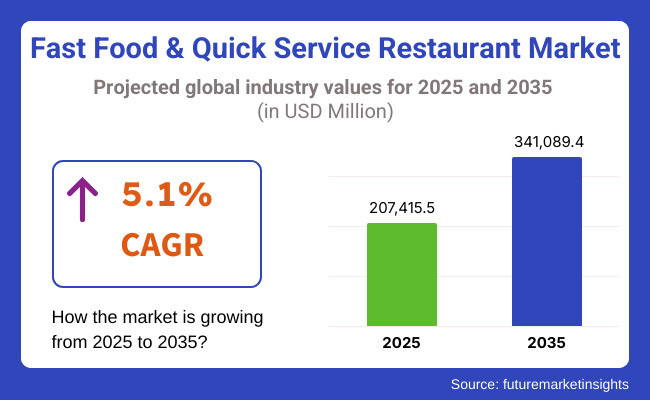
The Fast-Food and Quick-Service Restaurant (QSR) Market is projected to witness substantial growth between 2025 and 2035, driven by the rising demand for convenient and affordable dining options and the expansion of online food delivery services. The market is estimated to reach USD 207,415.5 million in 2025 and is expected to grow to USD 341,089.4 million by 2035, reflecting a compound annual growth rate (CAGR) of 5.1% throughout the assessment period.
One of the key factors influencing market expansion is the increasing urbanization and shifting consumer lifestyles, which favor quick and easily accessible meals. The fast-paced nature of modern living has led to a higher dependence on fast food and QSR chains, particularly among working professionals and younger consumers. Additionally, technological advancements in food delivery platforms and the rise of drive-thru and self-service kiosks have enhanced customer convenience, further propelling market growth.
USA cuisine, with its high level of international popularity and standardization and dominant international fast-food chain brands, leads the Cuisine Type segment. Popular American fast foods such as burgers, fried chicken, fries, sandwiches, and pizzas have taken a solid hold in the QSR market, where strong names like McDonald's, KFC, Dunkin, and Domino's Pizza are making aggressive expansions across regions.
One reason for their supremacy is the price, the uniformity, and the effective service model done by American fast food chains. Additionally, the demand for combo meals, value offerings, and customization has made American cuisine the most popular with international eaters, and this trend will endure in the quasi-fast food and QSR sector.
Regional Market Trends
North America
North America is a high-value market for the QSR and fast food industry, driven by the wide-ranging foodservice culture in the region, a high consumer base, and well-established global brands such as McDonald's, Burger King, and Subway. QSR chains and independent fast food restaurants cater to the growing consumer demand for socially acceptable, affordable, and portable food options due to the busy lifestyles people lead. The USA is the leading player in this market with its wide array of QSR chains and independent chains.
Canada is also a huge market, and demand for drive-thru and delivery is on the rise. Innovations like self-ordering kiosks, AI-driven menu set-up, and ordering through mobile applications have transformed the fast food sector. Moreover, the increasing consumer preference for healthy, organic, and plant-based fast food has resulted in QSR brands widening their product portfolio. Environmental sustainability is also one of the primary challenges as brands embrace sustainable packaging and employ waste reduction tactics to satisfy extremely strict environmental regulations.
Europe
A large part of the definitions comes from the QSR or fast food sector in Europe due to very high demand from the USA, Germany, France, and so on. Fast casual dining, which allows for higher-quality ingredients and healthier menu options compared to traditional fast food, has been steadily growing in the region. Consumers in Europe are becoming more health-conscious, driving higher sales of fast food products made with plants and organic ingredients.
Mass-market QSR brands such as KFC, Domino’s, and Five Guys are becoming more prominent as local chains roll out regional and gourmet fast foods. The strict food safety and environmental rules imposed by the European Union are establishing the standard within the industry for sustainability measures such as reduced plastic use, monitoring of carbon emissions, and waste reduction programs. In addition, an uptick in the ordering of food online has continued to fuel the sector, powered by the likes of Deliveroo and Uber Eats, with most QSRs optimizing their offerings for takeaway and home deliveries.
Asia-Pacific
The fast food and QSR market in the Asia-Pacific is expected to expand at the highest CAGR during the forecast period, owing to rapid urbanization, rising disposable income levels, and changes in dietary patterns. Market size is rapidly growing in China, India, Japan, and South Korea (China, in particular, has the largest QSRs in terms of growth and consumer spending). International chains such as McDonald’s, KFC, and Domino’s Pizza are expanding rapidly in the country, while domestic fast food chains and street vendors remain strong. The increasing adoption of digital payment tools and mobile food ordering applications has further propelled the growth of the market.
Faith in convenience, low-cost, and delicious fast food remains unchanged, although there is more of an emphasis on local and fusion foods to accommodate local tastes. However, due to several regulatory challenges concerning food safety norms, hygiene, and sustainability practices, they compel QSR players to develop high-quality control processes within the region.
Challenges and Opportunities
Challenge: Health and Nutrition Concerns
One of the widespread issues in the QSR and fast food industry, however, is the health impacts of fast food. Most fast foods are high in saturated fats, salt, and processed foods that contribute to rising obesity and lifestyle disorders. We expect consumers to gravitate toward healthy food options and QSR companies to feel pressure to reformulate their menus.
This has been accompanied by a growing consolidation on the part of many governments from country to country around tighter controls on nutritional labeling, sugar taxes, and ingredient statement requirements, which are further answered with menu innovation. Fast food chains have to juggle taste, affordability, and healthier alternatives to meet changing consumer expectations.
Opportunity: Rise of Digitalization and Sustainable Practices
Growing acceptance of digital technologies offers the fast food and QSR sector a great opportunity. Customer engagement powered by AI, intelligent drive-thrus, and digital ordering systems has driven convenience and efficiency, enabling brands to scale business and deliver customized experiences.
Furthermore, sustainability efforts are on the rise, with large QSR chains investing in plant-based options, green packaging, and carbon reduction measures. Brands that leverage technology-based solutions and emphasize sustainable practices will become the leaders in the changing fast food environment.
Shifts in the Fast Food & Quick Service Restaurant Market 2020 to 2024 and Future Trends 2025 to 2035
Between 2020 and 2024, the fast food & quick service restaurant (QSR) market experienced steady growth, driven by increasing urbanization, changing consumer lifestyles, and the rise of online food delivery platforms. The demand for convenient, affordable, and quickly prepared meals surged, particularly in metropolitan areas. The COVID-19 pandemic accelerated the adoption of drive-thru, takeaway, and contactless delivery services, reshaping operational models within the QSR sector.
Between 2025 and 2035, the fast food & quick service restaurant market will undergo a transformative shift driven by AI-driven automation, sustainability initiatives, and hyper-personalized customer experiences. Smart kitchens equipped with AI-driven cooking systems, autonomous food preparation robots, and real-time inventory tracking will enhance operational efficiency, reducing food waste and energy consumption.
Market Shifts: A Comparative Analysis 2020 to 2024 vs. 2025 to 2035
| Market Shift | 2020 to 2024 |
|---|---|
| Regulatory Landscape | Stricter food safety regulations, calorie labeling mandates, and bans on single-use plastics. |
| Technological Advancements | AI-powered kiosks, self-checkout, robotic food prep, and smart delivery platforms. |
| Industry Applications | Drive-thru, takeaway, food delivery, and cloud kitchens. |
| Adoption of Smart Equipment | Self-service kiosks, AI-based order predictions, and drone-based food delivery. |
| Sustainability & Cost Efficiency | Plant-based menu expansion, biodegradable packaging, and energy-efficient kitchen appliances. |
| Data Analytics & Predictive Modeling | AI-driven personalized promotions, demand forecasting, and cloud-based inventory tracking. |
| Production & Supply Chain Dynamics | COVID-19 supply chain disruptions, rising commodity costs, and increased demand for alternative proteins. |
| Market Growth Drivers | Growth is driven by convenience, digital ordering, and increasing demand for plant-based fast food. |
| Market Shift | 2025 to 2035 |
|---|---|
| Regulatory Landscape | AI-driven food safety compliance, blockchain-based ingredient traceability, and carbon-neutral QSR policies. |
| Technological Advancements | Autonomous QSR kitchens, voice-activated AI ordering, biometric payment authentication, and blockchain traceability. |
| Industry Applications | AI-powered robotic QSRs, 3D food printing outlets, and hyper-personalized nutrition-driven menus. |
| Adoption of Smart Equipment | Fully automated robotic kitchens, AI-powered vending machines, and smart packaging with real-time freshness tracking. |
| Sustainability & Cost Efficiency | Lab-grown meat alternatives, carbon-neutral restaurant models, and AI-driven waste reduction strategies. |
| Data Analytics & Predictive Modeling | Quantum-enhanced predictive modeling for menu optimization, AI-powered nutrition tracking, and real-time customer behavior analytics. |
| Production & Supply Chain Dynamics | AI-optimized supply chains, vertical farming-based ingredient sourcing, and blockchain-enabled real-time logistics tracking. |
| Market Growth Drivers | AI-powered QSR automation, sustainable fast food solutions, and the expansion of smart dining ecosystems. |
Country-wise Outlook
United States
The American fast food and quick service restaurant (QSR) market is growing steadily, fueled by soaring consumer demand for convenient and value-for-money meals, expanding digital food delivery platforms, and innovative menu development. The growing popularity of health-conscious fast food options and plant-based foods also drives market growth. The QSR sector across the nation is also witnessing automation of order processing, self-service kiosks, and the introduction of AI-based personalized menus.
| Country | CAGR (2025 to 2035) |
|---|---|
| USA | 5.0% |
United Kingdom
The UK QSR Market (Quick Service Restaurants) & fast food market, why the online food delivery services are rising, more international QSR chains (quick service restaurants), along with the growing grab-and-go foods, and the impact of the Covid-19 pandemic. People are choosing healthy fast food options like vegan fast food and gluten-free menus. Green packaging and sustainable sourcing are also defining the market, and QSR brands are adopting more environmentally friendly business methods.
| Country | CAGR (2025 to 2035) |
|---|---|
| UK | 5.2% |
European Union
The EU fast food & QSR market is experiencing growth due to the increasing urban population, changing eating habits, and rising consumer preference for quick and affordable meals. Countries like Germany, France, and Spain are witnessing a surge in QSR chains integrating digital payment systems, drive-thru automation, and AI-based menu recommendations. Stringent EU food safety regulations and sustainability initiatives are pushing brands toward organic, locally sourced, and plant-based menu offerings.
| Country | CAGR (2025 to 2035) |
|---|---|
| European Union | 5.3% |
Japan
Japan's quick service restaurants (QSR) & fast food market is transforming with a robust convenience culture, increasing popularity of Western fast food chains, and the use of cutting-edge technology in food service. Robotic food preparation innovation, automated food vending machines, and self-ordering kiosks lead the market. Additionally, healthier fast food consumption patterns, such as rice-based food items and seafood restaurants, are influencing the industry.
| Country | CAGR (2025 to 2035) |
|---|---|
| Japan | 5.1% |
South Korea
South Korea's QSR and fast food market is growing with the rising impact of international QSR brands, food delivery service growth, and Korean-inspired fast food innovation demand growth. Convenience meal solutions and the late-night eating trend are driving QSR sales. Moreover, innovations like AI-powered customer interactions and contactless ordering systems are improving the fast food customer experience.
| Country | CAGR (2025 to 2035) |
|---|---|
| South Korea | 5.4% |
Segmentation Outlook – Fast Food & Quick Service Restaurant Market
Branded Franchise Restaurants Lead Market Expansion as Standardized QSR Chains Gain Popularity
Branded franchise restaurants are the fastest-growing segment of the QSR market, providing customers with a consistent and familiar dining experience at many locations. In contrast to independent restaurants, branded franchises concentrate on applying successful business models, maintaining uniform food quality, efficient service, and robust brand identification.
Growth in the demand for established fast food restaurants has driven franchise-based restaurant expansion, as consumers embrace convenience and brand recognition in picking eating places. The rise of franchise-led international expansion has consolidated market demand, with top fast food chains entering new markets via master franchise deals, guaranteeing mass accessibility and local menu adaptations.
The incorporation of digital ordering platforms, including AI-driven menu personalization, blockchain-secured payment, and app-based loyalty schemes, has further accelerated adoption, guaranteeing hassle-free ordering and customer retention.
Creation of franchise-backed sustainability programs, such as green packaging film, waste-minimization programs, and plant-based menu extensions, has maximized market growth by aligning QSR brands with consumer needs for environmentally friendly meal options. Use of automation technology in QSR franchises, with AI-based kitchen management, robotics-based food preparation, and electronic customer service kiosks, has solidified market growth through increased operational effectiveness and decreased labor expenses.
Although it has the edge in scalability, brand reputation, and operational uniformity, the branded franchise segment is hampered by high setup expenditure, regulation complexities, and market saturation in developed markets. Emerging trends in AI-based customer intelligence, virtual extensions of brands, and ghost kitchens are enhancing market responsiveness, paving the way for branded franchise QSRs to sustain growth globally.
American Cuisine Drives Market Growth as Global Consumers Favor Classic Fast Food Offerings
American food has registered high market uptake, especially by urban consumers, youth, and foreign visitors, as QSR brands continue to extend their offerings to include typical American fast food fare. Contrary to local foods, American fast food is marked by worldwide popularity, uncomplicated preparation procedures, and prevalence.
The growing demand for American fast food, including burgers, fried chicken, hot dogs, and sandwiches, has driven adoption of this segment of cuisine, as consumers are looking for indulgent, familiar, and satisfying meals Fusion menu extensions with international takes on popular American items have driven increasing market demand, supporting diversity in taste profiles and fast food experience localization to alternate cultural markets.
Blending menu innovation for a healthy, more conscious set with organic produce, reduced-calorie content, and vegetable substitutes for standard American fare fast food further augments take-up, making health-focused consumer groups and diet-constrained market segments responsive to these items.
A major purpose in AI menu analytics creation, predictive consumer trend monitoring, real-time inventory management, and data-driven seasonal swings has saturated the market, maximizing improvements, allowing for improved response and consumer interaction. American fast food brands have solidified their market growth through online marketing efforts, such as social media-driven brand interaction, influencer-driven promotions & targeted web-based advertisement campaigns that ultimately secured enhanced consumer loyalty & brand recognition.
While the American cuisine category is buoyed by its international appeal, menu adaptability, and local compliance availability, it is weakened by growing health concerns regarding fast food, increased regulatory interest around ultra-processed foods, and changing dietary preferences towards plant-based and low-calorie foods.
However, the emergence of new innovations across the landscape spanning not just AI-based nutritional monitoring and alternative protein-based fast foods, but hybridizing of traditional and health-oriented options available at a single dine-in experience is allowing QSRs focusing on American cuisine outside of the USA to stick around in this evolving market and still grow as they carve growth opportunities out of a shrinking pie globally.
Independent QSRs Expand as Entrepreneur-Led Fast Food Ventures Gain Market Presence
The independent QSR category has won strong market acceptance, especially among local food entrepreneurs, small business owners, and specialty consumer niches, as demand for differentiated, non-standardized fast food products keeps increasing. Independent QSRs have no creative restrictions compared to branded franchises, enabling innovation through menus, regional modifications, and tailored customer relationships. The increasing need for community-based fast food experiences with locally sourced ingredients, artisanal preparations, and culturally relevant menu options has driven the adoption of independent QSRs as consumers look for unique dining options over mass-market fast food chains.
Though it has strengths in menu versatility, local economic impact, and brand uniqueness, the independent QSR segment has drawbacks like constrained scalability, greater operating expenses than franchised operations, and more competition from global QSR chains. Yet, innovations in AI-based business analytics, cloud-based inventory management, and hybrid dine-in and delivery service models are enhancing efficiency, profitability, and competitive positioning for independent fast food entrepreneurs globally.
Regional Cuisine-Based QSRs Gain Market Share as Ethnic Fast Food Demand Increases
The regional cuisine-based QSR market has grown steadily, fueled by increasing consumer demand for ethnic and traditional fast food. In contrast to traditional American fast food, regional cuisine QSRs specialize in genuine, culturally influenced food offerings adapted to local and global tastes. Rising demand for varied fast food choices, with Indian street foods, Chinese stir-fries, Italian pizza types, and Middle Eastern shawarma wraps, has driven the adoption of regionally branded QSRs, as world consumers accept multicultural food experiences.
Although it has the edge of cultural realness, menu diversification appeal, and favorable community backing, the regional cuisine QSR segment is challenged with operational intricacies in procuring ingredients, regulatory requirements for imported food items, and market barriers to penetration in foreign markets. In spite of these, innovations in AI-based recipe adaptation, cloud kitchen business growth strategies, and cross-cultural culinary partnerships are enhancing accessibility, consumer appeal, and market viability, guaranteeing further growth for regional cuisine-oriented QSR brands globally.
Competitive Outlook
The Fast-Food and Quick-Service Restaurant (QSR) Market is experiencing substantial growth due to changing consumer lifestyles, urbanization, and the rising demand for affordable and convenient dining options. The increasing popularity of drive-thru services, online food delivery platforms, and digital ordering systems has further propelled market expansion.
Additionally, growing preferences for customizable, healthier, and plant-based menu options are reshaping key players' strategies. Leading companies are investing in digital innovation, menu diversification, and sustainability initiatives to maintain their competitive edge.
Market Share Analysis by Company
| Company Name | Estimated Market Share (%) |
|---|---|
| McDonald's | 18-22% |
| Yum! Brands | 15-19% |
| Darden Concepts, Inc. | 10-14% |
| Quality Is Our Recipe, LLC | 8-12% |
| Carrols Restaurant Group, Inc. | 6-10% |
| Other Companies (combined) | 30-40% |
Key Company Offerings and Activities
| Company Name | Key Offerings/Activities |
|---|---|
| McDonald's | Operates a global fast-food chain offering burgers, fries, and beverages, with a focus on drive-thru, mobile app orders, and sustainability initiatives. |
| Yum! Brands | Owns KFC, Taco Bell, and Pizza Hut, specializing in fried chicken, Mexican fast food, and pizza, with a strong emphasis on global franchising and digital ordering. |
| Darden Concepts, Inc. | Operates casual dining brands like Olive Garden and LongHorn Steakhouse, focusing on sit-down quick service, Italian cuisine, and loyalty programs. |
| Quality Is Our Recipe, LLC | The parent company of Wendy’s is known for its fresh beef burgers, premium fast food, and digital ordering advancements. |
| Carrols Restaurant Group, Inc. | The largest Burger King franchisee operates thousands of locations with a focus on expansion and operational efficiency. |
Key Company Insights
McDonald's (18-22%)
As the world's largest fast food company, McDonald's remains the leader with its robust franchise system, large menu innovation, and digital evolution initiatives. The company is increasing mobile ordering, delivery alliances, and plant-based menu offerings to keep pace with changing consumer behavior.
Yum! Brands (15-19%)
A QSR giant, Yum! Brands owns KFC, Taco Bell, and Pizza Hut, utilizing robust global franchising, advertising campaigns, and menu personalization to appeal to various consumer tastes. The company is heavily investing in AI-powered digital ordering and loyalty programs.
Darden Concepts, Inc. (10-14%)
A leader in fast-casual dining, Darden Concepts owns Olive Garden, LongHorn Steakhouse, and other restaurant brands. The company focuses on dine-in experiences, loyalty rewards, and menu innovation while expanding its takeout and curbside pickup services.
Quality Is Our Recipe, LLC (8-12%)
Being the parent company of Wendy's, the brand competes on premium burger value, fresh ingredients, and digital ordering innovations.
Carrols Restaurant Group, Inc. (6-10%)
The largest Burger King franchisee, Carrols Restaurant Group, operates hundreds of Burger King locations across North America. To remain competitive, the company focuses on restaurant acquisitions, cost efficiencies, and value meal promotions.
Other Key Players (30-40% Combined)
The Fast Food & Quick Service Restaurant Market is also influenced by other regional and emerging brands such as:
- Subway – A leading sandwich and salad QSR chain, emphasizing healthy fast food and franchise-based expansion.
- Domino’s Pizza – A global leader in pizza delivery services, known for its tech-driven ordering system and aggressive expansion strategies.
- Chipotle Mexican Grill – Specializes in fast-casual Mexican cuisine, with a strong focus on organic ingredients, digital ordering, and sustainability.
- Burger King (owned by Restaurant Brands International) – Competes with McDonald's in burgers and value meal offerings, expanding drive-thru and mobile app services.
- Starbucks—Though primarily a coffeehouse chain, Starbucks plays a significant role in QSR market growth through its quick-service breakfast and beverage offerings.
Key Segmentation
By Type:
- Independent
- Branded/Franchise
By Cuisine:
- Indian
- Chinese
- American
- Italian
By End Users:
- Hotels, Restaurants & Cafes
- Retail Food Chains
- Cinemas
- Institutional
- Canteens
By Region:
- North America
- Latin America
- Western Europe
- Eastern Europe
- East Asia
- South Asia Pacific
- Middle East and Africa
Frequently Asked Questions
What was the overall size of the fast food & quick service restaurant market in 2025?
The overall market size for fast food & quick service restaurant market was USD 207,415.5 Million in 2025.
How big is the fast food & quick service restaurant market expected in 2035?
The fast food & quick service restaurant market is expected to reach USD 341,089.4 Million in 2035.
What will drive the demand for fast food & quick service restaurant market during the forecast period?
The rising demand for convenient and affordable dining options, coupled with the expansion of online food delivery services fuels Fast food & quick service restaurant Market during the forecast period.
List the top 5 countries contributing in fast food & quick service restaurant market?
The top 5 countries which drives the development of Fast food & quick service restaurant Market are USA, UK, Europe Union, Japan and South Korea.
Which is the leading segment in the fast food & quick service restaurant market?
On the basis of type, branded franchise restaurant to command significant share over the forecast period.
Preview the report firsthand - request a free sample
Get SampleGet the brochure for pricing and purchase details.
Get PDFTable of Content
- Executive Summary
- Industry Introduction, including Taxonomy and Market Definition
- Market Trends and Success Factors, including Macro-Economic Factors, Market Dynamics, and Recent Industry Developments
- Global Market Demand Analysis 2020 to 2024 and Forecast 2025 to 2035, including Historical Analysis and Future Projections
- Pricing Analysis
- Global Market Analysis 2020 to 2024 and Forecast 2025 to 2035
- Type
- Cuisine
- End Users
- Global Market Analysis 2020 to 2024 and Forecast 2025 to 2035, By Type
- Independent
- Branded/Franchise
- Global Market Analysis 2020 to 2024 and Forecast 2025 to 2035, By Cuisine
- Indian
- Chinese
- American
- Italian
- Global Market Analysis 2020 to 2024 and Forecast 2025 to 2035, By End Users
- Hotels, Restaurants & Cafes
- Retail Food Chains
- Cinemas
- Institutional
- Canteens
- Global Market Analysis 2020 to 2024 and Forecast 2025 to 2035, By Region
- North America
- Latin America
- Western Europe
- Eastern Europe
- East Asia
- South Asia Pacific
- Middle East and Africa
- North America Sales Analysis 2020 to 2024 and Forecast 2025 to 2035, by Key Segments and Countries
- Latin America Sales Analysis 2020 to 2024 and Forecast 2025 to 2035, by Key Segments and Countries
- Western Europe Sales Analysis 2020 to 2024 and Forecast 2025 to 2035, by Key Segments and Countries
- Eastern Europe Sales Analysis 2020 to 2024 and Forecast 2025 to 2035, by Key Segments and Countries
- East Asia Sales Analysis 2020 to 2024 and Forecast 2025 to 2035, by Key Segments and Countries
- South Asia Pacific Sales Analysis 2020 to 2024 and Forecast 2025 to 2035, by Key Segments and Countries
- Middle East and Africa Sales Analysis 2020 to 2024 and Forecast 2025 to 2035, by Key Segments and Countries
- Sales Forecast 2025 to 2035 by Type, Cuisine, and End Users for 30 Countries
- Competition Outlook, including Market Structure Analysis, Company Share Analysis by Key Players, and Competition Dashboard
- Company Profile
- Quality Is Our Recipe, LLC
- Carrols Restaurant Group, Inc
- Yum! Brands
- Darden Concepts, Inc.
- McDonald's
- Ark Restaurant Corp.
- DEL TACO RESTAURANT, INC.
- Restaurant Brands International Inc
- Kotipizza Group Oyj
- Chipotle Mexican Grill


