

- Industry Size (2025)
- USD 177.7 Mn
- Forecast (2035)
- USD 237.5 Mn
- CAGR (2025 to 2035)
- 2.9%
Demand for Soft Pack Label in USA Forecast and Outlook 2025 to 2035
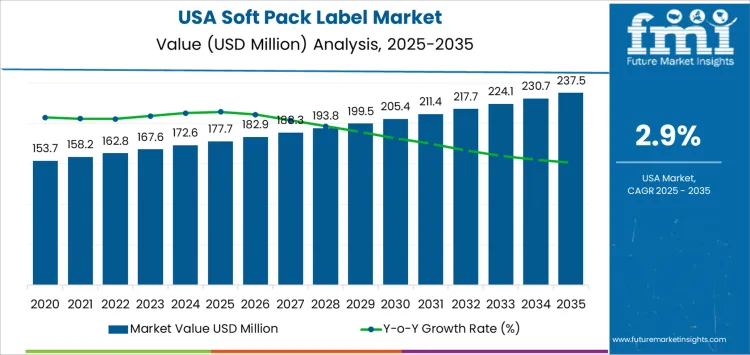
The demand for soft pack labels in the USA is expected to grow from USD 177.7 million in 2025 to USD 237.5 million by 2035, reflecting a compound annual growth rate (CAGR) of 2.9%. Soft pack labels are widely used in packaging applications across industries such as food and beverage, personal care, and pharmaceuticals. As packaging solutions continue to evolve, soft pack labels offer flexibility, durability, and cost-effectiveness, making them a popular choice for manufacturers. The increasing demand for flexible packaging and the shift towards sustainable, lightweight materials will drive steady growth in the soft pack label market.
The market will experience gradual growth, starting at USD 177.7 million in 2025 and rising to USD 182.9 million in 2026, USD 188.3 million in 2027, and USD 193.8 million in 2028. By 2029, demand for soft pack labels will rise to USD 199.5 million, continuing its upward trajectory through the 2030s. By 2035, the demand for soft pack labels is expected to reach USD 237.5 million, supported by the ongoing adoption of flexible packaging solutions and the growing emphasis on sustainability in packaging design.
Quick Stats of the Demand for Soft Pack Label in USA
- Demand for Soft Pack Label in USA Value (2025): USD 177.7 million
- Demand for Soft Pack Label in USA Forecast Value (2035): USD 237.5 million
- Demand for Soft Pack Label in USA Forecast CAGR (2025-2035): 2.9%
- Demand for Soft Pack Label in USA Key Material Type: 62% Plastic
- Demand for Soft Pack Label in USA Key Growth Regions: West USA, South USA, Northeast USA, Midwest USA
- Demand for Soft Pack Label in USA Key Players: Avery Dennison, CCL Industries, UPM Raflatac, Henkel, Toppan Printing
What is the Growth Forecast for the Soft Pack Label Industry in USA through 2035?
The saturation point analysis for the soft pack label market in the USA indicates that the market will reach maturity by the middle of the forecast period, around 2030. In the earlier years (2025-2029), the market will experience gradual growth driven by the steady adoption of soft pack labels across various industries. The primary driver during this period will be the increasing demand for flexible packaging solutions, particularly in sectors like food and beverage, where soft pack labels offer benefits in terms of cost efficiency and design flexibility.
As the market matures, the growth rate will likely decelerate slightly after 2029 as saturation sets in. This will occur due to widespread adoption of soft pack labels and the limited room for expansion in established markets. However, demand will remain stable, particularly as manufacturers continue to focus on improving packaging sustainability and addressing environmental concerns. By 2035, the soft pack label market will continue to grow at a more stable, mature rate, driven by ongoing advancements in packaging technology and continued demand for lightweight, efficient, and eco-friendly packaging solutions.
USA Soft Pack Label Industry Key Takeaways
| Metric | Value |
|---|---|
| Industry Sales Value (2025) | USD 177.7 million |
| Industry Forecast Value (2035) | USD 237.5 million |
| Industry Forecast CAGR (2025-2035) | 2.9% |
Why is the Demand for Soft Pack Labels in USA Growing?
Demand for soft pack labels in the USA is rising as flexible packaging continues to gain share within the overall packaging market. Flexible formats, such as pouches, sachets, and stand up bags, have accounted for a significant portion of the USA packaging market in recent years. Soft pack labels are preferred for these packages because they can flex with the pouch or bag, maintain adhesion through filling and shipping, and support lightweight, cost effective packaging that reduces material use and shipping weight. As demand increases for convenience foods, snack items, ready to eat meals, and single serve products, particularly in the food and beverage, snack, personal care, and health product segments, the use of flexible packaging and, by extension, soft pack labels grows.
At the same time, consumer demand for sustainability, convenience, and premium packaging drives growth. Many USA manufacturers and brands seek packaging solutions that use less plastic, reduce waste, and improve recyclability or material efficiency. Soft pack labels align with these objectives because they work with flexible pouches that often use less material than rigid containers. Advances in label printing technology and compatibility with flexible films support stable adhesion, high quality graphics, and efficient production, making soft pack labels more attractive than traditional rigid container labels. As the flexible packaging trend continues, demand for soft pack labels in the USA is expected to rise steadily in coming years.
What Is the Current State of the Demand for Soft Pack Labels in the USA in Terms of Material Type and End Use?
The demand for soft pack labels in the USA is driven by material type and end use. The leading material type is plastic, which accounts for 62% of the market share, while food is the dominant end-use sector, capturing 44% of the demand. Soft pack labels are commonly used for packaging in industries such as food, beverages, pharmaceuticals, and personal care. As consumers and industries seek durable, versatile, and cost-effective labeling solutions, plastic-based labels continue to dominate the market, with food packaging remaining the primary driver of demand.
How Is Plastic Leading the Material Type Demand for Soft Pack Labels in the USA?
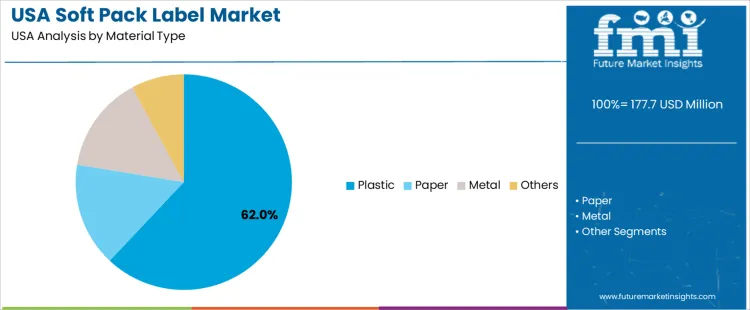
Plastic leads the material type demand for soft pack labels in the USA, holding 62% of the market share. Plastic labels are favored for their durability, resistance to moisture, and ability to maintain their appearance during transport and storage. These properties make plastic labels an ideal choice for soft packaging, which is commonly used in food, beverage, and consumer goods packaging. Plastic labels also provide a high level of flexibility in terms of design, offering the ability to print vibrant colors, logos, and other branding elements while maintaining durability.
The demand for plastic labels is driven by their widespread use in flexible packaging, particularly for products that require long shelf life and resistance to environmental factors such as humidity, temperature fluctuations, and rough handling during transportation. The growing demand for flexible, lightweight packaging in the food and beverage sector, along with the increasing emphasis on branding and product differentiation, continues to fuel the adoption of plastic-based soft pack labels in the USA.
How Is Food Leading the End-Use Demand for Soft Pack Labels in the USA?
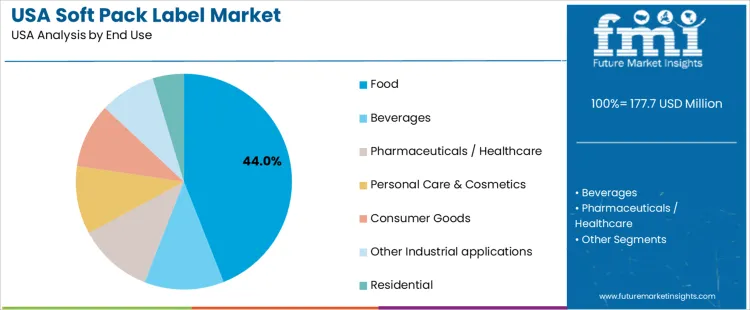
Food is the leading end-use sector for soft pack labels in the USA, accounting for 44% of the market share. The food industry relies heavily on soft pack labels to ensure product identification, regulatory compliance, and to convey branding and marketing information. Soft pack labels are commonly used for packaging a variety of food products, including snacks, ready-to-eat meals, and condiments, providing essential information such as ingredients, nutritional facts, and expiration dates.
The demand for soft pack labels in the food sector is driven by the need for convenient, flexible, and eye-catching packaging that ensures food safety and quality. As the food industry continues to shift toward more sustainable and flexible packaging solutions, the adoption of soft pack labels in the food sector is expected to remain strong. The increasing emphasis on product presentation, convenience, and eco-friendly packaging options continues to drive the demand for soft pack labels in the food industry in the USA.
What is the Demand Dynamics for Soft Pack Labels in the USA?
Demand for soft pack labels in the USA has been growing in line with rising use of flexible packaging formats. As companies across food and beverage, personal care, pharmaceuticals, and other consumer goods sectors shift toward lightweight, flexible pouches and packs, the need for appropriate soft pack labels increases. The broader flexible packaging market in the USA is substantial and growing, and soft pack labels represent a key part of that shift. Labels that adhere to flexible films or pouches enable product branding, regulatory compliance, ingredient information, and shelf appeal-making them increasingly important as flexible packs replace rigid containers.
What are the Drivers of Demand for Soft Pack Labels in the USA?
One major driver is growth in flexible packaging itself. The USA flexible packaging market is large and expanding as companies favour pouches, bags, and flexible formats over rigid packaging due to cost, weight, and convenience benefits. As more products move to flexible films and pouches, demand for soft pack labels grows in tandem. Another driver is rising consumer demand for convenient, on the go, shelf stable packaged goods such as snacks, beverages, personal care products, and household items-these often use flexible packaging with soft pack labels. Regulations and packaging compliance requirements (product information, nutrition labels, batch codes, expiry dates) also push producers to use high-quality labels on flexible packs. Finally, brand and marketing needs play a role: soft pack labels allow attractive graphics, branding, and design flexibility on flexible packaging, which helps companies attract consumers and differentiate products on store shelves.
What are the Restraints on Demand for Soft Pack Labels in the USA?
Even with growth, some factors constrain demand for soft pack labels. One restraint is that not all products are suitable for flexible packaging-heavy, fragile, or large-volume items may still require rigid containers, reducing the addressable market for soft pack labels. Another issue is cost: high barrier flexible packaging with high performance labels (e.g. for moisture or oxygen protection) can be more expensive than conventional rigid packaging or simpler label solutions, which may deter smaller or cost-sensitive brands. Environmental and regulatory pressure around plastic use and waste may also lead some companies or consumers to favour recyclable rigid packaging or paper-based solutions, which may reduce the pace of shift to flexible packs. Finally, achieving consistent label adhesion and durability on flexible films-especially in variable storage or transport conditions-can pose technical challenges, which may limit adoption if producers perceive risk of label failure or non compliance.
What are the Key Trends Influencing Demand for Soft Pack Labels in the USA?
A key trend is the ongoing shift from rigid packaging to flexible packaging formats across many product categories-including food, beverages, personal care, pet care, and household goods-which drives parallel growth in demand for soft pack labels. Another trend is greater emphasis on lightweight, cost efficient, and space saving packaging as supply chain, transportation, and sustainability pressures mount; flexible packs with soft pack labels help reduce shipping weight and material use. There is also increasing demand for high barrier flexible packaging that preserves freshness, extends shelf life, or protects sensitive contents, which often require specialized labels designed for flexible films. Additionally, growth of e commerce and direct to consumer distribution has encouraged use of flexible pouches that are easier to ship and store; such distribution models favour soft pack labeling. Finally, packaging innovation-including better adhesives, label materials, and printing technologies-is improving soft pack label quality and reliability, encouraging more brands to adopt flexible-pouch packaging with soft pack labels.
What is the Regional Demand Outlook for Soft Pack Labels in USA?
The demand for soft pack labels in the USA is projected to grow steadily across all regions. The West USA is leading with a projected CAGR of 3.4%, followed by the South USA at 3.0%, the Northeast USA at 2.7%, and the Midwest USA at 2.4%. These regional variations are driven by differences in packaging demand across industries such as food and beverage, pharmaceuticals, personal care, and consumer goods. The increasing adoption of flexible packaging solutions, particularly driven by e-commerce, sustainability, and logistical efficiencies, plays a significant role in driving this market.
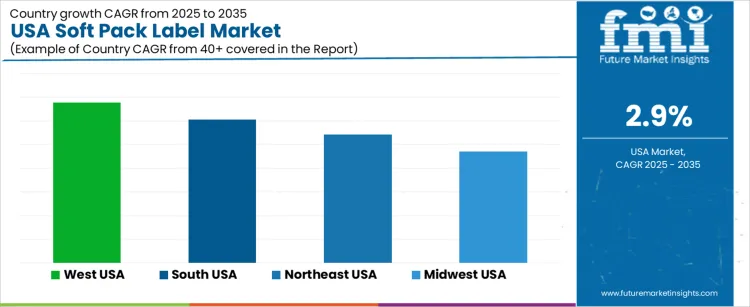
| Region | CAGR (%) |
|---|---|
| West USA | 3.4 |
| South USA | 3.0 |
| Northeast USA | 2.7 |
| Midwest USA | 2.4 |
What Drives Demand for Soft Pack Labels in the West USA?
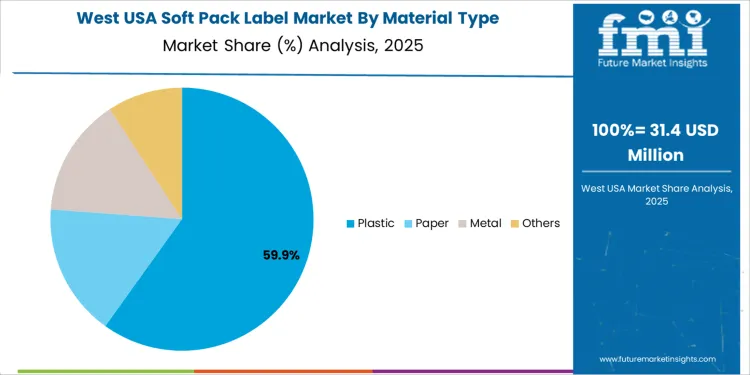
In the West USA, the demand for soft pack labels is projected to grow at a CAGR of 3.4%. This growth is primarily driven by the region’s robust manufacturing sector, particularly in food, beverage, and consumer goods. Soft pack labels are increasingly preferred for their lightweight, durable, and cost-effective nature, making them ideal for flexible packaging used in various products. The West also has a high concentration of environmentally conscious consumers, which drives demand for sustainable packaging options. As companies in this region look to reduce packaging waste and increase efficiency, the adoption of soft pack labels is expected to grow. The region’s high level of e-commerce activity also plays a significant role, as online shopping continues to fuel the need for innovative, space-saving packaging solutions.
Why is Demand for Soft Pack Labels Growing in the South USA?
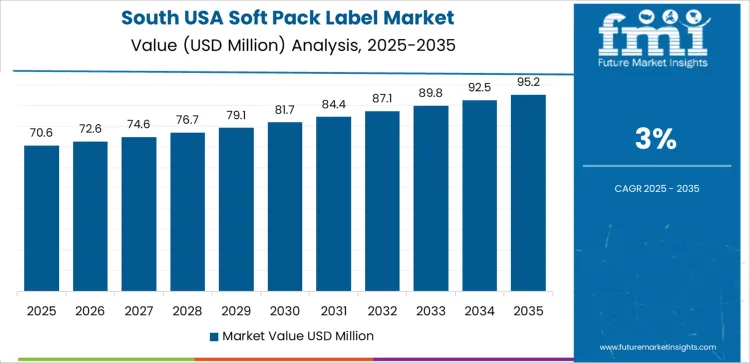
In the South USA, the projected CAGR for soft pack labels is 3.0%. The region’s growth in demand can be attributed to the expansion of the food and beverage industry, as well as the increasing use of flexible packaging across various sectors. Soft pack labels offer an efficient and versatile solution for packaging products in a wide range of industries, from personal care to pharmaceuticals. The South is also home to a growing number of manufacturers that are shifting to more sustainable packaging options. This shift is being driven by both consumer demand for eco-friendly products and regulations requiring more sustainable practices in the packaging industry. As businesses in the South continue to prioritize both cost-effectiveness and environmental sustainability, the demand for soft pack labels is expected to continue to rise.
What Supports the Growth of Soft Pack Labels in the Northeast USA?
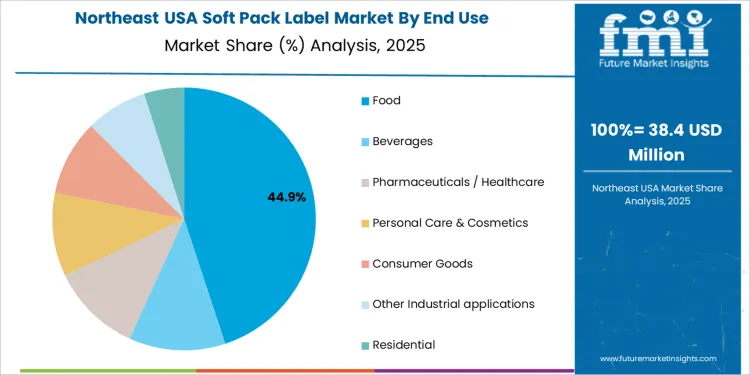
In the Northeast USA, the demand for soft pack labels is projected to grow at a CAGR of 2.7%. This steady growth is supported by the region’s strong presence in the pharmaceutical, food and beverage, and consumer goods industries. As more companies adopt flexible packaging for its convenience and cost-effectiveness, soft pack labels are increasingly becoming the solution of choice. Additionally, the Northeast’s high concentration of retail and e-commerce businesses boosts demand for packaging solutions that are both attractive and functional. Soft pack labels provide a reliable method for branding and ensuring product integrity while meeting the increasing consumer demand for more sustainable and eco-conscious packaging. As the market continues to prioritize convenience and sustainability, the adoption of soft pack labels in the Northeast is expected to grow.
How is Demand for Soft Pack Labels Evolving in the Midwest USA?
In the Midwest USA, the demand for soft pack labels is expected to grow at a CAGR of 2.4%. While growth in this region may be slower compared to others, the demand for flexible packaging solutions remains steady. The Midwest’s diverse industrial base, which includes the food, beverage, and pharmaceutical sectors, continues to drive the adoption of soft pack labels. As manufacturers in the region increasingly turn to flexible packaging for its logistical advantages, such as reduced weight and space efficiency, soft pack labels are becoming an essential component. Furthermore, as sustainability becomes more of a focus, companies are more likely to choose soft pack labels that are recyclable or made from sustainable materials. Although growth in the Midwest is more gradual, the steady demand from established industries ensures that soft pack labels will continue to see consistent adoption.
What is the Competitive Landscape for the Soft Pack Label Market in the USA?
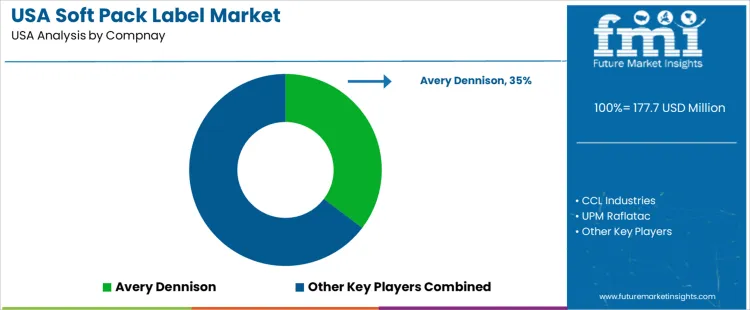
Demand for soft pack labels in the USA is rising as flexible packaging formats gain ground across food and beverage, personal care, cosmetics, and household goods industries. Flexible packaging has become a dominant format in US packaging, accounting for a large share of the overall packaging volume owing to its lightweight, cost efficient and space saving nature. Soft pack labels support that trend by offering a way to deliver branding and regulatory information on flexible pouches, bags, and films. Their suitability for moisture resistant, resealable, compact or low weight packs increases appeal to manufacturers seeking efficient, shelf ready packaging. As demand for convenience foods, take home cosmetics, and on the-go consumables grows in the USA, soft pack label demand reflects that shift toward flexible and sustainable packaging.
In that environment several producers and converters dominate supply. According to your data, Avery Dennison leads with about 35.3% share among identified firms. Other significant players include CCL Industries, UPM Raflatac, Henkel, and Toppan Printing. These companies compete on label quality, printing technology, material compatibility, supply chain reliability and ability to meet regulatory and branding demands. Some focus on high barrier, moisture resistant label materials suitable for food, pharmaceutical or cosmetic pouches. Others prioritise cost efficient films and pressure sensitive adhesives to serve high volume consumer goods clients. As flexible packaging continues to grow in share of US packaging formats, competition remains strong among soft pack label suppliers.
Key Players of the Soft Pack Label Industry in USA
- Avery Dennison
- CCL Industries
- UPM Raflatac
- Henkel
- Toppan Printing
Scope of the Report
| Items | Details |
|---|---|
| Quantitative Units | USD Million |
| Regions Covered | USA |
| Material Type | Plastic, Paper, Metal, Others |
| End Use | Food, Beverages, Pharmaceuticals / Healthcare, Personal Care & Cosmetics, Consumer Goods, Other Industrial Applications, Residential |
| Key Companies Profiled | Avery Dennison, CCL Industries, UPM Raflatac, Henkel, Toppan Printing |
| Additional Attributes | Dollar sales by material type and end-use show strong demand for plastic labels, particularly in food, beverage, and pharmaceutical applications. Paper labels are widely used in consumer goods and personal care sectors. Avery Dennison and CCL Industries lead the market, offering durable, high-quality label solutions across various industries. The market is expected to grow as consumer goods and packaging needs evolve, with increasing demand for eco-friendly and innovative labeling solutions. |
Key Segments in the Demand for Soft Pack Label in USA
Material Type
- Plastic
- Paper
- Metal
- Others
End Use
- Food
- Beverages
- Pharmaceuticals / Healthcare
- Personal Care & Cosmetics
- Consumer Goods
- Other Industrial Applications
- Residential
Region
- Northeast USA
- West USA
- Midwest USA
- South USA
Frequently Asked Questions
How big is the demand for soft pack label in USA in 2025?
The demand for soft pack label in USA is estimated to be valued at USD 177.7 million in 2025.
What will be the size of soft pack label in USA in 2035?
The market size for the soft pack label in USA is projected to reach USD 237.5 million by 2035.
How much will be the demand for soft pack label in USA growth between 2025 and 2035?
The demand for soft pack label in USA is expected to grow at a 2.9% CAGR between 2025 and 2035.
What are the key product types in the soft pack label in USA?
The key product types in soft pack label in USA are plastic, paper, metal and others.
Which end use segment is expected to contribute significant share in the soft pack label in USA in 2025?
In terms of end use, food segment is expected to command 44.0% share in the soft pack label in USA in 2025.
Preview the report firsthand - request a free sample
Get SampleGet the brochure for pricing and purchase details.
Get PDFTable of Content
- Executive Summary
- USA Market Outlook
- Demand-side Trends
- Supply-side Trends
- Technology Roadmap Analysis
- Analysis and Recommendations
- Market Overview
- Market Coverage / Taxonomy
- Market Definition / Scope / Limitations
- Market Background
- Market Dynamics
- Drivers
- Restraints
- Opportunity
- Trends
- Scenario Forecast
- Demand in Optimistic Scenario
- Demand in Likely Scenario
- Demand in Conservative Scenario
- Opportunity Map Analysis
- Product Life Cycle Analysis
- Supply Chain Analysis
- Investment Feasibility Matrix
- Value Chain Analysis
- PESTLE and Porter’s Analysis
- Regulatory Landscape
- Regional Parent Market Outlook
- Production and Consumption Statistics
- Import and Export Statistics
- Market Dynamics
- USA Market Analysis 2020 to 2024 and Forecast, 2025 to 2035
- Historical Market Size Value (USD Million) Analysis, 2020 to 2024
- Current and Future Market Size Value (USD Million) Projections, 2025 to 2035
- Y-o-Y Growth Trend Analysis
- Absolute $ Opportunity Analysis
- USA Market Pricing Analysis 2020 to 2024 and Forecast 2025 to 2035
- USA Market Analysis 2020 to 2024 and Forecast 2025 to 2035, By Material Type
- Introduction / Key Findings
- Historical Market Size Value (USD Million) Analysis By Material Type , 2020 to 2024
- Current and Future Market Size Value (USD Million) Analysis and Forecast By Material Type , 2025 to 2035
- Plastic
- Paper
- Metal
- Others
- Y-o-Y Growth Trend Analysis By Material Type , 2020 to 2024
- Absolute $ Opportunity Analysis By Material Type , 2025 to 2035
- USA Market Analysis 2020 to 2024 and Forecast 2025 to 2035, By End Use
- Introduction / Key Findings
- Historical Market Size Value (USD Million) Analysis By End Use, 2020 to 2024
- Current and Future Market Size Value (USD Million) Analysis and Forecast By End Use, 2025 to 2035
- Food
- Beverages
- Pharmaceuticals / Healthcare
- Personal Care & Cosmetics
- Consumer Goods
- Other Industrial applications
- Residential
- Y-o-Y Growth Trend Analysis By End Use, 2020 to 2024
- Absolute $ Opportunity Analysis By End Use, 2025 to 2035
- Market Structure Analysis
- Competition Dashboard
- Competition Benchmarking
- Market Share Analysis of Top Players
- By Regional
- By Material Type
- By End Use
- Competition Analysis
- Competition Deep Dive
- Avery Dennison
- Overview
- Product Portfolio
- Profitability by Market Segments (Product/Age /Sales Channel/Region)
- Sales Footprint
- Strategy Overview
- Marketing Strategy
- Product Strategy
- Channel Strategy
- CCL Industries
- UPM Raflatac
- Henkel
- Toppan Printing
- Avery Dennison
- Competition Deep Dive
- Assumptions & Acronyms Used
- Research Methodology


