

- Industry Size (2026)
- USD 3.6 Bn
- Forecast (2036)
- USD 14.6 Bn
- CAGR (2026 to 2036)
- 15.0%
Demand for AR VR Software in USA 2026 to 2036
Demand for AR VR software in USA is valued at USD 3.6 billion in 2026 and is forecasted to reach USD 14.6 billion by 2036, reflecting a CAGR of 15.0%. Demand expands as enterprises and consumers adopt immersive digital tools to enhance training, product visualization, collaboration, and interactive experiences. Acceleration of digital transformation, remote work adoption, and experiential technologies supports rapid software deployment across sectors.
Quick Stats for Demand for AR VR Software in USA
- USA AR VR Software Sales Value (2026): USD 3.6 billion
- USA AR VR Software Forecast Value (2036): USD 14.6 billion
- USA AR VR Software Forecast CAGR (2026 to 2036): 15.0%
- Leading Technology in USA: AR Software
- Key Growth Regions in USA: West USA, South USA, Northeast USA, Midwest USA
- Top Players in USA: Unity Technologies, Epic Games, Microsoft, PTC Inc., Vuforia (PTC)

AR software leads technology usage because overlay-based visualization integrates efficiently with real-world environments and existing hardware ecosystems. Enterprises apply AR solutions in maintenance guidance, workforce training, retail visualization, and industrial simulation without requiring fully immersive setups. Lower hardware dependency, scalability, and real-time contextual information strengthen adoption across commercial and industrial use cases.
West USA, South USA, Northeast USA, and Midwest USA represent key growth regions driven by concentration of technology firms, enterprise innovation hubs, and digital content development activity. Unity Technologies, Epic Games, Microsoft, PTC Inc., and Vuforia (PTC) anchor competitive activity through robust development platforms, enterprise-grade solutions, and continuous software innovation aligned with evolving immersive technology applications across the United States.
USA AR VR Software Key Takeaways
| Metric | Value |
|---|---|
| USA AR VR Software Sales Value (2026) | USD 3.6 billion |
| USA AR VR Software Forecast Value (2036) | USD 14.6 billion |
| USA AR VR Software Forecast CAGR (2026 to 2036) | 15.0% |
Why is the Demand for AR VR Software in USA Growing?
Demand for AR VR software in the United States grows due to expanding use across enterprise operations, healthcare, education, defense, and entertainment sectors. Manufacturing companies deploy immersive software to support workforce training, process simulation, and remote assistance within complex production environments. Healthcare providers apply AR VR platforms for surgical planning, medical education, pain management, and rehabilitation programs that rely on controlled virtual interaction. Educational institutions adopt immersive learning tools to enhance engagement in science, engineering, and vocational training programs.
Defense and aerospace organizations use simulation software to improve mission readiness, safety training, and scenario planning without physical resource constraints. Growth in remote and hybrid work increases adoption of virtual collaboration environments that support design review and spatial visualization. Retail and real estate sectors apply AR applications to improve product visualization and property walkthrough experiences. Advances in cloud computing, edge processing, and 5G connectivity improve software performance and accessibility. Software developers benefit from expanding hardware penetration across headsets and mobile devices. Corporate digital transformation initiatives prioritize immersive technologies that support productivity, skills transfer, and operational efficiency across distributed workforces.
How Are the Segments Classified in the Demand for AR and VR Software in USA?
Demand for AR and VR software in USA is shaped by enterprise digital transformation, workforce training modernization, and visualization requirements across industries. Buyers evaluate software stability, interoperability with enterprise IT systems, content scalability, and device compatibility. Adoption patterns show stronger penetration within structured organizations, supported by defined budgets, cybersecurity governance, and deployment across training, design validation, and operational support functions.
Which Technology Segment Leads Demand for AR and VR Software in USA?
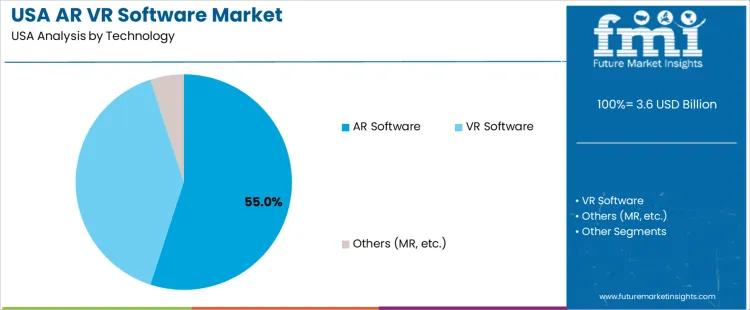
AR software holds 55.0%, representing the leading technology segment in USA demand. AR solutions enable real-time digital overlays within physical environments, supporting guided workflows, maintenance assistance, and contextual training. These capabilities align with manufacturing, field services, healthcare, and logistics operations requiring precision without isolating users from surroundings. VR software accounts for 40.0%, supporting immersive simulations, safety training, and virtual design reviews where full environmental immersion is required. Other technologies, including mixed reality, hold 5.0%, serving experimental and niche integration use cases. Technology distribution reflects stronger preference for AR due to practical deployment advantages and lower operational disruption.
Key Points
- AR software leads due to real-world workflow integration.
- Overlay-based guidance supports precision-driven operations.
- VR software serves immersive training and simulation needs.
Which Application Category Accounts for the Majority of AR and VR Software Demand in USA?
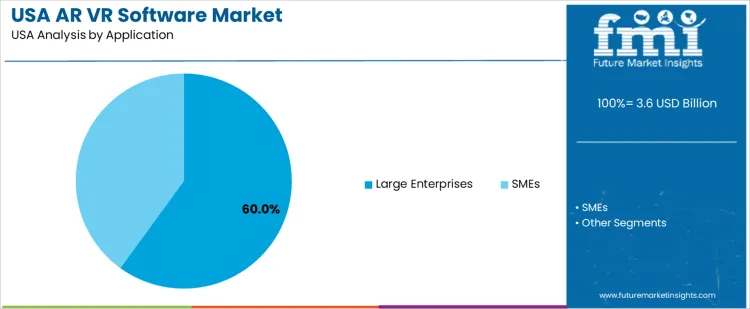
Large enterprises hold 60.0%, accounting for the majority of AR and VR software demand in USA. These organizations deploy immersive software across training programs, product design validation, remote expert assistance, and operational optimization initiatives. Large enterprises possess structured IT governance, cybersecurity frameworks, and internal development resources enabling scalable deployment. SMEs hold 40.0%, adopting AR and VR selectively for targeted training, customer engagement, and visualization use cases. Application distribution highlights concentration of advanced software adoption within large organizations managing complex, multi-site operations.
Key Points
- Large enterprises dominate due to scale and governance maturity.
- Enterprise adoption focuses on training and operational efficiency.
- SMEs adopt selectively based on cost and defined use cases.
What are the Key Dynamics in the AR VR Software Industry?
Demand rises as enterprises, educational institutions, healthcare providers, and entertainment companies in USA adopt augmented and virtual reality software to augment training, visualization, and immersive experience delivery. AR VR software supports simulation, remote collaboration, product design review, and experiential content. Adoption aligns with digital transformation strategies, strong technology infrastructure, and experimentation with immersive interaction models across corporate and consumer sectors.
How do enterprise digital transformation and immersive content needs drive demand in USA?
US manufacturers use AR software to provide remote assistance, overlay work instructions, and expedite maintenance workflows across complex machinery. VR platforms support immersive training simulations for safety, procedural rehearsal, and workforce upskilling in sectors with stringent quality standards. Higher education and vocational programs adopt VR to enhance experiential learning where physical lab access is limited. Healthcare providers use AR VR software for surgical planning, pain management, and therapeutic applications. Entertainment and media studios develop immersive experiences tied to gaming, virtual events, and branded content. High broadband penetration and cloud infrastructure facilitate development and distribution across diverse use cases.
How do cost barriers, content production complexity, and adoption behavior influence demand stability in USA?
Development and implementation costs for AR VR software remain significant, especially when creating custom enterprise content or integrating with legacy systems. Content production requires specialized skills in 3D modeling, user experience design, and real-time interaction logic, limiting rapid deployment. Hardware dependency and device fragmentation affect user experience consistency. Consumer adoption varies by demographics and use scenarios, with comfort and motion sensitivity influencing acceptance. Data security and privacy expectations impose design constraints for corporate use cases. Integration with existing enterprise platforms requires careful planning to avoid workflow disruption. Demand remains strong in targeted application areas, while broader expansion depends on cost reduction, demonstrable ROI, and compelling use cases within USA industries and institutions.
How Is Demand for AR VR Software in the USA Evolving by Region?
Demand for AR VR software in the USA is expanding due to enterprise digital transformation, immersive training adoption, and integration of virtual tools into design and operations. West USA leads with a 17.3% CAGR, supported by technology firms, content developers, and early enterprise adoption. South USA follows at 15.5%, driven by manufacturing training, logistics simulation, and workforce development initiatives. Northeast USA records a 13.8% CAGR, shaped by enterprise software use, education, and healthcare applications. Midwest USA posts 12.0%, reflecting manufacturing simulation and process optimization needs. Regional differences reflect enterprise readiness, industry mix, and pace of immersive technology integration across the USA.
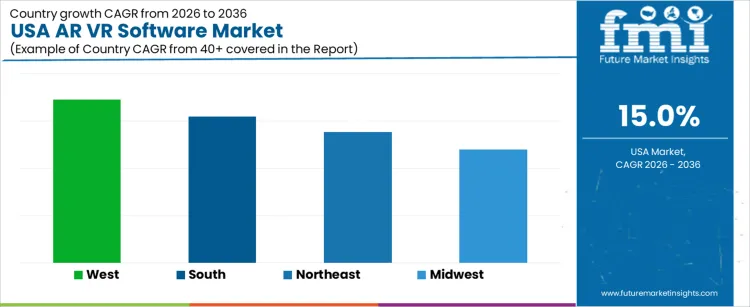
| Region | CAGR (2026 to 2036) |
|---|---|
| West USA | 17.3% |
| South USA | 15.5% |
| Northeast USA | 13.8% |
| Midwest USA | 12.0% |
How is West USA driving demand for AR VR Software in the USA?
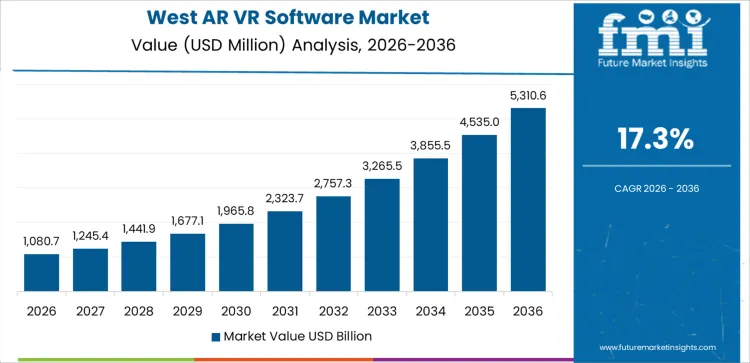
West USA drives demand through concentration of technology companies, software developers, and innovation-led enterprises. Region’s CAGR of 17.3% reflects widespread deployment of AR VR software for product design, remote collaboration, immersive training, and customer engagement. Enterprises integrate AR VR tools into digital workflows to shorten development cycles and improve visualization accuracy. Media, gaming, and entertainment sectors contribute to advanced content creation and platform development. Demand emphasizes high-fidelity graphics, cloud integration, and cross-device compatibility. Adoption remains enterprise-led and innovation-driven, aligned with rapid experimentation and continuous software upgrades across multiple industries.
- Technology and software-driven adoption
- Product design and collaboration use cases
- Media and content development activity
- High-fidelity and cloud-integrated platforms
How is South USA driving demand for AR VR Software in the USA?
South USA demand is shaped by manufacturing expansion, logistics operations, and workforce training requirements. Region’s CAGR of 15.5% reflects use of AR VR software for safety training, equipment simulation, and operational planning. Manufacturers deploy immersive training to reduce onboarding time and workplace incidents. Logistics providers apply VR tools for warehouse layout planning and process optimization. Enterprises prioritize scalable platforms, ease of deployment, and measurable productivity outcomes. Demand favors subscription-based software compatible with standard hardware. Growth remains training-led and efficiency-focused, aligned with regional workforce development and industrial growth.
- Manufacturing and logistics training usage
- Safety and equipment simulation applications
- Scalable and subscription-based platforms
- Productivity-focused enterprise adoption
How is Northeast USA driving demand for AR VR Software in the USA?
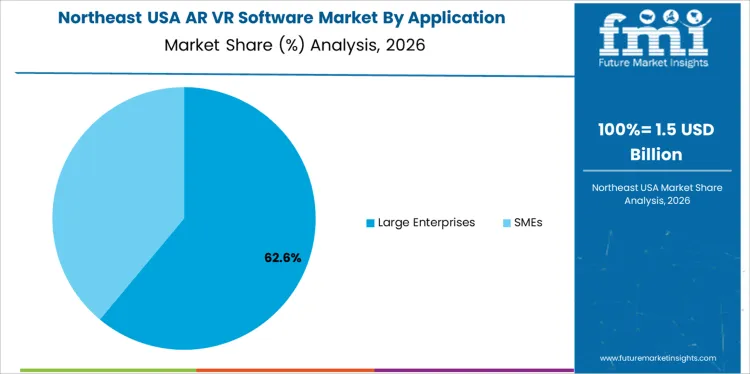
Northeast USA demand is driven by enterprise services, education institutions, and healthcare organizations. Region’s CAGR of 13.8% reflects adoption of AR VR software for professional training, medical simulation, and collaborative design. Universities and hospitals deploy immersive tools for education, surgical planning, and patient engagement. Enterprises emphasize data security, compliance, and integration with existing IT systems. Demand favors software supporting analytics, reporting, and multi-user collaboration. Growth aligns with institutional investment cycles and expansion of digital learning and healthcare technology initiatives.
- Education and healthcare application usage
- Enterprise training and collaboration tools
- Data security and compliance focus
- Institutional investment-driven adoption
How is Midwest USA driving demand for AR VR Software in the USA?
Midwest USA demand reflects manufacturing simulation, engineering design, and process optimization needs. Region’s CAGR of 12.0% is supported by use of AR VR software for virtual prototyping, assembly planning, and maintenance training. Automotive and industrial manufacturers adopt immersive tools to improve accuracy and reduce rework. Demand emphasizes compatibility with CAD systems and integration into engineering workflows. Adoption progresses steadily, aligned with capital planning and digital manufacturing initiatives. Growth remains engineering-led and process-focused rather than consumer-oriented.
- Manufacturing simulation and prototyping
- Engineering and maintenance training applications
- CAD-integrated immersive software
- Process optimization-driven adoption
What is the competitive landscape of demand for AR VR software in the USA?
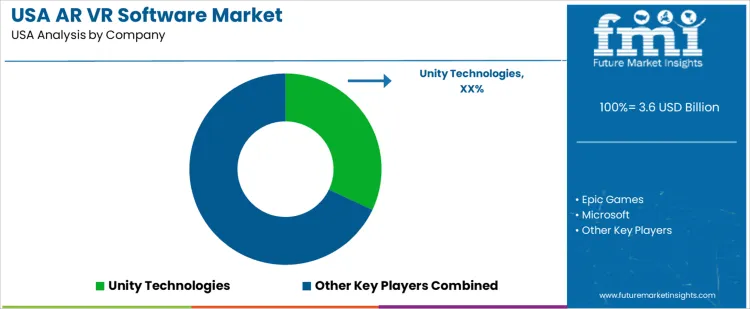
Demand for AR VR software in the USA is driven by adoption across gaming, enterprise training, industrial design, healthcare simulation, and education. Buyers evaluate platform capabilities for immersive visualization, spatial computing performance, real-time rendering, and interoperability with major head-mounted display ecosystems. Procurement teams prioritize solutions with strong developer support, integration with enterprise systems, and compliance with data privacy and cybersecurity expectations. Trend in the USA market reflects growth in metaverse-oriented applications, increasing use of AR in retail and field service workflows, and rising VR adoption for simulation and remote collaboration.
Unity Technologies maintains a strong position in the USA through its real-time 3D development platform widely used for AR and VR content creation across gaming and enterprise segments. Epic Games participates with Unreal Engine software enabling high-fidelity immersive experiences and extensive ecosystem support. Microsoft supports AR and mixed-reality development with its HoloLens platform and accompanying software tools for enterprise applications. PTC Inc. contributes AR software focused on industrial use cases such as remote guidance, maintenance workflows, and digital twin integration. Vuforia, part of PTC, offers widely adopted AR development tools used by U.S. businesses for mobile and wearable AR experiences. Competitive positioning in the USA reflects platform interoperability, developer ecosystem strength, localized support, and ability to deliver scalable AR VR applications across industry verticals.
Key Players in USA AR VR Software Demand
- Unity Technologies
- Epic Games
- Microsoft
- PTC Inc.
- Vuforia (PTC)
Scope of the Report
| Items | Details |
|---|---|
| Quantitative Units | USD billion |
| Technology | AR Software; VR Software; Others (Mixed Reality and related platforms) |
| Application | Large Enterprises; Small and Medium Enterprises |
| Regions Covered | West USA; South USA; Northeast USA; Midwest USA |
| Key Companies Profiled | Unity Technologies; Epic Games; Microsoft; PTC Inc.; Vuforia (PTC) |
| Additional Attributes | Demand reflects enterprise adoption across training, simulation, design visualization, and remote collaboration. AR software shows wider enterprise penetration, while VR adoption concentrates in immersive training and content development. SME uptake increases through cloud deployment, subscription licensing, and integration with existing industrial and collaboration software ecosystems. |
USA AR VR Software Demand by Segments
Technology:
- AR Software
- VR Software
- Others (MR, etc.)
Application:
- Large Enterprises
- SMEs
Region:
- West USA
- South USA
- Northeast USA
- Midwest USA
Frequently Asked Questions
How big is the demand for AR VR software in USA in 2026?
The demand for AR VR software in USA is estimated to be valued at USD 3.6 billion in 2026.
What will be the size of AR VR software in USA in 2036?
The market size for the AR VR software in USA is projected to reach USD 14.6 billion by 2036.
How much will be the demand for AR VR software in USA growth between 2026 and 2036?
The demand for AR VR software in USA is expected to grow at a 15.0% CAGR between 2026 and 2036.
What are the key product types in the AR VR software in USA?
The key product types in AR VR software in USA are ar software, vr software and others (mr, etc.).
Which application segment is expected to contribute significant share in the AR VR software in USA in 2026?
In terms of application, large enterprises segment is expected to command 60.0% share in the AR VR software in USA in 2026.
Preview the report firsthand - request a free sample
Get SampleGet the brochure for pricing and purchase details.
Get PDFTable of Content
- Executive Summary
- USA Market Outlook
- Demand-side Trends
- Supply-side Trends
- Technology Roadmap Analysis
- Analysis and Recommendations
- Market Overview
- Market Coverage / Taxonomy
- Market Definition / Scope / Limitations
- Market Background
- Market Dynamics
- Drivers
- Restraints
- Opportunity
- Trends
- Scenario Forecast
- Demand in Optimistic Scenario
- Demand in Likely Scenario
- Demand in Conservative Scenario
- Opportunity Map Analysis
- Product Life Cycle Analysis
- Supply Chain Analysis
- Investment Feasibility Matrix
- Value Chain Analysis
- PESTLE and Porter’s Analysis
- Regulatory Landscape
- Regional Parent Market Outlook
- Production and Consumption Statistics
- Import and Export Statistics
- Market Dynamics
- USA Market Analysis 2021 to 2025 and Forecast, 2026 to 2036
- Historical Market Size Value (USD Million) Analysis, 2021 to 2025
- Current and Future Market Size Value (USD Million) Projections, 2026 to 2036
- Y-o-Y Growth Trend Analysis
- Absolute $ Opportunity Analysis
- USA Market Pricing Analysis 2021 to 2025 and Forecast 2026 to 2036
- USA Market Analysis 2021 to 2025 and Forecast 2026 to 2036, By Technology
- Introduction / Key Findings
- Historical Market Size Value (USD Million) Analysis By Technology , 2021 to 2025
- Current and Future Market Size Value (USD Million) Analysis and Forecast By Technology , 2026 to 2036
- AR Software
- VR Software
- Others (MR, etc.)
- AR Software
- Y-o-Y Growth Trend Analysis By Technology , 2021 to 2025
- Absolute $ Opportunity Analysis By Technology , 2026 to 2036
- USA Market Analysis 2021 to 2025 and Forecast 2026 to 2036, By Application
- Introduction / Key Findings
- Historical Market Size Value (USD Million) Analysis By Application, 2021 to 2025
- Current and Future Market Size Value (USD Million) Analysis and Forecast By Application, 2026 to 2036
- Large Enterprises
- SMEs
- Large Enterprises
- Y-o-Y Growth Trend Analysis By Application, 2021 to 2025
- Absolute $ Opportunity Analysis By Application, 2026 to 2036
- Market Structure Analysis
- Competition Dashboard
- Competition Benchmarking
- Market Share Analysis of Top Players
- By Regional
- By Technology
- By Application
- Competition Analysis
- Competition Deep Dive
- Value (USD Million)y Technologies
- Overview
- Product Portfolio
- Profitability by Market Segments (Product/Age /Sales Channel/Region)
- Sales Footprint
- Strategy Overview
- Marketing Strategy
- Product Strategy
- Channel Strategy
- Epic Games
- Microsoft
- PTC Inc.
- Vuforia (PTC)
- Value (USD Million)y Technologies
- Competition Deep Dive
- Assumptions & Acronyms Used
- Research Methodology


