

- Industry Size (2026)
- USD 460.7 Mn
- Forecast (2036)
- USD 1419.0 Mn
- CAGR (2026 to 2036)
- 11.9%
Demand for AR VR Software in Japan 2026 to 2036
Demand for AR VR software in Japan is valued at USD 460.7 million in 2026 and is expected to reach USD 1,419.0 million by 2036, reflecting a CAGR of 11.9%. Demand accelerates as enterprises adopt immersive technologies to improve training efficiency, design visualization, remote collaboration, and customer engagement. Digital transformation programs and workforce upskilling initiatives support expanding deployment across industrial, commercial, and public-sector environments.
Quick Stats for Demand for AR VR Software in Japan
- Japan AR VR Software Sales Value (2026): USD 460.7 million
- Japan AR VR Software Forecast Value (2036): USD 1,419.0 million
- Japan AR VR Software Forecast CAGR (2026 to 2036): 11.9%
- Leading Technology in Japan: AR Software
- Key Growth Regions in Japan: Kyushu & Okinawa, Kanto, Kansai, Chubu, Tohoku
- Top Players in Japan: Sony Interactive Entertainment, Bandai Namco Research, NEC Corporation, Fujitsu, HTC Japan
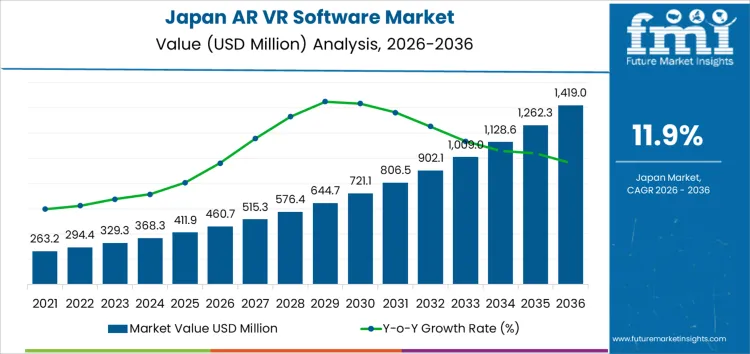
AR software leads technology usage because overlay-based visualization integrates effectively with real-world operations, existing hardware, and enterprise IT systems. Large enterprises prioritize AR solutions for maintenance guidance, digital twins, assembly validation, and field service optimization. Scalability, device interoperability, and lower hardware dependency compared with full VR environments strengthen adoption. Large enterprises lead application usage due to greater investment capacity, complex operational needs, and measurable productivity gains from immersive workflows. Integration with enterprise software platforms, cybersecurity controls, and data analytics reinforces suitability for large-scale deployments.
Kyushu & Okinawa, Kanto, Kansai, Chubu, and Tohoku represent key growth regions driven by corporate headquarters concentration, manufacturing clusters, and technology research hubs. Sony Interactive Entertainment, Bandai Namco Research, NEC Corporation, Fujitsu, and HTC Japan anchor competitive activity through content ecosystems, enterprise-grade platforms, and localized development aligned with Japan’s industrial digitization and immersive technology standards.
Japan AR VR Software Key Takeaways
| Metric | Value |
|---|---|
| Japan AR VR Software Sales Value (2026) | USD 460.7 million |
| Japan AR VR Software Forecast Value (2036) | USD 1,419.0 million |
| Japan AR VR Software Forecast CAGR (2026-2036) | 11.9% |
Why is the Demand for AR VR Software in Japan Growing?
Demand for AR VR software in Japan grows due to broad adoption across manufacturing, education, healthcare, and entertainment sectors. Industrial companies apply immersive software to support worker training, equipment maintenance, and production planning within digitally enabled factories. AR based guidance improves task accuracy in assembly and inspection processes where precision and repeatability are required. Education institutions adopt virtual environments to deliver experiential learning in science, engineering, and technical skill development. Healthcare providers use AR VR software for surgical simulation, rehabilitation programs, and medical training that reduces dependency on physical resources.
Entertainment and gaming industries expand immersive content libraries to meet consumer interest in interactive experiences. Tourism and cultural organizations apply virtual experiences to preserve heritage sites and extend access beyond physical locations. Workforce constraints and aging demographics increase reliance on simulation tools that accelerate skill transfer and reduce on-site training time. Integration of AR VR software with cloud platforms and 5G connectivity improves performance and accessibility. Domestic technology firms invest in content localization and usability design aligned with Japanese language and cultural norms. Enterprise digital transformation initiatives sustain long term software adoption across commercial and public sectors.
How Are the Segments Classified in the Demand for AR and VR Software in Japan?
Demand for AR and VR software in Japan is shaped by digital transformation programs, immersive training needs, and visualization requirements across enterprises. Buyers assess platform stability, integration with existing IT systems, content development flexibility, and device compatibility. Adoption patterns reflect strong enterprise-led deployment for training, design review, and operational support, aligned with Japan’s emphasis on precision workflows, workforce upskilling, and controlled technology implementation.
Which Technology Accounts for the Largest Share in Japan?
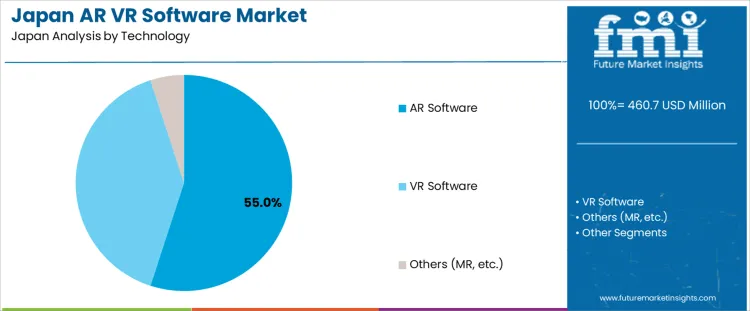
AR software holds 55.0%, making it the leading technology segment in Japan. AR applications support real-time overlays, guided workflows, and contextual information delivery within physical environments. These capabilities align with manufacturing, maintenance, and training use cases requiring hands-free assistance and accuracy. VR software holds 40.0%, supporting immersive simulations, virtual training environments, and design visualization. Other technologies, including mixed reality, hold 5.0%, addressing niche integration scenarios. Technology distribution reflects preference for AR due to practical deployment, lower motion constraints, and suitability for Japan’s operational settings.
Key Points:
- AR software leads due to real-world workflow integration.
- Overlay-based guidance supports precision tasks.
- VR serves immersive training and simulation needs.
Which Application Represents the Largest Share in Japan?
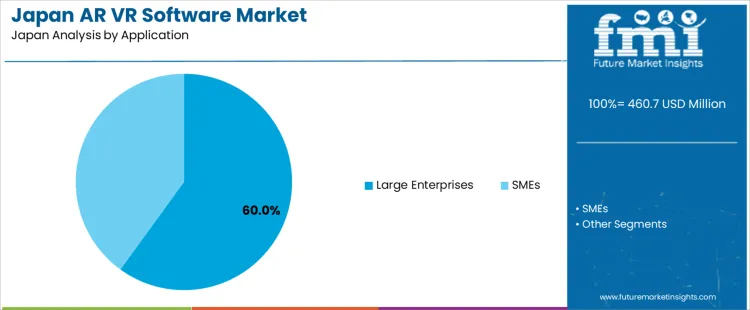
Large enterprises hold 60.0%, making them the leading application segment in Japan. These organizations deploy AR and VR software across training, design validation, remote assistance, and process optimization functions. Large enterprises possess structured budgets, IT governance frameworks, and internal development capabilities supporting adoption at scale. SMEs hold 40.0%, using AR and VR selectively for training efficiency and customer engagement. Application distribution reflects concentration of advanced software deployment within large enterprises managing complex operations and long-term digital strategies.
Key Points:
- Large enterprises lead due to scale and structured IT governance.
- Enterprise use focuses on training and operational support.
- SMEs adopt selectively based on cost and use-case clarity.
What are the Key Dynamics in the AR VR Software Industry in Japan?
Demand increases as Japan applies AR and VR software across manufacturing, entertainment, education, healthcare, and tourism. Software platforms support training simulation, design visualization, remote assistance, and immersive content delivery. Adoption aligns with advanced digital infrastructure, strong gaming culture, and enterprise efficiency goals. Usage concentrates in large corporations, public institutions, and content studios within major metropolitan regions.
How do industrial digitalization and immersive content development drive demand in Japan?
Japanese manufacturers use AR software for equipment maintenance guidance, assembly verification, and worker training in constrained factory environments. VR simulation supports safety training and process rehearsal in automotive, electronics, and construction sectors. Entertainment and gaming studios develop immersive experiences aligned with Japan’s strong console, animation, and character IP ecosystems. Education providers adopt VR for experiential learning and vocational training. Retail and tourism operators apply AR for location-based engagement and product visualization. High smartphone penetration and reliable networks enable deployment. Corporate emphasis on precision and standardized workflows supports software adoption where immersive tools improve accuracy and knowledge transfer.
How do cost considerations, content localization, and adoption behavior influence demand stability?
Development and customization costs remain significant, particularly for enterprise-grade applications requiring system integration. Japanese users expect high usability, language accuracy, and cultural alignment, increasing localization effort. Hardware dependency affects software uptake where device refresh cycles are slow. Motion sensitivity and comfort concerns influence user acceptance. Data security and privacy expectations shape software architecture. Conservative enterprise decision-making favors pilot projects over rapid scale-up. Fragmentation across platforms complicates standardization. Demand remains stable in gaming and targeted enterprise use cases, while broader expansion depends on cost reduction, compelling local content, and demonstrable productivity gains within Japan’s cautious adoption environment.
How Is Demand for AR VR Software in Japan Evolving by Region?
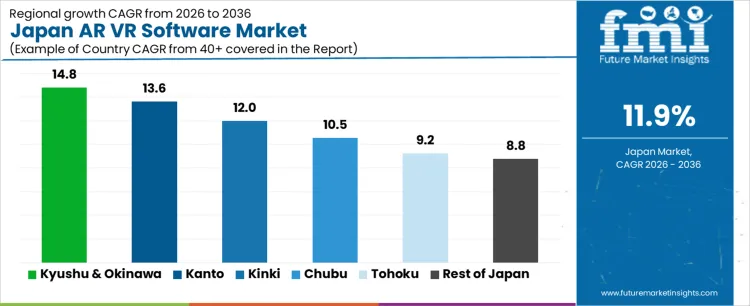
Demand for AR VR software in Japan is accelerating due to enterprise digital transformation, immersive training adoption, and expansion of content-driven experiences. Kyushu and Okinawa lead with a 14.8% CAGR, supported by manufacturing training, tourism applications, and pilot deployments. Kanto follows at 13.6%, driven by enterprise software adoption, media production, and research activity. Kansai records a 12.0% CAGR, shaped by industrial visualization and education use cases. Chubu posts 10.5%, reflecting manufacturing simulation and design validation needs. Tohoku shows 9.2%, supported by skills training and regional development programs. Rest of Japan records 8.8%, reflecting steady evaluation-stage adoption. Regional variation reflects enterprise readiness, content ecosystems, and workforce training priorities across Japan.
| Region | CAGR (2026 to 2036) |
|---|---|
| Kyushu & Okinawa | 14.8% |
| Kanto | 13.6% |
| Kansai | 12.0% |
| Chubu | 10.5% |
| Tohoku | 9.2% |
| Rest of Japan | 8.8% |
How is Kyushu and Okinawa driving demand for AR VR Software in Japan?
Kyushu and Okinawa drive demand through manufacturing training, equipment simulation, and tourism-oriented digital experiences. Region’s CAGR of 14.8% reflects use of AR VR software for workforce upskilling, maintenance guidance, and immersive visitor engagement. Manufacturers deploy VR training modules to improve safety outcomes and reduce downtime during onboarding. Tourism operators adopt AR applications for guided experiences and cultural content delivery. Enterprises prioritize ease of deployment, multilingual support, and compatibility with existing hardware. Demand favors subscription-based platforms offering scenario customization and analytics. Growth remains application-led, supported by regional innovation programs and practical return-on-investment use cases.
- Manufacturing training and maintenance simulation
- Tourism and cultural experience applications
- Subscription-based and customizable platforms
- ROI-focused enterprise deployment
How is Kanto driving demand for AR VR Software in Japan?
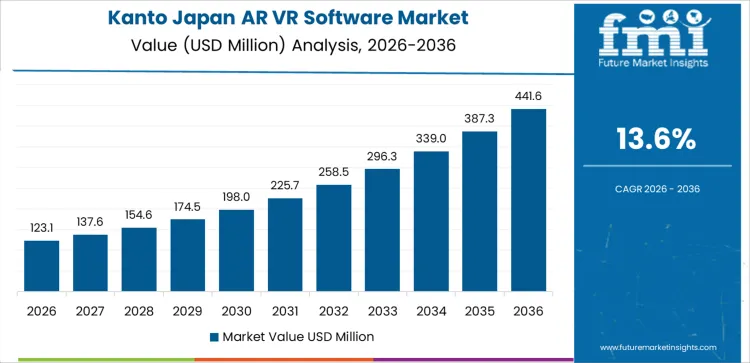
Kanto demand is shaped by enterprise concentration, media production, and advanced research ecosystems. Region’s CAGR of 13.6% reflects extensive adoption of AR VR software for product design, remote collaboration, marketing visualization, and professional training. Technology firms and content studios develop immersive applications for commercial deployment. Enterprises prioritize scalability, data security, and integration with cloud platforms. Universities and research centers support experimentation and validation of new interaction models. Demand favors high-fidelity software supporting cross-device compatibility. Growth aligns with digital workplace strategies and content innovation cycles rather than consumer entertainment alone.
- Enterprise design and collaboration use cases
- Media and content production development
- Cloud-integrated and secure platforms
- Research-driven application validation
How is Kansai driving demand for AR VR Software in Japan?
Kansai demand reflects balanced adoption across industrial visualization, education, and cultural institutions. Region’s CAGR of 12.0% is supported by AR VR software used for factory layout planning, safety training, and educational simulations. Manufacturers value visualization accuracy and workflow compatibility. Educational institutions deploy VR modules for experiential learning and technical instruction. Procurement decisions emphasize cost control, content relevance, and vendor support. Demand growth remains steady, aligned with practical deployment in structured environments rather than experimental usage.
- Industrial visualization and layout planning
- Education and skills training applications
- Cost-controlled and relevant content selection
- Structured and steady adoption
How is Chubu driving demand for AR VR Software in Japan?
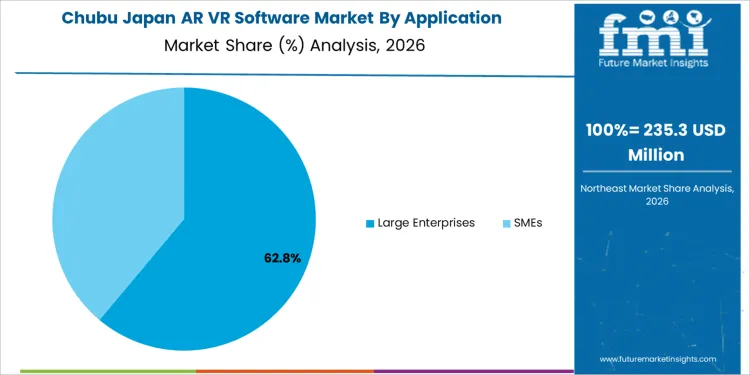
Chubu demand is anchored in manufacturing simulation, product design validation, and process optimization. Region’s CAGR of 10.5% reflects use of AR VR software for virtual prototyping, assembly planning, and operator training. Automotive and machinery manufacturers apply immersive tools to reduce design iterations and improve process accuracy. Demand favors software compatible with CAD systems and industrial workflows. Adoption progresses in line with capital planning and digital manufacturing initiatives. Growth remains moderate and engineering-led.
- Manufacturing simulation and prototyping
- CAD and workflow-integrated software
- Operator training and process accuracy
- Engineering-driven adoption
How is Tohoku driving demand for AR VR Software in Japan?
Tohoku demand is influenced by workforce development, technical training, and regional revitalization initiatives. Region’s CAGR of 9.2% reflects use of AR VR software in vocational education, safety training, and remote instruction. Institutions prioritize ease of use, localized content, and low infrastructure requirements. Public programs support adoption for skills transfer and education access. Demand growth remains cautious and capability-focused, aligned with regional development objectives.
- Vocational and technical training use
- Localized and easy-to-use content
- Public program-supported adoption
- Capability-building focus
How is Rest of Japan driving demand for AR VR Software in Japan?
Rest of Japan shows steady demand driven by evaluation projects, pilot deployments, and incremental enterprise adoption. Region’s CAGR of 8.8% reflects use of AR VR software for limited training, visualization, and internal communication needs. Buyers prioritize affordability, reliability, and vendor support. Adoption remains exploratory, aligned with assessing long-term value rather than scaling deployments. Growth follows gradual digital readiness improvement.
- Pilot and evaluation-stage deployments
- Limited training and visualization usage
- Cost-sensitive purchasing behavior
- Gradual and stable adoption patterns
What is the competitive landscape of demand for AR VR software in Japan?
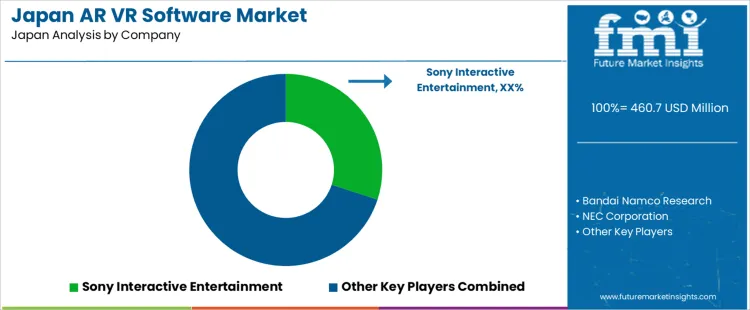
Demand for AR VR software in Japan is driven by adoption in gaming, industrial training, education, retail engagement, and enterprise visualization. Usage spans immersive simulation, virtual prototyping, augmented maintenance instructions, and consumer entertainment platforms. Buyers evaluate software interoperability with head-mounted displays, localization support for Japanese language contexts, integration with enterprise IT systems, and developer ecosystem strength. Procurement teams prioritize suppliers with Japan-based support, partnerships with hardware OEMs, and proven deployments that meet local security and data governance expectations. Trend in the Japan market reflects blending of virtual and augmented experiences into industrial training workflows, growth of metaverse-oriented initiatives, and interest in AR-enhanced retail and tourism engagement.
Sony Interactive Entertainment supports AR VR demand in Japan through platform-level software ecosystems, content development tools, and integration with its PlayStation VR hardware installed base. Bandai Namco Research participates with AR and VR applications for entertainment and branded experiences tailored to Japanese consumer preferences. NEC Corporation operates enterprise-oriented AR VR software solutions used for industrial training, remote support, and collaborative visualization within manufacturing and service sectors. Fujitsu provides AR VR platforms integrated with digital twin capabilities for enterprise use cases such as equipment maintenance and spatial planning. HTC Japan contributes AR VR software support through VIVE platforms and developer services targeting both consumer and enterprise segments. Competitive positioning in Japan reflects localization capability, integration with hardware ecosystems, software reliability, and alignment with market-specific content and enterprise requirements.
Key Players in Japan AR VR Software Demand
- Sony Interactive Entertainment
- Bandai Namco Research
- NEC Corporation
- Fujitsu
- HTC Japan
Scope of the Report
| Items | Values |
|---|---|
| Quantitative Units | USD million |
| Technology | AR Software; VR Software; Others (Mixed Reality, Extended Reality) |
| Application | Large Enterprises; Small and Medium Enterprises (SMEs) |
| Regions Covered | Kanto; Kansai; Chubu; Kyushu & Okinawa; Tohoku; Rest of Japan |
| Key Companies Profiled | Sony Interactive Entertainment; Bandai Namco Research; NEC Corporation; Fujitsu; HTC Japan |
| Additional Attributes | Demand supported by enterprise digital transformation, industrial simulation, gaming, and training use cases. Large enterprises dominate adoption due to higher IT budgets, while SME uptake improves through cloud-based platforms. Growth linked to Japan’s gaming ecosystem, manufacturing visualization needs, and expanding metaverse and immersive collaboration initiatives. |
Japan AR VR Software Demand by Segments
Technology:
- AR Software
- VR Software
- Others (MR, etc.)
Application:
- Large Enterprises
- SMEs
Region:
- Kyushu & Okinawa
- Kanto
- Kansai
- Chubu
- Tohoku
- Rest of Japan
Frequently Asked Questions
How big is the demand for AR VR software in Japan in 2026?
The demand for AR VR software in Japan is estimated to be valued at USD 460.7 million in 2026.
What will be the size of AR VR software in Japan in 2036?
The market size for the AR VR software in Japan is projected to reach USD 1,419.0 million by 2036.
How much will be the demand for AR VR software in Japan growth between 2026 and 2036?
The demand for AR VR software in Japan is expected to grow at a 11.9% CAGR between 2026 and 2036.
What are the key technology types in the AR VR software in Japan?
The key technology types in AR VR software in Japan are AR software, VR software, and others (MR, etc.).
Which application segment is expected to contribute significant share in the AR VR software in Japan in 2026?
In terms of application, large enterprises segment is expected to command 60.0% share in the AR VR software in Japan in 2026.
Preview the report firsthand - request a free sample
Get SampleGet the brochure for pricing and purchase details.
Get PDFTable of Content
- Executive Summary
- Japan Market Outlook
- Demand-side Trends
- Supply-side Trends
- Technology Roadmap Analysis
- Analysis and Recommendations
- Market Overview
- Market Coverage / Taxonomy
- Market Definition / Scope / Limitations
- Market Background
- Market Dynamics
- Drivers
- Restraints
- Opportunity
- Trends
- Scenario Forecast
- Demand in Optimistic Scenario
- Demand in Likely Scenario
- Demand in Conservative Scenario
- Opportunity Map Analysis
- Product Life Cycle Analysis
- Supply Chain Analysis
- Investment Feasibility Matrix
- Value Chain Analysis
- PESTLE and Porter’s Analysis
- Regulatory Landscape
- Regional Parent Market Outlook
- Production and Consumption Statistics
- Import and Export Statistics
- Market Dynamics
- Japan Market Analysis 2021 to 2025 and Forecast, 2026 to 2036
- Historical Market Size Value (USD Million) Analysis, 2021 to 2025
- Current and Future Market Size Value (USD Million) Projections, 2026 to 2036
- Y-o-Y Growth Trend Analysis
- Absolute $ Opportunity Analysis
- Japan Market Pricing Analysis 2021 to 2025 and Forecast 2026 to 2036
- Japan Market Analysis 2021 to 2025 and Forecast 2026 to 2036, By Technology
- Introduction / Key Findings
- Historical Market Size Value (USD Million) Analysis By Technology , 2021 to 2025
- Current and Future Market Size Value (USD Million) Analysis and Forecast By Technology , 2026 to 2036
- AR Software
- VR Software
- Others (MR, etc.)
- AR Software
- Y-o-Y Growth Trend Analysis By Technology , 2021 to 2025
- Absolute $ Opportunity Analysis By Technology , 2026 to 2036
- Japan Market Analysis 2021 to 2025 and Forecast 2026 to 2036, By Application
- Introduction / Key Findings
- Historical Market Size Value (USD Million) Analysis By Application, 2021 to 2025
- Current and Future Market Size Value (USD Million) Analysis and Forecast By Application, 2026 to 2036
- Large Enterprises
- SMEs
- Large Enterprises
- Y-o-Y Growth Trend Analysis By Application, 2021 to 2025
- Absolute $ Opportunity Analysis By Application, 2026 to 2036
- Market Structure Analysis
- Competition Dashboard
- Competition Benchmarking
- Market Share Analysis of Top Players
- By Regional
- By Technology
- By Application
- Competition Analysis
- Competition Deep Dive
- Sony Interactive Entertainment
- Overview
- Product Portfolio
- Profitability by Market Segments (Product/Age /Sales Channel/Region)
- Sales Footprint
- Strategy Overview
- Marketing Strategy
- Product Strategy
- Channel Strategy
- Bandai Namco Research
- NEC Corporation
- Fujitsu
- HTC Japan
- Sony Interactive Entertainment
- Competition Deep Dive
- Assumptions & Acronyms Used
- Research Methodology


