

- Industry Size (2026)
- USD 0.7 Bn
- Forecast (2036)
- USD 2.8 Bn
- CAGR (2026 to 2036)
- 15%
Food-Grade Post-Harvest Decay Control Coating Market Forecast and Outlook 2026 to 2036
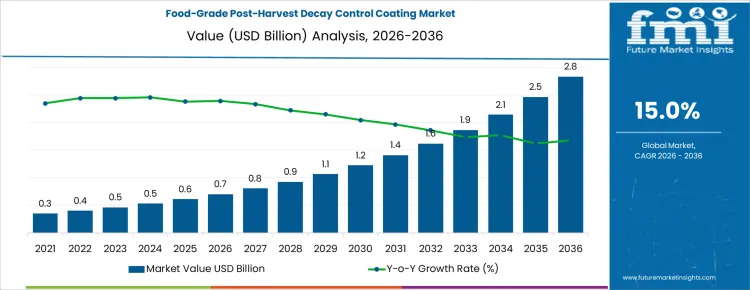
The food-grade post-harvest decay control coating market is projected to grow significantly, reaching USD 2.8 billion by 2036, up from USD 0.7 billion in 2026, with a 15% CAGR. The market is segmented by coating material type and produce type, with edible wax & lipid-based coatings leading the segment with a 37% share, offering superior moisture control and shelf life extension for produce. Chitosan & biopolymer coatings, plant-extract & antimicrobial blends, and protein & polysaccharide films follow, with growing interest in eco-friendly solutions. In terms of produce types, fruits (citrus, apples, berries) dominate the market, holding a 46% share, followed by vegetables, tropical fruits, and other produce. The demand for coatings in fruit preservation is driven by the high perishability of these products and the need for effective post-harvest management.
Quick Stats for Food-Grade Post-Harvest Decay Control Coating Market
- Food-Grade Post-Harvest Decay Control Coating MarketValue (2026): USD 0.7 billion
- Food-Grade Post-Harvest Decay Control Coating MarketForecast Value (2036): USD 2.8 billion
- Food-Grade Post-Harvest Decay Control Coating MarketForecast CAGR: 15%
- Leading Coating Material in Food-Grade Post-Harvest Decay Control Coating Market: Edible Wax & Lipid-Based Coatings
- Key Growth Regions in Food-Grade Post-Harvest Decay Control Coating Market: North America, Latin America, Asia Pacific, Europe
- Key Players in Food-Grade Post-Harvest Decay Control Coating Market: Apeel Sciences, AgroFresh Solutions, Pace International, Citrosol Group, Xeda International
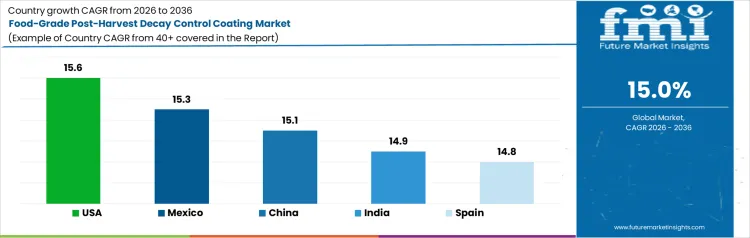
USA leads the market with the highest growth rate of 15.6% CAGR, driven by the increasing demand for fresh produce and food safety regulations. Brazil follows with 17.4% CAGR, supported by its large agricultural export sector. India grows at 17.8% CAGR, fueled by the need for better post-harvest management in a vast agricultural economy. China also sees growth at 15.1%, while Spain (14.8%) and Mexico (15.3%) contribute significantly to the market's expansion, driven by sustainability goals and the need to reduce food waste. These regions emphasize fresh, high-quality produce and regulatory compliance, further accelerating the market's growth.
Food‑Grade Post‑Harvest Decay Control Coating Market Key Takeaways
| Metric | Value |
|---|---|
| Industry Value (2026) | USD 0.7 billion |
| Forecast Value (2036) | USD 2.8 billion |
| Forecast CAGR (2026&-2036) | 15% |
How is the Global Food‑Grade Post‑Harvest Decay Control Coating Sector Advancing?
The global food‑grade post‑harvest decay control coating market is expanding as growers seek solutions to extend the shelf life of fruits and vegetables while preserving quality and minimizing waste. Post‑harvest decay can lead to significant losses, particularly in perishable products like apples, berries, and citrus. Food‑grade coatings are applied to protect crops from fungal and bacterial infections and reduce moisture loss, ensuring longer shelf life without compromising safety or appearance. These coatings are increasingly seen as an essential part of post‑harvest handling in both conventional and organic production systems.
The rise in consumer demand for fresh, minimally processed foods is driving adoption across the globe, as these coatings provide an effective solution for reducing spoilage and enhancing food safety. Innovations in biopolymer and natural ingredient formulations are further improving the sustainability profile of these coatings, making them more attractive to growers seeking eco‑friendly solutions. The growing focus on reducing food waste and improving the efficiency of the food supply chain is pushing the need for reliable decay control technologies.
Challenges such as the need for effective application methods, regulatory approval processes, and balancing cost with performance may affect market growth. Nonetheless, as food preservation becomes more crucial in combating food waste, the demand for food‑grade post‑harvest decay control coatings will continue to rise.
What Is the Segment-Wise Analysis for the Global Food-Grade Post-Harvest Decay Control Coating Market?
The global food-grade post-harvest decay control coating market is segmented by coating material type and produce type. Edible wax & lipid-based coatings lead the market with a 37% share, offering effective protection against decay and moisture loss. Other key coating materials include chitosan & biopolymer coatings, plant-extract & antimicrobial blends, and protein & polysaccharide films. In terms of produce types, fruits like citrus, apples, and berries hold the largest share at 46%, followed by vegetables, tropical fruits, and other produce types.
How Do Edible Wax & Lipid-Based Coatings Lead the Global Post-Harvest Decay Control Coating Market?
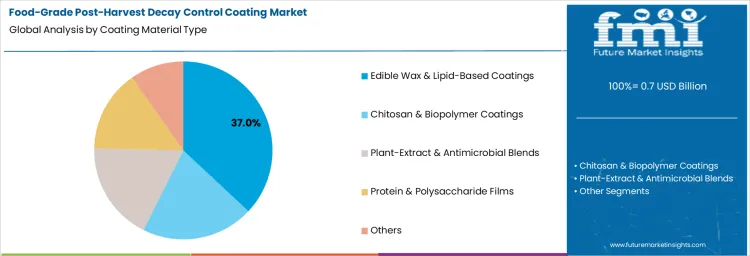
Edible wax & lipid-based coatings hold a 37% share in the global food-grade post-harvest decay control coating market due to their effectiveness in reducing moisture loss and extending the shelf life of produce. These coatings create a protective barrier that maintains freshness while preventing spoilage. Safe for consumption, they are ideal for fruits and vegetables. With growing demand for fresh, high-quality produce, edible wax and lipid-based coatings are increasingly preferred for post-harvest decay control. Their ability to ensure safety, prolong freshness, and maintain quality solidifies their position as market leaders.
Why Do Fruits (Citrus, Apples, Berries) Hold the Largest Market Share in the Global Food-Grade Coating Market?
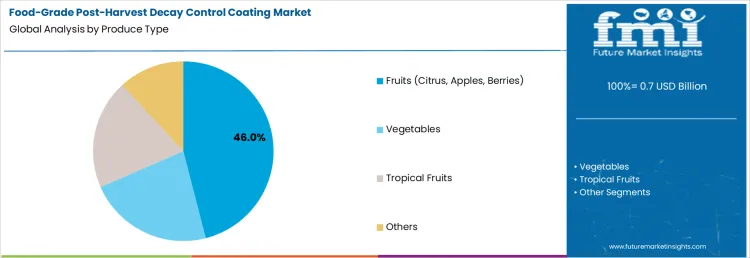
Fruits like citrus, apples, and berries hold a 46% share in the global food-grade post-harvest decay control coating market due to their high susceptibility to post-harvest decay. These fruits require effective protective coatings to maintain quality during transportation and storage. Food-grade coatings, such as edible waxes and lipid-based formulations, are essential in preserving their freshness and extending shelf life. The high demand for these fruits, combined with their need for quality preservation, drives their dominant share in the market, highlighting the importance of post-harvest decay control.
What Are the Key Drivers for the Food-Grade Post Harvest Decay Control Coating Market?
Demand for food-grade post-harvest decay control coatings is rising as growers and distributors seek to reduce fruit and vegetable losses after harvest. These coatings extend shelf life by slowing respiration, reducing moisture loss, and inhibiting decay organisms without compromising food safety. Increasing consumer demand for fresh, minimally processed produce year-round pushes suppliers to adopt coatings that maintain quality during transportation and storage. Stricter food safety regulations and retailer quality standards further drive uptake.
What Are the Main Restraints Impacting the food-grade Post-Harvest Decay Control Coating Market?
Adoption of food-grade decay control coatings faces challenges related to cost and perception. Premium coatings can increase post-harvest handling expenses, which may deter small producers or cost-sensitive supply chains. Some growers and packers worry that coatings could alter sensory attributes such as taste or texture, despite being food-safe and approved. Regulatory complexity also varies by region, making harmonized approval and labeling difficult for global suppliers. Limited awareness or understanding of coating benefits among smallholder farms can slow adoption rates, especially where traditional cold chain infrastructure remains the primary strategy for decay control.
What Key Trends Are Shaping the food-grade Post-Harvest Decay Control Coating Market?
Key trends include a shift toward natural and bio-based coating ingredients, such as chitosan, plant extracts, and edible polymers, responding to consumer preference for clean labels and eco-friendly solutions. Formulations that combine decay control with moisture retention and gas exchange regulation are gaining traction, offering multifunctional benefits. Integration with digital monitoring tools such as humidity and temperature sensors helps optimize coating performance during storage and transport. There is also growing interest in tailored solutions for specific crops, such as apples, berries, and tropical fruits, recognizing that different produce require unique post-harvest strategies to maximize shelf life.
What is the Growth Outlook for the Food-Grade Post-Harvest Decay Control Coating Marketby Country?
| Country | CAGR (%) |
|---|---|
| USA | 15.6% |
| China | 15.1% |
| Spain | 14.8% |
| Mexico | 15.3% |
| India | 14.9% |
The food-grade post-harvest decay control coating market is growing steadily, with the USA leading at a 15.6% CAGR, driven by the demand for solutions that extend the shelf life of fruits and vegetables while maintaining their safety and quality. China follows with 15.1%, supported by its large agricultural production and increasing focus on improving post-harvest handling. Spain’s market grows at 14.8%, fueled by the country’s focus on reducing food waste and improving food safety. Mexico’s market grows at 15.3%, driven by its agricultural exports, particularly fruits and vegetables, and the need for effective decay control solutions. India’s market grows at 14.9%, supported by the rising demand for better post-harvest management and improved food preservation techniques.
Why is the USA Leading in the Food-Grade Post-Harvest Decay Control Coating Market?
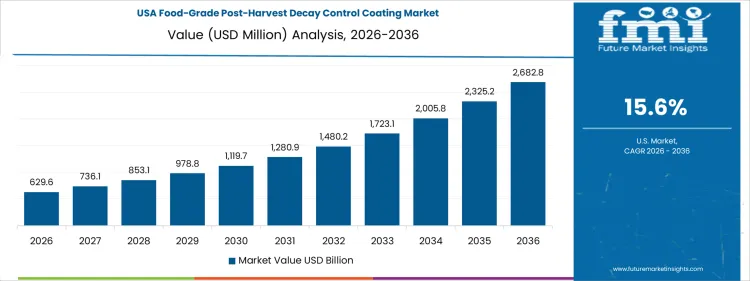
The USA’s food-grade post-harvest decay control coating market is growing at 15.6%, driven by the need to extend the shelf life of harvested fruits and vegetables, reduce food waste, and ensure food safety. With the growing demand for fresh produce, particularly in supermarkets and export markets, the USA is increasingly adopting food-grade coatings that help protect crops from decay and spoilage during storage and transportation. The market is also driven by consumer preferences for fresh, high-quality produce and a regulatory environment that emphasizes food safety standards. As sustainability concerns rise and efforts to reduce food waste intensify, the demand for post-harvest decay control coatings in the USA is expected to grow. The combination of agricultural innovation, consumer demand, and sustainability initiatives is driving market expansion in the USA.
What is Driving the Growth of the Food-Grade Post-Harvest Decay Control Coating Marketin China?
China’s food-grade post-harvest decay control coating market is growing at 15.1%, driven by the country’s vast agricultural production and the increasing focus on reducing post-harvest losses. With a large volume of fruits and vegetables produced and consumed domestically, as well as for export, China is adopting food-grade coatings to prevent spoilage and extend the shelf life of these products. The growing demand for fresh produce, along with rising consumer awareness of food safety and quality, is fueling the adoption of post-harvest decay control coatings. China’s focus on improving food security and modernizing its agricultural practices further supports the growth of this market. As the demand for efficient post-harvest management and food preservation techniques increases, China’s market for decay control coatings is expected to continue growing.
How is the Food-Grade Post-Harvest Decay Control Coating MarketExpanding in Spain?
Spain’s food-grade post-harvest decay control coating market is growing at 14.8%, driven by the need to reduce food waste and improve the preservation of fruits and vegetables. Spain’s significant agricultural sector, particularly in fruits like citrus, grapes, and tomatoes, faces the challenge of maintaining the quality of produce from harvest to consumption. Food-grade coatings are increasingly being used to extend the shelf life of produce, ensuring it remains fresh and safe for longer periods. The Spanish government’s focus on sustainability and the country’s commitment to reducing food waste further accelerate the adoption of post-harvest coatings. As consumer demand for high-quality, fresh produce rises and environmental concerns increase, the market for food-grade post-harvest decay control coatings in Spain is expected to expand.
What is Contributing to the Growth of the Food-Grade Post-Harvest Decay Control Coating Marketin Mexico?
Mexico’s food-grade post-harvest decay control coating market is growing at 15.3%, driven by its large agricultural exports, particularly in fruits like avocados, tomatoes, and berries. With Mexico being a key supplier of fresh produce to international markets, maintaining the quality and safety of crops during transportation and storage is essential. Food-grade coatings help prevent decay and extend the shelf life of these products, ensuring that they reach consumers in optimal condition. As Mexico continues to modernize its agricultural practices and meet international food safety standards, the demand for post-harvest decay control coatings is expected to rise. The country’s emphasis on reducing food waste and improving post-harvest management practices is contributing to the market’s growth.
What is Driving the Growth of the Food-Grade Post-Harvest Decay Control Coating Marketin India?
India’s food-grade post-harvest decay control coating market is growing at 14.9%, supported by the country’s large and diverse agricultural sector. With a focus on improving food preservation and reducing post-harvest losses, India is increasingly adopting food-grade coatings to protect fruits and vegetables from decay. India’s agricultural sector, which includes high-value crops like mangoes, citrus fruits, and vegetables, faces challenges in maintaining the quality of produce after harvest, particularly during storage and transport. Post-harvest decay control coatings help extend shelf life and reduce spoilage, which is essential for both domestic consumption and export. As India continues to modernize its agriculture and prioritize food safety, the demand for food-grade post-harvest decay control coatings is expected to grow steadily.
Who Are the Leaders in the Food‑Grade Post‑Harvest Decay Control Coating Market?
In the food‑grade post‑harvest decay control coating market Apeel Sciences, AgroFresh Solutions, Pace International, Citrosol Group, Xeda International, and others are competing with product brochures that highlight extended shelf life, reduced spoilage, and compliance with food safety standards. Apeel Sciences materials describe edible plant‑derived coatings formulated to slow water loss and microbial decay. Performance data is presented to demonstrate extended freshness in fruits and vegetables. Application guidance is provided with emphasis on gentle handling and coverage uniformity. AgroFresh Solutions brochures focus on integrated post‑harvest programs that pair decay control coatings with sensor‑driven storage recommendations. Coating benefits are shown alongside procedural steps that help packers align products with cold chain practices.
Pace International collateral is centered on food‑safe coating systems designed for a broad range of produce. Technical briefs describe reduced decay rates and improved marketability. Clear usage notes are included to aid operational decision making. Citrosol Group literature highlights citrus‑specific and general produce coatings that are marketed for their decay inhibition and moisture barrier properties, with visual summaries of application methods and expected results. Xeda International brochures present coating chemistries tailored for tropical and temperate crops, with concise charts showing post‑harvest quality improvements and handling tips. Others in the segment are positioned with niche, crop‑specific coating solutions described with clear instructions and measurable post‑harvest performance.
Key Players in Food-Grade Post-Harvest Decay Control Coating Market
- Apeel Sciences
- AgroFresh Solutions
- Pace International
- Citrosol Group
- Xeda International
- Others
Scope of Report
| Items | Values |
|---|---|
| Quantitative Units (2026) | USD billion |
| Coating Material Type | Edible Wax & Lipid-Based Coatings, Chitosan & Biopolymer Coatings, Plant-Extract & Antimicrobial Blends, Protein & Polysaccharide Films |
| Produce Type | Fruits (Citrus, Apples, Berries), Vegetables, Tropical Fruits, Others |
| Regions Covered | Asia Pacific, Europe, North America, Latin America, Middle East & Africa |
| Countries Covered | USA, China, Japan, South Korea, India, Australia & New Zealand, ASEAN, Germany, UK, France, Italy, Spain, Nordic, BENELUX, Brazil, Chile, Mexico, Saudi Arabia, Other GCC Countries, Turkey, South Africa, Other African Union |
| Key Companies Profiled | Apeel Sciences, AgroFresh Solutions, Pace International, Citrosol Group, Xeda International |
| Additional Attributes | Dollar sales by coating material type, produce type, and region; regional CAGR and growth outlook; distribution channels including agrochemical suppliers, post-harvest solutions, and produce distributors; innovation trends in post-harvest decay control; competitive positioning of global vs regional suppliers. |
Food-Grade Post-Harvest Decay Control Coating Marketby Segments
Coating Material Type
- Edible Wax & Lipid-Based Coatings
- Chitosan & Biopolymer Coatings
- Plant-Extract & Antimicrobial Blends
- Protein & Polysaccharide Films
- Others
Produce Type
- Fruits (Citrus, Apples, Berries)
- Vegetables
- Tropical Fruits
- Others
Region
- Asia Pacific
- China
- Japan
- South Korea
- India
- Australia & New Zealand
- ASEAN
- Rest of Asia Pacific
- Europe
- Germany
- United Kingdom
- France
- Italy
- Spain
- Nordic
- BENELUX
- Rest of Europe
- North America
- United States
- Canada
- Mexico
- Latin America
- Brazil
- Chile
- Rest of Latin America
- Middle East & Africa
- Kingdom of Saudi Arabia
- Other GCC Countries
- Turkey
- South Africa
- Other African Union
- Rest of Middle East & Africa
Frequently Asked Questions
How big is the food-grade post-harvest decay control coating market in 2026?
The global food-grade post-harvest decay control coating market is estimated to be valued at USD 0.7 billion in 2026.
What will be the size of food-grade post-harvest decay control coating market in 2036?
The market size for the food-grade post-harvest decay control coating market is projected to reach USD 2.8 billion by 2036.
How much will be the food-grade post-harvest decay control coating market growth between 2026 and 2036?
The food-grade post-harvest decay control coating market is expected to grow at a 15.0% CAGR between 2026 and 2036.
What are the key product types in the food-grade post-harvest decay control coating market ?
The key product types in food-grade post-harvest decay control coating market are edible wax & lipid-based coatings, chitosan & biopolymer coatings, plant-extract & antimicrobial blends, protein & polysaccharide films and others.
Which produce type segment to contribute significant share in the food-grade post-harvest decay control coating market in 2026?
In terms of produce type, fruits (citrus, apples, berries) segment to command 46.0% share in the food-grade post-harvest decay control coating market in 2026.
Preview the report firsthand - request a free sample
Get SampleGet the brochure for pricing and purchase details.
Get PDFTable of Content
- Executive Summary
- Global Market Outlook
- Demand-side Trends
- Supply-side Trends
- Technology Roadmap Analysis
- Analysis and Recommendations
- Market Overview
- Market Coverage / Taxonomy
- Market Definition / Scope / Limitations
- Market Background
- Market Dynamics
- Drivers
- Restraints
- Opportunity
- Trends
- Scenario Forecast
- Demand in Optimistic Scenario
- Demand in Likely Scenario
- Demand in Conservative Scenario
- Opportunity Map Analysis
- Product Life Cycle Analysis
- Supply Chain Analysis
- Investment Feasibility Matrix
- Value Chain Analysis
- PESTLE and Porter’s Analysis
- Regulatory Landscape
- Regional Parent Market Outlook
- Production and Consumption Statistics
- Import and Export Statistics
- Market Dynamics
- Global Market Analysis 2021 to 2025 and Forecast, 2026 to 2036
- Historical Market Size Value (USD Million) Analysis, 2021 to 2025
- Current and Future Market Size Value (USD Million) Projections, 2026 to 2036
- Y-o-Y Growth Trend Analysis
- Absolute $ Opportunity Analysis
- Global Market Pricing Analysis 2021 to 2025 and Forecast 2026 to 2036
- Global Market Analysis 2021 to 2025 and Forecast 2026 to 2036, By Coating Material Type
- Introduction / Key Findings
- Historical Market Size Value (USD Million) Analysis By Coating Material Type , 2021 to 2025
- Current and Future Market Size Value (USD Million) Analysis and Forecast By Coating Material Type , 2026 to 2036
- Edible Wax & Lipid-Based Coatings
- Chitosan & Biopolymer Coatings
- Plant-Extract & Antimicrobial Blends
- Protein & Polysaccharide Films
- Others
- Y-o-Y Growth Trend Analysis By Coating Material Type , 2021 to 2025
- Absolute $ Opportunity Analysis By Coating Material Type , 2026 to 2036
- Global Market Analysis 2021 to 2025 and Forecast 2026 to 2036, By Produce Type
- Introduction / Key Findings
- Historical Market Size Value (USD Million) Analysis By Produce Type, 2021 to 2025
- Current and Future Market Size Value (USD Million) Analysis and Forecast By Produce Type, 2026 to 2036
- Fruits (Citrus, Apples, Berries)
- Vegetables
- Tropical Fruits
- Others
- Y-o-Y Growth Trend Analysis By Produce Type, 2021 to 2025
- Absolute $ Opportunity Analysis By Produce Type, 2026 to 2036
- Global Market Analysis 2021 to 2025 and Forecast 2026 to 2036, By Region
- Introduction
- Historical Market Size Value (USD Million) Analysis By Region, 2021 to 2025
- Current Market Size Value (USD Million) Analysis and Forecast By Region, 2026 to 2036
- North America
- Latin America
- Western Europe
- Eastern Europe
- East Asia
- South Asia and Pacific
- Middle East & Africa
- Market Attractiveness Analysis By Region
- North America Market Analysis 2021 to 2025 and Forecast 2026 to 2036, By Country
- Historical Market Size Value (USD Million) Trend Analysis By Market Taxonomy, 2021 to 2025
- Market Size Value (USD Million) Forecast By Market Taxonomy, 2026 to 2036
- By Country
- USA
- Canada
- Mexico
- By Coating Material Type
- By Produce Type
- By Country
- Market Attractiveness Analysis
- By Country
- By Coating Material Type
- By Produce Type
- Key Takeaways
- Latin America Market Analysis 2021 to 2025 and Forecast 2026 to 2036, By Country
- Historical Market Size Value (USD Million) Trend Analysis By Market Taxonomy, 2021 to 2025
- Market Size Value (USD Million) Forecast By Market Taxonomy, 2026 to 2036
- By Country
- Brazil
- Chile
- Rest of Latin America
- By Coating Material Type
- By Produce Type
- By Country
- Market Attractiveness Analysis
- By Country
- By Coating Material Type
- By Produce Type
- Key Takeaways
- Western Europe Market Analysis 2021 to 2025 and Forecast 2026 to 2036, By Country
- Historical Market Size Value (USD Million) Trend Analysis By Market Taxonomy, 2021 to 2025
- Market Size Value (USD Million) Forecast By Market Taxonomy, 2026 to 2036
- By Country
- Germany
- UK
- Italy
- Spain
- France
- Nordic
- BENELUX
- Rest of Western Europe
- By Coating Material Type
- By Produce Type
- By Country
- Market Attractiveness Analysis
- By Country
- By Coating Material Type
- By Produce Type
- Key Takeaways
- Eastern Europe Market Analysis 2021 to 2025 and Forecast 2026 to 2036, By Country
- Historical Market Size Value (USD Million) Trend Analysis By Market Taxonomy, 2021 to 2025
- Market Size Value (USD Million) Forecast By Market Taxonomy, 2026 to 2036
- By Country
- Russia
- Poland
- Hungary
- Balkan & Baltic
- Rest of Eastern Europe
- By Coating Material Type
- By Produce Type
- By Country
- Market Attractiveness Analysis
- By Country
- By Coating Material Type
- By Produce Type
- Key Takeaways
- East Asia Market Analysis 2021 to 2025 and Forecast 2026 to 2036, By Country
- Historical Market Size Value (USD Million) Trend Analysis By Market Taxonomy, 2021 to 2025
- Market Size Value (USD Million) Forecast By Market Taxonomy, 2026 to 2036
- By Country
- China
- Japan
- South Korea
- By Coating Material Type
- By Produce Type
- By Country
- Market Attractiveness Analysis
- By Country
- By Coating Material Type
- By Produce Type
- Key Takeaways
- South Asia and Pacific Market Analysis 2021 to 2025 and Forecast 2026 to 2036, By Country
- Historical Market Size Value (USD Million) Trend Analysis By Market Taxonomy, 2021 to 2025
- Market Size Value (USD Million) Forecast By Market Taxonomy, 2026 to 2036
- By Country
- India
- ASEAN
- Australia & New Zealand
- Rest of South Asia and Pacific
- By Coating Material Type
- By Produce Type
- By Country
- Market Attractiveness Analysis
- By Country
- By Coating Material Type
- By Produce Type
- Key Takeaways
- Middle East & Africa Market Analysis 2021 to 2025 and Forecast 2026 to 2036, By Country
- Historical Market Size Value (USD Million) Trend Analysis By Market Taxonomy, 2021 to 2025
- Market Size Value (USD Million) Forecast By Market Taxonomy, 2026 to 2036
- By Country
- Kingdom of Saudi Arabia
- Other GCC Countries
- Turkiye
- South Africa
- Other African Union
- Rest of Middle East & Africa
- By Coating Material Type
- By Produce Type
- By Country
- Market Attractiveness Analysis
- By Country
- By Coating Material Type
- By Produce Type
- Key Takeaways
- Key Countries Market Analysis
- USA
- Pricing Analysis
- Market Share Analysis, 2025
- By Coating Material Type
- By Produce Type
- Canada
- Pricing Analysis
- Market Share Analysis, 2025
- By Coating Material Type
- By Produce Type
- Mexico
- Pricing Analysis
- Market Share Analysis, 2025
- By Coating Material Type
- By Produce Type
- Brazil
- Pricing Analysis
- Market Share Analysis, 2025
- By Coating Material Type
- By Produce Type
- Chile
- Pricing Analysis
- Market Share Analysis, 2025
- By Coating Material Type
- By Produce Type
- Germany
- Pricing Analysis
- Market Share Analysis, 2025
- By Coating Material Type
- By Produce Type
- UK
- Pricing Analysis
- Market Share Analysis, 2025
- By Coating Material Type
- By Produce Type
- Italy
- Pricing Analysis
- Market Share Analysis, 2025
- By Coating Material Type
- By Produce Type
- Spain
- Pricing Analysis
- Market Share Analysis, 2025
- By Coating Material Type
- By Produce Type
- France
- Pricing Analysis
- Market Share Analysis, 2025
- By Coating Material Type
- By Produce Type
- India
- Pricing Analysis
- Market Share Analysis, 2025
- By Coating Material Type
- By Produce Type
- ASEAN
- Pricing Analysis
- Market Share Analysis, 2025
- By Coating Material Type
- By Produce Type
- Australia & New Zealand
- Pricing Analysis
- Market Share Analysis, 2025
- By Coating Material Type
- By Produce Type
- China
- Pricing Analysis
- Market Share Analysis, 2025
- By Coating Material Type
- By Produce Type
- Japan
- Pricing Analysis
- Market Share Analysis, 2025
- By Coating Material Type
- By Produce Type
- South Korea
- Pricing Analysis
- Market Share Analysis, 2025
- By Coating Material Type
- By Produce Type
- Russia
- Pricing Analysis
- Market Share Analysis, 2025
- By Coating Material Type
- By Produce Type
- Poland
- Pricing Analysis
- Market Share Analysis, 2025
- By Coating Material Type
- By Produce Type
- Hungary
- Pricing Analysis
- Market Share Analysis, 2025
- By Coating Material Type
- By Produce Type
- Kingdom of Saudi Arabia
- Pricing Analysis
- Market Share Analysis, 2025
- By Coating Material Type
- By Produce Type
- Turkiye
- Pricing Analysis
- Market Share Analysis, 2025
- By Coating Material Type
- By Produce Type
- South Africa
- Pricing Analysis
- Market Share Analysis, 2025
- By Coating Material Type
- By Produce Type
- USA
- Market Structure Analysis
- Competition Dashboard
- Competition Benchmarking
- Market Share Analysis of Top Players
- By Regional
- By Coating Material Type
- By Produce Type
- Competition Analysis
- Competition Deep Dive
- Assumptions & Acronyms Used
- Research Methodology


