

- Industry Size (2026)
- USD 4680.0 Mn
- Forecast (2036)
- USD 8867.8 Mn
- CAGR (2026 to 2036)
- 6.6%
Clean-Label Emulsifiers Market Forecast and Outlook 2026 to 2036
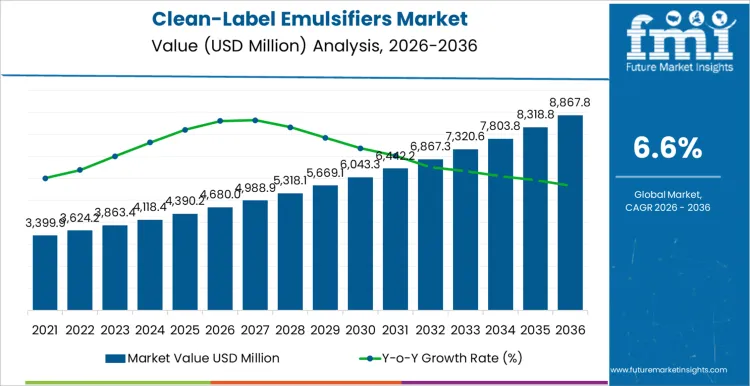
The clean-label emulsifiers are projected to reach USD 4,680.0 million in 2026 and USD 8,867.8 million by 2036, at a CAGR of 6.6% over the forecast period. Growth is anchored in reformulation activity driven by ingredient transparency requirements rather than expansion in processed food volumes. Demand concentrates in bakery, dairy alternatives, sauces, and convenience foods where emulsification performance directly affects texture, shelf stability, and visual quality. Lecithins and clean-label positioned mono- and diglycerides account for the largest share due to familiarity, multifunctionality, and regulatory acceptance. Spending prioritizes emulsifiers that maintain performance under heat, shear, and freeze-thaw conditions while supporting simplified ingredient declarations.
Bakery manufacturers increasingly specify lecithins and starch-derived emulsifiers to maintain crumb structure and dough handling after reformulation. Dairy alternative producers rely on protein-based and enzymatic emulsifiers to stabilize fat dispersion during UHT processing and extended ambient storage. In sauces and dressings, clean-label emulsifiers are selected to control oil droplet size while avoiding chemically modified declarations. Functional limits under high-fat systems and freeze-thaw cycles restrict application scope, leading to careful selection based on category-specific processing stress rather than broad substitution.
Quick Stats for Clean-Label Emulsifiers Market
- Clean-Label Emulsifiers Market Value (2026): USD 4,680.0 million
- Clean-Label Emulsifiers Market Forecast Value (2036): USD 8,867.8 million
- Clean-Label Emulsifiers Market Forecast CAGR 2026 to 2036: 6.6%
- Leading Emulsifier Type by Demand Share: Lecithin (soy, sunflower, rapeseed)
- Fastest-Growing Countries: India, China, Brazil, USA, UK
- Top Players in Global Demand: Cargill, ADM, Ingredion, DuPont (IFF), Lipoid
Clean-Label Emulsifiers Market Key Takeaways
| Metric | Value |
|---|---|
| Market Value (2026) | USD 4680.0 million |
| Market Forecast Value (2036) | USD 8867.8 million |
| Forecast CAGR 2026 to 2036 | 6.6% |
Why is the Demand for Clean-Label Emulsifiers Growing?
Food developers reformulating recipes to meet consumer demand for recognizable ingredient lists increasingly select clean-label emulsifiers derived from plant or minimally processed sources. Clean-label emulsifiers stabilize oil-water interfaces in products such as dressings, sauces, ice creams, and beverage emulsions where texture and visual appeal influence purchase decisions. Traditional synthetic surfactants often carry perception challenges among buyers who scrutinize labels for familiar names. Manufacturers of dairy alternatives and plant-based spreads rely on lecithin from sunflower or other plant sources to deliver creamy mouthfeel and controlled droplet size without compromising label simplicity.
Snack producers apply these emulsifiers to maintain crispness and uniform seasoning distribution during storage. Procurement of clean-label emulsifiers is reinforced by regulatory frameworks and retail category strategies that emphasize transparency in formulation. Ingredient specialists tailor products to perform under thermal processing, high shear mixing, and freeze-thaw conditions common in industrial food production. Sensory evaluation teams assess impact on creaminess, thickness, and flavor release to ensure product quality aligns with consumer expectations. Growth in functional beverages and fortified foods encourages integration of emulsifiers that enhance stability without adding artificial components, supporting expanded use across mainstream and niche market segments.
How Is the Clean-Label Emulsifiers Industry Segmented by Emulsifier Type, Application, and End User?
Demand for clean-label emulsifiers is shaped by ingredient transparency requirements, reformulation away from synthetic additives, and regulatory pressure on labeling clarity. Food producers prioritize emulsifiers derived from familiar sources that deliver functional performance without compromising label simplicity. Selection criteria include emulsification efficiency, processing tolerance, allergen considerations, and compatibility with existing formulations. Segmentation by emulsifier type, application, and end user explains how functionality, sourcing strategy, and production scale influence adoption across food categories emphasizing natural positioning.
Which Emulsifier Type Holds the Largest Share in Clean-Label Formulations?
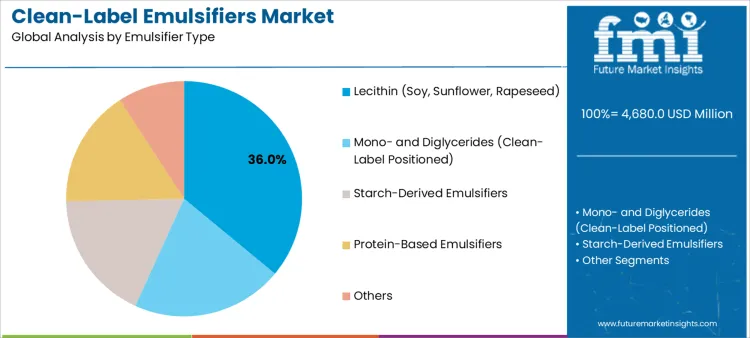
Lecithin derived from soy, sunflower, and rapeseed holds 36.0%, reflecting long-standing use, consumer familiarity, and multifunctional emulsification performance. Clean-label positioned mono- and diglycerides account for 24.0%, applied where functionality must be retained while meeting labeling expectations. Starch-derived emulsifiers represent 18.0%, supporting texture stability and moisture control in processed foods. Protein-based emulsifiers hold 14.0%, used in formulations requiring foaming and emulsification synergy. Other emulsifier types account for 8.0%, addressing niche formulation needs.
Key Points
- Lecithin remains the most widely accepted clean-label emulsifier.
- Clean-positioned mono- and diglycerides preserve processing performance.
- Starch systems support texture and stability requirements.
How Does Application Influence Clean-Label Emulsifier Demand?
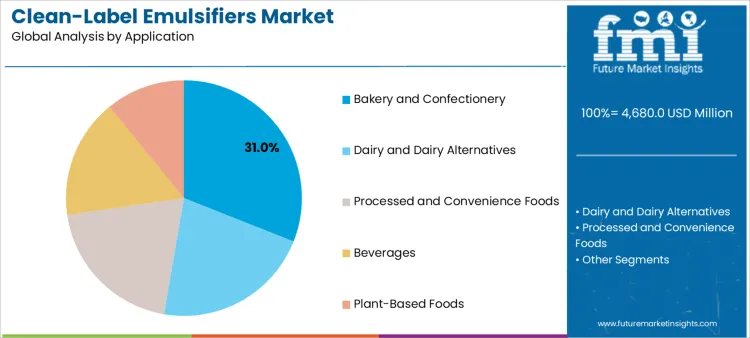
Bakery and confectionery applications represent 31.0%, driven by the need for dough stability, crumb structure, and shelf-life control. Dairy and dairy alternatives account for 24.0%, requiring emulsifiers compatible with protein and fat interactions. Processed and convenience foods hold 20.0%, where emulsification supports uniform texture and reheating stability. Beverages represent 15.0%, emphasizing dispersion and mouthfeel consistency. Plant-based foods account for 10.0%, reflecting increasing protein complexity and oil-water stabilization challenges. Application segmentation reflects varied functional priorities across product categories.
Key Points
- Bakery products rely on emulsifiers for structure and consistency.
- Dairy alternatives require protein-compatible emulsification.
- Processed foods emphasize stability during storage and reheating.
Which End Users Drive Demand for Clean-Label Emulsifiers?
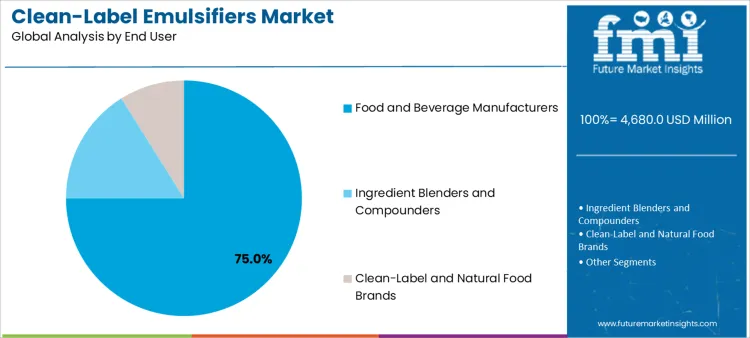
Food and beverage manufacturers account for 75.0%, reflecting large-scale reformulation programs and portfolio-wide clean-label transitions. Ingredient blenders and compounders represent 15.0%, supplying customized emulsifier solutions to multiple brands. Clean-label and natural food brands hold 10.0%, focusing on simplified ingredient decks and differentiated positioning. End user segmentation highlights concentration of demand among manufacturers managing volume production, regulatory compliance, and label-driven consumer expectations.
Key Points
- Large manufacturers dominate clean-label emulsifier consumption.
- Compounders support tailored formulation requirements.
- Natural brands prioritize minimal and recognizable ingredients.
What are the Key Dynamics in the Clean-Label Emulsifiers Market?
Demand in the clean-label emulsifiers market is driven by food and beverage manufacturers reformulating products to meet consumer expectations for simple, recognizable ingredient lists without compromising texture or stability. Adoption is concentrated where traditional emulsifiers are being replaced with agents derived from plant proteins, lecithins, or other minimally processed sources that support oil-water dispersion, moisture retention, and mouthfeel. Purchasing behavior places emphasis on ingredient origin, perceived naturalness, and performance under processing conditions common to sauces, bakery, dairy alternatives, and beverages.
How do formulation quality expectations in restructured products influence adoption?
Growth in the clean-label emulsifiers market reflects the challenge of balancing ingredient simplicity with functional demands of complex food systems. In mayonnaise, dressings, and cold sauces, products must maintain stable emulsions without synthetic emulsifiers while still delivering creamy texture and shelf life resilience. Bakery batters and cake mixes rely on clean-label emulsifiers that strengthen gas cells and improve crumb structure without affecting flavor. Plant-based milks and creamers require emulsifiers that sustain homogeneity through heat treatment and extended storage while supporting clean-label claims. Beverage applications with dispersed fruit or seed oil components use natural emulsifiers to prevent creaming and phase separation. Ingredient teams evaluate candidate systems for process tolerance during high shear mixing, heat exposure, and pH variation, ensuring sensory attributes align with both consumer expectations and brand positioning.
How do regulatory positioning and functional limits affect market growth?
Scalability in the clean-label emulsifiers market is influenced by regulatory interpretations of what constitutes a natural or minimally processed ingredient and by functional boundaries of specific emulsifier classes. Variations in country-level definitions and allowable labeling terminology shape formulation strategies for global products, guiding where certain plant-derived proteins or lecithins can be declared without triggering additional compliance work. Functional limits arise when natural emulsifiers lack the strength of synthetic counterparts under high fat loads or extreme processing conditions, leading to blend systems that balance performance with label simplicity. Cost exposure emerges when multi-component solutions are needed to achieve desired texture, mouthfeel, and shelf stability in demanding categories. Sensory characterization that verifies functionality and maintains consumer acceptability adds development effort, affecting how quickly new clean-label emulsifier systems are deployed across diverse product lines.
How Is Demand for the Clean-Label Emulsifiers Market Evolving Globally?
Global demand for clean-label emulsifiers is increasing as food manufacturers remove synthetic additives from formulations to meet transparency and regulatory expectations. Growth reflects clean-label reformulation across bakery, dairy, sauces, and ready meals where emulsification performance remains critical. Ingredient selection increasingly favors plant-based, enzymatic, and fermentation-derived systems supporting label simplicity and processing stability. Demand expansion remains tied to private label growth, retailer standards, and reformulation of legacy products. India records 7.8% CAGR, China records 7.5% CAGR, Brazil records 7.1% CAGR, USA records 5.9% CAGR, and UK records 5.7% CAGR. Adoption intensity is driven by reformulation requirements rather than packaged food volume growth.

| Country | CAGR (%) |
|---|---|
| India | 7.8% |
| China | 7.5% |
| Brazil | 7.1% |
| USA | 5.9% |
| UK | 5.7% |
What is driving growth of clean-label emulsifiers demand in India?
Demand for clean-label emulsifiers in India is expanding as packaged food manufacturers replace synthetic emulsifiers across bakery, dairy, and ready meal formulations. Growth at 7.8% CAGR reflects rising scrutiny on ingredient declarations and retailer acceptance standards. Reformulation activity concentrates on bread, biscuits, sauces, and dairy beverages requiring stable emulsification under thermal processing. Domestic processors prioritize plant-derived lecithins, enzyme-modified systems, and fermentation-based alternatives compatible with mass production. Cost sensitivity shapes selection toward multifunctional emulsifiers delivering texture and shelf stability at low dosages. Expansion of organized retail and private label foods increases specification pressure. Usage remains strongest within bakery fats, spreads, and value-added convenience foods serving urban consumption.
- Clean-label bakery reformulation activity
- Rising private label specification pressure
- Preference for plant-derived emulsifiers
- Cost-efficient multifunctional solutions
Why is China seeing expansion in clean-label emulsifiers adoption?
Clean-label emulsifiers demand in China is rising as industrial food processors align formulations with ingredient transparency and regulatory guidance. Growth at 7.5% CAGR reflects strong reformulation within bakery, dairy drinks, and processed foods supplied through modern retail channels. High-volume manufacturing environments require emulsifiers delivering consistent performance under ultra-high-temperature processing. Ingredient strategies focus on enzymatic and fermentation-based systems supporting simplified labeling. Domestic suppliers scale clean-label emulsifier production for centralized processors. Demand remains concentrated within industrial food manufacturing supplying national retail and foodservice networks with standardized formulation requirements.
- Industrial-scale reformulation programs
- High reliance on UHT processing stability
- Expansion of enzymatic emulsifier systems
- Centralized food manufacturing growth
What factors are shaping clean-label emulsifiers sales in Brazil?
Sales of clean-label emulsifiers in Brazil are increasing as manufacturers respond to nutrition labeling regulations and consumer preference for recognizable ingredients. Growth at 7.1% CAGR reflects reformulation across bakery, spreads, sauces, and dairy-based products. Tropical climate conditions elevate the need for emulsifiers providing stability under ambient storage. Producers focus on clean-label systems preserving texture and mouthfeel within reduced additive formulations. Demand remains strongest in mass-market bakery and processed foods serving price-sensitive consumers. Ingredient selection emphasizes functional reliability and compatibility with existing production infrastructure.
- Nutrition labeling driven reformulation
- Ambient storage stability requirements
- Growth of mass-market bakery products
- Demand for texture-preserving systems
How is the USA supporting growth of clean-label emulsifiers demand?
Clean-label emulsifiers market demand in the USA is advancing as manufacturers execute portfolio-wide ingredient simplification strategies. Growth at 5.9% CAGR reflects adoption across bakery, dairy alternatives, sauces, and prepared foods. Retailer and consumer expectations around ingredient transparency influence emulsifier selection. Plant-based lecithins and enzymatic systems replace synthetic emulsifiers while maintaining processing performance. Large brands prioritize solutions preserving texture, shelf life, and sensory consistency across national distribution. Demand is driven by reformulation compliance and label risk management rather than category expansion.
- Portfolio-wide clean-label reformulation
- Retail driven ingredient transparency
- Expansion of plant-based emulsifier usage
- Focus on texture and shelf stability
What is driving expansion of clean-label emulsifiers demand in the UK?
Demand for clean-label emulsifiers in the UK is rising as retailer standards and clean-label positioning reshape formulation strategies. Growth at 5.7% CAGR reflects reformulation across bakery, ready meals, dairy alternatives, and sauces. Ingredient lists face increased scrutiny under clean-label commitments. Manufacturers specify emulsifiers derived from natural or enzymatic sources supporting simplified labeling. Retail acceptance benchmarks emphasize consistency, texture, and shelf stability. Demand remains linked to compliance-driven reformulation cycles rather than increases in processed food consumption volumes.
- Retail-led clean-label standards
- Reformulation of bakery and ready meals
- Preference for enzymatic emulsifiers
- Emphasis on label simplicity and stability
What is the competitive landscape of demand for the clean-label emulsifiers market globally?

Clean-label reformulation pressure across bakery, dairy alternatives, sauces, and beverages is driving demand for recognizable emulsifier solutions. Product developers assess emulsification efficiency, stability under thermal and shear stress, performance across fat systems, and sensory neutrality. Buyer assessment includes ingredient familiarity, regulatory acceptance, allergen status, processing tolerance, and consistency at low inclusion rates. Procurement behavior reflects long reformulation cycles, reliance on application trials, and preference for suppliers supporting label simplification strategies. Trend in the clean-label emulsifiers market reflects replacement of synthetic emulsifiers with lecithins, starch-based systems, and fermentation-derived solutions without compromising shelf stability.
Cargill leads competitive positioning through broad lecithin and clean-label emulsifier portfolios supported by global sourcing scale. ADM competes by supplying plant-based emulsifiers aligned with non-GMO and allergen-aware positioning. Ingredion supports demand through starch-derived emulsifier systems integrated within texture and stability platforms. DuPont IFF maintains relevance by combining emulsification with functional ingredient and formulation expertise. Lipoid participates with specialty lecithins focused on high purity and functionality in premium applications. Competitive differentiation centers on label acceptance, functional performance reliability, supply consistency, and depth of formulation collaboration.
Key Players in the Clean-Label Emulsifiers Market
- Cargill
- ADM
- Ingredion
- DuPont (IFF)
- Lipoid
- Others
Scope of the Report
| Items | Values |
|---|---|
| Quantitative Units | USD million |
| Emulsifier Type | Lecithin (Soy, Sunflower, Rapeseed); Mono- and Diglycerides (Clean-Label Positioned); Starch-Derived Emulsifiers; Protein-Based Emulsifiers; Others |
| Application | Bakery and Confectionery; Dairy and Dairy Alternatives; Processed and Convenience Foods; Beverages; Plant-Based Foods |
| End User | Food and Beverage Manufacturers; Ingredient Blenders and Compounders; Clean-Label and Natural Food Brands |
| Regions Covered | Asia Pacific, Europe, North America, Latin America, Middle East & Africa |
| Countries Covered | India, China, Brazil, USA, UK, and 40+ countries |
| Key Companies Profiled | Cargill; ADM; Ingredion; DuPont (IFF); Lipoid; Others |
| Additional Attributes | Dollar sales by emulsifier type, application, and end user; emulsification efficiency supporting stable oil-water systems in bakery, dairy alternatives, beverages, and plant-based foods; performance of lecithin, starch-derived, and protein-based systems under heat and shear; label transparency and consumer acceptance priorities; formulation selection shaped by texture targets, shelf stability needs, and long-term supplier partnerships. |
Clean-Label Emulsifiers Market by Segment
Emulsifier Type:
- Lecithin (Soy, Sunflower, Rapeseed)
- Mono- and Diglycerides (Clean-Label Positioned)
- Starch-Derived Emulsifiers
- Protein-Based Emulsifiers
- Others
Application:
- Bakery and Confectionery
- Dairy and Dairy Alternatives
- Processed and Convenience Foods
- Beverages
- Plant-Based Foods
End User:
- Food and Beverage Manufacturers
- Ingredient Blenders and Compounders
- Clean-Label and Natural Food Brands
Region:
- Asia Pacific
- China
- Japan
- South Korea
- India
- Australia & New Zealand
- ASEAN
- Rest of Asia Pacific
- Europe
- Germany
- United Kingdom
- France
- Italy
- Spain
- Nordic
- BENELUX
- Rest of Europe
- North America
- United States
- Canada
- Mexico
- Latin America
- Brazil
- Chile
- Rest of Latin America
- Middle East & Africa
- Kingdom of Saudi Arabia
- Other GCC Countries
- Turkey
- South Africa
- Other African Union
- Rest of Middle East & Africa
Bibliography
- Codex Alimentarius Commission. (2023). General standard for food additives (CODEX STAN 192-1995): Food emulsifiers and stabilizing agents (latest revision). Food and Agriculture Organization of the United Nations; World Health Organization.
- European Food Safety Authority. (2023). Re-evaluation of lecithins (E 322) and related emulsifiers used in food applications. EFSA Journal, 21(8), e08132.
- Food and Agriculture Organization of the United Nations. (2023). Clean-label food processing: Implications for emulsifier selection and formulation performance. FAO Food Systems and Food Safety Division.
- International Organization for Standardization. (2023). ISO 11036: Sensory analysis - Methodology - Texture profile analysis relevant to emulsified food systems. ISO.
- McClements, D. J. (2023). Advances in natural and clean-label emulsifiers for food applications. Annual Review of Food Science and Technology, 14, 245-267.
Frequently Asked Questions
How big is the clean-label emulsifiers market in 2026?
The global clean-label emulsifiers market is estimated to be valued at USD 4,680.0 million in 2026.
What will be the size of clean-label emulsifiers market in 2036?
The market size for the clean-label emulsifiers market is projected to reach USD 8,867.8 million by 2036.
How much will be the clean-label emulsifiers market growth between 2026 and 2036?
The clean-label emulsifiers market is expected to grow at a 6.6% CAGR between 2026 and 2036.
What are the key product types in the clean-label emulsifiers market?
The key product types in clean-label emulsifiers market are lecithin (soy, sunflower, rapeseed), mono- and diglycerides (clean-label positioned), starch-derived emulsifiers, protein-based emulsifiers and others.
Which application segment to contribute significant share in the clean-label emulsifiers market in 2026?
In terms of application, bakery and confectionery segment to command 31.0% share in the clean-label emulsifiers market in 2026.
Preview the report firsthand - request a free sample
Get SampleGet the brochure for pricing and purchase details.
Get PDFTable of Content
- Executive Summary
- Global Market Outlook
- Demand-side Trends
- Supply-side Trends
- Technology Roadmap Analysis
- Analysis and Recommendations
- Market Overview
- Market Coverage / Taxonomy
- Market Definition / Scope / Limitations
- Market Background
- Market Dynamics
- Drivers
- Restraints
- Opportunity
- Trends
- Scenario Forecast
- Demand in Optimistic Scenario
- Demand in Likely Scenario
- Demand in Conservative Scenario
- Opportunity Map Analysis
- Product Life Cycle Analysis
- Supply Chain Analysis
- Investment Feasibility Matrix
- Value Chain Analysis
- PESTLE and Porter’s Analysis
- Regulatory Landscape
- Regional Parent Market Outlook
- Production and Consumption Statistics
- Import and Export Statistics
- Market Dynamics
- Global Market Analysis 2021 to 2025 and Forecast, 2026 to 2036
- Historical Market Size Value (USD Million) Analysis, 2021 to 2025
- Current and Future Market Size Value (USD Million) Projections, 2026 to 2036
- Y-o-Y Growth Trend Analysis
- Absolute $ Opportunity Analysis
- Global Market Pricing Analysis 2021 to 2025 and Forecast 2026 to 2036
- Global Market Analysis 2021 to 2025 and Forecast 2026 to 2036, By Emulsifier Type
- Introduction / Key Findings
- Historical Market Size Value (USD Million) Analysis By Emulsifier Type , 2021 to 2025
- Current and Future Market Size Value (USD Million) Analysis and Forecast By Emulsifier Type , 2026 to 2036
- Lecithin (Soy, Sunflower, Rapeseed)
- Mono- and Diglycerides (Clean-Label Positioned)
- Starch-Derived Emulsifiers
- Protein-Based Emulsifiers
- Others
- Lecithin (Soy, Sunflower, Rapeseed)
- Y-o-Y Growth Trend Analysis By Emulsifier Type , 2021 to 2025
- Absolute $ Opportunity Analysis By Emulsifier Type , 2026 to 2036
- Global Market Analysis 2021 to 2025 and Forecast 2026 to 2036, By Application
- Introduction / Key Findings
- Historical Market Size Value (USD Million) Analysis By Application, 2021 to 2025
- Current and Future Market Size Value (USD Million) Analysis and Forecast By Application, 2026 to 2036
- Bakery and Confectionery
- Dairy and Dairy Alternatives
- Processed and Convenience Foods
- Beverages
- Plant-Based Foods
- Bakery and Confectionery
- Y-o-Y Growth Trend Analysis By Application, 2021 to 2025
- Absolute $ Opportunity Analysis By Application, 2026 to 2036
- Global Market Analysis 2021 to 2025 and Forecast 2026 to 2036, By End User
- Introduction / Key Findings
- Historical Market Size Value (USD Million) Analysis By End User, 2021 to 2025
- Current and Future Market Size Value (USD Million) Analysis and Forecast By End User, 2026 to 2036
- Food and Beverage Manufacturers
- Ingredient Blenders and Compounders
- Clean-Label and Natural Food Brands
- Food and Beverage Manufacturers
- Y-o-Y Growth Trend Analysis By End User, 2021 to 2025
- Absolute $ Opportunity Analysis By End User, 2026 to 2036
- Global Market Analysis 2021 to 2025 and Forecast 2026 to 2036, By Region
- Introduction
- Historical Market Size Value (USD Million) Analysis By Region, 2021 to 2025
- Current Market Size Value (USD Million) Analysis and Forecast By Region, 2026 to 2036
- North America
- Latin America
- Western Europe
- Eastern Europe
- East Asia
- South Asia and Pacific
- Middle East & Africa
- Market Attractiveness Analysis By Region
- North America Market Analysis 2021 to 2025 and Forecast 2026 to 2036, By Country
- Historical Market Size Value (USD Million) Trend Analysis By Market Taxonomy, 2021 to 2025
- Market Size Value (USD Million) Forecast By Market Taxonomy, 2026 to 2036
- By Country
- USA
- Canada
- Mexico
- By Emulsifier Type
- By Application
- By End User
- By Country
- Market Attractiveness Analysis
- By Country
- By Emulsifier Type
- By Application
- By End User
- Key Takeaways
- Latin America Market Analysis 2021 to 2025 and Forecast 2026 to 2036, By Country
- Historical Market Size Value (USD Million) Trend Analysis By Market Taxonomy, 2021 to 2025
- Market Size Value (USD Million) Forecast By Market Taxonomy, 2026 to 2036
- By Country
- Brazil
- Chile
- Rest of Latin America
- By Emulsifier Type
- By Application
- By End User
- By Country
- Market Attractiveness Analysis
- By Country
- By Emulsifier Type
- By Application
- By End User
- Key Takeaways
- Western Europe Market Analysis 2021 to 2025 and Forecast 2026 to 2036, By Country
- Historical Market Size Value (USD Million) Trend Analysis By Market Taxonomy, 2021 to 2025
- Market Size Value (USD Million) Forecast By Market Taxonomy, 2026 to 2036
- By Country
- Germany
- UK
- Italy
- Spain
- France
- Nordic
- BENELUX
- Rest of Western Europe
- By Emulsifier Type
- By Application
- By End User
- By Country
- Market Attractiveness Analysis
- By Country
- By Emulsifier Type
- By Application
- By End User
- Key Takeaways
- Eastern Europe Market Analysis 2021 to 2025 and Forecast 2026 to 2036, By Country
- Historical Market Size Value (USD Million) Trend Analysis By Market Taxonomy, 2021 to 2025
- Market Size Value (USD Million) Forecast By Market Taxonomy, 2026 to 2036
- By Country
- Russia
- Poland
- Hungary
- Balkan & Baltic
- Rest of Eastern Europe
- By Emulsifier Type
- By Application
- By End User
- By Country
- Market Attractiveness Analysis
- By Country
- By Emulsifier Type
- By Application
- By End User
- Key Takeaways
- East Asia Market Analysis 2021 to 2025 and Forecast 2026 to 2036, By Country
- Historical Market Size Value (USD Million) Trend Analysis By Market Taxonomy, 2021 to 2025
- Market Size Value (USD Million) Forecast By Market Taxonomy, 2026 to 2036
- By Country
- China
- Japan
- South Korea
- By Emulsifier Type
- By Application
- By End User
- By Country
- Market Attractiveness Analysis
- By Country
- By Emulsifier Type
- By Application
- By End User
- Key Takeaways
- South Asia and Pacific Market Analysis 2021 to 2025 and Forecast 2026 to 2036, By Country
- Historical Market Size Value (USD Million) Trend Analysis By Market Taxonomy, 2021 to 2025
- Market Size Value (USD Million) Forecast By Market Taxonomy, 2026 to 2036
- By Country
- India
- ASEAN
- Australia & New Zealand
- Rest of South Asia and Pacific
- By Emulsifier Type
- By Application
- By End User
- By Country
- Market Attractiveness Analysis
- By Country
- By Emulsifier Type
- By Application
- By End User
- Key Takeaways
- Middle East & Africa Market Analysis 2021 to 2025 and Forecast 2026 to 2036, By Country
- Historical Market Size Value (USD Million) Trend Analysis By Market Taxonomy, 2021 to 2025
- Market Size Value (USD Million) Forecast By Market Taxonomy, 2026 to 2036
- By Country
- Kingdom of Saudi Arabia
- Other GCC Countries
- Turkiye
- South Africa
- Other African Union
- Rest of Middle East & Africa
- By Emulsifier Type
- By Application
- By End User
- By Country
- Market Attractiveness Analysis
- By Country
- By Emulsifier Type
- By Application
- By End User
- Key Takeaways
- Key Countries Market Analysis
- USA
- Pricing Analysis
- Market Share Analysis, 2025
- By Emulsifier Type
- By Application
- By End User
- Canada
- Pricing Analysis
- Market Share Analysis, 2025
- By Emulsifier Type
- By Application
- By End User
- Mexico
- Pricing Analysis
- Market Share Analysis, 2025
- By Emulsifier Type
- By Application
- By End User
- Brazil
- Pricing Analysis
- Market Share Analysis, 2025
- By Emulsifier Type
- By Application
- By End User
- Chile
- Pricing Analysis
- Market Share Analysis, 2025
- By Emulsifier Type
- By Application
- By End User
- Germany
- Pricing Analysis
- Market Share Analysis, 2025
- By Emulsifier Type
- By Application
- By End User
- UK
- Pricing Analysis
- Market Share Analysis, 2025
- By Emulsifier Type
- By Application
- By End User
- Italy
- Pricing Analysis
- Market Share Analysis, 2025
- By Emulsifier Type
- By Application
- By End User
- Spain
- Pricing Analysis
- Market Share Analysis, 2025
- By Emulsifier Type
- By Application
- By End User
- France
- Pricing Analysis
- Market Share Analysis, 2025
- By Emulsifier Type
- By Application
- By End User
- India
- Pricing Analysis
- Market Share Analysis, 2025
- By Emulsifier Type
- By Application
- By End User
- ASEAN
- Pricing Analysis
- Market Share Analysis, 2025
- By Emulsifier Type
- By Application
- By End User
- Australia & New Zealand
- Pricing Analysis
- Market Share Analysis, 2025
- By Emulsifier Type
- By Application
- By End User
- China
- Pricing Analysis
- Market Share Analysis, 2025
- By Emulsifier Type
- By Application
- By End User
- Japan
- Pricing Analysis
- Market Share Analysis, 2025
- By Emulsifier Type
- By Application
- By End User
- South Korea
- Pricing Analysis
- Market Share Analysis, 2025
- By Emulsifier Type
- By Application
- By End User
- Russia
- Pricing Analysis
- Market Share Analysis, 2025
- By Emulsifier Type
- By Application
- By End User
- Poland
- Pricing Analysis
- Market Share Analysis, 2025
- By Emulsifier Type
- By Application
- By End User
- Hungary
- Pricing Analysis
- Market Share Analysis, 2025
- By Emulsifier Type
- By Application
- By End User
- Kingdom of Saudi Arabia
- Pricing Analysis
- Market Share Analysis, 2025
- By Emulsifier Type
- By Application
- By End User
- Turkiye
- Pricing Analysis
- Market Share Analysis, 2025
- By Emulsifier Type
- By Application
- By End User
- South Africa
- Pricing Analysis
- Market Share Analysis, 2025
- By Emulsifier Type
- By Application
- By End User
- USA
- Market Structure Analysis
- Competition Dashboard
- Competition Benchmarking
- Market Share Analysis of Top Players
- By Regional
- By Emulsifier Type
- By Application
- By End User
- Competition Analysis
- Competition Deep Dive
- Cargill
- Overview
- Product Portfolio
- Profitability by Market Segments (Product/Age /Sales Channel/Region)
- Sales Footprint
- Strategy Overview
- Marketing Strategy
- Product Strategy
- Channel Strategy
- ADM
- Ingredion
- DuPont (IFF)
- Lipoid
- Others
- Cargill
- Competition Deep Dive
- Assumptions & Acronyms Used
- Research Methodology


