

- Industry Size (2026)
- USD 243.1 Mn
- Forecast (2036)
- USD 528.5 Mn
- CAGR (2026 to 2036)
- 8.1%
Demand for Acidity Regulator in South Korea Forecast and Outlook 2026 to 2036
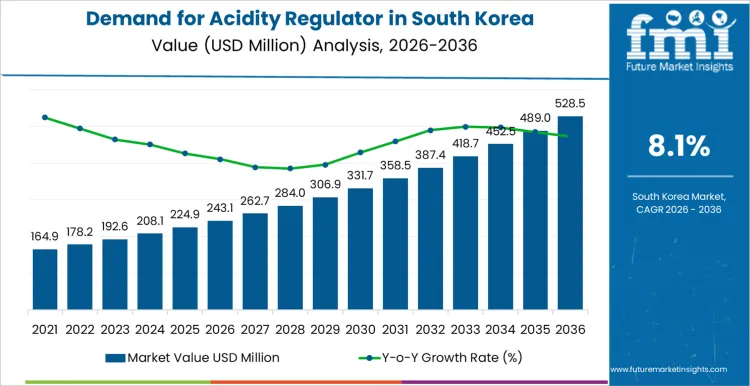
Revenue from acidity regulator sales in South Korea is set to reach USD 243.1 million in 2026. Expenditure on these essential food additives is likely to ascend to USD 528.5 million by 2036, expanding at a compound annual growth rate of 8.1%. South Korea represents a dynamic landscape for food processing ingredients, driven heavily by the global explosion of K-Food popularity. Exports of kimchi, gochujang, and ready-to-eat meals require robust preservation methods to maintain quality during shipping, necessitating high usage of pH control agents. Domestic consumption patterns are also shifting towards convenience foods, which rely on these additives to prevent spoilage and enhance flavor profiles. Manufacturers are continuously seeking efficient formulations that balance shelf-life extension with taste retention, fueling steady procurement of various organic acids.
Government agencies such as the Ministry of Food and Drug Safety (MFDS) are enforcing stricter hygiene and safety standards across the food processing domain. Policymakers are actively promoting sodium reduction initiatives to combat lifestyle diseases, encouraging processors to utilize acidity regulators as alternative flavor enhancers to salt. Compliance with these evolving regulations pushes companies to adopt higher-grade ingredients that ensure safety without compromising sensory attributes. Reimbursement or support for adopting safer manufacturing practices is encouraging small and medium enterprises to upgrade their ingredient sourcing. Public scrutiny regarding food safety is at an all-time high, compelling producers to use recognized and safe additives, thereby stabilizing demand for approved regulators within the national supply chain.
Quick Stats for Demand for Acidity Regulator in South Korea
- Demand for Acidity Regulator in South Korea Value (2026): USD 243.1 million
- Demand for Acidity Regulator in South Korea Forecast Value (2036): USD 528.5 million
- Demand for Acidity Regulator in South Korea Forecast CAGR: 8.1%
- Leading Type Segment for Acidity Regulator Industry in South Korea: Acetic Acid (27.0%)
- Leading Application Segment for Acidity Regulator Industry in South Korea: Beverages (36.3%)
- Key Growth Regions for Acidity Regulator Industry in South Korea: Jeju, South Gyeongsang, South Jeolla, North Jeolla
- Acidity Regulator Industry in South Korea Key Players: Archer Daniels Midland Company, Cargill, Incorporated, Tate & Lyle PLC, Jungbunzlauer Suisse AG, Corbion N.V.
Innovation is reshaping the sector as consumer preference tilts towards natural and unrecognizable ingredients. Research is heavily focused on developing clean label emulsifiers and natural preservatives derived from fermentation processes. Application of lactic acid is expanding beyond preservation into fortification, aligning with the growing trend of functional nutrition. Producers are integrating citric acid extracted from citrus fruits to appeal to health-conscious demographics who read labels meticulously. Developing advanced encapsulation technologies allows for controlled release of these acids, improving their effectiveness in complex food matrices like bakery and meat products. Such technological strides ensure that the industry remains responsive to both regulatory pressures and consumer desires for healthier, safer food options.
Demand for Acidity Regulator in South Korea Key Takeaways
| Metric | Value |
|---|---|
| Industry Size (2026) | USD 243.1 million |
| Industry Value (2036) | USD 528.5 million |
| CAGR (2026 to 2036) | 8.1% |
Which Industrial Factors Are Fueling Acidity Regulator Adoption?
Rising global demand for Korean fermented products acts as a primary catalyst for ingredient procurement. Kimchi exports alone require massive volumes of acetic acid and other pH stabilizers to prevent over-fermentation during logistics. Expansion of the convenience store culture in South Korea drives the need for shelf-stable functional food ingredients in lunchboxes and instant noodles. Increasing urbanization leads to busier lifestyles, boosting sales of processed foods that rely on food emulsifiers and regulators for texture and safety. Consequently, the modernization of South Korea's food processing infrastructure to meet international safety standards creates a sustained requirement for high-purity, regulatory-compliant additives.
How is the Sector Structured Across Key Segments?
Structure of this domain is categorized by chemical type and application vertical, reflecting the diverse utility of these ingredients. Product segmentation distinguishes between organic acids like citric and lactic, and inorganic ones like phosphoric acid. Application classification highlights where these ingredients add the most value, ranging from beverages to bakery items. Understanding this segmentation helps manufacturers tailor their supply chains; for instance, beverage companies require liquid bulk delivery, while bakeries may prefer powder forms. This division underscores the versatility of acidity regulators, which are essential across virtually every aisle of a modern supermarket.
Why Does the Acetic Acid Category Maintain Dominance?
Acetic Acid commands a 27.0% share of the industry. This dominance stems from its indispensable role in producing kimchi, pickles, and various Korean side dishes (banchan). Fermentation is a cornerstone of Korean cuisine, and acetic acid is the primary agent responsible for the characteristic tang and preservation of these staples. Industrial production of sauces and condiments also relies heavily on acetic acid for pH control and microbial stability. Low cost and high efficacy make it the preferred choice for mass-market food processing. Given the cultural dietary habits that emphasize fermented vegetables, demand for acetic acid remains structurally ingrained in the local food system.
How is the Beverages Application Contributing to Sector Growth?
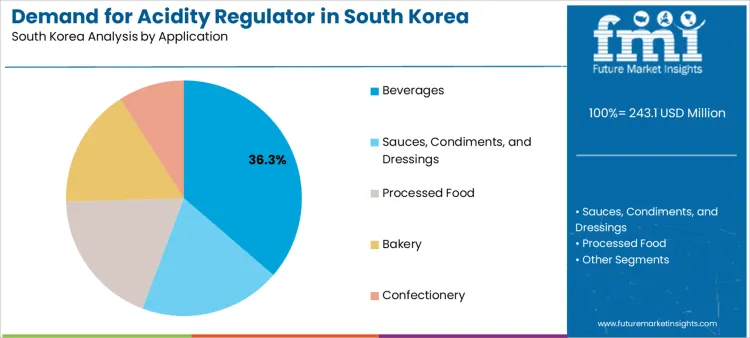
Beverages account for 36.3% of the usage share. South Korean consumers have a high affinity for functional drinks, ready-to-drink coffees, and flavored waters, all of which require precise pH management. Citrate market analysis shows high utilization in soft drinks to provide tartness and enhance preservative efficacy. Manufacturers use regulators to ensure stability of colors and flavors in vitamin drinks and sports beverages. Rise of "zero-calorie" and flavored sparkling water trends further boosts consumption of citric and malic acids to improve palatability. This segment's leadership is secured by the sheer volume of beverage production and the constant innovation in liquid refreshment categories.
Will the Expansion of Clean Label Trends Redefine Future Sales?
Usage of natural global organic acids market products is gaining traction as consumers increasingly scrutinize ingredient lists. Synthetic additives are facing skepticism, prompting manufacturers to switch to naturally sourced regulators like lemon-derived citric acid or fermentation-produced lactic acid. This shift offers significant opportunities for premium pricing and brand differentiation. Companies utilizing ascorbic acid market share analysis data are reformulating products to use Vitamin C as a dual-purpose antioxidant and acidity regulator. While natural sourcing presents supply chain challenges, the brand equity gained from "no artificial additives" claims is driving a definitive pivot towards clean-label acidity solutions.
How Do Raw Material Fluctuations Impact Design?
Volatility in the prices of corn, tapioca, and phosphate rock directly impacts the production costs of organic and inorganic acids. High purity phosphoric acid market availability is often linked to fertilizer industry dynamics, creating occasional supply tightness. Manufacturers must navigate these fluctuations by securing long-term contracts or diversifying their feedstock sources. Increases in energy costs also affect the fermentation and purification processes required for high-grade additives. To mitigate these risks, suppliers are investing in more efficient production technologies and exploring alternative substrates for fermentation, ensuring stable pricing and availability for their food processing clients.
Is the Trend Towards Functional Foods Affecting Demand?
Growth of the health-functional food sector is influencing ingredient choices significantly. Regulators are now selected not just for pH control, but for their metabolic benefits. Lecithin market synergies with acidity regulators are being explored to improve nutrient absorption. Feed acidifier market trends in livestock also reflect a move towards gut health, which mirrors the human functional food trend. Acidulants that support digestion or enhance the stability of probiotics are seeing higher uptake. This convergence of preservation and nutrition expands the role of acidity regulators, transforming them from simple additives into active functional ingredients.
How is the Landscape Evolving Across South Korea's Regions?
Regional consumption patterns reflect the distribution of food manufacturing hubs and agricultural processing centers. Industrial zones in the southeast focus on large-scale canning and sauce production, while agricultural provinces utilize regulators for fruit processing and fermentation. Government support for regional food clusters is decentralizing demand.
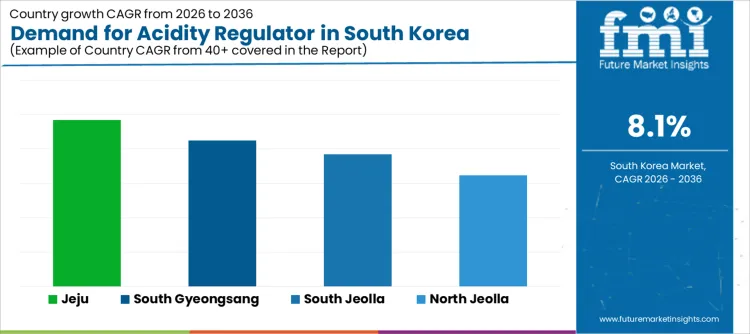
| Region | CAGR (2026 to 2036) |
|---|---|
| Jeju | 9.7% |
| South Gyeongsang | 8.5% |
| South Jeolla | 7.7% |
| North Jeolla | 6.5% |
Why is the Beverage Industry in Jeju Driving Rapid Growth?
Adoption of acidity regulators in Jeju is projected to expand at a CAGR of 9.7%. Jeju Island is famous for its citrus fruits (hallabong, tangerines) and volcanic water, fostering a booming beverage processing industry. Local manufacturers utilize citric acid and other regulators to produce premium juices, teas, and functional drinks marketed with the "Jeju" brand origin. Tourism drives high consumption of these local specialties. Investments in expanding production facilities for bottled water and fruit blends directly correlate with increased procurement of high-quality acidity regulators to maintain product consistency and safety.
How is Food Processing in South Gyeongsang Influencing Sales?
Sales of food additives in South Gyeongsang are likely to reach a CAGR of 8.5%. This region hosts significant industrial complexes and ports, facilitating the import of raw materials and export of processed foods. Large-scale seafood processing and canning facilities located here utilize acidity regulators for preservation and pH stabilization. Ammonium sulfate food grade market applications in dough conditioning for bakery factories in the region also contribute to demand. Proximity to major logistics hubs allows manufacturers in this area to efficiently supply both domestic and international retail chains, sustaining high volume consumption of industrial food ingredients.
What Specific Factors Drive Demand in South Jeolla?
Expansion in South Jeolla is anticipated to rise at a CAGR of 7.7%. Known as the "kitchen of Korea," South Jeolla is the heartland of traditional Korean food, particularly kimchi and salted seafood (jeotgal). Extensive agricultural output here supports a vast network of producers making fermented goods. These artisanal and industrial producers rely on acetic and lactic acids to control fermentation rates and ensure safety. Government initiatives to standardize and export Jeolla-branded foods are pushing local producers to adopt standardized acidity regulation methods, moving away from purely traditional, variable techniques to more consistent industrial processes.
Why is North Jeolla Modernizing its Food Clusters?
Deployment of food technologies in North Jeolla is expected to increase at a CAGR of 6.5%. The National Food Cluster in Iksan is a major driver, attracting food tech companies and research institutes. This hub fosters innovation in functional foods and sauces, driving demand for specialized regulators. Antacids market research often overlaps with food ingredient studies here, exploring ingredients that are gentle on the stomach. While growing from a smaller base, the focus on high-value, export-oriented food products ensures a steady increase in the need for premium, traceable acidity regulators.
What Strategic Initiatives Define Market Leadership?
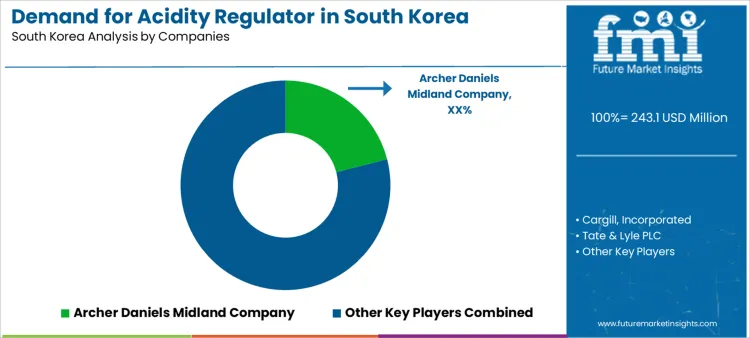
Archer Daniels Midland Company (ADM) commands a dominant position with a 21.0% share, leveraging its global supply chain and extensive portfolio of acidulants. Its strategy revolves around offering "solution-based" ingredients, helping customers reformulate products for better taste and stability. ADM invests heavily in technical support centers in Asia to assist Korean clients with specific formulation challenges. Competitors like Cargill and Tate & Lyle focus on sustainability and clean-label offerings, tapping into the premium segment. Strategic partnerships with local distributors allow these global giants to penetrate the fragmented SME food processor network effectively.
How Are Niche Competitors Challenging Global Giants?
Specialized players such as Jungbunzlauer and Corbion differentiate themselves through high-purity and fermentation-derived products. They target specific verticals like confectionery and medical nutrition where quality specifications are rigorous. Flurosilicic acid market share analysis is irrelevant here, but niche acid producers focus on specific organic acids like lactic or malic acid for specialized functions. By offering superior technical documentation and certifications (Halal, Kosher, Non-GMO), these companies appeal to export-oriented Korean manufacturers who need to meet strict international standards.
Key Companies
- Archer Daniels Midland Company
- Cargill, Incorporated
- Tate & Lyle PLC
- Jungbunzlauer Suisse AG
- Corbion N.V.
Scope of Report
| Items | Values |
|---|---|
| Quantitative Units | USD Million |
| Types | Acetic Acid, Lactic Acid, Citric Acid, Maleic Acid, Phosphoric Acid |
| Application | Beverages, Sauces/Condiments/Dressings, Processed Food, Bakery, Confectionery |
| Regions Covered | Jeju, South Gyeongsang, South Jeolla, North Jeolla |
| Key Companies Profiled | ADM, Cargill, Tate & Lyle, Jungbunzlauer, Corbion |
Demand for Acidity Regulator in South Korea by Segments
-
By Types
- Acetic Acid
- Lactic Acid
- Citric Acid
- Maleic Acid
- Phosphoric Acid
-
By Application
- Beverages
- Sauces, Condiments, and Dressings
- Processed Food
- Bakery
- Confectionery
Bibliography
- Ministry of Food and Drug Safety. (2024, October 1). Food additive standards and specifications (Notification No. 2024-56). Ministry of Food and Drug Safety, Republic of Korea.
- Ministry of Food and Drug Safety. (2024). Standards and specifications for foods (English compilation). Ministry of Food and Drug Safety, Republic of Korea.
- Statistics Korea. (2024, December 29). Monthly industrial statistics, November 2024. Statistics Korea, Republic of Korea.
- Korea Agro-Fisheries and Food Trade Corporation. (2025, February 14). 2024 coffee processed food segment market status report (market analysis). Korea Agro-Fisheries and Food Trade Corporation, Republic of Korea.
- Korea Agro-Fisheries and Food Trade Corporation. (2025, May 6). Food manufacturing industry trends from statistics: 2024 to Q1 2025. Korea Agro-Fisheries and Food Trade Corporation, Republic of Korea.
Frequently Asked Questions
How big is the demand for Acidity Regulator in South Korea in 2026?
The demand for Acidity Regulator in South Korea is estimated to be valued at USD 243.1 million in 2026.
What will be the size of Acidity Regulator in South Korea in 2036?
The industry size for the Acidity Regulator in South Korea is projected to reach USD 528.5 million by 2036.
How much will be the demand for Acidity Regulator in South Korea growth between 2026 and 2036?
The demand for Acidity Regulator in South Korea is expected to grow at a 8.1% CAGR between 2026 and 2036.
What are the key product types in the Acidity Regulator in South Korea?
The key product types in Acidity Regulator in South Korea are Acetic Acid, Lactic Acid, and Citric Acid.
Which end user segment is expected to contribute significant share in the Acidity Regulator in South Korea in 2026?
By end user, Beverages segment is expected to command 36.3% share in the Acidity Regulator in South Korea in 2026.
Preview the report firsthand - request a free sample
Get SampleGet the brochure for pricing and purchase details.
Get PDFTable of Content
- Executive Summary
- South Korea Market Outlook
- Demand-side Trends
- Supply-side Trends
- Technology Roadmap Analysis
- Analysis and Recommendations
- Market Overview
- Market Coverage / Taxonomy
- Market Definition / Scope / Limitations
- Market Background
- Market Dynamics
- Drivers
- Restraints
- Opportunity
- Trends
- Scenario Forecast
- Demand in Optimistic Scenario
- Demand in Likely Scenario
- Demand in Conservative Scenario
- Opportunity Map Analysis
- Product Life Cycle Analysis
- Supply Chain Analysis
- Investment Feasibility Matrix
- Value Chain Analysis
- PESTLE and Porter’s Analysis
- Regulatory Landscape
- Regional Parent Market Outlook
- Production and Consumption Statistics
- Import and Export Statistics
- Market Dynamics
- South Korea Market Analysis 2021 to 2025 and Forecast, 2026 to 2036
- Historical Market Size Value (USD Million) Analysis, 2021 to 2025
- Current and Future Market Size Value (USD Million) Projections, 2026 to 2036
- Y-o-Y Growth Trend Analysis
- Absolute $ Opportunity Analysis
- South Korea Market Pricing Analysis 2021 to 2025 and Forecast 2026 to 2036
- South Korea Market Analysis 2021 to 2025 and Forecast 2026 to 2036, By Types
- Introduction / Key Findings
- Historical Market Size Value (USD Million) Analysis By Types , 2021 to 2025
- Current and Future Market Size Value (USD Million) Analysis and Forecast By Types , 2026 to 2036
- Acetic Acid
- Lactic Acid
- Citric Acid
- Maleic Acid
- Phosphoric Acid
- Acetic Acid
- Y-o-Y Growth Trend Analysis By Types , 2021 to 2025
- Absolute $ Opportunity Analysis By Types , 2026 to 2036
- South Korea Market Analysis 2021 to 2025 and Forecast 2026 to 2036, By Application
- Introduction / Key Findings
- Historical Market Size Value (USD Million) Analysis By Application, 2021 to 2025
- Current and Future Market Size Value (USD Million) Analysis and Forecast By Application, 2026 to 2036
- Beverages
- Sauces, Condiments, and Dressings
- Processed Food
- Bakery
- Confectionery
- Beverages
- Y-o-Y Growth Trend Analysis By Application, 2021 to 2025
- Absolute $ Opportunity Analysis By Application, 2026 to 2036
- Market Structure Analysis
- Competition Dashboard
- Competition Benchmarking
- Market Share Analysis of Top Players
- By Regional
- By Types
- By Application
- Competition Analysis
- Competition Deep Dive
- Archer Daniels Midland Company
- Overview
- Product Portfolio
- Profitability by Market Segments (Product/Age /Sales Channel/Region)
- Sales Footprint
- Strategy Overview
- Marketing Strategy
- Product Strategy
- Channel Strategy
- Cargill, Incorporated
- Tate & Lyle PLC
- Jungbunzlauer Suisse AG
- Corbion N.V.
- Archer Daniels Midland Company
- Competition Deep Dive
- Assumptions & Acronyms Used
- Research Methodology


