

- Market Size (2026)
- USD 1018.0 Mn
- Forecast (2036)
- USD 1536.2 Mn
- CAGR (2026 to 2036)
- 4.2%
Citrate Market Size, Market Forecast and Outlook By FMI
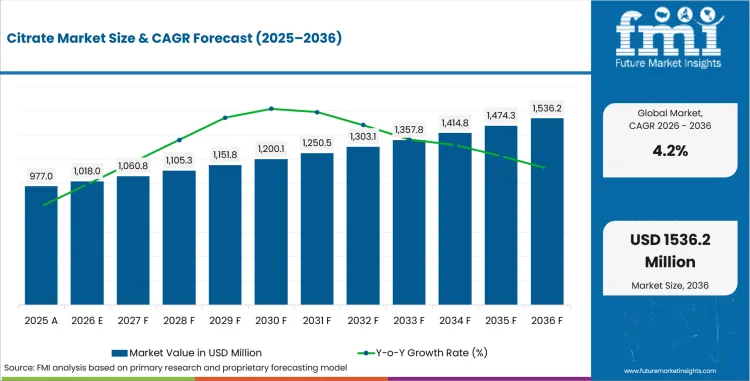
The citrate market was valued at USD 977.0 million in 2025. The market is set to reach USD 1,018.0 million by 2026-end and grow at a CAGR of 4.2% between 2026-2036 to reach USD 1,536.2 million by 2036. Sodium Citrate will dominate with a 34.0% share, while Food and Beverage will lead with a 38.0% share.
Key Takeaways, Market Size, and Forecast
- 2026 Market Size: USD 1018.0 Million
- 2036 Market Size: USD 1536.2 Million
- Compound Annual Growth Rate (CAGR): 4.2% from 2026 to 2036
- Absolute $ Opportunity: USD 518.2 Million between 2026 and 2036
- Leading Product Segment: Sodium Citrate
- Sodium Citrate Share in 2026: 34.0%
- Fastest-growing Country: USA
- USA CAGR: 4.5% through 2036
| Parameter | Details |
|---|---|
| Market Size in 2026 (Value) | USD 1018.0 Million |
| Market Forecast in 2036 (Value) | USD 1536.2 Million |
| CAGR (2026 to 2036) | 4.2% |
| Years Considered | 2021 to 2036 |
| Base Year | 2025 |
| Forecast Period | 2026 to 2036 |
| Units Considered | Value (USD Mn) |
| Leading Sub-Region | USA |
Summary of the Citrate Market
- Demand and Growth Drivers
- Food and beverage industry demand for sodium citrate and citric acid derivatives is shaped by their function as acidity regulators, emulsifiers, and preservatives across processed food, dairy, and beverage manufacturing lines.
- Pharmaceutical excipient applications are supporting steady citrate procurement, with sodium citrate and potassium citrate specified as buffering agents, anticoagulants, and effervescent tablet components in drug formulations.
- Growth reflects the breadth of citrate applications across food processing, pharmaceuticals, cleaning products, and industrial chelation, creating multi-sector demand resilience that stabilizes procurement volumes across economic cycles.
- Product and Segment View
- Sodium Citrate accounts for 34.0% of the product segment in 2026, reflecting its established role as the most widely used citrate salt across food preservation, dairy processing, and pharmaceutical buffering applications.
- Food and Beverage is likely to remain a leading application category, with food and beverage manufacturing accounting for the largest share of citrate procurement for acidity regulation, emulsification, and flavor enhancement.
- Food and Beverage Industry is expected to account for 36.0% of the end use segment, with food and beverage industry processors specifying citrate salts under long-term supply agreements with established producers.
- Geography and Competitive Outlook
- USA is expected to lead growth at 4.5% through 2036, supported by the scale of food processing infrastructure, pharmaceutical manufacturing, and industrial applications that collectively drive citrate demand.
- South Korea at 4.4% reflects demand shaped by quality-focused food manufacturing, pharmaceutical excipient requirements, and established citrate procurement patterns in processed food and beverage applications.
- Companies with integrated citric acid fermentation, multi-salt production capability, and food-grade and pharmaceutical-grade certification across multiple jurisdictions are positioned to capture share.
- Analyst Opinion
- Nandini Roy Choudhury, Principal Consultant at FMI says, 'Citrate suppliers with dual food-grade and pharmaceutical-grade capability that can guarantee supply stability from integrated fermentation operations are likely to strengthen procurement relationships as food processors and pharma manufacturers prioritize supply chain reliability.'
- The citrate market is characterized by stable multi-sector demand across food, pharmaceutical, and industrial applications that provides resilience against single-sector economic cyclicality.
- Adoption is supported by the regulatory acceptance of citrate salts as GRAS ingredients in food applications and as established pharmaceutical excipients with documented safety profiles across global pharmacopoeias.
- Production technology based on citric acid fermentation from carbohydrate feedstocks creates supply linkage to sugar and starch commodity markets that influences citrate pricing and margin stability.
Citrate Market Definition
The citrate market encompasses commercially traded products categorized by product, application, end use, technology, distribution channel. Core categories include sodium citrate, calcium citrate, potassium citrate, food and beverage, pharmaceuticals, personal care and cosmetics, food and beverage industry, pharmaceutical industry, and related formulations. The market covers revenue from 2026 to 2036 across all distribution and end-use channels.
Citrate Market Inclusions
Market scope encompasses all commercially traded citrate products categorized by product (sodium citrate, calcium citrate, potassium citrate, magnesium citrate, other citrates), application (food and beverage, pharmaceuticals, personal care and cosmetics, industrial applications), end use (food and beverage industry, pharmaceutical industry, personal care industry, industrial sector), technology (production technology, purification technology, formulation technology), distribution channel (indirect sales, direct sales). Revenue coverage spans 2026 to 2036.
Citrate Market Exclusions
The scope does not include raw unprocessed or non-commercial-grade citrate products sold outside organized trade channels. Products intended exclusively for non-commercial research or laboratory use are excluded.
Citrate Market Research Methodology
- Primary Research: FMI analysts conducted interviews with citrate producers, processors, distributors, and end-use specialists in key markets.
- Desk Research: Combined data from industry associations, regulatory databases, certification bodies, and manufacturer disclosures.
- Market Sizing and Forecasting: Bottom-up aggregation across product, application, end use, technology, distribution channel segments, triangulated with trade and production data.
- Data Validation: Cross-checked quarterly against production data, trade statistics, and manufacturer capacity utilization.
Why is the Citrate Market Growing?
- Multi-sector demand across food processing, pharmaceutical excipient, cleaning product, and industrial chelation applications provides structural volume stability for citrate salt procurement.
- Food safety and pharmaceutical GMP compliance requirements are consolidating citrate procurement among established fermentation producers with documented quality systems and supply chain traceability.
- USA leads growth at 4.5%, supported by the scale of domestic food processing, pharmaceutical manufacturing, and the breadth of industrial applications that collectively drive citrate demand.
The citrate market is expanding steadily as food processors, pharmaceutical manufacturers, and industrial users maintain consistent procurement of sodium citrate, potassium citrate, and calcium citrate across established applications. Sodium citrate leads the product segment, reflecting its versatility as an acidity regulator in processed foods, an emulsifier in dairy products, an anticoagulant in blood collection, and a buffering agent in pharmaceutical formulations. Food and beverage applications dominate demand, with processed food preservation, beverage pH management, and dairy emulsification accounting for the largest procurement volumes.
Growth is further supported by pharmaceutical excipient demand, where citrate salts serve as buffering agents, effervescent tablet components, and drug delivery system ingredients. Production technology is based on citric acid fermentation from sugar or starch feedstocks, creating supply linkage to carbohydrate commodity markets. Indirect sales dominate distribution, reflecting the B2B procurement structure across food manufacturing and pharmaceutical channels. Regional demand variation reflects differences in processed food consumption intensity, pharmaceutical manufacturing scale, and industrial application breadth.
Market Segmentation Analysis
- Sodium Citrate accounts for 34.0% of the product segment in 2026.
- Food and Beverage Industry leads the end use segment at 36.0% share.
- Production Technology accounts for 57.0% of the technology segment.
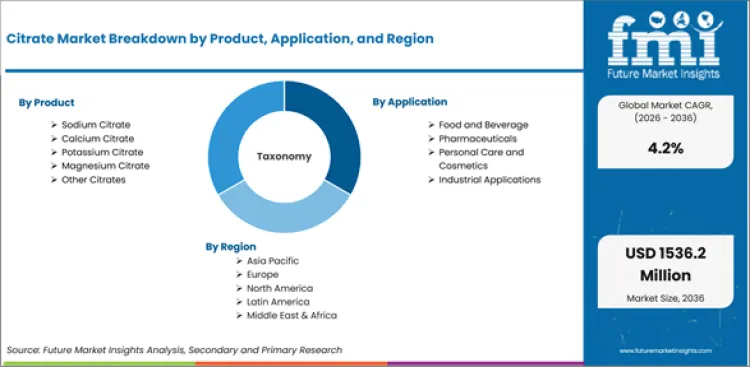
The citrate market is segmented by product, application, end use, technology, distribution channel. By product, segments include Sodium Citrate, Calcium Citrate, Potassium Citrate, Magnesium Citrate, Other Citrates. By application, segments include Food and Beverage, Pharmaceuticals, Personal Care and Cosmetics, Industrial Applications. By end use, segments include Food and Beverage Industry, Pharmaceutical Industry, Personal Care Industry, Industrial Sector. By technology, segments include Production Technology, Purification Technology, Formulation Technology. By distribution channel, segments include Indirect Sales, Direct Sales.
Insights into the Sodium Citrate Product Segment
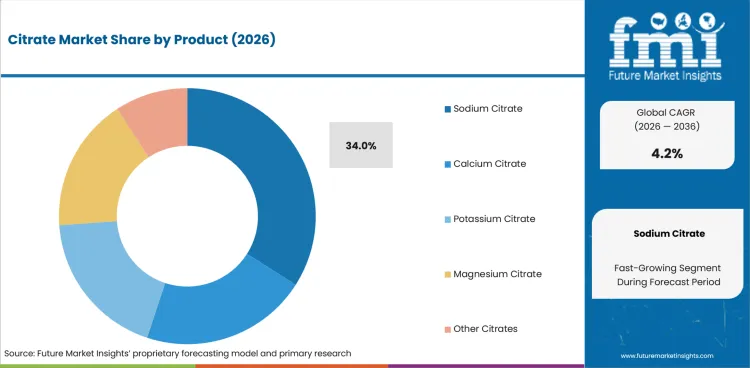
Sodium Citrate is expected to account for 34.0% of the product segment in 2026. Key sub-categories include trisodium citrate, disodium citrate, powder form, each serving distinct requirements. Demand is concentrated in commercial and institutional channels where consistency and compliance are primary criteria.
Procurement for sodium citrate products is shaped by downstream requirements, performance targets, and compatibility with existing systems. Suppliers with certified quality management and consistent output are gaining preference.
Insights into the Food and Beverage Application Segment
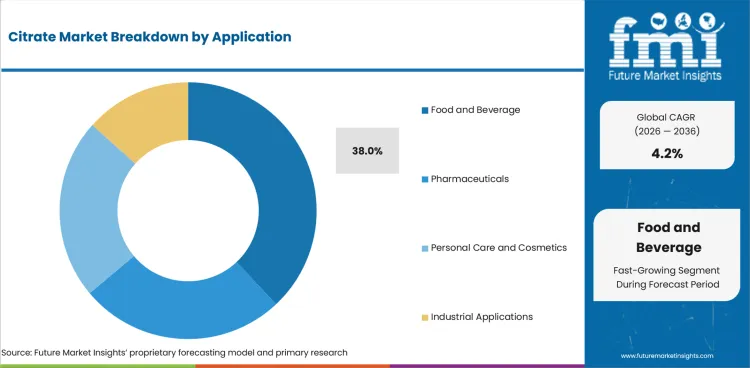
Food and Beverage is expected to account for 38.0% of the application segment in 2026. Key sub-categories include acidulant and flavoring, preservative, antacid formulations, each serving distinct requirements. Demand is concentrated in commercial and institutional channels where consistency and compliance are primary criteria.
Procurement for food and beverage products is shaped by downstream requirements, performance targets, and compatibility with existing systems. Suppliers with certified quality management and consistent output are gaining preference.
Citrate Market Drivers, Restraints, and Opportunities
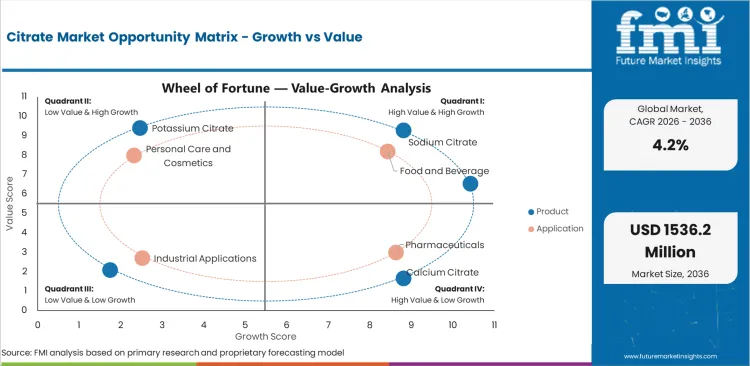
- Multi-Sector Demand Resilience is the primary structural demand driver for citrate products across commercial channels.
- Fermentation Feedstock Cost Linkage constrains adoption in certain segments, concentrating procurement among established suppliers.
- Food Safety and Pharma GMP Consolidation is expanding higher-value application segments.
The citrate market is expanding on the basis of multi-sector demand resilience, food safety and pharma gmp consolidation, and evolving distribution patterns. Fermentation Feedstock Cost Linkage remains a constraining factor.
Multi-Sector Demand Resilience
Demand is shaped by the breadth of citrate applications across food, pharmaceutical, and industrial sectors. This multi-sector demand profile provides procurement volume stability that single-application ingredients do not offer, attracting supply chain investment from integrated producers.
Fermentation Feedstock Cost Linkage
Adoption economics are influenced by the linkage of citrate production costs to sugar and starch commodity prices. Fermentation-based manufacturing creates raw material cost exposure that affects citrate pricing, particularly for producers without forward commodity hedging programs.
Food Safety and Pharma GMP Consolidation
Growth reflects the consolidation of citrate procurement among suppliers with dual food-grade and pharmaceutical-grade certification. Regulatory compliance costs and audit requirements create barriers that favor integrated producers over commodity traders.
Clean-Label Ingredient Positioning
Procurement is supported by the clean-label acceptance of citrate salts, which carry E-number designations familiar to consumers and are broadly accepted as natural-origin processing aids in food manufacturing.
Analysis of Citrate Market By Key Countries
.webp "Top Country Growth Comparison Citrate Market Cagr (2026 2036)")
| Country | CAGR |
|---|---|
| USA | 4.5% |
| UK | 4.0% |
| European Union (EU) | 4.2% |
| Japan | 3.9% |
| South Korea | 4.4% |
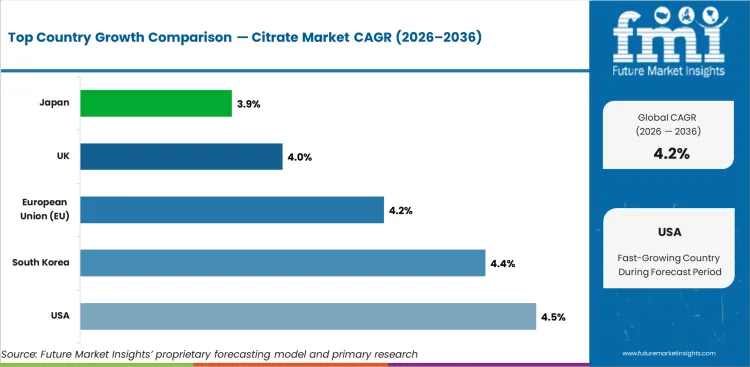
- USA leads at 4.5%, reflecting strong domestic demand and expanding commercial channels for sodium citrate products.
- South Korea at 4.4% reflects steady demand shaped by regulatory compliance and institutional procurement.
- European Union (EU) (4.2%) shows growth driven by market modernization and specification-led sourcing.
- UK (4.0%) shows growth driven by market modernization and specification-led sourcing.
The global citrate market is projected to expand at 4.2% CAGR from 2026 to 2036. The analysis covers more than 30 countries, with key markets listed below.
In-depth Analysis of Citrate Market in USA
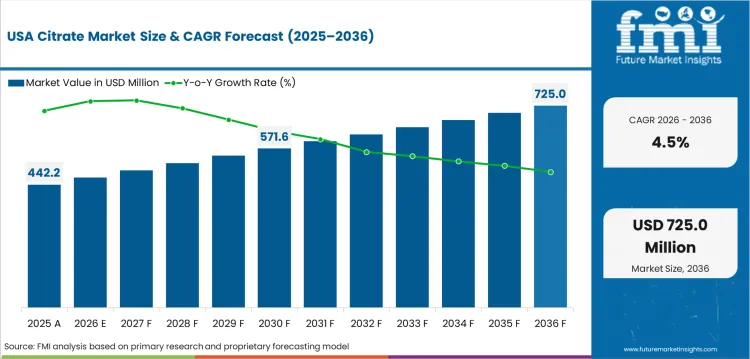
The USA is projected to register a CAGR of 4.5% through 2036. The scale of domestic food processing and pharmaceutical manufacturing drives citrate demand. FDA GRAS status and pharmaceutical excipient acceptance support broad-based procurement across food, drug, and industrial applications.
- The large domestic food processing sector generates stable volume demand for sodium citrate as an acidity regulator and preservative.
- FDA GRAS status and USP/NF pharmaceutical acceptance provide broad regulatory clearance for citrate procurement.
- Sustainability mandates are influencing fermentation feedstock sourcing and packaging decisions for citrate producers.
Sales Analysis of Citrate Market in UK
Post-Brexit regulatory realignment and food safety compliance requirements are shaping citrate procurement in the UK, projected to grow at 4.0% through 2036. Pharmaceutical excipient demand and processed food manufacturing provide stable demand channels for citrate salts across established applications.
- Post-Brexit food safety regulations are creating updated compliance standards for imported citrate ingredients.
- Pharmaceutical excipient demand provides a stable high-specification procurement channel for citrate salt suppliers.
- Retailer sustainability targets influence packaging and supply chain transparency for food-grade citrate products.
Growth Analysis of Citrate Market in European Union (EU)
EU-wide food safety regulations and pharmaceutical GMP requirements are shaping citrate procurement across member states, projected to grow at 4.2% through 2036. Harmonized E-number labeling and clean-label consumer acceptance support citrate positioning as a preferred processing aid.
- EU E-number acceptance and clean-label consumer familiarity support citrate salt specification in processed food manufacturing.
- Harmonized pharmaceutical GMP requirements enable consistent citrate excipient procurement across EU member states.
- EPR and sustainability mandates influence packaging and feedstock sourcing decisions for citrate producers.
Demand Outlook for Citrate Market in Japan
The mature food processing and pharmaceutical landscape in Japan is generating stable demand for citrate salts, projected to grow at 3.9% through 2036. JIS compliance and strict quality standards maintain high qualification thresholds that favor established citrate suppliers with documented purity and food safety records.
- Strict quality standards and long supplier qualification cycles maintain barriers for new citrate entrants in Japan.
- Pharmaceutical excipient demand from the mature domestic drug manufacturing sector provides stable citrate procurement volume.
- Food processing precision and JIS compliance requirements favor citrate suppliers with documented batch consistency.
Future Outlook for Citrate Market in South Korea
South Korea is projected to grow at 4.4% through 2036. Quality-focused food manufacturing and pharmaceutical production drive citrate procurement. MFDS regulatory frameworks and government R&D support shape ingredient qualification standards for citrate suppliers serving food and pharmaceutical channels.
- Quality-focused food processing and pharmaceutical industries maintain specification-grade citrate procurement standards.
- MFDS regulatory compliance shapes qualification requirements for citrate salt suppliers in food and drug applications.
- Government R&D support for food technology enables adoption of precision citrate dosing in automated manufacturing.
Competitive Landscape and Strategic Positioning
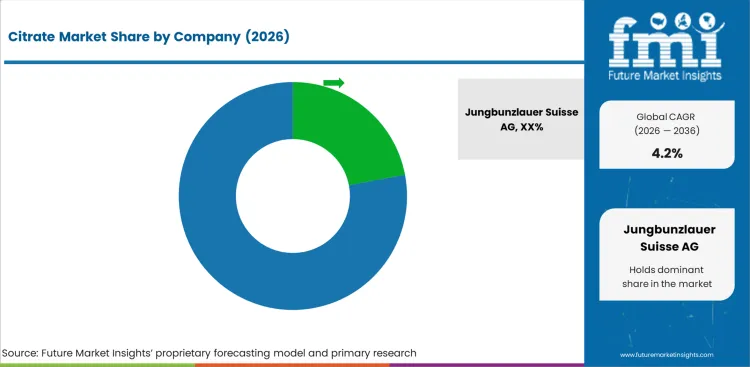
- Jungbunzlauer Suisse AG leads through established brand recognition, distribution reach, and product portfolio breadth across key end use channels.
- Archer Daniels Midland (ADM) and Cargill, Incorporated compete on product specialization, regional coverage, and formulation expertise.
- Emerging players target niche segments, clean-label positioning, and regional specialty applications.
Jungbunzlauer Suisse AG maintains a strong position through brand equity, distribution infrastructure, and established procurement relationships. Archer Daniels Midland (ADM) offers a complementary portfolio.
Cargill, Incorporated competes on quality, certification, and regional distribution. Mid-tier players focus on niche segments or specific application expertise.
Barriers include brand development investment, regulatory compliance, established retailer relationships, and distribution infrastructure. Strategic priorities include premiumization, emerging market expansion, and product innovation.
Key Companies in the Citrate Market
Key global companies leading the citrate market include:
- Jungbunzlauer Suisse AG, Archer Daniels Midland (ADM), Cargill, Incorporated, Gadot Biochemical Industries maintain leading positions through scale, brand recognition, and distribution infrastructure.
- Tate & Lyle PLC have established regional leadership through focused distribution and product specialization.
Competitive Benchmarking: Citrate Market
| Company | Fermentation Capacity | Food-Grade Certification | Pharma-Grade Capability | Geographic Footprint |
|---|---|---|---|---|
| Jungbunzlauer Suisse AG | High | Medium | Strong | Global |
| Archer Daniels Midland (ADM) | High | Medium | Strong | Global |
| Cargill, Incorporated | High | Medium | Strong | Global |
| Gadot Biochemical Industries | Medium | Medium | Moderate | Multi-regional |
| Tate & Lyle PLC | Medium | High | Moderate | Multi-regional |
Source: Future Market Insights competitive analysis, 2026.
Key Developments in Citrate Market
- In 2025, Jungbunzlauer Suisse AG expanded its sodium citrate portfolio with new formulations targeting end use applications.
- In 2025, Archer Daniels Midland (ADM) invested in capacity expansion to support growing demand for certified sodium citrate products across key regional markets.
Key Players in the Citrate Market
Major Global Players
- Jungbunzlauer Suisse AG
- Archer Daniels Midland (ADM)
- Cargill, Incorporated
Emerging Players/Startups
- Elchemy
- Acuitive Technologies
Report Scope and Coverage
| Parameter | Details |
|---|---|
| Market size by 2036 | USD 1536.2 Million |
| Growth rate | 4.2% CAGR (2026 to 2036) |
| Forecast period | 2026 to 2036 |
| Base year value (2025) | USD 977.0 Million |
| Key Segment Covered | Product, Application, End Use, Technology, Distribution Channel |
| Regions covered | North America, Latin America, Western Europe, Eastern Europe, East Asia, South Asia and Pacific, Middle East and Africa |
| Countries covered | USA, UK, European Union (EU), Japan, South Korea, 30 plus countries |
| Key companies profiled | Jungbunzlauer Suisse AG, Archer Daniels Midland (ADM), Cargill, Incorporated, Gadot Biochemical Industries, Tate & Lyle PLC |
| Approach | Hybrid bottom-up and top-down methodology starting with verified transaction data, projecting adoption velocity across segments and regions. |
Market Segmentation Analysis
Citrate Market Segmented by Product:
- Sodium Citrate
- Trisodium Citrate
- Disodium Citrate
- Calcium Citrate
- Powder Form
- Granular Form
- Potassium Citrate
- Monopotassium Citrate
- Tripotassium Citrate
- Magnesium Citrate
- Liquid Form
- Capsule Form
- Other Citrates
- Ammonium Citrate
- Zinc Citrate
Citrate Market Segmented by Application:
- Food and Beverage
- Acidulant and Flavoring
- Beverages
- Processed Foods
- Preservative
- Meat Products
- Dairy Products
- Acidulant and Flavoring
- Pharmaceuticals
- Antacid Formulations
- Acidity Relief
- Digestive Health
- Mineral Supplements
- Bone Health
- Electrolyte Balance
- Antacid Formulations
- Personal Care and Cosmetics
- pH Regulation
- Skin Care Products
- Hair Care Products
- Stabilizers
- Creams and Lotions
- Cosmetic Formulations
- pH Regulation
- Industrial Applications
- Cleaning Agents
- Household Cleaners
- Industrial Cleaners
- Water Treatment
- Scale Removal
- Metal Cleaning
- Cleaning Agents
Citrate Market Segmented by End Use:
- Food and Beverage Industry
- Food Manufacturers
- Processed Food Producers
- Beverage Manufacturers
- Beverage Producers
- Soft Drink Manufacturers
- Functional Drink Producers
- Food Manufacturers
- Pharmaceutical Industry
- Drug Manufacturers
- Generic Drug Producers
- Branded Drug Manufacturers
- Healthcare Providers
- Hospitals
- Clinics
- Drug Manufacturers
- Personal Care Industry
- Cosmetic Manufacturers
- Skin Care Brands
- Hair Care Brands
- Cosmetic Manufacturers
- Industrial Sector
- Chemical Manufacturers
- Specialty Chemicals
- Bulk Chemicals
- Cleaning Product Manufacturers
- Household Cleaners
- Industrial Cleaners
- Chemical Manufacturers
Citrate Market Segmented by Technology:
- Production Technology
- Fermentation Process
- Microbial Fermentation
- Submerged Fermentation
- Chemical Synthesis
- Neutralization Process
- Acid Base Reactions
- Fermentation Process
- Purification Technology
- Standard Purification
- Filtration
- Crystallization
- Advanced Purification
- Ion Exchange
- Membrane Separation
- Standard Purification
- Formulation Technology
- Powder Formulations
- Bulk Powder
- Granular Form
- Liquid Formulations
- Solutions
- Concentrated Liquids
- Powder Formulations
Citrate Market Segmented by Distribution Channel:
- Indirect Sales
- Distributors
- Chemical Distributors
- Specialty Distributors
- E commerce Platforms
- B2B Marketplaces
- Online Suppliers
- Distributors
- Direct Sales
- Manufacturer Direct
- Bulk Contracts
- Long Term Agreements
- Manufacturer Direct
Citrate Market by Region:
- North America
- USA
- Canada
- Mexico
- Latin America
- Brazil
- Chile
- Rest of Latin America
- Western Europe
- Germany
- UK
- Italy
- Spain
- France
- Nordic
- BENELUX
- Rest of Western Europe
- Eastern Europe
- Russia
- Poland
- Hungary
- Balkan & Baltic
- Rest of Eastern Europe
- East Asia
- China
- Japan
- South Korea
- South Asia and Pacific
- India
- ASEAN
- Australia & New Zealand
- Rest of South Asia and Pacific
- Middle East & Africa
- Kingdom of Saudi Arabia
- Other GCC Countries
- Türkiye
- South Africa
- Other African Union
- Rest of Middle East & Africa
Research Sources and Bibliography
- 1. Food and Agriculture Organization. (2025). FAO Global Food and Agriculture Statistics. FAO.
- 2. World Health Organization. (2025). WHO Global Health Observatory Data Repository. WHO.
- 3. International Organization for Standardization. (2025). ISO Food Safety Management Standards. ISO.
- 4. USA Food and Drug Administration. (2025). FDA Food Safety Modernization Act Compliance Guide. FDA.
- 5. European Commission. (2025). EU Food Safety and Quality Standards Framework. EC.
This bibliography is provided for reader reference.
This Report Answers
- Estimating the size of the market and revenue from 2026 to 2036.
- Segmenting by product, application, end use, technology, distribution channel.
- Insights about more than 30 markets in the region.
- Analysis of demand drivers, restraints, and growth opportunities.
- Assessment of the competitive landscape.
- Finding investment opportunities across key application and end-use segments.
- Tracking supply chain and distribution channel developments.
- Delivery of data in PDF and Excel formats.
Frequently Asked Questions
How big is the citrate market in 2026?
The global citrate market is estimated to be valued at USD 1,018.0 million in 2026.
What will be the size of the citrate market in 2036?
The market size for the citrate market is projected to reach USD 1,536.2 million by 2036.
How much will the citrate market growth be between 2026 and 2036?
The citrate market is expected to grow at a 4.2% CAGR between 2026 and 2036.
What are the key products in the citrate market?
The key products in the citrate market are Sodium Citrate, Calcium Citrate, Potassium Citrate, Magnesium Citrate and Other Citrates.
Which application segment is expected to contribute a significant share in the citrate market in 2026?
In terms of application, the food and beverage segment is expected to command 38.0% share in the citrate market in 2026.
Preview the report firsthand - request a free sample
Get SampleGet the brochure for pricing and purchase details.
Get PDFTable of Content
- Key Takeaways
- Market Size and CAGR
- Top Growth Driver
- Fastest Growing Segment
- Leading Region
- Key Companies
- Emerging Opportunities
- Executive Summary
- Global Market Outlook
- Demand-side Trends
- Supply-side Trends
- Technology Roadmap Analysis
- Analysis and Recommendations
- Analyst Perspective (What is happening? Why now? What should investors know?)
- Key Questions Answered
- How large is the market?
- What is the CAGR?
- What are key trends?
- Which region dominates?
- Who are the leaders?
- Market Overview
- Market Coverage / Taxonomy
- Market Definition / Scope / Limitations
- Research Methodology
- Chapter Orientation
- Analytical Lens and Working Hypotheses
- Market Structure, Signals, and Trend Drivers
- Benchmarking and Cross-market Comparability
- Market Sizing, Forecasting, and Opportunity Mapping
- Research Design and Evidence Framework
- Desk Research Programme (Secondary Evidence)
- Expert Input and Fieldwork (Primary Evidence)
- Tooling, Models, and Reference Databases
- Data Engineering and Model Build
- Quality Assurance and Audit Trail
- Market Background
- Market Dynamics (Drivers, Restraints, Opportunity, Trends)
- Scenario Forecast (Optimistic, Likely, Conservative)
- Impact Analysis
- AI Impact
- Sustainability Impact
- Regulatory Impact
- Technology Impact
- Consumer / Buyer Analysis
- Purchase Drivers
- Adoption Barriers
- Buyer Journey
- Opportunity Map Analysis
- Product Life Cycle Analysis
- Supply Chain Analysis
- Investment Feasibility Matrix
- Value Chain Analysis
- PESTLE and Porter's Analysis
- Regulatory Landscape
- Regional Parent Market Outlook
- Production and Consumption Statistics
- Import and Export Statistics
- Global Market Analysis and Forecast, 2021 to 2036
- Historical Market Size Value (USD Million) Analysis, 2021 to 2025
- Current and Future Market Size Value (USD Million) Projections, 2026 to 2036
- Y-o-Y Growth Trend Analysis
- Absolute $ Opportunity Analysis
- Global Market Pricing Analysis, 2021 to 2036
- Global Market Analysis and Forecast, By Product, 2021 to 2036
- Introduction / Key Findings
- Historical Market Size Value (USD Million) Analysis By Product, 2021 to 2025
- Current and Future Market Size Value (USD Million) Analysis and Forecast By Product, 2026 to 2036
- Sodium Citrate
- Trisodium Citrate
- Disodium Citrate
- Calcium Citrate
- Powder Form
- Granular Form
- Potassium Citrate
- Monopotassium Citrate
- Tripotassium Citrate
- Magnesium Citrate
- Liquid Form
- Capsule Form
- Other Citrates
- Ammonium Citrate
- Zinc Citrate
- Sodium Citrate
- Y-o-Y Growth Trend Analysis By Product, 2021 to 2025
- Absolute $ Opportunity Analysis By Product, 2026 to 2036
- Global Market Analysis and Forecast, By Application, 2021 to 2036
- Introduction / Key Findings
- Historical Market Size Value (USD Million) Analysis By Application, 2021 to 2025
- Current and Future Market Size Value (USD Million) Analysis and Forecast By Application, 2026 to 2036
- Food and Beverage
- Acidulant and Flavoring
- Preservative
- Pharmaceuticals
- Antacid Formulations
- Mineral Supplements
- Personal Care and Cosmetics
- pH Regulation
- Stabilizers
- Industrial Applications
- Cleaning Agents
- Water Treatment
- Food and Beverage
- Y-o-Y Growth Trend Analysis By Application, 2021 to 2025
- Absolute $ Opportunity Analysis By Application, 2026 to 2036
- Global Market Analysis and Forecast, By End Use, 2021 to 2036
- Introduction / Key Findings
- Historical Market Size Value (USD Million) Analysis By End Use, 2021 to 2025
- Current and Future Market Size Value (USD Million) Analysis and Forecast By End Use, 2026 to 2036
- Food and Beverage Industry
- Food Manufacturers
- Beverage Producers
- Pharmaceutical Industry
- Drug Manufacturers
- Healthcare Providers
- Personal Care Industry
- Cosmetic Manufacturers
- Industrial Sector
- Chemical Manufacturers
- Cleaning Product Manufacturers
- Food and Beverage Industry
- Y-o-Y Growth Trend Analysis By End Use, 2021 to 2025
- Absolute $ Opportunity Analysis By End Use, 2026 to 2036
- Global Market Analysis and Forecast, By Technology, 2021 to 2036
- Introduction / Key Findings
- Historical Market Size Value (USD Million) Analysis By Technology, 2021 to 2025
- Current and Future Market Size Value (USD Million) Analysis and Forecast By Technology, 2026 to 2036
- Production Technology
- Fermentation Process
- Chemical Synthesis
- Purification Technology
- Standard Purification
- Advanced Purification
- Formulation Technology
- Powder Formulations
- Liquid Formulations
- Production Technology
- Y-o-Y Growth Trend Analysis By Technology, 2021 to 2025
- Absolute $ Opportunity Analysis By Technology, 2026 to 2036
- Global Market Analysis and Forecast, By Distribution Channel, 2021 to 2036
- Introduction / Key Findings
- Historical Market Size Value (USD Million) Analysis By Distribution Channel, 2021 to 2025
- Current and Future Market Size Value (USD Million) Analysis and Forecast By Distribution Channel, 2026 to 2036
- Indirect Sales
- Distributors
- E commerce Platforms
- Direct Sales
- Manufacturer Direct
- Indirect Sales
- Y-o-Y Growth Trend Analysis By Distribution Channel, 2021 to 2025
- Absolute $ Opportunity Analysis By Distribution Channel, 2026 to 2036
- Global Market Analysis and Forecast, By Region, 2021 to 2036
- Introduction
- Historical Market Size Value (USD Million) Analysis By Region, 2021 to 2025
- Current Market Size Value (USD Million) Analysis and Forecast By Region, 2026 to 2036
- North America
- Latin America
- Western Europe
- Eastern Europe
- East Asia
- South Asia and Pacific
- Middle East & Africa
- Market Attractiveness Analysis By Region
- North America Market Analysis and Forecast, By Country, 2021 to 2036
- Historical Market Size Value (USD Million) Trend Analysis By Market Taxonomy, 2021 to 2025
- Market Size Value (USD Million) Forecast By Market Taxonomy, 2026 to 2036
- By Country
- USA
- Canada
- Mexico
- By Product
- By Application
- By End Use
- By Technology
- By Distribution Channel
- By Country
- Market Attractiveness Analysis
- By Country
- By Product
- By Application
- By End Use
- By Technology
- By Distribution Channel
- Key Takeaways
- Latin America Market Analysis and Forecast, By Country
- Historical Market Size Value (USD Million) Trend Analysis By Market Taxonomy, 2021 to 2025
- Market Size Value (USD Million) Forecast By Market Taxonomy, 2026 to 2036
- By Country
- Brazil
- Chile
- Rest of Latin America
- By Product
- By Application
- By End Use
- By Technology
- By Distribution Channel
- By Country
- Market Attractiveness Analysis
- By Country
- By Product
- By Application
- By End Use
- By Technology
- By Distribution Channel
- Key Takeaways
- Western Europe Market Analysis and Forecast, By Country
- Historical Market Size Value (USD Million) Trend Analysis By Market Taxonomy, 2021 to 2025
- Market Size Value (USD Million) Forecast By Market Taxonomy, 2026 to 2036
- By Country
- Germany
- UK
- Italy
- Spain
- France
- Nordic
- BENELUX
- Rest of Western Europe
- By Product
- By Application
- By End Use
- By Technology
- By Distribution Channel
- By Country
- Market Attractiveness Analysis
- By Country
- By Product
- By Application
- By End Use
- By Technology
- By Distribution Channel
- Key Takeaways
- Eastern Europe Market Analysis and Forecast, By Country
- Historical Market Size Value (USD Million) Trend Analysis By Market Taxonomy, 2021 to 2025
- Market Size Value (USD Million) Forecast By Market Taxonomy, 2026 to 2036
- By Country
- Russia
- Poland
- Hungary
- Balkan & Baltic
- Rest of Eastern Europe
- By Product
- By Application
- By End Use
- By Technology
- By Distribution Channel
- By Country
- Market Attractiveness Analysis
- By Country
- By Product
- By Application
- By End Use
- By Technology
- By Distribution Channel
- Key Takeaways
- East Asia Market Analysis and Forecast, By Country
- Historical Market Size Value (USD Million) Trend Analysis By Market Taxonomy, 2021 to 2025
- Market Size Value (USD Million) Forecast By Market Taxonomy, 2026 to 2036
- By Country
- China
- Japan
- South Korea
- By Product
- By Application
- By End Use
- By Technology
- By Distribution Channel
- By Country
- Market Attractiveness Analysis
- By Country
- By Product
- By Application
- By End Use
- By Technology
- By Distribution Channel
- Key Takeaways
- South Asia and Pacific Market Analysis and Forecast, By Country
- Historical Market Size Value (USD Million) Trend Analysis By Market Taxonomy, 2021 to 2025
- Market Size Value (USD Million) Forecast By Market Taxonomy, 2026 to 2036
- By Country
- India
- ASEAN
- Australia & New Zealand
- Rest of South Asia and Pacific
- By Product
- By Application
- By End Use
- By Technology
- By Distribution Channel
- By Country
- Market Attractiveness Analysis
- By Country
- By Product
- By Application
- By End Use
- By Technology
- By Distribution Channel
- Key Takeaways
- Middle East & Africa Market Analysis and Forecast, By Country
- Historical Market Size Value (USD Million) Trend Analysis By Market Taxonomy, 2021 to 2025
- Market Size Value (USD Million) Forecast By Market Taxonomy, 2026 to 2036
- By Country
- Kingdom of Saudi Arabia
- Other GCC Countries
- Türkiye
- South Africa
- Other African Union
- Rest of Middle East & Africa
- By Product
- By Application
- By End Use
- By Technology
- By Distribution Channel
- By Country
- Market Attractiveness Analysis
- By Country
- By Product
- By Application
- By End Use
- By Technology
- By Distribution Channel
- Key Takeaways
- Key Countries Market Analysis
- USA
- Pricing Analysis
- Market Share Analysis, 2025
- By Product
- By Application
- By End Use
- By Technology
- By Distribution Channel
- Canada
- Pricing Analysis
- Market Share Analysis, 2025
- By Product
- By Application
- By End Use
- By Technology
- By Distribution Channel
- Mexico
- Pricing Analysis
- Market Share Analysis, 2025
- By Product
- By Application
- By End Use
- By Technology
- By Distribution Channel
- Brazil
- Pricing Analysis
- Market Share Analysis, 2025
- By Product
- By Application
- By End Use
- By Technology
- By Distribution Channel
- Chile
- Pricing Analysis
- Market Share Analysis, 2025
- By Product
- By Application
- By End Use
- By Technology
- By Distribution Channel
- Germany
- Pricing Analysis
- Market Share Analysis, 2025
- By Product
- By Application
- By End Use
- By Technology
- By Distribution Channel
- UK
- Pricing Analysis
- Market Share Analysis, 2025
- By Product
- By Application
- By End Use
- By Technology
- By Distribution Channel
- Italy
- Pricing Analysis
- Market Share Analysis, 2025
- By Product
- By Application
- By End Use
- By Technology
- By Distribution Channel
- Spain
- Pricing Analysis
- Market Share Analysis, 2025
- By Product
- By Application
- By End Use
- By Technology
- By Distribution Channel
- France
- Pricing Analysis
- Market Share Analysis, 2025
- By Product
- By Application
- By End Use
- By Technology
- By Distribution Channel
- India
- Pricing Analysis
- Market Share Analysis, 2025
- By Product
- By Application
- By End Use
- By Technology
- By Distribution Channel
- ASEAN
- Pricing Analysis
- Market Share Analysis, 2025
- By Product
- By Application
- By End Use
- By Technology
- By Distribution Channel
- Australia & New Zealand
- Pricing Analysis
- Market Share Analysis, 2025
- By Product
- By Application
- By End Use
- By Technology
- By Distribution Channel
- China
- Pricing Analysis
- Market Share Analysis, 2025
- By Product
- By Application
- By End Use
- By Technology
- By Distribution Channel
- Japan
- Pricing Analysis
- Market Share Analysis, 2025
- By Product
- By Application
- By End Use
- By Technology
- By Distribution Channel
- South Korea
- Pricing Analysis
- Market Share Analysis, 2025
- By Product
- By Application
- By End Use
- By Technology
- By Distribution Channel
- Russia
- Pricing Analysis
- Market Share Analysis, 2025
- By Product
- By Application
- By End Use
- By Technology
- By Distribution Channel
- Poland
- Pricing Analysis
- Market Share Analysis, 2025
- By Product
- By Application
- By End Use
- By Technology
- By Distribution Channel
- Hungary
- Pricing Analysis
- Market Share Analysis, 2025
- By Product
- By Application
- By End Use
- By Technology
- By Distribution Channel
- Kingdom of Saudi Arabia
- Pricing Analysis
- Market Share Analysis, 2025
- By Product
- By Application
- By End Use
- By Technology
- By Distribution Channel
- Türkiye
- Pricing Analysis
- Market Share Analysis, 2025
- By Product
- By Application
- By End Use
- By Technology
- By Distribution Channel
- South Africa
- Pricing Analysis
- Market Share Analysis, 2025
- By Product
- By Application
- By End Use
- By Technology
- By Distribution Channel
- USA
- Market Structure Analysis
- Competition Dashboard
- Competition Benchmarking
- Market Share Analysis of Top Players
- By Regional
- By Product
- By Application
- By End Use
- By Technology
- By Distribution Channel
- Emerging Startups
- Innovation Benchmarking
- Competition Analysis
- Competition Deep Dive
- Jungbunzlauer Suisse AG
- Overview
- Product Portfolio
- Profitability by Market Segments (Product/Region/Sales Channel)
- Sales Footprint
- Strategy Overview
- Marketing Strategy
- Product Strategy
- Channel Strategy
- Archer Daniels Midland (ADM)
- Cargill, Incorporated
- Gadot Biochemical Industries
- Tate & Lyle PLC
- Other Companies & Regional Players
- Jungbunzlauer Suisse AG
- Case Studies
- Success Stories
- Recent Developments
- Competition Deep Dive
- Assumptions & Acronyms Used


