

- Market Size (2026)
- USD 554.7 Mn
- Forecast (2036)
- USD 775.0 Mn
- CAGR (2026 to 2036)
- 3.4%
Summary of the Calcium Citrate Malate Market
- Demand and Growth Drivers
- Calcium fortification uptake in functional beverages, dairy alternatives, and fortified cereals is likely to support strong demand as food and beverage manufacturers continue expanding nutritional fortification strategies across mass-consumption products.
- Bone health and geriatric nutrition demand is likely to remain a key growth driver as aging populations and preventive healthcare trends continue increasing demand for highly bioavailable calcium formulations in supplements and clinical nutrition products.
- Pharmaceutical-grade specification requirements are expected to support adoption as USP and Ph. Eur. compliance standards continue strengthening premium demand for high-purity calcium citrate malate across pharmaceutical and nutraceutical applications during the forecast period.
- Product and Segment View
- Food and Beverage will probably stay the most popular industrial use area because fortified drinks, dairy alternatives, and ready-to-eat nutritional food products are all becoming more popular.
- Sweetener is likely to be the most popular application, thanks to a steady demand for basic formulations, widespread use in processed foods, and established ways to buy it in food manufacturing.
- Powder is likely to stay a popular high-value form segment because manufacturers want to make it easier to mix, change the formula, and handle large amounts of it in factories.
- Geography and Competitive Outlook
- The United Kingdom is likely to remain a key market owing to rising bone health awareness, strong nutraceutical demand, and increasing use of premium calcium fortification across healthcare and food applications.
- Japan is likely to sustain strong demand due to aging demographics, advanced preventive healthcare adoption, and high consumption of functional foods and nutritional supplements.
- Companies that can combine pharmaceutical-grade compliance, formulation flexibility, and large-scale supply partnerships are likely to gain traction during the forecast period.
- Analyst Opinion
- Nandini Roy Choudhury, Principal Consultant at FMI says, “Companies that can improve product purity while balancing bioavailability claims and cost-efficient large-scale supply are likely to strengthen their position over the forecast period.”
- The calcium citrate malate market is evolving from a specialized calcium ingredient category into a broader functional nutrition and pharmaceutical solutions segment.
- Adoption is being driven by strong demand for highly bioavailable calcium sources that support bone health, preventive nutrition, and premium fortification across multiple end-use industries.
- The market is also benefiting from expanding pharmaceutical-grade applications and increasing consumer focus on long-term healthy aging outcomes.
- Demand is further supported by the need for scalable ingredient solutions that balance compliance, efficacy, affordability, and long-term nutritional value.
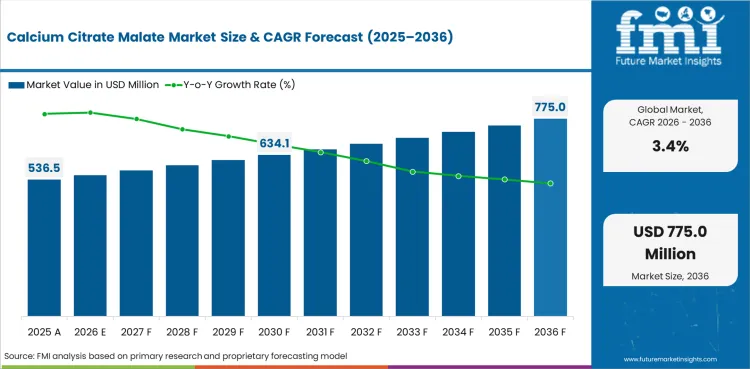
Key Takeaways, Market Size, and Forecast
- The calcium citrate malate market was valued at USD 536.5 million in 2025.
- By 2036, the calcium citrate malate market is expected to reach USD 775.0 million.
- From 2026 to 2036, the market is projected to grow at a CAGR of 3.4%.
- The market is expected to create an incremental opportunity of USD 220.25 million between 2026 and 2036.
- In 2026, the food and beverage segment is projected to account for 31.5% of industrial use, driven by demand for fortified foods and functional beverages.
- The United Kingdom (11.56%) and Japan (10.20%) are among the fastest-growing markets globally.
Calcium Citrate Malate Market Definition
The calcium citrate malate market encompasses commercially produced calcium citrate malate (CCM) ingredients, a highly bioavailable calcium salt used for nutritional fortification across functional beverages, dairy products, fortified cereals and bakery, nutritional supplements, and pharmaceutical calcium therapy applications. Products are supplied in powder and crystal forms across food, pharmaceutical, and nutraceutical grades.
Calcium Citrate Malate Market Inclusions
Market scope includes all commercially traded calcium citrate malate products segmented by form (powder, crystal), end-use (food and beverage, pharmaceutical, nutraceutical), industrial application (fortified beverages, dairy products, bakery, functional foods), and distribution channel. Revenue sizing spans the 2026 to 2036 forecast period.
Calcium Citrate Malate Market Exclusions
The scope excludes alternative calcium salts including calcium carbonate, calcium citrate, and calcium phosphate products that do not contain the citrate-malate double salt structure, combination calcium-vitamin D supplement finished products, and synthetic calcium compounds used in industrial applications outside of nutrition.
Calcium Citrate Malate Market Research Methodology
- Primary Research: FMI analysts interviewed leaders of calcium ingredient converter operations, functional food and beverage formulators, dietary supplement brand procurement managers, and pharmaceutical excipient buyers in North America, Europe, and Asia-Pacific.
- Desk Research: To set verifiable baseline parameters, data collection combined calcium fortification research publications, dietary supplement category scan data, company annual reports, and pharmacopoeia monograph data.
- Market Sizing and Forecasting: To come up with baseline values, we add up the transaction volumes of CCM ingredients from the bottom up. We then use region-specific bone health category growth and calcium fortification adoption rates to predict demand through 2036.
- Data validation and update cycle: Every three months, projections are checked against calcium ingredient shipment disclosures, dietary supplement category growth data, and functional beverage reformulation registrations.
Why is the Calcium Citrate Malate Market Growing?
- The use of calcium fortification in functional drinks and dairy alternatives keeps CCM purchases going.
- The demand for bone health and geriatric nutrition pulls CCM into high-end supplement formulations.
- Pharmaceutical-grade specification requirements help premium converters charge 30% to 50% more than their competitors.
The calcium citrate malate market is growing steadily because the calcium fortification category is growing, the demand for bone health and geriatric nutrition is growing, and the requirements for pharmaceutical-grade specifications are getting stricter. CCM has better calcium bioavailability than carbonate and citrate alternatives. This makes it a good choice for premium positioning in functional beverage fortification, dairy alternative calcium enrichment, and dietary supplement formulation.
Adding more details to functional beverage and dairy alternative reformulation. Because of its low-impact flavor profile and solubility benefits, plant-based milk, protein drink, and functional juice makers are using CCM to add calcium. These applications keep structural procurement volumes steady and help converters who have food-grade documentation depth.
Pharmaceutical-grade specification is both a way to boost sales and a way to increase profits. Ph. Eur. and USP CCM that meets the requirements of the monograph costs 30 to 50 percent more than food-grade material. This supports converter investment in purification capacity and regulatory documentation capability for calcium supplement and bone health pharmaceutical customers.
Segmental Analysis
- Powder form leads at 52.8 percent share in 2026, supported by dosing accuracy, shelf stability, and formulation compatibility across supplement, functional beverage, and fortified food applications.
- Food and beverage industrial use at 31.5 percent and food and beverage end-use at 41.6 percent reflect the dominance of fortification applications across functional beverage, dairy, and fortified food manufacturers.
- Hypermarket and supermarket distribution at 36.5 percent reflects the retail supplement and fortified food consumer purchase pathway, while B2B ingredient distribution anchors manufacturer procurement.
The calcium citrate malate market is segmented by industrial use, application, distribution channel, form, and geographic regions. Segment shares in 2026 reflect the dominant use cases, format preferences, and channel structures that characterise the category across mature and emerging geographies.
Insights into the Food and Beverage Segment
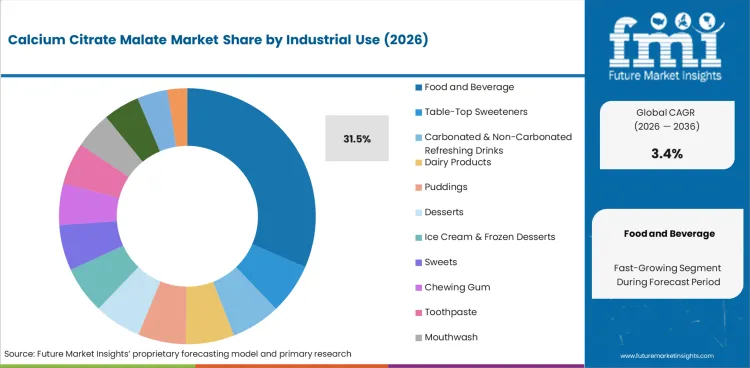
Food and Beverage is projected to lead the industrial use segment with a 31.5% share in 2026. This leadership reflects established manufacturing and supply infrastructure, competitive unit economics, and functional superiority in meeting core customer requirements across the dominant application channels.
Within this category, adjacent sub-segments are gaining share as customers respond to reformulation, regulatory, and consumer preference shifts. Converters and suppliers with format breadth and regional capacity are best positioned to capture this subsegment rotation.
Insights into the Sweetener Segment
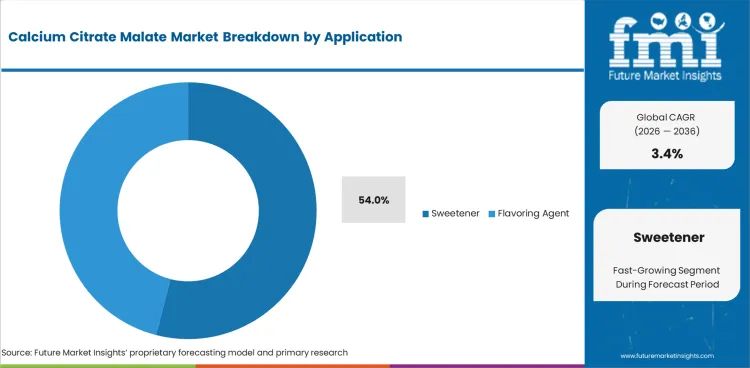
Sweetener is projected to lead the application segment with a 54.0% share in 2026. This leadership reflects established manufacturing and supply infrastructure, competitive unit economics, and functional superiority in meeting core customer requirements across the dominant application channels.
Insights into the Hypermarket/Supermarket Segment
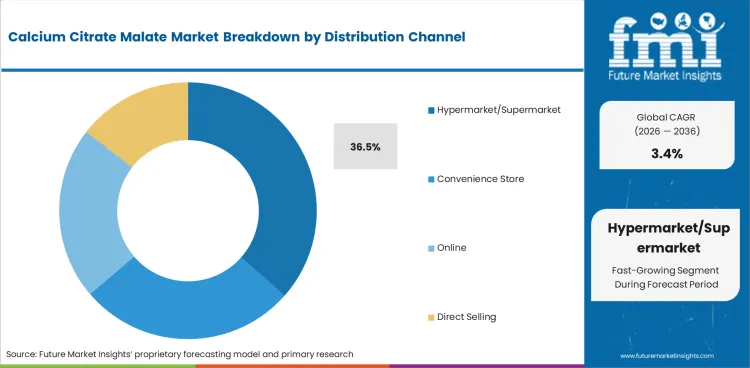
Hypermarket/Supermarket is projected to lead the distribution channel segment with a 36.5% share in 2026. This leadership reflects established manufacturing and supply infrastructure, competitive unit economics, and functional superiority in meeting core customer requirements across the dominant application channels.
Calcium Citrate Malate Market Drivers, Restraints, and Opportunities
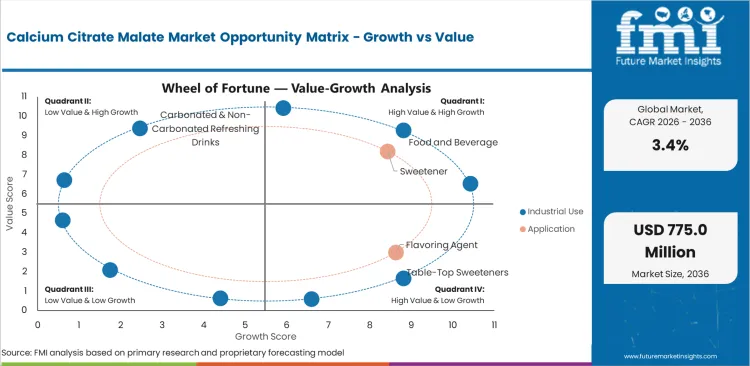
- Calcium fortification in functional drinks and dairy substitutes keeps the need for ingredients going.
- The demand for premium supplement formulation positioning is growing because of the need for bone health and nutrition for older people.
- Pharmaceutical-grade standards make it possible for premium converters to charge 30% to 50% more.
Three things are happening at the same time in the calcium citrate malate market: category expansion is increasing baseline demand; regulatory and reformulation pressure is changing specifications; and advanced method or format innovation is widening premium pricing bands. Manufacturers and suppliers are responding by putting money into reformulation, increasing capacity, and working with retailers or getting certified by regulators.
Calcium Fortification Category Expansion
Growth shows that demand for the bone health and geriatric nutrition categories is going up because the population is getting older in North America, Europe, Japan, and East Asia. CCM-based supplements with high bioavailability in osteoporosis prevention, women's health, and senior nutrition formulations are keeping the structural category growing.
Bone Health and Geriatric Nutrition Demand
Growth reflects rising bone health and geriatric nutrition category demand driven by aging demographics across North America, Europe, Japan, and East Asia. CCM-based supplements commanding premium bioavailability positioning in osteoporosis prevention, women's health, and senior nutrition formulations are sustaining structural category growth.
Pharmaceutical-Grade Specification Premium
Adoption is supported by pharmaceutical-grade specification requirements under USP and European Pharmacopoeia monographs. Pharmaceutical-grade CCM commands 30 to 50 percent pricing premiums over food-grade material, supporting converter investment in purification capacity and regulatory documentation capability across calcium supplement and bone health pharmaceutical customer segments.
Emerging-Market Nutrition Fortification Programmes
Substantial opportunity exists in emerging-market calcium fortification programmes where public health initiatives are supporting nutrition-grade ingredient procurement. Indian Food Safety and Standards Authority fortification policy, Chinese functional food regulation, and Brazilian public health nutrition programmes are expanding CCM demand across fortified staple food categories.
Analysis of Calcium Citrate Malate Market By Key Countries
.webp "Top Country Growth Comparison Calcium Citrate Malate Market Cagr (2026 2036)")
| Country | CAGR |
|---|---|
| United Kingdom | 11.56% |
| Japan | 10.20% |
| United States | 2.80% |
| Brazil | 2.70% |
| Germany | 2.60% |
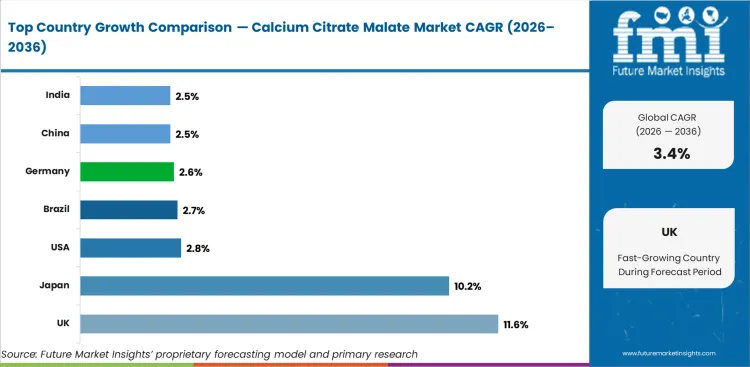
- North America and Western Europe lead premium pharmaceutical-grade CCM consumption, while Asia-Pacific delivers the highest absolute growth through functional beverage expansion and fortification programme activity.
- United States leads at 2.8 percent country CAGR within the low-growth overall category, propelled by scaled supplement category consumption and pharmaceutical-grade CCM procurement.
- United Kingdom and Japan sustain structural demand through mature supplement categories and premium functional beverage reformulation.
- China and India deliver rising growth through fortification programme expansion, functional beverage category development, and emerging domestic converter capacity investment.
The calcium citrate malate market is projected to grow globally at a CAGR of 3.4% from 2026 to 2036. Among the top markets, United Kingdom leads at 11.56%, followed by Japan at 10.20%, while United States posts 2.80%, Brazil records 2.70%, and Germany stands at 2.60%. The analysis spans over 30 countries, with the leading markets detailed below.
Demand Outlook for Calcium Citrate Malate Market in United States
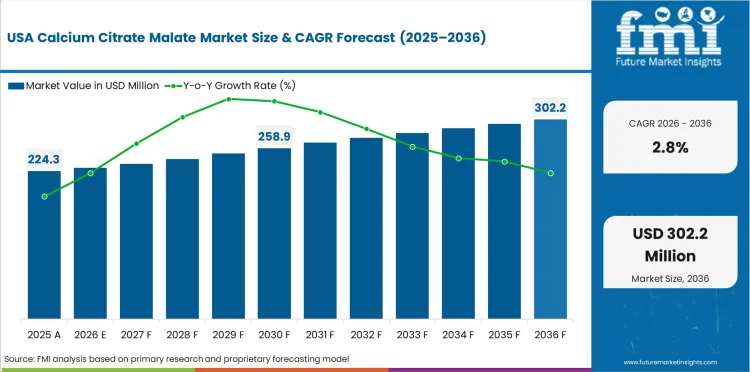
The United States is projected to grow through 2036, shaped by scaled supplement category consumption, functional beverage fortification, and pharmaceutical-grade CCM procurement across bone health and women's health categories. Domestic ingredient distributors and specialty supplement manufacturers anchor CCM category demand with scaled procurement programmes.
- Scaled supplement category consumption drives CCM procurement programmes.
- Functional beverage fortification expands ingredient supplier relationships.
- Pharmaceutical-grade CCM sustains premium-specification converter positioning.
Future Outlook for Calcium Citrate Malate Market in United Kingdom
The United Kingdom is projected to grow at an 11.56 percent CAGR through 2036, with demand supported by mature supplement category depth, premium functional beverage reformulation, and rising plant-based dairy alternative fortification activity. UK supplement brands and functional food manufacturers anchor category demand across pharmacy and specialty retail channels.
- Mature supplement category depth sustains scaled CCM procurement.
- Premium functional beverage reformulation expands ingredient demand.
- Plant-based dairy alternative fortification drives calcium enrichment procurement.
Opportunity Analysis for Calcium Citrate Malate Market in Germany
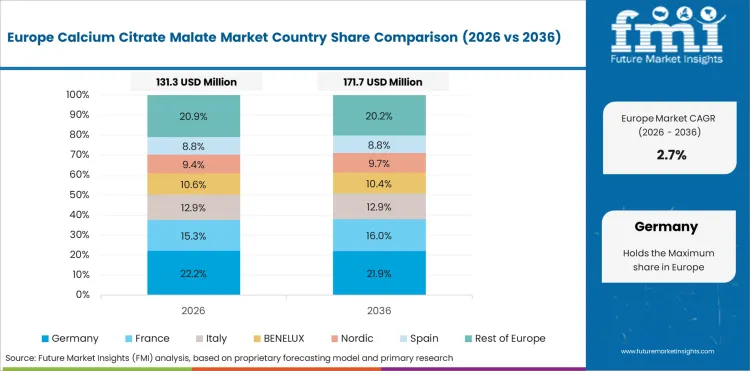
Germany demonstrates steady growth through 2036 as the country's mature supplement category, scaled functional food manufacturing, and strong pharmaceutical-grade ingredient regulation support consistent CCM demand. German formulators favour documented-origin and pharmaceutical-grade CCM across premium supplement and fortified food applications.
- Mature supplement category sustains scaled CCM procurement.
- Scaled functional food manufacturing drives ingredient supplier relationships.
- Pharmaceutical-grade ingredient regulation supports documented-origin procurement.
In-depth Analysis for Calcium Citrate Malate Market in Japan
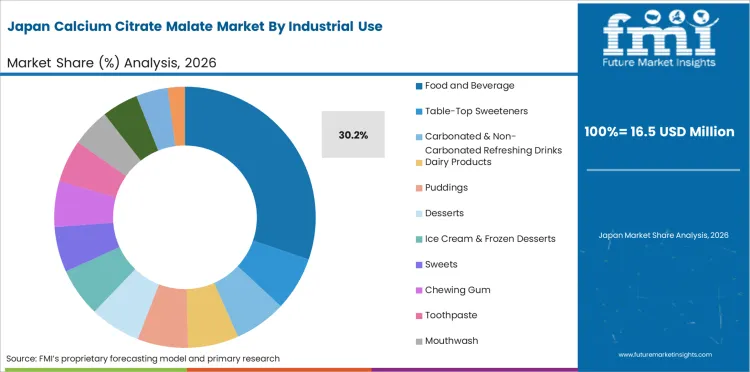
Japan is projected to grow at a 10.20 percent CAGR through 2036, reflecting mature supplement and functional food category depth, strong geriatric nutrition segment demand, and premium pharmaceutical-grade specification preference. Japanese distributors and formulators favour high-specification CCM with documented bioavailability data.
- Mature supplement and functional food category depth sustains premium demand.
- Geriatric nutrition segment drives bone health formulation procurement.
- Premium pharmaceutical-grade preference supports documented-specification supply.
Sales Analysis for Calcium Citrate Malate Market in China
China is expected to demonstrate strong growth through 2036, propelled by functional food and beverage category expansion, rising bone health supplement demand, and public health fortification programme activity. Chinese formulators are expanding CCM adoption across premium supplement and functional beverage ranges with rising domestic converter capacity investment.
- Functional food and beverage category expansion drives CCM adoption.
- Bone health supplement demand expands premium formulation procurement.
- Public health fortification programmes sustain ingredient procurement scale.
In-depth Analysis for Calcium Citrate Malate Market in India
India demonstrates strong growth through 2036, supported by FSSAI fortification policy implementation, rising supplement category expansion, and domestic converter capacity investment. Indian supplement brands and functional food manufacturers are scaling CCM procurement across bone health, women's health, and geriatric nutrition category positioning.
- FSSAI fortification policy drives scaled ingredient procurement programmes.
- Rising supplement category expansion supports premium formulation demand.
- Domestic converter capacity investment reshapes regional supply economics.
Competitive Landscape and Strategic Positioning
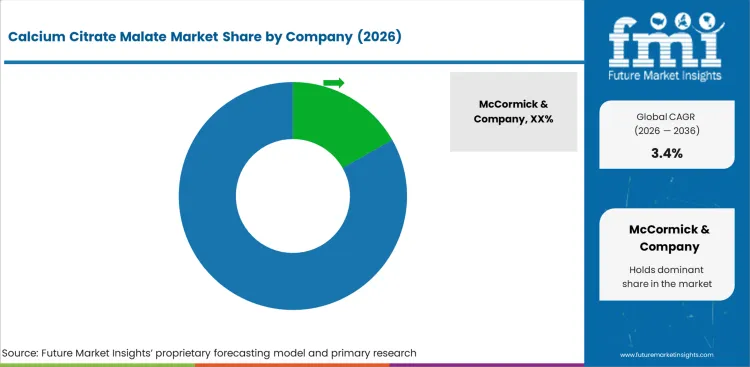
- The top converters collectively hold material share, with competitive differentiation shifting from unit cost to reformulation capability, certification depth, and customer-relationship tenure.
- Regional specialists are gaining share where local regulatory mandates and customer preference favour certified or specialised product and service offerings.
- Start-ups and SMEs are carving niche positions in climate, clean-label, and digital-channel categories targeting premium customer segments.
The calcium citrate malate market is shaped by specialist calcium salt converters and integrated nutrition ingredient houses. Jungbunzlauer Suisse AG leads the global CCM category with integrated citric acid feedstock access, scaled converter capacity, and established supplement and functional beverage customer relationships across North American and European markets.
Gadot Biochemical Industries anchors the Israeli and global specialty calcium salt segment with scaled pharmaceutical-grade and food-grade production capacity serving supplement and fortified food customers. Dr. Paul Lohmann GmbH KG operates as a European specialist calcium salt converter with strong pharmaceutical-grade positioning.
Nikunj Chemicals and Sancha Chemicals represent scaled Indian converter capacity serving both domestic and export customers with cost-advantaged CCM supply. American Elements and Spectrum Chemical anchor North American specialty chemical distribution with CCM portfolios serving pharmaceutical, laboratory, and specialty supplement customers.
Barriers to entry include citric acid and malic acid feedstock access, calcium salt processing capital requirements, pharmaceutical-grade regulatory documentation across USP, Ph. Eur., and JP frameworks, and the multi-year customer qualification cycles typical of supplement, functional food, and pharmaceutical customers. Strategic priorities across leading converters include pharmaceutical-grade capacity investment, Indian and Chinese capacity expansion, and direct supplement brand customer partnership development.
Key Companies in Calcium Citrate Malate Market
Key global companies leading the calcium citrate malate market include:
-
Jungbunzlauer Suisse AG (Switzerland), Gadot Biochemical Industries (Israel), and Dr. Paul Lohmann GmbH KG (Germany) were identified as leading players in the calcium citrate malate market, given their scaled converter capacity, integrated feedstock access, and established supplement and functional beverage customer relationships across global markets.
- Nikunj Chemicals (India), Sancha Chemicals (India), American Elements (USA), and Spectrum Chemical (USA) operate as scaled regional converters and specialty chemical distributors with established supplement and pharmaceutical customer positioning.
- Emerging Chinese, Indian, and regional specialist converters are building positions in cost-competitive food-grade CCM supply serving expanding functional beverage and fortification programme customer segments across Asia-Pacific and emerging markets.
Competitive Benchmarking: Calcium Citrate Malate Market
| Company | Grade Breadth | Pharmaceutical-Grade Capability | Customer Access | Geographic Footprint |
|---|---|---|---|---|
| Jungbunzlauer Suisse AG | High | High | Strong | Global |
| Gadot Biochemical Industries | High | High | Strong | Global |
| Dr. Paul Lohmann GmbH KG | High | High | Moderate | Europe |
| Nikunj Chemicals | Medium | Medium | Moderate | India, Global |
| Sancha Chemicals | Medium | Medium | Moderate | India, Asia-Pacific |
| American Elements | Medium | Medium | Moderate | North America, Global |
| Spectrum Chemical | Medium | High | Moderate | North America |
Source: Future Market Insights competitive analysis, 2026.
Key Developments in Calcium Citrate Malate Market
- In 2025, Jungbunzlauer expanded its citric acid and calcium salt capacity to serve rising global functional beverage and dietary supplement customer demand for premium calcium fortification ingredients.
- In 2025, Gadot Biochemical Industries extended its pharmaceutical-grade CCM production capacity to serve tightening supplement and bone health pharmaceutical regulatory specifications across North American and European customers.
Key Players in the Calcium Citrate Malate Market:
Major Global Players:
- McCormick & Company
- Olam International
- Everest Spices
- MDH (Mahashian Di Hatti)
- Synthite Industries
- Badia Spices
- Frontier Co-op
Emerging Players/Startups:
- DS Group (Catch Spices)
- Bart Ingredients
- Organic India
- Others (Local & Unorganized)
Report Scope and Coverage
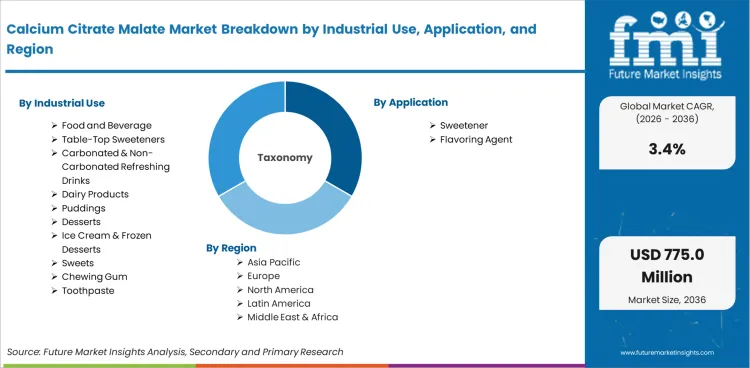
| Metric | Value |
|---|---|
| Quantitative Units | USD 554.7 million to USD 775.0 million, at a CAGR of 3.4% |
| Market Definition | The calcium citrate malate market encompasses commercially produced calcium citrate malate (CCM) ingredients, a highly bioavailable calcium salt used for nutritional fortification across functional beverages, dairy products, fortified cereals and bakery, nutritional supplements, and pharmaceutical calcium therapy applications. Products are supplied in powder and crystal forms across food, pharmaceutical, and nutraceutical grades. |
| Regions Covered | North America, Latin America, Europe, East Asia, South Asia and Pacific, Middle East and Africa |
| Countries Covered | India, China, USA, UK, Germany, Japan, South Korea, Brazil, 30 plus countries |
| Key Companies Profiled | McCormick & Company, Olam International, Everest Spices, MDH (Mahashian Di Hatti), Synthite Industries, Badia Spices, Frontier Co-op, DS Group (Catch Spices), Bart Ingredients, Organic India, Others (Local & Unorganized) |
| Forecast Period | 2026 to 2036 |
| Approach | Hybrid bottom-up and top-down methodology starting with verified calcium citrate malate market transaction data, projecting adoption velocity across segments and regions. |
Market Segmentation Analysis
Calcium Citrate Malate Market Market Segmented by Industrial Use:
- Food and Beverage
- Table-Top Sweeteners
- Carbonated & Non-Carbonated Refreshing Drinks
- Dairy Products
- Puddings
- Desserts
- Ice Cream & Frozen Desserts
- Sweets
- Chewing Gum
- Toothpaste
- Mouthwash
- Animal Feed
- Pharmaceuticals
- Cosmetics
Calcium Citrate Malate Market Market Segmented by Application:
- Sweetener
- Flavoring Agent
Calcium Citrate Malate Market Market Segmented by Distribution Channel:
- Hypermarket/Supermarket
- Convenience Store
- Online
- Direct Selling
Calcium Citrate Malate Market Market Segmented by Form:
- Powder
- Crystal
Calcium Citrate Malate Market Market Segmented by End-Use Category:
- Food & Beverage
- Pharmaceutical
- Others
Calcium Citrate Malate Market Market Segmented by Product Function:
- Low-Sodium Flavor Enhancement
- Umami Taste Enhancement
- Calcium Fortification
- Salt Replacement
- Taste Masking
- Stability Improvement
Calcium Citrate Malate Market Market by Region:
- North America
- USA
- Canada
- Mexico
- Latin America
- Brazil
- Chile
- Rest of Latin America
- Western Europe
- Germany
- UK
- Italy
- Spain
- France
- Nordic
- BENELUX
- Rest of Western Europe
- Eastern Europe
- Russia
- Poland
- Hungary
- Balkan & Baltic
- Rest of Eastern Europe
- East Asia
- China
- Japan
- South Korea
- South Asia and Pacific
- India
- ASEAN
- Australia & New Zealand
- Rest of South Asia and Pacific
- Middle East & Africa
- Kingdom of Saudi Arabia
- Other GCC Countries
- Turkiye
- South Africa
- Other African Union
- Rest of Middle East & Africa
Research Sources and Bibliography
1. United States Pharmacopeial Convention. (2024). USP Monograph for Calcium Citrate Malate. USP.
2. European Pharmacopoeia Commission. (2024). European Pharmacopoeia Monograph on Calcium Salts. EDQM.
3. U.S. Food and Drug Administration. (2024). Calcium Fortification and Dietary Supplement Regulation. FDA.
4. Food Safety and Standards Authority of India. (2024). FSSAI Fortification Standards. FSSAI.
5. National Institutes of Health Office of Dietary Supplements. (2024). Calcium Fact Sheet for Health Professionals. NIH ODS.
This bibliography is provided for reader reference.
This Report Answers
- Market sizing and revenue forecasting for calcium citrate malate market from 2026 to 2036.
- Segmentation analysis across the primary axes and regional geographies.
- Regional and country-level insights covering over 30 markets with comparative growth analysis.
- Regulatory and compliance analysis covering key multilateral, national, and industry frameworks.
- Competitive landscape assessment covering market structure, vendor positioning, and recent developments.
- Investment opportunity mapping across growth verticals and geographic regions.
- Supply chain tracking from input sourcing to finished product distribution.
- Data delivery in PDF and Excel formats with quarterly refresh access.
Frequently Asked Questions
How large is the demand for Calcium Citrate Malate Market in the global market in 2026?
Demand for calcium citrate malate market in the global market is estimated to be valued at USD 554.7 million in 2026.
What will be the market size of Calcium Citrate Malate Market by 2036?
Market size for calcium citrate malate market is projected to reach USD 775.0 million by 2036.
What is the expected demand growth for Calcium Citrate Malate Market between 2026 and 2036?
Demand for calcium citrate malate market is expected to grow at a CAGR of 3.4% between 2026 and 2036.
Which Industrial Use is poised to lead global sales by 2026?
Food and Beverage accounts for 31.5% in 2026, reflecting established manufacturing infrastructure and functional performance advantages.
How is the Powder segment driving Calcium Citrate Malate Market adoption?
Powder represents 52.8% of the form demand as leading operators drive procurement volumes.
What is driving demand in the United States?
The United States registers a 2.80% CAGR through 2036, propelled by sustained category consumption, regulatory shifts, and customer reformulation or outsourcing mandates.
What does Calcium Citrate Malate Market definition mean in this report?
The calcium citrate malate market The calcium citrate malate market encompasses commercially produced calcium citrate malate (CCM) ingredients, a highly bioavailable calcium salt used for nutritional fortification across functional beverages, dairy products, fortified cereals and bakery, nutritional supplements, and pharmaceutical calcium therapy applications. Products are supplied in powder and crystal forms across food, pharmaceutical, and nutraceutical grades.
How does FMI build and validate the Calcium Citrate Malate Market forecast?
Forecasting models apply a hybrid bottom-up methodology starting with verified transaction data, cross-validated against industry sales statistics and manufacturer financial disclosures.
Preview the report firsthand - request a free sample
Get SampleGet the brochure for pricing and purchase details.
Get PDFTable of Content
- Executive Summary
- Global Market Outlook
- Demand-side Trends
- Supply-side Trends
- Technology Roadmap Analysis
- Analysis and Recommendations
- Market Overview
- Market Coverage / Taxonomy
- Market Definition / Scope / Limitations
- Research Methodology
- Chapter Orientation
- Analytical Lens and Working Hypotheses
- Market Structure, Signals, and Trend Drivers
- Benchmarking and Cross-market Comparability
- Market Sizing, Forecasting, and Opportunity Mapping
- Research Design and Evidence Framework
- Desk Research Programme (Secondary Evidence)
- Company Annual and Sustainability Reports
- Peer-reviewed Journals and Academic Literature
- Corporate Websites, Product Literature, and Technical Notes
- Earnings Decks and Investor Briefings
- Statutory Filings and Regulatory Disclosures
- Technical White Papers and Standards Notes
- Trade Journals, Industry Magazines, and Analyst Briefs
- Conference Proceedings, Webinars, and Seminar Materials
- Government Statistics Portals and Public Data Releases
- Press Releases and Reputable Media Coverage
- Specialist Newsletters and Curated Briefings
- Sector Databases and Reference Repositories
- FMI Internal Proprietary Databases and Historical Market Datasets
- Subscription Datasets and Paid Sources
- Social Channels, Communities, and Digital Listening Inputs
- Additional Desk Sources
- Expert Input and Fieldwork (Primary Evidence)
- Primary Modes
- Qualitative Interviews and Expert Elicitation
- Quantitative Surveys and Structured Data Capture
- Blended Approach
- Why Primary Evidence is Used
- Field Techniques
- Interviews
- Surveys
- Focus Groups
- Observational and In-context Research
- Social and Community Interactions
- Stakeholder Universe Engaged
- C-suite Leaders
- Board Members
- Presidents and Vice Presidents
- R&D and Innovation Heads
- Technical Specialists
- Domain Subject-matter Experts
- Scientists
- Physicians and Other Healthcare Professionals
- Governance, Ethics, and Data Stewardship
- Research Ethics
- Data Integrity and Handling
- Primary Modes
- Tooling, Models, and Reference Databases
- Desk Research Programme (Secondary Evidence)
- Data Engineering and Model Build
- Data Acquisition and Ingestion
- Cleaning, Normalisation, and Verification
- Synthesis, Triangulation, and Analysis
- Quality Assurance and Audit Trail
- Market Background
- Market Dynamics
- Drivers
- Restraints
- Opportunity
- Trends
- Scenario Forecast
- Demand in Optimistic Scenario
- Demand in Likely Scenario
- Demand in Conservative Scenario
- Opportunity Map Analysis
- Product Life Cycle Analysis
- Supply Chain Analysis
- Investment Feasibility Matrix
- Value Chain Analysis
- PESTLE and Porter’s Analysis
- Regulatory Landscape
- Regional Parent Market Outlook
- Production and Consumption Statistics
- Import and Export Statistics
- Market Dynamics
- Global Market Analysis 2021 to 2025 and Forecast, 2026 to 2036
- Historical Market Size Value (USD Million) Analysis, 2021 to 2025
- Current and Future Market Size Value (USD Million) Projections, 2026 to 2036
- Y-o-Y Growth Trend Analysis
- Absolute $ Opportunity Analysis
- Global Market Pricing Analysis 2021 to 2025 and Forecast 2026 to 2036
- Global Market Analysis 2021 to 2025 and Forecast 2026 to 2036, By Industrial Use
- Introduction / Key Findings
- Historical Market Size Value (USD Million) Analysis By Industrial Use , 2021 to 2025
- Current and Future Market Size Value (USD Million) Analysis and Forecast By Industrial Use , 2026 to 2036
- Food and Beverage
- Table-Top Sweeteners
- Carbonated & Non-Carbonated Refreshing Drinks
- Dairy Products
- Puddings
- Desserts
- Ice Cream & Frozen Desserts
- Sweets
- Chewing Gum
- Toothpaste
- Mouthwash
- Food and Beverage
- Y-o-Y Growth Trend Analysis By Industrial Use , 2021 to 2025
- Absolute $ Opportunity Analysis By Industrial Use , 2026 to 2036
- Global Market Analysis 2021 to 2025 and Forecast 2026 to 2036, By Application
- Introduction / Key Findings
- Historical Market Size Value (USD Million) Analysis By Application, 2021 to 2025
- Current and Future Market Size Value (USD Million) Analysis and Forecast By Application, 2026 to 2036
- Sweetener
- Flavoring Agent
- Sweetener
- Y-o-Y Growth Trend Analysis By Application, 2021 to 2025
- Absolute $ Opportunity Analysis By Application, 2026 to 2036
- Global Market Analysis 2021 to 2025 and Forecast 2026 to 2036, By Distribution Channel
- Introduction / Key Findings
- Historical Market Size Value (USD Million) Analysis By Distribution Channel, 2021 to 2025
- Current and Future Market Size Value (USD Million) Analysis and Forecast By Distribution Channel, 2026 to 2036
- Hypermarket/Supermarket
- Convenience Store
- Online
- Direct Selling
- Hypermarket/Supermarket
- Y-o-Y Growth Trend Analysis By Distribution Channel, 2021 to 2025
- Absolute $ Opportunity Analysis By Distribution Channel, 2026 to 2036
- Global Market Analysis 2021 to 2025 and Forecast 2026 to 2036, By Form
- Introduction / Key Findings
- Historical Market Size Value (USD Million) Analysis By Form, 2021 to 2025
- Current and Future Market Size Value (USD Million) Analysis and Forecast By Form, 2026 to 2036
- Powder
- Crystal
- Powder
- Y-o-Y Growth Trend Analysis By Form, 2021 to 2025
- Absolute $ Opportunity Analysis By Form, 2026 to 2036
- Global Market Analysis 2021 to 2025 and Forecast 2026 to 2036, By End-Use Category
- Introduction / Key Findings
- Historical Market Size Value (USD Million) Analysis By End-Use Category, 2021 to 2025
- Current and Future Market Size Value (USD Million) Analysis and Forecast By End-Use Category, 2026 to 2036
- Food & Beverage
- Pharmaceutical
- Others
- Food & Beverage
- Y-o-Y Growth Trend Analysis By End-Use Category, 2021 to 2025
- Absolute $ Opportunity Analysis By End-Use Category, 2026 to 2036
- Global Market Analysis 2021 to 2025 and Forecast 2026 to 2036, By Product Function
- Introduction / Key Findings
- Historical Market Size Value (USD Million) Analysis By Product Function, 2021 to 2025
- Current and Future Market Size Value (USD Million) Analysis and Forecast By Product Function, 2026 to 2036
- Low-Sodium Flavor Enhancement
- Umami Taste Enhancement
- Calcium Fortification
- Salt Replacement
- Taste Masking
- Stability Improvement
- Low-Sodium Flavor Enhancement
- Y-o-Y Growth Trend Analysis By Product Function, 2021 to 2025
- Absolute $ Opportunity Analysis By Product Function, 2026 to 2036
- Global Market Analysis 2021 to 2025 and Forecast 2026 to 2036, By Region
- Introduction
- Historical Market Size Value (USD Million) Analysis By Region, 2021 to 2025
- Current Market Size Value (USD Million) Analysis and Forecast By Region, 2026 to 2036
- North America
- Latin America
- Western Europe
- Eastern Europe
- East Asia
- South Asia and Pacific
- Middle East & Africa
- Market Attractiveness Analysis By Region
- North America Market Analysis 2021 to 2025 and Forecast 2026 to 2036, By Country
- Historical Market Size Value (USD Million) Trend Analysis By Market Taxonomy, 2021 to 2025
- Market Size Value (USD Million) Forecast By Market Taxonomy, 2026 to 2036
- By Country
- USA
- Canada
- Mexico
- By Industrial Use
- By Application
- By Distribution Channel
- By Form
- By End-Use Category
- By Product Function
- By Country
- Market Attractiveness Analysis
- By Country
- By Industrial Use
- By Application
- By Distribution Channel
- By Form
- By End-Use Category
- By Product Function
- Key Takeaways
- Latin America Market Analysis 2021 to 2025 and Forecast 2026 to 2036, By Country
- Historical Market Size Value (USD Million) Trend Analysis By Market Taxonomy, 2021 to 2025
- Market Size Value (USD Million) Forecast By Market Taxonomy, 2026 to 2036
- By Country
- Brazil
- Chile
- Rest of Latin America
- By Industrial Use
- By Application
- By Distribution Channel
- By Form
- By End-Use Category
- By Product Function
- By Country
- Market Attractiveness Analysis
- By Country
- By Industrial Use
- By Application
- By Distribution Channel
- By Form
- By End-Use Category
- By Product Function
- Key Takeaways
- Western Europe Market Analysis 2021 to 2025 and Forecast 2026 to 2036, By Country
- Historical Market Size Value (USD Million) Trend Analysis By Market Taxonomy, 2021 to 2025
- Market Size Value (USD Million) Forecast By Market Taxonomy, 2026 to 2036
- By Country
- Germany
- UK
- Italy
- Spain
- France
- Nordic
- BENELUX
- Rest of Western Europe
- By Industrial Use
- By Application
- By Distribution Channel
- By Form
- By End-Use Category
- By Product Function
- By Country
- Market Attractiveness Analysis
- By Country
- By Industrial Use
- By Application
- By Distribution Channel
- By Form
- By End-Use Category
- By Product Function
- Key Takeaways
- Eastern Europe Market Analysis 2021 to 2025 and Forecast 2026 to 2036, By Country
- Historical Market Size Value (USD Million) Trend Analysis By Market Taxonomy, 2021 to 2025
- Market Size Value (USD Million) Forecast By Market Taxonomy, 2026 to 2036
- By Country
- Russia
- Poland
- Hungary
- Balkan & Baltic
- Rest of Eastern Europe
- By Industrial Use
- By Application
- By Distribution Channel
- By Form
- By End-Use Category
- By Product Function
- By Country
- Market Attractiveness Analysis
- By Country
- By Industrial Use
- By Application
- By Distribution Channel
- By Form
- By End-Use Category
- By Product Function
- Key Takeaways
- East Asia Market Analysis 2021 to 2025 and Forecast 2026 to 2036, By Country
- Historical Market Size Value (USD Million) Trend Analysis By Market Taxonomy, 2021 to 2025
- Market Size Value (USD Million) Forecast By Market Taxonomy, 2026 to 2036
- By Country
- China
- Japan
- South Korea
- By Industrial Use
- By Application
- By Distribution Channel
- By Form
- By End-Use Category
- By Product Function
- By Country
- Market Attractiveness Analysis
- By Country
- By Industrial Use
- By Application
- By Distribution Channel
- By Form
- By End-Use Category
- By Product Function
- Key Takeaways
- South Asia and Pacific Market Analysis 2021 to 2025 and Forecast 2026 to 2036, By Country
- Historical Market Size Value (USD Million) Trend Analysis By Market Taxonomy, 2021 to 2025
- Market Size Value (USD Million) Forecast By Market Taxonomy, 2026 to 2036
- By Country
- India
- ASEAN
- Australia & New Zealand
- Rest of South Asia and Pacific
- By Industrial Use
- By Application
- By Distribution Channel
- By Form
- By End-Use Category
- By Product Function
- By Country
- Market Attractiveness Analysis
- By Country
- By Industrial Use
- By Application
- By Distribution Channel
- By Form
- By End-Use Category
- By Product Function
- Key Takeaways
- Middle East & Africa Market Analysis 2021 to 2025 and Forecast 2026 to 2036, By Country
- Historical Market Size Value (USD Million) Trend Analysis By Market Taxonomy, 2021 to 2025
- Market Size Value (USD Million) Forecast By Market Taxonomy, 2026 to 2036
- By Country
- Kingdom of Saudi Arabia
- Other GCC Countries
- Turkiye
- South Africa
- Other African Union
- Rest of Middle East & Africa
- By Industrial Use
- By Application
- By Distribution Channel
- By Form
- By End-Use Category
- By Product Function
- By Country
- Market Attractiveness Analysis
- By Country
- By Industrial Use
- By Application
- By Distribution Channel
- By Form
- By End-Use Category
- By Product Function
- Key Takeaways
- Key Countries Market Analysis
- USA
- Pricing Analysis
- Market Share Analysis, 2025
- By Industrial Use
- By Application
- By Distribution Channel
- By Form
- By End-Use Category
- By Product Function
- Canada
- Pricing Analysis
- Market Share Analysis, 2025
- By Industrial Use
- By Application
- By Distribution Channel
- By Form
- By End-Use Category
- By Product Function
- Mexico
- Pricing Analysis
- Market Share Analysis, 2025
- By Industrial Use
- By Application
- By Distribution Channel
- By Form
- By End-Use Category
- By Product Function
- Brazil
- Pricing Analysis
- Market Share Analysis, 2025
- By Industrial Use
- By Application
- By Distribution Channel
- By Form
- By End-Use Category
- By Product Function
- Chile
- Pricing Analysis
- Market Share Analysis, 2025
- By Industrial Use
- By Application
- By Distribution Channel
- By Form
- By End-Use Category
- By Product Function
- Germany
- Pricing Analysis
- Market Share Analysis, 2025
- By Industrial Use
- By Application
- By Distribution Channel
- By Form
- By End-Use Category
- By Product Function
- UK
- Pricing Analysis
- Market Share Analysis, 2025
- By Industrial Use
- By Application
- By Distribution Channel
- By Form
- By End-Use Category
- By Product Function
- Italy
- Pricing Analysis
- Market Share Analysis, 2025
- By Industrial Use
- By Application
- By Distribution Channel
- By Form
- By End-Use Category
- By Product Function
- Spain
- Pricing Analysis
- Market Share Analysis, 2025
- By Industrial Use
- By Application
- By Distribution Channel
- By Form
- By End-Use Category
- By Product Function
- France
- Pricing Analysis
- Market Share Analysis, 2025
- By Industrial Use
- By Application
- By Distribution Channel
- By Form
- By End-Use Category
- By Product Function
- India
- Pricing Analysis
- Market Share Analysis, 2025
- By Industrial Use
- By Application
- By Distribution Channel
- By Form
- By End-Use Category
- By Product Function
- ASEAN
- Pricing Analysis
- Market Share Analysis, 2025
- By Industrial Use
- By Application
- By Distribution Channel
- By Form
- By End-Use Category
- By Product Function
- Australia & New Zealand
- Pricing Analysis
- Market Share Analysis, 2025
- By Industrial Use
- By Application
- By Distribution Channel
- By Form
- By End-Use Category
- By Product Function
- China
- Pricing Analysis
- Market Share Analysis, 2025
- By Industrial Use
- By Application
- By Distribution Channel
- By Form
- By End-Use Category
- By Product Function
- Japan
- Pricing Analysis
- Market Share Analysis, 2025
- By Industrial Use
- By Application
- By Distribution Channel
- By Form
- By End-Use Category
- By Product Function
- South Korea
- Pricing Analysis
- Market Share Analysis, 2025
- By Industrial Use
- By Application
- By Distribution Channel
- By Form
- By End-Use Category
- By Product Function
- Russia
- Pricing Analysis
- Market Share Analysis, 2025
- By Industrial Use
- By Application
- By Distribution Channel
- By Form
- By End-Use Category
- By Product Function
- Poland
- Pricing Analysis
- Market Share Analysis, 2025
- By Industrial Use
- By Application
- By Distribution Channel
- By Form
- By End-Use Category
- By Product Function
- Hungary
- Pricing Analysis
- Market Share Analysis, 2025
- By Industrial Use
- By Application
- By Distribution Channel
- By Form
- By End-Use Category
- By Product Function
- Kingdom of Saudi Arabia
- Pricing Analysis
- Market Share Analysis, 2025
- By Industrial Use
- By Application
- By Distribution Channel
- By Form
- By End-Use Category
- By Product Function
- Turkiye
- Pricing Analysis
- Market Share Analysis, 2025
- By Industrial Use
- By Application
- By Distribution Channel
- By Form
- By End-Use Category
- By Product Function
- South Africa
- Pricing Analysis
- Market Share Analysis, 2025
- By Industrial Use
- By Application
- By Distribution Channel
- By Form
- By End-Use Category
- By Product Function
- USA
- Market Structure Analysis
- Competition Dashboard
- Competition Benchmarking
- Market Share Analysis of Top Players
- By Regional
- By Industrial Use
- By Application
- By Distribution Channel
- By Form
- By End-Use Category
- By Product Function
- Competition Analysis
- Competition Deep Dive
- McCormick & Company
- Overview
- Product Portfolio
- Profitability by Market Segments (Product/Age /Sales Channel/Region)
- Sales Footprint
- Strategy Overview
- Marketing Strategy
- Product Strategy
- Channel Strategy
- Olam International
- Everest Spices
- MDH (Mahashian Di Hatti)
- Synthite Industries
- Badia Spices
- Frontier Co-op
- DS Group (Catch Spices)
- Bart Ingredients
- Organic India
- Others (Local & Unorganized)
- McCormick & Company
- Competition Deep Dive
- Assumptions & Acronyms Used


