

- Industry Size (2026)
- USD 330.1 Bn
- Forecast (2036)
- USD 625.5 Bn
- CAGR (2026 to 2036)
- 6.6%
Cosmetics Market Forecast and Outlook 2026 to 2036
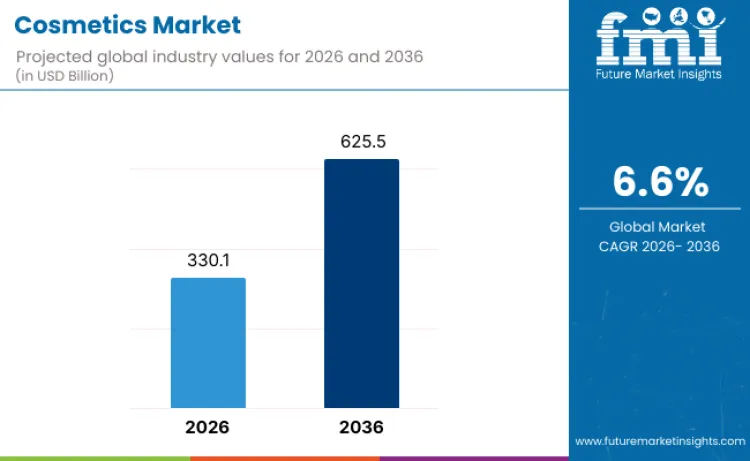
The cosmetics industry is expected to be valued at USD 330.1 billion in 2026, supported by shifting beauty preferences and continuous innovation in product formulations. Cosmetics sales revenue is forecast to grow at a CAGR of 6.6% through 2036, lifting the overall industry value to over USD 625.5 billion by the end of the forecast period, as per FMI’s estimates. Rising consumer demand for personalized beauty solutions and multifunctional products remains a key driver accelerating this expansion.
Manufacturers are channeling significant capital into advanced research facilities, aiming to develop breakthrough formulations through biotechnology integration and sustainable ingredient sourcing without compromising performance efficacy. Product developers are shifting focus from mass-market approaches to customized beauty systems, redefining consumer interaction across digital platforms and specialized retail environments. Such behavioral changes encourage cosmetics companies to introduce intelligent formulation technologies utilizing skin analysis algorithms and microbiome-compatible ingredients.
Quick Stats for Cosmetics Market
- Cosmetics Industry Value (2026): USD 330.1 Billion
- Cosmetics Industry Forecast Value (2036): USD 625.5 Billion
- Cosmetics Industry Forecast CAGR: 6.6%
- Cosmetics Industry Leading Product Category: Skin Care (34.2%)
- Cosmetics Industry Key Growth Regions: China, India, Germany
- Cosmetics Industry Top Players: L'Oréal Group, Unilever plc, Procter & Gamble, Coty Inc., Estée Lauder Companies Inc.
Researchers are combining biotechnology advances with traditional cosmetic chemistry to ensure enhanced product performance across diverse skin types and conditions. Development of sustainable packaging solutions is gaining momentum, addressing environmental concerns while maintaining product integrity and shelf appeal. Focus is shifting toward comprehensive ingredient traceability systems that document sourcing origins while enabling ethical manufacturing practices. Advancements in microencapsulation technologies enable formulators to achieve targeted delivery systems while preserving active ingredient potency, enhancing user experience while reducing application frequency requirements.
Cosmetics Market Key Takeaways
| Metric | Value |
|---|---|
| Industry Size (2026) | USD 330.1 Billion |
| Industry Size (2036) | USD 625.5 Billion |
| CAGR (2026-2036) | 6.6% |
Source: FMI’s proprietary forecasting model and primary research
What Drivers Are Accelerating Skin Care Adoption?
Shift toward preventive skincare approaches is serving as significant catalyst for broader acceptance of science-based formulations among health-conscious consumers. Recent advances in dermatological research have complemented traditional beauty routines by introducing targeted treatments addressing specific skin concerns without causing irritation. This precision approach appeals to consumers seeking measurable results through evidence-based skincare protocols, and FMI is of the opinion that scientific credibility increasingly shapes purchase decisions in skin care. Success of social media education campaigns has expanded awareness regarding proper skincare layering techniques and ingredient compatibility. Research programs highlighting the benefits of consistent skincare regimens are driving adoption among younger demographics previously focused solely on makeup applications. Aesthetic professionals are capitalizing on these trends by offering personalized consultations featuring medical-grade cosmetic recommendations. Integrating skincare with wellness lifestyle practices is becoming standard, ensuring beauty routines support overall health objectives while addressing cosmetic goals.
How Is the Cosmetics Market Segmented Across Key Categories?
Global landscape is intricately segmented to address diverse requirements of the beauty industry, categorizing sector by product formulation, end-user demographics, and distribution channel preferences. Structural division allows stakeholders to identify specific consumption patterns, such as rising demand for anti-aging treatments in mature markets or preference for vibrant color cosmetics in younger consumer segments. By analyzing these segments, manufacturers can tailor product development strategies to meet distinct needs of professional makeup artists versus everyday consumers.
Segmentation also highlights shift from generic beauty products to specialized formulations reflecting individual skin concerns and lifestyle preferences. As industry matures, granular segmentation becomes essential for understanding cultural beauty preferences and purchasing behaviors, ensuring brand positioning aligns with evolving consumer sophistication levels across different geographic markets.
Why Do Skin Care Formulations Maintain Dominance?
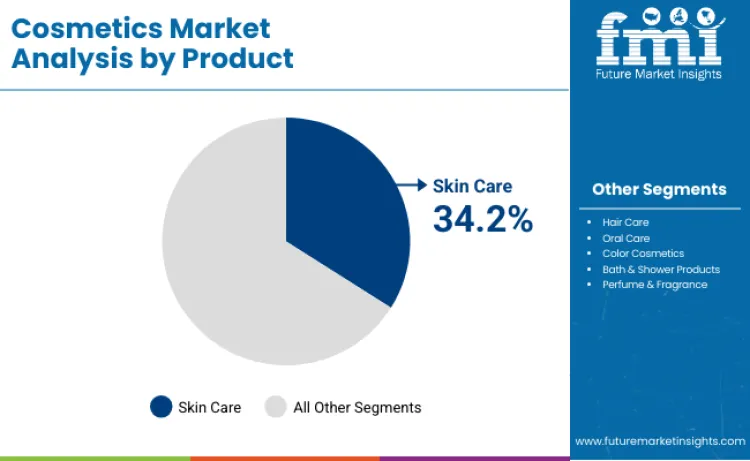
Skin Care segment accounts for 34.2% of market share in 2026, driven by increased consumer awareness regarding skin health and aging prevention. Leadership position is underpinned by scientific advancement in active ingredient research and dermatological validation of product efficacy. Segment benefits from continuous innovation, such as peptide integration and growth factor technology addressing cellular regeneration processes. Research focused on personalized skincare demonstrates consumer willingness to invest in targeted treatments addressing individual skin concerns over generic solutions. Critical role in daily beauty routines and long-term skin maintenance further solidifies standing, as these products form foundation for all other cosmetic applications. As wellness consciousness expands, demand for scientifically-formulated skincare products addressing both immediate and long-term skin health is expected to remain robust.
Why Do Specialty Beauty Stores Lead Distribution Channels?
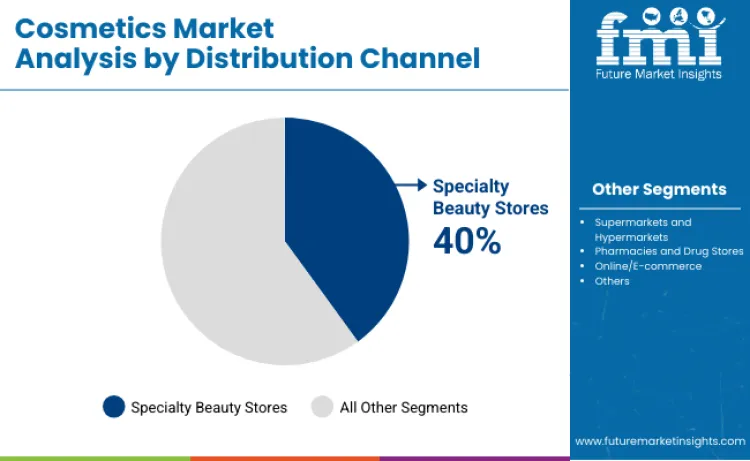
Specialty Beauty Stores command 40% of market share in 2026, reflecting consumer preference for expert consultation and product discovery experiences. Dominance is linked to knowledgeable staff providing personalized recommendations and demonstration opportunities unavailable through mass retail channels. Retailers rely on specialized training programs to ensure proper product knowledge and application techniques at point of sale. These venues are essential for reaching beauty enthusiasts and professionals requiring access to premium brands and exclusive product launches, driving priority status in distribution strategies. Emphasis on experiential shopping ensures products designed for sophisticated consumers remain primary focus. High-touch service requirements necessitate specialized retail environments, bolstering sustained partnerships between premium brands and beauty specialty retailers.
Cosmetics Market Dynamics
Why Are Technological Innovations Driving Premium Demand?
Technological advancement embedded in modern cosmetic formulations continues reshaping consumption patterns by elevating products from basic beauty aids to sophisticated skincare systems. Advanced delivery mechanisms enable active ingredients to penetrate deeper skin layers, creating superior results compared to traditional formulations. Nanotechnology applications allow for time-released ingredient activation, ensuring sustained benefits throughout daily wear cycles. Modern consumers increasingly appreciate scientific validation and clinical testing results, connecting product efficacy with research credentials and dermatological endorsements.
How Will Digital Beauty Transformation Impact Growth Prospects?
Virtual try-on technologies and augmented reality applications focus on enhanced consumer engagement through personalized product selection processes. Digital platforms enable brands to offer customized shade matching and skincare analysis, creating new consultation opportunities beyond traditional retail settings. Social media integration introduces products to global audiences through influencer partnerships and user-generated content strategies. Strategic collaborations with technology companies ensure proper digital infrastructure while maintaining brand authenticity and educational value.
What Role Does Ingredient Transparency Play in Consumer Selection?
Established brands leverage clean ingredient formulations to differentiate products in increasingly competitive premium segments. Consumer research demonstrates preference for brands providing detailed ingredient sourcing information and environmental impact assessments over conventional alternatives. Scientific backing and clinical testing create emotional connections with consumers valuing safety and efficacy over marketing claims. Limited edition collections featuring sustainable packaging and ethical sourcing practices justify premium positioning while building consumer trust and brand loyalty among environmentally conscious purchasers.
How Will the Cosmetics Industry Evolve in Major Nations?
Global landscape for cosmetics consumption is characterized by diverse beauty standards and cultural preferences, influenced by traditional practices and modern lifestyle demands. Established markets prioritize technological innovation and anti-aging solutions, whereas developing economies focus on accessible beauty products and color cosmetics. Asia-Pacific regions emerge as significant growth centers due to expanding middle-class populations and increasing exposure to international beauty trends. Conversely, European markets emphasize natural ingredients and sustainable packaging solutions. Government initiatives supporting domestic beauty brands and export promotion ensure sustained growth opportunities across diverse cultural markets.
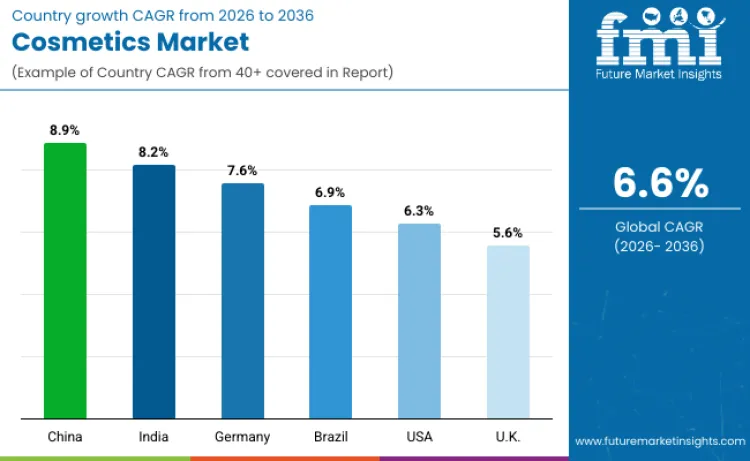
| Country | CAGR (2026 to 2036) |
|---|---|
| China | 8.9% |
| India | 8.2% |
| Germany | 7.6% |
| Brazil | 6.9% |
| USA | 6.3% |
| UK | 5.6% |
Source: Future Market Insights’ proprietary forecasting model and primary research
What Is Powering Rapid Growth in China’s Cosmetics Landscape?
Sales of beauty products in China are set to grow at 8.9% CAGR through 2036. Expansion is underpinned by rapid urbanization and rising disposable incomes among younger demographics seeking premium beauty experiences. Growth is fueled by cultural emphasis on skincare excellence and integration of traditional Chinese medicine ingredients with modern cosmetic science. Premiumization trends drive increased spending on luxury beauty brands and professional-grade skincare treatments. Presence of established domestic brands with centuries-old herbal knowledge ensures authentic positioning while competing with international alternatives. Emphasis on digital commerce integration and livestream shopping continues to be primary driver, maintaining China's position as dynamic market for innovative beauty products.
How Are Tradition and Aspiration Shaping India’s Cosmetics Expansion?
Demand for cosmetic products in India is projected to rise at 8.2% CAGR during assessment period. Initiatives emphasizing traditional beauty practices combined with modern formulation techniques foster favorable environment for diverse product acceptance. Increasing awareness of skincare importance creates demand for specialized treatments addressing tropical climate challenges and pollution exposure. Rising female workforce participation prompts consumers to invest in professional makeup and grooming products for workplace requirements. Shift is supported by growing celebrity endorsements and Bollywood influence, accelerating uptake of color cosmetics across urban and semi-urban markets while fueling sector expansion through aspirational beauty standards.
Why Do Science and Sustainability Anchor Cosmetics Demand in Germany?
Cosmetics industry in Germany is poised to expand at 7.6% CAGR. Growth is largely attributed to stringent quality standards and consumer preference for scientifically-validated beauty products. Government focus on sustainable manufacturing practices encourages development of eco-friendly formulations and packaging solutions. Increasing partnerships between German research institutions and cosmetic manufacturers ensure product safety and efficacy validation. Strong regulatory framework combined with consumer demand for organic and natural ingredients attracts significant investment in clean beauty categories. Emphasis on dermatological testing and clinical validation further drives adoption of premium therapeutic cosmetics.
What Makes Brazil a Standout Market for Beauty Innovation?
Sales of beauty products in Brazil are set to grow at 6.9% CAGR. Expansion is underpinned by vibrant beauty culture and emphasis on personal grooming across all demographic segments. Growth is fueled by abundant natural ingredients providing unique formulation opportunities for skincare and hair care products. Rising awareness of sun protection drives revenue generation in specialized UV protection cosmetics. Presence of established beauty retailers and professional salon networks ensures efficient distribution channels. Emphasis on celebrating natural beauty diversity and inclusive shade ranges continues to be primary driver, maintaining Brazil's position as influential market for innovative cosmetic solutions.
How Is the USA Cosmetics Market Evolving Beyond Conventional Beauty?
Demand for cosmetic products in USA is projected to rise at 6.3% CAGR during assessment period. Initiatives emphasizing self-expression and individuality foster favorable environment for diverse beauty product adoption. Increasing investment in anti-aging research creates demand for advanced skincare technologies and professional treatments. High consumer awareness regarding ingredient safety prompts preference for clean beauty formulations over conventional alternatives. Shift is supported by diverse demographic influences requiring inclusive product ranges, accelerating uptake of customizable beauty solutions across ethnic and age segments while fueling sector expansion.
Why Does the UK Remain a Hub for Premium and Ethical Beauty?
Revenue from beauty products in UK is set to grow at 5.6% CAGR. Expansion is underpinned by sophisticated consumer preferences and demand for luxury beauty experiences. Growth is fueled by increasing interest in sustainable beauty practices and ethical sourcing considerations. Consumer preference for heritage brands with proven track records drives revenue generation in established cosmetic categories. Presence of influential fashion and beauty media ensures widespread trend dissemination and product awareness. Emphasis on professional makeup artistry and special occasion beauty services continues to be primary driver, maintaining UK position as trend-setting market for premium cosmetic innovations.
What is the Competitive Outlook for the Cosmetics Market?
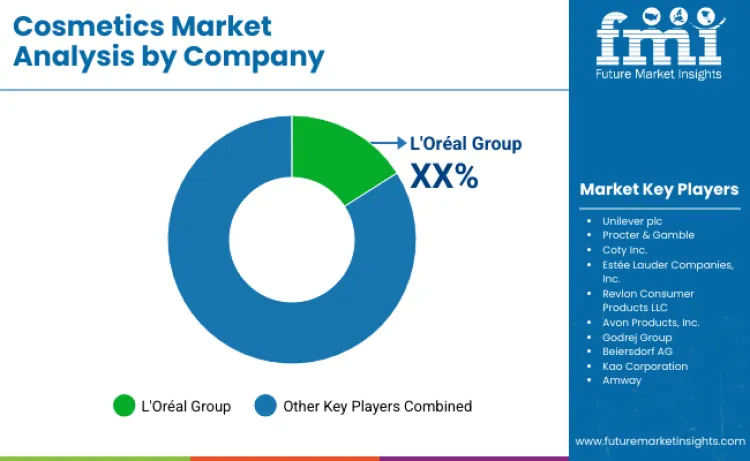
Market participants are increasingly emphasizing technological differentiation to enhance formulation performance while strengthening consumer trust through clinical validation and dermatologist-backed collaborations. Major companies such as L'Oréal Group and Unilever are accelerating investments in biotechnology research and personalized beauty platforms to improve product efficacy and consumer engagement. A key trend is the development of proprietary delivery systems that boost active ingredient absorption and improve skin compatibility. Players are also forming strategic partnerships with dermatology clinics to validate claims, reinforce product credibility, and establish a stronger medical positioning.
Innovation remains a key competitive battleground, with companies adopting artificial intelligence for advanced skin analysis and tailored product recommendations. Consolidation is also gaining momentum, as leading beauty groups acquire fast-growing indie brands to diversify portfolios and secure access to niche consumer segments. In parallel, collaborations with technology firms are enabling exclusive digital beauty tools, including virtual consultations and personalized shopping experiences. L'Oréal Group continues to hold a leadership position through sustained R&D investment and a multi-brand portfolio catering to a wide range of consumer needs.
Key Players in Cosmetics Market
- L'Oréal Group
- Unilever plc
- Procter & Gamble
- Coty Inc.
- Estée Lauder Companies, Inc.
- Revlon Consumer Products LLC
- Avon Products, Inc.
- Godrej Group
- Beiersdorf AG
- Kao Corporation
- Amway
Report Scope
| Items | Values |
|---|---|
| Quantitative Units | USD Billion |
| Product Category Segments | Skin Care; Hair Care; Oral Care; Color Cosmetics; Bath & Shower Products; Perfume & Fragrance |
| End-Use Categories | Women; Men |
| Distribution Channel Categories | Specialty Beauty Stores; Supermarkets and Hypermarkets; Pharmacies and Drug Stores; Online/E-commerce; Others |
| Regions Covered | North America, Europe, East Asia, South Asia, Latin America, Middle East & Africa |
| Key Countries | China, India, Germany, Brazil, USA, UK. |
| Key Companies Profiled | L'Oréal Group; Unilever plc; Procter & Gamble; Coty Inc.; Estée Lauder Companies, Inc.; Revlon Consumer Products LLC; Avon Products, Inc.; Godrej Group; Beiersdorf AG; Kao Corporation; Amway |
| Additional Attributes | Dollar sales measured for cosmetic products across beauty and personal care applications, specified by product category positioning (skincare, color cosmetics, hair care, fragrance), demographic targeting (age groups, gender preferences), distribution format (specialty retail, mass market, e-commerce), seasonal consumption patterns (holiday gifting, summer sun protection), premium versus mass market positioning, and regulatory compliance factors influencing international distribution and ingredient approval processes. |
Cosmetics Market by Segments
Product:
- Skin Care
- Hair Care
- Oral Care
- Color Cosmetics
- Bath & Shower Products
- Perfume & Fragrance
End-Use:
- Women
- Men
Distribution Channel:
- Specialty Beauty Stores
- Supermarkets and Hypermarkets
- Pharmacies and Drug Stores
- Online/E-commerce
- Others
Bibliography
- American Academy of Dermatology Association. (2024). Clinical guidelines for cosmetic ingredient safety and efficacy in dermatological applications.
- International Federation of Societies of Cosmetic Chemists. (2024). Sustainable formulation practices and biodegradable ingredient integration in cosmetic product development.
- Global Association for Sustainable Cosmetics. (2024). Environmental impact assessment and circular economy principles in the cosmetics industry.
- Society of Cosmetic Chemists. (2024). Advanced delivery systems and emerging technologies in modern cosmetic formulations.
Frequently Asked Questions
How large is the demand for Cosmetics in the global market in 2026?
Cosmetics industry is estimated to be valued at USD 330.1 billion in 2026.
What will be the market size of Cosmetics in the global market by 2036?
The market size for Cosmetics is projected to reach USD 625.5 billion by 2036.
What is the expected demand growth for Cosmetics between 2026 and 2036?
Demand for Cosmetics is expected to grow at a CAGR of 6.6% between 2026 and 2036.
Which Product segment is poised to lead global sales by 2026?
Skin Care formulations are expected to be the dominant product segment, capturing approximately 34.2% of the global market share in 2026.
How significant is the role of Specialty Beauty Stores in driving Cosmetics adoption in 2026?
Specialty Beauty Stores represent a critical distribution segment, projected to hold a substantial 40% share of the total market in 2026.
Preview the report firsthand - request a free sample
Get SampleGet the brochure for pricing and purchase details.
Get PDFTable of Content
- Executive Summary
- Global Market Outlook
- Demand-side Trends
- Supply-side Trends
- Technology Roadmap Analysis
- Analysis and Recommendations
- Market Overview
- Market Coverage / Taxonomy
- Market Definition / Scope / Limitations
- Market Background
- Market Dynamics
- Drivers
- Restraints
- Opportunity
- Trends
- Scenario Forecast
- Demand in Optimistic Scenario
- Demand in Likely Scenario
- Demand in Conservative Scenario
- Opportunity Map Analysis
- Product Life Cycle Analysis
- Supply Chain Analysis
- Investment Feasibility Matrix
- Value Chain Analysis
- PESTLE and Porter’s Analysis
- Regulatory Landscape
- Regional Parent Market Outlook
- Production and Consumption Statistics
- Import and Export Statistics
- Market Dynamics
- Global Market Analysis 2020 to 2025 and Forecast, 2026 to 2036
- Historical Market Size Value (USD Million) Analysis, 2020 to 2025
- Current and Future Market Size Value (USD Million) Projections, 2026 to 2036
- Y-o-Y Growth Trend Analysis
- Absolute $ Opportunity Analysis
- Global Market Pricing Analysis 2020 to 2025 and Forecast 2026 to 2036
- Global Market Analysis 2020 to 2025 and Forecast 2026 to 2036, By Product Type
- Introduction / Key Findings
- Historical Market Size Value (USD Million) Analysis By Product Type, 2020 to 2025
- Current and Future Market Size Value (USD Million) Analysis and Forecast By Product Type, 2026 to 2036
- Skin Care
- Hair Care
- Oral Care
- Color Cosmetics
- Bath & Shower Products
- Perfume & Fragrance
- Y-o-Y Growth Trend Analysis By Product Type, 2020 to 2025
- Absolute $ Opportunity Analysis By Product Type, 2026 to 2036
- Global Market Analysis 2020 to 2025 and Forecast 2026 to 2036, By End-Use
- Introduction / Key Findings
- Historical Market Size Value (USD Million) Analysis By End-Use, 2020 to 2025
- Current and Future Market Size Value (USD Million) Analysis and Forecast By End-Use, 2026 to 2036
- Women
- Men
- Y-o-Y Growth Trend Analysis By End-Use, 2020 to 2025
- Absolute $ Opportunity Analysis By End-Use, 2026 to 2036
- Global Market Analysis 2020 to 2025 and Forecast 2026 to 2036, By Distribution Channel
- Introduction / Key Findings
- Historical Market Size Value (USD Million) Analysis By Distribution Channel, 2020 to 2025
- Current and Future Market Size Value (USD Million) Analysis and Forecast By Distribution Channel, 2026 to 2036
- Specialty Beauty Stores
- Supermarkets and Hypermarkets
- Pharmacies and Drug Stores
- Online/E-commerce
- Others
- Y-o-Y Growth Trend Analysis By Distribution Channel, 2020 to 2025
- Absolute $ Opportunity Analysis By Distribution Channel, 2026 to 2036
- Market Structure Analysis
- Competition Dashboard
- Competition Benchmarking
- Market Share Analysis of Top Players
- By Regional
- By Product Type
- By End-Use
- By Distribution Channel
- Competition Analysis
- Competition Deep Dive
- L’Oréal Group
- Overview
- Product Portfolio
- Profitability by Market Segments (Product/Age /Sales Channel/Region)
- Sales Footprint
- Strategy Overview
- Marketing Strategy
- Product Strategy
- Channel Strategy
- Unilever plc
- Procter & Gamble
- Coty Inc.
- Estée Lauder Companies, Inc.
- L’Oréal Group
- Competition Deep Dive
- Assumptions & Acronyms Used
- Research Methodology


