About The Report

    Methodology

    Organic Cosmetics Market Size and Share Forecast Outlook 2026 to 2036

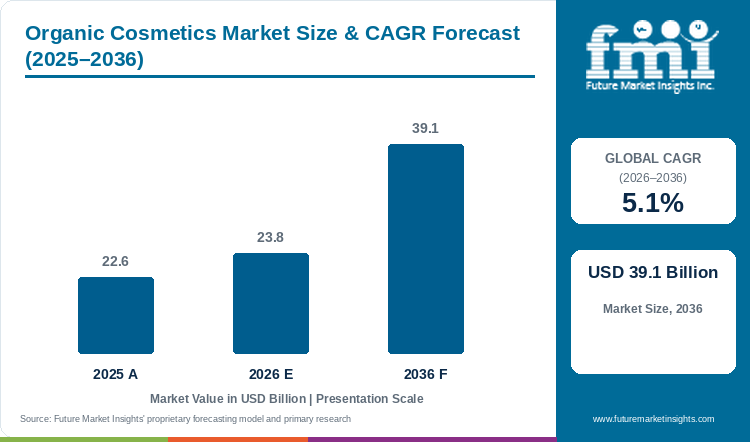
    The organic cosmetics market is valued at USD 23.8 billion in 2026 and is projected to expand to USD 39.1 billion by 2036, reflecting a steady 5.1% CAGR. This growth pattern indicates a decisive shift in where value accrues, as consumers increasingly demand products backed by performance data and rigorous validation. According to FMI, the market’s trajectory is being reshaped by two structural forces: the rapid industrialization of bio‑based ingredient production, which strengthens supply chain resilience, and a rising preference for high‑efficacy organic formulations capable of matching, or surpassing, the functional benchmarks of synthetic alternatives.

    Market is witnessing a significant injection of funds into R&D, with major players betting heavily on the future of lab-grown naturals. Financial impact is already visible; L’Occitane Group reported that net sales grew 24.1% in FY2024, crossing €2.5 billion, confirming that premium natural positioning retains pricing power even amidst economic headwinds. Procurement teams now evaluate potential ingredient partners based on "biocompatibility" and supply resilience rather than just organic certification.

    Nicolas Hieronimus, CEO of L'Oréal, noted in February 2025: “2024 was a defining year as we made L’Oréal future fit and laid many foundations for our next conquests: we augmented our marketing and R&I capabilities with AI and tech, advanced with the harmonisation of our IT, simplified our organisational structures, and strengthened our industrial and supply chain resilience. This will allow us to go ever faster and further in our conquest of new beauty spaces: geographic, demographic and highly promising technologies that offer innovative science-based beauty solutions to the consumer of tomorrow.”

    This emphasizes how hybrid platforms are scaling "science-based beauty" to mass markets, effectively proving that the divide between nature and technology is disappearing in favor of a cohesive, integrated user experience.

    One metric makes the point: The Honest Company expanded its gross margin by 710 basis points to 38.7% in Q3 2024, illustrating the profitability shift toward streamlined, high-efficiency portfolios. Those dynamics drive a re-evaluation of SKU complexity, as manufacturers cut low-performing "pure" organic lines in favor of hybrid formulations that deliver measurable skin health benefits. For retailers, the trade-off is clear: shelf space is increasingly reserved for brands that can prove "clinical organic" claims, pushing legacy herbal brands to modernize or face delisting. Consequently, next moves center on securing patent protection for proprietary extraction methods, ensuring that margin gains are defended against generic "green" competitors.

    Organic Cosmetics Market Market Value Analysis

    Summary of Organic Cosmetics Market

    What Is the Growth Outlook for the Organic Cosmetics Market as per Future Market Insights Projection?

    According to FMI's estimates, the global organic cosmetics market is projected to grow from USD 23.8 billion in 2026 to USD 39.1 billion by 2036, representing a 5.1% CAGR over the forecast period. This trajectory reflects a shift where organic personal care is no longer a niche premium segment but a baseline expectation for efficacy-driven consumers.

    FMI Research Approach: Based on FMI’s proprietary global modeling framework incorporating major operator revenue reports (L'Occitane, Weleda), household spending indices on personal care, and R&D investment patterns in biotech-actives.

    How Do FMI Analysts Perceive the Organic Cosmetics Market to Evolve?

    FMI analysts opine that the market is transitioning away from passive "clean label" marketing toward active "bio-regenerative" claims backed by clinical data. This evolution forces brands to invest in fermentation technologies that produce nature-identical ingredients without the environmental footprint of traditional farming.

    FMI Research Approach: Developed using analysis of patent filings (L'Oreal's nitric oxide patents), venture capital trends in biotech beauty (Olive Tree People), and retail sell-through data from major chains.

    Which Country Holds the Largest Share in the Global Organic Cosmetics Market?

    Japan holds a dominant value share, supported by a sophisticated consumer base that demands high-functionality natural cosmetics and a regulatory environment that rewards safety and efficacy. The country's focus on "circular economy" packaging and refillable systems further cements its leadership in sustainable innovation.

    FMI Research Approach: Built using country-level production statistics (METI), analysis of export data for J-Beauty brands, and mapping of regulatory approvals for new cosmetic ingredients.

    How Large Will the Organic Cosmetics Market Be by 2036?

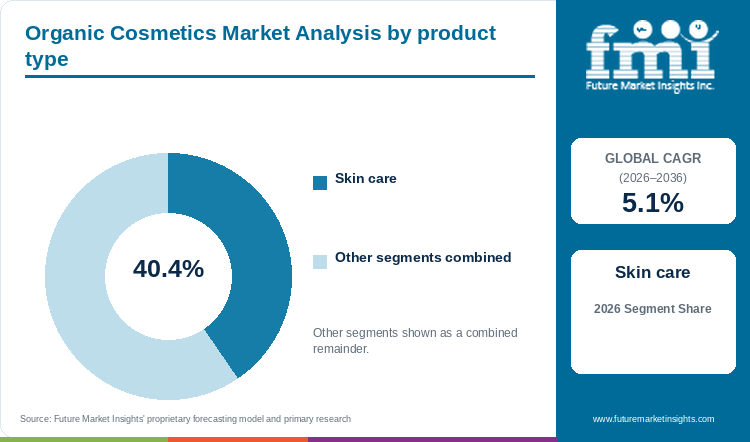
    The global organic cosmetics market is expected to reach USD 39.1 billion by 2036, with the Skin Care segment currently commanding a 40.4% share. This dominance is driven by the critical need for anti-aging and barrier-repair solutions, where organic formulations are increasingly viewed as safer long-term alternatives to harsh synthetics.

    FMI Research Approach: Long-term forecasts rely on demographic trends (aging populations in key markets), disposable income projections for premium beauty, and the scaling of direct-to-consumer distribution models.

    What Is the Definition of the Organic Cosmetics Market?

    The organic cosmetics market encompasses revenue generated from commercial activities designed for personal grooming and hygiene using ingredients derived from organic farming or natural sources. This includes skin care, hair care, makeup, and body care products that carry certification or verifiable claims of natural origin, excluding general chemical-based cosmetics.

    FMI Research Approach: Definition structured using FMI’s segmentation taxonomy covering product types, ingredient standards, and distribution channels.

    What Are Globally Unique Trends Shaping the Organic Cosmetics Market?

    Globally, the sector is shaped by the "Biotech Pivot" in developed markets and the "Ayurvedic Modernization" in emerging economies, where traditional knowledge is being repackaged for global export. Brands are increasingly leveraging "waterless" formulations to reduce shipping weights and preservative needs, aligning with natural cosmetics industry analysis in Europe sustainability goals.

    FMI Research Approach: Insights derived from global sustainability reports (Shiseido), startup funding patterns in G-Beauty (Oliveda), and consumer behavior analysis regarding eco-friendly packaging.

    Organic Cosmetics Market Key Takeaways

    Metric Details
    Industry Size (2026) USD 23.8 Billion
    Industry Value (2036) USD 39.1 Billion
    CAGR (2026-2036) 5.1%

    Source: Future Market Insights (FMI) analysis, based on proprietary forecasting model and primary research.

    Why Is Biotech Integration Redefining Formulation?

    The integration of biotechnology into organic formulation is no longer experimental but a core revenue driver that is fundamentally altering the supply chains of beauty providers. L'Oreal invested over €1.3 billion in Research & Innovation in 2024, explicitly targeting biobased ingredients which now make up 66% of their formulas. That strategic shift allows operators to bypass agricultural volatility and climate risks, maintaining high production volumes by brewing actives in labs rather than harvesting them from fields. As per FMI's projection, this technological overlay forces smaller competitors to partner with "ingredient tech" firms or risk obsolescence, as consumers increasingly equate lab-grown consistency with superior safety and efficacy.

    Simultaneously, in the ingredient sector, the push for herbal beauty products is merging with rigorous clinical validation. Manufacturers are moving away from simple extracts toward molecularly refined actives that can claim specific dermatological benefits, such as barrier repair or microbiome balance. That pressure shifts the competitive advantage toward players who can demonstrate a "closed loop" sustainability model, where the ingredient production process itself generates zero waste. Consequently, the market is bifurcating into mass-market "clean" brands and premium "bio-clinical" lines, where the latter commands significantly higher margins due to the proprietary nature of their active compounds.

    What is Segmentation Outlook for Organic Cosmetics Market?

    The organic cosmetics market is segmented by type, end user, sales channel, and price range, providing a comprehensive view of the industry's diverse revenue streams. It is segmented by type into Skin Care, Hair Care, Makeup, and Body Care, with Skin Care serving as the efficacy anchor. The end user landscape spans Women, Men, Unisex, and Baby, while sales channels cover Online Retailing, Hypermarkets, and Specialty Stores. FMI analysts opine that the price range mix is stabilizing around the Mid-Range segment, as "masstige" brands force premium incumbents to justify their pricing through superior evidence. By 2036, the channel mix will likely tilt further toward digital platforms that offer personalized diagnostics, while the ingredient focus shifts from "sourced" to "engineered."

    Why Skin Care Dominates the Product Mix?

    Organic Cosmetics Market Analysis By Product Mix

    Skin Care commands 40.4% of the market, serving as the backbone of the organic ecosystem where efficacy claims are most scrutinized. The resilience of this segment is underpinned by a resurgence in "skin barrier health," as consumers actively seek vegan cosmetics that repair rather than just conceal. Shiseido's 2024 launch of refillable products for its flagship creams illustrates the mechanism: packaging innovation combined with high-performance formulas drives repeat purchase. That structure increases customer lifetime value, as users lock into a regimen that aligns with both their dermatological needs and environmental values. For manufacturers, the practical impact is a requirement to invest in "hero products" that can achieve a broader routine.

    Why Women Remain the Core End User?

    Organic Cosmetics Market Analysis By End Use

    Women end user segment account for 50.7% of the market, driving the primary volume in high-margin categories like anti-aging and hydration. Those dynamic drives a continuous loop of innovation, where brands like Sol de Janeiro deliver triple-digit growth by targeting specific female-centric concerns with "year-round" appeal. That demand pressure shifts product development toward multi-functional formats, such as halal cosmetics that offer sun protection and moisturization in one step. Compared with the emerging men's segment, the female demographic shows higher willingness to pay for proven "bio-actives," forcing brands to substantiate claims with rigorous clinical trials. Consequently, marketing strategies pivot from "lifestyle" imagery to "science-first" education.

    How Online Retailing Reshapes Distribution?

    Organic Cosmetics Market Analysis By Distribution

    Online Retailing now captures 41.2% of the market channel, reflecting the digitization of the beauty advisory process and the demand for seamless replenishment. Aggregators and brand-owned sites are transforming fragmented product listings into curated K-beauty product experiences, using AI to match skin types with organic formulations. Jones Road Beauty generated over $1 million in revenue specifically from post-purchase offers, proving that digital channels are vital for maximizing basket size. This trend indicates that the future of recreational booking lies in mobile-first platforms that can offer real-time ingredient transparency, effectively removing the friction that has historically plagued the discovery process for niche organic brands.

    Why Mid-Range Pricing Captures Volume?

    Organic Cosmetics Market Analysis By Price Range

    Mid-Range products hold a 46.0% share, striking the balance between accessible entry points and the promise of quality ingredients. The focus here is on "affordable efficacy," where consumers trade down from luxury but refuse to compromise on beauty and personal care product safety standards. Clorox reported a 21% net sales increase in its Wellness segment, driven by Burt's Bees volume recovery, which underscores the mass appeal of mid-tier natural options. That cost curve accelerates adoption among younger demographics who are price-sensitive but ingredient-conscious. For retailers, the implication is a need to optimize assortment planning to favor brands that offer "premium" attributes at "masstige" price points.

    How Is Sustainability Becoming a "Clinical" Requirement?

    The material footprint of beauty is under intense scrutiny, driving a shift toward eco-conscious "hard goods" and influencing the purchasing decisions of institutional buyers. Production statistics show that brands are rapidly adopting "waterless" or concentrated formats to reduce shipping weight and plastic usage. That constraint forces recreational service providers to audit their supply chains and eliminate single-use plastics from their operations. Whether it is cosmetics packaging or ingredient sourcing, parents increasingly demand products that align with environmental values. This pressure is creating a competitive advantage for operators who can demonstrate a closed-loop sustainability model.

    In April 2025, Tina Müller, CEO of Weleda AG, stated: “2024 was a year of renewal for Weleda, and a very strong year for us economically. Our good performance shows that our strategy of growth with responsibility is successful. We have taken the appropriate measures to further strengthen our competitiveness and resilience. Our focus on the four growth levers of innovation, premiumisation, digitalisation and internationalisation is exactly right.” This emphasizes how hybrid platforms are scaling "responsible growth" to global markets, effectively proving that the physical-digital divide is disappearing in favor of a cohesive, integrated user experience. Value pools expand for players that can authenticate their supply chain from soil to shelf.

    Which Country Is Leading the Organic Cosmetics Market Growth?

    The global market exhibits distinct regional drivers, from infrastructure-led growth in Asia to regulation-led expansion in North America, creating a complex tapestry of growth opportunities. According to FMI's estimates, Asia Pacific is leveraging its manufacturing dominance to export "functional naturals" to the West, while Europe doubles on stringent "Green Deal" compliance. The mature markets of the USA and Canada are focusing on preimmunizing existing assets rather than expanding footprint, creating a "two-speed" global economy. Input data puts the scale at a tipping point where emerging markets are no longer just sourcing hubs but primary consumption engines for cosmetic ingredients.

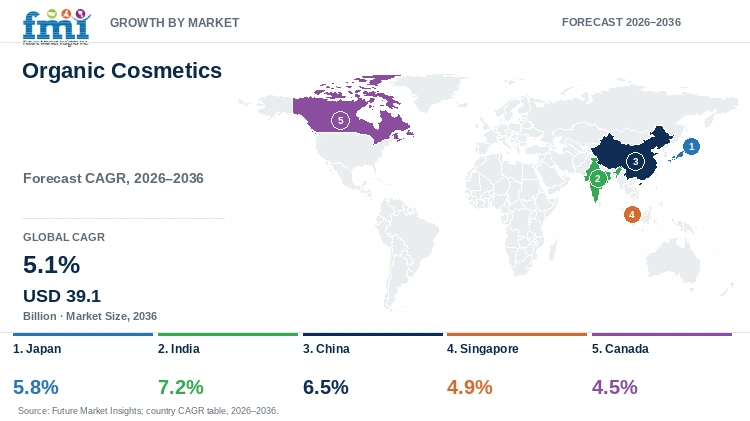
    Organic Cosmetics Market Cagr Analysis By Country

    Country CAGR (2026 to 2036)
    Japan 5.8%
    India 7.2%
    China 6.5%
    Singapore 4.9%
    Canada 4.5%

    Source: Future Market Insights’ proprietary forecasting model and primary research

    Why Japan Remains the Innovation Hub?

    Sales of organic cosmetics in Japan are set to rise at 5.8% CAGR, driven by a cultural affinity for ritualistic skincare and advanced fermentation technologies. Official figures from the Ministry of Economy, Trade and Industry (METI) show cosmetic shipments amounted to 1,302.4 billion yen in 2023, marking a 2.9% increase that underpins the sector's resilience. That structure increases the pressure on brands to innovate, as Japanese consumers demand products that are both traditionally rooted and scientifically advanced.

    A Corporate Statement from Shiseido Company in 2024 noted: "To realize a circular economy, it is important to select materials and design products with the reuse of resources in mind. To reduce our consumption of single-use plastic, we are developing packaging made from a material that can be more easily sorted and recycled after use without compromising the quality of the packaging's design." This commitment forces local competitors to adopt similar "eco-design" principles or lose relevance. Execution now depends on integrating natural cosmetic color technologies with sustainable packaging.

    Why India Is the Fastest Growing Market?

    Demand for Organic Cosmetics in India is anticipated to grow at 7.2% CAGR, fueled by a structural shift where "Ayurveda" is being rebranded as "luxury wellness." India Brand Equity Foundation (IBEF) reports the Ayurveda and wellness tourism market contributed ₹1.4 trillion (US$16.4 billion) to India's economy in FY2025, with organic cosmetics riding this wave through D2C channels. That dynamic drives a surge in "D2C" brands that bypass traditional retail to speak directly to millennials in Tier-2 cities. For distributors, the binding constraint becomes last-mile logistics, as demand disperses beyond the metros. Winners build capability in vernacular marketing, connecting traditional herbal benefits with modern dermatological formats.​

    Why Is China Pivoting to Efficacy?

    The Organic Cosmetics industry in China is projected to expand at 6.5% CAGR, reflecting a steady demand for "safe" beauty amidst a regulatory crackdown on false claims. National Bureau of Statistics data via Jing Daily reported a record-breaking 40.6 billion RMB in retail sales in May 2024, an 18.7% jump that signals a robust rebound in consumer confidence. That change reduces the viability of "concept" brands, as the new CSAR regulations require rigorous efficacy testing for all functional claims. That rule tightens the market, favoring large incumbents who can afford clinical trials. Consequently, the market shifts from "storytelling" to "evidence-based" marketing, favoring nourishing hair and skin care brands.

    Why Singapore Acts as the Premium Gateway?

    Organic Cosmetics in Singapore is poised to register a 4.9% CAGR, serving as the high-value testbed for Southeast Asian expansion. Department of Statistics Singapore reported that retail sales of Cosmetics, Toiletries & Medical Goods increased 2.7% in October 2024, indicating steady post-pandemic recovery. That usage pattern concentrates value in the "prestige" segment, where consumers are willing to pay a premium for imported organic labels. That channel mix reallocates margin to specialty retailers who can offer personalized consultation. For global brands, Singapore is the "showroom" for the wider region, where brand equity is built before scaling to mass markets.

    Why Canada Is Focusing on Clean Formulations?

    Organic Cosmetics in Canada is projected to expand at 4.5% CAGR, with a distinct emphasis on "clean beauty" standards that align with North American transparency trends. The market is influenced by the broader North American shift toward "ingredient safety" and corporate responsibility. Carla Vernón, CEO of The Honest Company, highlighted this regional momentum in November 2024: "Our strong third quarter results are a clear reflection of the power of the Honest brand and the strength of the Honest team that has executed our strategy and Transformation Initiative with discipline and excellence. Our ability to grow profitably is evidenced in our results - with double-digit revenue growth reaching an all-time high, significant expansion in gross margin, and positive net income for the period."

    This performance demonstrates that "clean" positioning is a scalable driver of profitability across the region. Next moves center on expanding organic vegan face cream distribution into mainstream drugstores.

    Which Strategy Wins: Scale or Specialization?

    Organic Cosmetics Market Analysis By Company

    Competitive advantage in the organic cosmetics sector is increasingly shaped not by the size of a brand’s portfolio but by its ability to control the key constraints that determine scalability. Whether the bottleneck lies in clinical evidence, regulatory compliance, distribution access, or manufacturing capacity, market leaders are those who can resolve these choke points faster and more effectively than rivals. As profit pools shift, value is concentrating around players that excel at removing specific operational barriers, signaling a transition from breadth‑driven competition to one defined by execution speed, proof‑based differentiation, and operational depth.

    Unilever reported that its Beauty & Wellbeing unit grew underlying sales by 6.5% in 2024, proving that scaled incumbents can capture value by integrating organic vegan face cream market share analysis insights into mass distribution. That structure increases the barrier to entry for independent brands, who must now match the R&D spending of giants to prove efficacy. Consequently, the market is bifurcating into massive, capital-intensive conglomerates and agile, localized providers.

    Strategy in organic cosmetics is set by a simple asymmetry: some players own distribution leverage, while others win through differentiated proof, capacity, or specialized workflows. Challenger brands like Olive Tree People (Oliveda) are disrupting the status quo with "waterless" formulations, reporting sales exceeding USD 200 million in North America for 2024/2025. This "G-Beauty" movement leverages ingredient potency to command premium prices, bypassing the commoditized middle market. As per FMI's projection, this pressure forces legacy players to acquire niche innovators to fill gaps in their "bio-active" portfolios. Winners build capability in rapid product iteration, launching personal care aid extensions that cater to micro-trends before they fade.

    Recent Developments:

    • In July 2025, certified organic luxury beauty brand Ogee launched at Nordstrom's New York City flagship store and on Nordstrom.com, with further expansion to 14 additional USA locations in September 2025. This partnership significantly increases accessibility to Ogee's Jojoba-based organic skincare and makeup, blending high-performance results with USDA-certified organic ingredients in a premium retail setting.
    • In September 2025, multiple organic cosmetics brands and products secured wins in Allure's Best of Beauty Awards for clean beauty categories. These accolades underscore the rising mainstream validation of organic ingredients, with winners demonstrating rigorous standards for efficacy, safety, and natural sourcing in skincare, haircare, and makeup.

    Key Players in Organic Cosmetics Market

    • L’Oréal Group
    • Estée Lauder Companies
    • Procter & Gamble
    • Unilever PLC
    • WELEDA AG
    • Groupe L’OCCITANE
    • KORRES Group
    • The Clorox Company (Burt's Bees)
    • The Honest Company
    • Shiseido Company
    • Olive Tree People (Oliveda)
    • Jones Road Beauty
    • Saie Beauty
    • Kosas Cosmetics

    Market Definition

    The organic cosmetics market is defined as the aggregate of commercial activities and service ecosystems specifically designed to provide personal grooming, hygiene, and beautification using ingredients derived from organic farming or natural sources. It encompasses a broad spectrum of product categories, ranging from skin care and hair care to makeup and body care, all of which must carry verifiable claims of natural origin or organic certification. This definition focuses on the product component of the value chain, measuring the revenue generated from retail sales, direct-to-consumer subscriptions, and professional salon distribution that facilitates the consumer experience.

    The scope of this market explicitly includes revenue streams derived from both physical and digital-hybrid retail formats. This covers all forms of organized retail (department stores, specialty beauty retailers), family-oriented hypermarkets, and specialized online platforms where "clean beauty" is curated. It also includes the burgeoning sector of "masstige" natural brands that bridge the gap between drugstore accessibility and premium formulation standards. Furthermore, the market sizing incorporates spending on institutional partnerships, such as salon-grade products used by professionals, and destination retail revenue specifically attributed to brand-owned boutiques.

    The market explicitly excludes revenue generated from the general retail sale of synthetic or chemical-based cosmetics that do not make specific natural or organic claims. For example, the purchase of a standard petroleum-based moisturizer is excluded, whereas the fee for a certified organic face oil is included. Similarly, the market excludes general medical treatments or prescription-only dermatological drugs, focusing instead on over-the-counter recreational and functional beauty products. Government-funded public health initiatives and non-commercial community distribution that do not generate direct revenue through retail fees are also excluded from the market valuation.

    Scope of Report

    Items Values
    Quantitative Units (2026) USD 23.8 Billion
    Product Type Skin Care, Hair Care, Makeup, Body Care
    End User Women, Men, Unisex, Baby
    Sales Channel Online Retailing, Hypermarkets/Supermarkets, Convenience Stores, Specialty Stores, Direct Selling, Departmental Stores
    Regions covered North America, Europe, Asia Pacific, Latin America, Middle East & Africa
    Countries covered Japan, India, China, Singapore, Canada, and key global markets
    Key companies profiled L’Oréal, Estée Lauder, Unilever, WELEDA, L’OCCITANE, Clorox, Honest Company
    Additional attributes Revenue analysis by segments, adoption trends across settings, regulatory and compliance landscape (as relevant), pricing and reimbursement considerations (when relevant), channel mix economics, supply chain exposure, and competitive positioning analysis

    Source: FMI analysis based on primary research and proprietary forecasting model

    Organic Cosmetics Market by Segments

    By Product Type:

    • Skin Care
    • Hair Care
    • Makeup
    • Body Care

    By End User:

    • Women
    • Men
    • Unisex
    • Baby

    By Sales Channel:

    • Online Retailing
    • Hypermarkets/Supermarkets
    • Convenience Stores
    • Specialty Stores
    • Direct Selling
    • Departmental Stores

    By Price Range:

    • Economy
    • Mid-Range
    • Premium

    Bibliography

    • Ministry of Economy, Trade and Industry (METI). (2024). Current Survey of Production Statistics: Chemical Industry. Government of Japan.
    • Department of Statistics Singapore. (2024). Monthly Retail Sales Index: Cosmetics, Toiletries & Medical Goods. Government of Singapore.
    • Statistics Korea (KOSTAT). (2024). Retail Sales by Commodity Group: Cosmetics and Personal Care. Government of South Korea.
    • Australian Bureau of Statistics (ABS). (2024). Retail Trade: Pharmaceutical, Cosmetic and Toiletry Goods. Government of Australia.
    • Ministry of Commerce, Thailand. (2024). Trade Statistics: Beauty and Personal Care Product Imports and Exports. Government of Thailand.
    • Statistics Canada. (2024). Retail Commodity Survey: Personal Care Products. Government of Canada.
    • Banco Central do Brasil. (2024). Consumer Spending Indicators for Household Goods and Personal Care. Government of Brazil.
    • National Statistical Office (NSO) Philippines. (2024). Retail Trade and Consumer Goods Sales Statistics. Government of the Philippines.

    Frequently Asked Questions

    What is the current global market size for Organic Cosmetics?

    The global market is valued at USD 23.8 billion in 2026, driven by rising consumer awareness of ingredient safety and a shift toward "clinical natural" formulations.

    What is the projected CAGR for the organic cosmetics market?

    The market is projected to grow at a steady 5.1% CAGR from 2026 to 2036, supported by biotechnology advancements and the expansion of online retail channels.

    Which product segment dominates the market?

    Skin Care accounts for the largest share at 40.4%, as parents and consumers prioritize anti-aging and barrier-repair products that offer long-term skin health benefits.

    Which sales channel is experiencing the fastest growth?

    Online Retailing holds a dominant 41.2% share, fueled by the convenience of digital discovery and the rise of AI-driven personalized product recommendations.

    Who are the leading players in the organic cosmetics market?

    The L’Oréal Group leads with a prominent market share, followed by major operators like Estée Lauder, Unilever, and specialized players such as WELEDA and L’OCCITANE.

    Table of Content

    1. Executive Summary
      • Global Market Outlook
      • Demand to side Trends
      • Supply to side Trends
      • Technology Roadmap Analysis
      • Analysis and Recommendations
    2. Market Overview
      • Market Coverage / Taxonomy
      • Market Definition / Scope / Limitations
    3. Research Methodology
      • Chapter Orientation
      • Analytical Lens and Working Hypotheses
        • Market Structure, Signals, and Trend Drivers
        • Benchmarking and Cross-market Comparability
        • Market Sizing, Forecasting, and Opportunity Mapping
      • Research Design and Evidence Framework
        • Desk Research Programme (Secondary Evidence)
          • Company Annual and Sustainability Reports
          • Peer-reviewed Journals and Academic Literature
          • Corporate Websites, Product Literature, and Technical Notes
          • Earnings Decks and Investor Briefings
          • Statutory Filings and Regulatory Disclosures
          • Technical White Papers and Standards Notes
          • Trade Journals, Industry Magazines, and Analyst Briefs
          • Conference Proceedings, Webinars, and Seminar Materials
          • Government Statistics Portals and Public Data Releases
          • Press Releases and Reputable Media Coverage
          • Specialist Newsletters and Curated Briefings
          • Sector Databases and Reference Repositories
          • FMI Internal Proprietary Databases and Historical Market Datasets
          • Subscription Datasets and Paid Sources
          • Social Channels, Communities, and Digital Listening Inputs
          • Additional Desk Sources
        • Expert Input and Fieldwork (Primary Evidence)
          • Primary Modes
            • Qualitative Interviews and Expert Elicitation
            • Quantitative Surveys and Structured Data Capture
            • Blended Approach
          • Why Primary Evidence is Used
          • Field Techniques
            • Interviews
            • Surveys
            • Focus Groups
            • Observational and In-context Research
            • Social and Community Interactions
          • Stakeholder Universe Engaged
            • C-suite Leaders
            • Board Members
            • Presidents and Vice Presidents
            • R&D and Innovation Heads
            • Technical Specialists
            • Domain Subject-matter Experts
            • Scientists
            • Physicians and Other Healthcare Professionals
          • Governance, Ethics, and Data Stewardship
            • Research Ethics
            • Data Integrity and Handling
        • Tooling, Models, and Reference Databases
      • Data Engineering and Model Build
        • Data Acquisition and Ingestion
        • Cleaning, Normalisation, and Verification
        • Synthesis, Triangulation, and Analysis
      • Quality Assurance and Audit Trail
    4. Market Background
      • Market Dynamics
        • Drivers
        • Restraints
        • Opportunity
        • Trends
      • Scenario Forecast
        • Demand in Optimistic Scenario
        • Demand in Likely Scenario
        • Demand in Conservative Scenario
      • Opportunity Map Analysis
      • Product Life Cycle Analysis
      • Supply Chain Analysis
      • Investment Feasibility Matrix
      • Value Chain Analysis
      • PESTLE and Porter’s Analysis
      • Regulatory Landscape
      • Regional Parent Market Outlook
      • Production and Consumption Statistics
      • Import and Export Statistics
    5. Global Market Analysis 2021 to 2025 and Forecast, 2026 to 2036
      • Historical Market Size Value (USD Million) Analysis, 2021 to 2025
      • Current and Future Market Size Value (USD Million) Projections, 2026 to 2036
        • Y to o to Y Growth Trend Analysis
        • Absolute $ Opportunity Analysis
    6. Global Market Pricing Analysis 2021 to 2025 and Forecast 2026 to 2036
    7. Global Market Analysis 2021 to 2025 and Forecast 2026 to 2036, By Product Mix
      • Introduction / Key Findings
      • Historical Market Size Value (USD Million) Analysis By Product Mix , 2021 to 2025
      • Current and Future Market Size Value (USD Million) Analysis and Forecast By Product Mix , 2026 to 2036
        • Skin Care
        • Hair Care
        • Makeup
        • Body Care
      • Y to o to Y Growth Trend Analysis By Product Mix , 2021 to 2025
      • Absolute $ Opportunity Analysis By Product Mix , 2026 to 2036
    8. Global Market Analysis 2021 to 2025 and Forecast 2026 to 2036, By End Use
      • Introduction / Key Findings
      • Historical Market Size Value (USD Million) Analysis By End Use, 2021 to 2025
      • Current and Future Market Size Value (USD Million) Analysis and Forecast By End Use, 2026 to 2036
        • Women
        • Men
        • Unisex
        • Baby
      • Y to o to Y Growth Trend Analysis By End Use, 2021 to 2025
      • Absolute $ Opportunity Analysis By End Use, 2026 to 2036
    9. Global Market Analysis 2021 to 2025 and Forecast 2026 to 2036, By Distribution
      • Introduction / Key Findings
      • Historical Market Size Value (USD Million) Analysis By Distribution, 2021 to 2025
      • Current and Future Market Size Value (USD Million) Analysis and Forecast By Distribution, 2026 to 2036
        • Online Retailing
        • Hypermarkets/Supermarkets
        • Convenience Stores
        • Specialty Stores
        • Direct Selling
      • Y to o to Y Growth Trend Analysis By Distribution, 2021 to 2025
      • Absolute $ Opportunity Analysis By Distribution, 2026 to 2036
    10. Global Market Analysis 2021 to 2025 and Forecast 2026 to 2036, By Price Range
      • Introduction / Key Findings
      • Historical Market Size Value (USD Million) Analysis By Price Range, 2021 to 2025
      • Current and Future Market Size Value (USD Million) Analysis and Forecast By Price Range, 2026 to 2036
        • Mid-Range
        • Economy
        • Premium
      • Y to o to Y Growth Trend Analysis By Price Range, 2021 to 2025
      • Absolute $ Opportunity Analysis By Price Range, 2026 to 2036
    11. Global Market Analysis 2021 to 2025 and Forecast 2026 to 2036, By Region
      • Introduction
      • Historical Market Size Value (USD Million) Analysis By Region, 2021 to 2025
      • Current Market Size Value (USD Million) Analysis and Forecast By Region, 2026 to 2036
        • North America
        • Latin America
        • Western Europe
        • Eastern Europe
        • East Asia
        • South Asia and Pacific
        • Middle East & Africa
      • Market Attractiveness Analysis By Region
    12. North America Market Analysis 2021 to 2025 and Forecast 2026 to 2036, By Country
      • Historical Market Size Value (USD Million) Trend Analysis By Market Taxonomy, 2021 to 2025
      • Market Size Value (USD Million) Forecast By Market Taxonomy, 2026 to 2036
        • By Country
          • USA
          • Canada
          • Mexico
        • By Product Mix
        • By End Use
        • By Distribution
        • By Price Range
      • Market Attractiveness Analysis
        • By Country
        • By Product Mix
        • By End Use
        • By Distribution
        • By Price Range
      • Key Takeaways
    13. Latin America Market Analysis 2021 to 2025 and Forecast 2026 to 2036, By Country
      • Historical Market Size Value (USD Million) Trend Analysis By Market Taxonomy, 2021 to 2025
      • Market Size Value (USD Million) Forecast By Market Taxonomy, 2026 to 2036
        • By Country
          • Brazil
          • Chile
          • Rest of Latin America
        • By Product Mix
        • By End Use
        • By Distribution
        • By Price Range
      • Market Attractiveness Analysis
        • By Country
        • By Product Mix
        • By End Use
        • By Distribution
        • By Price Range
      • Key Takeaways
    14. Western Europe Market Analysis 2021 to 2025 and Forecast 2026 to 2036, By Country
      • Historical Market Size Value (USD Million) Trend Analysis By Market Taxonomy, 2021 to 2025
      • Market Size Value (USD Million) Forecast By Market Taxonomy, 2026 to 2036
        • By Country
          • Germany
          • UK
          • Italy
          • Spain
          • France
          • Nordic
          • BENELUX
          • Rest of Western Europe
        • By Product Mix
        • By End Use
        • By Distribution
        • By Price Range
      • Market Attractiveness Analysis
        • By Country
        • By Product Mix
        • By End Use
        • By Distribution
        • By Price Range
      • Key Takeaways
    15. Eastern Europe Market Analysis 2021 to 2025 and Forecast 2026 to 2036, By Country
      • Historical Market Size Value (USD Million) Trend Analysis By Market Taxonomy, 2021 to 2025
      • Market Size Value (USD Million) Forecast By Market Taxonomy, 2026 to 2036
        • By Country
          • Russia
          • Poland
          • Hungary
          • Balkan & Baltic
          • Rest of Eastern Europe
        • By Product Mix
        • By End Use
        • By Distribution
        • By Price Range
      • Market Attractiveness Analysis
        • By Country
        • By Product Mix
        • By End Use
        • By Distribution
        • By Price Range
      • Key Takeaways
    16. East Asia Market Analysis 2021 to 2025 and Forecast 2026 to 2036, By Country
      • Historical Market Size Value (USD Million) Trend Analysis By Market Taxonomy, 2021 to 2025
      • Market Size Value (USD Million) Forecast By Market Taxonomy, 2026 to 2036
        • By Country
          • China
          • Japan
          • South Korea
        • By Product Mix
        • By End Use
        • By Distribution
        • By Price Range
      • Market Attractiveness Analysis
        • By Country
        • By Product Mix
        • By End Use
        • By Distribution
        • By Price Range
      • Key Takeaways
    17. South Asia and Pacific Market Analysis 2021 to 2025 and Forecast 2026 to 2036, By Country
      • Historical Market Size Value (USD Million) Trend Analysis By Market Taxonomy, 2021 to 2025
      • Market Size Value (USD Million) Forecast By Market Taxonomy, 2026 to 2036
        • By Country
          • India
          • ASEAN
          • Australia & New Zealand
          • Rest of South Asia and Pacific
        • By Product Mix
        • By End Use
        • By Distribution
        • By Price Range
      • Market Attractiveness Analysis
        • By Country
        • By Product Mix
        • By End Use
        • By Distribution
        • By Price Range
      • Key Takeaways
    18. Middle East & Africa Market Analysis 2021 to 2025 and Forecast 2026 to 2036, By Country
      • Historical Market Size Value (USD Million) Trend Analysis By Market Taxonomy, 2021 to 2025
      • Market Size Value (USD Million) Forecast By Market Taxonomy, 2026 to 2036
        • By Country
          • Kingdom of Saudi Arabia
          • Other GCC Countries
          • Turkiye
          • South Africa
          • Other African Union
          • Rest of Middle East & Africa
        • By Product Mix
        • By End Use
        • By Distribution
        • By Price Range
      • Market Attractiveness Analysis
        • By Country
        • By Product Mix
        • By End Use
        • By Distribution
        • By Price Range
      • Key Takeaways
    19. Key Countries Market Analysis
      • USA
        • Pricing Analysis
        • Market Share Analysis, 2025
          • By Product Mix
          • By End Use
          • By Distribution
          • By Price Range
      • Canada
        • Pricing Analysis
        • Market Share Analysis, 2025
          • By Product Mix
          • By End Use
          • By Distribution
          • By Price Range
      • Mexico
        • Pricing Analysis
        • Market Share Analysis, 2025
          • By Product Mix
          • By End Use
          • By Distribution
          • By Price Range
      • Brazil
        • Pricing Analysis
        • Market Share Analysis, 2025
          • By Product Mix
          • By End Use
          • By Distribution
          • By Price Range
      • Chile
        • Pricing Analysis
        • Market Share Analysis, 2025
          • By Product Mix
          • By End Use
          • By Distribution
          • By Price Range
      • Germany
        • Pricing Analysis
        • Market Share Analysis, 2025
          • By Product Mix
          • By End Use
          • By Distribution
          • By Price Range
      • UK
        • Pricing Analysis
        • Market Share Analysis, 2025
          • By Product Mix
          • By End Use
          • By Distribution
          • By Price Range
      • Italy
        • Pricing Analysis
        • Market Share Analysis, 2025
          • By Product Mix
          • By End Use
          • By Distribution
          • By Price Range
      • Spain
        • Pricing Analysis
        • Market Share Analysis, 2025
          • By Product Mix
          • By End Use
          • By Distribution
          • By Price Range
      • France
        • Pricing Analysis
        • Market Share Analysis, 2025
          • By Product Mix
          • By End Use
          • By Distribution
          • By Price Range
      • India
        • Pricing Analysis
        • Market Share Analysis, 2025
          • By Product Mix
          • By End Use
          • By Distribution
          • By Price Range
      • ASEAN
        • Pricing Analysis
        • Market Share Analysis, 2025
          • By Product Mix
          • By End Use
          • By Distribution
          • By Price Range
      • Australia & New Zealand
        • Pricing Analysis
        • Market Share Analysis, 2025
          • By Product Mix
          • By End Use
          • By Distribution
          • By Price Range
      • China
        • Pricing Analysis
        • Market Share Analysis, 2025
          • By Product Mix
          • By End Use
          • By Distribution
          • By Price Range
      • Japan
        • Pricing Analysis
        • Market Share Analysis, 2025
          • By Product Mix
          • By End Use
          • By Distribution
          • By Price Range
      • South Korea
        • Pricing Analysis
        • Market Share Analysis, 2025
          • By Product Mix
          • By End Use
          • By Distribution
          • By Price Range
      • Russia
        • Pricing Analysis
        • Market Share Analysis, 2025
          • By Product Mix
          • By End Use
          • By Distribution
          • By Price Range
      • Poland
        • Pricing Analysis
        • Market Share Analysis, 2025
          • By Product Mix
          • By End Use
          • By Distribution
          • By Price Range
      • Hungary
        • Pricing Analysis
        • Market Share Analysis, 2025
          • By Product Mix
          • By End Use
          • By Distribution
          • By Price Range
      • Kingdom of Saudi Arabia
        • Pricing Analysis
        • Market Share Analysis, 2025
          • By Product Mix
          • By End Use
          • By Distribution
          • By Price Range
      • Turkiye
        • Pricing Analysis
        • Market Share Analysis, 2025
          • By Product Mix
          • By End Use
          • By Distribution
          • By Price Range
      • South Africa
        • Pricing Analysis
        • Market Share Analysis, 2025
          • By Product Mix
          • By End Use
          • By Distribution
          • By Price Range
    20. Market Structure Analysis
      • Competition Dashboard
      • Competition Benchmarking
      • Market Share Analysis of Top Players
        • By Regional
        • By Product Mix
        • By End Use
        • By Distribution
        • By Price Range
    21. Competition Analysis
      • Competition Deep Dive
        • L’Oréal Group
          • Overview
          • Product Portfolio
          • Profitability by Market Segments (Product/Age /Sales Channel/Region)
          • Sales Footprint
          • Strategy Overview
            • Marketing Strategy
            • Product Strategy
            • Channel Strategy
        • Estée Lauder Companies
        • Procter & Gamble
        • Unilever PLC
        • WELEDA AG
        • Groupe L’OCCITANE
        • KORRES Group
    22. Assumptions & Acronyms Used

    List of Tables

    • Table 1: Global Market Value (USD Million) Forecast by Region, 2021 to 2036
    • Table 2: Global Market Value (USD Million) Forecast by Product Mix , 2021 to 2036
    • Table 3: Global Market Value (USD Million) Forecast by End Use, 2021 to 2036
    • Table 4: Global Market Value (USD Million) Forecast by Distribution, 2021 to 2036
    • Table 5: Global Market Value (USD Million) Forecast by Price Range, 2021 to 2036
    • Table 6: North America Market Value (USD Million) Forecast by Country, 2021 to 2036
    • Table 7: North America Market Value (USD Million) Forecast by Product Mix , 2021 to 2036
    • Table 8: North America Market Value (USD Million) Forecast by End Use, 2021 to 2036
    • Table 9: North America Market Value (USD Million) Forecast by Distribution, 2021 to 2036
    • Table 10: North America Market Value (USD Million) Forecast by Price Range, 2021 to 2036
    • Table 11: Latin America Market Value (USD Million) Forecast by Country, 2021 to 2036
    • Table 12: Latin America Market Value (USD Million) Forecast by Product Mix , 2021 to 2036
    • Table 13: Latin America Market Value (USD Million) Forecast by End Use, 2021 to 2036
    • Table 14: Latin America Market Value (USD Million) Forecast by Distribution, 2021 to 2036
    • Table 15: Latin America Market Value (USD Million) Forecast by Price Range, 2021 to 2036
    • Table 16: Western Europe Market Value (USD Million) Forecast by Country, 2021 to 2036
    • Table 17: Western Europe Market Value (USD Million) Forecast by Product Mix , 2021 to 2036
    • Table 18: Western Europe Market Value (USD Million) Forecast by End Use, 2021 to 2036
    • Table 19: Western Europe Market Value (USD Million) Forecast by Distribution, 2021 to 2036
    • Table 20: Western Europe Market Value (USD Million) Forecast by Price Range, 2021 to 2036
    • Table 21: Eastern Europe Market Value (USD Million) Forecast by Country, 2021 to 2036
    • Table 22: Eastern Europe Market Value (USD Million) Forecast by Product Mix , 2021 to 2036
    • Table 23: Eastern Europe Market Value (USD Million) Forecast by End Use, 2021 to 2036
    • Table 24: Eastern Europe Market Value (USD Million) Forecast by Distribution, 2021 to 2036
    • Table 25: Eastern Europe Market Value (USD Million) Forecast by Price Range, 2021 to 2036
    • Table 26: East Asia Market Value (USD Million) Forecast by Country, 2021 to 2036
    • Table 27: East Asia Market Value (USD Million) Forecast by Product Mix , 2021 to 2036
    • Table 28: East Asia Market Value (USD Million) Forecast by End Use, 2021 to 2036
    • Table 29: East Asia Market Value (USD Million) Forecast by Distribution, 2021 to 2036
    • Table 30: East Asia Market Value (USD Million) Forecast by Price Range, 2021 to 2036
    • Table 31: South Asia and Pacific Market Value (USD Million) Forecast by Country, 2021 to 2036
    • Table 32: South Asia and Pacific Market Value (USD Million) Forecast by Product Mix , 2021 to 2036
    • Table 33: South Asia and Pacific Market Value (USD Million) Forecast by End Use, 2021 to 2036
    • Table 34: South Asia and Pacific Market Value (USD Million) Forecast by Distribution, 2021 to 2036
    • Table 35: South Asia and Pacific Market Value (USD Million) Forecast by Price Range, 2021 to 2036
    • Table 36: Middle East & Africa Market Value (USD Million) Forecast by Country, 2021 to 2036
    • Table 37: Middle East & Africa Market Value (USD Million) Forecast by Product Mix , 2021 to 2036
    • Table 38: Middle East & Africa Market Value (USD Million) Forecast by End Use, 2021 to 2036
    • Table 39: Middle East & Africa Market Value (USD Million) Forecast by Distribution, 2021 to 2036
    • Table 40: Middle East & Africa Market Value (USD Million) Forecast by Price Range, 2021 to 2036

    List of Figures

    • Figure 1: Global Market Pricing Analysis
    • Figure 2: Global Market Value (USD Million) Forecast 2021-2036
    • Figure 3: Global Market Value Share and BPS Analysis by Product Mix , 2026 and 2036
    • Figure 4: Global Market Y-o-Y Growth Comparison by Product Mix , 2026-2036
    • Figure 5: Global Market Attractiveness Analysis by Product Mix
    • Figure 6: Global Market Value Share and BPS Analysis by End Use, 2026 and 2036
    • Figure 7: Global Market Y-o-Y Growth Comparison by End Use, 2026-2036
    • Figure 8: Global Market Attractiveness Analysis by End Use
    • Figure 9: Global Market Value Share and BPS Analysis by Distribution, 2026 and 2036
    • Figure 10: Global Market Y-o-Y Growth Comparison by Distribution, 2026-2036
    • Figure 11: Global Market Attractiveness Analysis by Distribution
    • Figure 12: Global Market Value Share and BPS Analysis by Price Range, 2026 and 2036
    • Figure 13: Global Market Y-o-Y Growth Comparison by Price Range, 2026-2036
    • Figure 14: Global Market Attractiveness Analysis by Price Range
    • Figure 15: Global Market Value (USD Million) Share and BPS Analysis by Region, 2026 and 2036
    • Figure 16: Global Market Y-o-Y Growth Comparison by Region, 2026-2036
    • Figure 17: Global Market Attractiveness Analysis by Region
    • Figure 18: North America Market Incremental Dollar Opportunity, 2026-2036
    • Figure 19: Latin America Market Incremental Dollar Opportunity, 2026-2036
    • Figure 20: Western Europe Market Incremental Dollar Opportunity, 2026-2036
    • Figure 21: Eastern Europe Market Incremental Dollar Opportunity, 2026-2036
    • Figure 22: East Asia Market Incremental Dollar Opportunity, 2026-2036
    • Figure 23: South Asia and Pacific Market Incremental Dollar Opportunity, 2026-2036
    • Figure 24: Middle East & Africa Market Incremental Dollar Opportunity, 2026-2036
    • Figure 25: North America Market Value Share and BPS Analysis by Country, 2026 and 2036
    • Figure 26: North America Market Value Share and BPS Analysis by Product Mix , 2026 and 2036
    • Figure 27: North America Market Y-o-Y Growth Comparison by Product Mix , 2026-2036
    • Figure 28: North America Market Attractiveness Analysis by Product Mix
    • Figure 29: North America Market Value Share and BPS Analysis by End Use, 2026 and 2036
    • Figure 30: North America Market Y-o-Y Growth Comparison by End Use, 2026-2036
    • Figure 31: North America Market Attractiveness Analysis by End Use
    • Figure 32: North America Market Value Share and BPS Analysis by Distribution, 2026 and 2036
    • Figure 33: North America Market Y-o-Y Growth Comparison by Distribution, 2026-2036
    • Figure 34: North America Market Attractiveness Analysis by Distribution
    • Figure 35: North America Market Value Share and BPS Analysis by Price Range, 2026 and 2036
    • Figure 36: North America Market Y-o-Y Growth Comparison by Price Range, 2026-2036
    • Figure 37: North America Market Attractiveness Analysis by Price Range
    • Figure 38: Latin America Market Value Share and BPS Analysis by Country, 2026 and 2036
    • Figure 39: Latin America Market Value Share and BPS Analysis by Product Mix , 2026 and 2036
    • Figure 40: Latin America Market Y-o-Y Growth Comparison by Product Mix , 2026-2036
    • Figure 41: Latin America Market Attractiveness Analysis by Product Mix
    • Figure 42: Latin America Market Value Share and BPS Analysis by End Use, 2026 and 2036
    • Figure 43: Latin America Market Y-o-Y Growth Comparison by End Use, 2026-2036
    • Figure 44: Latin America Market Attractiveness Analysis by End Use
    • Figure 45: Latin America Market Value Share and BPS Analysis by Distribution, 2026 and 2036
    • Figure 46: Latin America Market Y-o-Y Growth Comparison by Distribution, 2026-2036
    • Figure 47: Latin America Market Attractiveness Analysis by Distribution
    • Figure 48: Latin America Market Value Share and BPS Analysis by Price Range, 2026 and 2036
    • Figure 49: Latin America Market Y-o-Y Growth Comparison by Price Range, 2026-2036
    • Figure 50: Latin America Market Attractiveness Analysis by Price Range
    • Figure 51: Western Europe Market Value Share and BPS Analysis by Country, 2026 and 2036
    • Figure 52: Western Europe Market Value Share and BPS Analysis by Product Mix , 2026 and 2036
    • Figure 53: Western Europe Market Y-o-Y Growth Comparison by Product Mix , 2026-2036
    • Figure 54: Western Europe Market Attractiveness Analysis by Product Mix
    • Figure 55: Western Europe Market Value Share and BPS Analysis by End Use, 2026 and 2036
    • Figure 56: Western Europe Market Y-o-Y Growth Comparison by End Use, 2026-2036
    • Figure 57: Western Europe Market Attractiveness Analysis by End Use
    • Figure 58: Western Europe Market Value Share and BPS Analysis by Distribution, 2026 and 2036
    • Figure 59: Western Europe Market Y-o-Y Growth Comparison by Distribution, 2026-2036
    • Figure 60: Western Europe Market Attractiveness Analysis by Distribution
    • Figure 61: Western Europe Market Value Share and BPS Analysis by Price Range, 2026 and 2036
    • Figure 62: Western Europe Market Y-o-Y Growth Comparison by Price Range, 2026-2036
    • Figure 63: Western Europe Market Attractiveness Analysis by Price Range
    • Figure 64: Eastern Europe Market Value Share and BPS Analysis by Country, 2026 and 2036
    • Figure 65: Eastern Europe Market Value Share and BPS Analysis by Product Mix , 2026 and 2036
    • Figure 66: Eastern Europe Market Y-o-Y Growth Comparison by Product Mix , 2026-2036
    • Figure 67: Eastern Europe Market Attractiveness Analysis by Product Mix
    • Figure 68: Eastern Europe Market Value Share and BPS Analysis by End Use, 2026 and 2036
    • Figure 69: Eastern Europe Market Y-o-Y Growth Comparison by End Use, 2026-2036
    • Figure 70: Eastern Europe Market Attractiveness Analysis by End Use
    • Figure 71: Eastern Europe Market Value Share and BPS Analysis by Distribution, 2026 and 2036
    • Figure 72: Eastern Europe Market Y-o-Y Growth Comparison by Distribution, 2026-2036
    • Figure 73: Eastern Europe Market Attractiveness Analysis by Distribution
    • Figure 74: Eastern Europe Market Value Share and BPS Analysis by Price Range, 2026 and 2036
    • Figure 75: Eastern Europe Market Y-o-Y Growth Comparison by Price Range, 2026-2036
    • Figure 76: Eastern Europe Market Attractiveness Analysis by Price Range
    • Figure 77: East Asia Market Value Share and BPS Analysis by Country, 2026 and 2036
    • Figure 78: East Asia Market Value Share and BPS Analysis by Product Mix , 2026 and 2036
    • Figure 79: East Asia Market Y-o-Y Growth Comparison by Product Mix , 2026-2036
    • Figure 80: East Asia Market Attractiveness Analysis by Product Mix
    • Figure 81: East Asia Market Value Share and BPS Analysis by End Use, 2026 and 2036
    • Figure 82: East Asia Market Y-o-Y Growth Comparison by End Use, 2026-2036
    • Figure 83: East Asia Market Attractiveness Analysis by End Use
    • Figure 84: East Asia Market Value Share and BPS Analysis by Distribution, 2026 and 2036
    • Figure 85: East Asia Market Y-o-Y Growth Comparison by Distribution, 2026-2036
    • Figure 86: East Asia Market Attractiveness Analysis by Distribution
    • Figure 87: East Asia Market Value Share and BPS Analysis by Price Range, 2026 and 2036
    • Figure 88: East Asia Market Y-o-Y Growth Comparison by Price Range, 2026-2036
    • Figure 89: East Asia Market Attractiveness Analysis by Price Range
    • Figure 90: South Asia and Pacific Market Value Share and BPS Analysis by Country, 2026 and 2036
    • Figure 91: South Asia and Pacific Market Value Share and BPS Analysis by Product Mix , 2026 and 2036
    • Figure 92: South Asia and Pacific Market Y-o-Y Growth Comparison by Product Mix , 2026-2036
    • Figure 93: South Asia and Pacific Market Attractiveness Analysis by Product Mix
    • Figure 94: South Asia and Pacific Market Value Share and BPS Analysis by End Use, 2026 and 2036
    • Figure 95: South Asia and Pacific Market Y-o-Y Growth Comparison by End Use, 2026-2036
    • Figure 96: South Asia and Pacific Market Attractiveness Analysis by End Use
    • Figure 97: South Asia and Pacific Market Value Share and BPS Analysis by Distribution, 2026 and 2036
    • Figure 98: South Asia and Pacific Market Y-o-Y Growth Comparison by Distribution, 2026-2036
    • Figure 99: South Asia and Pacific Market Attractiveness Analysis by Distribution
    • Figure 100: South Asia and Pacific Market Value Share and BPS Analysis by Price Range, 2026 and 2036
    • Figure 101: South Asia and Pacific Market Y-o-Y Growth Comparison by Price Range, 2026-2036
    • Figure 102: South Asia and Pacific Market Attractiveness Analysis by Price Range
    • Figure 103: Middle East & Africa Market Value Share and BPS Analysis by Country, 2026 and 2036
    • Figure 104: Middle East & Africa Market Value Share and BPS Analysis by Product Mix , 2026 and 2036
    • Figure 105: Middle East & Africa Market Y-o-Y Growth Comparison by Product Mix , 2026-2036
    • Figure 106: Middle East & Africa Market Attractiveness Analysis by Product Mix
    • Figure 107: Middle East & Africa Market Value Share and BPS Analysis by End Use, 2026 and 2036
    • Figure 108: Middle East & Africa Market Y-o-Y Growth Comparison by End Use, 2026-2036
    • Figure 109: Middle East & Africa Market Attractiveness Analysis by End Use
    • Figure 110: Middle East & Africa Market Value Share and BPS Analysis by Distribution, 2026 and 2036
    • Figure 111: Middle East & Africa Market Y-o-Y Growth Comparison by Distribution, 2026-2036
    • Figure 112: Middle East & Africa Market Attractiveness Analysis by Distribution
    • Figure 113: Middle East & Africa Market Value Share and BPS Analysis by Price Range, 2026 and 2036
    • Figure 114: Middle East & Africa Market Y-o-Y Growth Comparison by Price Range, 2026-2036
    • Figure 115: Middle East & Africa Market Attractiveness Analysis by Price Range
    • Figure 116: Global Market - Tier Structure Analysis
    • Figure 117: Global Market - Company Share Analysis
    Dashboard
    Dashboard
    Dashboard
    Dashboard
    Dashboard
    Dashboard

    Our Research Products

    Full Research Suite

    The "Full Research Suite" delivers actionable market intel, deep dives on markets or technologies, so clients act faster, cut risk, and unlock growth.

    Competitor Leaderboard Report

    The Leaderboard benchmarks and ranks top vendors, classifying them as Established Leaders, Leading Challengers, or Disruptors & Challengers.

    Future Leaders Index

    Locates where complements amplify value and substitutes erode it, forecasting net impact by horizon

    Market Data & Forecasts

    We deliver granular, decision-grade intel: market sizing, 5-year forecasts, pricing, adoption, usage, revenue, and operational KPIs—plus competitor tracking, regulation, and value chains—across 60 countries broadly.

    Market Focus Report

    Spot the shifts before they hit your P&L. We track inflection points, adoption curves, pricing moves, and ecosystem plays to show where demand is heading, why it is changing, and what to do next across high-growth markets and disruptive tech

    Survey Report

    Real-time reads of user behavior. We track shifting priorities, perceptions of today’s and next-gen services, and provider experience, then pace how fast tech moves from trial to adoption, blending buyer, consumer, and channel inputs with social signals (#WhySwitch, #UX).

    Bespoke Reports

    Partner with our analyst team to build a custom report designed around your business priorities. From analysing market trends to assessing competitors or crafting bespoke datasets, we tailor insights to your needs.

    Supplier Intelligence

    Discovery & Profiling

    Capacity & Footprint

    Performance & Risk

    Compliance & Governance

    Commercial Readiness

    Who Supplies Whom

    Scorecards & Shortlists

    Playbooks & Docs

    Category Intelligence

    Definition & Scope

    Demand & Use Cases

    Cost Drivers

    Market Structure

    Supply Chain Map

    Trade & Policy

    Operating Norms

    Deliverables

    Buyer Intelligence

    Account Basics

    Spend & Scope

    Procurement Model

    Vendor Requirements

    Terms & Policies

    Entry Strategy

    Pain Points & Triggers

    Outputs

    Pricing Analysis

    Benchmarks

    Trends

    Should-Cost

    Indexation

    Landed Cost

    Commercial Terms

    Deliverables

    Brand Analysis

    Positioning & Value Prop

    Share & Presence

    Customer Evidence

    Go-to-Market

    Digital & Reputation

    Compliance & Trust

    KPIs & Gaps

    Outputs

    Full Research Suite comprises of:

    Market outlook & trends analysis

    Market outlook & trends analysis

    Interviews & case studies

    Interviews & case studies

    Strategic recommendations

    Strategic recommendations

    Vendor profiles & capabilities analysis

    Vendor profiles & capabilities analysis

    5-year forecasts

    5-year forecasts

    8 regions and 60+ country-level data splits

    8 regions and 60+ country-level data splits

    Market segment data splits

    Market segment data splits

    12 months of continuous data updates

    12 months of continuous data updates

    DELIVERED AS:

    PDF EXCEL ONLINE

    Full Research Suite


    $5000

    $7500

    $10000

    Buy Report Now
    Similar Industry Reports

    Similar Industry Reports

    ASEAN Organic Cosmetics Market
    ASEAN Organic Cosmetics Market

    ASEAN Organic Cosmetics Market Analysis - Trends, Growth & Forecast 2026 to 2036

    Organic Beverages Market
    Organic Beverages Market

    The Organic Beverages Market is segmented by Product Type (Organic coffee, Organic tea, Organic juice, Organic soft drinks, Organic dairy beverages, Organic alcoholic beverages, Organic enhanced waters), Distribution Channel (Retail stores, Online retailing) and Region. Forecast for 2026 to 2036.

    Organic Seed Varieties Market
    Organic Seed Varieties Market

    The Organic Seed Varieties Market is segmented by Crop Type (Vegetable Seeds, Grain Seeds, Fruit Seeds, Herb and Flower Seeds, Oilseed and Alternative Grains), Distribution Channel (Direct Sales, Retail Channels, Online Sales and E-Commerce Platforms, Cooperatives and Buying Clubs, Wholesale and Institutional Buyers) and Region. Forecast for 2026 to 2036.

    Organic Yeast Market
    Organic Yeast Market

    The Organic Yeast Market is segmented by Product Type (Bakers Yeast, Yeast Autolysate, Torula Yeast, Brewer's Yeast, Nutritional Yeast, Inactive Dried Yeast, Other), Sales Channel (Direct Sales/B2B Sales, Indirect Sales/B2C Sales) and Region. Forecast for 2026 to 2036.

    Organic Drinks Market
    Organic Drinks Market

    The Organic Drinks Market is segmented by Type (Soft Drinks, Hot Drinks, Organic Tea, Organic Coffee, and Others), Source (Organic Fruits, Organic Vegetables, and Others),Technology (High-Pressure Processing, Pulse Electric Field Treatment, and Others), Region Forecast for 2026 to 2036.

    Organic Acai Juice Market
    Organic Acai Juice Market

    The Organic Acai Juice Market is segmented by End Use (HoReCa and Household), Distribution Channel (Direct and Indirect), Packaging Type (Sterile Filled Bag-In-Box, Plastic Drum, Plastic Container, Stainless Steel Container, Steel Drum, Tetra Packs, and Bottles) and Region. Forecast for 2026 to 2036.

    Organic Acid Market
    Organic Acid Market

    The Organic Acid Market is segmented by Product Type (Citric Acid, Lactic Acid, Formic Acid, Acetic Acid, Propionic Acid, Ascorbic Acid, Gluconic Acid, Fumaric Acid, Malic Acid, Others), Application (Poultry and Farming, Food and Beverages, Industrial, Pharmaceuticals, Personal Care), and Region. Forecast for 2026 to 2036.

    Organic Pet Food Market
    Organic Pet Food Market

    Organic Pet Food Market Growth – Trends & Forecast 2026 to 2036

    Organic Cocoa Market
    Organic Cocoa Market

    Organic Cocoa Market Size and Share Forecast Outlook 2026 to 2036

    Cosmetics ODM Market
    Cosmetics ODM Market

    Cosmetics ODM Market Forecast and Outlook 2026 to 2036

    Organic Fertilizer Market
    Organic Fertilizer Market

    Organic Fertilizer Market Forecast and Outlook 2026 to 2036

    Cosmetics Market
    Cosmetics Market

    Cosmetics Market Forecast and Outlook 2026 to 2036

    Organic Photoconductor Drum Market
    Organic Photoconductor Drum Market

    Organic Photoconductor Drum Market Size and Share Forecast Outlook 2026 to 2036

    Organic Textile Cotton Seeds Market
    Organic Textile Cotton Seeds Market

    Organic Textile Cotton Seeds Market Size and Share Forecast Outlook 2026 to 2036

    Cosmetics and Personal Care PP Jar and Closure Recycling Streams in Market
    Cosmetics and Personal Care PP Jar and Closure Recycling Streams in Market

    Cosmetics and Personal Care PP Jar and Closure Recycling Streams in Market Analysis Size and Share Forecast Outlook 2026 to 2036

    Organic Salad Dressing Market
    Organic Salad Dressing Market

    Organic Salad Dressing Market Forecast and Outlook 2025 to 2035

    Organic Oats Market
    Organic Oats Market

    Organic Oats Market Size and Share Forecast Outlook 2025 to 2035

    Organic Dried Distillers Grain Feed Market
    Organic Dried Distillers Grain Feed Market

    Organic Dried Distillers Grain Feed Market Size and Share Forecast Outlook 2025 to 2035

    Organic Hemp Market
    Organic Hemp Market

    Organic Hemp Market Size and Share Forecast Outlook 2025 to 2035

    Organic Dyes Market
    Organic Dyes Market

    Organic Dyes Market Size and Share Forecast Outlook 2025 to 2035

    Future Market Insights

    Organic Cosmetics Market