

- Industry Size (2026)
- USD 718.6 Mn
- Forecast (2036)
- USD 6583.5 Mn
- CAGR (2026 to 2036)
- 24.8%
Demand for Insurtech in South Korea Forecast and Outlook 2026 to 2036
Sales of insurtech solutions in South Korea are projected to be valued at USD 718.6 million in 2026. The industry is estimated to surpass USD 6,583.5 million by 2036, advancing at a compound annual growth rate of 24.8%. The industry is characterized by a rapid convergence of traditional insurance practices with cutting-edge digital technologies, driven by a highly connected consumer base and a regulatory environment that increasingly favors digital innovation. As legacy insurers grapple with saturation in standard product lines, the adoption of data-driven models to personalize coverage and streamline operations has shifted from an experimental strategy to a core survival imperative.
The expansion is primarily influenced by the government's active deregulation of the financial sector, specifically through the introduction of specialized licenses for small-scale, short-term digital insurance providers. This policy shift has lowered the barrier to entry, encouraging a wave of startups to challenge incumbents with niche, on-demand products. Furthermore, the high penetration of super-apps in South Korea allows for the seamless integration of embedded finance and insurance products directly into daily digital transactions, creating a frictionless distribution channel that traditional agency models cannot match.
Quick Stats for Insurtech Industry in South Korea
- Industry Value (2026): USD 718.6 million
- Industry Forecast Value (2036): USD 6,583.5 million
- Industry Forecast CAGR: 24.8%
- Leading Insurance Type: Health Insurance (34%)
- Leading End User: Insurance Companies (41.8%)
- Leading Technology: Artificial Intelligence (30.0%)
- Key Growth Regions: South Gyeongsang, North Jeolla, South Jeolla, Jeju
- Key Players: Entrust, Onfido, IDEMIA, Transmit Security, Secret Double Octopus
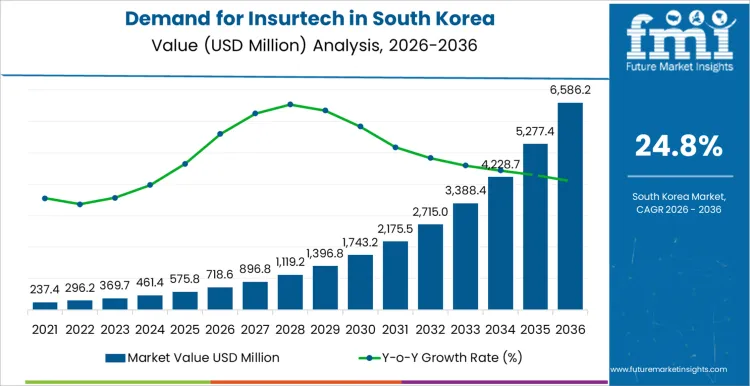
Insurers are investing heavily in AI in fintech capabilities to automate underwriting and claims processing, significantly reducing turnaround times and operational costs. The integration of IoT devices, particularly in the health and automotive sectors, is enabling a shift from reactive compensation models to proactive risk prevention services. This technological evolution is further supported by robust telecommunications infrastructure, which facilitates real-time data transmission required for usage-based insurance models.
The competitive sphere is characterized by aggressive collaboration between tech giants and traditional financial institutions. Major Korean insurers are launching their own digital subsidiaries or partnering with fintech as a service platforms to accelerate their digital transformation. International players like Entrust and Onfido are also gaining traction by providing the essential security and identity layers needed to build trust in fully digital onboarding processes. This ecosystem of partnership and competition is fostering innovation in cybersecurity insurance, ensuring that the sector remains resilient against the digital risks associated with rapid technological adoption through 2036.
Insurtech Industry in South Korea Key Takeaways
| Metric | Value |
|---|---|
| Industry Size (2026) | USD 718.6 million |
| Industry Value (2036) | USD 6,583.5 million |
| CAGR (2026 to 2036) | 24.8% |
What Catalysts Are Accelerating Digital Insurance Adoption?
The primary catalyst for growth is the MyData government initiative, which empowers consumers to control their financial data and share it with third-party providers. This open banking framework has revolutionized the insurance landscape by allowing insurtech companies to access granular customer data from banks and hospitals to create highly customized insurance portfolios. Additionally, the demographic shift toward an aging population is driving demand for digital health management platforms that bundle insurance coverage with wellness services. The increasing frequency of cyber threats targeting financial institutions has also necessitated the adoption of advanced security technologies, further fueling the demand for authentication solutions within the insurtech stack.
How is the Sector Structured Across Key Segments?
The sector is segmented to address the diverse needs of both consumers and enterprises in a digitally mature economy. It is primarily categorized by insurance type, reflecting the specific product lines undergoing transformation. The end user segment distinguishes between the entities deploying these technologies, while the technology segment highlights the underlying digital enablers. Each segment plays a vital role, where health insurance drives volume through consumer engagement and insurance companies drive value through infrastructure upgrades.
How is Wellness Data Reshaping Coverage Models?
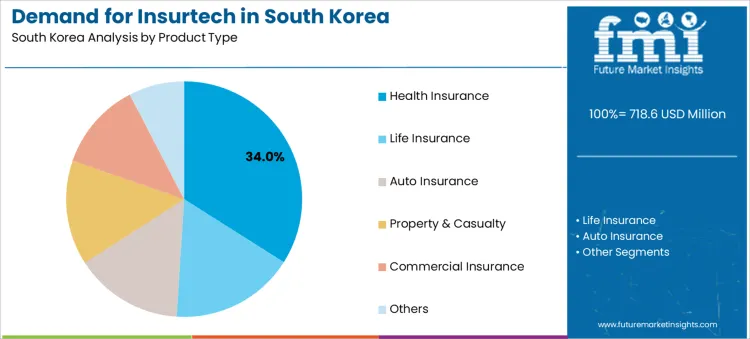
The health insurance segment commands a 34% share of the industry. This dominance is driven by the integration of wearable technology and mobile health apps with insurance policies. Insurers are utilizing real-time health data to offer premium discounts and personalized health coaching, effectively moving the value proposition from simple payout to active health management. The regulatory environment supporting non-medical healthcare services by insurers has further incentivized the development of comprehensive healthcare super-apps.
Why Are Incumbents Leading the Tech Investment Charge?
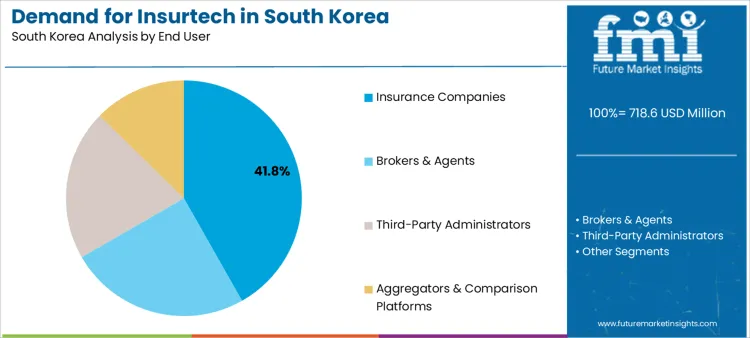
Insurance companies hold the majority share of 41.8% among end users. This is attributed to the massive scale of digital transformation projects undertaken by legacy carriers to replace aging core systems. These companies are investing significantly in commercial insurance platforms and automated claims solutions to compete with agile digital-native entrants. The need to improve customer retention rates and lower combined ratios is compelling these large organizations to adopt cloud-native technologies and API-first architectures.
How is AI Revolutionizing Risk Assessment?
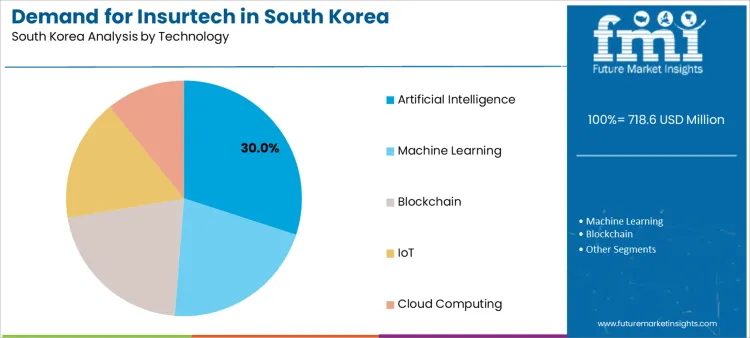
Artificial intelligence accounts for 30.0% of the technology share. This adoption is driven by the need to process vast amounts of unstructured data for more accurate underwriting and fraud detection. Machine learning algorithms are being deployed to analyze everything from medical records to vehicle telematics data, enabling granular risk segmentation that was previously impossible. The use of AI-powered chatbots and virtual assistants has also become standard for handling routine customer inquiries, allowing human agents to focus on complex claims and advisory services.
Why is Property Tech Gaining Traction?
The real estate insurtech segment is emerging as a critical component within the property & casualty category. This growth is fueled by the digitalization of the Korean housing market and the integration of smart home sensors for risk mitigation. Platforms that offer instant property valuation and automated policy issuance for renters and homeowners are streamlining the complex real estate insurance process. These solutions are increasingly bundled with mortgage and lease agreements, creating a seamless user experience for property transactions.
Will Usage-Based Models Disrupt Auto Insurance?
A major trend reshaping the landscape is the rise of telematics based auto insurance. South Korea's high vehicle density and advanced 5G network make it an ideal market for UBI (Usage-Based Insurance) models. Insurers are partnering with automakers and navigation apps to collect driving behavior data, offering lower premiums to safe drivers. This trend is driven by the desire to reduce accident rates and provide fairer pricing models for low-mileage drivers, leveraging the broader insurance telematics ecosystem.
Is Legacy Infrastructure Stifling Innovation?
The most significant restraint is the complexity of integrating modern insurtech solutions with the rigid legacy mainframe systems still used by many large insurers. This technical debt slows down product launches and creates data silos that hinder a unified view of the customer. Overcoming this requires substantial investment in middleware and third party administration tpa service platforms that can bridge the gap between old and new technologies.
How Will Embedded Ecosystems Expand Distribution?
The emerging field of embedded insurance presents a frontier of opportunity. E-commerce platforms and travel apps are increasingly acting as distribution channels for micro-insurance products, such as mobile handset protection and trip cancellation coverage. Suppliers who can provide modular APIs that allow non-insurance brands to sell coverage seamlessly stand to capture significant revenue. This transitional landscape is creating new revenue streams for insurers while offering customers protection exactly when they need it, such as guaranteed auto protection gap insurance at the point of car sale.
How is the Insurtech Landscape Evolving Across South Korea's Regions?
The regional sphere shows a concentration of R&D and pilot programs in specialized industrial and administrative zones, while tourism hubs focus on travel-related technologies. High-growth areas are characterizing their modernization by integrating smart city data with insurance risk models. As distinct provinces digitize their local economies, the utilization of specific insurtech solutions is becoming tailored to regional economic activities.
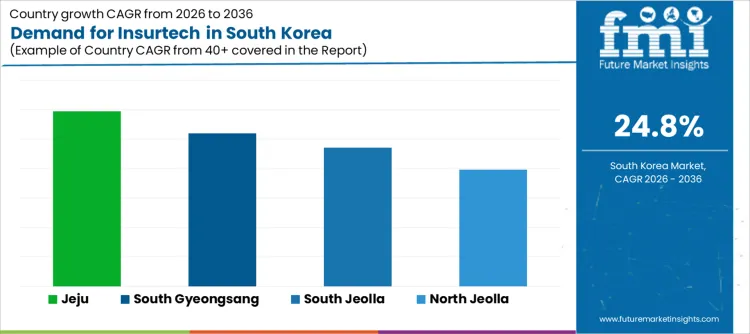
| Region | CAGR (2026 to 2036) |
|---|---|
| Jeju | 29.7% |
| South Gyeongsang | 26.0% |
| South Jeolla | 23.5% |
| North Jeolla | 19.8% |
Why is Tourism Driving Insurtech Innovation in Jeju?
Adoption of insurtech solutions in Jeju is projected to expand at a CAGR of 29.7%. As a premier international tourism destination and a testbed for smart grid technologies, Jeju creates a unique demand for on-demand travel insurance and electric vehicle (EV) specific coverage. The "smart tourism" initiative encourages the use of mobile platforms that bundle travel safety insurance with rental services and attraction bookings. Companies in this domain are developing parametric insurance products that automatically payout for flight delays or weather disruptions, enhancing the visitor experience through seamless digital protection.
How is Industrial Risk Management Evolving in South Gyeongsang?
Sales of digital insurance platforms in South Gyeongsang are likely to reach a CAGR of 26.0%. The region's status as a heavy industrial and shipbuilding hub necessitates advanced commercial insurance solutions capable of handling complex liability and marine risks. The digitization of shipyards and manufacturing plants is driving the adoption of IoT-enabled risk monitoring platforms that integrate with insurance policies to adjust premiums based on real-time safety data. This focus on industrial safety tech creates a market for insurtechs specializing in predictive maintenance and worker safety monitoring.
What Role Does Energy Infrastructure Play in South Jeolla?
The insurtech sector in South Jeolla is anticipated to rise at a CAGR of 23.5%. Anchored by the Energy Valley project, this region is a focal point for the renewable energy sector, driving demand for specialized insurance products for solar and wind farms. Insurtech solutions here focus on using weather data analytics and remote sensing to assess risks and process claims for renewable energy assets. The integration of blockchain for transparent energy trading and automated smart contract insurance for grid stability represents a key growth avenue.
How is Agricultural Tech Influencing North Jeolla?
Deployment of insurance technologies in North Jeolla is expected to increase at a CAGR of 19.8%. With a strong agricultural base and the developing Saemangeum smart city, the region is seeing adoption of agri-insurtech solutions. Drone imagery and satellite data are being used to automate crop insurance claims and assess yield risks with high precision. The demand is driven by the need to protect farmers against climate volatility through accessible mobile platforms that offer micro-insurance products tailored to seasonal harvest cycles.
How Are Companies Competing and Strengthening Their Positions in the South Korean Insurtech Industry?
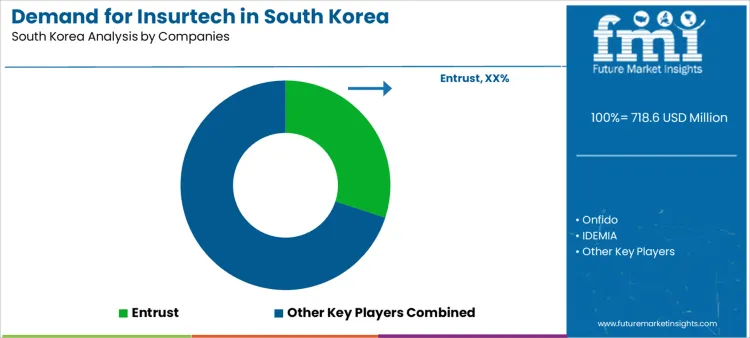
The competitive landscape is defined by a race to secure platform dominance through partnerships with super-apps and financial holding companies. Industry leaders like Entrust and Onfido are strengthening their positions by providing the critical identity infrastructure that underpins secure digital insurance transactions. There is also a marked trend toward open innovation, where traditional insurers establish innovation labs and accelerator programs to co-develop products with startups, ensuring they remain at the forefront of the fintech revolution.
Mergers and acquisitions are targeted at specialized data analytics firms, as insurers seek to internalize the AI capabilities needed for predictive modeling. Leading companies are actively investing in blockchain technology to streamline complex multiparty processes like reinsurance and subrogation. Furthermore, competitive intensity is driving a shift toward "prevention-as-a-service," where insurers compete not just on price, but on their ability to help customers avoid losses entirely through smart monitoring and early warning systems.
Key Companies
- Entrust
- Onfido
- IDEMIA
- Transmit Security
- Secret Double Octopus
- Kakao Pay Insurance
- Toss Insurance
- Carrot General Insurance
- Samsung Fire & Marine Insurance
- Hyundai Marine & Fire Insurance
Scope of Report
| Items | Values |
|---|---|
| Quantitative Units | USD Million |
| Insurance Type | Health Insurance, Life Insurance, Auto Insurance, Property & Casualty Insurance, Commercial Insurance |
| End User | Insurance Companies, Brokers & Agents, Third-Party Administrators, Aggregators & Comparison Platforms |
| Technology | Artificial Intelligence, Machine Learning & Data Analytics, Blockchain & Smart Contracts, Internet of Things, Cloud Computing |
| Regions Covered | South Gyeongsang, North Jeolla, South Jeolla, Jeju |
| Key Companies Profiled | Entrust, Onfido, IDEMIA, Transmit Security, Secret Double Octopus, and others. |
Insurtech Industry in South Korea by Segments
By Insurance Type:
- Health Insurance
- Life Insurance
- Auto Insurance
- Property & Casualty Insurance
- Commercial Insurance
By End User:
- Insurance Companies
- Brokers & Agents
- Third-Party Administrators
- Aggregators & Comparison Platforms
By Technology:
- Artificial Intelligence
- Machine Learning & Data Analytics
- Blockchain & Smart Contracts
- Internet of Things
- Cloud Computing
By Region:
- South Gyeongsang
- North Jeolla
- South Jeolla
- Jeju
Bibliography
- Financial Services Commission (FSC). (2025, January 7). Annual Work Plan for 2025 (includes fintech scale up and digital transformation policy agenda).
- Ministry of Science and ICT (MSIT). (2024, December 31). MSIT’s Work Plan for 2025 (includes National AI Computing Center and AI transformation in industries).
- Statistics Korea (KOSTAT). (2025, February 3). Online Shopping Trends for December 2024 and Online International Direct Sales and Purchases Trends for the Fourth Quarter of 2024.
- Korea Insurance Development Institute (KIDI). (2025, January 30). Discussion I: Outlook and Key Tasks for the Life Insurance Industry in 2025.
- Financial Services Commission (FSC). (2025, July 28). Authorities Propose Plans to Set Up Anti-vishing Platform Using Artificial Intelligence Analytics.
Frequently Asked Questions
How big is the demand for insurtech in south korea in 2026?
The demand for insurtech in south korea is estimated to be valued at USD 718.6 million in 2026.
What will be the size of insurtech in south korea in 2036?
The market size for the insurtech in south korea is projected to reach USD 6,586.2 million by 2036.
How much will be the demand for insurtech in south korea growth between 2026 and 2036?
The demand for insurtech in south korea is expected to grow at a 24.8% CAGR between 2026 and 2036.
What are the key product types in the insurtech in south korea?
The key product types in insurtech in south korea are 0.2, 0.16, 0.13, 0.11 and 0.06.
Which 0.418 segment is expected to contribute significant share in the insurtech in south korea in 2026?
In terms of 0.418, 0.264 segment is expected to command 0.0% share in the insurtech in south korea in 2026.
Preview the report firsthand - request a free sample
Get SampleGet the brochure for pricing and purchase details.
Get PDFTable of Content
- Executive Summary
- South Korea Market Outlook
- Demand-side Trends
- Supply-side Trends
- Technology Roadmap Analysis
- Analysis and Recommendations
- Market Overview
- Market Coverage / Taxonomy
- Market Definition / Scope / Limitations
- Market Background
- Market Dynamics
- Drivers
- Restraints
- Opportunity
- Trends
- Scenario Forecast
- Demand in Optimistic Scenario
- Demand in Likely Scenario
- Demand in Conservative Scenario
- Opportunity Map Analysis
- Product Life Cycle Analysis
- Supply Chain Analysis
- Investment Feasibility Matrix
- Value Chain Analysis
- PESTLE and Porter’s Analysis
- Regulatory Landscape
- Regional Parent Market Outlook
- Production and Consumption Statistics
- Import and Export Statistics
- Market Dynamics
- South Korea Market Analysis 2021 to 2025 and Forecast, 2026 to 2036
- Historical Market Size Value (USD Million) Analysis, 2021 to 2025
- Current and Future Market Size Value (USD Million) Projections, 2026 to 2036
- Y-o-Y Growth Trend Analysis
- Absolute $ Opportunity Analysis
- South Korea Market Pricing Analysis 2021 to 2025 and Forecast 2026 to 2036
- South Korea Market Analysis 2021 to 2025 and Forecast 2026 to 2036, By 0.34
- Introduction / Key Findings
- Historical Market Size Value (USD Million) Analysis By 0.34 , 2021 to 2025
- Current and Future Market Size Value (USD Million) Analysis and Forecast By 0.34 , 2026 to 2036
- 0.2
- 0.16
- 0.13
- 0.11
- 0.06
- 0.2
- Y-o-Y Growth Trend Analysis By 0.34 , 2021 to 2025
- Absolute $ Opportunity Analysis By 0.34 , 2026 to 2036
- South Korea Market Analysis 2021 to 2025 and Forecast 2026 to 2036, By 0.418
- Introduction / Key Findings
- Historical Market Size Value (USD Million) Analysis By 0.418, 2021 to 2025
- Current and Future Market Size Value (USD Million) Analysis and Forecast By 0.418, 2026 to 2036
- 0.264
- 0.192
- 0.126
- 0.264
- Y-o-Y Growth Trend Analysis By 0.418, 2021 to 2025
- Absolute $ Opportunity Analysis By 0.418, 2026 to 2036
- South Korea Market Analysis 2021 to 2025 and Forecast 2026 to 2036, By 0.3
- Introduction / Key Findings
- Historical Market Size Value (USD Million) Analysis By 0.3, 2021 to 2025
- Current and Future Market Size Value (USD Million) Analysis and Forecast By 0.3, 2026 to 2036
- 0.25
- 0.2
- 0.15
- 0.1
- 0.25
- Y-o-Y Growth Trend Analysis By 0.3, 2021 to 2025
- Absolute $ Opportunity Analysis By 0.3, 2026 to 2036
- Market Structure Analysis
- Competition Dashboard
- Competition Benchmarking
- Market Share Analysis of Top Players
- By Regional
- By 0.34
- By 0.418
- By 0.3
- Competition Analysis
- Competition Deep Dive
- Competition Deep Dive
- Assumptions & Acronyms Used
- Research Methodology


