

- Industry Size (2026)
- USD 109.2 Mn
- Forecast (2036)
- USD 197.1 Mn
- CAGR (2026 to 2036)
- 6.1%
Demand for Humidifier in South Korea Forecast and Outlook 2026 to 2036
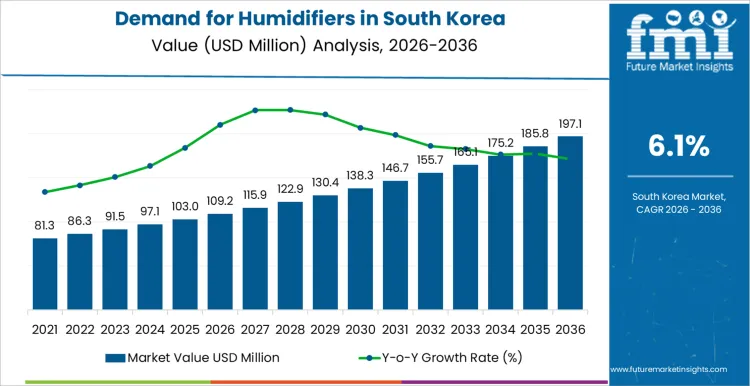
Demand for humidifiers in South Korea is projected to generate a valuation of USD 109.2 million in 2026. The sector is anticipated to reach USD 197.1 million by 2036, advancing at a compound annual growth rate of 6.1%. The Korean peninsula experiences intensely dry winters due to the influence of the Siberian high pressure system, necessitating artificial humidification in residential and commercial spaces to prevent respiratory ailments and skin irritation. The widespread use of traditional floor heating systems, known as Ondol, further exacerbates indoor dryness by radiating heat without adding moisture, thereby driving consistent sales of moisture-regulating hardware. Consumers are increasingly prioritizing respiratory health, particularly amidst recurring issues with fine dust and seasonal dryness, ensuring that these devices are considered essential home appliances rather than seasonal luxuries.
The sector has undergone a significant transformation following historical safety concerns, leading to a consumer base that is hyper-vigilant regarding hygiene, water tank cleanliness, and ease of maintenance. Manufacturers are responding by engineering devices with fully detachable water tanks, stainless steel components, and UV-sterilization features to prevent bacterial proliferation and build trust. There is a marked preference for devices that integrate seamlessly into the smart home ecosystem, allowing users to monitor and adjust indoor humidity conditions remotely via smartphone applications.
Shift towards hygiene-centric and connected devices is reshaping the product landscape, favoring premium models that offer transparency regarding water quality and air purity. The convergence of air purification and humidification functions is also gaining traction among space-conscious urban dwellers living in high-rise apartments.
Quick Stats for Demand for Humidifier in South Korea
- Demand for Humidifier in South Korea Industry Value (2026): USD 109.2 million
- Demand for Humidifier in South Korea Industry Forecast Value (2036): USD 197.1 million
- Demand for Humidifier in South Korea Forecast CAGR: 6.1%
- Demand for Humidifier in South Korea Leading Type Segment: Ultrasonic Humidifiers (36.0%)
- Demand for Humidifier in South Korea Leading Installation: Portable Humidifiers (67.9%)
- Demand for Humidifier in South Korea Leading End User: Residential Humidifiers (58.4%)
- Demand for Humidifier in South Korea Key Growth Regions: Jeju, South Gyeongsang, South Jeolla, North Jeolla
- Demand for Humidifier in South Korea Key Players: Honeywell International Inc., Dyson Ltd., De'Longhi S.p.A, Condair, BONECO AG
Technological advancements are pivoting towards hybrid models that combine the energy efficiency of ultrasonic technology with the hygiene benefits of warm mist generation to optimize user comfort. Innovation is particularly strong in the humidifier supplies sector, where anti-bacterial filters and specialized cleaning agents are being developed to extend device lifespans and ensure safety. Companies are focusing on noise reduction technologies to cater to light sleepers and nurseries, a critical demographic for this industry. The adoption of active humidifier devices in medical and elder care facilities provides a stable revenue stream beyond the consumer retail season. Integration of indoor air quality monitor sensors triggers automatic operation, removing the need for manual intervention and ensuring optimal respiratory conditions are maintained around the clock.
Demand for Humidifier in South Korea Key Takeaways
| Metric | Value |
|---|---|
| Industry Size (2026) | USD 109.2 million |
| Industry Value (2036) | USD 197.1 million |
| CAGR (2026 to 2036) | 6.1% |
What Factors Are Driving the Adoption of Moisture Control?
A primary catalyst for growth is the increasing prevalence of respiratory conditions and dry skin syndrome among the South Korean population, exacerbated by urbanization and pollution. Parents are investing heavily in air humidifier units to protect infants and young children from the harsh, dry winter air that promotes the spread of influenza and other viruses. The government's emphasis on healthy indoor environments in public facilities, including schools and daycare centers, stimulates B2B demand for reliable humidity solutions. The growing trend of "planterior" (plant interior) design also contributes, as urban gardeners require controlled humidity levels to maintain exotic houseplants, expanding the utility of these devices beyond human health to lifestyle maintenance.
How is the Sector Structured Across Key Segments?
The sector is segmented to address the diverse needs of residential comfort, industrial static control, and medical care environments. It is primarily categorized by humidifier type, reflecting the technology used to generate mist. The installation type segment highlights the mobility requirements of the user base. The end-user segment underscores the specific environments driving consumption. Each segment plays a vital role, where ultrasonic technology drives volume through affordability and portable units dominate due to the flexible nature of modern Korean housing layouts.
Why Do Ultrasonic Humidifiers Lead the Technology Mix?
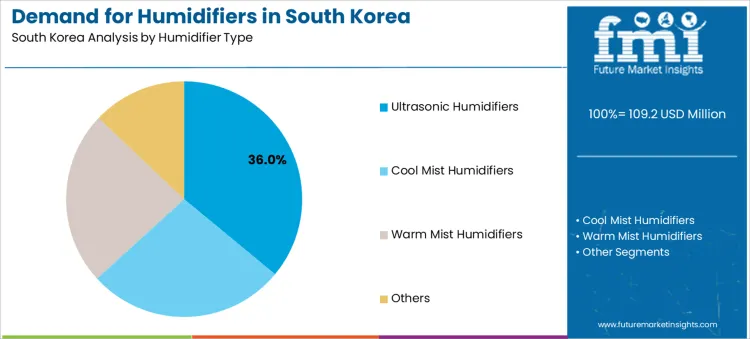
Ultrasonic Humidifiers command a 36.0% share of the industry, favored for their quiet operation, low energy consumption, and compact form factors. This technology uses high-frequency vibrations to create a fine mist, making it safer for households with children as there is no hot water involved. The immediate mist generation and cool output align perfectly with the needs of Korean apartments that are often overheated during winter. While commercial humidifier units may use electrode steam, the mass consumer base overwhelmingly prefers the silence and efficiency of ultrasonic models for bedroom use.
Why Are Portable Units the Preferred Installation Choice?
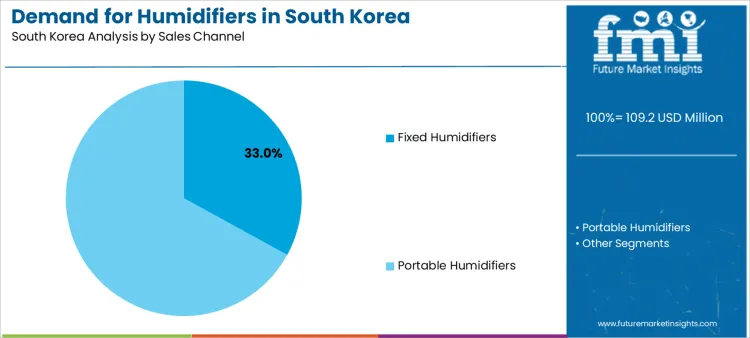
Portable Humidifiers account for 67.9% of the installation volume, reflecting the lifestyle of South Korean consumers who value flexibility and space optimization. Many households live in apartments where space is at a premium, making large, fixed installations impractical. Users prefer devices that can be moved from the living room during the day to the bedroom at night. This segment is supported by a robust supply of portable dehumidifiers and humidifiers that cater to single-person households, a growing demographic that demands appliances with small footprints and USB connectivity.
How Does the Residential Sector Dominate Consumption?
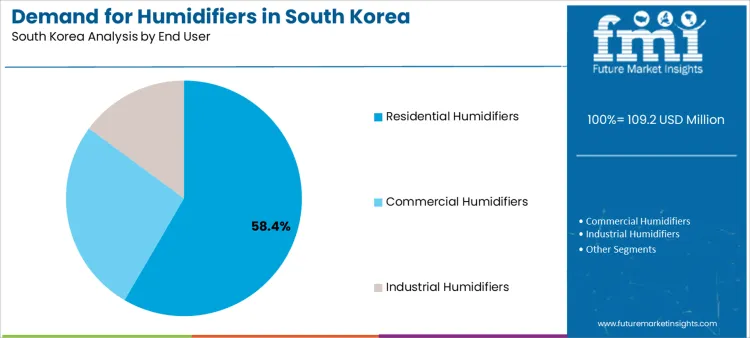
Residential Humidifiers represent the dominant end-user segment with 58.4% of the total value. The intense focus on family health, particularly for newborns and the elderly, drives high penetration rates in homes. South Korean consumers are knowledgeable about the benefits of maintaining 40-60% humidity for skin health and viral suppression. High-end apartments are increasingly integrating smart air purifiers with humidification capabilities, but standalone units remain popular for targeted moisture control. The desire to counteract the drying effects of heaters creates a recurring seasonal demand spike from October to March every year.
Will Smart Integration Redefine User Experience?
A significant trend is the incorporation of IoT capabilities that allow humidifiers to synchronize with other smart home devices. Modern units can communicate with air filters and thermostats to create a holistic indoor climate management system. Users can schedule operation times, monitor water levels, and receive cleaning reminders via smartphone apps. This connectivity appeals to the tech-savvy Korean consumer base, transforming the humidifier from a passive appliance into an active component of the smart home ecosystem that responds dynamically to environmental changes.
Does Maintenance Anxiety Hinder Expansion?
The most significant restraint is the consumer burden associated with regular cleaning and filter replacement to prevent mold and bacteria growth. The memory of the disinfectant safety crisis makes users extremely cautious about chemical additives, leading to a demand for purely physical cleaning solutions. Manufacturers must design units that are easily disassembled and dishwasher safe to overcome this barrier. The fear of "white dust" from mineral deposits in tap water also drives interest in desiccant dehumidifiers and distilled water solutions, complicating the user experience for some demographics.
How Can Industrial Applications Unlock New Value?
The emerging field of precision manufacturing presents a frontier of opportunity for high-capacity humidification. South Korea's massive semiconductor and display panel industries require rigorous static electricity control, which is achieved through precise humidity regulation. Suppliers who can provide industrial-grade heat pump cabin dehumidifiers and humidifiers with tight tolerance controls stand to capture significant revenue. Expanding into data centers, where humidity control is vital for server health, offers another lucrative avenue for growth beyond the saturated residential space.
How is the Humidifier Landscape Evolving Across South Korea's Regions?
The regional sphere shows a distinct pattern where industrial hubs drive demand for large-scale environmental control systems, while tourist-heavy islands focus on premium hospitality comfort. High-growth areas are characterizing their development by upgrading public and private infrastructure to meet higher air quality standards. As distinct provinces implement local health and safety guidelines, the utilization of humidification technology is becoming tailored to regional climatic and economic conditions.
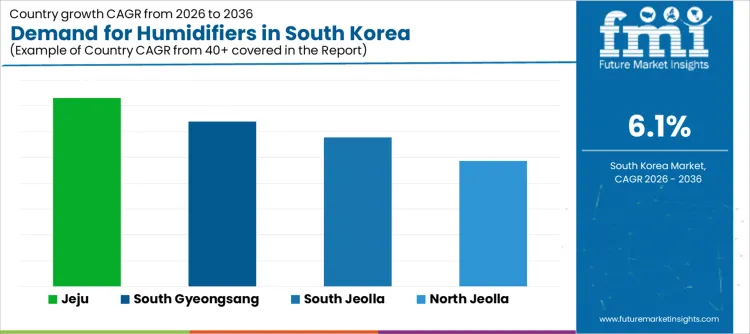
| Region | CAGR (2026 to 2036) |
|---|---|
| Jeju | 7.3% |
| South Gyeongsang | 6.4% |
| South Jeolla | 5.8% |
| North Jeolla | 4.9% |
Why is Tourism Driving Demand in Jeju?
Adoption of humidifiers in Jeju is projected to expand at a CAGR of 7.3%. As the nation's premier tourist destination, Jeju's hospitality sector is investing heavily in guest comfort to maintain its reputation. Luxury hotels and resorts are equipping rooms with premium humidifiers leading brands to counter the drying effects of air conditioning and heating systems. The demand is also driven by the influx of long-term visitors and digital nomads who expect high-standard amenities in their accommodations, creating a steady B2B channel for high-end, aesthetic devices.
How is Manufacturing Density Influencing South Gyeongsang?
Sales of industrial humidity control units in South Gyeongsang are likely to reach a CAGR of 6.4%. This region is the industrial heartland of Korea, hosting major shipbuilding, automotive, and machinery plants. The demand is fueled by the need to maintain optimal environmental conditions for painting, coating, and assembly processes where humidity affects product quality. Factory operators are installing robust air humidifier and dehumidifier systems to protect sensitive equipment and ensure worker comfort, driving volume in the heavy-duty segment.
What Role Does Agriculture Play in South Jeolla?
The humidifier sector in South Jeolla is anticipated to rise at a CAGR of 5.8%. As a key agricultural hub, the region utilizes humidification systems in smart farms and greenhouses to optimize crop growth, particularly for mushrooms and tropical fruits. The expansion of controlled-environment agriculture requires precise moisture delivery systems. Suppliers are finding opportunities in providing durable, energy-efficient units that can withstand the demanding conditions of agricultural operations, supporting the region's transition to high-tech farming.
How is Residential Development Shaping North Jeolla?
Deployment of household humidifiers in North Jeolla is expected to increase at a CAGR of 4.9%. The region's gradual urbanization and the development of new residential districts in cities like Jeonju are driving consumer sales. New apartment complexes often feature built-in system air conditioners but lack central humidification, prompting residents to purchase standalone units. The focus here is on cost-effective, reliable portable units that serve the needs of young families and the aging population living in these developing urban centers.
What Strategies Define Leadership in Humidity Control?
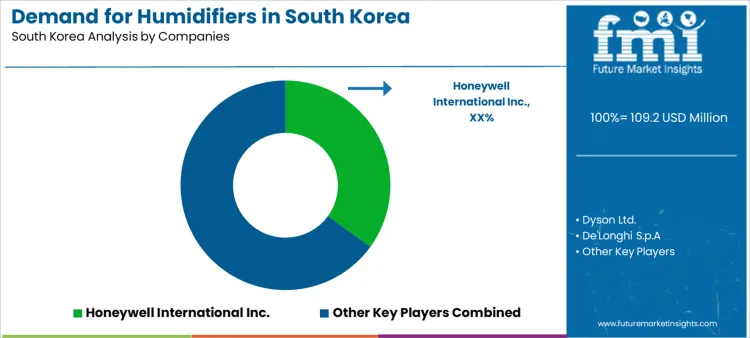
The competitive landscape is dominated by Honeywell International Inc., which commands a robust 35.0% share of the sector. Their strategy centers on leveraging their deep expertise in industrial controls to offer highly reliable, high-capacity units for the commercial and industrial segments. They prioritize performance and durability over aesthetic flair, securing long-term contracts with manufacturing facilities and commercial buildings. Dyson Ltd. targets the premium consumer segment with distinct, bladeless designs and integrated air purification, appealing to design-conscious users who view the humidifier as a status symbol.
How Are Local and European Brands Competing?
De'Longhi S.p.A and BONECO AG differentiate themselves through European engineering heritage, emphasizing hygiene features like boiling modes and silver ionization to address safety concerns. Domestic Korean brands are countering by focusing on "desk-terior" designs, compact, USB-powered, and visually appealing units that fit on office desks and nightstands. These local players are agile, quickly adopting features like mood lighting and cute character collaborations to capture the younger demographic. The competition is driving rapid innovation in ease of cleaning, with fully washable tanks becoming a standard requirement to compete in the hygiene-sensitive Korean environment.
Key Companies
- Honeywell International Inc.
- Dyson Ltd.
- De'Longhi S.p.A
- Condair
- BONECO AG
- Winia
- Cuckoo Electronics
- Shinil Electronics
- LG Electronics
- Samsung Electronics
Scope of Report
| Items | Values |
|---|---|
| Quantitative Units | USD Million |
| Humidifier Type | Ultrasonic, Cool Mist, Warm Mist, Others |
| Installation Type | Portable Humidifiers, Fixed Humidifiers |
| End User | Residential, Commercial, Industrial |
| Sales Channel | Online, Retail/Offline |
| Regions Covered | Jeju, South Gyeongsang, South Jeolla, North Jeolla |
| Key Companies Profiled | Honeywell, Dyson, De'Longhi, Condair, BONECO, and others. |
Demand for Humidifier in South Korea by Segments
By Humidifier Type
- Ultrasonic Humidifiers
- Cool Mist Humidifiers
- Warm Mist Humidifiers
- Others
By Installation Type
- Portable Humidifiers
- Fixed Humidifiers
By End User
- Residential Humidifiers
- Commercial Humidifiers
- Industrial Humidifiers
By Sales Channel
- Online
- Retail/Offline
Bibliography
- Ministry of Environment. (2025, February 4). Completion of administrative measures for 570 household chemical products violating standards in 2024 ensuring public safety. Ministry of Environment, Republic of Korea.
- Ministry of Environment. (2024, December 31). Environmental policies: Changes coming in 2025. Ministry of Environment, Republic of Korea.
- Korea Consumer Agency. (2025, March 18). Prohibited substances detected in 8 out of 42 air purifier filters. Korea Consumer Agency, Republic of Korea.
- Korea Consumer Agency. (2025, January 22). Safety survey on air purifier filters. Korea Consumer Agency, Republic of Korea.
- Seoul National University. (2024). Master’s thesis on air pollution-related factors including temperature and humidity and respiratory disease mortality in Korea. Seoul National University, Republic of Korea.
Frequently Asked Questions
How big is the demand for Humidifier in South Korea in 2026?
The demand for humidifier in South Korea is estimated to be valued at USD 109.2 million in 2026.
What will be the size of Humidifier in South Korea in 2036?
The industry size for the humidifier in South Korea is projected to reach USD 197.1 million by 2036.
How much will be the demand for Humidifier in South Korea growth between 2026 and 2036?
The demand for humidifier in South Korea is expected to grow at a 6.1% CAGR between 2026 and 2036.
What are the key product types in the Humidifier in South Korea?
The key product types in humidifier in South Korea are ultrasonic, cool mist, warm mist, and others.
Which end user segment is expected to contribute significant share in the Humidifier in South Korea in 2026?
In terms of end user, the residential humidifiers segment is expected to command 58.4% share in the humidifier in South Korea in 2026.
Preview the report firsthand - request a free sample
Get SampleGet the brochure for pricing and purchase details.
Get PDFTable of Content
- Executive Summary
- South Korea Market Outlook
- Demand-side Trends
- Supply-side Trends
- Technology Roadmap Analysis
- Analysis and Recommendations
- Market Overview
- Market Coverage / Taxonomy
- Market Definition / Scope / Limitations
- Market Background
- Market Dynamics
- Drivers
- Restraints
- Opportunity
- Trends
- Scenario Forecast
- Demand in Optimistic Scenario
- Demand in Likely Scenario
- Demand in Conservative Scenario
- Opportunity Map Analysis
- Product Life Cycle Analysis
- Supply Chain Analysis
- Investment Feasibility Matrix
- Value Chain Analysis
- PESTLE and Porter’s Analysis
- Regulatory Landscape
- Regional Parent Market Outlook
- Production and Consumption Statistics
- Import and Export Statistics
- Market Dynamics
- South Korea Market Analysis 2021 to 2025 and Forecast, 2026 to 2036
- Historical Market Size Value (USD Million) Analysis, 2021 to 2025
- Current and Future Market Size Value (USD Million) Projections, 2026 to 2036
- Y-o-Y Growth Trend Analysis
- Absolute $ Opportunity Analysis
- South Korea Market Pricing Analysis 2021 to 2025 and Forecast 2026 to 2036
- South Korea Market Analysis 2021 to 2025 and Forecast 2026 to 2036, By Humidifier Type
- Introduction / Key Findings
- Historical Market Size Value (USD Million) Analysis By Humidifier Type , 2021 to 2025
- Current and Future Market Size Value (USD Million) Analysis and Forecast By Humidifier Type , 2026 to 2036
- Ultrasonic Humidifiers
- Cool Mist Humidifiers
- Warm Mist Humidifiers
- Others
- Ultrasonic Humidifiers
- Y-o-Y Growth Trend Analysis By Humidifier Type , 2021 to 2025
- Absolute $ Opportunity Analysis By Humidifier Type , 2026 to 2036
- South Korea Market Analysis 2021 to 2025 and Forecast 2026 to 2036, By Installation Type
- Introduction / Key Findings
- Historical Market Size Value (USD Million) Analysis By Installation Type, 2021 to 2025
- Current and Future Market Size Value (USD Million) Analysis and Forecast By Installation Type, 2026 to 2036
- Portable Humidifiers
- Cool Mist Humidifiers
- Ultrasonic Humidifiers
- Warm Mist Humidifiers
- Portable Humidifiers
- Y-o-Y Growth Trend Analysis By Installation Type, 2021 to 2025
- Absolute $ Opportunity Analysis By Installation Type, 2026 to 2036
- South Korea Market Analysis 2021 to 2025 and Forecast 2026 to 2036, By End User
- Introduction / Key Findings
- Historical Market Size Value (USD Million) Analysis By End User, 2021 to 2025
- Current and Future Market Size Value (USD Million) Analysis and Forecast By End User, 2026 to 2036
- Residential Humidifiers
- Commercial Humidifiers
- Industrial Humidifiers
- Residential Humidifiers
- Y-o-Y Growth Trend Analysis By End User, 2021 to 2025
- Absolute $ Opportunity Analysis By End User, 2026 to 2036
- South Korea Market Analysis 2021 to 2025 and Forecast 2026 to 2036, By Sales Channel
- Introduction / Key Findings
- Historical Market Size Value (USD Million) Analysis By Sales Channel, 2021 to 2025
- Current and Future Market Size Value (USD Million) Analysis and Forecast By Sales Channel, 2026 to 2036
- Fixed Humidifiers
- Portable Humidifiers
- Fixed Humidifiers
- Y-o-Y Growth Trend Analysis By Sales Channel, 2021 to 2025
- Absolute $ Opportunity Analysis By Sales Channel, 2026 to 2036
- Market Structure Analysis
- Competition Dashboard
- Competition Benchmarking
- Market Share Analysis of Top Players
- By Regional
- By Humidifier Type
- By Installation Type
- By End User
- By Sales Channel
- Competition Analysis
- Competition Deep Dive
- Honeywell International Inc.
- Overview
- Product Portfolio
- Profitability by Market Segments (Product/Age /Sales Channel/Region)
- Sales Footprint
- Strategy Overview
- Marketing Strategy
- Product Strategy
- Channel Strategy
- Dyson Ltd.
- De'Longhi S.p.A
- Condair
- BONECO AG
- Honeywell International Inc.
- Competition Deep Dive
- Assumptions & Acronyms Used
- Research Methodology


