

- Industry Size (2026)
- USD 411.42 Mn
- Forecast (2036)
- USD 789.65 Mn
- CAGR (2026 to 2036)
- 6.7%
Humidifiers Industry Outlook in the UK 2026 to 2036
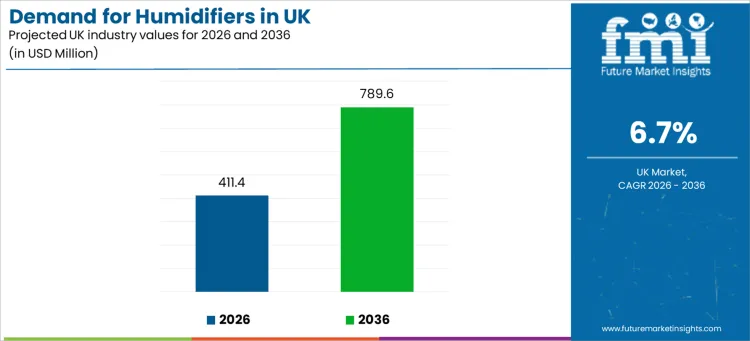
Demand for humidifiers in the UK is projected at USD 411.42 million in 2026 and is expected to reach USD 789.65 million by 2036, expanding at a 6.7% CAGR. This demand curve is shaped by how households, facility managers, and building operators manage indoor comfort, air quality perception, and moisture balance during heating-heavy months.
Humidification is now treated as a practical control tool for comfort outcomes such as dry throat irritation, nose dryness, sleep comfort, and skin comfort during winter. It is also used to protect indoor assets that react poorly to dry air, including wood furniture, instruments, and sensitive materials stored in temperature-controlled spaces. Decision-makers focus on measurable benefits such as stable moisture output, quiet operation, energy efficiency, and ease of cleaning since poor hygiene discipline can cause performance degradation and user dissatisfaction.
In commercial environments, humidification tends to be specified through building services planning where the goal is occupant comfort, static control, and better stability for equipment and materials. Across both homes and commercial settings, buyers prefer products that deliver predictable results without creating condensation risk or complex maintenance routines.
Quick Stats in the Humidifiers in the UK Industry
- Humidifiers Industry Value in UK (2026): USD 411.42 million
- Humidifiers Industry Forecast Value in UK (2036): USD 789.65 million
- Humidifiers Industry Growth Forecast (2026 to 2036): 6.7% CAGR
- Leading regional growth: England (7.4%)
- Leading humidifier type: Ultrasonic Humidifiers (34.5% share)
- Leading installation type: Portable Humidifiers (64.5% share)
- Leading end user: Residential Humidifiers (55.5% share)
- Leading sales channel: Fixed Humidifiers (56% share)
- Key companies profiled: Honeywell International Inc.; Dyson Ltd.; De’Longhi S.p.A; Condair
Humidifiers Industry in the UK Key Takeaways
| Metric | Value |
|---|---|
| Industry Value (2026) | USD 411.42 million |
| Industry Forecast Value (2036) | USD 789.65 million |
| Forecast CAGR (2026 to 2036) | 6.7% |
Why is the UK Building Sustained Demand for Humidifiers?
Demand growth in the UK is supported by the comfort gap created when indoor heating lowers relative humidity. In winter, many homes and offices experience dry air conditions that reduce perceived comfort. Building services bodies highlight the comfort relevance of maintaining indoor humidity in healthy ranges. CIBSE guidance on humidity control discusses benefits tied to keeping relative humidity above 40% for wellbeing and related outcomes.
Workplaces and public environments also face governance expectations around aerosol-related risks in water systems. HSE lists humidifiers as one of the systems that can create a risk of legionella if not managed correctly. This pushes adoption toward designs and operating routines that prioritise hygiene, cleaning accessibility, and predictable water handling. It also increases buyer attention on operating instructions, consumable replacement schedules, and maintenance discipline.
Many procurement and product teams align humidification feature roadmaps with the humidifiers outlook, then extend planning across specific use cases linked to air humidifiers where portability and user experience drive buying behaviour. Commercial teams often evaluate broader building needs through the commercial humidifier outlook where facilities prioritise uptime and consistent output.
How is Humidifiers Demand Segmented by Humidifier Type, Installation Type, End User, and Sales Channel?
Segmentation in the UK reflects how buyers balance comfort improvement, maintenance effort, footprint constraints, and purchase confidence.
Why are Ultrasonic Humidifiers selected for comfort-first use in indoor spaces?
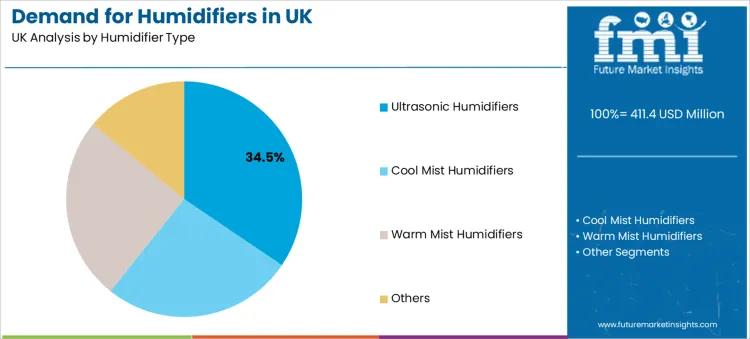
Ultrasonic humidifiers hold a 34.5% share, making them the leading type. Buyers choose ultrasonic designs for quiet performance, low perceived disruption during sleep, and suitability for bedrooms, living rooms, and work-from-home spaces. This segment also benefits from the expectation of efficient mist output with compact product designs, which suits modern UK home layouts where equipment footprint matters.
For stakeholders targeting household penetration, ultrasonic designs also support premium positioning through features such as automatic humidity sensing, night modes, and fine mist control. Product teams that optimise for user experience often map competitive positioning alongside the air humidifier outlook where consumer adoption is influenced by noise levels, ease of operation, and cleaning convenience.
What makes portable humidifiers the primary installation choice for households and small offices?
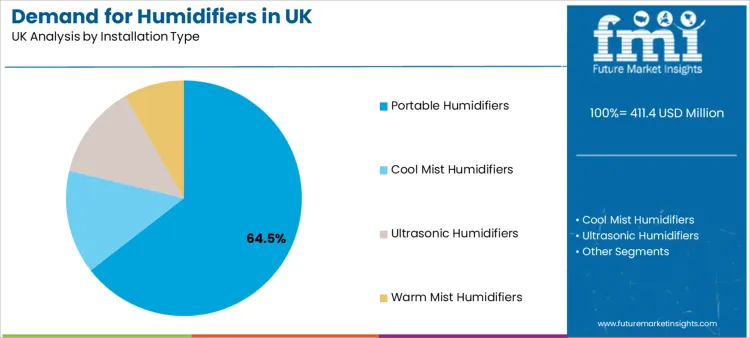
Portable humidifiers account for a 64.5% share, showing that buyers prioritise flexibility and quick deployment. Portables allow users to move devices across rooms based on sleep routines, childcare needs, seasonal dryness, or short-term comfort issues. This installation type also reduces installation complexity, making it attractive for renters and multi-occupancy households where permanent building changes are not practical.
Portability also fits the UK’s mixed building stock, including older homes where room-by-room comfort management is often preferred. This is reinforced by adoption patterns tracked in the humidifiers outlook, where portable formats represent a major unit driver due to accessibility and lower entry cost.
Why do residential buyers dominate end-use demand for humidifiers in the UK?
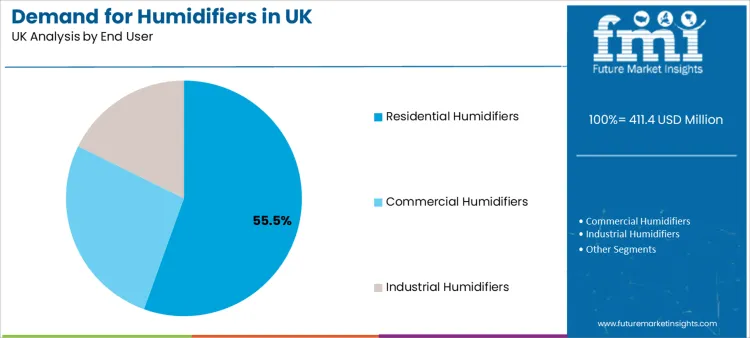
Residential humidifiers represent a 55.5% share, reflecting comfort-led adoption in homes. Buyers in this segment value relief from dryness-related discomfort, better sleep experience, and improved perceived air feel during heating months. They also respond strongly to ease-of-use and low maintenance burden, since poor cleaning habits can reduce performance and create unpleasant odours.
Residential adoption is also shaped by health and safety awareness. HSE highlights that humidifiers can be a legionella risk system when poorly managed. This drives demand toward products that are easier to clean and operate with clear maintenance guidance.
Why is purchasing concentrated in fixed humidifiers as the leading sales channel?
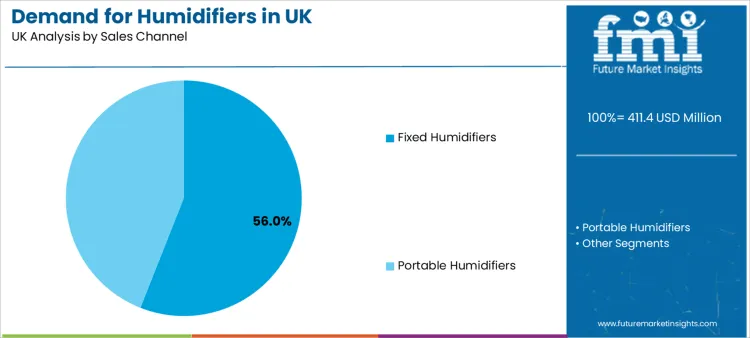
Fixed humidifiers hold a 56% share as the leading sales channel classification in the UK dataset. This reflects how many buyers prefer controlled purchase decisions tied to trusted retail formats, bundled service support, or structured purchasing routes that feel reliable at the point of sale. For larger buyers, fixed purchase routes can also indicate preference for planned procurement rather than impulse-driven purchases, especially when humidification is being adopted as part of a wider indoor comfort improvement plan.
For suppliers and channel partners, this segment rewards clearer product education, strong warranty support, and reliable replacement availability, including accessories and filters aligned with the humidifier supplies outlook.
What are the Dynamics, Restraints, Opportunities, and Threats Shaping this Space?
What dynamics are keeping adoption steady across both homes and facilities?
Comfort needs are a strong driver, especially where indoor heating reduces moisture levels. CIBSE material on humidity control highlights the relevance of maintaining healthier humidity conditions for wellbeing outcomes. Buyers value products that deliver stable output without disrupting daily routines.
What restraints slow adoption or reduce repeat purchases?
Maintenance fatigue is a key restraint. If cleaning is difficult or water reservoirs are hard to access, users stop using the device. Risk awareness also influences procurement. HSE lists humidifiers among systems that can create a legionella risk, which increases attention on hygiene control. This can delay purchase decisions in offices, care settings, and shared buildings where responsibility and compliance expectations are stricter.
Where do the strongest opportunities sit for brands and service partners?
- User-friendly cleaning and hygiene design: Products that reduce cleaning friction can improve retention and repeat purchases, strengthened by accessory ecosystems mapped in humidifier supplies.
- Commercial standardisation: Offices and controlled environments require predictable output and planned servicing, aligning with the commercial humidifier outlook.
- Feature upgrades in portable formats: Quiet operation, sensing accuracy, and compact design keep portable adoption strong within the air humidifier outlook.
What threats can disrupt demand expectations?
Improper use and poor cleaning discipline can create negative user outcomes and brand reputation risk. Legionella control expectations also remain a compliance concern in shared environments. HSE’s broader legionella risk guidance reinforces the need to avoid aerosol risks and manage water systems responsibly.
How is Humidifiers Demand Evolving across Key Regions in the UK?
Regional growth differs based on housing stock characteristics, heating patterns, commercial building concentration, and consumer adoption behaviour.
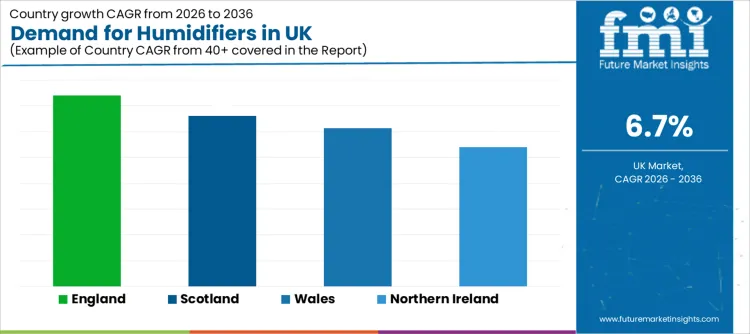
| Region | CAGR 2026 to 2036 |
|---|---|
| England | 7.4% |
| Scotland | 6.6% |
| Wales | 6.1% |
| Northern Ireland | 5.4% |
Why is England leading growth through higher household penetration and wider retail availability?
England expands at 7.4%, supported by larger household volumes and stronger product availability across retail and online channels. Comfort-focused buying, especially in winter when heating loads increase dryness drives adoption. England also shows stronger replacement cycles where consumers upgrade to quieter or more feature-rich models.
How is Scotland growing through seasonal comfort needs and steady household uptake?
Scotland grows at 6.6%, driven by comfort demand during colder periods and steady uptake in residential settings. Buyers tend to prioritise durability, reliable output, and products that remain stable in day-to-day use with minimal upkeep complexity.
What is shaping Wales as it builds demand through value-driven purchases and practical use cases?
Wales rises at 6.1%, with growth shaped by practical adoption patterns where users prioritise visible comfort improvement and manageable operating costs. Portability and ease of cleaning remain important buying factors in this region.
Why is Northern Ireland progressing through measured adoption and cautious maintenance expectations?
Northern Ireland grows at 5.4%, reflecting cautious adoption driven by value assurance and ease of maintenance. Buyers tend to prefer products with straightforward operation and clear care guidance, especially in households where devices are used seasonally rather than year-round.
What Defines the Competitive Landscape for Humidifiers in the UK?
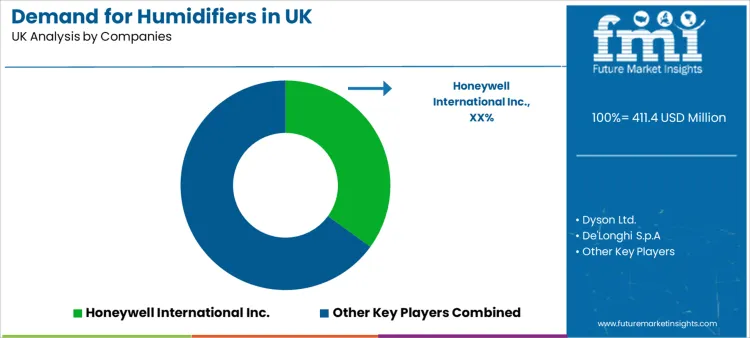
Competition is shaped by product reliability, cleaning simplicity, quiet performance, and brand trust. Buyers compare products on moisture output stability, noise levels in sleep settings, tank refill convenience, and how well the device prevents leakage or residue buildup. Customer support matters because maintenance routines can determine long-term satisfaction and repeat purchases.
Honeywell International Inc. competes through broad indoor comfort portfolios and trusted brand presence across home devices. Dyson Ltd. is positioned strongly where design quality, user experience, and premium functionality influence purchase behaviour. De’Longhi S.p.A competes through household appliance reach and product familiarity in home comfort categories. Condair is relevant where commercial-grade humidification performance and building-level control needs shape buying decisions, especially in environments where output stability and maintenance discipline are essential.
Key Industry Participants
- Honeywell International Inc.
- Dyson Ltd.
- De’Longhi S.p.A
- Condair
Scope of Report
| Items | Values |
|---|---|
| Quantitative Units | USD Million |
| Humidifier Type | Ultrasonic Humidifiers; Cool Mist Humidifiers; Warm Mist Humidifiers; Others |
| Installation Type | Portable Humidifiers; Cool Mist Humidifiers; Ultrasonic Humidifiers; Warm Mist Humidifiers |
| End User | Residential Humidifiers; Commercial Humidifiers; Industrial Humidifiers |
| Sales Channel | Fixed Humidifiers; Portable Humidifiers |
| Regions Covered | England; Scotland; Wales; Northern Ireland |
| Key Companies Profiled | Honeywell International Inc.; Dyson Ltd.; De’Longhi S.p.A; Condair |
Humidifiers Demand in the UK by Segments
By Humidifier Type:
- Ultrasonic Humidifiers
- Cool Mist Humidifiers
- Warm Mist Humidifiers
- Others
By Installation Type:
- Portable Humidifiers
- Cool Mist Humidifiers
- Ultrasonic Humidifiers
- Warm Mist Humidifiers
By End User:
- Residential Humidifiers
- Commercial Humidifiers
- Industrial Humidifiers
By Sales Channel:
- Fixed Humidifiers
- Portable Humidifiers
By Region:
- England
- Scotland
- Wales
- Northern Ireland
Bibliography
- Chartered Institution of Building Services Engineers. (n.d.). Humidity control.
- Health and Safety Executive. (n.d.). Other systems that can create a risk of legionella.
- Health and Safety Executive. (2013). Legionnaires’ disease: The control of legionella bacteria in water systems (ACOP L8).
Frequently Asked Questions
How big is the demand for humidifiers in uk in 2026?
The demand for humidifiers in uk is estimated to be valued at USD 411.4 million in 2026.
What will be the size of humidifiers in uk in 2036?
The market size for the humidifiers in uk is projected to reach USD 789.6 million by 2036.
How much will be the demand for humidifiers in uk growth between 2026 and 2036?
The demand for humidifiers in uk is expected to grow at a 6.7% CAGR between 2026 and 2036.
What are the key product types in the humidifiers in uk?
The key product types in humidifiers in uk are ultrasonic humidifiers, cool mist humidifiers, warm mist humidifiers and others.
Which installation type segment is expected to contribute significant share in the humidifiers in uk in 2026?
In terms of installation type, portable humidifiers segment is expected to command 64.5% share in the humidifiers in uk in 2026.
Preview the report firsthand - request a free sample
Get SampleGet the brochure for pricing and purchase details.
Get PDFTable of Content
- Executive Summary
- UK Market Outlook
- Demand-side Trends
- Supply-side Trends
- Technology Roadmap Analysis
- Analysis and Recommendations
- Market Overview
- Market Coverage / Taxonomy
- Market Definition / Scope / Limitations
- Market Background
- Market Dynamics
- Drivers
- Restraints
- Opportunity
- Trends
- Scenario Forecast
- Demand in Optimistic Scenario
- Demand in Likely Scenario
- Demand in Conservative Scenario
- Opportunity Map Analysis
- Product Life Cycle Analysis
- Supply Chain Analysis
- Investment Feasibility Matrix
- Value Chain Analysis
- PESTLE and Porter’s Analysis
- Regulatory Landscape
- Regional Parent Market Outlook
- Production and Consumption Statistics
- Import and Export Statistics
- Market Dynamics
- UK Market Analysis 2021 to 2025 and Forecast, 2026 to 2036
- Historical Market Size Value (USD Million) Analysis, 2021 to 2025
- Current and Future Market Size Value (USD Million) Projections, 2026 to 2036
- Y-o-Y Growth Trend Analysis
- Absolute $ Opportunity Analysis
- UK Market Pricing Analysis 2021 to 2025 and Forecast 2026 to 2036
- UK Market Analysis 2021 to 2025 and Forecast 2026 to 2036, By Humidifier Type
- Introduction / Key Findings
- Historical Market Size Value (USD Million) Analysis By Humidifier Type , 2021 to 2025
- Current and Future Market Size Value (USD Million) Analysis and Forecast By Humidifier Type , 2026 to 2036
- Ultrasonic Humidifiers
- Cool Mist Humidifiers
- Warm Mist Humidifiers
- Others
- Ultrasonic Humidifiers
- Y-o-Y Growth Trend Analysis By Humidifier Type , 2021 to 2025
- Absolute $ Opportunity Analysis By Humidifier Type , 2026 to 2036
- UK Market Analysis 2021 to 2025 and Forecast 2026 to 2036, By Installation Type
- Introduction / Key Findings
- Historical Market Size Value (USD Million) Analysis By Installation Type, 2021 to 2025
- Current and Future Market Size Value (USD Million) Analysis and Forecast By Installation Type, 2026 to 2036
- Portable Humidifiers
- Cool Mist Humidifiers
- Ultrasonic Humidifiers
- Warm Mist Humidifiers
- Portable Humidifiers
- Y-o-Y Growth Trend Analysis By Installation Type, 2021 to 2025
- Absolute $ Opportunity Analysis By Installation Type, 2026 to 2036
- UK Market Analysis 2021 to 2025 and Forecast 2026 to 2036, By End User
- Introduction / Key Findings
- Historical Market Size Value (USD Million) Analysis By End User, 2021 to 2025
- Current and Future Market Size Value (USD Million) Analysis and Forecast By End User, 2026 to 2036
- Residential Humidifiers
- Commercial Humidifiers
- Industrial Humidifiers
- Residential Humidifiers
- Y-o-Y Growth Trend Analysis By End User, 2021 to 2025
- Absolute $ Opportunity Analysis By End User, 2026 to 2036
- UK Market Analysis 2021 to 2025 and Forecast 2026 to 2036, By Sales Channel
- Introduction / Key Findings
- Historical Market Size Value (USD Million) Analysis By Sales Channel, 2021 to 2025
- Current and Future Market Size Value (USD Million) Analysis and Forecast By Sales Channel, 2026 to 2036
- Fixed Humidifiers
- Portable Humidifiers
- Fixed Humidifiers
- Y-o-Y Growth Trend Analysis By Sales Channel, 2021 to 2025
- Absolute $ Opportunity Analysis By Sales Channel, 2026 to 2036
- Market Structure Analysis
- Competition Dashboard
- Competition Benchmarking
- Market Share Analysis of Top Players
- By Regional
- By Humidifier Type
- By Installation Type
- By End User
- By Sales Channel
- Competition Analysis
- Competition Deep Dive
- Honeywell International Inc.
- Overview
- Product Portfolio
- Profitability by Market Segments (Product/Age /Sales Channel/Region)
- Sales Footprint
- Strategy Overview
- Marketing Strategy
- Product Strategy
- Channel Strategy
- Dyson Ltd.
- De'Longhi S.p.A
- Condair
- Honeywell International Inc.
- Competition Deep Dive
- Assumptions & Acronyms Used
- Research Methodology


