

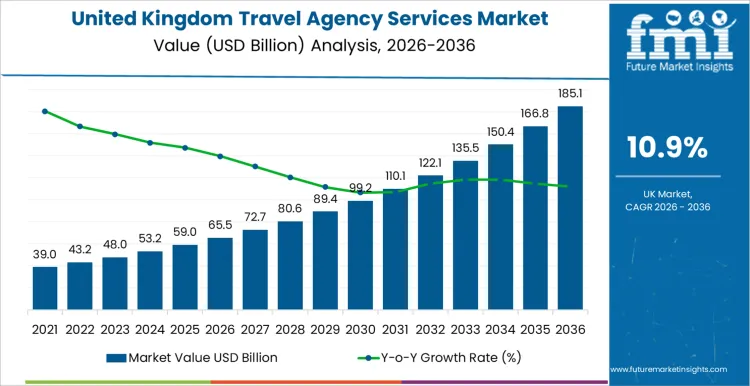
- Industry Size (2026)
- USD 65.49 Bn
- Forecast (2036)
- USD 185.07 Bn
- CAGR (2026 to 2036)
- 10.9%
Travel Agency Services Outlook in the UK 2026 to 2036
Demand for travel agency services in the UK is projected to reach USD 65.49 billion in 2026. This is expected to rise to USD 185.07 billion by 2036, expanding at a 10.9% CAGR. Growth is being shaped by a clear shift in traveller priorities, confidence, convenience, value assurance, and problem-solving during disruption.
Travel planning is no longer only about finding the cheapest fare. It is about building an itinerary that can survive real-world complications such as delays, missed connections, policy changes, refund constraints, and last-minute schedule changes. For CEOs and commercial leaders, this category now sits closer to a high-trust service layer than a transactional booking function. For airlines, hotels, and destination partners, agency-driven demand increasingly influences how inventory is packaged, priced, and converted.
The UK environment supports both short domestic breaks and high-frequency outbound trips. Buyers range from independent leisure travellers planning flexible travel to corporate teams managing predictable schedules and duty-of-care expectations. Agency services are also expanding into experience-led planning, itinerary personalisation, and bundled protection, especially for travellers who want clear accountability when something goes wrong.
Quick Stats for Travel Agency Services Demand in the UK
- Travel Agency Services Valuation in the UK (2026): USD 65.49 billion
- Travel Agency Services Forecast Valuation in the UK (2036): USD 185.07 billion
- Travel Agency Services Forecast CAGR (2026 to 2036): 10.9%
- Leading Regional Growth: England (12.0%)
- Leading Services Provided: Full-service Travel Arrangements (41.0% share)
- Leading Booking Channel: Phone Booking (49.0% share)
- Leading Tourist Type: Domestic (56.0% share)
- Leading Tour Type: Independent Traveller (43% share)
- Leading Demography: Men (38.0% share)
- Key Companies Profiled: Expedia Group; Booking Holdings; TUI Group; American Express Global Business Travel; Viator
Why is the UK a High-Activity Hub for Travel Agency Services?
The UK remains a high-activity hub because travel volumes have returned strongly and traveller expectations are rising. The UK Parliament briefing on tourism notes that inbound and outbound visits to and from the UK reached their highest recorded level in 2024, with visitor numbers exceeding 2019 levels for the first time since the pandemic. This creates structural demand for itinerary planning, booking coordination, and service support.
Outbound and inbound flows also reinforce agency relevance. ONS estimates that overseas residents made 10.4 million visits to Great Britain and spent £10.2 billion in Q3 2024, while Great Britain residents made 29.0 million visits outside the UK and spent £28.4 billion during the same quarter. As volume rises, agencies gain leverage in travel packaging, upsell services, and disruption management support.
Passenger volumes highlight the scale of travel movement. UK government transport statistics report 258.5 million passengers travelled internationally to or from UK airports in 2024. This type of sustained airport throughput increases the need for booking flexibility, itinerary resilience, and responsive support when flight patterns shift.
Traveller behaviour is also evolving. ABTA’s Travel Trends for 2025 highlights shifting preferences and changing holiday habits that shape how trips are designed and sold. This supports a broader push toward curated travel, experiential add-ons, and higher confidence booking paths.
Many travel leaders align long-range planning with travel agency services and expand category strategy into adjacent demand pools such as online travel booking where digital discovery and conversion behaviours influence channel priorities.
How is Travel Agency Services Demand Segmented by Services Provided, Booking Channel, Tourist Type, Tour Type, and Demography?
Segment demand in the UK is shaped by how travellers balance time, trust, and control. Some buyers want end-to-end planning with accountability. Others want selective support for only a part of the trip.
Why do Full-service Travel Arrangements remain Central for higher-assurance trip planning?
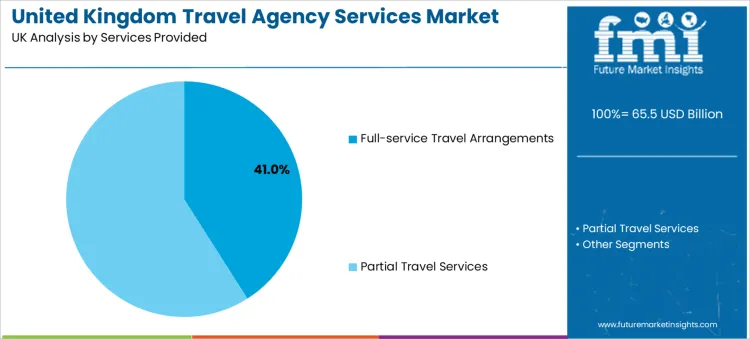
Full-service travel arrangements account for a 41.0% share, making them the leading service category. This reflects a strong preference for end-to-end coordination that reduces planning burden and limits risk exposure. Travellers using full-service arrangements typically value itinerary structure, bundled pricing clarity, and a single point of contact for changes.
These programmes often include flights, accommodation, transfers, insurance guidance, and experience planning. For agency leaders, this segment supports higher wallet share and stronger customer retention because the agency becomes the trusted owner of the journey.
Full-service demand also increases when travellers choose multi-destination itineraries or plan around fixed dates where rebooking options need to be managed quickly. Trip designers frequently align full-service propositions with the experience-led shift tracked in luxury travel, especially when travellers want premium stays and time-efficient planning without sacrificing flexibility.
Why is Phone Booking the Preferred Channel for Reassurance-led Travel Decisions?
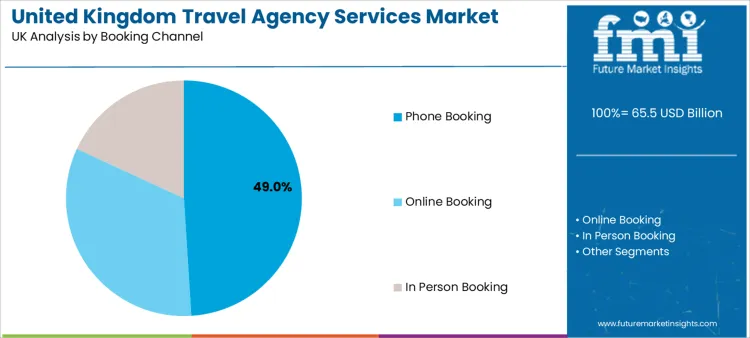
Phone booking holds a 49.0% share, signalling the importance of human guidance during decision-making. Travellers often use phone support when booking is complex, when policy details are unclear, or when reassurance matters more than speed. This channel also performs strongly when the traveller expects changes, prefers negotiation, or wants to confirm inclusions and exclusions before payment.
For travel providers and service partners, phone booking remains a high-conversion path because customer intent is typically stronger once a person is speaking with an agent. It also improves attachment rate for upgrades such as flexible fares, seat selection, insurance, and transfers. Phone-driven conversion remains relevant even as discovery shifts online, a pattern frequently reflected in travel technology solutions that combine digital discovery with assisted selling.
Why does Domestic Travel lead Demand among all Agency Service Options in the UK?
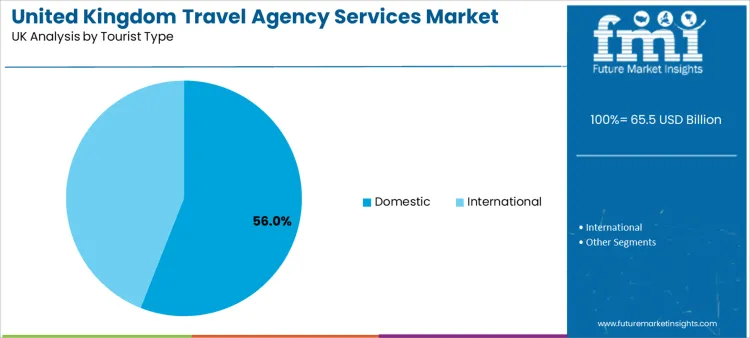
Domestic travel represents a 56.0% share, making it the largest tourist type segment. This reflects frequent short breaks, regional exploration, event-led travel, and convenience-first trip planning. Domestic trips often benefit from agency value when travellers want better accommodation options, packaged experiences, or support during peak travel seasons when inventory becomes limited.
Domestic demand also supports repeat customer behaviour because travellers tend to book multiple shorter trips through the year. Agencies that build loyalty programmes, curated local experiences, and flexible cancellation options can build consistent conversion in this segment. Domestic trip packaging often expands alongside demand patterns captured in domestic tourism where local travel behaviours support resilient demand even during global uncertainty.
What makes Independent Travel a strong Tour-Style Choice for Individuals in the UK?
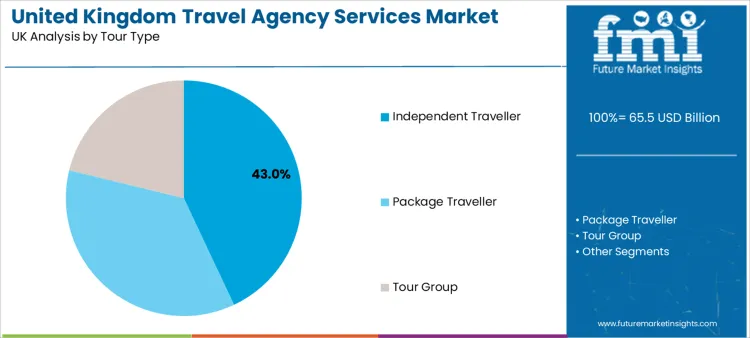
Independent travellers hold a 43% share, showing strong preference for control over timing, routing, and experience choices. These customers want flexibility and personalisation rather than fixed schedules. They still rely on agencies for value, supplier access, and assurance, especially when building multi-stop itineraries or handling premium reservations.
Independent travel also drives demand for modular service bundles. Travellers may use agencies for flights and accommodation while self-managing local experiences, or use agency support only for complex legs of the trip. This supports stronger adoption of curated activity platforms and experience marketplaces. Experience-led expansion aligns naturally with tourism activities where travellers prioritise itinerary quality and memorable experiences.
Why does the Men’s Demographic Show a Stronger Share in Agency-based Travel Services?
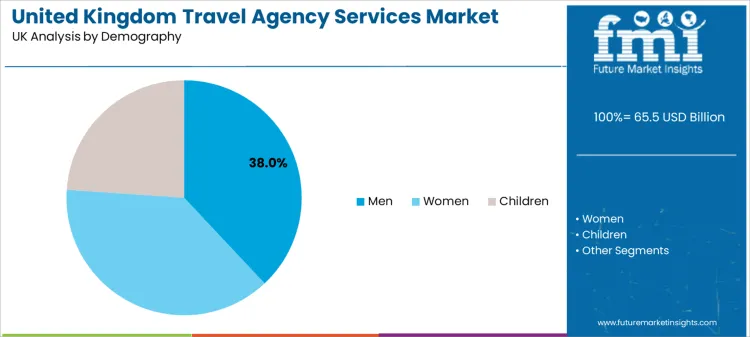
Men account for a 38.0% share, reflecting differences in booking behaviour, travel purpose mix, and channel preferences in certain trip categories. This segment often shows stronger adoption in structured bookings, business-linked itineraries, and trips where time efficiency is critical.
Agencies respond by offering simplified booking paths, concierge-style planning, and itinerary consolidation that reduces time spent comparing options. Demography trends also shape marketing strategy, messaging tone, and service design, particularly when agencies target premium packages, activity-based travel, or event-led bookings.
What are the Dynamics, Restraints, Opportunities, and Threats Shaping this Sector?
How are Volume Recovery and Traveller Expectations driving Higher-value Agency Services?
Strong travel volumes support continued demand. International passenger traffic through UK airports remains substantial, supporting consistent booking activity and service needs. Increased travel frequency creates more touchpoints where agency support becomes valuable: rebooking, upgrades, protection, itinerary restructuring, and supplier negotiation.
Shifts in travel habits also influence demand. ABTA’s Travel Trends for 2025 highlights changing preferences that shape how travellers select destinations, experiences, and quality levels. Agencies that can translate these preferences into curated itineraries gain stronger conversion.
What Restraints Challenge Profitability and Service Consistency?
Margin pressure remains a persistent restraint, especially when online platforms compress commissions and push agencies into discounting. Customer expectations for instant response and 24/7 support also raise operating costs. Disruption events such as flight cancellations can create temporary workload spikes that affect service quality if staffing is not scaled.
Compliance adds friction in packaged offerings. The Package Travel and Linked Travel Arrangements Regulations 2018 apply across the UK to the sale of packages and linked travel arrangements, shaping obligations for sellers. For agencies, this increases the need for strong documentation, clear disclosure, and customer protection structures.
Where are the strongest opportunities for agencies and travel technology partners?
- Bundled protection and flexibility layers: Travellers increasingly pay for confidence. This supports higher-value packages that include flexible cancellation options and trip protection. Many agencies align this with demand seen in travel insurance.
- Corporate and managed travel growth: Duty of care, cost control, and policy compliance keep corporate planning relevant. This supports service design aligned with business travel and integrated expense workflows.
- Experiential packaging expansion: Travellers want curated experiences that match personal interests. Agencies that bundle experiences and local logistics benefit from momentum in adventure tourism and similar experience categories.
What Threats can Disrupt Growth Trajectories?
Operational disruptions remain a key threat, including airline schedule volatility, capacity constraints during peak seasons, and sudden policy changes that affect travel rules. Reputation risk is also significant. If customer service fails during disruption, brand trust erodes quickly.
Another risk sits in compliance exposure. Package travel rules define obligations tied to disclosure and performance of sold travel bundles. Agencies that scale packages without strong governance face higher complaint risk and legal exposure.
How is Travel Agency Services Demand Evolving across Key Regions in the UK?
Demand varies across regions based on population density, travel frequency, business travel concentration, and access to agency networks.
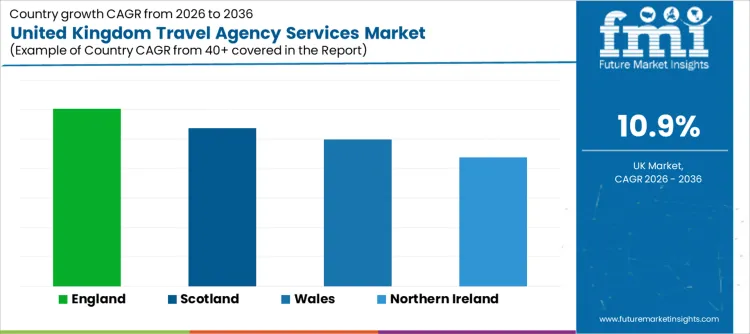
| Region | CAGR (2026-2036) |
|---|---|
| England | 12.0% |
| Scotland | 10.7% |
| Wales | 10.0% |
| Northern Ireland | 8.8% |
Why is England driving stronger growth through volume concentration and premium booking behaviour?
England leads at 12.0%, supported by higher trip frequency, stronger international connectivity, and higher density of agency networks and travel service providers. Large urban centres create strong demand for both leisure and corporate bookings.
England also supports higher conversion in full-service arrangements, particularly when travellers want packaged convenience and higher assurance. Demand patterns here often connect to ecosystem expansion in vacation rentals and accommodation-driven planning services that require fast access to high-quality inventory.
How is Scotland expanding through experience-led demand and trust-based booking preferences?
Scotland is anticipated to expand at a 10.7% CAGR, supported by steady leisure movement and a strong preference for guided decision-making in higher-value trips. Agencies in Scotland often win through service quality and destination knowledge, especially when trips include multi-stop routes, seasonal travel, or experience-driven itineraries.
What is shaping Wales as it builds consistent growth through practical booking support?
Wales expands at a CAGR of 10.0%, shaped by demand for reliable booking support, value clarity, and simplified planning. Agencies often perform well in Wales by offering partial services that complement customer control, particularly for travellers who prefer to manage parts of the trip independently while relying on the agency for core booking assurance.
Why is Northern Ireland progressing through targeted agency use and steady outbound travel behaviour?
Northern Ireland grows at 8.8%, reflecting consistent demand patterns where travellers often seek agency support for confidence and cost control. Agencies can strengthen positioning through transparent pricing, responsive communication, and strong supplier relationships that reduce friction during changes.
What defines the Competitive Landscape for Travel Agency Services in the UK?
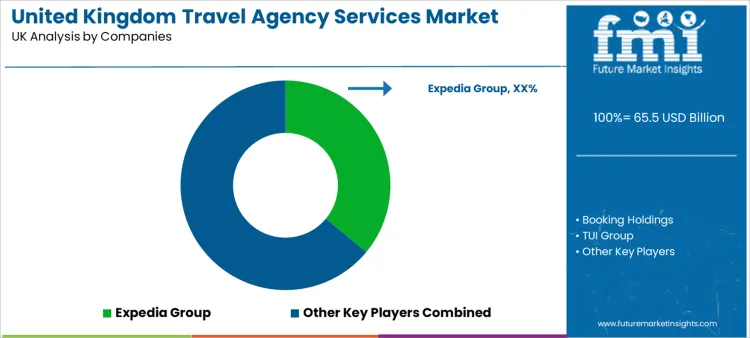
Competition is shaped by customer trust, inventory access, conversion efficiency, and post-booking support. Agencies win when they reduce travel friction from planning through return. This includes clear itineraries, transparent inclusions, fast response times, and reliable assistance during disruption.
Expedia Group competes strongly through global inventory access and strong digital booking reach. Booking Holdings benefits from platform scale and strong accommodation-driven conversion.
TUI Group holds strong packaged holiday positioning through vertically integrated offerings. American Express Global Business Travel is relevant for managed travel programmes where policy compliance and duty-of-care matter. Viator strengthens experience-based trip design by enabling activity discovery and booking at scale.
Leading players are differentiating through personalisation, flexible packaging, and service responsiveness. Agencies that combine digital discovery with high-quality human support are best positioned to hold customer loyalty in a high-expectation environment.
Key Industry Participants
- Expedia Group
- Booking Holdings
- TUI Group
- American Express Global Business Travel
- Viator
Scope of Report
| Items | Values |
|---|---|
| Quantitative Units | USD Billion |
| Services Provided | Full-service Travel Arrangements; Partial Travel Services |
| Booking Channel | Phone Booking; Online Booking; In Person Booking |
| Tourist Type | Domestic; International |
| Tour Type | Independent Traveller; Package Traveller; Tour Group |
| Demography | Men; Women; Children |
| Regions Covered | England; Scotland; Wales; Northern Ireland |
| Key Companies Profiled | Expedia Group; Booking Holdings; TUI Group; American Express Global Business Travel; Viator |
Travel Agency Services Demand in the UK by Segment
By Services Provided
- Full-service Travel Arrangements
- Partial Travel Services
By Booking Channel
- Phone Booking
- Online Booking
- In Person Booking
By Tourist Type
- Domestic
- International
By Tour Type
- Independent Traveller
- Package Traveller
- Tour Group
By Demography
- Men
- Women
- Children
By Region
- England
- Scotland
- Wales
- Northern Ireland
Bibliography
- Association of British Travel Agents. (2024). Travel Trends for 2025.
- Office for National Statistics. (2025). Overseas travel and tourism, provisional: July to September and October to December 2024.
- UK Government. (2025). Transport Statistics Great Britain 2024: International travel.
- UK Parliament. (2025). Tourism: Statistics and policy.
- UK Government. (2022). Package holidays: complying with regulations (guidance for businesses).
- UK Legislation. (2018). Package Travel and Linked Travel Arrangements Regulations 2018.
Frequently Asked Questions
How big is the demand for travel agency services in uk in 2026?
The demand for travel agency services in uk is estimated to be valued at USD 65.5 billion in 2026.
What will be the size of travel agency services in uk in 2036?
The market size for the travel agency services in uk is projected to reach USD 185.1 billion by 2036.
How much will be the demand for travel agency services in uk growth between 2026 and 2036?
The demand for travel agency services in uk is expected to grow at a 10.9% CAGR between 2026 and 2036.
What are the key product types in the travel agency services in uk?
The key product types in travel agency services in uk are full-service travel arrangements and partial travel services.
Which booking channel segment is expected to contribute significant share in the travel agency services in uk in 2026?
In terms of booking channel, phone booking segment is expected to command 49.0% share in the travel agency services in uk in 2026.
Preview the report firsthand - request a free sample
Get SampleGet the brochure for pricing and purchase details.
Get PDFTable of Content
- Executive Summary
- UK Market Outlook
- Demand-side Trends
- Supply-side Trends
- Technology Roadmap Analysis
- Analysis and Recommendations
- Market Overview
- Market Coverage / Taxonomy
- Market Definition / Scope / Limitations
- Market Background
- Market Dynamics
- Drivers
- Restraints
- Opportunity
- Trends
- Scenario Forecast
- Demand in Optimistic Scenario
- Demand in Likely Scenario
- Demand in Conservative Scenario
- Opportunity Map Analysis
- Product Life Cycle Analysis
- Supply Chain Analysis
- Investment Feasibility Matrix
- Value Chain Analysis
- PESTLE and Porter’s Analysis
- Regulatory Landscape
- Regional Parent Market Outlook
- Production and Consumption Statistics
- Import and Export Statistics
- Market Dynamics
- UK Market Analysis 2021 to 2025 and Forecast, 2026 to 2036
- Historical Market Size Value (USD Million) Analysis, 2021 to 2025
- Current and Future Market Size Value (USD Million) Projections, 2026 to 2036
- Y-o-Y Growth Trend Analysis
- Absolute $ Opportunity Analysis
- UK Market Pricing Analysis 2021 to 2025 and Forecast 2026 to 2036
- UK Market Analysis 2021 to 2025 and Forecast 2026 to 2036, By Services Provided
- Introduction / Key Findings
- Historical Market Size Value (USD Million) Analysis By Services Provided , 2021 to 2025
- Current and Future Market Size Value (USD Million) Analysis and Forecast By Services Provided , 2026 to 2036
- Full-service Travel Arrangements
- Partial Travel Services
- Full-service Travel Arrangements
- Y-o-Y Growth Trend Analysis By Services Provided , 2021 to 2025
- Absolute $ Opportunity Analysis By Services Provided , 2026 to 2036
- UK Market Analysis 2021 to 2025 and Forecast 2026 to 2036, By Booking Channel
- Introduction / Key Findings
- Historical Market Size Value (USD Million) Analysis By Booking Channel, 2021 to 2025
- Current and Future Market Size Value (USD Million) Analysis and Forecast By Booking Channel, 2026 to 2036
- Phone Booking
- Online Booking
- In Person Booking
- Phone Booking
- Y-o-Y Growth Trend Analysis By Booking Channel, 2021 to 2025
- Absolute $ Opportunity Analysis By Booking Channel, 2026 to 2036
- UK Market Analysis 2021 to 2025 and Forecast 2026 to 2036, By Tourist Type
- Introduction / Key Findings
- Historical Market Size Value (USD Million) Analysis By Tourist Type, 2021 to 2025
- Current and Future Market Size Value (USD Million) Analysis and Forecast By Tourist Type, 2026 to 2036
- Domestic
- International
- Domestic
- Y-o-Y Growth Trend Analysis By Tourist Type, 2021 to 2025
- Absolute $ Opportunity Analysis By Tourist Type, 2026 to 2036
- UK Market Analysis 2021 to 2025 and Forecast 2026 to 2036, By Tour Type
- Introduction / Key Findings
- Historical Market Size Value (USD Million) Analysis By Tour Type, 2021 to 2025
- Current and Future Market Size Value (USD Million) Analysis and Forecast By Tour Type, 2026 to 2036
- Independent Traveller
- Package Traveller
- Tour Group
- Independent Traveller
- Y-o-Y Growth Trend Analysis By Tour Type, 2021 to 2025
- Absolute $ Opportunity Analysis By Tour Type, 2026 to 2036
- UK Market Analysis 2021 to 2025 and Forecast 2026 to 2036, By Demography
- Introduction / Key Findings
- Historical Market Size Value (USD Million) Analysis By Demography, 2021 to 2025
- Current and Future Market Size Value (USD Million) Analysis and Forecast By Demography, 2026 to 2036
- Men
- Women
- Children
- Men
- Y-o-Y Growth Trend Analysis By Demography, 2021 to 2025
- Absolute $ Opportunity Analysis By Demography, 2026 to 2036
- Market Structure Analysis
- Competition Dashboard
- Competition Benchmarking
- Market Share Analysis of Top Players
- By Regional
- By Services Provided
- By Booking Channel
- By Tourist Type
- By Tour Type
- By Demography
- Competition Analysis
- Competition Deep Dive
- Expedia Group
- Overview
- Product Portfolio
- Profitability by Market Segments (Product/Age /Sales Channel/Region)
- Sales Footprint
- Strategy Overview
- Marketing Strategy
- Product Strategy
- Channel Strategy
- Booking Holdings
- TUI Group
- American Express Global Business Travel
- Viator
- Expedia Group
- Competition Deep Dive
- Assumptions & Acronyms Used
- Research Methodology


