

- Market Size (2026)
- USD 572.8 Bn
- Forecast (2036)
- USD 1540.5 Bn
- CAGR (2026 to 2036)
- 10.4%
Travel Agency Services Market Size, Market Forecast and Outlook By FMI
The travel agency services market was valued at USD 518.8 billion in 2025 and is forecast to reach USD 572.8 billion in 2026. Industry revenue is forecast to reach USD 1540.5 billion by 2036 at 10.4% CAGR. Online booking is projected to account for 65.0% share of booking channel in 2026. By services provided, full-service travel arrangements are anticipated to represent 60.0% share in 2026.
Summary of the Travel Agency Services Market
- Demand and Growth Drivers
- Package planning is taking share as travelers want flight choices and hotel stays arranged under one service process.
- Corporate travel programs are returning to managed channels as firms need spend rules and traveler support records.
- Digital search behavior keeps online booking central as travelers compare route choices and prices before payment.
- Product and Segment View
- Online booking is projected to account for 65.0% share in 2026 since websites and mobile apps handle routine trip search.
- Full-service travel arrangements are forecast to capture 60.0% share in 2026 as complex trips need coordinated support.
- Domestic travel is projected to hold 55.0% share in 2026, as shorter trips create repeated booking activity.
- Geography and Competitive Outlook
- India is projected to record 13.8% CAGR by 2036, as organized holiday booking and outbound travel expansion.
- China is forecast to expand at 12.9% CAGR by 2036 as domestic trip volume feeds mobile booking flows.
- Booking Holdings and Expedia Group shape online competition through broad inventory access and platform reach.
- Analyst Opinion
- Ronak Shah, Principal Consultant for Travel and Tourism at FMI, says, “Travel agency services are no longer judged only by ticket access. Clients compare planning speed with refund support and itinerary advice. Online booking controls the first search step. Human agents keep value in complex trips and high-risk journeys. Corporate accounts need policy control and traveler tracking with less staff effort.”
- Travel Agency Services Market Value Analysis
- Travel agency services value is moving from separate ticketing toward complete travel planning and service assurance.
- Operator spending depends on booking engines and consultant productivity as agencies serve self-service and assisted journeys.
- Platform investment is moving into trip recommendation tools that shorten search and improving package conversion.
- Demand comes from domestic holidays and business travel programs seeking simpler control over travel spend.
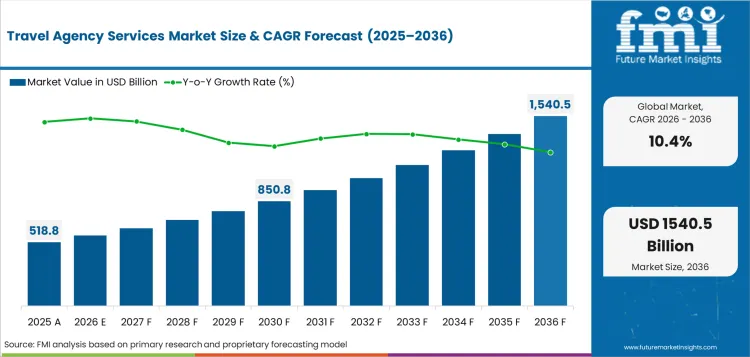
Key Takeaways, Market Size, and Forecast
| Metric | Value |
|---|---|
| Market Size (2025) | USD 518.8 Billion |
| Market Size (2036) | USD 1540.5 Billion |
| CAGR (2026–2036) | 10.4% |
| Incremental Opportunity (2026–2036) | USD 967.7 Billion |
| Leading Distribution Channel (2026) | Online Booking |
| Online Booking Share (2026) | 65.0% |
| Leading Component (2026) | Full-Service Travel Arrangements |
| Full-Service Travel Arrangements Share (2026) | 60.0% |
| Highlight | India and China are expected to record faster demand growth, with projected CAGRs of 13.8% and 12.9% respectively by 2036 |
Trip disruptions are putting pressure on travel agencies to manage refunds and customer support after bookings are made. In April 2024, the USA Department of Transportation introduced rules requiring agencies to give quick refunds when flights are cancelled or significantly changed. There is also a related rule covering vouchers for disruptions caused by serious diseases, valid for at least five years. Because of this, agencies must improve their refund systems and coordination with airlines while protecting their profit margins.
The business model is shifting. For instance, Booking Holdings’ 2024 report shows that more bookings are moving to the “merchant model,” where the platform controls payment. Merchant bookings reached USD 104.2 billion in 2024, while traditional agency bookings dropped by 10.9% to USD 61.4 billion. This shift means travel companies need stronger payment systems and better customer support after the booking is completed. Despite the growth of online tools, human travel agents remain important. According to ABTA, 38% of people still booked their holidays through travel professionals, especially for complex or high-value trips where support is needed if plans go wrong.
Travel Agency Services Market Definition
Travel agency services cover revenue earned by firms arranging transport and stays for leisure or business travelers. Scope includes flight booking and hotel reservation support. Itinerary planning and package design are included. Corporate desk services and tour coordination are covered if service revenue is captured by the agency. Direct supplier revenue from airlines and hotels is excluded unless a booking service fee or agency margin is earned.
Travel Agency Services Market Inclusions
Scope includes full-service travel planning and partial booking support. Online booking and phone-based assistance are included. In-person agency offices and corporate travel desks are covered. Domestic and international trips are included across leisure and business users. Package travelers and independent travelers are included when agencies arrange or support the booking flow.
Travel Agency Services Market Exclusions
Scope excludes direct airline revenue and hotel room revenue booked without agency margin. Pure advertising income from travel media is outside the main boundary. Destination management services are excluded unless sold as agency booking support. Standalone travel insurance underwriting is excluded. Passenger transport operations are outside the market boundary.
Travel Agency Services Market Research Methodology
- Primary Research: FMI analysts reviewed agency booking workflows and traveler service needs across leisure and business travel channels.
- Desk Research: Public tourism statistics and aviation traffic data supported demand checks across country markets.
- Market Sizing and Forecasting: Forecast values use supplied anchors and segment-level share estimates across booking channels.
- Data validation: Checks compared international arrivals and passenger traffic with agency platform activity and corporate travel behavior.
Why is the Travel Agency Services Market Growing?
- Package travelers use agencies to reduce planning time as flights and hotels become harder to compare across supplier channels.
- Corporate travel managers are returning to structured travel programs as staff trips need fare control and traveler support during disruption.
- Online travel agencies move routine airfare and hotel transactions toward digital self-service as booking habits move online.
Global trip volume gives travel agency services a wider service pool across leisure and business travel. World Travel and Tourism Council placed travel and tourism contribution at USD 11.6 trillion in 2025. Sector employment reached 366 million jobs worldwide in the same outlook. Such scale widens the revenue pool for itinerary planning and assisted booking fees. Travelers need route choices and service help after disruption. Agency value therefore moves toward comparison depth and problem handling after booking.
Air traffic recovery raises agency demand for agencies through flight-heavy itineraries and group journeys. International Air Transport Association reported total passenger demand growth of 5.7% in November 2025. Passenger load factor reached 83.7% during the same month. High aircraft use makes seat choice and itinerary timing more sensitive for travelers. Agencies with live fare access and quick rebooking support are expected to retain travelers who need certainty before departure.
Market Segmentation Analysis
- Online booking is projected to capture 65.0% share in 2026, as online agencies use websites and mobile apps before agent contact.
- Full-service travel arrangements are forecast to account for 60.0% share in 2026, as complex trips need coordinated support.
- Domestic travel is expected to hold 55.0% share in 2026 as tourism activity creates repeated booking activity.
- Package Traveller is projected to represent 45.0% share in 2026, as bundled trips reduce planning work.
- Men are expected to account for 40.0% share in 2026 as business trips and solo travel support service use.
- 26 to 35 Years is forecast to hold 25.0% share in 2026 as young professionals combine leisure trips with digital booking.
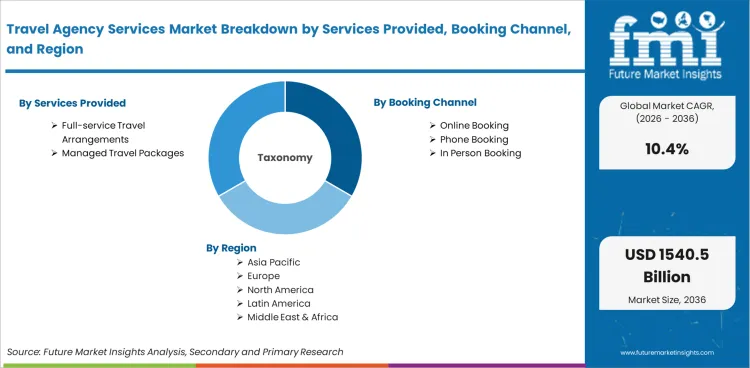
Market segmentation covers six primary groups based on service scope and booking behavior. Services provided explains how much planning support an agency delivers. Booking channel shows whether the transaction begins online or through assisted contact. Tourist type separates domestic trips from international trips. Tour type explains how structured the trip is before purchase. Demography and age group show traveler patterns by consumer profile.
Insights into Travel Agency Services Market by Services Provided
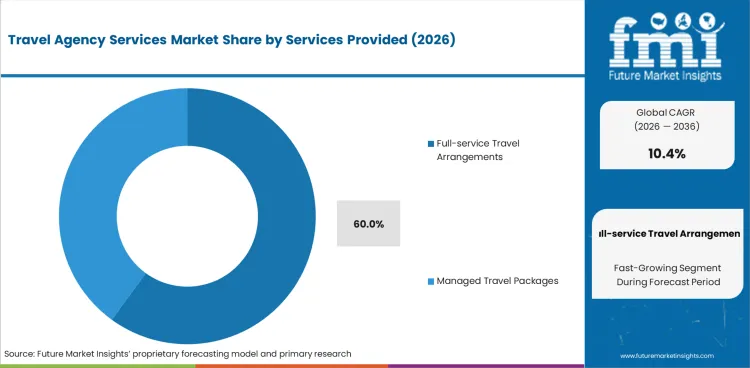
- Full-service travel arrangements are projected to account for 60.0% share in 2026, as travelers seek one point of control for transport and stays.
- Partial travel services retain use among travelers needing only tickets or accommodation support.
Insights into Travel Agency Services Market by Booking Channel
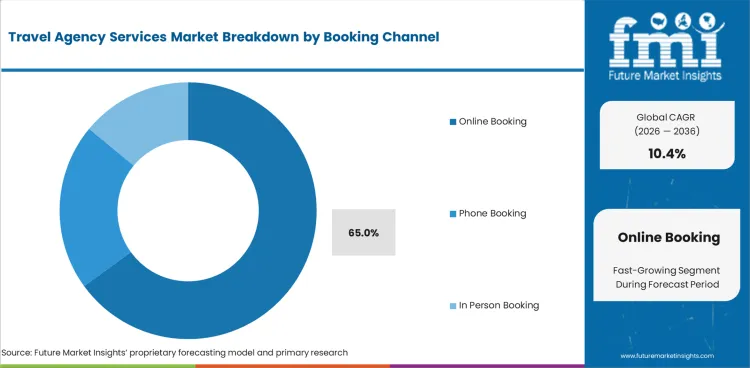
- Online booking is forecast to hold 65.0% share in 2026, led by websites and apps handling search and payment at lower cost.
- Phone booking continues for complex itinerary changes and travelers needing confirmation before payment.
Insights into Travel Agency Services Market by Tourist Type
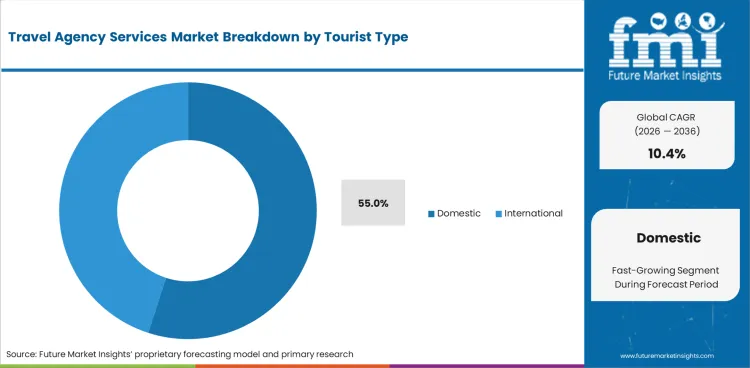
- Domestic travel is projected to capture 55.0% share in 2026 as short-haul trips create frequent booking requirements.
- International trips support higher service value as visas and route changes raise the need for adviser support.
Insights into Travel Agency Services Market by Tour Type
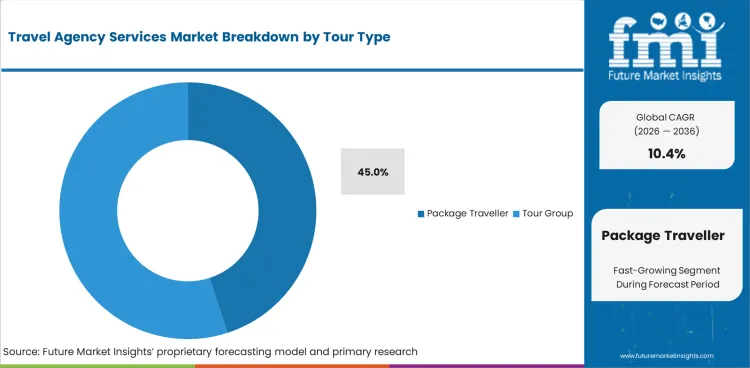
- Package traveller is projected to account for 45.0% share in 2026 as bundled trips make budgeting simpler.
- Independent Traveller demand forms around selective use of agency support as solo travelers often book transport alone and use advisers for complex routes and activity planning.
Insights into Travel Agency Services Market by Demography
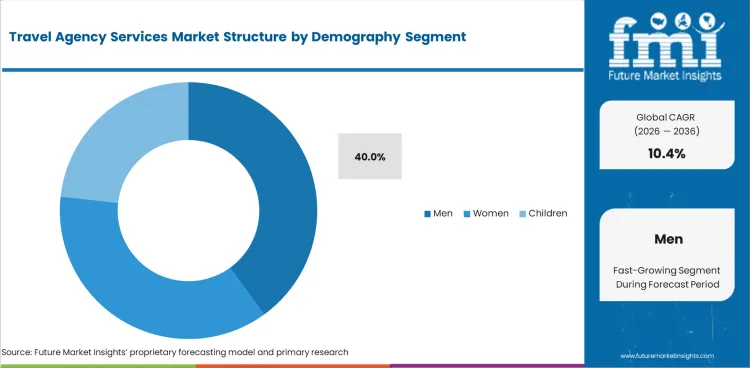
- Men are forecast to hold 40.0% share in 2026, as business trips and solo leisure journeys support booking service adoption.
- Women travelers continue to support social tourism packages and group trips with safety screening and clearer itinerary details keeping assisted planning important for selected journeys.
Insights into Travel Agency Services Market by Age Group
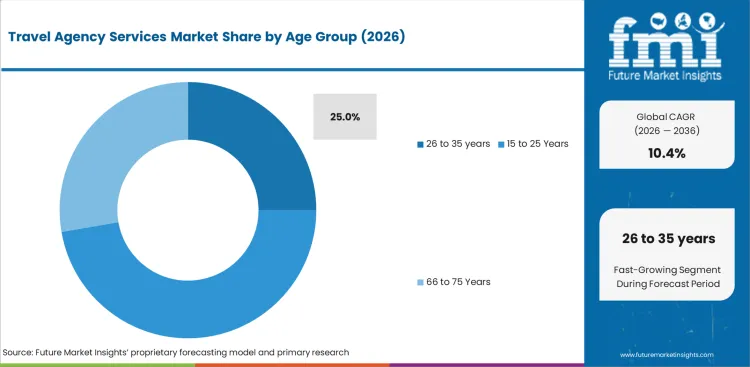
- 26 to 35 years is anticipated to account for 25.0% share in 2026 as younger workers combine mobile booking with adviser support.
- 36 to 45 years supports family trips requiring clearer schedules with service backup. Older age groups use guided tours and assisted travel for comfort-focused journeys.
Travel Agency Services Market Drivers, Restraints and Opportunities
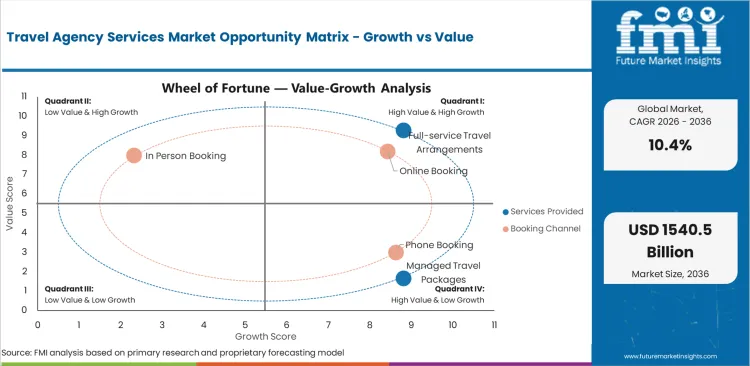
- Digital search conversion gives agency platforms a larger role in early trip planning and price comparison.
- Commission pressure can limit margins as hotels and airlines push direct booking with loyalty benefits.
- Event tourism packages open opportunity as travelers combine transport and local activities under one trip plan.
Travel agency services growth is expected from digital booking and assisted planning working together. United Nations Tourism reported international tourist arrivals up 4% in 2025 to 1.5 billion. Agency platforms can convert this flow into bookings as they make comparison easier. Human advisors add value in itinerary changes and destination-specific planning. Margin pressure will be more visible if suppliers keep pushing direct discounts. Agencies need package depth and service clarity to protect revenue per trip.
Voice of Traveler and Decision-driver Analysis
Traveler decisions are expected to depend on value and planning support as holiday choices become harder to compare. ABTA’s Holiday Habits 2025-26 report stated in October 2025 that its Travel Confidence Index rose by six points. The report also found that 65% of people see holidays as the most important time of year and 80% link holidays with mental health. Travel agencies can turn price comparison and trip assurance into paid service value.
Regulatory and Travel Policy Impact Analysis
Travel policy is expected to become a stronger operating factor for agencies as Europe shifts toward digital border checks. The European Commission stated that the Entry/Exit System started progressive operation on 12 October 2025 and became fully operational on 10 April 2026 across 29 European countries. The system registers travel document data and biometric data for non-EU short-stay travelers. Agencies need clearer pre-trip guidance and stronger document support for Europe-bound travelers.
Analysis of Travel Agency Services Market by Key Countries
.webp "Top Country Growth Comparison Travel Agency Services Market Cagr (2026 2036)")
| Country | CAGR |
|---|---|
| India | 13.8% |
| China | 12.9% |
| Indonesia | 12.4% |
| Saudi Arabia | 12.1% |
| United Arab Emirates | 11.8% |
| Brazil | 11.3% |
| Mexico | 11.0% |
Source: Future Market Insights, 2026.
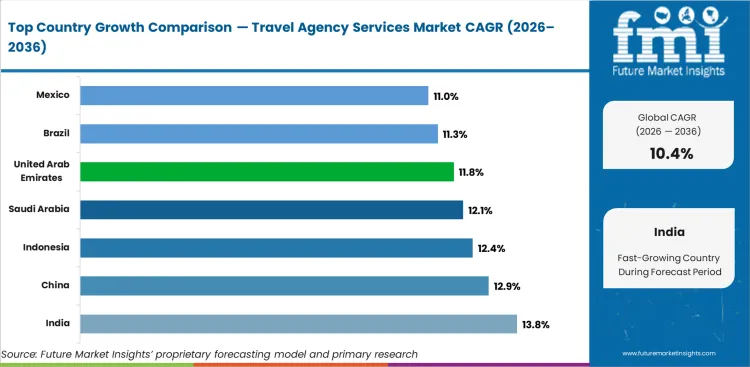
Travel Agency Services Market CAGR Analysis by Country
- India is projected to record 13.8% CAGR by 2036, as outbound trips and digital payment use expanding agency activity.
- China is expected to expand at 12.9% CAGR by 2036 with large domestic trips feeding mobile booking flows.
- Indonesia is forecast to grow at 12.4% CAGR by 2036 as inbound tourism and island travel raising packaged planning needs.
- Saudi Arabia is expected to advance at 12.1% CAGR by 2036, as religious travel and leisure projects increasing booking volume.
- United Arab Emirates is projected to rise at 11.8% CAGR by 2036 through airport connectivity and hotel-based destination pull.
- Brazil is forecast at 11.3% CAGR by 2036 as foreign arrivals and domestic leisure spending support agency use. Mexico is expected to post 11.0% CAGR by 2036 as cross-border arrivals and air travel keep booking flows active.
Country performance differs by digital access and travel product depth. India and China track above the global pace as mobile booking volume and large domestic trip counts lift activity. Indonesia and Saudi Arabia benefit from tourism policy support and travel infrastructure spending. United Arab Emirates and Mexico rely on hub traffic and leisure inflows. Brazil records a positive trend as international arrivals recover and agencies rebuild packaged leisure demand.
Demand Outlook for Travel Agency Services in India
Demand in India is projected to record a 13.8% CAGR by 2036 as organized trip planning becomes more common. India tourism ministry data reported 20.57 million international tourist arrivals in 2024. Domestic agency growth is expected from middle-income households booking holidays with flights and hotels. Online payment use and packaged itineraries are expected to raise conversion for full-service agencies.
- Outbound travel planners can sell bundled trips combining air tickets with hotel stays and support services.
- Domestic holiday planners are expected to use agency sites for comparison before moving to assisted booking.
- Travel agents serving families can gain repeat orders by keeping itinerary changes simple and transparent.
Demand Analysis of Travel Agency Services in China
The market in China is expected to expand at 12.9% CAGR by 2036 with domestic travel scale and mobile booking depth supporting agency flows. China recorded 5.615 billion domestic travel trips in 2024. Domestic travelers spent above 5.75 trillion yuan during the same year. Platform agencies will need fast search and payment tools to hold share.
- Mobile app booking will benefit from large domestic travel frequency across leisure and family trips.
- Tour group services can support older travelers who prefer fixed plans and local-language assistance.
- Personalized packages are expected to gain share as travelers compare price and comfort before payment.
Sales Analysis of Travel Agency Services in Indonesia
Sales in Indonesia are forecast to grow at 12.4% CAGR by 2036, as island travel and inbound recovery promoting packaged trips. BPS-Statistics Indonesia reported 1.31 million international visitor arrivals in May 2025. Domestic tourism trips reached 97.67 million in the same month. Agency demand will align with transport coordination across air routes and hotel stays.
- Island itineraries create a stronger role for agencies aligning transport timing and lodging support.
- Domestic travel specialists can serve families needing clear price packages during school and holiday periods.
- Inbound tour sellers can gain from travelers seeking local activity planning and safer route choices.
Opportunity Analysis of Travel Agency Services in Saudi Arabia
Industry in Saudi Arabia is expected to advance at 12.1% CAGR by 2036, as pilgrimage and leisure travel move into organized booking flows. Saudi tourism ministry data placed inbound tourists at 29.7 million in 2024. Domestic tourism reached 86.2 million tourists in the same year. Religious travel needs documentation and schedule support.
- Pilgrimage booking creates repeat service demand for visa guidance and accommodation coordination.
- Leisure packages can grow as new destination areas seek wider visitor mixes and longer stays.
- Corporate desks will gain value as events and business meetings add structured travel needs.
Future Outlook for Travel Agency Services in United Arab Emirates
United Arab Emirates is projected to rise at 11.8% CAGR through 2036 as premium city trips keep travel active. Dubai welcomed 18.72 million international overnight visitors in 2024. High hotel supply and airline access support agency packaging. Service value is expected from premium itineraries and group travel coordination.
- Premium leisure travelers use agencies for hotel selection and activity planning across short stays.
- Group travel services can grow through meetings and events connected to Dubai hospitality capacity.
- Digital agencies will need broad inventory access to convert price comparison into bookings.
Growth Analysis of Travel Agency Services in Brazil
Demand in Brazil is forecast at 11.3% CAGR by 2036 as domestic leisure and inbound recovery move together. Government data reported 6.65 million international visitors in 2024. Foreign tourist spending reached USD 7.3 billion during the same year. Agency services can grow through beach holidays and nature-based packages.
- Leisure agencies can build packaged trips around beaches and nature circuits with clearer price control.
- Inbound operators will need multilingual support and route planning for longer trips.
- Domestic packages can raise uptake when payment plans and hotel choices are explained simply.
Demand Outlook for Travel Agency Services in Mexico
Demand in Mexico is expected to post 11.0% CAGR by 2036 as cross-border arrivals and air travel keep booking flows active. Official tourism reporting placed international visitor arrivals at 8.3 million in October 2025. Tourist arrivals reached 3.74 million in the same month. Agency demand will concentrate in air-inclusive resort packages and inbound itinerary support.
- Resort travel supports package sellers merging flights and hotel choices for family groups.
- Cross-border travel creates steady need for simple booking support and clear cancellation terms.
- Inbound agencies can use cultural and beach itineraries to raise service value beyond accommodation booking.
Competitive Landscape and Strategic Positioning
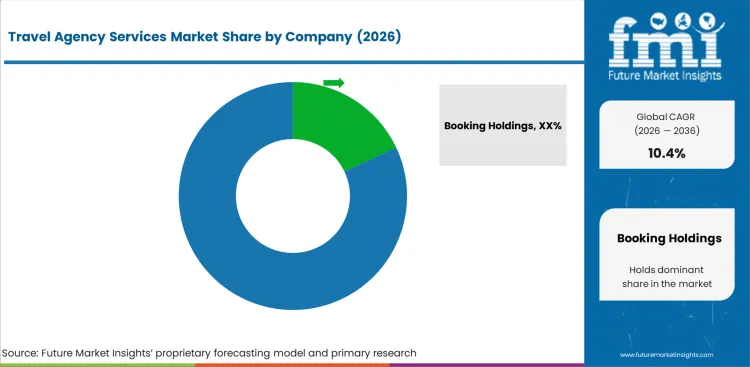
- Global online platforms are expected to hold an advantage through deeper inventory and faster trip search.
- Corporate travel management providers are expected to compete through account tools and traveler care during schedule disruption.
- Specialist agencies are expected to gain clients through cruise packages and activity planning requiring adviser input.
Travel agency services competition is built on inventory depth and the ability to reduce planning time for travelers. Large online platforms compete by making search and comparison easier across flights and hotels. Booking.com expanded AI-powered planning tools in October 2024 with Smart Filter and review summaries. Expedia Group introduced Romie and over 40 features in May 2024. Platform scale is expected to pressure agencies unable to shorten comparison time or guide travelers to clear booking choices.
Corporate travel management providers compete on policy control and traveler care instead of broad consumer reach. Amex GBT completed the CWT acquisition in September 2025 after a long review process. BCD Travel expanded agentic AI with Oversee in July 2025. Corporate clients are expected to favor suppliers that keep travelers inside approved booking channels. Competitive advantage will favor providers that combine fast digital support with clear service cover during schedule changes.
Key Companies in the Travel Agency Services Market
Industry competitive structure is easier to assess by role as platform aggregators and corporate travel managers serving distinct booking requirements.
- Global Online Platforms: Booking Holdings and Expedia Group serve large consumer audiences through accommodation and flight inventory. Priceline and Viator strengthen this group with discount booking and activity planning.
- Corporate Travel Managers: Amex GBT and BCD Travel serve companies needing policy control and employee support during trips. CWT now operates as part of Amex GBT after the 2025 acquisition.
- Integrated Leisure and Retail Specialists: TUI Group and Flight Centre Travel Group combine agency services with package travel. Travel Leaders Group supports agency network reach in the United States.
Competitive Benchmarking: Travel Agency Services Market
| Company | Inventory Access Depth | Assisted Service Network | Corporate Account Control | Geographic Footprint |
|---|---|---|---|---|
| Booking Holdings | High | Strong | Medium | Global online reach |
| Expedia Group | High | Strong | Medium | Global online reach |
| TUI Group | High | Strong | Medium | Europe centered leisure package reach |
| Amex GBT | Medium | Strong | Strong | Global corporate travel reach |
| BCD Travel | Medium | Strong | Strong | Global corporate travel reach |
| CWT | Medium | Strong | Strong | Now part of Amex GBT |
| Flight Centre Travel Group | Medium | Strong | Medium | Australia and global retail |
| Travel Leaders Group | Medium | Medium | Strong | North America agency network |
| Viator | Medium | Medium | Medium | Global activities |
| Priceline | Medium | Strong | Medium | United States online travel |
Source: Future Market Insights competitive analysis, 2026. Ratings reflect relative positioning based on inventory access depth and assisted service network.
Key Developments in Travel Agency Services Market
- In May 2024, Expedia Group introduced Romie and over 40 new travel features at EXPLORE to support planning and booking across its platform.
- In October 2024, Booking.com expanded AI-powered tools including Smart Filter and review summaries to make trip search and property evaluation easier for travelers.
- In September 2025, Amex GBT completed its acquisition of CWT after announcing the transaction in March 2024.
Key Players in the Travel Agency Services Market
Major Global Players:
- Booking Holdings
- Expedia Group
- TUI Group
- Amex GBT
- BCD Travel
Specialist and Regional Players:
- Flight Centre Travel Group
- Travel Leaders Group
- Viator
- Priceline
- CWT
Report Scope and Coverage
| Parameter | Details |
|---|---|
| Quantitative Units | USD 572.8 billion to USD 1540.5 billion at 10.4% CAGR |
| Market Definition | Revenue earned by firms arranging transport, stays, packages, and booking support for leisure or business travelers |
| Services Provided | Full-service travel arrangements, partial travel services |
| Booking Channel | Online booking, phone booking, in-person booking |
| Tourist Type | Domestic, international |
| Tour Type | Package traveller, tour group, independent traveller |
| Demography | Men, women, children |
| Age Group | Less than 15 years, 15 to 25 years, 26 to 35 years, 36 to 45 years, 46 to 55 years, 66 to 75 years, over 75 years |
| Regions Covered | North America, Latin America, Western Europe, Eastern Europe, East Asia, South Asia and Pacific, Middle East and Africa |
| Countries Covered | India, China, Indonesia, Saudi Arabia, United Arab Emirates, Brazil, Mexico, 30+ countries |
| Key Companies Profiled | Booking Holdings, Expedia Group, TUI Group, Amex GBT, BCD Travel, Flight Centre Travel Group, Travel Leaders Group, Viator, Priceline, CWT |
| Forecast Period | 2026 to 2036 |
| Approach | Supplied values, tourism flow checks, agency service evidence, and segment share estimates |
Source: Future Market Insights, 2026.
Travel Agency Services Market Breakdown by Services Provided, Booking Channel, Tourist Type, Tour Type, Demography, Age Group, and Region
Travel Agency Services Market Segmented by Services Provided:
- Full-service Travel Arrangements
- End-to-end Planning
- Flight Booking
- Hotel Reservation
- Managed Travel Packages
- Itinerary Planning
- Travel Insurance
- Partial Travel Services
- Transport Booking
- Accommodation Booking
- End-to-end Planning
Travel Agency Services Market Segmented by Booking Channel:
- Online Booking
- Website Booking
- Mobile App Booking
- Phone Booking
- Call Centers
- Customer Assistance
- In Person Booking
- Travel Agency Offices
- Corporate Desks
Travel Agency Services Market Segmented by Tourist Type:
- Domestic
- Leisure Travel
- Holiday Trips
- Business Travel
- Corporate Trips
- Leisure Travel
- International
- Leisure Tourism
- Vacation Packages
- Business Travel
- Global Meetings
- Leisure Tourism
Travel Agency Services Market Segmented by Tour Type:
- Package Traveller
- Pre-arranged Packages
- Custom Packages
- Tour Group
- Leisure Groups
- Family Tours
- Independent Traveller
- Solo Travelers
- Couple Travelers
Travel Agency Services Market Segmented by Demography:
- Men
- Solo Male Travelers
- Group Travelers
- Women
- Solo Female Travelers
- Women-only Tours
- Children
- Family Travel
- School Travel
Travel Agency Services Market Segmented by Age Group:
- Less than 15 Years
- 15 to 25 Years
- 26 to 35 Years
- 36 to 45 Years
- 46 to 55 Years
- 66 to 75 Years
- Over 75 Years
Travel Agency Services Market by Region:
- North America
- United States
- Canada
- Mexico
- Latin America
- Brazil
- Argentina
- Rest of Latin America
- Western Europe
- Germany
- United Kingdom
- Italy
- Spain
- France
- BENELUX
- Rest of Western Europe
- Eastern Europe
- Poland
- Romania
- Rest of Eastern Europe
- East Asia
- China
- Japan
- South Korea
- South Asia and Pacific
- India
- ASEAN
- Australia and New Zealand
- Rest of South Asia and Pacific
- Middle East and Africa
- Saudi Arabia
- United Arab Emirates
- Oman
- Kuwait
- South Africa
- Rest of Middle East and Africa
Research Sources and Bibliography
- USA Department of Transportation. (2024, April 24). Final rule: Refunds and other consumer protections.
- Booking Holdings Inc. (2025, February 20). Annual report on Form 10-K for the fiscal year ended December 31, 2024. USA Securities and Exchange Commission.
- ABTA. (2024, October 8). Holiday habits 2024-25.
- International Air Transport Association. (2025, December). IATA financial services fact sheet.
- United Nations Tourism. (2026, January 20). International tourist arrivals up 4% in 2025 reflecting strong travel demand around the world.
- International Air Transport Association. (2026, January 29). Strong 2025 passenger demand masks ongoing capacity constraints.
- World Travel & Tourism Council. (2026, April 14). Travel & tourism sees best year ever and emerges as the world’s fastest growing sector.
- Press Information Bureau. (2026, January 29). Arrivals of foreign tourists. Government of India.
- The State Council of the People’s Republic of China. (2025, January 22). China sees domestic travel surge in 2024.
- BPS-Statistics Indonesia. (2025, July 1). The international visitor arrivals in May 2025 reached 1.31 million, an increase of 14.01 percent year-on-year.
- Saudi Press Agency. (2025, June 22). Tourism Ministry: Saudi Arabia tops 100 million visitors for second consecutive year in 2024.
- Dubai Department of Economy and Tourism. (2025). Annual visitor report 2024.
- Secretariat for Social Communication. (2025, January 27). Foreign tourists bring USD 7.3 billion to Brazil, largest amount in 15 years. Government of Brazil.
- Booking Holdings Inc. (2024, October 30). Booking.com enhances travel planning with new AI-powered features for easier, smarter decisions.
- Expedia Group. (2024, May 14). Put your trip on autopilot: Expedia Group introduces new innovations at EXPLORE to take the stress out of travel and enhance partner experience.
- Global Business Travel Group, Inc. (2025, September 2). Amex GBT completes acquisition of CWT.
Bibliography uses government sources, official industry evidence and official company publications relevant to travel agency services.
This Report Answers
- What is the current and future size of the travel agency services market?
- How fast is the travel agency services market forecast to expand between 2026 and 2036?
- Which booking channel is expected to account for the leading travel agency services market share in 2026?
- Which services provided segment is projected to account for the leading travel agency services market share in 2026?
- Why are package travelers important for the travel agency services market revenue outlook?
- Which countries are forecast to record faster travel agency services market expansion?
- Who are the main companies active in travel agency services supply?
- How does FMI define the travel agency services market scope?
- How does FMI estimate and validate the travel agency services market forecast?
Frequently Asked Questions
What is the global market demand for travel agency services market in 2026?
In 2026, travel agency services value is forecast to reach USD 572.8 billion as online booking and package planning expand.
How big will the travel agency services market be in 2036?
By 2036, the travel agency services industry is forecast to reach USD 1540.5 billion as managed planning gains wider travel use.
How much is travel agency services market expected to expand between 2026 and 2036?
Between 2026 and 2036, travel agency services sector is projected to expand at 10.4% CAGR led by digital bookings and rising package use.
Which booking channel is expected to lead travel agency services market demand in 2026?
Online booking is projected to account for 65.0% share in 2026 as travelers compare prices and confirm trips through digital channels.
Which services provided segment is expected to lead travel agency services market by 2026?
Full-service travel arrangements are projected to represent 60.0% share in 2026 since complex trips need coordinated planning and service backup.
Which country is forecast to record faster growth in travel agency services market?
India is projected to record 13.8% CAGR by 2036 due to outbound and domestic trip booking becoming more structured across online channels.
What does travel agency services market include?
Scope includes online and assisted booking services for transport and stays. Packages and corporate travel support are covered across leisure and business users.
How does FMI estimate travel agency services market forecast?
FMI uses supplied value anchors, tourism flow checks and segment share analysis to validate market size and country growth across the forecast period.
Why are package travelers important in travel agency services market?
Package travelers create higher service value as agencies combine transport with lodging and activity planning under one booking relationship with clearer pricing.
Who are the key players in travel agency services market?
Key players include Booking Holdings and Expedia Group. TUI Group completes the group with Amex GBT and BCD Travel.
Preview the report firsthand - request a free sample
Get SampleGet the brochure for pricing and purchase details.
Get PDFTable of Content
- Key Takeaways
- Market Size and CAGR
- Top Growth Driver
- Fastest Growing Segment
- Leading Region
- Key Companies
- Emerging Opportunities
- Executive Summary
- Global Market Outlook
- Demand-side Trends
- Supply-side Trends
- Technology Roadmap Analysis
- Analysis and Recommendations
- Analyst Perspective (What is happening? Why now? What should investors know?)
- Key Questions Answered
- How large is the market?
- What is the CAGR?
- What are key trends?
- Which region dominates?
- Who are the leaders?
- Market Overview
- Market Coverage / Taxonomy
- Market Definition / Scope / Limitations
- Research Methodology
- Chapter Orientation
- Analytical Lens and Working Hypotheses
- Market Structure, Signals, and Trend Drivers
- Benchmarking and Cross-market Comparability
- Market Sizing, Forecasting, and Opportunity Mapping
- Research Design and Evidence Framework
- Desk Research Programme (Secondary Evidence)
- Expert Input and Fieldwork (Primary Evidence)
- Tooling, Models, and Reference Databases
- Data Engineering and Model Build
- Quality Assurance and Audit Trail
- Market Background
- Market Dynamics (Drivers, Restraints, Opportunity, Trends)
- Scenario Forecast (Optimistic, Likely, Conservative)
- Impact Analysis
- AI Impact
- Sustainability Impact
- Regulatory Impact
- Technology Impact
- Consumer / Buyer Analysis
- Purchase Drivers
- Adoption Barriers
- Buyer Journey
- Opportunity Map Analysis
- Product Life Cycle Analysis
- Supply Chain Analysis
- Investment Feasibility Matrix
- Value Chain Analysis
- PESTLE and Porter's Analysis
- Regulatory Landscape
- Regional Parent Market Outlook
- Production and Consumption Statistics
- Import and Export Statistics
- Global Market Analysis and Forecast, 2021 to 2036
- Historical Market Size Value (USD Billion) Analysis, 2021 to 2025
- Current and Future Market Size Value (USD Billion) Projections, 2026 to 2036
- Y-o-Y Growth Trend Analysis
- Absolute $ Opportunity Analysis
- Global Market Pricing Analysis, 2021 to 2036
- Global Market Analysis and Forecast, By Services Provided, 2021 to 2036
- Introduction / Key Findings
- Historical Market Size Value (USD Billion) Analysis By Services Provided, 2021 to 2025
- Current and Future Market Size Value (USD Billion) Analysis and Forecast By Services Provided, 2026 to 2036
- Full-service Travel Arrangements
- End-to-end Planning
- Managed Travel Packages
- Partial Travel Services
- Transport Booking
- Accommodation Booking
- Full-service Travel Arrangements
- Y-o-Y Growth Trend Analysis By Services Provided, 2021 to 2025
- Absolute $ Opportunity Analysis By Services Provided, 2026 to 2036
- Global Market Analysis and Forecast, By Booking Channel, 2021 to 2036
- Introduction / Key Findings
- Historical Market Size Value (USD Billion) Analysis By Booking Channel, 2021 to 2025
- Current and Future Market Size Value (USD Billion) Analysis and Forecast By Booking Channel, 2026 to 2036
- Online Booking
- Website Booking
- Mobile App Booking
- Phone Booking
- Call Centers
- Customer Assistance
- In Person Booking
- Travel Agency Offices
- Corporate Desks
- Online Booking
- Y-o-Y Growth Trend Analysis By Booking Channel, 2021 to 2025
- Absolute $ Opportunity Analysis By Booking Channel, 2026 to 2036
- Global Market Analysis and Forecast, By Tourist Type, 2021 to 2036
- Introduction / Key Findings
- Historical Market Size Value (USD Billion) Analysis By Tourist Type, 2021 to 2025
- Current and Future Market Size Value (USD Billion) Analysis and Forecast By Tourist Type, 2026 to 2036
- Domestic
- Leisure Travel
- Business Travel
- Corporate Trips
- International
- Leisure Tourism
- Business Travel
- Domestic
- Y-o-Y Growth Trend Analysis By Tourist Type, 2021 to 2025
- Absolute $ Opportunity Analysis By Tourist Type, 2026 to 2036
- Global Market Analysis and Forecast, By Tour Type, 2021 to 2036
- Introduction / Key Findings
- Historical Market Size Value (USD Billion) Analysis By Tour Type, 2021 to 2025
- Current and Future Market Size Value (USD Billion) Analysis and Forecast By Tour Type, 2026 to 2036
- Package Traveller
- Pre-arranged Packages
- Custom Packages
- Tour Group
- Leisure Groups
- Family Tours
- Independent Traveller
- Solo Travelers
- Couple Travelers
- Package Traveller
- Y-o-Y Growth Trend Analysis By Tour Type, 2021 to 2025
- Absolute $ Opportunity Analysis By Tour Type, 2026 to 2036
- Global Market Analysis and Forecast, By Demography, 2021 to 2036
- Introduction / Key Findings
- Historical Market Size Value (USD Billion) Analysis By Demography, 2021 to 2025
- Current and Future Market Size Value (USD Billion) Analysis and Forecast By Demography, 2026 to 2036
- Men
- Solo Male Travelers
- Group Travelers
- Women
- Solo Female Travelers
- Women-only Tours
- Children
- Family Travel
- School Travel
- Men
- Y-o-Y Growth Trend Analysis By Demography, 2021 to 2025
- Absolute $ Opportunity Analysis By Demography, 2026 to 2036
- Global Market Analysis and Forecast, By Age Group
- Introduction / Key Findings
- Historical Market Size Value (USD Billion) Analysis By Age Group, 2021 to 2025
- Current and Future Market Size Value (USD Billion) Analysis and Forecast By Age Group, 2026 to 2036
- 26 to 35 Years
- Less than 15 Years
- 15 to 25 Years
- 36 to 45 Years
- 46 to 55 Years
- 66 to 75 Years
- Over 75 Years
- 26 to 35 Years
- Y-o-Y Growth Trend Analysis By Age Group, 2021 to 2025
- Absolute $ Opportunity Analysis By Age Group, 2026 to 2036
- Global Market Analysis and Forecast, By Region, 2021 to 2036
- Introduction
- Historical Market Size Value (USD Billion) Analysis By Region, 2021 to 2025
- Current Market Size Value (USD Billion) Analysis and Forecast By Region, 2026 to 2036
- North America
- Latin America
- Western Europe
- Eastern Europe
- East Asia
- South Asia and Pacific
- Middle East & Africa
- Market Attractiveness Analysis By Region
- North America Market Analysis and Forecast, By Country, 2021 to 2036
- Historical Market Size Value (USD Billion) Trend Analysis By Market Taxonomy, 2021 to 2025
- Market Size Value (USD Billion) Forecast By Market Taxonomy, 2026 to 2036
- By Country
- USA
- Canada
- By Services Provided
- By Booking Channel
- By Tourist Type
- By Tour Type
- By Demography
- By Age Group
- By Country
- Market Attractiveness Analysis
- By Country
- By Services Provided
- By Booking Channel
- By Tourist Type
- By Tour Type
- By Demography
- By Age Group
- Key Takeaways
- Latin America Market Analysis and Forecast, By Country
- Historical Market Size Value (USD Billion) Trend Analysis By Market Taxonomy, 2021 to 2025
- Market Size Value (USD Billion) Forecast By Market Taxonomy, 2026 to 2036
- By Country
- Brazil
- Mexico
- Chile
- Rest of Latin America
- By Services Provided
- By Booking Channel
- By Tourist Type
- By Tour Type
- By Demography
- By Age Group
- By Country
- Market Attractiveness Analysis
- By Country
- By Services Provided
- By Booking Channel
- By Tourist Type
- By Tour Type
- By Demography
- By Age Group
- Key Takeaways
- Western Europe Market Analysis and Forecast, By Country
- Historical Market Size Value (USD Billion) Trend Analysis By Market Taxonomy, 2021 to 2025
- Market Size Value (USD Billion) Forecast By Market Taxonomy, 2026 to 2036
- By Country
- Germany
- UK
- Italy
- Spain
- France
- Nordic
- BENELUX
- Rest of Western Europe
- By Services Provided
- By Booking Channel
- By Tourist Type
- By Tour Type
- By Demography
- By Age Group
- By Country
- Market Attractiveness Analysis
- By Country
- By Services Provided
- By Booking Channel
- By Tourist Type
- By Tour Type
- By Demography
- By Age Group
- Key Takeaways
- Eastern Europe Market Analysis and Forecast, By Country
- Historical Market Size Value (USD Billion) Trend Analysis By Market Taxonomy, 2021 to 2025
- Market Size Value (USD Billion) Forecast By Market Taxonomy, 2026 to 2036
- By Country
- Russia
- Poland
- Hungary
- Balkan & Baltic
- Rest of Eastern Europe
- By Services Provided
- By Booking Channel
- By Tourist Type
- By Tour Type
- By Demography
- By Age Group
- By Country
- Market Attractiveness Analysis
- By Country
- By Services Provided
- By Booking Channel
- By Tourist Type
- By Tour Type
- By Demography
- By Age Group
- Key Takeaways
- East Asia Market Analysis and Forecast, By Country
- Historical Market Size Value (USD Billion) Trend Analysis By Market Taxonomy, 2021 to 2025
- Market Size Value (USD Billion) Forecast By Market Taxonomy, 2026 to 2036
- By Country
- China
- Japan
- South Korea
- By Services Provided
- By Booking Channel
- By Tourist Type
- By Tour Type
- By Demography
- By Age Group
- By Country
- Market Attractiveness Analysis
- By Country
- By Services Provided
- By Booking Channel
- By Tourist Type
- By Tour Type
- By Demography
- By Age Group
- Key Takeaways
- South Asia and Pacific Market Analysis and Forecast, By Country
- Historical Market Size Value (USD Billion) Trend Analysis By Market Taxonomy, 2021 to 2025
- Market Size Value (USD Billion) Forecast By Market Taxonomy, 2026 to 2036
- By Country
- India
- ASEAN
- Australia & New Zealand
- Rest of South Asia and Pacific
- By Services Provided
- By Booking Channel
- By Tourist Type
- By Tour Type
- By Demography
- By Age Group
- By Country
- Market Attractiveness Analysis
- By Country
- By Services Provided
- By Booking Channel
- By Tourist Type
- By Tour Type
- By Demography
- By Age Group
- Key Takeaways
- Middle East & Africa Market Analysis and Forecast, By Country
- Historical Market Size Value (USD Billion) Trend Analysis By Market Taxonomy, 2021 to 2025
- Market Size Value (USD Billion) Forecast By Market Taxonomy, 2026 to 2036
- By Country
- Kingdom of Saudi Arabia
- Other GCC Countries
- Türkiye
- South Africa
- Other African Union
- Rest of Middle East & Africa
- By Services Provided
- By Booking Channel
- By Tourist Type
- By Tour Type
- By Demography
- By Age Group
- By Country
- Market Attractiveness Analysis
- By Country
- By Services Provided
- By Booking Channel
- By Tourist Type
- By Tour Type
- By Demography
- By Age Group
- Key Takeaways
- Key Countries Market Analysis
- USA
- Pricing Analysis
- Market Share Analysis, 2025
- By Services Provided
- By Booking Channel
- By Tourist Type
- By Tour Type
- By Demography
- By Age Group
- Canada
- Pricing Analysis
- Market Share Analysis, 2025
- By Services Provided
- By Booking Channel
- By Tourist Type
- By Tour Type
- By Demography
- By Age Group
- Mexico
- Pricing Analysis
- Market Share Analysis, 2025
- By Services Provided
- By Booking Channel
- By Tourist Type
- By Tour Type
- By Demography
- By Age Group
- Brazil
- Pricing Analysis
- Market Share Analysis, 2025
- By Services Provided
- By Booking Channel
- By Tourist Type
- By Tour Type
- By Demography
- By Age Group
- Chile
- Pricing Analysis
- Market Share Analysis, 2025
- By Services Provided
- By Booking Channel
- By Tourist Type
- By Tour Type
- By Demography
- By Age Group
- Germany
- Pricing Analysis
- Market Share Analysis, 2025
- By Services Provided
- By Booking Channel
- By Tourist Type
- By Tour Type
- By Demography
- By Age Group
- UK
- Pricing Analysis
- Market Share Analysis, 2025
- By Services Provided
- By Booking Channel
- By Tourist Type
- By Tour Type
- By Demography
- By Age Group
- Italy
- Pricing Analysis
- Market Share Analysis, 2025
- By Services Provided
- By Booking Channel
- By Tourist Type
- By Tour Type
- By Demography
- By Age Group
- Spain
- Pricing Analysis
- Market Share Analysis, 2025
- By Services Provided
- By Booking Channel
- By Tourist Type
- By Tour Type
- By Demography
- By Age Group
- France
- Pricing Analysis
- Market Share Analysis, 2025
- By Services Provided
- By Booking Channel
- By Tourist Type
- By Tour Type
- By Demography
- By Age Group
- India
- Pricing Analysis
- Market Share Analysis, 2025
- By Services Provided
- By Booking Channel
- By Tourist Type
- By Tour Type
- By Demography
- By Age Group
- ASEAN
- Pricing Analysis
- Market Share Analysis, 2025
- By Services Provided
- By Booking Channel
- By Tourist Type
- By Tour Type
- By Demography
- By Age Group
- Australia & New Zealand
- Pricing Analysis
- Market Share Analysis, 2025
- By Services Provided
- By Booking Channel
- By Tourist Type
- By Tour Type
- By Demography
- By Age Group
- China
- Pricing Analysis
- Market Share Analysis, 2025
- By Services Provided
- By Booking Channel
- By Tourist Type
- By Tour Type
- By Demography
- By Age Group
- Japan
- Pricing Analysis
- Market Share Analysis, 2025
- By Services Provided
- By Booking Channel
- By Tourist Type
- By Tour Type
- By Demography
- By Age Group
- South Korea
- Pricing Analysis
- Market Share Analysis, 2025
- By Services Provided
- By Booking Channel
- By Tourist Type
- By Tour Type
- By Demography
- By Age Group
- Russia
- Pricing Analysis
- Market Share Analysis, 2025
- By Services Provided
- By Booking Channel
- By Tourist Type
- By Tour Type
- By Demography
- By Age Group
- Poland
- Pricing Analysis
- Market Share Analysis, 2025
- By Services Provided
- By Booking Channel
- By Tourist Type
- By Tour Type
- By Demography
- By Age Group
- Hungary
- Pricing Analysis
- Market Share Analysis, 2025
- By Services Provided
- By Booking Channel
- By Tourist Type
- By Tour Type
- By Demography
- By Age Group
- Kingdom of Saudi Arabia
- Pricing Analysis
- Market Share Analysis, 2025
- By Services Provided
- By Booking Channel
- By Tourist Type
- By Tour Type
- By Demography
- By Age Group
- Türkiye
- Pricing Analysis
- Market Share Analysis, 2025
- By Services Provided
- By Booking Channel
- By Tourist Type
- By Tour Type
- By Demography
- By Age Group
- South Africa
- Pricing Analysis
- Market Share Analysis, 2025
- By Services Provided
- By Booking Channel
- By Tourist Type
- By Tour Type
- By Demography
- By Age Group
- USA
- Market Structure Analysis
- Competition Dashboard
- Competition Benchmarking
- Market Share Analysis of Top Players
- By Regional
- By Services Provided
- By Booking Channel
- By Tourist Type
- By Tour Type
- By Demography
- By Age Group
- Emerging Startups
- Innovation Benchmarking
- Competition Analysis
- Competition Deep Dive
- Booking Holdings
- Overview
- Product Portfolio
- Profitability by Market Segments
- Sales Footprint
- Strategy Overview
- Marketing Strategy
- Product Strategy
- Channel Strategy
- Expedia Group
- TUI Group
- Amex GBT
- BCD Travel
- Flight Centre Travel Group
- Travel Leaders Group
- Viator
- Priceline
- CWT
- Booking Holdings
- Case Studies
- Success Stories
- Recent Developments
- Competition Deep Dive
- Assumptions & Acronyms Used


