

- Market Size (2026)
- USD 16.9 Bn
- Forecast (2036)
- USD 43.2 Bn
- CAGR (2026 to 2036)
- 9.9%
Demand for Travel Agency Services in South Korea Forecast and Outlook 2026 to 2036
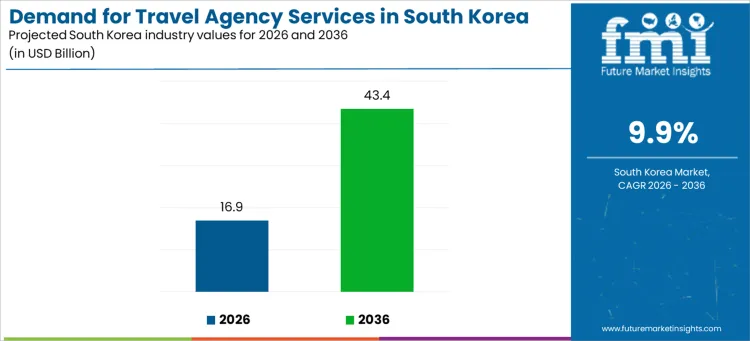
Revenue generated by travel agency services in South Korea is projected to be valued at USD 16.9 billion in 2026. This dynamic service sector is anticipated to reach USD 43.2 billion by 2036, advancing at a compound annual growth rate of 9.9%. South Korea's travel landscape is undergoing a fundamental restructuring driven by the "revenge travel" phenomenon and a permanent shift toward experiential luxury.
The modern South Korean traveler, empowered by high disposable income and strong digital literacy, is moving away from standardized group itineraries toward hyper-personalized, curated experiences. Agencies are consequently pivoting from being simple ticket bookers to becoming lifestyle consultants who manage complex itineraries involving niche activities like golf retreats, culinary tours, and K-Culture pilgrimages.
Expansion is fueled by the government's aggressive "Visit Korea Year" campaigns and the strategic relaxation of visa requirements for key inbound demographics. The massive outbound tourism sector, traditionally focused on Southeast Asia and Japan, is diversifying into long-haul destinations in Europe and North America, necessitating the expertise of professional agents to navigate complex logistical requirements. Corporate travel is also seeing a resurgence, with South Korean conglomerates resuming global business expansion, thereby driving demand for managed travel solutions that ensure duty-of-care compliance and cost optimization.
Quick Stats for Demand for Travel Agency Services in South Korea
- Industry Value (2026): USD 16.9 Billion
- Industry Forecast Value (2036): USD 43.2 Billion
- Industry Forecast CAGR: 9.9%
- Leading Service: Full-service Travel Arrangements (55.0%)
- Leading Booking Channel: Online Booking (72.0%)
- Leading Tour Type: Independent Traveller (60.0%)
- Key Growth Regions: Jeju, South Gyeongsang, South Jeolla, North Jeolla
- Key Players: Expedia Group, Booking Holdings, TUI Group, American Express Global Business Travel, Viator
Technological adoption is centering on the integration of super-apps and AI-driven chatbots that offer 24/7 customer support. Agencies are leveraging online travel agencies sector overview and forecast data to predict travel intent and push personalized recommendations directly to users' smartphones. This digital-first approach allows for seamless booking of flights, accommodation, and in-destination activities within a single ecosystem. The rise of user generated content in tourism sector overview platforms creates a feedback loop where traveler reviews directly influence agency product development and marketing strategies.
Demand for Travel Agency Services in South Korea Key Takeaways
| Metric | Value |
|---|---|
| Industry Size (2026) | USD 16.9 Billion |
| Industry Value (2036) | USD 43.2 Billion |
| CAGR (2026 to 2036) | 9.9% |
What Trends Are Reshaping the Role of Intermediaries?
A primary catalyst for growth is the evolving definition of value among South Korean travelers, who now prioritize unique experiences over rock-bottom prices. Agencies are responding by creating exclusive partnerships with local artisans, chefs, and guides to offer tours that cannot be booked independently. The influence of social media drives demand for "Instagrammable" destinations, prompting agents to curate visually stunning itineraries. Corporate entities are increasingly adopting managed travel distribution overview tools to monitor employee safety and spending in real-time. The "Bleisure" trend, where business trips are extended for leisure, requires agile booking services that can handle split-billing and complex scheduling, further cementing the role of professional agencies.
How is the Sector Structured Across Key Segments?
The sector is segmented to address the diverse needs of leisure seekers and corporate road warriors. It is primarily categorized by services provided, reflecting the depth of engagement. The booking channel segment highlights the transition from physical storefronts to digital interfaces. The tour type segment distinguishes between rigid group schedules and flexible individual plans. Each segment plays a vital role, where full-service arrangements capture high-value luxury clients and online booking drives mass-market volume.
Why Do Full-Service Arrangements Command Value?
Full-service Travel Arrangements command a 55.0% share of the industry revenue. This dominance is attributed to the complexity of post-pandemic travel, where changing regulations and health protocols require expert guidance. High-net-worth individuals and corporate clients prefer a single point of contact to manage flights, transfers, accommodation, and insurance. The assurance of having an agent to resolve unexpected disruptions, such as flight cancellations or medical emergencies abroad, justifies the service fees associated with comprehensive packages.
How Has Online Booking Monopolized Transactions?
Online Booking holds the majority share of 72.0%. South Korea boasts one of the world's fastest internet speeds and highest smartphone penetration rates, creating a natural environment for digital commerce. Consumers increasingly rely on online airline booking platform interfaces and OTAs to compare prices and secure instant confirmations. The convenience of managing itineraries via mobile apps, coupled with the integration of digital payment wallets like KakaoPay, has rendered physical travel agencies niche service providers for the elderly or ultra-luxury segments.
Is the Independent Traveler Segment Outpacing Groups?
The Independent Traveler segment accounts for 60.0% of the volume. Modern Korean tourists, particularly Millennials and Gen Z, reject the rigid schedules of traditional group tours in favor of freedom and spontaneity. This shift drives demand for travel intermediary services that offer modular components, such as rail passes, museum tickets, or day tours, rather than all-inclusive bundles. Agencies are adapting by becoming "enablers" of independent travel, providing the logistical support and travel advertising insights needed for travelers to build their own adventures.
Who Dominates the Demographic Split?
Women travelers are emerging as a significant force, driving trends in wellness and shopping tourism. However, the Men segment remains substantial due to the high volume of corporate and industrial tourism travel. Business travel remains heavily male-dominated in South Korea's industrial conglomerates, sustaining steady demand for premium airline seats and business hotels. Conversely, female consumers are more likely to utilize agencies for leisure packages involving spa retreats, culinary workshops, and cultural immersion experiences.
Sector Dynamics Will AI Personalization Replace Human Agents?
A significant trend is the deployment of generative AI to create bespoke travel itineraries in seconds. Major platforms are utilizing digital travel technologies to analyze a user's past behavior and social media likes to suggest highly relevant destinations and hotels. This technology enhances the discovery phase, allowing agencies to convert lookers into bookers more efficiently. While simple queries are handled by bots, human agents are moving up the value chain to handle complex, high-touch interactions that require empathy and nuanced understanding.
Does Geopolitical Instability Hinder Outbound Growth?
The most significant restraint is the sensitivity of the sector to currency fluctuations and geopolitical tensions. A weak Korean Won makes international travel more expensive, dampening demand for long-haul packages. Regional diplomatic issues can lead to sudden drops in travel to specific destinations. Overcoming this requires agencies to maintain a diversified portfolio of destinations and offer flexible cancellation policies. Promoting domestic alternatives and b2b travel partnerships helps buffer revenue against international volatility.
How Can Niche Tourism Unlock New Revenue?
The emerging field of special interest tourism presents a frontier of opportunity. Suppliers who specialize in niches such as pet-friendly travel, cycling tours, or educational trips for children stand to capture significant revenue. The aging population creates a growing demand for "Silver Tourism," requiring accessible itineraries and medical support. By catering to these specific communities with tailored services, agencies can avoid the commoditization trap of the general online travel sector.
How is the Agency Landscape Evolving Across South Korea's Regions?
The regional analysis shows a distinct pattern where metropolitan hubs serve as outbound gateways, while scenic provinces focus on inbound and domestic experience curation. High-growth areas are characterizing their development by integrating local culture with smart tourism infrastructure. As distinct provinces implement tourism revitalization projects, the utilization of agency services is becoming tailored to regional attractions.
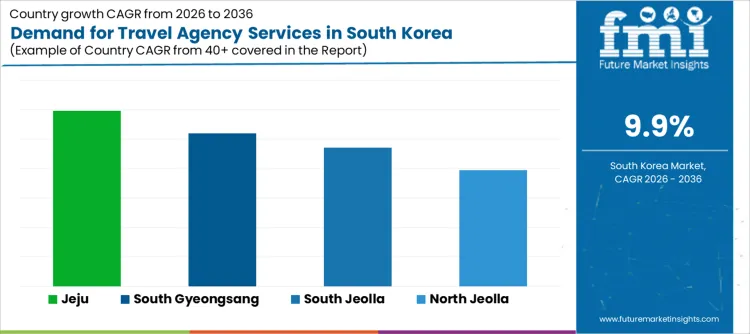
| Region | CAGR (2026 to 2036) |
|---|---|
| Jeju | 11.9% |
| South Gyeongsang | 10.4% |
| South Jeolla | 9.4% |
| North Jeolla | 7.9% |
Why is Visa-Free Entry Driving Demand in Jeju?
Adoption of travel services in Jeju is projected to expand at a CAGR of 11.9%. As a premier international destination with a visa-free policy, Jeju attracts a massive influx of tourists requiring ground handling, accommodation, and tour guidance. The demand is driven by the MICE (Meetings, Incentives, Conferences, and Exhibitions) industry, which relies on specialized agencies to manage large-scale corporate events. Local agencies are pivoting to offer eco-tourism and wellness retreats, capitalizing on the island's UNESCO World Natural Heritage status.
How is Industrial Heritage Influencing South Gyeongsang?
Sales of travel packages in South Gyeongsang are likely to reach a CAGR of 10.4%. This region, home to heavy industries and coastal cities like Tongyeong, is developing industrial tourism assets. The demand is fueled by educational tours and technical visits arranged by specialized B2B agencies. The growing popularity of the southern coast as a yachting and marine leisure destination is creating a niche for luxury travel concierges capable of chartering vessels and arranging private island excursions.
What Role Does Gastronomy Play in South Jeolla?
The travel intermediary sector in South Jeolla is anticipated to rise at a CAGR of 9.4%. Known as the "Kitchen of Korea," this region attracts culinary tourists seeking authentic food experiences. Agencies here are curating "gourmet tours" that include farm visits, cooking classes with masters, and dining at renowned local establishments. The focus is on immersive cultural experiences that require local connections, making regional specialist agencies indispensable for delivering high-quality itineraries.
How is Cultural Preservation Shaping North Jeolla?
Deployment of tour services in North Jeolla is expected to increase at a CAGR of 7.9%. Centered around the Jeonju Hanok Village, the region is a hub for heritage tourism. The demand is driven by international and domestic travelers seeking traditional "Hanok" stays and Hanbok experiences. Agencies play a crucial role in managing the inventory of these boutique accommodations and organizing cultural festivals. The integration of digital guides and AR-enhanced tours is enhancing the visitor experience while preserving the historical integrity of the sites.
What Strategies Define Market Leadership in Travel Booking?
The competitive landscape is characterized by the dominance of global OTA giants who have successfully localized their offerings to suit Korean preferences. Expedia Group maintains a commanding position with a 36.0% share, capitalizing on its vast inventory and loyalty programs. Domestic platforms like Naver Travel and Yanolja are fiercely competing by integrating travel expenses processing features for business users and offering exclusive deals on domestic glamping and staycations. This rivalry ensures that the sector remains innovative, constantly pushing the boundaries of convenience and personalization through 2036.
How Are Domestic Platforms Challenging Global Giants?
South Korean "Super Apps" are disrupting the traditional hierarchy by embedding travel services into everyday lifestyle apps. Companies are leveraging user data to offer highly targeted "flash deals" and loyalty rewards that can be used across retail and travel. Strategic partnerships between telecom providers and travel agencies are becoming common to offer roaming and data bundles as part of the travel package. This ecosystem approach locks users into a specific platform, increasing lifetime value and making it difficult for standalone foreign agencies to compete solely on price.
Key Companies
- Expedia Group
- Booking Holdings
- TUI Group
- American Express Global Business Travel
- Viator
- Hana Tour
- Modetour
- Yanolja
- Naver Travel
- Interpark Tour
Scope of Report
| Items | Values |
|---|---|
| Quantitative Units | USD Billion |
| Services Provided | Full-service Travel Arrangements, Partial Travel Services |
| Booking Channel | Phone Booking, Online Booking, In Person Booking |
| Tourist Type | Domestic, International |
| Tour Type | Independent Traveller, Package Traveller, Tour Group |
| Demography | Men, Women, Children |
| Regions Covered | Jeju, South Gyeongsang, South Jeolla, North Jeolla |
| Key Companies Profiled | Expedia Group, Booking Holdings, TUI Group, Amex GBT, Viator, and others. |
Demand for Travel Agency Services in South Korea by Segments
By Services Provided:
- Full-service Travel Arrangements
- Partial Travel Services
By Booking Channel:
- Phone Booking
- Online Booking
- In Person Booking
By Tourist Type:
- Domestic
- International
By Tour Type:
- Independent Traveller
- Package Traveller
- Tour Group
By Demography:
- Men
- Women
- Children
Bibliography
- Ministry of Culture, Sports and Tourism. (2024, December 31). Business plan: 2025 policy direction of the Ministry of Culture, Sports and Tourism. Ministry of Culture, Sports and Tourism, Republic of Korea.
- Ministry of Culture, Sports and Tourism. (2025, February 5). What does the future of the tourism industry look like with artificial intelligence. Ministry of Culture, Sports and Tourism, Republic of Korea.
- Statistics Korea. (2025, February 4). Online shopping in December 2024. Statistics Korea, Republic of Korea.
- Incheon International Airport Corporation. (2024, December 31). Aviation statistics. Incheon International Airport Corporation, Republic of Korea.
- Incheon International Airport Corporation. (2025, May 8). Incheon International Airport ranked 3rd globally in international passenger traffic. Incheon International Airport Corporation, Republic of Korea.
Frequently Asked Questions
How big is the demand for travel agency services in south korea in 2026?
The demand for travel agency services in south korea is estimated to be valued at USD 16.9 billion in 2026.
What will be the size of travel agency services in south korea in 2036?
The market size for the travel agency services in south korea is projected to reach USD 43.4 billion by 2036.
How much will be the demand for travel agency services in south korea growth between 2026 and 2036?
The demand for travel agency services in south korea is expected to grow at a 9.9% CAGR between 2026 and 2036.
What are the key product types in the travel agency services in south korea?
The key product types in travel agency services in south korea are 0.45.
Which 0.72 segment is expected to contribute significant share in the travel agency services in south korea in 2026?
In terms of 0.72, 0.18 segment is expected to command 0.0% share in the travel agency services in south korea in 2026.
Preview the report firsthand - request a free sample
Get SampleGet the brochure for pricing and purchase details.
Get PDFTable of Content
- Executive Summary
- South Korea Market Outlook
- Demand-side Trends
- Supply-side Trends
- Technology Roadmap Analysis
- Analysis and Recommendations
- Market Overview
- Market Coverage / Taxonomy
- Market Definition / Scope / Limitations
- Market Background
- Market Dynamics
- Drivers
- Restraints
- Opportunity
- Trends
- Scenario Forecast
- Demand in Optimistic Scenario
- Demand in Likely Scenario
- Demand in Conservative Scenario
- Opportunity Map Analysis
- Product Life Cycle Analysis
- Supply Chain Analysis
- Investment Feasibility Matrix
- Value Chain Analysis
- PESTLE and Porter’s Analysis
- Regulatory Landscape
- Regional Parent Market Outlook
- Production and Consumption Statistics
- Import and Export Statistics
- Market Dynamics
- South Korea Market Analysis 2021 to 2025 and Forecast, 2026 to 2036
- Historical Market Size Value (USD Million) Analysis, 2021 to 2025
- Current and Future Market Size Value (USD Million) Projections, 2026 to 2036
- Y-o-Y Growth Trend Analysis
- Absolute $ Opportunity Analysis
- South Korea Market Pricing Analysis 2021 to 2025 and Forecast 2026 to 2036
- South Korea Market Analysis 2021 to 2025 and Forecast 2026 to 2036, By 0.55
- Introduction / Key Findings
- Historical Market Size Value (USD Million) Analysis By 0.55 , 2021 to 2025
- Current and Future Market Size Value (USD Million) Analysis and Forecast By 0.55 , 2026 to 2036
- 0.45
- 0.45
- Y-o-Y Growth Trend Analysis By 0.55 , 2021 to 2025
- Absolute $ Opportunity Analysis By 0.55 , 2026 to 2036
- South Korea Market Analysis 2021 to 2025 and Forecast 2026 to 2036, By 0.72
- Introduction / Key Findings
- Historical Market Size Value (USD Million) Analysis By 0.72, 2021 to 2025
- Current and Future Market Size Value (USD Million) Analysis and Forecast By 0.72, 2026 to 2036
- 0.18
- 0.1
- 0.18
- Y-o-Y Growth Trend Analysis By 0.72, 2021 to 2025
- Absolute $ Opportunity Analysis By 0.72, 2026 to 2036
- South Korea Market Analysis 2021 to 2025 and Forecast 2026 to 2036, By 0.6
- Introduction / Key Findings
- Historical Market Size Value (USD Million) Analysis By 0.6, 2021 to 2025
- Current and Future Market Size Value (USD Million) Analysis and Forecast By 0.6, 2026 to 2036
- 0.25
- 0.15
- 0.25
- Y-o-Y Growth Trend Analysis By 0.6, 2021 to 2025
- Absolute $ Opportunity Analysis By 0.6, 2026 to 2036
- Market Structure Analysis
- Competition Dashboard
- Competition Benchmarking
- Market Share Analysis of Top Players
- By Regional
- By 0.55
- By 0.72
- By 0.6
- Competition Analysis
- Competition Deep Dive
- Competition Deep Dive
- Assumptions & Acronyms Used
- Research Methodology


