

- Industry Size (2026)
- USD 599.5 Bn
- Forecast (2036)
- USD 2668.8 Bn
- CAGR (2026 to 2036)
- 16.1%
Demand for Digital Commerce in the UK 2026 to 2036
The demand for digital commerce in the UK is projected to reach USD 599.5 billion in 2026 and grow to USD 2,668.8 billion by 2036, at a CAGR of 16.1%. This growth is primarily driven by evolving consumer expectations for seamless online shopping experiences across multiple platforms. As digital commerce becomes an integral part of everyday transactions, businesses are increasingly investing in advanced platforms that align with consumer preferences for speed, personalization, and convenience.
Retailers are adapting by integrating omnichannel commerce systems that unify online storefronts with physical inventory and fulfillment, enabling flexible services like click-and-collect and efficient delivery options. This integration is becoming essential, rather than optional, as businesses aim to provide consistent, high-quality customer experiences. Digital analytics tools are helping businesses optimize pricing, inventory, and promotions, reinforcing the growing reliance on data-driven decisions. The rise of mobile commerce and growing consumer use of social platforms for shopping, digital commerce is expected to expand further across the UK. As companies balance growth ambitions with operational efficiency, investing in robust, scalable e-commerce systems will remain key to staying competitive in a rapidly shifting marketplace.
Quick Stats for Digital Commerce Industry in the UK
- Digital Commerce Industry Value (2026): USD 599.5 billion
- Digital Commerce Industry Forecast Value (2036): USD 2,668.8 billion
- Digital Commerce Industry Forecast CAGR 2026 to 2036: 16.1%
- Leading Business Model by Demand Share: Business-to-Business (B2B)
- Fastest-Growing Regions: England, Scotland, Wales, Northern Ireland
- Key Industry Participants: Shopify, Adobe, Salesforce, Microsoft, Oracle, SAP
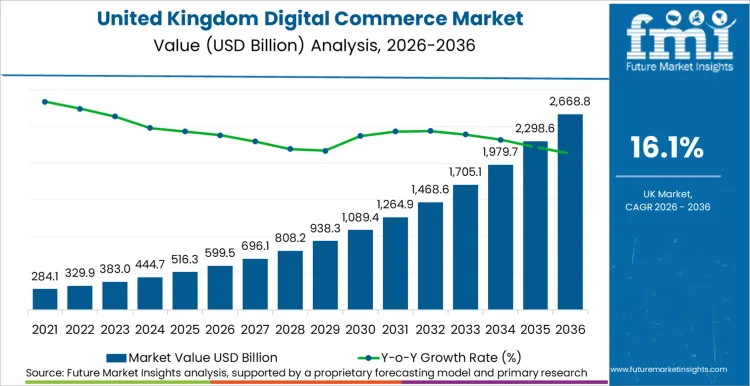
Digital Commerce Industry in the UK Key Takeaways
| Metric | Value |
|---|---|
| Industry Value (2026) | USD 599.5 billion |
| Industry Forecast Value (2036) | USD 2,668.8 billion |
| Forecast CAGR (2026 to 2036) | 16.1% |
Source: FMI analysis based on primary research and proprietary forecasting model
Why is the UK Building Steady Demand for Digital Commerce?
UK buyers increasingly prefer seamless online purchasing experiences, which drives businesses to invest in digital commerce capabilities that align with consumer expectations. Shoppers expect intuitive interfaces, fast checkout flows, secure payments and personalized recommendations, making digital commerce a routine channel for everything from everyday essentials to niche products.
Retailers and brands in the UK adapt by integrating advanced commerce platforms that support omnichannel engagement. These systems synchronise online storefronts with in-store inventory and fulfilment, enabling practices such as click-and-collect and flexible delivery options. Merchants see this integration as essential to meet buyer preferences rather than experimental, which propels consistent deployment of digital commerce solutions.
Business buyers also seek deeper insights into customer behaviour and sales performance through digital analytics and commerce data integration. Tools that deliver actionable reporting help teams optimize pricing, promotion and inventory decisions. This practical focus on measurable outcomes strengthens investment in digital commerce technologies as UK companies balance growth ambitions with tight operational control.
How is Digital Commerce Demand Segmented by End User, Business Model, and Solution in the UK?
Demand for digital commerce in the UK reflects how organizations capitalize on online platforms to expand reach, optimize transactions, and streamline business processes. Segmentation follows operational needs, industry engagement strategies, and the technology infrastructure required to support diverse e-commerce ecosystems.
Why do manufacturers and distributors lead end-user adoption?
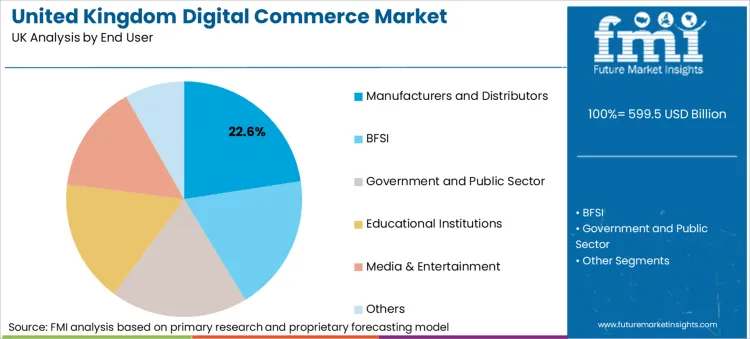
Manufacturers and distributors account for 22.6% of the demand, reflecting the critical need for digital platforms to enhance product distribution, supply chain efficiency, and customer engagement. These sectors benefit from digital commerce by gaining direct access to global industries, improving inventory management, and enabling faster order fulfillment. E-commerce systems provide a unified solution for managing large-scale product catalogs, pricing, and customer relationships, which is key in competitive manufacturing and distribution environments.
Manufacturers and distributors leverage digital platforms to facilitate bulk transactions, streamline procurement, and offer value-added services to customers, creating a more efficient and responsive business model.
What drives the preference for B2B over B2C business models?
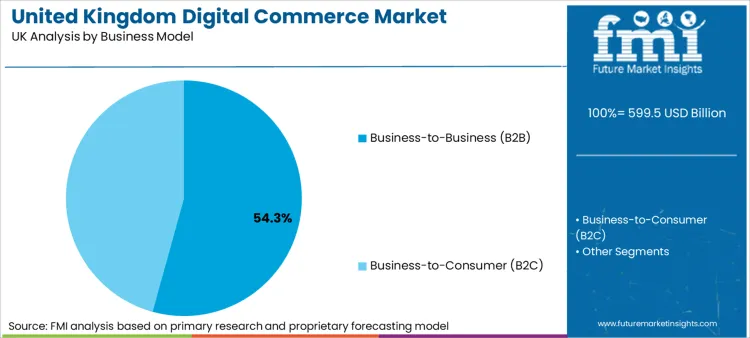
Business-to-business (B2B) holds a 54.3% share, indicating that organizations priorities digital commerce platforms that streamline complex, high-value transactions between businesses. B2B platforms cater to industries that require bulk orders, negotiated contracts, and long-term supplier relationships, making them essential for procurement-driven processes.
B2B digital commerce enables manufacturers, distributors, and other industrial players to access larger contract opportunities, manage custom orders, and provide tailored pricing for clients. B2B solutions often integrate with existing enterprise resource planning (ERP) systems, offering a seamless, end-to-end workflow from ordering to delivery.
Why does software dominate as the preferred solution?
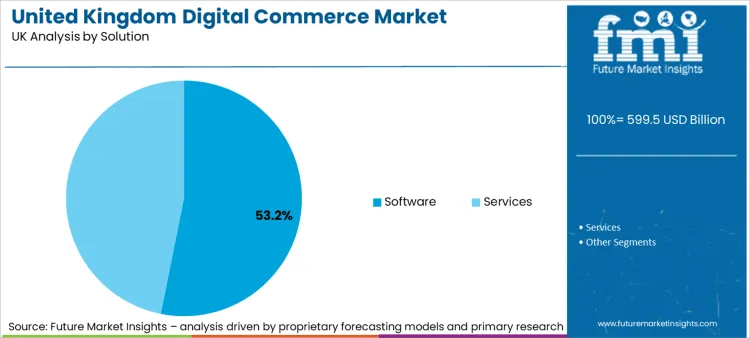
Software represents 53.2% of the solution demand, reflecting the preference for digital tools that manage transactions, inventory, customer interactions, and payment processing. E-commerce software enables businesses to customise online storefronts, automate order handling, integrate with supply chain systems, and provide real-time customer insights.
Software solutions also enhance security, scalability, and data management, allowing companies to support high transaction volumes and global customer bases. As businesses grow, they increasingly rely on specialised software to improve operational efficiency and ensure a consistent user experience across multiple digital touchpoints.
What are the Key Dynamics in Demand for Digital Commerce in the UK?
In the UK, demand for digital commerce is driven by high internet penetration, widespread mobile usage, and entrenched consumer preference for online purchasing across categories such as fashion, groceries, electronics and travel bookings. Retailers priorities seamless cross-channel experiences with fast checkout, tailored recommendations and reliable delivery visibility. Business investment in platform capabilities, digital marketing and customer data analytics reflects competitive pressure to capture share in an industry where online sales account for a significant proportion of total retail revenue. Consumer expectations for convenience, personalized offers and flexible fulfilment underpin ongoing engagement with digital commerce channels.
How do consumer behavior and technology adoption influence industry uptake?
UK shoppers exhibit sophisticated online behavior characterized by frequent comparison of price and delivery options across marketplaces and brand sites. Widespread use of smartphones and contactless payment methods supports impulse buys and repeat transactions, especially during peak periods such as seasonal promotions and festive sales. Retailers integrate mobile apps with loyalty programs and push notifications to maintain relevance in consumers’ digital routines. Social commerce features incorporated into popular social networks influence discovery and conversion, with rich media and shoppable content shortening the path from awareness to purchase. Digital wallets, buy now pay later options, and saved payment credentials accelerate repeat purchases and reduce friction at checkout, shaping how consumers engage with digital commerce.
How do logistics expectations and regulatory frameworks shape ongoing demand?
Demand for digital commerce in the UK is influenced by customer expectations around fulfilment speed and returns handling. Same-day delivery, click-and-collect services at convenience stores or lockers, and transparent tracking status affect retailer selection by consumers, especially in urban and suburban areas. Retailers invest in micro-fulfilment solutions and partnerships with last-mile operators to meet these service benchmarks without eroding margins. Consumer protection and electronic transaction regulations govern how retailers manage data privacy, returns rights and transparent pricing, influencing platform design and operational practices. Cross-border digital commerce continues to evolve with changes in trade and customs requirements, affecting retailers’ inventory strategy and delivery times for imported goods.
How is Digital Commerce Demand Evolving across Key Regions in the UK?
Demand for digital commerce across the UK accelerates as businesses shift to online platforms, expand e-commerce ecosystems, and invest in digital transformation. Regional variation reflects technology adoption, logistics integration, consumer behavior, and how companies adapt to evolving customer expectations, mobile commerce, and omnichannel strategies.
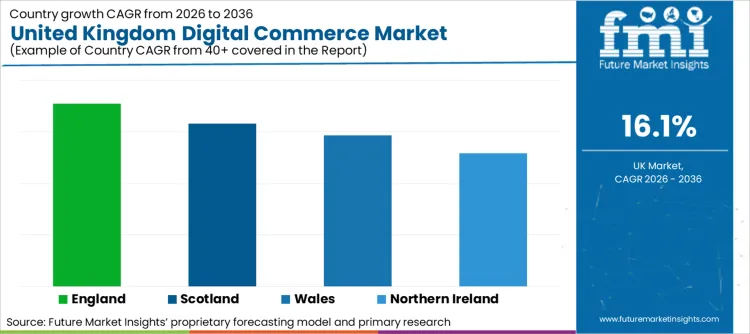
| Region | CAGR 2026 to 2036 |
|---|---|
| England | 17.7% |
| Scotland | 15.8% |
| Wales | 14.7% |
| Northern Ireland | 12.9% |
Why is England leading expansion through e-commerce maturity and infrastructure investment?
England grows at 17.7%, supported by advanced e-commerce infrastructure, high internet penetration, and diverse digital consumer industries. Demand rises where large retailers and SMEs alike focus on seamless omnichannel experiences and integrated logistics. Companies prioritise platforms that support mobile shopping, personalized services, and efficient order fulfilment, driving repeat business and customer loyalty.
How is Scotland progressing through targeted adoption in regional retail and services?
Scotland expands at 15.8%, shaped by increasing adoption within regional retail and service sectors. Demand builds where businesses enhance digital offerings to cater to local industries, integrating e-commerce solutions with brick-and-mortar stores. Retailers seek platforms that enable flexible payment options, enhance user experience, and streamline local delivery logistics while aligning with regional consumer trends.
What is shaping Wales as businesses focus on efficiency and streamlined digital tools?
Wales advances at 14.7%, driven by businesses focusing on efficiency, cost control, and enhanced customer experience through digital commerce. Demand strengthens when solutions simplify online product catalogues, automate inventory management, and integrate easily with existing back-end systems. Companies prioritise scalable platforms that enable growth without overwhelming operational resources, particularly in smaller retail and service environments.
Why is Northern Ireland showing measured growth tied to selective platform adoption?
Northern Ireland records 12.9% growth, reflecting selective adoption of digital commerce platforms among SMEs and niche sectors. Adoption progresses where businesses seek platforms that provide clear ROI through improved online visibility and streamlined customer service. Demand improves when digital tools align with local industry conditions and support sustainable growth without major capital investment.
What Defines the Competitive Landscape for Digital Commerce in the UK?
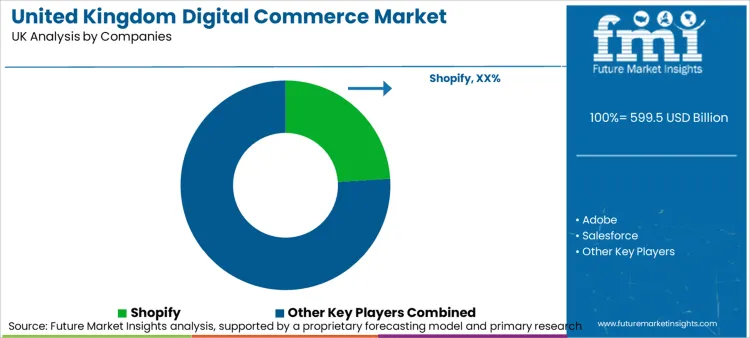
Demand for digital commerce in the UK is driven by the rapid adoption of e-commerce, the growth of omnichannel retail strategies, and the increasing importance of customer experience optimization. Companies evaluate digital commerce platforms based on their scalability, ease of integration with existing ERP and CRM systems, payment gateway options, and the ability to support personalized customer experiences. Buyers focus on features like AI-driven analytics, mobile compatibility, user interface design, and the capacity to handle high traffic volumes, especially during peak shopping periods. Procurement behavior leans toward solutions that provide flexibility, robust security, and multi-channel support, while also aligning with data privacy regulations like GDPR.
Shopify leads the UK industry with its cloud-based, scalable e-commerce solutions that cater to businesses of all sizes, offering easy-to-use tools for creating and managing online stores. Adobe competes with its Experience Cloud, providing an integrated suite of tools for digital marketing, personalization, and customer experience management. Salesforce supports demand through its comprehensive Commerce Cloud, which integrates CRM and customer insights into the e-commerce experience, fostering personalized interactions. Microsoft participates through its Azure-based e-commerce platforms, providing flexible and secure cloud infrastructure. Oracle and SAP are both major players, offering robust, enterprise-level digital commerce solutions that integrate with their ERP systems and are favored by large businesses looking for end-to-end digital transformation. Competitive differentiation centers on platform flexibility, integration capabilities, pricing models, and the ability to support both B2B and B2C sales channels.
Key Industry Participants
- Shopify
- Adobe
- Salesforce
- Microsoft
- Oracle
- SAP
Scope of Report
| Items | Values |
|---|---|
| Quantitative Units | USD billion |
| End User | Manufacturers and Distributors; BFSI; Government and Public Sector; Educational Institutions; Media & Entertainment; Others |
| Business Model | Business-to-Business (B2B); Business-to-Consumer (B2C) |
| Solution | Software; Services |
| Regions Covered | England; Scotland; Wales; Northern Ireland |
| Key Companies Profiled | Shopify; Adobe; Salesforce; Microsoft; Oracle; SAP |
Digital Commerce Demand in the UK by Segments
End User:
- Manufacturers and Distributors
- BFSI
- Government and Public Sector
- Educational Institutions
- Media & Entertainment
- Others
Business Model:
- Business-to-Business (B2B)
- Business-to-Consumer (B2C)
Solution:
- Software
- Services
By Region
- England
- Scotland
- Wales
- Northern Ireland
Bibliography
- Office for National Statistics. (2023). Internet sales as a percentage of total retail sales in the UK. UK Government.
- Department for Business and Trade. (2023). Digital growth and adoption among UK businesses. UK Government.
- HM Government. (2024). UK digital strategy: Enabling growth through digital commerce and services. UK Government.
- Information Commissioner’s Office. (2023). Data protection and privacy considerations for online retail and e-commerce. UK Government.
- Organisation for Economic Co-operation and Development. (2023). E-commerce, digital platforms, and cross-border trade. OECD Publishing.
Frequently Asked Questions
How big is the digital commerce industry in the UK in 2026?
The digital commerce industry in the UK is projected to be valued at USD 599.5 billion in 2026.
What will be the size of the digital commerce industry in the UK in 2036?
The industry size for digital commerce in the UK is projected to reach USD 2,668.8 billion by 2036.
How much will the demand for digital commerce in the UK grow between 2026 and 2036?
Demand for digital commerce in the UK is projected to grow at a 16.1% CAGR between 2026 and 2036.
Which business model holds a significant share in the digital commerce industry in the UK in 2026?
In terms of business model, Business-to-Business (B2B) is expected to account for a 54.3% share in 2026.
Which end-user sector contributes a major share in the digital commerce industry in the UK in 2026?
The manufacturing and distribution sector is expected to account for a 22.6% share in the digital commerce industry in the UK in 2026.
Preview the report firsthand - request a free sample
Get SampleGet the brochure for pricing and purchase details.
Get PDFTable of Content
- Executive Summary
- UK Market Outlook
- Demand-side Trends
- Supply-side Trends
- Technology Roadmap Analysis
- Analysis and Recommendations
- Market Overview
- Market Coverage / Taxonomy
- Market Definition / Scope / Limitations
- Market Background
- Market Dynamics
- Drivers
- Restraints
- Opportunity
- Trends
- Scenario Forecast
- Demand in Optimistic Scenario
- Demand in Likely Scenario
- Demand in Conservative Scenario
- Opportunity Map Analysis
- Product Life Cycle Analysis
- Supply Chain Analysis
- Investment Feasibility Matrix
- Value Chain Analysis
- PESTLE and Porter’s Analysis
- Regulatory Landscape
- Regional Parent Market Outlook
- Production and Consumption Statistics
- Import and Export Statistics
- Market Dynamics
- UK Market Analysis 2021 to 2025 and Forecast, 2026 to 2036
- Historical Market Size Value (USD Million) Analysis, 2021 to 2025
- Current and Future Market Size Value (USD Million) Projections, 2026 to 2036
- Y-o-Y Growth Trend Analysis
- Absolute $ Opportunity Analysis
- UK Market Pricing Analysis 2021 to 2025 and Forecast 2026 to 2036
- UK Market Analysis 2021 to 2025 and Forecast 2026 to 2036, By End User
- Introduction / Key Findings
- Historical Market Size Value (USD Million) Analysis By End User , 2021 to 2025
- Current and Future Market Size Value (USD Million) Analysis and Forecast By End User , 2026 to 2036
- Manufacturers and Distributors
- BFSI
- Government and Public Sector
- Educational Institutions
- Media & Entertainment
- Others
- Manufacturers and Distributors
- Y-o-Y Growth Trend Analysis By End User , 2021 to 2025
- Absolute $ Opportunity Analysis By End User , 2026 to 2036
- UK Market Analysis 2021 to 2025 and Forecast 2026 to 2036, By Business Model
- Introduction / Key Findings
- Historical Market Size Value (USD Million) Analysis By Business Model, 2021 to 2025
- Current and Future Market Size Value (USD Million) Analysis and Forecast By Business Model, 2026 to 2036
- Business-to-Business (B2B)
- Business-to-Consumer (B2C)
- Business-to-Business (B2B)
- Y-o-Y Growth Trend Analysis By Business Model, 2021 to 2025
- Absolute $ Opportunity Analysis By Business Model, 2026 to 2036
- UK Market Analysis 2021 to 2025 and Forecast 2026 to 2036, By Solution
- Introduction / Key Findings
- Historical Market Size Value (USD Million) Analysis By Solution, 2021 to 2025
- Current and Future Market Size Value (USD Million) Analysis and Forecast By Solution, 2026 to 2036
- Software
- Services
- Software
- Y-o-Y Growth Trend Analysis By Solution, 2021 to 2025
- Absolute $ Opportunity Analysis By Solution, 2026 to 2036
- Market Structure Analysis
- Competition Dashboard
- Competition Benchmarking
- Market Share Analysis of Top Players
- By Regional
- By End User
- By Business Model
- By Solution
- Competition Analysis
- Competition Deep Dive
- Shopify
- Overview
- Product Portfolio
- Profitability by Market Segments (Product/Age /Sales Channel/Region)
- Sales Footprint
- Strategy Overview
- Marketing Strategy
- Product Strategy
- Channel Strategy
- Adobe
- Salesforce
- Microsoft
- Oracle
- SAP
- Shopify
- Competition Deep Dive
- Assumptions & Acronyms Used
- Research Methodology


