

- Industry Size (2026)
- USD 760.9 Mn
- Forecast (2036)
- USD 3236.6 Mn
- CAGR:15.6%
- (2026 to 2036)
Conversational Commerce Outlook in the UK 2026 to 2036
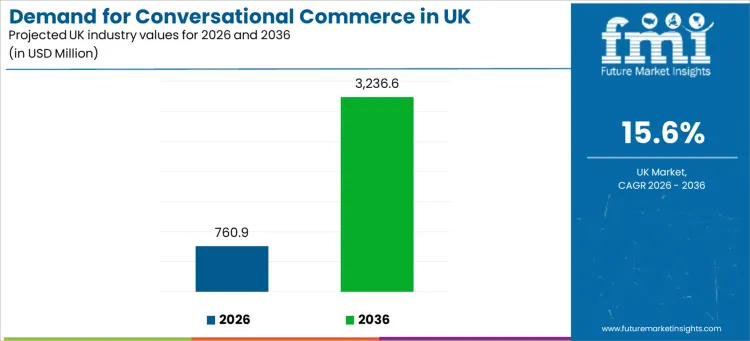
Demand for conversational commerce in the UK is projected at USD 760.9 million in 2026 and is expected to reach USD 3,236.6 million by 2036, expanding at a 15.6% CAGR. This demand is shaped by how retail leaders, digital-first consumer brands, banks, and public service operators push customer journeys into real-time messaging, voice-enabled shopping, and automated assisted selling.
Conversational buying is treated as a revenue and service layer rather than a standalone feature. Leadership teams evaluate performance through conversion lift, customer response speed, containment rates, repeat purchase behavior, and the ability to scale support without compromising brand tone. For large retailers, the business case is tied to basket expansion and checkout completion. For fintech and financial service leaders, the objective centers on verified identity workflows, secure service resolution, and compliant product education.
Technology service providers influence outcomes by integrating natural language interfaces into commerce stacks, order management, customer data platforms, and payment flows. Platform readiness is measured through intent recognition quality, agent handover control, multilingual capability, analytics visibility, and governance frameworks that protect customer data.
Quick Stats for Conversational Commerce Demand in the UK
- Conversational Commerce Valuation in the UK (2026): USD 760.9 million
- Conversational Commerce Forecast Valuation in the UK (2036): USD 3,236.6 million
- Conversational Commerce Forecast CAGR (2026–2036): 15.6%
- Leading Regional Growth: England (17.1%)
- Leading Solution: Software (56.9% share)
- Leading Enterprise Size: SMEs (47.0% share)
- Leading Industry: Finance (20.8% share)
- Leading Company Presence: Meta (30.0% share)
- Key Companies Profiled: Meta; Google; Amazon; Microsoft; Apple
Conversational Commerce Industry in the UK Key Takeaways
| Metric | Value |
|---|---|
| Industry Value (2026) | USD 760.9 million |
| Industry Forecast Value (2036) | USD 3,236.6 million |
| Forecast CAGR (2026 to 2036) | 15.6% |
Why is the UK Building Strong Demand for Conversational Commerce?
UK organisations are reshaping digital engagement around conversations because buying decisions increasingly happen inside chat windows, social messaging, voice assistants, and in-app support journeys. Retail and consumer brands prioritise guided discovery, product comparison, and quick resolution of delivery or returns questions, since these moments directly influence purchase completion. A conversational layer keeps customers inside the same flow instead of sending them across multiple pages and forms.
Executives also view conversational journeys as a cost-control lever. High-volume service categories such as order updates, store availability checks, appointment scheduling, refunds, and loyalty queries can be partially automated when intent routing is reliable. This changes the economics of customer support by protecting agent time for complex cases and high-value customers.
Finance-led adoption stands out because customer trust and compliance create a clear demand for structured guidance. Finance holds a 20.8% share of UK’s demand, reflecting the role of identity checks, product explanations, and secure servicing in banking and insurance journeys. UK financial firms also operate under Consumer Duty expectations that focus on customer outcomes, clarity, and support quality, which pushes investments into better guidance experiences and fewer service dead ends.
Regulatory expectations also shape how conversational systems are designed. UK data protection requirements influence how organisations handle personal data used in automated assistance and personalisation, especially where AI models are involved. This supports demand for platforms with strong governance, audit-ready controls, and clear explainability paths.
Leaders evaluating roadmap decisions often benchmark platform maturity against global conversational commerce benchmarks tracked across key verticals, especially where message-led discovery and guided checkout are already influencing performance KPIs.
How is Conversational Commerce Demand Segmented by Solution, Enterprise Size, Industry, and Company Presence?
Segmentation reflects purchasing realities across UK commerce teams, platform owners, and service operators. It also maps directly to who owns the budget, who controls customer experience, and who carries operational risk.
Why does software take the lead as organisations standardise conversational buying journeys across channels?
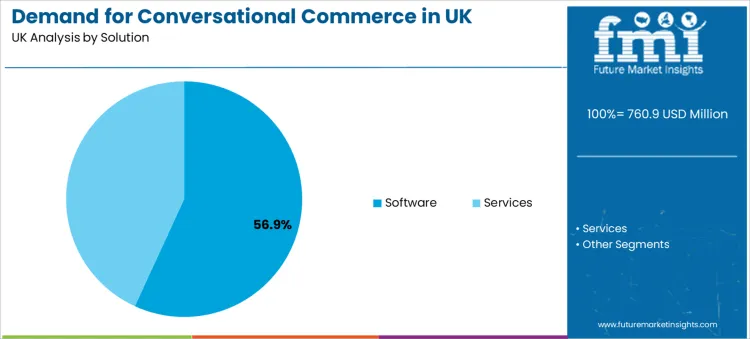
Software accounts for a 56.9% share, making it the leading solution category. This position reflects the need to orchestrate conversations across messaging apps, brand websites, mobile applications, and customer support environments while maintaining a consistent intent model and data trail.
Software-first rollouts also connect strongly with enterprise efforts to standardise intent models, escalation paths, and performance monitoring practices that are discussed across conversational AI platform adoption patterns.
Software-led deployments also support governance disciplines. Organisations increasingly require role-based access controls, training workflows for intents, supervised testing, and measurable performance thresholds before changes go live. These requirements fit software-centric delivery models where experience design, monitoring, and iteration can be managed as a continuous program.
How are SMEs shaping adoption as they prioritise faster customer response without building large support teams?
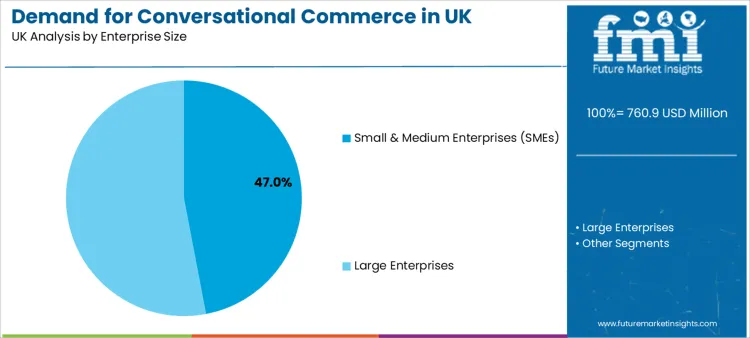
SMEs represent a 47.0% share, positioning them as the leading enterprise size segment. This reflects a practical business reality: smaller organisations still need always-on engagement, product guidance, and service responsiveness, yet they operate with limited support headcount.
SME deployments typically focus on outcomes that are easy to measure: faster first response, fewer abandoned carts, lower inbound ticket volume, and improved repeat purchases. Owners and leaders also look for plug-in integrations with existing commerce platforms and payment providers, since implementation complexity can block adoption.
For technology providers, this segment rewards solutions that simplify onboarding, reduce training effort, and provide pre-built flows that can be tailored without heavy engineering. SMEs also value transparent pricing and predictable performance, since they need a clear return pathway before scaling to more sophisticated journeys such as voice buying or personalised recommendations.
Why does finance stand out as the largest industry group for conversational buying experiences in the UK?
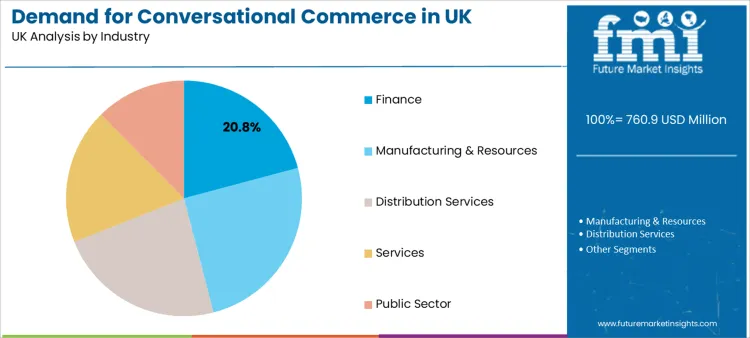
Finance captures a 20.8% share, making it the leading industry category. This reflects a service environment where customers demand clarity, speed, and trusted guidance, while firms must meet strict expectations around fairness, data handling, and customer outcomes. The UK Consumer Duty framework reinforces the requirement for firms to support customer understanding and help them achieve good outcomes across products and servicing. Banks and digital lenders also use this layer to reduce service friction in high-frequency journeys, a direction that aligns with how chatbot-led customer engagement models are being deployed across enterprise environments.
Conversational support helps financial institutions reduce friction in high-volume queries such as balance checks, card support, appointment requests, product explanations, and dispute handling. When well designed, these flows reduce repeat contacts and improve service resolution time.
Other sectors also contribute to UK demand, including manufacturing and resources, distribution-led commerce operations, and public sector service environments. Even where share values are not stated, these categories often adopt conversational journeys to reduce inbound calls, guide users through form-heavy processes, and improve accessibility for non-expert users.
How is Meta shaping early conversational shopping expectations across UK messaging ecosystems?
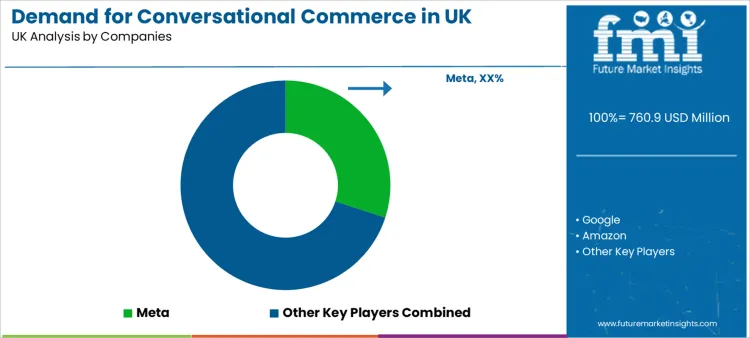
Meta holds a 30.0% share in the company landscape, reflecting how messaging-first engagement patterns influence buying behaviors. Brands deploy assisted journeys inside widely used messaging environments where customers already spend time, enabling product questions, store support, and order updates without requiring new app downloads.
Alongside Meta, platforms and ecosystems associated with Google, Amazon, Microsoft, and Apple influence deployment decisions through cloud integration paths, voice assistants, device ecosystems, productivity tooling, and commerce enablement services. Organisations often treat this as a portfolio strategy, selecting channel partners while retaining a unified orchestration layer to protect consistent service quality.
What are the Dynamics, Restraints, Opportunities, and Threats Shaping this Space?
What dynamics are strengthening demand across UK digital commerce execution?
Customer behavior continues to shift toward online shopping and digital service journeys, supporting broader adoption of conversational engagement. UK retail statistics track sustained internet-enabled sales activity as a key indicator of how purchasing stays anchored in digital channels.
Another driver is the focus on reducing friction across the buying journey. Retail leaders want fewer clicks, fewer abandoned carts, and faster resolution of uncertainty during checkout. Conversational prompts can guide customers through product selection, delivery choices, and returns policies in a way that feels familiar and immediate.
What restraints can slow adoption or limit program scale?
Quality risk is a practical restraint. If intent recognition fails, customers lose trust quickly. This forces buyers to invest in testing, escalation design, and monitoring discipline. Integration complexity can also slow rollouts, especially when commerce stacks include older order management tools or fragmented customer data.
Data protection and governance needs create additional barriers for organisations that do not have mature compliance frameworks. Personalised assistance requires careful control of data usage, retention, and explainability. UK guidance on AI and data protection pushes firms to treat fairness and accountability as design requirements rather than afterthoughts.
Where do the most actionable opportunities exist for stakeholders?
- Revenue acceleration through assisted conversion: Retail leaders can target high-intent moments such as product comparison, size selection, financing options, and delivery scheduling.
- Service productivity through containment and smart routing: Organisations can reduce inbound volume by automating repeat queries while protecting a smooth handover to agents.
- Cross-channel consistency through a unified orchestration layer: The strongest programs keep tone, policy, and customer context aligned across messaging, web chat, and app experiences.
Many UK decision-makers treat conversational journeys as part of a wider commerce modernisation push, especially where digital commerce expansion patterns in the UK are reshaping customer journeys.
What threats can disrupt performance expectations?
Regulatory pressure is a risk if customer protection controls are weak. Online safety and platform governance expectations can influence how organisations handle content, abuse reporting, and harmful interactions in digital environments. Ofcom guidance tied to the Online Safety Act sets expectations for enforcement approaches, raising the need for safe design across consumer-facing digital services.
Brand risk is another threat. Poorly designed automation can create customer frustration, public complaints, and reputational damage. Competitive risk also increases as leaders build differentiated experiences that set new customer expectations for speed and accuracy.
How is Conversational Commerce Demand Evolving across Key Regions in the UK?
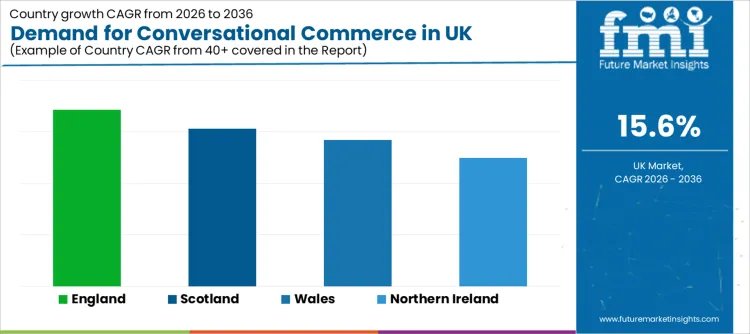
| Region | CAGR (2026 to 2036) |
|---|---|
| England | 17.1% |
| Scotland | 15.3% |
| Wales | 14.2% |
| Northern Ireland | 12.5% |
Why is England leading adoption as enterprise scale accelerates messaging-based conversion and customer support?
England expands at 17.1%, reflecting broader enterprise scale and dense retail ecosystems. Large multi-site retailers and service providers are more likely to run structured experimentation programs, link conversational journeys to conversion analytics, and allocate budgets to platform integration. Leaders also pursue omnichannel coherence, ensuring customers can begin a journey in chat and complete it across web, app, and store-aligned service flows.
How is Scotland building growth through practical deployment focused on service reliability and controlled automation?
Scotland grows at 15.3%, shaped by operational adoption that prioritises stable service performance. Organisations tend to focus on predictable use cases such as order updates, appointment scheduling, and policy explanations before expanding into deeper personalisation. Decision makers also evaluate vendors on support readiness, training enablement, and the ability to maintain consistent performance across seasonal demand peaks.
What is driving Wales as digital engagement programs expand access to assisted buying for consumers and local operators?
Wales rises at 14.2%, supported by growing digital commerce participation and the need for accessible assistance across customer journeys. Organisations value simple deployment models that connect to existing commerce tools while improving response time and service resolution. Growth is strengthened by solutions that work well for mixed digital maturity environments where some customers need guided support rather than self-navigation.
Why is Northern Ireland progressing through measured investment and selective scaling of conversational engagement journeys?
Northern Ireland advances at 12.5%, reflecting staged rollouts and disciplined procurement. Adoption expands when platforms demonstrate clear value in reducing inbound calls, improving service response, and protecting customer satisfaction. Organisations also rely on strong escalation controls so that automated flows never trap customers, especially for payment issues, delivery complaints, or identity-sensitive servicing.
What Defines the Competitive Landscape for Conversational Commerce in the UK?
Competition is shaped by orchestration capability, channel coverage, compliance readiness, and ecosystem partnerships. Buyers prioritise platforms that can manage the full lifecycle of conversational journeys, from intent design to analytics, while integrating cleanly with commerce stacks and service tooling.
Meta holds a strong position in the ecosystem due to messaging-centric engagement patterns and brand adoption of chat-driven journeys, supported by its 30.0% share. Google influences adoption through AI infrastructure, search-to-chat discovery pathways, and cloud-aligned deployment preferences.
Amazon shapes expectations through retail and logistics integration models that connect service automation with fulfilment realities. Microsoft supports enterprise rollouts through productivity-aligned workflows, identity management, and cloud-based deployment routes. Apple contributes through device ecosystems and consumer-facing interface expectations where voice and mobile-first service experiences remain important.
Procurement decisions increasingly favor partners that can prove measurable outcomes such as conversion lift, resolution speed, and controlled escalation design. Service providers also win by demonstrating strong governance, reliable performance monitoring, and clear operational playbooks that reduce rollout risk.
Key Industry Participants
- Meta
- Amazon
- Microsoft
- Apple
Scope of Report
| Items | Values |
|---|---|
| Quantitative Units | USD Million |
| Solution | Software; Services |
| Enterprise Size | Small & Medium Enterprises (SMEs); Large Enterprises |
| Industry | Finance; Manufacturing & Resources; Distribution; Public Sector |
| Regions Covered | England; Scotland; Wales; Northern Ireland |
| Key Companies Profiled | Meta; Google; Amazon; Microsoft; Apple |
Conversational Commerce Demand in the UK by Segments
By Solution
- Software
- Services
By Enterprise Size
- Small & Medium Enterprises (SMEs)
- Large Enterprises
By Industry
- Finance
- Manufacturing & Resources
- Distribution
- Public Sector
By Region
- England
- Scotland
- Wales
- Northern Ireland
Bibliography
- Financial Conduct Authority. (2022). FG22/5: Final non-Handbook guidance for firms on the Consumer Duty.
- Financial Conduct Authority. (2025). PS22/9: A new Consumer Duty (updated version).
- Information Commissioner’s Office. (2023). Guidance on AI and data protection.
- Ofcom. (2025). Online Safety Enforcement Guidance (Online Safety Act 2023).
- Office for National Statistics. (2025). Retail sales index time series: Internet sales as a percentage of total retail sales (J4MC).
- Office for National Statistics. (2025). Retail sales index time series: Internet retail sales, £ millions (JE2J).
Preview the report firsthand - request a free sample
Get SampleGet the brochure for pricing and purchase details.
Get PDFTable of Content
- Executive Summary
- UK Market Outlook
- Demand-side Trends
- Supply-side Trends
- Technology Roadmap Analysis
- Analysis and Recommendations
- Market Overview
- Market Coverage / Taxonomy
- Market Definition / Scope / Limitations
- Market Background
- Market Dynamics
- Drivers
- Restraints
- Opportunity
- Trends
- Scenario Forecast
- Demand in Optimistic Scenario
- Demand in Likely Scenario
- Demand in Conservative Scenario
- Opportunity Map Analysis
- Product Life Cycle Analysis
- Supply Chain Analysis
- Investment Feasibility Matrix
- Value Chain Analysis
- PESTLE and Porter’s Analysis
- Regulatory Landscape
- Regional Parent Market Outlook
- Production and Consumption Statistics
- Import and Export Statistics
- Market Dynamics
- UK Market Analysis 2021 to 2025 and Forecast, 2026 to 2036
- Historical Market Size Value (USD Million) Analysis, 2021 to 2025
- Current and Future Market Size Value (USD Million) Projections, 2026 to 2036
- Y-o-Y Growth Trend Analysis
- Absolute $ Opportunity Analysis
- UK Market Pricing Analysis 2021 to 2025 and Forecast 2026 to 2036
- UK Market Analysis 2021 to 2025 and Forecast 2026 to 2036, By Solution
- Introduction / Key Findings
- Historical Market Size Value (USD Million) Analysis By Solution , 2021 to 2025
- Current and Future Market Size Value (USD Million) Analysis and Forecast By Solution , 2026 to 2036
- Software
- Services
- Software
- Y-o-Y Growth Trend Analysis By Solution , 2021 to 2025
- Absolute $ Opportunity Analysis By Solution , 2026 to 2036
- UK Market Analysis 2021 to 2025 and Forecast 2026 to 2036, By Enterprise Size
- Introduction / Key Findings
- Historical Market Size Value (USD Million) Analysis By Enterprise Size, 2021 to 2025
- Current and Future Market Size Value (USD Million) Analysis and Forecast By Enterprise Size, 2026 to 2036
- Small & Medium Enterprises (SMEs)
- Large Enterprises
- Small & Medium Enterprises (SMEs)
- Y-o-Y Growth Trend Analysis By Enterprise Size, 2021 to 2025
- Absolute $ Opportunity Analysis By Enterprise Size, 2026 to 2036
- UK Market Analysis 2021 to 2025 and Forecast 2026 to 2036, By Industry
- Introduction / Key Findings
- Historical Market Size Value (USD Million) Analysis By Industry, 2021 to 2025
- Current and Future Market Size Value (USD Million) Analysis and Forecast By Industry, 2026 to 2036
- Finance
- Manufacturing & Resources
- Distribution Services
- Services
- Public Sector
- Finance
- Y-o-Y Growth Trend Analysis By Industry, 2021 to 2025
- Absolute $ Opportunity Analysis By Industry, 2026 to 2036
- Market Structure Analysis
- Competition Dashboard
- Competition Benchmarking
- Market Share Analysis of Top Players
- By Regional
- By Solution
- By Enterprise Size
- By Industry
- Competition Analysis
- Competition Deep Dive
- Meta
- Overview
- Product Portfolio
- Profitability by Market Segments (Product/Age /Sales Channel/Region)
- Sales Footprint
- Strategy Overview
- Marketing Strategy
- Product Strategy
- Channel Strategy
- Amazon
- Microsoft
- Apple
- Meta
- Competition Deep Dive
- Assumptions & Acronyms Used
- Research Methodology


