

- Industry Size (2026)
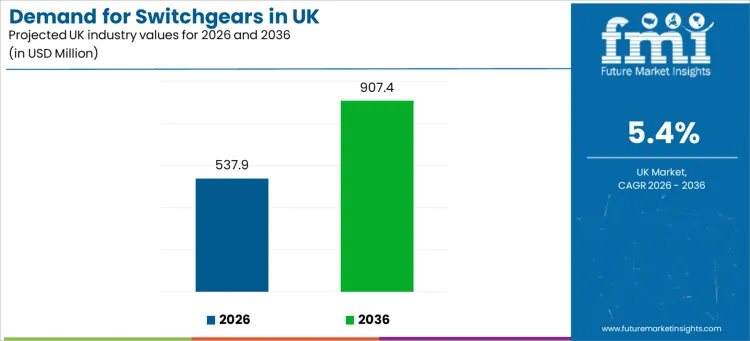
- USD 537.9 Mn
- Forecast (2036)
- USD 907.4 Mn
- CAGR (2026 to 2036)
- 5.4%
Switchgears Outlook in the UK 2026 to 2036
Demand for switchgears in the UK is projected at USD 537.9 million in 2026 and is expected to reach USD 907.4 million by 2036, expanding at a 5.4% CAGR. This trajectory is linked to grid reinforcement, capacity additions across distribution networks, and the shift toward electrified end-use systems that require stable fault protection and isolation performance.
Switchgears are deployed to control, protect, and isolate electrical assets across substations, feeders, industrial plants, commercial buildings, and residential distribution. Procurement teams evaluate them through reliability under fault events, safety design, uptime contribution, footprint efficiency, maintainability, and lifecycle compliance. Product leaders also track interoperability with digital protection relays, monitoring sensors, and remote switching architectures used in modern substation automation.
For CEOs and system operators, the decision lens is operational continuity. Unexpected downtime can cascade across service contracts, grid performance commitments, and industrial productivity. For technology service providers, value sits in condition monitoring integration, data-driven maintenance planning, and deployment workflows that reduce commissioning complexity.
Quick Stats for Switchgears Demand in the UK
- Switchgears Valuation in the UK (2026): USD 537.9 million
- Switchgears Forecast Valuation in the UK (2036): USD 907.4 million
- Forecast CAGR 2026 to 2036: 5.4%
- Leading Regional Growth: England (5.9%)
- Leading Component Type: Power Distributor Switch Breaker (31.1% share)
- Leading Voltage Type: Low Voltage (less than 1kV) (37.2% share)
- Leading Construction Type: Outdoor (42.9% share)
- Leading Insulation Type: Air Insulated Switchgear (29.6% share)
- Leading End User: T&D Utilities (35.6% share)
- Key Companies Profiled: ABB Ltd.; Siemens AG; Schneider Electric SE; General Electric (GE); Eaton Corporation
Switchgears Industry in the UK Key Takeaways
| Metric | Value |
|---|---|
| Industry Value (2026) | USD 537.9 million |
| Industry Forecast Value (2036) | USD 907.4 million |
| Forecast CAGR (2026 to 2036) | 5.4% |
Source: FMI analysis based on primary research and proprietary forecasting model
Why is the UK Building Strong Demand for Switchgears?
UK electricity infrastructure is being reshaped by higher power flow volatility, a larger share of renewables, and rising electrification across transport, heating, and industrial operations. This increases the need for robust protection and switching assets that can handle frequent operations without compromising safety or asset life.
A major demand driver is network investment discipline set by regulated price controls. Ofgem’s RIIO-ED2 framework sets the revenue allowances for electricity distribution operators and defines what they must deliver across the 2023 to 2028 period. Switchgear procurement aligns closely with such output commitments because new connections, reinforcement work, and reliability programs typically require feeder upgrades, protection redesign, and substation expansion.
System planning also pushes requirements toward stronger resilience and flexibility. NESO’s Future Energy Scenarios outlines pathways to net zero and highlights the central role of network planning and system coordination. The practical effect is a higher emphasis on substation densification, improved fault management, and faster restoration capability. These objectives raise the value of safe, maintainable designs that can be deployed quickly across multiple sites.
Safety compliance and standardisation further anchor demand. IEC publications in the 62271 family set technical expectations for high-voltage switchgear and controlgear, including internal arc classification requirements for metal-enclosed designs. Buyers use these requirements to set acceptance criteria, supplier qualification gates, and testing documentation expectations.
Stakeholders benchmarking global equipment direction often scan broader category coverage such as switchgears to see how compact layouts, lifecycle diagnostics, and digital-ready architectures are gaining traction across regions.
How is Switchgears Demand Segmented by Component, Voltage, Construction, Insulation, and End User?
Segmentation reflects how electrical assets are deployed across grid nodes, industrial sites, and commercial premises. It also reflects the engineering need to balance footprint constraints, safety outcomes, and service access during maintenance cycles.
Why do power distributor switch breakers hold the largest component share in UK deployments?
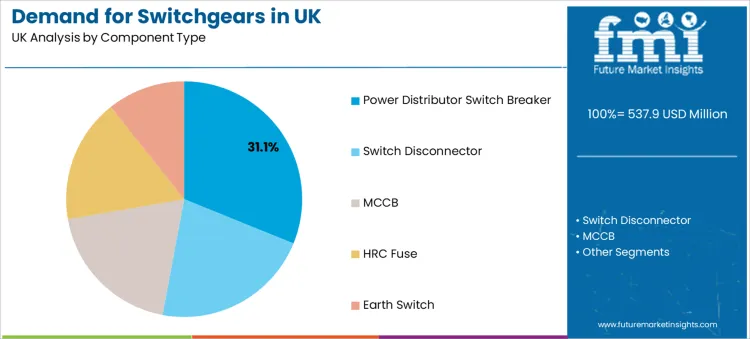
Power distributor switch breaker leads with a 31.1% share. This category anchors feeder control and protection logic in many distribution and industrial applications. It is commonly evaluated for interrupting performance, thermal stability, mechanical endurance, and compatibility with protection relay coordination schemes.
For utilities and large facility operators, the operational focus is controlled isolation during faults and planned outages. Switch breaker selection shapes arc flash risk management, restoration speed, and operator safety procedures. Vendors that pair hardware reliability with clear service documentation and spares availability tend to build stronger procurement confidence.
Why does low voltage dominate installation volumes across multi-site electrification projects?

Low voltage (less than 1kV) leads with a 36.5% share. This aligns with the scale of low-voltage distribution in commercial buildings, industrial panels, critical facilities, and downstream distribution points that need fast, repeatable protection structures.
Low-voltage adoption also rises when organisations modernise facility electrical rooms, integrate EV charging infrastructure, and upgrade backup power architectures. For service providers, digital metering integration and remote monitoring capability strengthen the value proposition across dispersed assets.
Why is outdoor construction leading switchgear placement decisions?
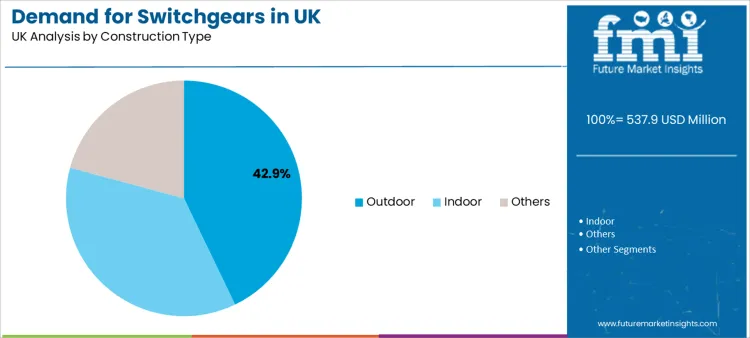
Outdoor construction leads with a 42.9% share. Outdoor installations are often linked to substation footprints, space constraints, and the practical need to expand capacity without major building redevelopment. Outdoor-ready designs are selected for enclosure integrity, ingress protection, corrosion resistance, and maintainable access under varied weather conditions.
Utilities and industrial operators increasingly value modular outdoor solutions that reduce civil work time and shorten commissioning cycles. This supports faster reinforcement activity when new loads connect to distribution networks.
What makes air insulated switchgear a steady insulation choice for broad UK use cases?
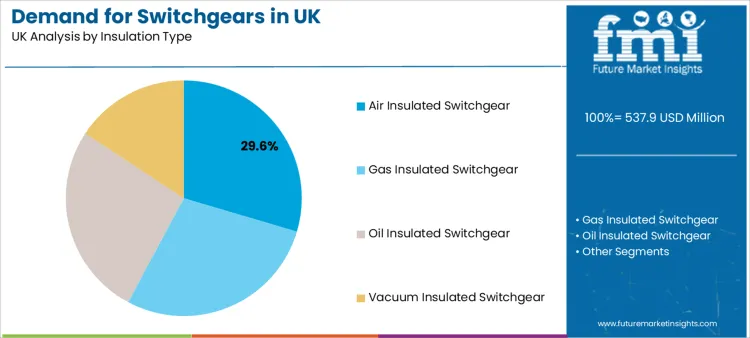
Air insulated switchgear holds a 29.6% share, placing it as the leading insulation type. Air-insulated designs remain a common baseline where maintenance access and visual inspection routines matter, which is consistent with air insulated medium voltage switchgear demand patterns seen across utility and facility environments.
Gas insulated, oil insulated, and vacuum insulated options continue to serve important roles in space-constrained environments, higher voltage conditions, and performance-driven applications where compactness and switching endurance are critical. Many procurement teams weigh insulation choices against gas insulated switchgear, especially when substation sites are tight on space and compact layouts become a priority.
Why do T&D utilities lead end-user demand for switchgears in the UK?
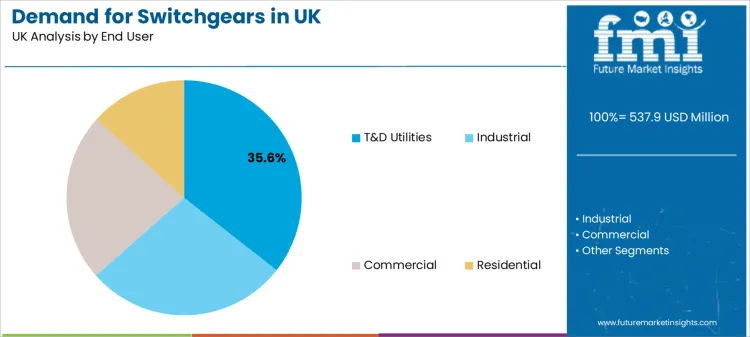
T&D utilities lead with a 35.6% share, reflecting the central role of distribution and transmission reinforcement across the UK energy transition. Utilities buy switchgear not only for new builds, but also for refurbishment cycles, fault performance upgrades, and reliability programs tied to regulated output incentives.
Industrial adoption remains significant where manufacturers expand electrified processes, improve motor control protection, and stabilise power quality. Commercial and residential demand increases where building upgrades, electrified heating, and distributed energy resources place new strain on local distribution assets.
What are the Dynamics, Restraints, Opportunities, and Threats Shaping this Space?
What Dynamics are strengthening UK’s Demand Fundamentals?
Grid reinforcement is a core driver, supported by regulated output delivery and network reliability commitments. Ofgem’s RIIO-ED2 structure influences capital planning and service delivery requirements for distribution operators.
System planning is also raising performance expectations. NESO highlights pathways that require strategic system coordination, stronger flexibility, and infrastructure planning that can support evolving demand profilesThese objectives raise switchgear requirements for operational endurance, monitoring readiness, and safe fault isolation.
What restraints can slow deployment momentum?
Supply chain volatility can delay project schedules, especially for higher-rated assemblies and specialised configurations. Skilled workforce availability is another constraint because commissioning and protection testing require trained engineers and consistent site access.
Compliance and documentation burden also influences lead times. IEC requirements related to performance classification and internal arc behaviour increase testing and validation expectations for certain installations.
Where do practical opportunities sit for suppliers and service partners?
Digital-ready switchgear offers clear opportunity through embedded sensors, thermal monitoring, and predictive maintenance support. As high-density computing sites expand, load-critical environments are shaping specifications for redundancy, fast isolation, and low downtime tolerance, reflecting switchgear adoption tied to data center power infrastructure.
Compact, space-efficient designs also open opportunities, especially where urban substations face footprint constraints. Stakeholders planning high-capacity installations often track emerging trends in utility-scale switchgears to align equipment choices with footprint constraints and grid expansion requirements.
What Threats can Disrupt Demand Expectations?
Extreme weather events and flooding risk can challenge outdoor installation resilience if asset hardening is not aligned with local conditions. Regulatory shifts can also reshape procurement preferences, including rules tied to insulation choices and environmental stewardship across high-voltage assets.
How is Switchgears Demand Evolving across Key Regions in the UK?
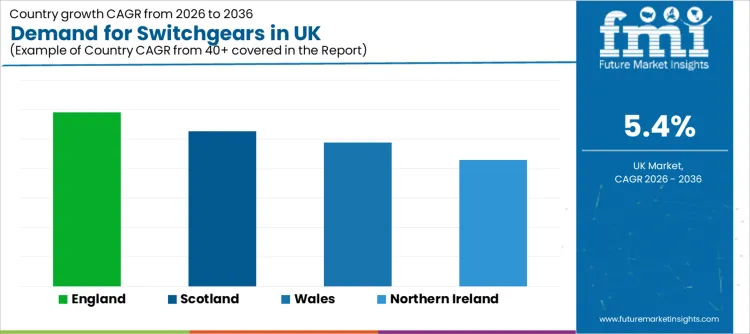
| Region | CAGR 2026 to 2036 |
|---|---|
| England | 5.9% |
| Scotland | 5.3% |
| Wales | 4.9% |
| Northern Ireland | 4.3% |
Source: FMI analysis based on primary research and proprietary forecasting model
Why is England accelerating demand through grid reinforcement and commercial electrification loads?
England grows at 5.9%, supported by higher concentration of commercial infrastructure, industrial demand nodes, and large-scale distribution reinforcement programs. Upgrades in feeder protection, urban substation expansion, and capacity additions for new connections contribute to higher volumes. Providers that deliver fast installation cycles and strong service coverage fit procurement priorities in multi-site projects.
How is Scotland scaling switchgear demand through transmission integration and renewable connection activity?
Scotland advances at 5.3%, shaped by renewable generation expansion and the infrastructure needed to move power across long-distance corridors. This pushes demand for switchgear solutions that support stable switching endurance, reliable fault isolation, and streamlined maintenance access in remote or exposed environments.
What is supporting Wales as switchgear demand grows through staged network upgrades?
Wales expands at 4.9%, linked to distribution reinforcement and capacity upgrades that support industrial estates, commercial development, and local resilience programs. Practical project delivery is influenced by site access, installation scheduling, and efficient commissioning support. Suppliers that provide configurable designs and dependable spares availability tend to align well with these requirements.
Why is Northern Ireland seeing steady expansion through targeted investment programs and reliability objectives?
Northern Ireland increases at 4.3%, reflecting a measured growth profile tied to targeted grid strengthening and reliability improvement needs. Demand rises when utilities and major facilities prioritise protection upgrades, replace aging assemblies, and add control capability that improves outage response.
What Defines the Competitive Landscape for Switchgears in the UK?
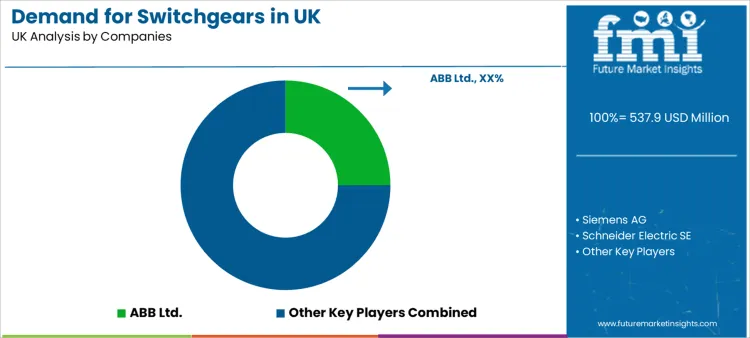
Competition is shaped by reliability under fault events, safety design maturity, field service responsiveness, and deployment scalability. Buyers prioritise equipment that meets testing expectations, supports repeatable commissioning workflows, and integrates cleanly with protection systems.
Suppliers with portfolios tuned for compact layouts and fast serviceability often gain stronger positioning in space-constrained builds, aligning with air insulated medium voltage switchgear demand patterns and switchgear adoption tied to data center power infrastructure.
ABB Ltd. competes through a broad portfolio and established substation and distribution capabilities. Siemens AG competes through engineering depth and strong positioning in grid automation alignment. Schneider Electric SE competes through distribution infrastructure strengths and digital integration support.
General Electric (GE) competes through power system equipment expertise, particularly in higher-performance electrical infrastructure contexts. Eaton Corporation competes through electrical distribution portfolios and reliability-focused product positioning.
Stakeholders comparing insulation strategy and footprint constraints often align planning decisions with air insulated medium voltage switchgear demand patterns and switchgear adoption tied to data center power infrastructure to track where reliability targets and space limitations are tightening.
Key Industry Participants
- ABB Ltd.
- Siemens AG
- Schneider Electric SE
- General Electric (GE)
- Eaton Corporation
Scope of Report
| Items | Values |
|---|---|
| Quantitative Units | USD Million |
| Component Type | Power Distributor Switch Breaker; Switch Disconnector; MCCB; HRC Fuse; Earth Switch |
| Voltage Type | Low Voltage (less than 1kV); Medium Voltage (1kV to 75kV); High Voltage (75kV to 230kV); Extra High Voltage (230kV to 500kV); Ultra-High Voltage (above 500kV) |
| Construction Type | Outdoor; Indoor; Others |
| Insulation Type | Air Insulated Switchgear; Gas Insulated Switchgear; Oil Insulated Switchgear; Vacuum Insulated Switchgear |
| End User | T&D Utilities; Industrial; Commercial; Residential |
| Regions Covered | England; Scotland; Wales; Northern Ireland |
| Key Companies Profiled | ABB Ltd.; Siemens AG; Schneider Electric SE; General Electric (GE); Eaton Corporation |
Switchgears Demand in the UK by Segments
By Component Type
- Power Distributor Switch Breaker
- Switch Disconnector
- MCCB
- HRC Fuse
- Earth Switch
By Voltage Type
- Low Voltage (less than 1kV)
- Medium Voltage (1kV to 75kV)
- High Voltage (75kV to 230kV)
- Extra High Voltage (230kV to 500kV)
- Ultra-High Voltage (above 500kV)
By Construction Type
- Outdoor
- Indoor
- Others
By Insulation Type
- Air Insulated Switchgear
- Gas Insulated Switchgear
- Oil Insulated Switchgear
- Vacuum Insulated Switchgear
By End User
- T&D Utilities
- Industrial
- Commercial
- Residential
By Region
- England
- Scotland
- Wales
- Northern Ireland
Bibliography
- Electricity System Operator. (2024). Future Energy Scenarios 2024: Pathways to Net Zero.
- National Energy System Operator. (2025). Future Energy Scenarios (FES): Pathways to Net Zero.
- Office of Gas and Electricity Markets. (2025). Electricity distribution price control 2023 to 2028 (RIIO-ED2).
- Office of Gas and Electricity Markets. (2024). RIIO-2 Electricity Distribution Summary Annual Report: 2023-24.
- International Electrotechnical Commission. (2024). IEC 62271-214:2024 High-voltage switchgear and controlgear Part 214: Internal arc classification of AC metal-enclosed pole-mounted switchgear and controlgear.
- Department for Energy Security and Net Zero. (2024). Electricity Networks Strategic Framework: Enabling a secure, net zero energy system.
Frequently Asked Questions
How big is the demand for switchgears in uk in 2026?
The demand for switchgears in uk is estimated to be valued at USD 537.9 million in 2026.
What will be the size of switchgears in uk in 2036?
The market size for the switchgears in uk is projected to reach USD 907.4 million by 2036.
How much will be the demand for switchgears in uk growth between 2026 and 2036?
The demand for switchgears in uk is expected to grow at a 5.4% CAGR between 2026 and 2036.
What are the key product types in the switchgears in uk?
The key product types in switchgears in uk are power distributor switch breaker, switch disconnector, mccb, hrc fuse and earth switch.
Which voltage type segment is expected to contribute significant share in the switchgears in uk in 2026?
In terms of voltage type, low voltage (less than 1kv) segment is expected to command 37.2% share in the switchgears in uk in 2026.
Preview the report firsthand - request a free sample
Get SampleGet the brochure for pricing and purchase details.
Get PDFTable of Content
- Executive Summary
- UK Market Outlook
- Demand-side Trends
- Supply-side Trends
- Technology Roadmap Analysis
- Analysis and Recommendations
- Market Overview
- Market Coverage / Taxonomy
- Market Definition / Scope / Limitations
- Market Background
- Market Dynamics
- Drivers
- Restraints
- Opportunity
- Trends
- Scenario Forecast
- Demand in Optimistic Scenario
- Demand in Likely Scenario
- Demand in Conservative Scenario
- Opportunity Map Analysis
- Product Life Cycle Analysis
- Supply Chain Analysis
- Investment Feasibility Matrix
- Value Chain Analysis
- PESTLE and Porter’s Analysis
- Regulatory Landscape
- Regional Parent Market Outlook
- Production and Consumption Statistics
- Import and Export Statistics
- Market Dynamics
- UK Market Analysis 2021 to 2025 and Forecast, 2026 to 2036
- Historical Market Size Value (USD Million) Analysis, 2021 to 2025
- Current and Future Market Size Value (USD Million) Projections, 2026 to 2036
- Y-o-Y Growth Trend Analysis
- Absolute $ Opportunity Analysis
- UK Market Pricing Analysis 2021 to 2025 and Forecast 2026 to 2036
- UK Market Analysis 2021 to 2025 and Forecast 2026 to 2036, By Component Type
- Introduction / Key Findings
- Historical Market Size Value (USD Million) Analysis By Component Type , 2021 to 2025
- Current and Future Market Size Value (USD Million) Analysis and Forecast By Component Type , 2026 to 2036
- Power Distributor Switch Breaker
- Switch Disconnector
- MCCB
- HRC Fuse
- Earth Switch
- Power Distributor Switch Breaker
- Y-o-Y Growth Trend Analysis By Component Type , 2021 to 2025
- Absolute $ Opportunity Analysis By Component Type , 2026 to 2036
- UK Market Analysis 2021 to 2025 and Forecast 2026 to 2036, By Voltage Type
- Introduction / Key Findings
- Historical Market Size Value (USD Million) Analysis By Voltage Type, 2021 to 2025
- Current and Future Market Size Value (USD Million) Analysis and Forecast By Voltage Type, 2026 to 2036
- Low Voltage (less than 1kV)
- Medium Voltage (1kV to 75kV)
- High Voltage (75kV to 230kV)
- Extra High Voltage (230kV to 500kV)
- Ultra-High Voltage (above 500kV)
- Low Voltage (less than 1kV)
- Y-o-Y Growth Trend Analysis By Voltage Type, 2021 to 2025
- Absolute $ Opportunity Analysis By Voltage Type, 2026 to 2036
- UK Market Analysis 2021 to 2025 and Forecast 2026 to 2036, By Construction Type
- Introduction / Key Findings
- Historical Market Size Value (USD Million) Analysis By Construction Type, 2021 to 2025
- Current and Future Market Size Value (USD Million) Analysis and Forecast By Construction Type, 2026 to 2036
- Outdoor
- Indoor
- Others
- Outdoor
- Y-o-Y Growth Trend Analysis By Construction Type, 2021 to 2025
- Absolute $ Opportunity Analysis By Construction Type, 2026 to 2036
- UK Market Analysis 2021 to 2025 and Forecast 2026 to 2036, By Insulation Type
- Introduction / Key Findings
- Historical Market Size Value (USD Million) Analysis By Insulation Type, 2021 to 2025
- Current and Future Market Size Value (USD Million) Analysis and Forecast By Insulation Type, 2026 to 2036
- Air Insulated Switchgear
- Gas Insulated Switchgear
- Oil Insulated Switchgear
- Vacuum Insulated Switchgear
- Air Insulated Switchgear
- Y-o-Y Growth Trend Analysis By Insulation Type, 2021 to 2025
- Absolute $ Opportunity Analysis By Insulation Type, 2026 to 2036
- UK Market Analysis 2021 to 2025 and Forecast 2026 to 2036, By End User
- Introduction / Key Findings
- Historical Market Size Value (USD Million) Analysis By End User, 2021 to 2025
- Current and Future Market Size Value (USD Million) Analysis and Forecast By End User, 2026 to 2036
- T&D Utilities
- Industrial
- Commercial
- Residential
- T&D Utilities
- Y-o-Y Growth Trend Analysis By End User, 2021 to 2025
- Absolute $ Opportunity Analysis By End User, 2026 to 2036
- Market Structure Analysis
- Competition Dashboard
- Competition Benchmarking
- Market Share Analysis of Top Players
- By Regional
- By Component Type
- By Voltage Type
- By Construction Type
- By Insulation Type
- By End User
- Competition Analysis
- Competition Deep Dive
- ABB Ltd.
- Overview
- Product Portfolio
- Profitability by Market Segments (Product/Age /Sales Channel/Region)
- Sales Footprint
- Strategy Overview
- Marketing Strategy
- Product Strategy
- Channel Strategy
- Siemens AG
- Schneider Electric SE
- General Electric (GE)
- Eaton Corporation
- ABB Ltd.
- Competition Deep Dive
- Assumptions & Acronyms Used
- Research Methodology


