

- Market Size (2026)
- USD 8.40 Bn
- Forecast (2036)
- USD 20.50 Bn
- CAGR (2026 to 2036)
- 9.3%
Smart Industrial Illumination Market Size, Forecast, and Outlook By FMI
Summary of the Smart Industrial Illumination Market
- Demand and Growth Drivers
- Rising energy efficiency regulations and corporate sustainability targets are pushing industrial facilities to adopt connected lighting systems that can measure, verify, and report energy savings.
- Rapid growth in warehouses and smart factories is increasing demand for sensor‑enabled luminaires that support occupancy‑based lighting and zone‑level control.
- Manufacturers and warehouse operators are adopting smart industrial illumination to improve safety compliance and audit readiness through data‑driven lighting controls.
- The shift from standard LED retrofits to connected luminaires with software and controls is raising average project values and driving higher revenues per installation.
- Product and Segment View
- Connected luminaires are projected to account for 38.0% of component demand in 2026.
- Smart nodes are expected to represent 31.0% share in 2026 as sensing moves closer to the fixture.
- Wired DALI is projected to account for 37.0% in 2026.
- Safety compliance is expected to hold 29.0% of application segment in 2026.
- Geography and Competitive Outlook
- The USA is forecast to expand at 7.9% CAGR through 2036 as warehouse and plant projects continue.
- China is projected to rise at 8.4% CAGR over the assessment period as smart factories raise the lighting control need.
- South Korea is expected to post the fastest country pace at 11.5% CAGR by 2036.
- Signify is one of the key players in the market due to its connected lighting scale and Interact platform.
- Analyst Opinion
- Nikhil Kaitwade, Associate Vice President at FMI says, "Smart industrial illumination is moving from light replacement to work-area intelligence. Buyers want energy savings that can be measured and safety performance that can be documented. Suppliers with fixture control and project delivery depth will have the strongest position."
- Smart Industrial Illumination Market Value Analysis
- Smart industrial illumination is moving beyond the traditional lighting product purchase. Buyers now compare fixture life and control depth before approving projects.
- The shift from basic LED light retrofits to connected luminaires raises average project value. Controls and software bring recurring service income into the mix.
- Solid-state lighting creates the hardware platform for smart industrial systems. Sensors and gateways turn each light point into a data node.
Key Takeaways, Market Size, and Forecast
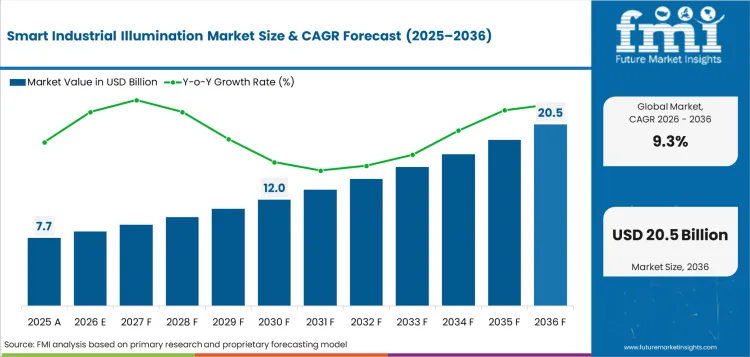
- The smart industrial illumination market was valued at USD 7.69 billion in 2025.
- The market is expected to reach USD 8.40 billion in 2026.
- By 2036, the smart industrial illumination market is projected to be worth USD 20.50 billion.
- From 2026 to 2036, the sector is projected to expand at 9.3% CAGR.
- The market is projected to create an incremental opportunity of USD 12.10 billion between 2026 and 2036.
- Connected luminaires are expected to account for 38.0% of component demand in 2026.
- Hybrid connectivity is projected to hold 44.0% of connectivity demand in 2026.
- South Korea at 11.5% CAGR and Japan at 10.9% CAGR are some of the rapidly growing country markets.
Factory ceilings and warehouse aisles are turning smart industrial illumination into a controls-led upgrade. DesignLights Consortium published NLC5.1 requirements in June 2024 for systems on its Networked Lighting Controls QPL. That makes energy monitoring and reported control capability part of supplier screening. Helvar states that its 322D2 High Bay Multisensor supports 15 m mounting height and 21 m detection diameter. Sensor reach at that level fits high-rack areas where fixture-level control reduces wasted output. Signify stated in March 2026 that Interact supports centralized real-time control across professional indoor spaces. The company also stated that Interact is trusted in over 40,000 projects worldwide. Multi-site owners can use that scale as evidence for standardized deployment. MEAN WELL stated in August 2025 that its DLC-02 controller has two DALI bus channels with up to 12 input devices per channel. Modular control hardware is likely to help integrators retrofit mixed industrial layouts without full rewiring.
Smart Industrial Illumination Market Definition
The smart industrial illumination market includes connected lighting systems used in warehouses, manufacturing plants, cold storage buildings, and industrial back-of-house spaces. The scope covers luminaires, sensors, gateways, control software, wiring methods, wireless links, and project services tied to industrial lighting control. Digital Addressable Lighting Interface means a wired control method that sends commands to individual fixtures. Bluetooth Low Energy means a low-power wireless method used for short-range lighting and sensor communication.
Smart Industrial Illumination Market Inclusions
Market scope covers commercially sold smart industrial lighting systems categorized by component, end use, connectivity, application, sales channel, and region. Components include connected luminaires, smart nodes, gateways, and software platforms. End uses include warehouses, manufacturing plants, cold storage, and retail backrooms. Revenue scope covers new installations, retrofit projects, control upgrades, software licences, and project integration services from 2026 to 2036.
Smart Industrial Illumination Market Exclusions
Scope does not include decorative lighting, residential smart bulbs, outdoor municipal-only lighting, consumer lamps, vehicle lighting, signage lighting, or basic non-connected industrial fixtures. The scope excludes general electrical contracting work when lighting control hardware or software is not supplied. It excludes building automation work that does not include lighting control integration.
Smart Industrial Illumination Market Research Methodology
- Primary research: FMI analysts considered feedback from lighting integrators, plant facility teams, warehouse operators, electrical contractors, and industrial automation specialists.
- Desk research: The desk review used energy efficiency policies, building energy records, official statistics, company releases, and industry lighting control documentation.
- Market sizing and forecasting: The model combined project value, component mix, retrofit intensity, software use, and country industrial activity.
- Data validation: Forecasts were checked against smart factory activity, energy rules, warehouse construction signals, and supplier product launches.
Why is the Smart Industrial Illumination Market Growing?
- Industrial sites are replacing basic light upgrades with connected systems that measure energy use by zone.
- Warehouse operators are adding sensors to lighting networks so that aisles and docks receive light only when needed.
- Factories are treating lighting control as part of wider building and process monitoring work.
Energy teams are moving lighting work into a measured savings discipline. The United States Department of Energy Integrated Lighting Campaign recognized 16 organizations in August 2024 across 10 categories tied to advanced controls and integrated systems. That evidence shows how control projects are being judged by measured savings and operational proof. Buyers are expected to favor suppliers with a proven light management system that can document savings after installation.
Buildings are a large electricity load, so industrial lighting projects remain tied to energy policy and plant cost control. The International Energy Agency reported in 2025 that buildings account for about 30% of global final energy use and over half of electricity use. Industrial luminaires are a practical entry point because fixture replacement is easier than large building shell work. This makes building automation systems more useful when lighting data feeds into heating, ventilation, and occupancy decisions.
Market Segmentation Analysis
- Connected luminaires are projected to represent 38.0% of component demand in 2026 as buyers prefer fixtures with embedded control points.
- Warehouses are expected to account for 36.0% of end-use demand as smart warehouse technologies raise the need for zone-level lighting.
- Hybrid connectivity is projected to hold 44.0% of connectivity demand in 2026 as wireless lighting is paired with wired reliability.
- Energy optimization is expected to capture 41.0% of application demand as light control switches and sensors reduce wasted operating hours.
- Direct projects are projected to account for 48.0% of sales channel demand as large sites need design control and integration support.
- Automation-heavy warehouses using automated material handling systems need lighting schedules that match motion patterns and shift plans.
The market is divided into five primary segment groups based on component, end use, connectivity, application, and sales channel. Component includes connected luminaires, smart nodes, gateways, and software platforms. End use includes warehouses, manufacturing plants, cold storage, and retail backrooms. Connectivity includes hybrid, wired DALI, and wireless BLE. Application includes energy optimization, safety compliance, asset tracking, and predictive maintenance. Sales channel includes direct projects, contractors, and OEM bundles.
Insights into the Connected Luminaires Component Segment
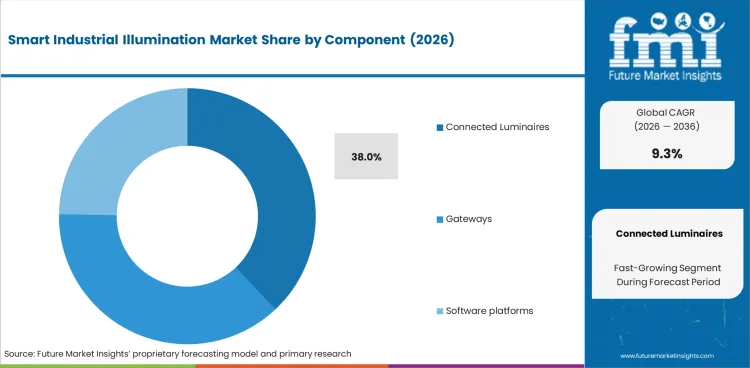
- Connected luminaires are projected to account for 38.0% of component demand in 2026. This position reflects buyer preference for fixtures that combine light output with sensing and control.
- Smart nodes and gateways add value when projects need data capture beyond the fixture body. LED modules support the hardware path that makes connected systems easier to build.
- Rack ready luminaires fit warehouse aisles that need light placement close to storage layouts. Software platforms hold a smaller share but create service income after installation.
Insights into the Warehouses End-Use Segment
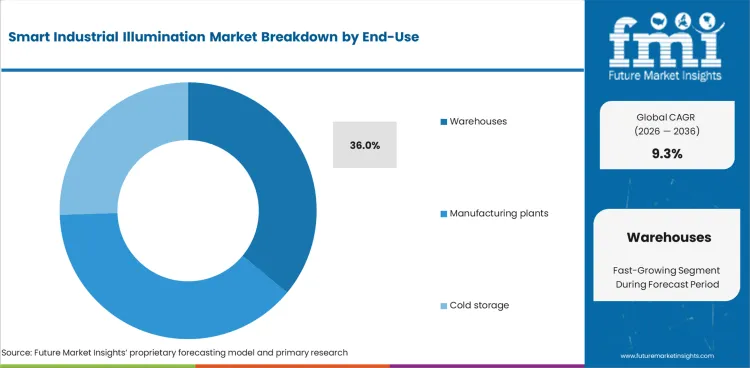
- Warehouses are projected to hold 36.0% of end-use demand in 2026. Operators value lighting that follows activity across aisles, staging zones, and loading doors.
- Cold storage projects favor low-heat LED systems that reduce lighting waste and lessen cooling load. Retail backrooms stay smaller but need lower-cost control packages.
Insights into the Hybrid Connectivity Segment
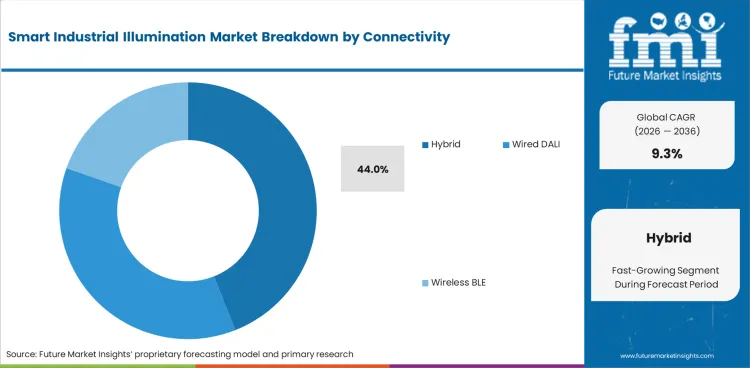
- Hybrid connectivity is projected to capture 44.0% of connectivity demand in 2026. Plants often keep wired control for core areas and add wireless sensing where cabling is costly.
- Hybrid connectivity is gaining traction as industrial sites retain wired controls in critical zones while adding wireless sensors in areas where rewiring is costly or disruptive.
Insights into the Energy Optimization Application Segment
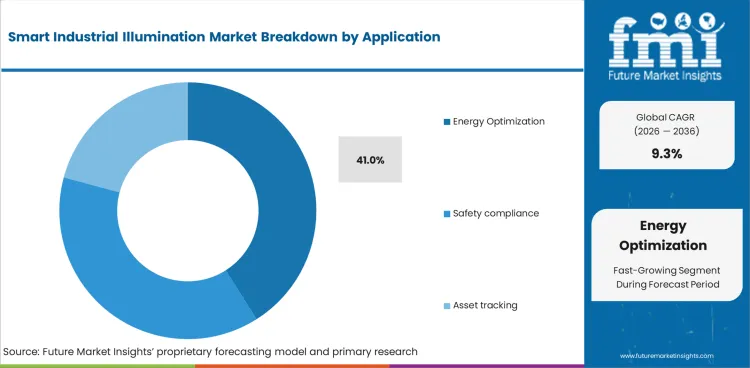
- Energy optimization is projected to account for 41.0% of application demand in 2026. The share reflects project approvals that depend on savings proof and utility cost control.
- Asset tracking and predictive maintenance make lighting networks more useful for operations teams. Their share improves when sensors are installed at ceiling height across work zones.
Insights into the Direct Projects Sales Channel Segment
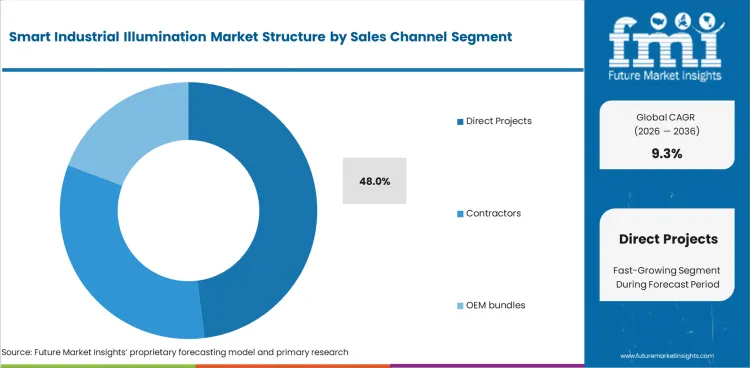
- Direct projects are projected to account for 48.0% of sales channel demand in 2026. Large industrial sites often need design checks and system integration before approval.
- Direct projects dominate sales because large industrial sites require upfront design validation and system integration before procurement.
Smart Industrial Illumination Market Drivers, Restraints, and Opportunities
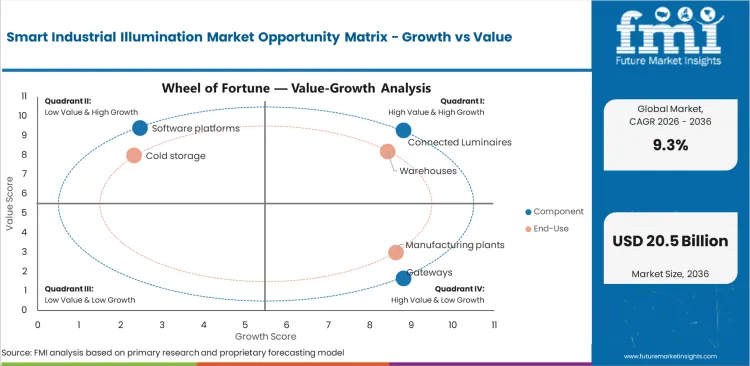
- Energy reporting is pushing buyers toward luminaires that can show savings after installation.
- Controls integration creates project delays when lighting networks must connect with plant systems.
- Sensor-rich lighting creates opportunity in predictive maintenance and industrial space analytics.
Energy rules are making industrial lighting a measurable building upgrade. The European Commission advanced minimum energy performance work in 2024 with non-residential thresholds that target the worst performing 16% by 2030 and 26% by 2033. Those rules encourage owners to choose lighting projects that can be verified. Suppliers with smart building experience can link lighting performance to broader renovation planning.
One of the significant restraint is integration risk between luminaires and older site controls. A warehouse may use modern control software in one zone and older switchgear in another. This gap raises commissioning time and can slow acceptance testing. Suppliers that build smart spaces around open protocols can reduce rework during handover.
Opportunity is expanding in applications that use light points as data points. Human-centric lighting can support shift work where comfort and visibility affect task quality. Asset tracking can use ceiling sensors to understand movement across a plant floor. Predictive maintenance becomes more useful when fixture health, occupancy, and temperature data are viewed together.
Analysis of Smart Industrial Illumination Market By Key Countries
.webp "Top Country Growth Comparison Smart Industrial Illumination Market Cagr (2026 2036)")
| Country | CAGR |
|---|---|
| South Korea | 11.5% |
| Japan | 10.9% |
| UK | 10.2% |
| Germany | 9.6% |
| India | 8.7% |
| China | 8.4% |
| USA | 7.9% |
Source: Future Market Insights, 2026.
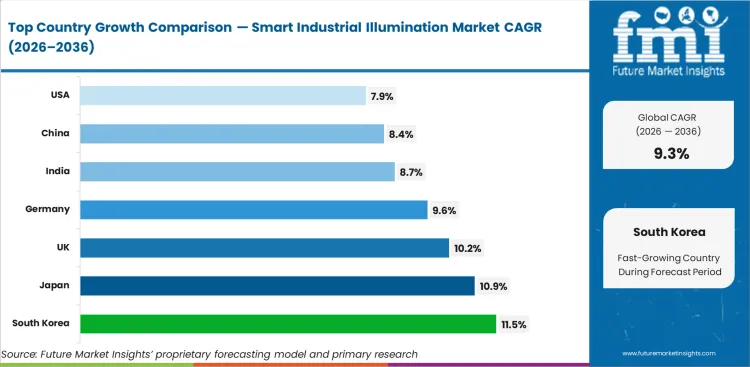
Smart Industrial Illumination Market CAGR Analysis By Country
- South Korea is expected to post 11.5% CAGR through 2036 as digital factory policy supports sensor-linked plant upgrades.
- Japan is forecast at 10.9% CAGR through 2036 as factories seek lower power use and better maintenance visibility.
- The UK is projected to rise at 10.2% CAGR through 2036 as non-domestic building efficiency work supports connected lighting upgrades.
- Germany is expected to advance at 9.6% CAGR through 2036 as industrial energy pressure supports control-rich lighting projects.
- India is forecast to grow at 8.7% CAGR through 2036 as new industrial parks create greenfield lighting opportunities.
- China is expected to expand at 8.4% CAGR through 2036 as smart factory scale creates demand for networked luminaires.
- The USA is projected to record 7.9% CAGR through 2036 as warehouse retrofits and private nonresidential projects support demand.
Demand for smart industrial illumination is forecast to rise at 9.3% CAGR from 2026 to 2036. Country-level analysis covers large industrial economies and markets with visible factory or building efficiency activity. South Korea, Japan, and the UK are forecast above the global pace. The USA and China remain large commercial markets even with lower country CAGRs.
Demand Outlook for Smart Industrial Illumination Market in the United States
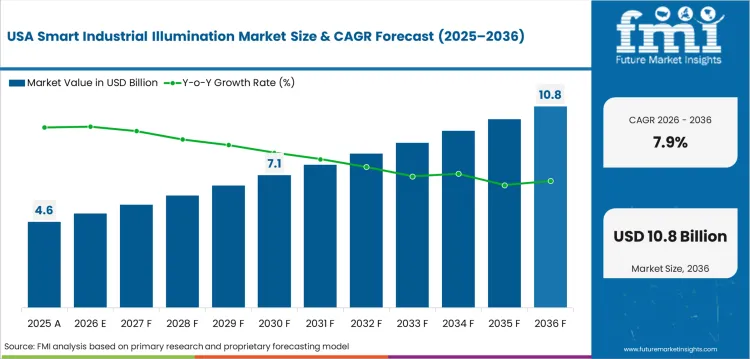
The USA smart industrial illumination industry is projected to record 7.9% CAGR through 2036 as private nonresidential upgrades support retrofit activity. The United States Census Bureau reported January 2026 construction spending at an annual rate of USD 2190.4 billion, with private nonresidential construction at USD 728.2 billion. This construction activity gives lighting suppliers a steady project pipeline in industrial and logistics buildings. Warehouses using warehouse digital twin tools need fixtures and sensors that can map activity by zone.
- Warehouse owners are expected to favor lighting networks that align with shift schedules and dock use.
- Projects that combine sensors with warehouse robotics can improve visibility around fast-moving equipment.
- Electrical contractors remain important because retrofit timing depends on site access and safe shutdown windows.
Sales Analysis of Smart Industrial Illumination Market in China
China is expected to expand at 8.4% CAGR through 2036 as factory digitalization strengthens the case for networked lighting. China’s Ministry of Industry and Information Technology said the country had built over 30000 basic-level smart factories by February 2025. That factory scale supports connected luminaires and smart nodes across production floors. Local buyers are expected to value systems that connect light control with energy monitoring.
- Smart factory upgrades create repeat need for sensors and gateways inside manufacturing buildings.
- Local suppliers can compete when fixtures meet plant controls and safety acceptance needs.
- Multisite manufacturers are expected to favor software that gives consistent reporting across plants.
Demand Outlook for Smart Industrial Illumination Market in India
India is forecast to grow at 8.7% CAGR through 2036 as industrial parks increase greenfield lighting demand. India’s Press Information Bureau reported in March 2026 that the country had 306 plug-and-play industrial parks and 20 additional parks and smart cities under development. This pipeline supports direct project sales for luminaires, sensors, and gateway packages. Suppliers that train contractors can improve installation quality across dispersed sites.
- New industrial parks create demand for lighting plans during early building design.
- Energy optimization is expected to drive buying in warehouses and manufacturing plants.
- Contractor networks matter because project execution is spread across many states and city clusters.
Opportunity Analysis of Smart Industrial Illumination Market in Germany
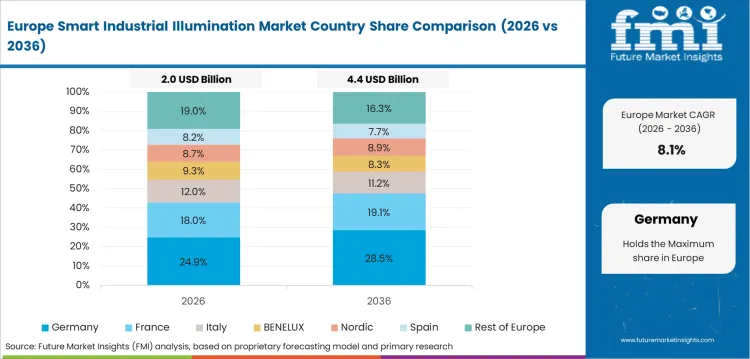
Germany is expected to advance at 9.6% CAGR through 2036 as energy cost control supports connected lighting investment. Germany’s statistics office reported gross electricity production of 507.5 billion kWh in 2025, with renewable power accounting for 57.2%. Industrial buyers are expected to use lighting controls to manage site-level electricity load more closely. Campus projects may extend the same control thinking to LED smart light pole assets outside plants.
- Factory owners are expected to favor wired control in core production zones.
- Hybrid systems can suit retrofits where wireless sensors avoid disruptive cable work.
- Lighting suppliers with automation partners can reduce control handover risk in complex buildings.
Future Outlook for Smart Industrial Illumination Market in the United Kingdom
The UK is projected to rise at 10.2% CAGR through 2036 as non-domestic energy management strengthens the retrofit case. The United Kingdom Department for Energy Security and Net Zero recorded 1748;000 non-domestic buildings in England and Wales at the end of March 2025. The same 2025 framework reported 120 TWh of electricity use across non-domestic buildings during 2023. This building stock creates a broad addressable field for lighting control upgrades.
- Factories and warehouses are expected to prioritize systems that show electricity savings after installation.
- Direct projects can gain share when building owners need audit-ready energy data.
- Contractors remain central to retrofit timing because many sites must stay open during lighting work.
Sales Outlook for Smart Industrial Illumination Market in Japan
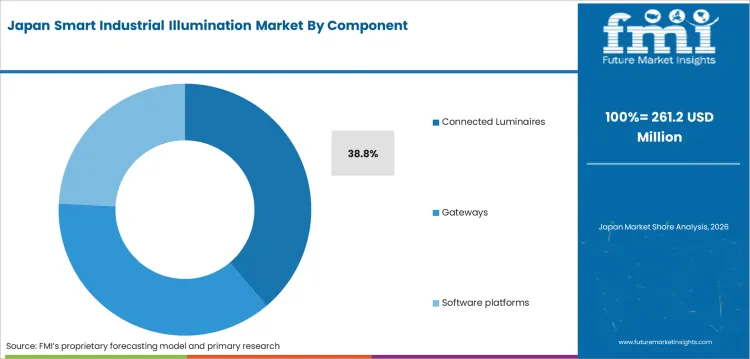
Japan is forecast at 10.9% CAGR through 2036 as industrial decarbonization pressure supports lighting control projects. Japan’s Statistics Bureau reported that the industrial sector produced 340 million tons of carbon dioxide in fiscal 2023. This keeps plant energy management high on the operating agenda. Lighting suppliers can benefit when systems reduce power use and produce data for facility managers.
- Manufacturing plants are expected to lead demand where lighting quality affects inspection and safety.
- Connected luminaires can replace older fixtures while adding zone-level measurement.
- Automation-friendly software improves the case for predictive maintenance in large factory buildings.
Demand Analysis of Smart Industrial Illumination Market in South Korea
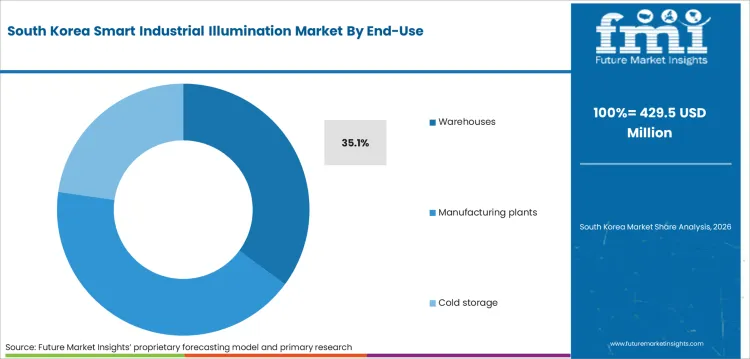
South Korea is expected to post 11.5% CAGR through 2036 as factory automation supports faster use of connected lighting. The country’s Ministry of SMEs and Startups said its 2025 plan would introduce robots, data-driven smart factories, and autonomous factory tools in over 1700 manufacturing small and medium-sized enterprises. Lighting systems can serve as useful ceiling networks for sensing and safety alerts. Suppliers with local automation ties are expected to see stronger project access.
- Smart nodes are expected to gain as factories use ceiling points for sensor coverage.
- Hybrid connectivity can fit plants that combine new wireless sensing with existing wired control.
- Project buyers are expected to value low downtime because factory work cannot pause for long lighting upgrades.
Competitive Landscape and Strategic Positioning
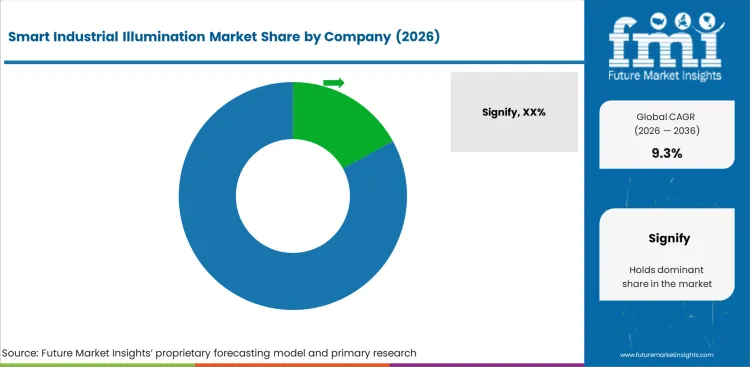
Smart Industrial Illumination Market Analysis By Company
- Signify leads with connected luminaires and Interact controls across industrial projects.
- Acuity Inc. holds a strong North American position through lighting brands and intelligent spaces capability.
- Zumtobel Group and TRILUX compete in European industrial lighting through product depth and project support.
- Schneider Electric, Siemens, ABB, Eaton, and Legrand connect lighting into wider automation and electrical systems.
Competition is shaped by project delivery and control integration depth. Lighting specialists win when they can supply fixtures, sensors, and software as one system. Automation companies stand out when lighting becomes part of a wider controls package. Suppliers linked to high end lighting design language can use better visual comfort as a differentiator in premium industrial spaces.
Barriers include commissioning time, protocol compatibility, and proof of energy savings. Large buyers are expected to prefer vendors that can show past industrial work and support multiple buildings. Smaller suppliers can compete in retrofit work when they offer faster installation and local service coverage. Price alone is less useful when a site needs control data and reliable handover.
Key Companies in the Smart Industrial Illumination Market
Key global companies active in the smart industrial illumination market include:
- Luminaires and controls leaders: Signify, Acuity Inc., Zumtobel Group, TRILUX, and Cree Lighting.
- Automation and power integrators: Schneider Electric, Siemens, ABB, Eaton, and Legrand.
- Platform strength is strongest where suppliers combine fixture portfolios with controls, sensors, and installation partners.
- Signify is assigned an estimated 14.0% 2026 share based on connected lighting scale and industrial control breadth.
Competitive Benchmarking: Smart Industrial Illumination Market
| Company | Sensor-embedded luminaires | Controls integration depth | Industrial channel reach | Geographic footprint |
|---|---|---|---|---|
| Signify | High | Strong | High | Global, with Interact and broad professional lighting coverage |
| Acuity Inc. | High | Strong | High | North America centered, with intelligent spaces capability |
| Zumtobel Group | High | Strong | Medium | Europe centered, with industrial and architectural lighting depth |
| Schneider Electric | Medium | Strong | High | Global, with electrical and building control channels |
| Siemens | Medium | Strong | High | Global, with automation and smart building partnerships |
| Eaton | Medium | Medium | High | Global, with electrical systems and emergency lighting depth |
| ABB | Medium | Strong | High | Global, with automation and DC building technology ties |
| Legrand | Medium | Strong | High | Global, with lighting control and wiring device strength |
| Cree Lighting | Medium | Medium | Medium | North America centered, with industrial and harsh-environment lighting |
| TRILUX | High | Medium | Medium | Europe centered, with industry and logistics lighting coverage |
Source: Future Market Insights, 2026.
Key Developments in Smart Industrial Illumination Market
- In August 2025, Acuity Brands Lighting had nine solutions selected for the 2025 Illuminating Engineering Society Progress Report.
- In June 2024, Schneider Electric launched its SMART Buildings division in Canada to integrate energy efficiency, lighting, security, and maintenance.
- In February 2026, Cree Lighting announced a long-term contract manufacturing agreement to strengthen capacity and restore delivery performance.
- In September 2024, TRILUX opened a new production and development site in Poland with EUR 32 million investment and planned capacity of up to 1 million luminaires per year.
Key Players in the Smart Industrial Illumination Market
Major Global Lighting Players:
- Signify
- Acuity Inc.
- Zumtobel Group
- TRILUX
- Cree Lighting
Automation and Power Integrators:
- Schneider Electric
- Siemens
- ABB
- Eaton
- Legrand
Report Scope and Coverage
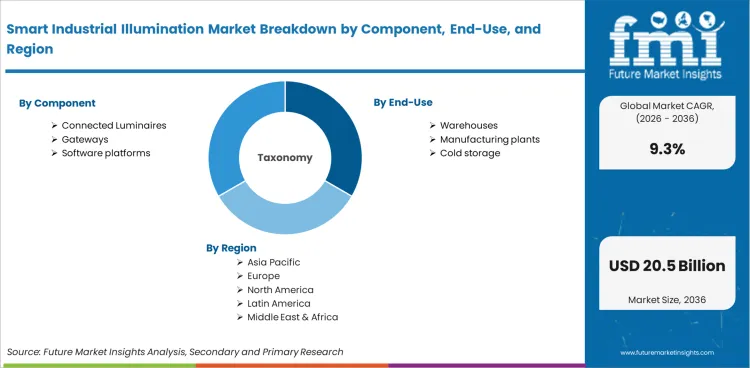
Smart Industrial Illumination Market Breakdown By Component, End Use, Connectivity, Application, Sales Channel, And Region
| Parameter | Details |
|---|---|
| Quantitative Units | USD 8.40 billion to USD 20.50 billion, at 9.3% CAGR |
| Market Definition | Connected lighting systems used in industrial buildings for illumination, control, sensing, and energy management |
| Component | Connected luminaires, Smart nodes, Gateways, Software platforms |
| End Use | Warehouses, Manufacturing plants, Cold storage, Retail backrooms |
| Connectivity | Hybrid, Wired DALI, Wireless BLE |
| Application | Energy optimization, Safety compliance, Asset tracking, Predictive maintenance |
| Sales Channel | Direct projects, Contractors, OEM bundles |
| Regions Covered | North America, Latin America, Europe, East Asia, South Asia and Pacific, Middle East and Africa |
| Countries Covered | USA, UK, Germany, China, India, Japan, South Korea, and 30 plus countries |
| Key Companies Profiled | Signify, Acuity Inc., Zumtobel Group, Schneider Electric, Siemens, Eaton, ABB, Legrand, Cree Lighting, TRILUX |
| Forecast Period | 2026 to 2036 |
| Approach | Hybrid bottom-up and top-down method using project demand, retrofit intensity, and smart industrial activity |
Source: Future Market Insights, 2026.
Smart Industrial Illumination Market by Segments
Smart Industrial Illumination Market Segmented by Component:
- Connected luminaires
- Smart nodes
- Gateways
- Software platforms
Smart Industrial Illumination Market Segmented by End Use:
- Warehouses
- Manufacturing plants
- Cold storage
- Retail backrooms
Smart Industrial Illumination Market Segmented by Connectivity:
- Hybrid
- Wired DALI
- Wireless BLE
Smart Industrial Illumination Market Segmented by Application:
- Energy optimization
- Safety compliance
- Asset tracking
- Predictive maintenance
Smart Industrial Illumination Market Segmented by Sales Channel:
- Direct projects
- Contractors
- OEM bundles
Smart Industrial Illumination Market by Region:
- North America
- USA
- Canada
- Mexico
- Latin America
- Brazil
- Chile
- Rest of Latin America
- Europe
- Germany
- UK
- Italy
- Spain
- France
- Rest of Europe
- East Asia
- China
- Japan
- South Korea
- South Asia and Pacific
- India
- ASEAN
- Australia and New Zealand
- Rest of South Asia and Pacific
- Middle East and Africa
- Saudi Arabia
- Other Gulf Cooperation Council Countries
- South Africa
- Rest of Middle East and Africa
Research Sources and Bibliography
- 1. USA Department of Energy. (2024, August 16). 2024 recognitions. Integrated Lighting Campaign.
- 2. International Energy Agency. (2025). Energy efficiency policy toolkit 2025.
- 3. European Commission. (2024). Minimum energy performance standards for non-residential buildings and trajectories for the progressive renovation of residential buildings.
- 4. USA Census Bureau. (2026, March 23). Monthly construction spending, January 2026.
- 5. State Council of the People’s Republic of China. (2025, February 12). China establishes over 30,000 smart factories: Ministry.
- 6. Press Information Bureau. (2026, March 27). Press release on industrial parks and industrial corridor development. Government of India.
- 7. Federal Statistical Office of Germany. (2026, February). Gross electricity production in Germany 2019 to 2025.
- 8. Department for Energy Security and Net Zero. (2025, August 21). Non-domestic National Energy Efficiency Data-Framework 2025.
- 9. Statistics Bureau of Japan. (2025). Statistical handbook of Japan 2025.
- 10. Ministry of SMEs and Startups. (2025, January 10). Ministry of SMEs and Startups announces plan for 2025.
- 11. Signify. (2025, November 27). Signify enables greater control and energy savings for site managers with Signify Interact motion and daylight DALI sensors.
- 12. Siemens. (2024, February 29). Siemens, Enlighted, and Zumtobel Group partner to advance smart building solutions.
- 13. ABB. (2024, October 8). ABB and Zumtobel Group partner to advance smart lighting and building solutions and direct current industry applications.
- 14. Legrand. (2025, April 29). Legrand launches Wattstopper i3 with KODE Labs.
- 15. European Investment Bank. (2024, December 11). Austria: EIB supports Zumtobel Group in the development of innovative lighting solutions.
- 16. Eaton. (2024, March 4). Eaton to unveil its latest products and software at Light + Building 2024.
- 17. Acuity Inc. (2025, August 25). Nine innovative lighting solutions from Acuity Brands Lighting selected for the 2025 IES Progress Report.
- 18. Schneider Electric. (2024, June 25). Schneider Electric launches SMART Buildings division to drive sustainable building innovation in Canada.
- 19. Cree Lighting. (2026, February 26). Cree Lighting announces long-term strategic manufacturing agreement to strengthen capacity and restore delivery performance.
- 20. TRILUX. (2024, September). TRILUX opens new factory in Poland.
This Report Answers
- What is the current valuation of the Smart Industrial Illumination Market?
- How fast is the Smart Industrial Illumination Market projected to expand from 2026 to 2036?
- Which component segment is projected to lead the Smart Industrial Illumination Market in 2026?
- Which end-use segment is expected to create the largest demand pool?
- Which country is forecast to record the fastest CAGR through 2036?
- Which companies are active in connected industrial lighting and controls?
- How do energy rules and smart factory activity affect buying decisions?
Frequently Asked Questions
What is the Smart Industrial Illumination Market worth in 2026?
The Smart Industrial Illumination Market is forecast to reach USD 8.40 billion in 2026. It is expected to reach USD 20.50 billion by 2036.
What CAGR is expected for the Smart Industrial Illumination Market?
The Smart Industrial Illumination Market is projected to expand at 9.3% CAGR from 2026 to 2036 as industrial sites add connected controls.
Which component leads the Smart Industrial Illumination Market?
Connected luminaires are projected to lead component demand with 38.0% share in 2026 as industrial buyers prefer fixtures with sensing functions.
Which application leads the Smart Industrial Illumination Market?
Energy optimization is expected to lead application demand with 41.0% share in 2026 as facility teams need measured savings after installation.
Which country grows fastest in the Smart Industrial Illumination Market?
South Korea is expected to record the fastest country pace at 11.5% CAGR through 2036 as factory automation supports connected lighting.
How does smart industrial illumination work?
Smart industrial illumination uses connected fixtures and sensors to adjust light by occupancy. Gateways and software coordinate zones and safety rules.
What gives smart industrial illumination better payback?
Payback improves when fixtures reduce power use and cut maintenance visits. Energy data gives facility teams proof after the project is complete.
How long do smart industrial illumination systems last?
Service life depends on fixture quality and driver design. Connected LED systems usually reduce replacement frequency when compared with older industrial lighting.
How should buyers compare smart industrial illumination suppliers?
Buyers should compare fixture performance and controls compatibility first. Project references and after-installation support should guide final supplier selection.
Preview the report firsthand - request a free sample
Get SampleGet the brochure for pricing and purchase details.
Get PDFTable of Content
- Executive Summary
- Global Market Outlook
- Demand-side Trends
- Supply-side Trends
- Technology Roadmap Analysis
- Analysis and Recommendations
- Market Overview
- Market Coverage / Taxonomy
- Market Definition / Scope / Limitations
- Research Methodology
- Chapter Orientation
- Analytical Lens and Working Hypotheses
- Market Structure, Signals, and Trend Drivers
- Benchmarking and Cross-market Comparability
- Market Sizing, Forecasting, and Opportunity Mapping
- Research Design and Evidence Framework
- Desk Research Programme (Secondary Evidence)
- Company Annual and Sustainability Reports
- Peer-reviewed Journals and Academic Literature
- Corporate Websites, Product Literature, and Technical Notes
- Earnings Decks and Investor Briefings
- Statutory Filings and Regulatory Disclosures
- Technical White Papers and Standards Notes
- Trade Journals, Industry Magazines, and Analyst Briefs
- Conference Proceedings, Webinars, and Seminar Materials
- Government Statistics Portals and Public Data Releases
- Press Releases and Reputable Media Coverage
- Specialist Newsletters and Curated Briefings
- Sector Databases and Reference Repositories
- FMI Internal Proprietary Databases and Historical Market Datasets
- Subscription Datasets and Paid Sources
- Social Channels, Communities, and Digital Listening Inputs
- Additional Desk Sources
- Expert Input and Fieldwork (Primary Evidence)
- Primary Modes
- Qualitative Interviews and Expert Elicitation
- Quantitative Surveys and Structured Data Capture
- Blended Approach
- Why Primary Evidence is Used
- Field Techniques
- Interviews
- Surveys
- Focus Groups
- Observational and In-context Research
- Social and Community Interactions
- Stakeholder Universe Engaged
- C-suite Leaders
- Board Members
- Presidents and Vice Presidents
- R&D and Innovation Heads
- Technical Specialists
- Domain Subject-matter Experts
- Scientists
- Physicians and Other Healthcare Professionals
- Governance, Ethics, and Data Stewardship
- Research Ethics
- Data Integrity and Handling
- Primary Modes
- Tooling, Models, and Reference Databases
- Desk Research Programme (Secondary Evidence)
- Data Engineering and Model Build
- Data Acquisition and Ingestion
- Cleaning, Normalisation, and Verification
- Synthesis, Triangulation, and Analysis
- Quality Assurance and Audit Trail
- Market Background
- Market Dynamics
- Drivers
- Restraints
- Opportunity
- Trends
- Scenario Forecast
- Demand in Optimistic Scenario
- Demand in Likely Scenario
- Demand in Conservative Scenario
- Opportunity Map Analysis
- Product Life Cycle Analysis
- Supply Chain Analysis
- Investment Feasibility Matrix
- Value Chain Analysis
- PESTLE and Porter’s Analysis
- Regulatory Landscape
- Regional Parent Market Outlook
- Production and Consumption Statistics
- Import and Export Statistics
- Market Dynamics
- Global Market Analysis 2021 to 2025 and Forecast, 2026 to 2036
- Historical Market Size Value (USD Million) Analysis, 2021 to 2025
- Current and Future Market Size Value (USD Million) Projections, 2026 to 2036
- Y-o-Y Growth Trend Analysis
- Absolute $ Opportunity Analysis
- Global Market Pricing Analysis 2021 to 2025 and Forecast 2026 to 2036
- Global Market Analysis 2021 to 2025 and Forecast 2026 to 2036, By Component
- Introduction / Key Findings
- Historical Market Size Value (USD Million) Analysis By Component , 2021 to 2025
- Current and Future Market Size Value (USD Million) Analysis and Forecast By Component , 2026 to 2036
- Connected Luminaires
- Gateways
- Software platforms
- Connected Luminaires
- Y-o-Y Growth Trend Analysis By Component , 2021 to 2025
- Absolute $ Opportunity Analysis By Component , 2026 to 2036
- Global Market Analysis 2021 to 2025 and Forecast 2026 to 2036, By End-Use
- Introduction / Key Findings
- Historical Market Size Value (USD Million) Analysis By End-Use, 2021 to 2025
- Current and Future Market Size Value (USD Million) Analysis and Forecast By End-Use, 2026 to 2036
- Warehouses
- Manufacturing plants
- Cold storage
- Warehouses
- Y-o-Y Growth Trend Analysis By End-Use, 2021 to 2025
- Absolute $ Opportunity Analysis By End-Use, 2026 to 2036
- Global Market Analysis 2021 to 2025 and Forecast 2026 to 2036, By Connectivity
- Introduction / Key Findings
- Historical Market Size Value (USD Million) Analysis By Connectivity, 2021 to 2025
- Current and Future Market Size Value (USD Million) Analysis and Forecast By Connectivity, 2026 to 2036
- Hybrid
- Wired DALI
- Wireless BLE
- Hybrid
- Y-o-Y Growth Trend Analysis By Connectivity, 2021 to 2025
- Absolute $ Opportunity Analysis By Connectivity, 2026 to 2036
- Global Market Analysis 2021 to 2025 and Forecast 2026 to 2036, By Application
- Introduction / Key Findings
- Historical Market Size Value (USD Million) Analysis By Application, 2021 to 2025
- Current and Future Market Size Value (USD Million) Analysis and Forecast By Application, 2026 to 2036
- Energy Optimization
- Safety compliance
- Asset tracking
- Energy Optimization
- Y-o-Y Growth Trend Analysis By Application, 2021 to 2025
- Absolute $ Opportunity Analysis By Application, 2026 to 2036
- Global Market Analysis 2021 to 2025 and Forecast 2026 to 2036, By Sales Channel
- Introduction / Key Findings
- Historical Market Size Value (USD Million) Analysis By Sales Channel, 2021 to 2025
- Current and Future Market Size Value (USD Million) Analysis and Forecast By Sales Channel, 2026 to 2036
- Direct Projects
- Contractors
- OEM bundles
- Direct Projects
- Y-o-Y Growth Trend Analysis By Sales Channel, 2021 to 2025
- Absolute $ Opportunity Analysis By Sales Channel, 2026 to 2036
- Global Market Analysis 2021 to 2025 and Forecast 2026 to 2036, By Region
- Introduction
- Historical Market Size Value (USD Million) Analysis By Region, 2021 to 2025
- Current Market Size Value (USD Million) Analysis and Forecast By Region, 2026 to 2036
- North America
- Latin America
- Western Europe
- Eastern Europe
- East Asia
- South Asia and Pacific
- Middle East & Africa
- Market Attractiveness Analysis By Region
- North America Market Analysis 2021 to 2025 and Forecast 2026 to 2036, By Country
- Historical Market Size Value (USD Million) Trend Analysis By Market Taxonomy, 2021 to 2025
- Market Size Value (USD Million) Forecast By Market Taxonomy, 2026 to 2036
- By Country
- USA
- Canada
- Mexico
- By Component
- By End-Use
- By Connectivity
- By Application
- By Sales Channel
- By Country
- Market Attractiveness Analysis
- By Country
- By Component
- By End-Use
- By Connectivity
- By Application
- By Sales Channel
- Key Takeaways
- Latin America Market Analysis 2021 to 2025 and Forecast 2026 to 2036, By Country
- Historical Market Size Value (USD Million) Trend Analysis By Market Taxonomy, 2021 to 2025
- Market Size Value (USD Million) Forecast By Market Taxonomy, 2026 to 2036
- By Country
- Brazil
- Chile
- Rest of Latin America
- By Component
- By End-Use
- By Connectivity
- By Application
- By Sales Channel
- By Country
- Market Attractiveness Analysis
- By Country
- By Component
- By End-Use
- By Connectivity
- By Application
- By Sales Channel
- Key Takeaways
- Western Europe Market Analysis 2021 to 2025 and Forecast 2026 to 2036, By Country
- Historical Market Size Value (USD Million) Trend Analysis By Market Taxonomy, 2021 to 2025
- Market Size Value (USD Million) Forecast By Market Taxonomy, 2026 to 2036
- By Country
- Germany
- UK
- Italy
- Spain
- France
- Nordic
- BENELUX
- Rest of Western Europe
- By Component
- By End-Use
- By Connectivity
- By Application
- By Sales Channel
- By Country
- Market Attractiveness Analysis
- By Country
- By Component
- By End-Use
- By Connectivity
- By Application
- By Sales Channel
- Key Takeaways
- Eastern Europe Market Analysis 2021 to 2025 and Forecast 2026 to 2036, By Country
- Historical Market Size Value (USD Million) Trend Analysis By Market Taxonomy, 2021 to 2025
- Market Size Value (USD Million) Forecast By Market Taxonomy, 2026 to 2036
- By Country
- Russia
- Poland
- Hungary
- Balkan & Baltic
- Rest of Eastern Europe
- By Component
- By End-Use
- By Connectivity
- By Application
- By Sales Channel
- By Country
- Market Attractiveness Analysis
- By Country
- By Component
- By End-Use
- By Connectivity
- By Application
- By Sales Channel
- Key Takeaways
- East Asia Market Analysis 2021 to 2025 and Forecast 2026 to 2036, By Country
- Historical Market Size Value (USD Million) Trend Analysis By Market Taxonomy, 2021 to 2025
- Market Size Value (USD Million) Forecast By Market Taxonomy, 2026 to 2036
- By Country
- China
- Japan
- South Korea
- By Component
- By End-Use
- By Connectivity
- By Application
- By Sales Channel
- By Country
- Market Attractiveness Analysis
- By Country
- By Component
- By End-Use
- By Connectivity
- By Application
- By Sales Channel
- Key Takeaways
- South Asia and Pacific Market Analysis 2021 to 2025 and Forecast 2026 to 2036, By Country
- Historical Market Size Value (USD Million) Trend Analysis By Market Taxonomy, 2021 to 2025
- Market Size Value (USD Million) Forecast By Market Taxonomy, 2026 to 2036
- By Country
- India
- ASEAN
- Australia & New Zealand
- Rest of South Asia and Pacific
- By Component
- By End-Use
- By Connectivity
- By Application
- By Sales Channel
- By Country
- Market Attractiveness Analysis
- By Country
- By Component
- By End-Use
- By Connectivity
- By Application
- By Sales Channel
- Key Takeaways
- Middle East & Africa Market Analysis 2021 to 2025 and Forecast 2026 to 2036, By Country
- Historical Market Size Value (USD Million) Trend Analysis By Market Taxonomy, 2021 to 2025
- Market Size Value (USD Million) Forecast By Market Taxonomy, 2026 to 2036
- By Country
- Kingdom of Saudi Arabia
- Other GCC Countries
- Turkiye
- South Africa
- Other African Union
- Rest of Middle East & Africa
- By Component
- By End-Use
- By Connectivity
- By Application
- By Sales Channel
- By Country
- Market Attractiveness Analysis
- By Country
- By Component
- By End-Use
- By Connectivity
- By Application
- By Sales Channel
- Key Takeaways
- Key Countries Market Analysis
- USA
- Pricing Analysis
- Market Share Analysis, 2025
- By Component
- By End-Use
- By Connectivity
- By Application
- By Sales Channel
- Canada
- Pricing Analysis
- Market Share Analysis, 2025
- By Component
- By End-Use
- By Connectivity
- By Application
- By Sales Channel
- Mexico
- Pricing Analysis
- Market Share Analysis, 2025
- By Component
- By End-Use
- By Connectivity
- By Application
- By Sales Channel
- Brazil
- Pricing Analysis
- Market Share Analysis, 2025
- By Component
- By End-Use
- By Connectivity
- By Application
- By Sales Channel
- Chile
- Pricing Analysis
- Market Share Analysis, 2025
- By Component
- By End-Use
- By Connectivity
- By Application
- By Sales Channel
- Germany
- Pricing Analysis
- Market Share Analysis, 2025
- By Component
- By End-Use
- By Connectivity
- By Application
- By Sales Channel
- UK
- Pricing Analysis
- Market Share Analysis, 2025
- By Component
- By End-Use
- By Connectivity
- By Application
- By Sales Channel
- Italy
- Pricing Analysis
- Market Share Analysis, 2025
- By Component
- By End-Use
- By Connectivity
- By Application
- By Sales Channel
- Spain
- Pricing Analysis
- Market Share Analysis, 2025
- By Component
- By End-Use
- By Connectivity
- By Application
- By Sales Channel
- France
- Pricing Analysis
- Market Share Analysis, 2025
- By Component
- By End-Use
- By Connectivity
- By Application
- By Sales Channel
- India
- Pricing Analysis
- Market Share Analysis, 2025
- By Component
- By End-Use
- By Connectivity
- By Application
- By Sales Channel
- ASEAN
- Pricing Analysis
- Market Share Analysis, 2025
- By Component
- By End-Use
- By Connectivity
- By Application
- By Sales Channel
- Australia & New Zealand
- Pricing Analysis
- Market Share Analysis, 2025
- By Component
- By End-Use
- By Connectivity
- By Application
- By Sales Channel
- China
- Pricing Analysis
- Market Share Analysis, 2025
- By Component
- By End-Use
- By Connectivity
- By Application
- By Sales Channel
- Japan
- Pricing Analysis
- Market Share Analysis, 2025
- By Component
- By End-Use
- By Connectivity
- By Application
- By Sales Channel
- South Korea
- Pricing Analysis
- Market Share Analysis, 2025
- By Component
- By End-Use
- By Connectivity
- By Application
- By Sales Channel
- Russia
- Pricing Analysis
- Market Share Analysis, 2025
- By Component
- By End-Use
- By Connectivity
- By Application
- By Sales Channel
- Poland
- Pricing Analysis
- Market Share Analysis, 2025
- By Component
- By End-Use
- By Connectivity
- By Application
- By Sales Channel
- Hungary
- Pricing Analysis
- Market Share Analysis, 2025
- By Component
- By End-Use
- By Connectivity
- By Application
- By Sales Channel
- Kingdom of Saudi Arabia
- Pricing Analysis
- Market Share Analysis, 2025
- By Component
- By End-Use
- By Connectivity
- By Application
- By Sales Channel
- Turkiye
- Pricing Analysis
- Market Share Analysis, 2025
- By Component
- By End-Use
- By Connectivity
- By Application
- By Sales Channel
- South Africa
- Pricing Analysis
- Market Share Analysis, 2025
- By Component
- By End-Use
- By Connectivity
- By Application
- By Sales Channel
- USA
- Market Structure Analysis
- Competition Dashboard
- Competition Benchmarking
- Market Share Analysis of Top Players
- By Regional
- By Component
- By End-Use
- By Connectivity
- By Application
- By Sales Channel
- Competition Analysis
- Competition Deep Dive
- Signify
- Overview
- Product Portfolio
- Profitability by Market Segments (Product/Age /Sales Channel/Region)
- Sales Footprint
- Strategy Overview
- Marketing Strategy
- Product Strategy
- Channel Strategy
- Acuity Inc.
- Zumtobel Group
- TRILUX
- Cree Lighting
- Automation and Power Integrators:
- Schneider Electric
- Signify
- Competition Deep Dive
- Assumptions & Acronyms Used


