

- Industry Size (2026)
- USD 4.0 Bn
- Forecast (2036)
- USD 10.8 Bn
- CAGR (2026 to 2036)
- 10.4%
LED Smart Light Pole Market Forecast and Outlook 2026 to 2036
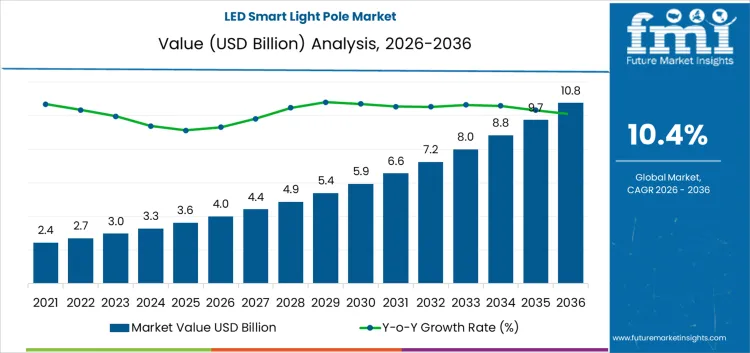
The LED smart light pole market is projected to increase from USD 4.0 billion in 2026 to USD 10.8 billion by 2036, reflecting a CAGR of 10.4%. Demand in this category is shaped by municipal budgeting cycles and infrastructure grant timing rather than by steady replacement programs. Project pipelines fluctuate with election schedules, procurement approvals, and changes in urban development priorities. This planning instability raises buffer costs for both manufacturers and integrators, who must carry excess inventory, maintain flexible installation crews, and reserve fabrication capacity without firm delivery dates. As a result, cost structures in this market are heavier than in conventional street lighting equipment categories.
Variability in project size and specification further complicates execution and pricing discipline. Some cities bundle lighting with sensors, charging points, or communications equipment, while others procure basic poles with limited electronics. Suppliers must therefore manage wide configuration spreads and uncertain order timing. Regional differences in tender rules and financing mechanisms influence how work is staged and paid. Working capital exposure becomes a competitive factor, not just engineering capability. Market expansion depends on the ability to absorb schedule volatility and funding gaps, not on uniform, year by year growth in urban lighting upgrades.
Quick Stats for LED Smart Light Pole Market
- LED Smart Light Pole Market Value (2026): USD 4.0 billion
- LED Smart Light Pole Market Forecast Value (2036): USD 10.8 billion
- LED Smart Light Pole Market Forecast CAGR 2026 to 2036: 10.4%
- Leading Type in LED Smart Light Pole Market: Standard LED smart light poles
- Key Growth Regions in LED Smart Light Pole Market: Asia Pacific, North America, Europe
- Top Players in LED Smart Light Pole Market: Signify (Philips Lighting), Acuity Brands, Schréder, Eaton Corporation, Hubbell Incorporated, Zumtobel Group, Osram Licht AG
What is the Growth Forecast for LED Smart Light Pole Market through 2036?
The expansion of the LED smart light pole market is being driven by a change in how cities treat street infrastructure, shifting from single-purpose assets to multi-function digital nodes. What used to be a lighting project is now often a bundled deployment that combines illumination, cameras, environmental sensors, public Wi-Fi, EV charging interfaces, and traffic management hardware on the same physical structure. This reframes procurement from a maintenance budget decision into an urban infrastructure platform decision. Once a city standardizes on a pole architecture, rollouts follow corridor logic, covering main roads, transit routes, and commercial districts in coordinated programs rather than isolated installations. Growth is therefore governed by municipal platform adoption and rollout sequencing, not by lamp replacement cycles.
The path toward USD 11 billion by 2036 is shaped by replication across districts and secondary cities after initial smart city cores prove operational value. Early deployments focus on visibility and control, while later phases emphasize data utilization and service integration, which raises electronics content per pole even when lighting specifications stay similar. Value growth comes from higher functional density per installation and longer deployment programs rather than from higher pole counts alone. Competitive advantage rests on system integration capability, interoperability with city IT platforms, and long-term service support, since municipalities prioritize reliability, upgrade paths, and lifecycle manageability over hardware-only pricing.
LED Smart Light Pole Market Key Takeaways
| Metric | Value |
|---|---|
| Market Value (2026) | USD 4.0 billion |
| Forecast Value (2036) | USD 10.8 billion |
| Forecast CAGR 2026 to 2036 | 10.4% |
How Is the LED Smart Light Pole Market Transforming Urban and Commercial Lighting?
LED smart light poles are increasingly adopted to provide energy-efficient, connected, and adaptive lighting solutions for streets, campuses, and commercial properties. Historically, conventional street and outdoor lighting relied on static fixtures with limited control, resulting in higher energy consumption and maintenance requirements. Modern smart light poles integrate LED lighting with sensors, wireless connectivity, and control modules to enable dimming, adaptive lighting schedules, and real-time monitoring of energy usage. Municipal authorities, commercial developers, and infrastructure operators prioritize reliability, ease of maintenance, and integration with smart city platforms. Early adoption focused on pilot urban projects, while current demand spans city streets, corporate campuses, and transport hubs, driven by operational efficiency, enhanced safety, and digital connectivity requirements. Luminaire performance, network compatibility, and energy consumption influence supplier selection.
Increasing focus on operational efficiency, public safety, and infrastructure management is shaping market growth. Compared with conventional poles, LED smart poles emphasize automated control, data collection, and adaptability to changing lighting needs. Cost structures depend on LED quality, sensor integration, and connectivity infrastructure, concentrating margins among suppliers delivering reliable, high-performance systems. Operators adopt smart light poles to reduce energy expenditure, improve illumination quality, and support infrastructure monitoring. By 2036, LED smart light poles are expected to enable integrated lighting and urban management networks, providing efficient illumination, real-time monitoring, and enhanced public safety across municipal and commercial environments.
What Factors Are Shaping the Demand for LED Smart Light Poles by System Configuration and Urban Use Case in 2026?
The LED smart light pole market in 2026 is segmented by product type and by application. By system configuration, demand is divided into standard LED smart light poles, solar powered poles, modular IoT integrated poles, and sensor enabled adaptive lighting poles, each offering different balances between functionality, installation complexity, and lifecycle cost. By application, demand is organized around urban street lighting, commercial campuses, parking facilities, and public parks or pedestrian zones, which differ in operating hours, safety requirements, and maintenance access. These segments reflect how municipalities and property owners align infrastructure upgrades with budget cycles, energy strategies, and long term asset management plans.
Why Do Standard LED Smart Light Poles Represent the Largest Installed Base?
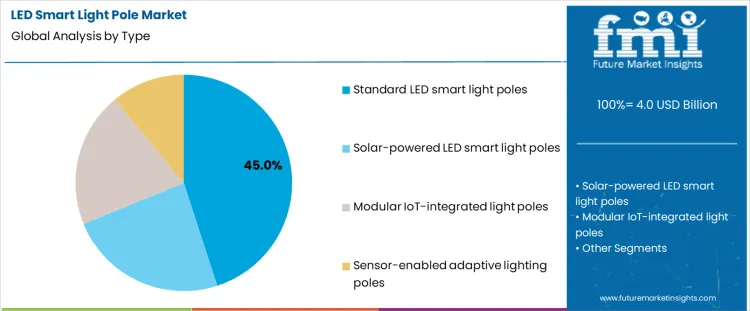
Standard LED smart light poles account for about 45% of demand in 2026, largely because they align with the existing structure of public lighting replacement programs. Many cities are upgrading conventional poles to LED while adding basic connectivity and monitoring features without changing the overall street furniture concept. This approach allows utilities and municipalities to reuse foundations, wiring routes, and maintenance procedures. The technology is familiar, procurement frameworks already exist, and rollout can proceed street by street without major redesign. These poles deliver immediate gains in energy use control and fault monitoring while keeping operational practices stable. The scale of these retrofit programs and the need for predictable execution keep standard configurations as the core volume driver.
Solar powered, modular, and sensor heavy designs address more specific planning goals. Solar poles are chosen where grid access is limited or where energy autonomy is prioritized, but they depend on local climate and space for panels. Modular IoT poles support future upgrades, yet their higher upfront cost slows adoption in budget constrained projects. Sensor enabled adaptive systems offer richer functionality, but they require integration with traffic or city platforms. These options grow through targeted projects, while the bulk of deployments continues to follow the simpler, standardized replacement path.
Why Does Urban Street Lighting Dominate Application Demand?
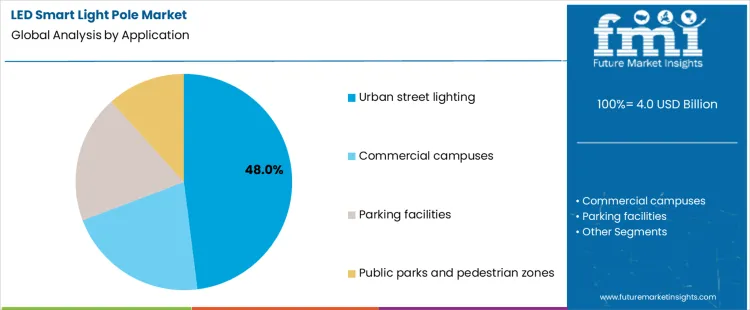
Urban street lighting represents about 48% of demand in 2026 because it covers the largest continuous network of poles under municipal control. Streets require uniform, reliable illumination for safety and traffic flow, and they operate for long hours every day. This creates a strong economic case for efficient, remotely monitored systems. Replacement cycles are often driven by city wide programs rather than by isolated projects, which concentrates spending in this category. Once a standard is selected, thousands of poles can be deployed under one framework contract. This scale effect and the critical role of street lighting in public infrastructure explain why it absorbs the largest share of smart pole investment.
Commercial campuses, parking areas, and parks follow different decision processes. Campus and parking projects are usually site specific and smaller in scale. Parks and pedestrian zones often emphasize design and experience, which leads to selective, feature rich installations rather than mass deployment. These segments adopt smart poles where specific needs justify them, but their total pole counts are far lower than those of street networks. As a result, while they contribute to innovation and feature development, urban street lighting remains the main volume anchor for the market.
How Are the Key Dynamics of City Platform Consolidation, Procurement Risk, and Vendor Rationalization Reshaping the LED Smart Light Pole Market through 2036?
The category is being shaped by how cities manage assets, not by lighting performance alone. Smart poles combine lighting, connectivity, sensing, and power distribution, which turns a streetlight into a multi service node. This creates a strong case for platform standardization across districts, but adoption is slowed by procurement risk, interdepartment coordination, and fear of long term lock in. At the same time, municipalities and utilities want to reduce vendor sprawl and operating complexity through consolidated frameworks. The result is a market driven by governance models and rollout economics, where scale programs, not pilot projects, determine winners and losers.
Why Are City Asset Consolidation and Multi Service Infrastructure Strategies Driving the LED Smart Light Pole Market through 2036?
Demand is being pulled by how cities rationalize street furniture rather than by lighting upgrades. Poles already occupy prime public space and have power access, making them natural hosts for cameras, connectivity, signage, and environmental sensors. Replacing multiple standalone installations with one standardized pole reduces permitting, maintenance, and visual clutter. For utilities, a unified pole platform simplifies grid monitoring and service access. Once a city defines a standard smart pole family, deployment becomes programmatic across districts and years. Volume then follows capital planning cycles and corridor redevelopment schedules rather than isolated smart city pilots or one off technology trials.
What Procurement Risk, Interoperability Concerns, and Lock in Fears Are Slowing Wider Rollout?
The main restraint is institutional risk, not technical feasibility. Smart poles sit at the intersection of lighting, IT, telecom, and public safety, which means multiple departments must agree on specifications and governance. Choosing the wrong platform can lock a city into proprietary interfaces for decades. Interoperability with future sensors and networks is hard to guarantee. Budget approvals are also complex because benefits are spread across agencies while costs sit in one project. Public tender rules favor proven designs and long references, which slows adoption of newer platforms. These factors stretch decision timelines and keep many projects in pilot or limited district phases.
How Are Platformization and Vendor Framework Agreements Changing the Structure of This Category?
The trend is toward fewer, broader platforms rather than bespoke street projects. Cities and utilities increasingly issue framework contracts for standardized pole families that can be configured with different modules over time. This shifts competition from selling individual poles to being accepted into long term infrastructure programs. Suppliers are integrating lighting, mounting systems, power, and data interfaces into unified designs to reduce interface risk. Once a platform is approved, it can be rolled out across multiple projects without re tendering each component. The market is moving from project based procurement to portfolio based deployment governed by multiyear urban infrastructure roadmaps.
What is the Demand for LED Smart Light Poles by Country?

| Country | CAGR (%) |
|---|---|
| US | 9.7% |
| UK | 9.3% |
| China | 11.0% |
| India | 11.8% |
| Brazil | 10.0% |
Demand for LED smart light poles is rising as municipalities and commercial facilities adopt intelligent lighting systems to improve energy efficiency, operational control, and lighting performance. India leads with an 11.8% CAGR, driven by installation of advanced street lighting, growing municipal infrastructure projects, and adoption of smart control systems. China follows at 11.0%, supported by urban lighting projects and integration of connected lighting networks. Brazil records 10.0% growth, shaped by city development projects and adoption of energy-efficient street lighting. The USA grows at 9.7%, influenced by replacement of traditional street lights with smart LED systems. The UK shows 9.3% CAGR, reflecting steady adoption of LED smart poles for public and commercial spaces.
How is the United States experiencing growth in the LED smart light pole market?
United States is experiencing growth at a CAGR of 9.7%, driven by municipal initiatives in smart city programs and infrastructure modernization in states such as California, New York, and Texas. LED smart light poles are optimized for energy-efficient illumination, IoT connectivity, and integration with traffic and public safety systems. Demand is concentrated in urban centers and metropolitan road networks. Investments focus on product reliability, compliance with federal and state electrical codes, and network integration capabilities. Growth reflects the increasing need for connected lighting systems, energy savings, and enhanced urban monitoring.
- Smart city and urban infrastructure are projected to drive adoption.
- Poles optimize energy efficiency and connectivity.
- Metropolitan road networks concentrate demand.
- Regulatory compliance and integration capabilities guide investment.
How is the United Kingdom witnessing growth in the LED smart light pole market?
United Kingdom is witnessing growth at a CAGR of 9.3%, supported by urban lighting upgrades, government-backed smart city programs, and public safety initiatives in London, Birmingham, and Manchester. LED smart light poles are optimized for low-energy operation, IoT-enabled traffic management, and environmental monitoring. Demand is concentrated in municipal roadways, residential districts, and public spaces. Investments prioritize compliance with UK electrical and safety standards, product longevity, and network integration. Growth reflects government-driven initiatives to modernize street lighting infrastructure and enhance operational efficiency.
- Municipal smart city projects drive adoption.
- Poles enhance energy savings and IoT integration.
- Roadways and public spaces concentrate demand.
- Compliance and longevity guide investment.
How is China experiencing growth in the LED smart light pole market?
China is experiencing growth at a CAGR of 11%, fueled by extensive urbanization, industrial park lighting, and smart city deployments in Beijing, Shanghai, and Shenzhen. LED smart light poles are optimized for energy efficiency, sensor-based traffic control, and data connectivity. Demand is concentrated in new urban districts, industrial zones, and expressways. Investments focus on large-scale deployment, reliability, and compliance with national electrical and safety standards. Growth reflects rapid urban expansion, government-backed smart infrastructure projects, and the integration of connected lighting into city management systems.
- Urban development and industrial zones drive adoption.
- Poles optimize traffic management and energy efficiency.
- Industrial and urban districts concentrate demand.
- Reliability and standards compliance guide investment.
How is India witnessing growth in the LED smart light pole market?
India is witnessing growth at a CAGR of 11.8%, supported by government initiatives such as Smart Cities Mission and widespread municipal infrastructure upgrades in Mumbai, Delhi, and Bengaluru. LED smart light poles are optimized for energy-efficient lighting, remote monitoring, and IoT connectivity. Demand is concentrated in urban roads, residential areas, and public infrastructure. Investments prioritize durability, compliance with national electrical codes, and integration with city management platforms. Growth reflects increasing government focus on efficient, connected urban lighting and reducing energy consumption.
- Smart city programs and municipal upgrades drive adoption.
- Poles enhance energy efficiency and remote monitoring.
- Urban roads and public infrastructure concentrate demand.
- Durability and code compliance guide investment.
How is Brazil experiencing growth in the LED smart light pole market?
Brazil is experiencing growth at a CAGR of 10%, driven by municipal lighting modernization, commercial street lighting, and industrial park installations in São Paulo, Rio de Janeiro, and Paraná. LED smart light poles are optimized for energy efficiency, connectivity, and reliability in high-humidity tropical conditions. Demand is concentrated in urban streets, industrial facilities, and public areas. Investments focus on product longevity, compliance with national electrical standards, and integration with monitoring and traffic systems. Growth reflects increasing adoption of smart lighting to improve urban management and reduce operational energy costs.
- Municipal and industrial lighting drives adoption.
- Poles optimize energy efficiency and connectivity.
- Urban streets and industrial zones concentrate demand.
- Longevity and compliance guide investment.
Who Are the Key Competitors in the LED Smart Light Pole Market and How Do They Compete?
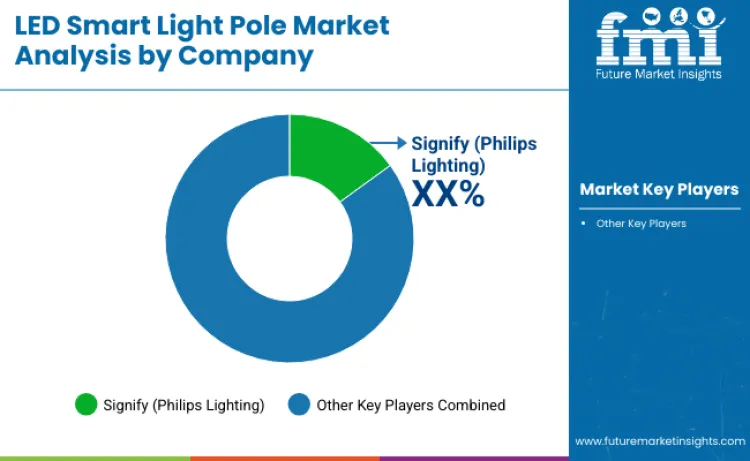
Competition in the LED smart light pole market is shaped by integration of lighting performance, control systems, and connectivity for urban infrastructure. Signify (Philips Lighting) supplies smart light poles that combine high-efficacy LEDs with sensors and networked controls for adaptive illumination and data services. Acuity Brands provides modular LED pole systems with embedded control platforms that support remote monitoring, dimming, and integration with smart city applications. Schréder delivers intelligent poles designed for energy efficiency and sensor interoperability, targeting municipalities seeking connected infrastructure. Eaton Corporation offers smart light poles with robust electrical protection, networked control interfaces, and grid integration capabilities. Hubbell Incorporated supplies LED lighting and control systems engineered for durability and ease of installation in urban, commercial, and industrial settings.
Osram Licht AG develops LED smart pole solutions with advanced optical design and connectivity options for traffic and pedestrian environments. Zumtobel Group provides integrated lighting systems that support adaptive control and energy management tailored to architectural and public spaces. Other regional and specialty suppliers offer solutions focused on local regulatory compliance, wireless control add-ons, or simplified installation for retrofit projects. Competitive differentiation arises from light quality, sensor integration, network compatibility, and service ecosystems that support remote diagnostics and control. Suppliers that combine proven LED performance, interoperable control systems, and support for data-driven urban applications maintain relevance as cities and infrastructure operators adopt smart lighting for energy savings, safety, and connectivity objectives.
Key Players in the LED Smart Light Pole Market
- Signify (Philips Lighting)
- Acuity Brands
- Schréder
- Eaton Corporation
- Hubbell Incorporated
- Zumtobel Group
- Osram Licht AG
Scope of the Report
| Items | Values |
|---|---|
| Quantitative Units (2026) | USD billion |
| Type | Standard LED Smart Light Poles, Solar-Powered LED Smart Light Poles, Modular IoT-Integrated Light Poles, Sensor-Enabled Adaptive Lighting Poles |
| Application | Urban Street Lighting, Commercial Campuses, Parking Facilities, Public Parks and Pedestrian Zones |
| Regions Covered | Asia Pacific, Europe, North America, Latin America, Middle East & Africa |
| Countries Covered | China, Japan, South Korea, India, Australia & New Zealand, ASEAN, Germany, United Kingdom, France, Italy, Spain, Nordic, BENELUX, United States, Canada, Mexico, Brazil, Chile, Saudi Arabia, Turkey, South Africa, and other regional markets |
| Key Companies Profiled | Signify (Philips Lighting), Acuity Brands, Schréder, Eaton Corporation, Hubbell Incorporated, Zumtobel Group, Osram Licht AG |
| Additional Attributes | Dollar sales by type and application; standard smart poles as the largest installed base; urban street lighting as the leading application; demand driven by smart city programs and multi-service infrastructure strategies; procurement shaped by municipal budgeting cycles and framework contracts; adoption constrained by interoperability concerns, procurement risk, and platform lock-in fears. |
LED Smart Light Pole Market Segmentation
Type:
- Standard LED smart light poles
- Solar-powered LED smart light poles
- Modular IoT-integrated light poles
- Sensor-enabled adaptive lighting poles
Application:
- Urban street lighting
- Commercial campuses
- Parking facilities
- Public parks and pedestrian zones
Region:
- Asia Pacific
- China
- Japan
- South Korea
- India
- Australia & New Zealand
- ASEAN
- Rest of Asia Pacific
- Europe
- Germany
- United Kingdom
- France
- Italy
- Spain
- Nordic
- BENELUX
- Rest of Europe
- North America
- United States
- Canada
- Mexico
- Latin America
- Brazil
- Chile
- Rest of Latin America
- Middle East & Africa
- Kingdom of Saudi Arabia
- Other GCC Countries
- Turkey
- South Africa
- Other African Union
- Rest of Middle East & Africa
Bibliography
- International Energy Agency. (2023). Energy efficient lighting and digital controls in cities. IEA.
- United Nations Department of Economic and Social Affairs. (2023). Smart cities and infrastructure: Digital transformation for sustainable development. United Nations.
- USA Department of Energy. (2024). Energy savings potential of connected lighting systems in outdoor and municipal applications. USA DOE.
- USA Department of Energy. (2023). LED lighting and smart controls in public infrastructure. USA DOE.
Frequently Asked Questions
How big is the led smart light pole market in 2026?
The global led smart light pole market is estimated to be valued at USD 4.0 billion in 2026.
What will be the size of led smart light pole market in 2036?
The market size for the led smart light pole market is projected to reach USD 10.8 billion by 2036.
How much will be the led smart light pole market growth between 2026 and 2036?
The led smart light pole market is expected to grow at a 10.4% CAGR between 2026 and 2036.
What are the key product types in the led smart light pole market?
The key product types in led smart light pole market are standard led smart light poles , solar‑powered led smart light poles, modular iot‑integrated light poles and sensor‑enabled adaptive lighting poles.
Which application segment to contribute significant share in the led smart light pole market in 2026?
In terms of application, urban street lighting segment to command 48.0% share in the led smart light pole market in 2026.
Preview the report firsthand - request a free sample
Get SampleGet the brochure for pricing and purchase details.
Get PDFTable of Content
- Executive Summary
- Global Market Outlook
- Demand-side Trends
- Supply-side Trends
- Technology Roadmap Analysis
- Analysis and Recommendations
- Market Overview
- Market Coverage / Taxonomy
- Market Definition / Scope / Limitations
- Market Background
- Market Dynamics
- Drivers
- Restraints
- Opportunity
- Trends
- Scenario Forecast
- Demand in Optimistic Scenario
- Demand in Likely Scenario
- Demand in Conservative Scenario
- Opportunity Map Analysis
- Product Life Cycle Analysis
- Supply Chain Analysis
- Investment Feasibility Matrix
- Value Chain Analysis
- PESTLE and Porter’s Analysis
- Regulatory Landscape
- Regional Parent Market Outlook
- Production and Consumption Statistics
- Import and Export Statistics
- Market Dynamics
- Global Market Analysis 2021 to 2025 and Forecast, 2026 to 2036
- Historical Market Size Value (USD Million) Analysis, 2021 to 2025
- Current and Future Market Size Value (USD Million) Projections, 2026 to 2036
- Y-o-Y Growth Trend Analysis
- Absolute $ Opportunity Analysis
- Global Market Pricing Analysis 2021 to 2025 and Forecast 2026 to 2036
- Global Market Analysis 2021 to 2025 and Forecast 2026 to 2036, By Type
- Introduction / Key Findings
- Historical Market Size Value (USD Million) Analysis By Type, 2021 to 2025
- Current and Future Market Size Value (USD Million) Analysis and Forecast By Type, 2026 to 2036
- Standard LED smart light poles
- Solar‑powered LED smart light poles
- Modular IoT‑integrated light poles
- Sensor‑enabled adaptive lighting poles
- Standard LED smart light poles
- Y-o-Y Growth Trend Analysis By Type, 2021 to 2025
- Absolute $ Opportunity Analysis By Type, 2026 to 2036
- Global Market Analysis 2021 to 2025 and Forecast 2026 to 2036, By Application
- Introduction / Key Findings
- Historical Market Size Value (USD Million) Analysis By Application, 2021 to 2025
- Current and Future Market Size Value (USD Million) Analysis and Forecast By Application, 2026 to 2036
- Urban street lighting
- Commercial campuses
- Parking facilities
- Public parks and pedestrian zones
- Urban street lighting
- Y-o-Y Growth Trend Analysis By Application, 2021 to 2025
- Absolute $ Opportunity Analysis By Application, 2026 to 2036
- Global Market Analysis 2021 to 2025 and Forecast 2026 to 2036, By Region
- Introduction
- Historical Market Size Value (USD Million) Analysis By Region, 2021 to 2025
- Current Market Size Value (USD Million) Analysis and Forecast By Region, 2026 to 2036
- North America
- Latin America
- Western Europe
- Eastern Europe
- East Asia
- South Asia and Pacific
- Middle East & Africa
- Market Attractiveness Analysis By Region
- North America Market Analysis 2021 to 2025 and Forecast 2026 to 2036, By Country
- Historical Market Size Value (USD Million) Trend Analysis By Market Taxonomy, 2021 to 2025
- Market Size Value (USD Million) Forecast By Market Taxonomy, 2026 to 2036
- By Country
- USA
- Canada
- Mexico
- By Type
- By Application
- By Country
- Market Attractiveness Analysis
- By Country
- By Type
- By Application
- Key Takeaways
- Latin America Market Analysis 2021 to 2025 and Forecast 2026 to 2036, By Country
- Historical Market Size Value (USD Million) Trend Analysis By Market Taxonomy, 2021 to 2025
- Market Size Value (USD Million) Forecast By Market Taxonomy, 2026 to 2036
- By Country
- Brazil
- Chile
- Rest of Latin America
- By Type
- By Application
- By Country
- Market Attractiveness Analysis
- By Country
- By Type
- By Application
- Key Takeaways
- Western Europe Market Analysis 2021 to 2025 and Forecast 2026 to 2036, By Country
- Historical Market Size Value (USD Million) Trend Analysis By Market Taxonomy, 2021 to 2025
- Market Size Value (USD Million) Forecast By Market Taxonomy, 2026 to 2036
- By Country
- Germany
- UK
- Italy
- Spain
- France
- Nordic
- BENELUX
- Rest of Western Europe
- By Type
- By Application
- By Country
- Market Attractiveness Analysis
- By Country
- By Type
- By Application
- Key Takeaways
- Eastern Europe Market Analysis 2021 to 2025 and Forecast 2026 to 2036, By Country
- Historical Market Size Value (USD Million) Trend Analysis By Market Taxonomy, 2021 to 2025
- Market Size Value (USD Million) Forecast By Market Taxonomy, 2026 to 2036
- By Country
- Russia
- Poland
- Hungary
- Balkan & Baltic
- Rest of Eastern Europe
- By Type
- By Application
- By Country
- Market Attractiveness Analysis
- By Country
- By Type
- By Application
- Key Takeaways
- East Asia Market Analysis 2021 to 2025 and Forecast 2026 to 2036, By Country
- Historical Market Size Value (USD Million) Trend Analysis By Market Taxonomy, 2021 to 2025
- Market Size Value (USD Million) Forecast By Market Taxonomy, 2026 to 2036
- By Country
- China
- Japan
- South Korea
- By Type
- By Application
- By Country
- Market Attractiveness Analysis
- By Country
- By Type
- By Application
- Key Takeaways
- South Asia and Pacific Market Analysis 2021 to 2025 and Forecast 2026 to 2036, By Country
- Historical Market Size Value (USD Million) Trend Analysis By Market Taxonomy, 2021 to 2025
- Market Size Value (USD Million) Forecast By Market Taxonomy, 2026 to 2036
- By Country
- India
- ASEAN
- Australia & New Zealand
- Rest of South Asia and Pacific
- By Type
- By Application
- By Country
- Market Attractiveness Analysis
- By Country
- By Type
- By Application
- Key Takeaways
- Middle East & Africa Market Analysis 2021 to 2025 and Forecast 2026 to 2036, By Country
- Historical Market Size Value (USD Million) Trend Analysis By Market Taxonomy, 2021 to 2025
- Market Size Value (USD Million) Forecast By Market Taxonomy, 2026 to 2036
- By Country
- Kingdom of Saudi Arabia
- Other GCC Countries
- Turkiye
- South Africa
- Other African Union
- Rest of Middle East & Africa
- By Type
- By Application
- By Country
- Market Attractiveness Analysis
- By Country
- By Type
- By Application
- Key Takeaways
- Key Countries Market Analysis
- USA
- Pricing Analysis
- Market Share Analysis, 2025
- By Type
- By Application
- Canada
- Pricing Analysis
- Market Share Analysis, 2025
- By Type
- By Application
- Mexico
- Pricing Analysis
- Market Share Analysis, 2025
- By Type
- By Application
- Brazil
- Pricing Analysis
- Market Share Analysis, 2025
- By Type
- By Application
- Chile
- Pricing Analysis
- Market Share Analysis, 2025
- By Type
- By Application
- Germany
- Pricing Analysis
- Market Share Analysis, 2025
- By Type
- By Application
- UK
- Pricing Analysis
- Market Share Analysis, 2025
- By Type
- By Application
- Italy
- Pricing Analysis
- Market Share Analysis, 2025
- By Type
- By Application
- Spain
- Pricing Analysis
- Market Share Analysis, 2025
- By Type
- By Application
- France
- Pricing Analysis
- Market Share Analysis, 2025
- By Type
- By Application
- India
- Pricing Analysis
- Market Share Analysis, 2025
- By Type
- By Application
- ASEAN
- Pricing Analysis
- Market Share Analysis, 2025
- By Type
- By Application
- Australia & New Zealand
- Pricing Analysis
- Market Share Analysis, 2025
- By Type
- By Application
- China
- Pricing Analysis
- Market Share Analysis, 2025
- By Type
- By Application
- Japan
- Pricing Analysis
- Market Share Analysis, 2025
- By Type
- By Application
- South Korea
- Pricing Analysis
- Market Share Analysis, 2025
- By Type
- By Application
- Russia
- Pricing Analysis
- Market Share Analysis, 2025
- By Type
- By Application
- Poland
- Pricing Analysis
- Market Share Analysis, 2025
- By Type
- By Application
- Hungary
- Pricing Analysis
- Market Share Analysis, 2025
- By Type
- By Application
- Kingdom of Saudi Arabia
- Pricing Analysis
- Market Share Analysis, 2025
- By Type
- By Application
- Turkiye
- Pricing Analysis
- Market Share Analysis, 2025
- By Type
- By Application
- South Africa
- Pricing Analysis
- Market Share Analysis, 2025
- By Type
- By Application
- USA
- Market Structure Analysis
- Competition Dashboard
- Competition Benchmarking
- Market Share Analysis of Top Players
- By Regional
- By Type
- By Application
- Competition Analysis
- Competition Deep Dive
- Competition Deep Dive
- Assumptions & Acronyms Used
- Research Methodology


