

- Industry Size (2026)
- USD 1.2 Bn
- Forecast (2036)
- USD 3.1 Bn
- CAGR (2026 to 2036)
- 9.90%
Foldable OLED Next-Gen Smart Substrates Market Forecast and Outlook 2026 to 2036
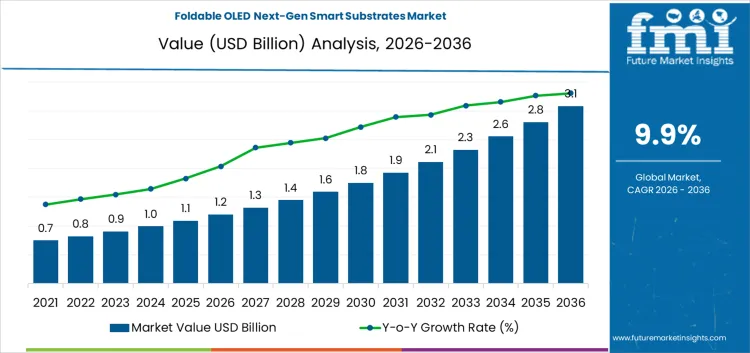
The foldable OLED next-gen smart substrates market is valued at USD 1.2 billion in 2026 and is projected to reach USD 3.1 billion by 2036, expanding at a CAGR of 9.90% over the forecast period. Procurement behavior in this market is being shaped by stringent reliability expectations and high tolerance thresholds for mechanical failure in foldable devices. Purchasing decisions are typically guided by long qualification cycles, where substrates are validated across thousands of fold tests before volume commitments are made. Buyer risk aversion remains elevated, as substrate failure directly impacts brand reputation, warranty exposure, and product recall risk.
Vendor lock-in is reinforced through co-development models, customized material formulations, and process-specific integration with OLED fabrication lines. Once substrates are designed into a display stack, switching costs rise sharply due to requalification requirements, yield disruption risks, and tooling adjustments. As a result, procurement strategies favor established suppliers with proven consistency, scalable capacity, and roadmap alignment, shaping long-term supply relationships and limiting rapid supplier substitution between 2026 and 2036.
Quick Stats for Foldable OLED Next-Gen Smart Substrates Market
- Foldable OLED Next-Gen Smart Substrates Market Value (2026): USD 1.2 Billion
- Foldable OLED Next-Gen Smart Substrates Market Forecast Value (2036): USD 3.1 Billion
- Foldable OLED Next-Gen Smart Substrates Market Forecast CAGR 2026 to 2036: 9.90%
- Leading Substrate Type in Foldable OLED Next-Gen Smart Substrates Market: Ultra-Thin Glass
- Leading Fold Mechanism in Foldable OLED Next-Gen Smart Substrates Market: Inward Fold
- Key Growth Regions in Foldable OLED Next-Gen Smart Substrates Market: Asia Pacific, North America, Europe
- Top Key Players in Foldable OLED Next-Gen Smart Substrates Market: Samsung Display, BOE Technology, LG Display, Tianma, Visionox, AUO
Foldable OLED Next-Gen Smart Substrates Market Key Takeaways
| Metric | Value |
|---|---|
| Industry Value (2026) | USD 1.2 Billion |
| Forecast Value (2036) | USD 3.1 Billion |
| Forecast CAGR 2026 to 2036 | 9.90% |
How Is the Global Foldable OLED Next-Gen Smart Substrates Market Advancing?
The global foldable OLED next-generation smart substrates market is advancing steadily, driven by the increasing adoption of foldable and flexible display technologies in consumer electronics. Smart substrates form the foundational layer for foldable OLED panels, enabling repeated bending while maintaining electrical stability, optical clarity, and mechanical durability. Their role is becoming increasingly critical as device manufacturers push for thinner, lighter, and more compact form factors.
A key driver supporting market growth is the expansion of foldable smartphones, tablets, and emerging form factors such as rollable and multi-fold displays. These applications require substrates with high flexibility, low thermal expansion, and strong resistance to mechanical fatigue. Next-generation smart substrates, including advanced polymer films and hybrid composite structures, are being adopted to meet these performance requirements while supporting high-resolution OLED architectures.
Ongoing advancements in materials engineering and substrate processing technologies are further strengthening market adoption. Improvements in surface treatment, barrier coatings, and stress-relief layer design are enhancing substrate lifespan and yield rates in OLED manufacturing. As foldable display adoption broadens across premium and mid-range devices, the smart substrates market supporting foldable OLED panels is expected to maintain consistent growth over the forecast period.
What Is the Segment-Wise Overview of the Foldable OLED Next-Gen Smart Substrates Market?
The foldable OLED next-gen smart substrates market is defined by material innovation and evolving fold mechanisms. Ultra-thin glass leads the substrate type segment with a 46% share, driven by its superior surface smoothness, optical clarity, and enhanced scratch resistance compared to polymer-based alternatives. These properties support high-resolution OLED performance while enabling reliable fold endurance. Colorless polyimide and hybrid glass-polymer substrates follow, addressing flexibility and durability trade-offs for different device designs. By fold mechanism, inward folding accounts for 43% of demand, reflecting its widespread adoption in foldable smartphones where display protection and compact form factors are critical. Outward fold, rollable, and multi-fold designs are gaining attention but remain secondary as manufacturers prioritize proven designs.
Why Does Ultra-Thin Glass Lead the Foldable OLED Next-Gen Smart Substrates Market?
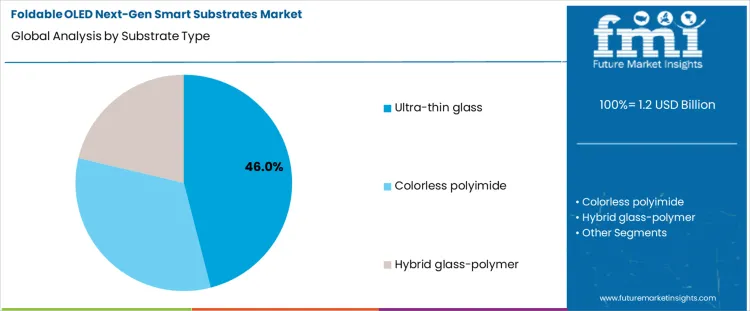
Ultra-thin glass accounts for 46% of the substrate type segment in the Foldable OLED Next-Gen Smart Substrates Market due to its superior optical performance, surface uniformity, and long-term durability. Compared to polymer-based substrates, ultra-thin glass offers better scratch resistance, improved display clarity, and enhanced barrier properties, which are critical for premium foldable OLED devices. Its ability to maintain structural stability while supporting tight bending radii has made it a preferred choice for leading smartphone manufacturers. Advances in chemical strengthening and thickness reduction technologies have further improved fold endurance without compromising mechanical integrity. As foldable devices move toward higher resolution displays and longer product lifecycles, ultra-thin glass continues to dominate as the substrate material that best balances flexibility, reliability, and visual performance.
Why Does Inward Fold Mechanism Dominate the Foldable OLED Next-Gen Smart Substrates Market?
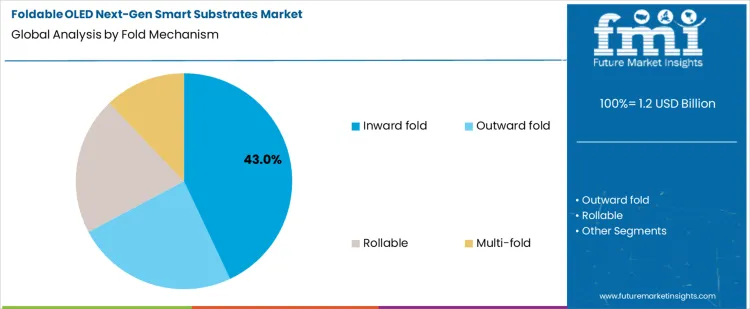
The inward fold mechanism holds a 43% share of the fold mechanism segment, driven by its practical design advantages and strong adoption in foldable smartphones. Inward folding protects the OLED display surface when the device is closed, reducing exposure to scratches, impact, and environmental damage. This design approach aligns well with ultra-thin glass substrates, which benefit from controlled bending stress and reduced external contact. Inward fold designs also enable compact device profiles while maintaining larger internal screen areas, appealing to both manufacturers and consumers. The established manufacturing ecosystem, proven hinge designs, and lower durability risk compared to outward or rollable mechanisms have reinforced inward folding as the preferred choice. As device makers prioritize reliability and user experience, inward fold mechanisms remain dominant in next-generation foldable OLED designs.
What Are the Key Dynamics for the Foldable OLED Next-Gen Smart Substrates Market?
The foldable oled next-gen smart substrates market is driven by the increasing adoption of flexible display technologies across consumer electronics, including foldable smartphones, tablets, wearables, and portable gaming devices. Next-generation substrates enable OLED panels to bend, fold, and roll without performance degradation, supporting slimmer form factors and new user experiences. Key market dynamics include rapid innovation in flexible materials, rising consumer demand for advanced display features, and competitive pressure among OEMs to differentiate products. Manufacturers are focusing on enhancing substrate durability, optical clarity, and mechanical reliability to meet the performance standards required for foldable applications.
Why Is the Foldable OLED Next-Gen Smart Substrates Market Growing?
The market is growing as leading electronics brands continue to expand their portfolios of foldable and flexible devices, driving demand for advanced OLED display components. Consumer interest in immersive visual experiences, multitasking capabilities, and innovative form factors is supporting faster adoption of foldable displays. Technological advancements in substrate materials such as ultra-thin glass (UTG), polyimide films, and hybrid flexible layers are improving product performance while maintaining resilience under repeated folding cycles. Greater investments in manufacturing capacity and economies of scale are helping reduce production costs, making foldable devices more accessible to a broader audience.
What Are the Challenges Impacting the Foldable OLED Next-Gen Smart Substrates Market?
Challenges in the market include high production costs associated with advanced flexible materials and specialized manufacturing processes, which can limit adoption among mid-tier device makers. Ensuring long-term reliability under repeated folding and environmental stress remains a technical challenge, requiring rigorous quality testing and material optimization. Limited global manufacturing capacity for next-gen substrates can lead to supply bottlenecks and extended lead times. Integration complexity, including alignment of flexible substrates with backplane electronics and protective layers, adds design and engineering constraints. Competition from alternative display technologies and potential shifts in consumer preferences could influence long-term market dynamics.
What Is the Growth Outlook for the Foldable OLED Next-Gen Smart Substrates Market by Country?
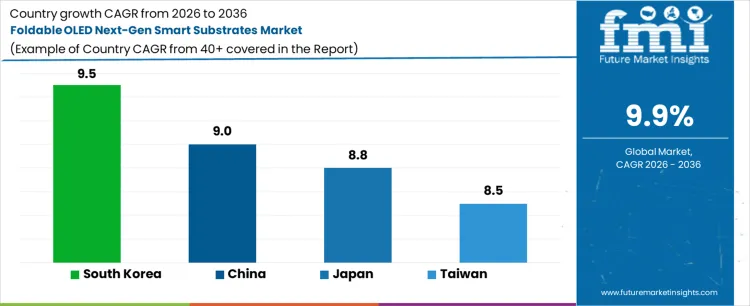
| Country | CAGR (%) |
|---|---|
| South Korea | 9.5% |
| China | 9.0% |
| Japan | 8.8% |
| Taiwan | 8.5% |
The foldable OLED next-gen smart substrates market is expanding as foldable display adoption accelerates across consumer electronics. South Korea leads with a 9.5% CAGR, driven by its dominance in OLED panel manufacturing and foldable device innovation. China follows at 9.0%, supported by rapid capacity expansion and localization of display materials. Japan grows at 8.8%, benefiting from strong advanced materials expertise and precision manufacturing. Taiwan expands at 8.5%, driven by its integrated electronics supply chain and focus on cost-efficient substrate solutions. As foldable displays evolve into new applications, demand for next-generation smart substrates is expected to increase steadily across all major regions.
What Is Driving the Growth of the Foldable OLED Next-Gen Smart Substrates Market in South Korea?
The foldable OLED next-gen smart substrates market in South Korea is growing at a CAGR of 9.5%, driven by the country’s leadership in OLED panel manufacturing and foldable device innovation. South Korean display manufacturers are at the forefront of commercializing foldable smartphones, tablets, and emerging form factors, creating sustained demand for advanced smart substrates. These substrates must offer high flexibility, mechanical durability, thermal stability, and compatibility with thin-film encapsulation processes. Continuous investment in next-generation OLED fabrication lines and materials R&D is accelerating adoption of ultra-thin glass and advanced polymer-based substrates. In addition, strong collaboration between display makers, material suppliers, and equipment vendors supports rapid technology iteration. As foldable displays expand into laptops, automotive displays, and wearable electronics, South Korea’s dominance in OLED manufacturing is expected to sustain strong growth in next-gen smart substrate demand.
How Is the Foldable OLED Next-Gen Smart Substrates Market Expanding in China?
The foldable OLED next-gen smart substrates market in China is expanding at a CAGR of 9.0%, supported by aggressive capacity expansion in OLED display manufacturing. Chinese panel makers are increasing production of foldable OLED displays to serve both domestic and global electronics brands. This expansion is driving demand for cost-effective yet high-performance smart substrates capable of supporting repeated folding cycles and high-resolution displays. Government-backed investments in display technology and materials localization are strengthening China’s substrate supply chain. In addition, growing adoption of foldable smartphones and experimentation with new foldable form factors are encouraging manufacturers to refine substrate designs. Chinese material suppliers are also advancing polymer substrates and hybrid solutions to improve flexibility and yield. As China continues to scale OLED production and reduce reliance on imports, demand for next-generation smart substrates is expected to grow steadily.
What Is Supporting Growth of the Foldable OLED Next-Gen Smart Substrates Market in Japan?
The foldable OLED next-gen smart substrates market in Japan is growing at a CAGR of 8.8%, driven by strong expertise in advanced materials and precision manufacturing. Japanese companies play a critical role in supplying high-performance polymers, ultra-thin glass, and surface treatment technologies used in foldable OLED substrates. Emphasis on reliability, optical clarity, and long-term durability aligns well with the demanding requirements of foldable displays. Japan’s focus on materials innovation supports development of substrates that reduce crease visibility and improve folding endurance. Collaboration between material suppliers and global display manufacturers is further strengthening market adoption. In addition, Japan’s automotive and consumer electronics sectors are exploring foldable and flexible display applications beyond smartphones. As demand for premium and high-reliability foldable displays increases, Japan’s role in supplying next-gen smart substrates is expected to remain significant.
How Is the Foldable OLED Next-Gen Smart Substrates Market Developing in Taiwan?
The foldable OLED next-gen smart substrates market in Taiwan is expanding at a CAGR of 8.5%, supported by the country’s strong electronics manufacturing ecosystem and advanced display component capabilities. Taiwanese firms are increasingly involved in supplying substrates, films, and processing technologies for foldable OLED production. Integration with semiconductor and electronics manufacturing strengths enables efficient scaling of substrate fabrication and quality control. Growing collaboration with global OLED panel makers is increasing demand for high-flexibility, lightweight substrate solutions. Taiwan’s focus on yield improvement and cost optimization is particularly important as foldable displays move toward broader market adoption. In addition, investment in advanced materials and processing equipment is improving substrate performance and manufacturability. As foldable OLED displays gain wider acceptance across consumer electronics, demand for next-generation smart substrates in Taiwan is expected to rise steadily.
How Are Companies Competing in the Foldable OLED Next-Gen Smart Substrates Market?
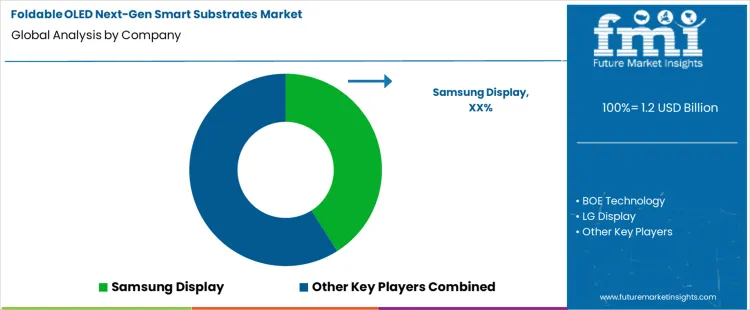
Competition in the foldable OLED next-generation smart substrates market is driven by mechanical durability, optical performance, yield stability, and compatibility with ultra-thin, flexible device designs. Foldable and rollable displays place extreme stress on substrates due to repeated bending, tight fold radii, and exposure to heat during OLED deposition. As a result, companies differentiate through advanced polymer substrates, hybrid glass-polymer structures, and proprietary coating technologies that improve flexibility while maintaining dimensional stability and low defect rates.
Samsung Display, BOE Technology, and LG Display lead competition through large-scale manufacturing capability and rapid commercialization of advanced foldable OLED substrates. Samsung Display emphasizes ultra-thin flexible substrates engineered for high bend endurance and consistent optical clarity, supporting premium foldable smartphones and emerging form factors. BOE Technology competes by scaling next-generation flexible substrates with a strong focus on cost efficiency, yield improvement, and broad adoption across multiple device tiers. LG Display differentiates through materials engineering and process optimization aimed at improving substrate uniformity, thermal stability, and long-term reliability in foldable OLED panels.
Tianma, Visionox, and AUO compete through targeted innovation, customer collaboration, and niche application focus. Tianma emphasizes flexible OLED substrates optimized for mid-range and automotive foldable displays, balancing durability and manufacturability. Visionox differentiates with proprietary flexible substrate technologies designed to enable tighter folding radii and thinner display stacks. AUO competes by applying precision manufacturing and advanced materials know-how to smart substrates that support foldable, rollable, and hybrid display concepts. Across the market, competitive advantage is shaped by fold endurance, substrate flatness, yield control, and the ability to support evolving foldable device designs at commercial scale.
Key Players in Foldable OLED Next-Gen Smart Substrates Market
- Samsung Display
- BOE Technology
- LG Display
- Tianma
- Visionox
- AUO
Scope of Report
| Attributes | Description |
|---|---|
| Quantitative Unit (2026) | USD Billion |
| Substrate Type | Ultra-Thin Glass, Colorless Polyimide, Hybrid Glass-Polymer |
| Fold Mechanism | Inward Fold, Outward Fold, Rollable, Multi-Fold |
| Regions Covered | Asia Pacific, Europe, North America, Latin America, Middle East & Africa |
| Countries Covered | China, Japan, South Korea, India, Australia & New Zealand, ASEAN, Rest of Asia Pacific, Germany, United Kingdom, France, Italy, Spain, Nordic, BENELUX, Rest of Europe, United States, Canada, Mexico, Brazil, Chile, Rest of Latin America, Kingdom of Saudi Arabia, Other GCC Countries, Turkey, South Africa, Other African Union, Rest of Middle East & Africa |
| Key Companies Profiled | Samsung Display, BOE Technology, LG Display, Tianma, Visionox, AUO |
| Additional Attributes | Dollar sales by substrate type and fold mechanism; regional market size and forecast analysis; growth outlook across major regions; adoption trends for next-generation foldable OLED substrates; assessment of durability requirements, bending radius performance, and demand patterns across inward-fold, outward-fold, rollable, and multi-fold display architectures. |
Foldable OLED Next-Gen Smart Substrates Market by Key Segments
Substrate Type
- Ultra-thin glass
- Colorless polyimide
- Hybrid glass-polymer
Fold Mechanism
- Inward fold
- Outward fold
- Rollable
- Multi-fold
Region
- Asia Pacific
- China
- Japan
- South Korea
- India
- Australia & New Zealand
- ASEAN
- Rest of Asia Pacific
- Europe
- Germany
- United Kingdom
- France
- Italy
- Spain
- Nordic
- BENELUX
- Rest of Europe
- North America
- United States
- Canada
- Mexico
- Latin America
- Brazil
- Chile
- Rest of Latin America
- Middle East & Africa
- Kingdom of Saudi Arabia
- Other GCC Countries
- Turkey
- South Africa
- Other African Union
- Rest of Middle East & Africa
Bibliography
LG. (2024, November 11). LG Display succeeds in developing world’s first stretchable display that expands by 50 percent. LG Corporation, Press Release.
Samsung Display Co., Ltd. (2024, January 8). Samsung Display to showcase new panel technologies at CES 2024. Samsung Display Newsroom.
Macrelli, G., R. (and coauthors). (2024). Commercial glass strengthening and safety technologies: Lessons learned and yet to be learned. Glass Technology: European Journal of Glass Science and Technology Part A, 65(3).
Lin, J. (2023). Applications of flexible polyimide: Barrier material, sensor material, and functional material. Soft Science, 3, 37.
Frequently Asked Questions
How big is the foldable oled next-gen smart substrates market in 2026?
The global foldable oled next-gen smart substrates market is estimated to be valued at USD 1.2 billion in 2026.
What will be the size of foldable oled next-gen smart substrates market in 2036?
The market size for the foldable oled next-gen smart substrates market is projected to reach USD 3.1 billion by 2036.
How much will be the foldable oled next-gen smart substrates market growth between 2026 and 2036?
The foldable oled next-gen smart substrates market is expected to grow at a 9.9% CAGR between 2026 and 2036.
What are the key product types in the foldable oled next-gen smart substrates market?
The key product types in foldable oled next-gen smart substrates market are ultra-thin glass, colorless polyimide and hybrid glass-polymer.
Which fold mechanism segment to contribute significant share in the foldable oled next-gen smart substrates market in 2026?
In terms of fold mechanism, inward fold segment to command 43.0% share in the foldable oled next-gen smart substrates market in 2026.
Preview the report firsthand - request a free sample
Get SampleGet the brochure for pricing and purchase details.
Get PDFTable of Content
- Executive Summary
- Global Market Outlook
- Demand-side Trends
- Supply-side Trends
- Technology Roadmap Analysis
- Analysis and Recommendations
- Market Overview
- Market Coverage / Taxonomy
- Market Definition / Scope / Limitations
- Market Background
- Market Dynamics
- Drivers
- Restraints
- Opportunity
- Trends
- Scenario Forecast
- Demand in Optimistic Scenario
- Demand in Likely Scenario
- Demand in Conservative Scenario
- Opportunity Map Analysis
- Product Life Cycle Analysis
- Supply Chain Analysis
- Investment Feasibility Matrix
- Value Chain Analysis
- PESTLE and Porter’s Analysis
- Regulatory Landscape
- Regional Parent Market Outlook
- Production and Consumption Statistics
- Import and Export Statistics
- Market Dynamics
- Global Market Analysis 2021 to 2025 and Forecast, 2026 to 2036
- Historical Market Size Value (USD Million) Analysis, 2021 to 2025
- Current and Future Market Size Value (USD Million) Projections, 2026 to 2036
- Y-o-Y Growth Trend Analysis
- Absolute $ Opportunity Analysis
- Global Market Pricing Analysis 2021 to 2025 and Forecast 2026 to 2036
- Global Market Analysis 2021 to 2025 and Forecast 2026 to 2036, By Substrate Type
- Introduction / Key Findings
- Historical Market Size Value (USD Million) Analysis By Substrate Type , 2021 to 2025
- Current and Future Market Size Value (USD Million) Analysis and Forecast By Substrate Type , 2026 to 2036
- Ultra-thin glass
- Colorless polyimide
- Hybrid glass-polymer
- Ultra-thin glass
- Y-o-Y Growth Trend Analysis By Substrate Type , 2021 to 2025
- Absolute $ Opportunity Analysis By Substrate Type , 2026 to 2036
- Global Market Analysis 2021 to 2025 and Forecast 2026 to 2036, By Fold Mechanism
- Introduction / Key Findings
- Historical Market Size Value (USD Million) Analysis By Fold Mechanism, 2021 to 2025
- Current and Future Market Size Value (USD Million) Analysis and Forecast By Fold Mechanism, 2026 to 2036
- Inward fold
- Outward fold
- Rollable
- Multi-fold
- Inward fold
- Y-o-Y Growth Trend Analysis By Fold Mechanism, 2021 to 2025
- Absolute $ Opportunity Analysis By Fold Mechanism, 2026 to 2036
- Global Market Analysis 2021 to 2025 and Forecast 2026 to 2036, By Region
- Introduction
- Historical Market Size Value (USD Million) Analysis By Region, 2021 to 2025
- Current Market Size Value (USD Million) Analysis and Forecast By Region, 2026 to 2036
- North America
- Latin America
- Western Europe
- Eastern Europe
- East Asia
- South Asia and Pacific
- Middle East & Africa
- Market Attractiveness Analysis By Region
- North America Market Analysis 2021 to 2025 and Forecast 2026 to 2036, By Country
- Historical Market Size Value (USD Million) Trend Analysis By Market Taxonomy, 2021 to 2025
- Market Size Value (USD Million) Forecast By Market Taxonomy, 2026 to 2036
- By Country
- USA
- Canada
- Mexico
- By Substrate Type
- By Fold Mechanism
- By Country
- Market Attractiveness Analysis
- By Country
- By Substrate Type
- By Fold Mechanism
- Key Takeaways
- Latin America Market Analysis 2021 to 2025 and Forecast 2026 to 2036, By Country
- Historical Market Size Value (USD Million) Trend Analysis By Market Taxonomy, 2021 to 2025
- Market Size Value (USD Million) Forecast By Market Taxonomy, 2026 to 2036
- By Country
- Brazil
- Chile
- Rest of Latin America
- By Substrate Type
- By Fold Mechanism
- By Country
- Market Attractiveness Analysis
- By Country
- By Substrate Type
- By Fold Mechanism
- Key Takeaways
- Western Europe Market Analysis 2021 to 2025 and Forecast 2026 to 2036, By Country
- Historical Market Size Value (USD Million) Trend Analysis By Market Taxonomy, 2021 to 2025
- Market Size Value (USD Million) Forecast By Market Taxonomy, 2026 to 2036
- By Country
- Germany
- UK
- Italy
- Spain
- France
- Nordic
- BENELUX
- Rest of Western Europe
- By Substrate Type
- By Fold Mechanism
- By Country
- Market Attractiveness Analysis
- By Country
- By Substrate Type
- By Fold Mechanism
- Key Takeaways
- Eastern Europe Market Analysis 2021 to 2025 and Forecast 2026 to 2036, By Country
- Historical Market Size Value (USD Million) Trend Analysis By Market Taxonomy, 2021 to 2025
- Market Size Value (USD Million) Forecast By Market Taxonomy, 2026 to 2036
- By Country
- Russia
- Poland
- Hungary
- Balkan & Baltic
- Rest of Eastern Europe
- By Substrate Type
- By Fold Mechanism
- By Country
- Market Attractiveness Analysis
- By Country
- By Substrate Type
- By Fold Mechanism
- Key Takeaways
- East Asia Market Analysis 2021 to 2025 and Forecast 2026 to 2036, By Country
- Historical Market Size Value (USD Million) Trend Analysis By Market Taxonomy, 2021 to 2025
- Market Size Value (USD Million) Forecast By Market Taxonomy, 2026 to 2036
- By Country
- China
- Japan
- South Korea
- By Substrate Type
- By Fold Mechanism
- By Country
- Market Attractiveness Analysis
- By Country
- By Substrate Type
- By Fold Mechanism
- Key Takeaways
- South Asia and Pacific Market Analysis 2021 to 2025 and Forecast 2026 to 2036, By Country
- Historical Market Size Value (USD Million) Trend Analysis By Market Taxonomy, 2021 to 2025
- Market Size Value (USD Million) Forecast By Market Taxonomy, 2026 to 2036
- By Country
- India
- ASEAN
- Australia & New Zealand
- Rest of South Asia and Pacific
- By Substrate Type
- By Fold Mechanism
- By Country
- Market Attractiveness Analysis
- By Country
- By Substrate Type
- By Fold Mechanism
- Key Takeaways
- Middle East & Africa Market Analysis 2021 to 2025 and Forecast 2026 to 2036, By Country
- Historical Market Size Value (USD Million) Trend Analysis By Market Taxonomy, 2021 to 2025
- Market Size Value (USD Million) Forecast By Market Taxonomy, 2026 to 2036
- By Country
- Kingdom of Saudi Arabia
- Other GCC Countries
- Turkiye
- South Africa
- Other African Union
- Rest of Middle East & Africa
- By Substrate Type
- By Fold Mechanism
- By Country
- Market Attractiveness Analysis
- By Country
- By Substrate Type
- By Fold Mechanism
- Key Takeaways
- Key Countries Market Analysis
- USA
- Pricing Analysis
- Market Share Analysis, 2025
- By Substrate Type
- By Fold Mechanism
- Canada
- Pricing Analysis
- Market Share Analysis, 2025
- By Substrate Type
- By Fold Mechanism
- Mexico
- Pricing Analysis
- Market Share Analysis, 2025
- By Substrate Type
- By Fold Mechanism
- Brazil
- Pricing Analysis
- Market Share Analysis, 2025
- By Substrate Type
- By Fold Mechanism
- Chile
- Pricing Analysis
- Market Share Analysis, 2025
- By Substrate Type
- By Fold Mechanism
- Germany
- Pricing Analysis
- Market Share Analysis, 2025
- By Substrate Type
- By Fold Mechanism
- UK
- Pricing Analysis
- Market Share Analysis, 2025
- By Substrate Type
- By Fold Mechanism
- Italy
- Pricing Analysis
- Market Share Analysis, 2025
- By Substrate Type
- By Fold Mechanism
- Spain
- Pricing Analysis
- Market Share Analysis, 2025
- By Substrate Type
- By Fold Mechanism
- France
- Pricing Analysis
- Market Share Analysis, 2025
- By Substrate Type
- By Fold Mechanism
- India
- Pricing Analysis
- Market Share Analysis, 2025
- By Substrate Type
- By Fold Mechanism
- ASEAN
- Pricing Analysis
- Market Share Analysis, 2025
- By Substrate Type
- By Fold Mechanism
- Australia & New Zealand
- Pricing Analysis
- Market Share Analysis, 2025
- By Substrate Type
- By Fold Mechanism
- China
- Pricing Analysis
- Market Share Analysis, 2025
- By Substrate Type
- By Fold Mechanism
- Japan
- Pricing Analysis
- Market Share Analysis, 2025
- By Substrate Type
- By Fold Mechanism
- South Korea
- Pricing Analysis
- Market Share Analysis, 2025
- By Substrate Type
- By Fold Mechanism
- Russia
- Pricing Analysis
- Market Share Analysis, 2025
- By Substrate Type
- By Fold Mechanism
- Poland
- Pricing Analysis
- Market Share Analysis, 2025
- By Substrate Type
- By Fold Mechanism
- Hungary
- Pricing Analysis
- Market Share Analysis, 2025
- By Substrate Type
- By Fold Mechanism
- Kingdom of Saudi Arabia
- Pricing Analysis
- Market Share Analysis, 2025
- By Substrate Type
- By Fold Mechanism
- Turkiye
- Pricing Analysis
- Market Share Analysis, 2025
- By Substrate Type
- By Fold Mechanism
- South Africa
- Pricing Analysis
- Market Share Analysis, 2025
- By Substrate Type
- By Fold Mechanism
- USA
- Market Structure Analysis
- Competition Dashboard
- Competition Benchmarking
- Market Share Analysis of Top Players
- By Regional
- By Substrate Type
- By Fold Mechanism
- Competition Analysis
- Competition Deep Dive
- Samsung Display
- Overview
- Product Portfolio
- Profitability by Market Segments (Product/Age /Sales Channel/Region)
- Sales Footprint
- Strategy Overview
- Marketing Strategy
- Product Strategy
- Channel Strategy
- BOE Technology
- LG Display
- Tianma
- Visionox
- AUO
- Samsung Display
- Competition Deep Dive
- Assumptions & Acronyms Used
- Research Methodology


