

- Industry Size (2026)
- USD 556 Mn
- Forecast (2036)
- USD 1362 Mn
- CAGR (2026 to 2036)
- 9.4%
DPP-Enabled Smart Labels and Inlays for FMCG Packaging Market Forecast and Outlook 2026 to 2036
The DPP-enabled smart labels and inlays for FMCG packaging market is valued at USD 556 million in 2026 and is projected to reach USD 1,362 million by 2036, reflecting a CAGR of 9.4%. Early growth from 2026 to 2031, increasing from approximately USD 556 million to USD 837 million, is driven by adoption across personal care, food, and beverage packaging. Integration of digital product passports (DPP) in smart labels enhances traceability, anti-counterfeiting, and sustainability reporting, prompting FMCG brands to deploy advanced inlays and connected packaging solutions.
From 2031 to 2036, market expansion accelerates from roughly USD 837 million to USD 1,362 million. Growth contribution is reinforced by regulatory requirements for product transparency, expanding e-commerce penetration, and rising consumer demand for verifiable product authenticity. Technological improvements in NFC, RFID, and QR-enabled inlays, combined with seamless integration into packaging lines, ensure ongoing adoption. The market trajectory reflects steady value accumulation, with innovation and regulatory alignment driving sustained uptake across the FMCG sector over the forecast period.
Quick Stats of the DPP-Enabled Smart Labels and Inlays for FMCG Packaging Market:
- DPP-Enabled Smart Labels and Inlays for FMCG Packaging Market Value (2026): USD 556 million
- DPP-Enabled Smart Labels and Inlays for FMCG Packaging Market Forecast Value (2036): USD 1,362 million
- DPP-Enabled Smart Labels and Inlays for FMCG Packaging Market Forecast CAGR (2026–2036): 9.4%
- Leading Packaging Format in DPP-Enabled Smart Labels and Inlays for FMCG Packaging Market: Smart barcode + RFID-enabled labels (45%)
- Key Growth Regions in DPP-Enabled Smart Labels and Inlays for FMCG Packaging Market: India, China, USA, Brazil, Germany
- Top Players in DPP-Enabled Smart Labels and Inlays for FMCG Packaging Market: Avery Dennison, Smartrac, Zebra, Schreiner ProTech, Shenzhen RZX, Invengo, UFlex, Local converters, Toppan
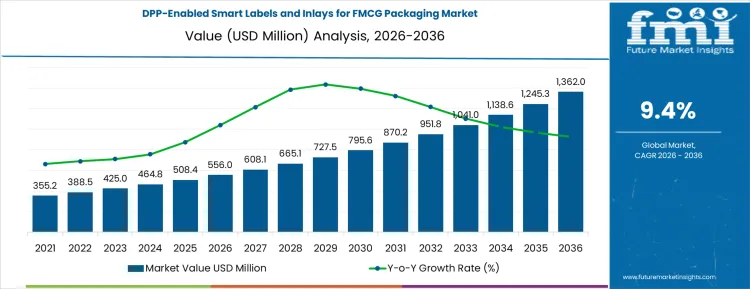
What is the Growth Forecast for the DPP-Enabled Smart Labels and Inlays for FMCG Packaging Market through 2036?
From 2026 to 2031, the DPP-enabled smart labels and inlays market grows from USD 556 million to approximately USD 837 million, representing the early adoption curve. Growth during this phase is driven by selective integration in high-value FMCG products, where digital product passports enhance traceability, anti-counterfeiting, and consumer engagement. Uptake is concentrated among premium brands and pilot programs, with year-on-year value additions increasing steadily as label performance, printing accuracy, and backend integration with digital platforms are validated. Early growth reflects cautious adoption and limited SKU deployment rather than broad commercialization.
Between 2031 and 2036, the market expands from roughly USD 837 million to USD 1,362 million, illustrating the late adoption curve characterized by structural scaling across FMCG portfolios. Growth accelerates as DPP-enabled labels and inlays become embedded in mass-market products, multi-SKU lines, and global distribution networks. Annual additions widen due to higher per-unit adoption, repeat procurement, and portfolio-wide integration. While early growth relied on selective deployment and validation, later expansion is driven by standardized implementation, broader consumer engagement, and structural inclusion of DPP-enabled smart labeling in FMCG packaging strategies.
DPP Enabled Smart Labels and Inlays for FMCG Packaging Market Key Takeaways
| Metric | Value |
|---|---|
| Market Value (2026) | USD 556 million |
| Forecast Value (2036) | USD 1,362 million |
| Forecast CAGR (2026–2036) | 9.4% |
What Is Driving the Demand for DPP-Enabled Smart Labels and Inlays for FMCG Packaging?
Historical demand for DPP-enabled smart labels and inlays in FMCG packaging arose from the limitations of static barcodes and traditional tracking methods. FMCG supply chains expanded rapidly with globalised production and multi-tier distribution networks, increasing the need for reliable product authentication and recall traceability. Counterfeiting risks and quality control failures prompted early adopters to explore digital tracking technologies. Digital Product Passports (DPP) and smart inlays provided machine readable data beyond basic identification, offering provenance records and conditional alerts. Initial uptake was concentrated in high-value or highly regulated FMCG segments such as pharmaceuticals, premium beverages, and infant nutrition where liability concerns were acute.
Future demand for DPP-enabled smart labels and inlays in FMCG packaging is expected to reflect regulatory compliance and data-driven supply chain control rather than incremental tracking improvements. Emerging policy frameworks in major markets are mandating DPP implementation to support lifecycle transparency, circular economy reporting, and product safety. FMCG manufacturers will integrate smart labels and inlays to meet requirements for detailed material disclosures, recycling instructions, and authenticated origin data. Advances in printed electronics, near field communication interfaces, and cloud-linked data systems will lower unit costs and facilitate real time interaction with retail and consumer applications.
What Factors Are Affecting the Demand for DPP Enabled Smart Labels and Inlays for FMCG Packaging Market in Terms of End Use Application and Packaging Format and Type?
Demand for DPP enabled smart labels and inlays for FMCG packaging is segmented by end use application and packaging format and type across traceability driven supply chains. FMCG and retail traceability applications account for about 40% of total demand, making this the leading end use segment. Food and beverage packaging, e commerce and logistics, retail and distribution, and other FMCG packaging uses represent additional applications without disclosed share splits. These segments differ in data density requirements, scanning frequency, and regulatory exposure. Digital product passport requirements influence label functionality, data persistence, and system interoperability. Packaging format and type determine integration feasibility and line speed compatibility.
What Drives Demand by End Use Application in the DPP Enabled Smart Labels and Inlays for FMCG Packaging Market?
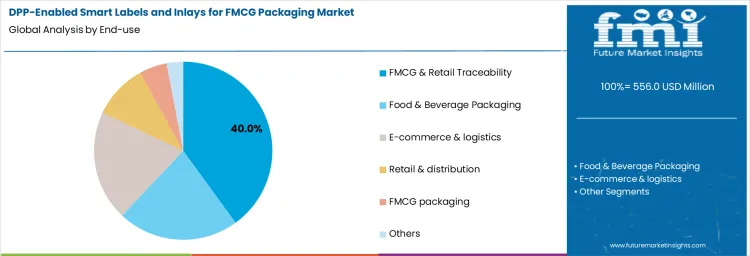
FMCG and retail traceability leads demand with a 40% share due to high SKU volumes and regulatory reporting obligations. These applications require persistent product identifiers across distribution and retail touchpoints. Food and beverage packaging adopts smart labels to support batch tracking and product information access. E commerce and logistics applications use smart identifiers to manage parcel level visibility and routing accuracy. Retail and distribution environments rely on scannable data for inventory control and recall management. Adoption intensity aligns with regulatory timelines and data management maturity. End use demand therefore reflects traceability enforcement and operational data needs rather than consumer engagement features or marketing driven applications.
Application driven demand remains stable because traceability requirements are embedded in compliance frameworks. FMCG producers integrate DPP readiness into packaging roadmaps. Food and beverage operators align adoption with quality and recall systems. Logistics providers adopt where data interoperability improves throughput. Retailers deploy selectively based on system integration capacity. These patterns limit short term volatility. End use segmentation highlights structural dependence on traceability infrastructure.
How Does Packaging Format and Type Shape Demand for DPP Enabled Smart Labels and Inlays for FMCG Packaging Market?
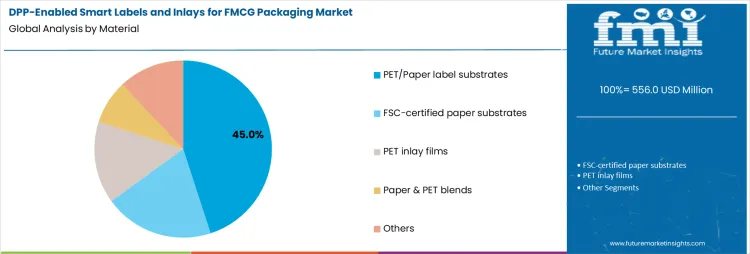
Smart barcode and RFID enabled labels account for about 45% of total demand, making them the leading packaging format. Their dominance reflects compatibility with existing scanning infrastructure and automated identification systems. High speed printable smart labels are used in food and beverage packaging where throughput requirements are critical. RFID inlays and QR labels support logistics and parcel level tracking. QR enabled labels are applied in retail environments requiring consumer or regulator access to product data. Other formats address niche integration needs. Packaging format selection depends on data capacity, application speed, and cost per unit. Demand follows infrastructure compatibility rather than maximum data sophistication.
Smart barcode and RFID formats maintain leadership due to reliability across supply chain touchpoints. High speed printable labels support continuous production lines. RFID inlays enable non line of sight scanning in logistics settings. QR labels offer low cost data access solutions. Operators favor formats aligned with existing hardware and software systems. Major format shifts are avoided due to system validation and training costs.
How Are DPP Enabled Smart Labels and Inlays Being Applied in FMCG Packaging?
What Operational and Regulatory Conditions Support Adoption of DPP Enabled Smart Labels and Inlays?
Selection aligns with packaging lines that require secure printing, NFC/RFID or QR code integration, and compatibility with automated filling and labeling systems. Brand owners rely on DPP standards to meet regulatory compliance, reporting, and sustainability targets. Retailers leverage real-time scanning for inventory management and anti-counterfeit measures. Packaging engineers ensure labels and inlays maintain adhesion and readability across different materials and storage conditions. These conditions arise from efficiency, regulatory compliance, and traceability priorities in structured FMCG production workflows.
Which Practical Considerations Limit Wider Use of DPP Enabled Smart Labels and Inlays?
Cost per unit is higher than conventional labels, impacting adoption in low-margin products. Integration may require modification of existing labeling or printing lines. Consumer engagement depends on awareness and smartphone compatibility. Security and data management infrastructure is needed to support DPP functionality. Label durability under storage and transportation conditions affects readability. These factors result in selective deployment where traceability, regulatory compliance, and consumer engagement justify incremental cost and operational adaptation.
What is the Demand for DPP Enabled Smart Labels and Inlays for FMCG Packaging by Country?
| Country | CAGR (%) |
|---|---|
| USA | 8.8% |
| Germany | 7.5% |
| China | 11.0% |
| India | 12.0% |
| Brazil | 8.0% |
| Japan | 4.8% |
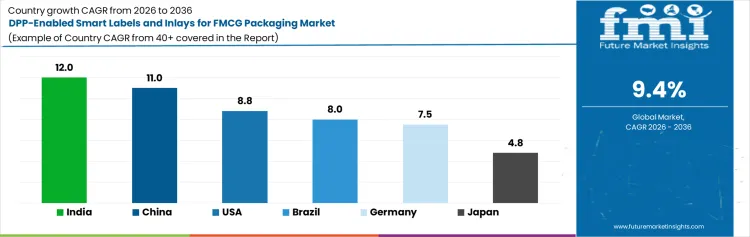
The demand for DPP enabled smart labels and inlays for FMCG packaging varies across countries, driven by anti-counterfeiting needs, traceability requirements, and digital packaging adoption. India leads with a 12.0% CAGR, supported by growing FMCG production, rising adoption of track and trace technologies, and regulatory push for packaging security. China follows at 11.0%, driven by large scale FMCG manufacturing, e commerce growth, and implementation of smart packaging solutions. The USA grows at 8.8%, reflecting adoption in retail, food, and personal care products. Brazil records 8.0%, shaped by organized retail and anti-counterfeiting initiatives. Germany posts 7.5%, supported by regulatory standards, while Japan grows at 4.8%, reflecting mature FMCG markets and steady adoption.
How Is Smart Packaging Driving Growth in the United States?
In the United States, revenue from the DPP-Enabled Smart Labels and Inlays for FMCG Packaging Market is expanding at a CAGR of 8.80% through 2036, driven by adoption of digital product passport (DPP) technology to enhance traceability, authenticity verification, and sustainability reporting in fast-moving consumer goods. Manufacturers are integrating smart labels and inlays for beverages, packaged foods, and personal care products distributed through retail and e-commerce channels. Domestic suppliers provide high-precision RFID, NFC, and QR-enabled labels compatible with existing packaging lines. Regulatory compliance, brand protection initiatives, and recurring FMCG production cycles are sustaining predictable procurement nationwide.
- Beverage, packaged food, and personal care producers adopt DPP-enabled smart labels and inlays
- Labels provide traceability, authenticity verification, and sustainability reporting
- Domestic suppliers provide RFID, NFC, and QR-enabled labels compatible with packaging lines
- Recurring FMCG production cycles sustain predictable procurement
How Are Regulatory and Brand Protection Initiatives Supporting Growth in Germany?
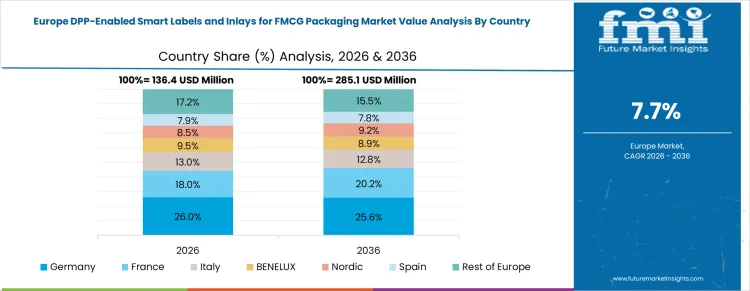
Germany continues to record steady growth in the DPP-Enabled Smart Labels and Inlays Market at a CAGR of 7.50% through 2036, supported by regulations on product traceability and environmental reporting. Manufacturers are adopting smart labels and inlays for packaged foods, beverages, and personal care items to comply with digital product passport standards. Demand is concentrated in retail and industrial packaging operations. Domestic suppliers provide high-precision smart labels and inlays engineered for durability, scanning reliability, and compatibility with automated packaging lines. Compliance-driven procurement and stable FMCG production are sustaining measured adoption nationwide.
- Regulatory standards and brand protection initiatives drive DPP-enabled smart label adoption
- Packaged foods, beverages, and personal care products anchor demand
- Domestic suppliers provide durable, high-precision labels and inlays
- Compliance-driven procurement sustains steady adoption levels
How Is FMCG Production Expansion Accelerating Adoption in China?
In China, revenue from the DPP-Enabled Smart Labels and Inlays Market is growing at a CAGR of 11.00% through 2036, driven by expansion of FMCG manufacturing and retail distribution. Manufacturers are integrating smart labels and inlays to ensure product traceability, prevent counterfeiting, and support sustainability reporting. Demand is strong across beverages, packaged foods, and personal care products distributed via e-commerce and modern retail channels. Domestic suppliers are scaling production of RFID, NFC, and QR-enabled labels compatible with automated packaging operations. High FMCG output volumes and structured procurement programs are sustaining rapid adoption nationwide.
- FMCG production and retail expansion drive DPP-enabled smart label adoption
- Beverages, packaged foods, and personal care products anchor demand
- Domestic suppliers scale RFID, NFC, and QR-enabled label production
- Structured procurement programs sustain consistent adoption
How Is Organized FMCG Manufacturing Supporting Growth in India?
India is witnessing strong expansion in the DPP-Enabled Smart Labels and Inlays Market at a CAGR of 12.00% through 2036, supported by growth in organized food, beverage, and personal care manufacturing. Manufacturers are adopting smart labels and inlays to improve traceability, verify product authenticity, and meet emerging sustainability standards. Demand is rising across urban retail, e-commerce, and institutional FMCG supply chains. Domestic suppliers provide cost-aligned, high-precision labels and inlays suitable for large-scale packaging operations. Expanding retail networks and organized FMCG production are sustaining robust procurement nationwide.
- Organized FMCG manufacturing increases demand for DPP-enabled smart labels and inlays
- Beverages, packaged foods, and personal care products drive high-volume adoption
- Domestic suppliers provide cost-aligned, high-precision labels and inlays
- Retail expansion and organized production sustain procurement growth
How Are Retail and FMCG Distribution Supporting Adoption in Brazil?
Brazil is seeing steady growth in the DPP-Enabled Smart Labels and Inlays Market at a CAGR of 8.00% through 2036, supported by increasing adoption of traceability and brand protection technologies in food, beverage, and personal care products. Manufacturers are integrating smart labels and inlays to ensure authenticity, monitor supply chains, and support environmental reporting. Demand is concentrated in retail distribution and industrial packaging hubs. Domestic suppliers are expanding production of high-precision labels and inlays compatible with automated packaging lines. Growth in FMCG shipments and retail networks is sustaining recurring procurement across operations nationwide.
- Food, beverage, and personal care products drive adoption of DPP-enabled smart labels and inlays
- Labels provide traceability, authenticity verification, and supply chain monitoring
- Domestic suppliers expand production of high-precision labels and inlays
- Retail and FMCG distribution growth sustain recurring procurement
Which Companies Are Shaping Competition in The DPP Enabled Smart Labels and Inlays for FMCG Packaging Market Across Traceability and Consumer Information Uses?
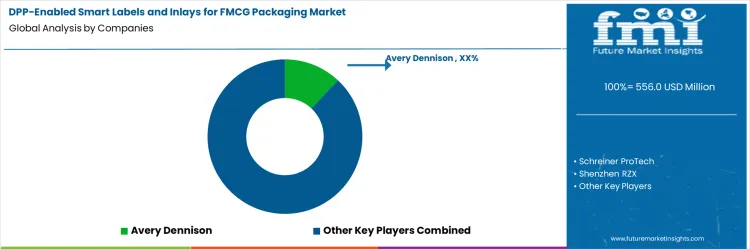
The DPP Enabled Smart Labels and Inlays for FMCG Packaging Market is driven by label material suppliers and RFID inlay developers supporting digital product passport requirements. Avery Dennison and Smartrac play a central role through RFID and NFC inlays integrated into pressure sensitive labels used across FMCG packaging formats. Zebra contributes through hardware and encoding ecosystem alignment rather than label conversion alone. Schreiner ProTech supports premium and regulated applications through functional labels designed for durability and data integrity across supply chains. These companies compete on inlay reliability, readability across environments, and compatibility with high speed label application lines.
Regional manufacturers and converters add competitive depth through localized production and customization. Shenzhen RZX and Invengo supply RFID inlays and components widely used in Asia based FMCG supply chains, supporting cost sensitive deployments. UFlex participates through smart packaging initiatives that integrate labels and inlays within flexible packaging workflows. Toppan contributes through printing, security, and information management capabilities aligned with serialized packaging. Local converters play an important role by encoding, converting, and applying smart labels tailored to brand specific DPP frameworks. Competitive positioning depends on execution accuracy, supply continuity, and alignment with evolving regulatory data structures rather than proprietary platform ownership alone.
Key Players in the DPP Enabled Smart Labels and Inlays for FMCG Packaging Market
- Avery Dennison
- Smartrac
- Zebra
- Schreiner ProTech
- Shenzhen RZX, Invengo
- UFlex
- Local converters
- Toppan
Scope of the Report
| Items | Values |
|---|---|
| Quantitative Units (2026) | USD million |
| End-use / Application | FMCG & Retail Traceability; Food & Beverage Packaging; E-commerce & logistics; Retail & distribution; FMCG packaging; Others |
| Packaging Format / Type | Smart barcode + RFID-enabled labels; High-speed printable smart labels; RFID inlays & QR labels; QR-enabled labels; Others |
| Material | PET/Paper label substrates; FSC-certified paper substrates; PET inlay films; Paper & PET blends; Others |
| Technology | NFC/RFID Inlay Integration; Eco-friendly conductive inks; Low-cost RFID integration; Digital printing + embedded coding; Others |
| Region | Asia Pacific; Europe; North America; Latin America; Middle East & Africa |
| Countries Covered | China; Japan; South Korea; India; Australia & New Zealand; ASEAN; Germany; United Kingdom; France; Italy; Spain; Nordic; BENELUX; United States; Canada; Mexico; Brazil; Chile; Kingdom of Saudi Arabia; Other GCC Countries; Turkey; South Africa; Other African Union; Rest of Asia Pacific; Rest of Europe; Rest of Latin America; Rest of Middle East & Africa |
| Key Companies Profiled | Avery Dennison; Smartrac; Zebra; Schreiner ProTech; Shenzhen RZX; Invengo; UFlex; Local converters; Toppan |
| Additional Attributes | Dollar by sales across end-use applications, packaging formats, materials, and technologies; Smart barcode + RFID-enabled labels lead due to compatibility with scanning infrastructure and automated systems; NFC/RFID integration enables real-time tracking, traceability, and anti-counterfeiting; High-speed printable labels support continuous production lines; QR-enabled labels facilitate consumer engagement and regulatory reporting; Adoption driven by regulatory compliance, traceability enforcement, e-commerce growth, and brand protection initiatives; Domestic and regional suppliers provide scalable, durable, and high-precision smart labels and inlays. |
DPP Enabled Smart Labels and Inlays for FMCG Packaging Market Segmentation
End-use / Application:
- FMCG & Retail Traceability
- Food & Beverage Packaging
- E-commerce & logistics
- Retail & distribution
- FMCG packaging
- Others
Packaging Format / Type:
- Smart barcode + RFID-enabled labels
- High-speed printable smart labels
- RFID inlays & QR labels
- QR-enabled labels
- Others
Material:
- PET/Paper label substrates
- FSC-certified paper substrates
- PET inlay films
- Paper & PET blends
- Others
Technology:
- NFC/RFID Inlay Integration
- Eco-friendly conductive inks
- Low-cost RFID integration
- Digital printing + embedded coding
- Others
Region
Asia Pacific
- China
- Japan
- South Korea
- India
- Australia & New Zealand
- ASEAN
- Rest of Asia Pacific
Europe
- Germany
- United Kingdom
- France
- Italy
- Spain
- Nordic
- BENELUX
- Rest of Europe
North America
- United States
- Canada
- Mexico
Latin America
- Brazil
- Chile
- Rest of Latin America
Middle East & Africa
- Kingdom of Saudi Arabia
- Other GCC Countries
- Turkey
- South Africa
- Other African Union
- Rest of Middle East & Africa
Frequently Asked Questions
How big is the DPP-enabled smart labels and inlays for FMCG packaging market in 2026?
The global DPP-enabled smart labels and inlays for FMCG packaging market is estimated to be valued at USD 556.0 million in 2026.
What will be the size of DPP-enabled smart labels and inlays for FMCG packaging market in 2036?
The market size for the DPP-enabled smart labels and inlays for FMCG packaging market is projected to reach USD 1,362.0 million by 2036.
How much will be the DPP-enabled smart labels and inlays for FMCG packaging market growth between 2026 and 2036?
The DPP-enabled smart labels and inlays for FMCG packaging market is expected to grow at a 9.4% CAGR between 2026 and 2036.
What are the key product types in the DPP-enabled smart labels and inlays for FMCG packaging market?
The key product types in DPP-enabled smart labels and inlays for FMCG packaging market are FMCG & retail traceability, food & beverage packaging, e-commerce & logistics, retail & distribution, FMCG packaging and others.
Which packaging format segment to contribute significant share in the DPP-enabled smart labels and inlays for FMCG packaging market in 2026?
In terms of packaging format, smart barcode + rfid-enabled labels segment to command 45.0% share in the DPP-enabled smart labels and inlays for FMCG packaging market in 2026.
Preview the report firsthand - request a free sample
Get SampleGet the brochure for pricing and purchase details.
Get PDFTable of Content
- Executive Summary
- Global Market Outlook
- Demand-side Trends
- Supply-side Trends
- Technology Roadmap Analysis
- Analysis and Recommendations
- Market Overview
- Market Coverage / Taxonomy
- Market Definition / Scope / Limitations
- Market Background
- Market Dynamics
- Drivers
- Restraints
- Opportunity
- Trends
- Scenario Forecast
- Demand in Optimistic Scenario
- Demand in Likely Scenario
- Demand in Conservative Scenario
- Opportunity Map Analysis
- Product Life Cycle Analysis
- Supply Chain Analysis
- Investment Feasibility Matrix
- Value Chain Analysis
- PESTLE and Porter’s Analysis
- Regulatory Landscape
- Regional Parent Market Outlook
- Production and Consumption Statistics
- Import and Export Statistics
- Market Dynamics
- Global Market Analysis 2021 to 2025 and Forecast, 2026 to 2036
- Historical Market Size Value (USD Million) Analysis, 2021 to 2025
- Current and Future Market Size Value (USD Million) Projections, 2026 to 2036
- Y-o-Y Growth Trend Analysis
- Absolute $ Opportunity Analysis
- Global Market Pricing Analysis 2021 to 2025 and Forecast 2026 to 2036
- Global Market Analysis 2021 to 2025 and Forecast 2026 to 2036, By End-use
- Introduction / Key Findings
- Historical Market Size Value (USD Million) Analysis By End-use , 2021 to 2025
- Current and Future Market Size Value (USD Million) Analysis and Forecast By End-use , 2026 to 2036
- FMCG & Retail Traceability
- Food & Beverage Packaging
- E-commerce & logistics
- Retail & distribution
- FMCG packaging
- Others
- Y-o-Y Growth Trend Analysis By End-use , 2021 to 2025
- Absolute $ Opportunity Analysis By End-use , 2026 to 2036
- Global Market Analysis 2021 to 2025 and Forecast 2026 to 2036, By Packaging Format
- Introduction / Key Findings
- Historical Market Size Value (USD Million) Analysis By Packaging Format, 2021 to 2025
- Current and Future Market Size Value (USD Million) Analysis and Forecast By Packaging Format, 2026 to 2036
- Smart barcode + RFID-enabled labels
- High-speed printable smart labels
- RFID inlays & QR labels
- QR-enabled labels
- Others
- Y-o-Y Growth Trend Analysis By Packaging Format, 2021 to 2025
- Absolute $ Opportunity Analysis By Packaging Format, 2026 to 2036
- Global Market Analysis 2021 to 2025 and Forecast 2026 to 2036, By Material
- Introduction / Key Findings
- Historical Market Size Value (USD Million) Analysis By Material, 2021 to 2025
- Current and Future Market Size Value (USD Million) Analysis and Forecast By Material, 2026 to 2036
- PET/Paper label substrates
- FSC-certified paper substrates
- PET inlay films
- Paper & PET blends
- Others
- Y-o-Y Growth Trend Analysis By Material, 2021 to 2025
- Absolute $ Opportunity Analysis By Material, 2026 to 2036
- Global Market Analysis 2021 to 2025 and Forecast 2026 to 2036, By Technology
- Introduction / Key Findings
- Historical Market Size Value (USD Million) Analysis By Technology, 2021 to 2025
- Current and Future Market Size Value (USD Million) Analysis and Forecast By Technology, 2026 to 2036
- NFC/RFID Inlay Integration
- Eco-friendly conductive inks
- Low-cost RFID integration
- Digital printing + embedded coding
- Others
- Y-o-Y Growth Trend Analysis By Technology, 2021 to 2025
- Absolute $ Opportunity Analysis By Technology, 2026 to 2036
- Global Market Analysis 2021 to 2025 and Forecast 2026 to 2036, By Region
- Introduction
- Historical Market Size Value (USD Million) Analysis By Region, 2021 to 2025
- Current Market Size Value (USD Million) Analysis and Forecast By Region, 2026 to 2036
- North America
- Latin America
- Western Europe
- Eastern Europe
- East Asia
- South Asia and Pacific
- Middle East & Africa
- Market Attractiveness Analysis By Region
- North America Market Analysis 2021 to 2025 and Forecast 2026 to 2036, By Country
- Historical Market Size Value (USD Million) Trend Analysis By Market Taxonomy, 2021 to 2025
- Market Size Value (USD Million) Forecast By Market Taxonomy, 2026 to 2036
- By Country
- USA
- Canada
- Mexico
- By End-use
- By Packaging Format
- By Material
- By Technology
- By Country
- Market Attractiveness Analysis
- By Country
- By End-use
- By Packaging Format
- By Material
- By Technology
- Key Takeaways
- Latin America Market Analysis 2021 to 2025 and Forecast 2026 to 2036, By Country
- Historical Market Size Value (USD Million) Trend Analysis By Market Taxonomy, 2021 to 2025
- Market Size Value (USD Million) Forecast By Market Taxonomy, 2026 to 2036
- By Country
- Brazil
- Chile
- Rest of Latin America
- By End-use
- By Packaging Format
- By Material
- By Technology
- By Country
- Market Attractiveness Analysis
- By Country
- By End-use
- By Packaging Format
- By Material
- By Technology
- Key Takeaways
- Western Europe Market Analysis 2021 to 2025 and Forecast 2026 to 2036, By Country
- Historical Market Size Value (USD Million) Trend Analysis By Market Taxonomy, 2021 to 2025
- Market Size Value (USD Million) Forecast By Market Taxonomy, 2026 to 2036
- By Country
- Germany
- UK
- Italy
- Spain
- France
- Nordic
- BENELUX
- Rest of Western Europe
- By End-use
- By Packaging Format
- By Material
- By Technology
- By Country
- Market Attractiveness Analysis
- By Country
- By End-use
- By Packaging Format
- By Material
- By Technology
- Key Takeaways
- Eastern Europe Market Analysis 2021 to 2025 and Forecast 2026 to 2036, By Country
- Historical Market Size Value (USD Million) Trend Analysis By Market Taxonomy, 2021 to 2025
- Market Size Value (USD Million) Forecast By Market Taxonomy, 2026 to 2036
- By Country
- Russia
- Poland
- Hungary
- Balkan & Baltic
- Rest of Eastern Europe
- By End-use
- By Packaging Format
- By Material
- By Technology
- By Country
- Market Attractiveness Analysis
- By Country
- By End-use
- By Packaging Format
- By Material
- By Technology
- Key Takeaways
- East Asia Market Analysis 2021 to 2025 and Forecast 2026 to 2036, By Country
- Historical Market Size Value (USD Million) Trend Analysis By Market Taxonomy, 2021 to 2025
- Market Size Value (USD Million) Forecast By Market Taxonomy, 2026 to 2036
- By Country
- China
- Japan
- South Korea
- By End-use
- By Packaging Format
- By Material
- By Technology
- By Country
- Market Attractiveness Analysis
- By Country
- By End-use
- By Packaging Format
- By Material
- By Technology
- Key Takeaways
- South Asia and Pacific Market Analysis 2021 to 2025 and Forecast 2026 to 2036, By Country
- Historical Market Size Value (USD Million) Trend Analysis By Market Taxonomy, 2021 to 2025
- Market Size Value (USD Million) Forecast By Market Taxonomy, 2026 to 2036
- By Country
- India
- ASEAN
- Australia & New Zealand
- Rest of South Asia and Pacific
- By End-use
- By Packaging Format
- By Material
- By Technology
- By Country
- Market Attractiveness Analysis
- By Country
- By End-use
- By Packaging Format
- By Material
- By Technology
- Key Takeaways
- Middle East & Africa Market Analysis 2021 to 2025 and Forecast 2026 to 2036, By Country
- Historical Market Size Value (USD Million) Trend Analysis By Market Taxonomy, 2021 to 2025
- Market Size Value (USD Million) Forecast By Market Taxonomy, 2026 to 2036
- By Country
- Kingdom of Saudi Arabia
- Other GCC Countries
- Turkiye
- South Africa
- Other African Union
- Rest of Middle East & Africa
- By End-use
- By Packaging Format
- By Material
- By Technology
- By Country
- Market Attractiveness Analysis
- By Country
- By End-use
- By Packaging Format
- By Material
- By Technology
- Key Takeaways
- Key Countries Market Analysis
- USA
- Pricing Analysis
- Market Share Analysis, 2025
- By End-use
- By Packaging Format
- By Material
- By Technology
- Canada
- Pricing Analysis
- Market Share Analysis, 2025
- By End-use
- By Packaging Format
- By Material
- By Technology
- Mexico
- Pricing Analysis
- Market Share Analysis, 2025
- By End-use
- By Packaging Format
- By Material
- By Technology
- Brazil
- Pricing Analysis
- Market Share Analysis, 2025
- By End-use
- By Packaging Format
- By Material
- By Technology
- Chile
- Pricing Analysis
- Market Share Analysis, 2025
- By End-use
- By Packaging Format
- By Material
- By Technology
- Germany
- Pricing Analysis
- Market Share Analysis, 2025
- By End-use
- By Packaging Format
- By Material
- By Technology
- UK
- Pricing Analysis
- Market Share Analysis, 2025
- By End-use
- By Packaging Format
- By Material
- By Technology
- Italy
- Pricing Analysis
- Market Share Analysis, 2025
- By End-use
- By Packaging Format
- By Material
- By Technology
- Spain
- Pricing Analysis
- Market Share Analysis, 2025
- By End-use
- By Packaging Format
- By Material
- By Technology
- France
- Pricing Analysis
- Market Share Analysis, 2025
- By End-use
- By Packaging Format
- By Material
- By Technology
- India
- Pricing Analysis
- Market Share Analysis, 2025
- By End-use
- By Packaging Format
- By Material
- By Technology
- ASEAN
- Pricing Analysis
- Market Share Analysis, 2025
- By End-use
- By Packaging Format
- By Material
- By Technology
- Australia & New Zealand
- Pricing Analysis
- Market Share Analysis, 2025
- By End-use
- By Packaging Format
- By Material
- By Technology
- China
- Pricing Analysis
- Market Share Analysis, 2025
- By End-use
- By Packaging Format
- By Material
- By Technology
- Japan
- Pricing Analysis
- Market Share Analysis, 2025
- By End-use
- By Packaging Format
- By Material
- By Technology
- South Korea
- Pricing Analysis
- Market Share Analysis, 2025
- By End-use
- By Packaging Format
- By Material
- By Technology
- Russia
- Pricing Analysis
- Market Share Analysis, 2025
- By End-use
- By Packaging Format
- By Material
- By Technology
- Poland
- Pricing Analysis
- Market Share Analysis, 2025
- By End-use
- By Packaging Format
- By Material
- By Technology
- Hungary
- Pricing Analysis
- Market Share Analysis, 2025
- By End-use
- By Packaging Format
- By Material
- By Technology
- Kingdom of Saudi Arabia
- Pricing Analysis
- Market Share Analysis, 2025
- By End-use
- By Packaging Format
- By Material
- By Technology
- Turkiye
- Pricing Analysis
- Market Share Analysis, 2025
- By End-use
- By Packaging Format
- By Material
- By Technology
- South Africa
- Pricing Analysis
- Market Share Analysis, 2025
- By End-use
- By Packaging Format
- By Material
- By Technology
- USA
- Market Structure Analysis
- Competition Dashboard
- Competition Benchmarking
- Market Share Analysis of Top Players
- By Regional
- By End-use
- By Packaging Format
- By Material
- By Technology
- Competition Analysis
- Competition Deep Dive
- Avery Dennison
- Overview
- Product Portfolio
- Profitability by Market Segments (Product/Age /Sales Channel/Region)
- Sales Footprint
- Strategy Overview
- Marketing Strategy
- Product Strategy
- Channel Strategy
- Schreiner ProTech
- Shenzhen RZX
- UFlex
- Local converters
- Toppan
- Smartrac
- Zebra
- Invengo
- Avery Dennison
- Competition Deep Dive
- Assumptions & Acronyms Used
- Research Methodology


