

- Industry Size (2026)
- USD 463 Mn
- Forecast (2036)
- USD 1211.9 Mn
- CAGR (2026 to 2036)
- 10.1%
UV-LED Curable Inks for Direct-to-Shape Packaging in FMCG Market Forecast and Outlook 2026 to 2036
The UV-LED curable inks for direct-to-shape packaging in FMCG market is valued at USD 463 million in 2026 and is projected to reach USD 1,211.9 million by 2036, reflecting a CAGR of 10.1%. Growth over this period is shaped by line speed requirements, substrate diversity, and curing energy constraints within high throughput packaging operations. Adoption is influenced by compatibility with bottles, cans, tubes, and rigid containers across varied FMCG categories. Cost structures are affected by photoinitiator selection, ink laydown efficiency, and lamp integration. Preference is given to inks delivering fast cure without heat distortion. Procurement decisions emphasize operational reliability and print consistency over unit ink pricing.
Between 2026 and 2036, outcomes are guided by buyer risk management and production continuity considerations. Once inks are qualified on direct-to-shape lines, switching is limited by recalibration effort and downtime exposure. Vendor lock-in develops through press settings, color management profiles, and customer approval files. Switching costs remain elevated where brand color accuracy and surface durability are critical. Fragmentation persists across packaging formats due to differing curvature and material constraints. At the same time, concentration increases within high volume FMCG programs where repeat qualification supports scale efficiency. Market structure is shaped by process integration depth rather than aggressive price competition.
Quick Stats for UV LED Curable Inks for Direct to Shape Packaging in FMCG Market
- UV LED Curable Inks for Direct to Shape Packaging in FMCG Market Value (2026): USD 463 million
- UV LED Curable Inks for Direct to Shape Packaging in FMCG Market Forecast Value (2036): USD 1,211.9 million
- UV LED Curable Inks for Direct to Shape Packaging in FMCG Market Forecast CAGR (2026 to 2036): 10.1%
- Leading FMCG Category in UV LED Curable Inks for Direct to Shape Packaging in FMCG Market: Beverages
- Key Growth Regions in UV LED Curable Inks for Direct to Shape Packaging in FMCG Market: Asia Pacific, North America, Europe
- Top Players in UV LED Curable Inks for Direct to Shape Packaging in FMCG Market: Flint Group, DIC Corporation (Sun Chemical), Toyo Ink SC Holdings (Artience Group), INX International Ink Co., Siegwerk

What Is the Growth Forecast for UV LED Curable Inks for Direct to Shape Packaging in FMCG Market through 2036?
Line speed requirements and print adhesion on complex containers define the early growth phase of the UV LED curable inks for direct to shape packaging in FMCG market between 2026 and 2031. During this period, the market expands from USD 463 million to USD 677 million, adding USD 214 million in value. Annual progression from USD 272 million to USD 463 million reflects increasing adoption of direct printing on bottles, tubs, and rigid containers across food, personal care, and household products. Historical growth was constrained by curing limitations and substrate sensitivity. Forward expansion in this phase is supported by faster curing under LED systems, reduced heat exposure, and improved ink performance on plastics and coated substrates.
Packaging line integration and SKU proliferation drive growth from 2031 to 2036. Over this period, the market increases from USD 677 million to USD 1,211.9 million, adding USD 533 million and representing the stronger expansion window. Annual values rise from USD 743 million to USD 1,211.9 million, indicating accelerating year over year momentum. Earlier demand focused on selective high volume products, while future growth reflects broader rollout across multiple FMCG categories. Shorter changeover times, consistent print quality, and compatibility with high throughput filling lines support sustained expansion as UV LED curable inks become standard solutions for direct to shape packaging applications.
UV LED Curable Inks for Direct to Shape Packaging in FMCG Market Key Takeaways
| Metric | Value |
|---|---|
| Market Value (2026) | USD 463 million |
| Forecast Value (2036) | USD 1,211.9 million |
| Forecast CAGR (2026 to 2036) | 10.1% |
What Is Driving Demand in the UV-LED Curable Inks for Direct-to-Shape Packaging in the FMCG Market?
Demand for UV-LED curable inks used in direct-to-shape printing on consumer packaged goods (CPG) containers has emerged from specific production bottlenecks rather than broad decoration trends. Fast moving consumer goods manufacturers require high quality graphics on bottles, tubes, and other shaped substrates at high line speeds. Traditional UV curing systems use mercury lamps that generate heat, consume high energy, and require extensive ventilation and floor space. On irregular shapes, inconsistent cure leads to tacky surfaces, poor adhesion, or product rejects. UV-LED curable inks were adopted in targeted lines to address these performance constraints, enabling instant cure with lower heat impact, reduced energy use, and fewer emissions. Initial uptake was driven by operations where production scale and shape complexity exposed the limits of legacy curing systems.
Future growth will be shaped by expanding FMCG print variability, sustainability expectations, and defined production efficiency targets rather than incremental aesthetic improvement alone. Brands increasingly offer personalised designs, variant packaging, and limited runs that require flexible changeovers without sacrificing throughput. UV-LED curing supports rapid start-stop operations, lower maintenance, and integration with digital print platforms, aligning with operational metrics in flexible manufacturing environments. Regulatory pressure on energy consumption and emissions in printing facilities is also influencing procurement specifications. Advances in photoinitiator chemistry and LED integration technologies are improving colour gamut, adhesion to diverse polymers, and cure uniformity on three-dimensional surfaces.
What Factors Are Affecting the Demand for UV LED Curable Inks for Direct to Shape Packaging in FMCG Market in Terms of Packaging Format and FMCG Category?
The UV LED curable inks market for direct to shape FMCG packaging is driven by brand differentiation needs, line speed requirements, and sustainability targets linked to energy efficient curing. Demand focuses on inks that cure instantly on three dimensional containers while delivering durability and visual consistency. Adoption depends on container geometry, substrate compatibility, and integration with high throughput filling lines. Market leadership reflects process efficiency and print reliability rather than decorative novelty.
What Is Driving Leadership by Packaging Format in the UV LED Curable Inks Market?
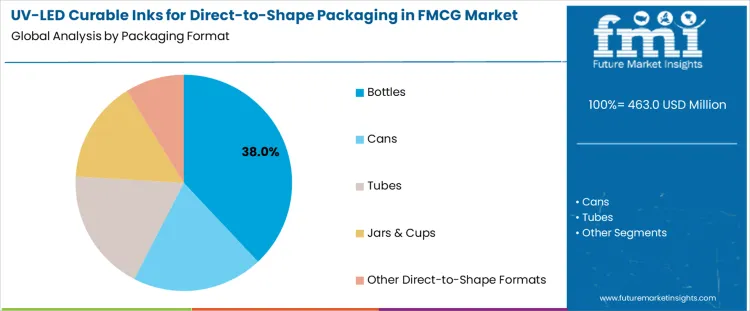
Bottles account for about 38% of demand because they represent the most widely used direct to shape packaging format across FMCG categories. Beverage, personal care, and home care brands increasingly adopt direct printing on bottles to eliminate labels, reduce material use, and improve recyclability. UV LED curable inks enable high speed decoration on curved bottle surfaces with immediate curing, allowing inline printing before or after filling. Their low heat output is critical for thin wall plastic bottles that deform under conventional UV lamps. Consistent adhesion on PET, HDPE, and PP substrates supports widespread adoption. Bottles also offer large printable surface areas, increasing ink consumption per unit. High production volumes and standardized bottle shapes reinforce repeat usage of qualified ink systems. Brand owners favor bottle printing for premiumization and tamper resistance, further anchoring demand.
Cans, tubes, jars, cups, and other formats contribute secondary demand. Cans require higher abrasion resistance but involve lower shape variability. Tubes present flexibility challenges during printing. Jars and cups are used selectively in food and cosmetics. Other formats operate at smaller scale. Packaging format leadership therefore reflects unit volume, surface availability, and compatibility with continuous high speed decoration rather than geometric complexity alone.
What Is Driving Leadership by FMCG Category in the UV LED Curable Inks Market?

Beverages represent about 34% of demand because they dominate FMCG packaging volumes and increasingly rely on visually distinctive containers. Direct to shape printing supports rapid design changes for promotions, regional variants, and limited editions without inventory complexity. UV LED inks provide strong color density and abrasion resistance required for cold chain handling and high moisture exposure. Beverage filling lines operate at very high speeds, favoring instant cure systems that do not slow throughput. Sustainability initiatives to reduce labels and sleeves further accelerate adoption. High turnover and short product cycles drive continuous ink demand across water, soft drinks, and functional beverages.
Personal care, home care, packaged food, dairy, and other FMCG categories contribute meaningful but smaller shares. Personal care emphasizes aesthetics and chemical resistance. Home care focuses on durability against cleaners. Food and dairy require compliance and wash resistance but operate at lower decoration volumes. OTC and pet care remain niche. Category leadership therefore reflects packaging volume, branding intensity, and line speed requirements rather than diversity of FMCG product segments.
How Are UV-LED Curable Inks Being Applied Across Direct-to-Shape FMCG Packaging?
Use appears in food, beverage, personal care, and household product packaging where high-speed, high-resolution printing on bottles, jars, and containers is required. Manufacturers adopt UV-LED curable inks to provide rapid curing, vibrant colors, and adhesion on diverse substrates such as PET, HDPE, glass, and metal. Packaging converters integrate these inks in direct-to-shape printing processes, reducing lead times and improving line efficiency. These applications reflect operational and production priorities rather than purely aesthetic objectives, with adoption driven by print quality, process speed, and regulatory compliance.
What Operational and Material Conditions Support Adoption of UV-LED Curable Inks for Direct-to-Shape Packaging?
Selection aligns with substrates requiring rapid curing, chemical resistance, and high adhesion without affecting container functionality. Ink formulations are optimized for viscosity, pigment concentration, and LED wavelength compatibility to ensure uniform coverage and durability. Production lines monitor ink deposition, curing intensity, and container handling to prevent defects or uneven coverage. Quality control evaluates adhesion, color vibrancy, scratch resistance, and regulatory compliance with food-contact and consumer safety standards. These conditions emerge from operational efficiency, print reliability, and substrate compatibility priorities in FMCG packaging workflows.
Which Practical Considerations Limit Wider Use of UV-LED Curable Inks for Direct-to-Shape Packaging?
High equipment and ink costs may limit adoption in low-margin or small-scale production. Substrate variability, surface energy, and geometry can affect curing and adhesion. Process precision, LED intensity, and curing distance require strict control for consistent performance. Regulatory approvals for food-contact and safety vary by region. These factors lead to selective deployment where print quality, production efficiency, and compliance justify incremental cost and operational oversight in FMCG packaging operations.
What is the Demand for UV LED Curable Inks for Direct to Shape Packaging in FMCG by Country?
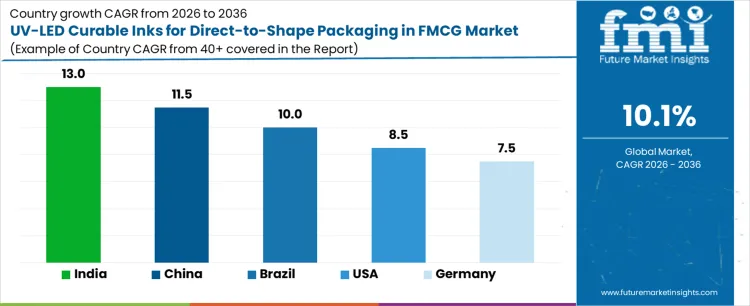
| Country | CAGR (%) |
|---|---|
| India | 13.0% |
| China | 11.5% |
| Brazil | 10.0% |
| USA | 8.5% |
| Germany | 7.5% |
The demand for UV LED curable inks for direct to shape packaging in FMCG varies across countries, driven by sustainable packaging adoption, high speed printing needs, and regulatory compliance. India leads with a 13.0% CAGR, supported by rapid FMCG sector growth, increasing packaging production, and adoption of energy efficient UV LED printing technologies. China follows at 11.5%, driven by large scale FMCG packaging operations and regulatory focus on low VOC inks. Brazil records 10.0%, shaped by growing packaged goods industry and modernization of printing lines. The USA grows at 8.5%, reflecting adoption in FMCG packaging and sustainable printing initiatives. Germany posts 7.5%, supported by mature packaging markets and eco-friendly printing practices.
How are UV-LED curable inks expanding direct-to-shape packaging applications in India?
In India, the UV-LED curable inks for direct-to-shape packaging in FMCG market is growing at a CAGR of 13% through 2036, driven by rising demand for innovative packaging, growth in the fast-moving consumer goods sector, and adoption of energy-efficient curing technologies. Manufacturers are using UV-LED inks to enhance print quality, reduce production time, and improve sustainability by lowering energy consumption. Demand is concentrated in industrial packaging hubs, beverage and personal care production facilities, and printing technology centers. Compared to China, India emphasizes high-volume FMCG packaging and rapid industrial adoption. Domestic suppliers provide high-performance, energy-efficient inks suitable for recurring packaging and finishing operations.
- Industrial packaging hubs, FMCG production facilities, and printing technology centers drive adoption
- Inks improve print quality, reduce curing time, and lower energy consumption
- Domestic suppliers provide high-performance, energy-efficient solutions
- Recurring packaging and finishing operations sustain adoption
How are industrial expansion and sustainability initiatives driving growth in China?
In China, revenue is growing at a CAGR of 11.5% through 2036, supported by large-scale FMCG production, growing consumer demand, and government incentives for energy-efficient manufacturing. Manufacturers are adopting UV-LED curable inks to improve print adhesion, reduce VOC emissions, and increase production efficiency on direct-to-shape packaging lines. Demand is concentrated in beverage and personal care industrial hubs, packaging facilities, and printing technology zones. Compared to India, adoption emphasizes large-scale integration and production optimization. Domestic suppliers provide cost-effective, high-performance inks suitable for recurring direct-to-shape printing operations.
- Beverage and personal care hubs, packaging facilities, and printing technology zones drive adoption
- Inks improve adhesion, reduce VOCs, and increase efficiency
- Domestic suppliers provide cost-effective, high-performance solutions
- Recurring direct-to-shape printing operations sustain adoption
How are FMCG innovation and operational efficiency driving adoption in Brazil?
In Brazil, the market is expanding at a CAGR of 10% through 2036, fueled by growth in packaged beverages, personal care products, and increasing adoption of modern printing technologies. Manufacturers are integrating UV-LED curable inks to enhance print quality, maintain product aesthetics, and reduce curing energy. Demand is concentrated in beverage production hubs, FMCG packaging plants, and industrial printing facilities. Compared to the USA, adoption emphasizes cost efficiency and large-scale deployment in emerging industrial clusters. Domestic suppliers provide high-performance inks suitable for recurring packaging and finishing cycles.
- Beverage production hubs, FMCG packaging plants, and industrial printing facilities drive adoption
- Inks enhance print quality and maintain aesthetics
- Domestic suppliers provide high-performance, energy-efficient solutions
- Recurring packaging and finishing cycles sustain adoption
How are high-volume production and regulatory compliance driving growth in the United States?
In the United States, revenue is growing at a CAGR of 8.5% through 2036, supported by increasing FMCG production, demand for visually appealing packaging, and energy-efficient manufacturing requirements. Manufacturers are adopting UV-LED curable inks to reduce energy use, improve curing speed, and maintain high-quality print standards. Demand is concentrated in industrial packaging hubs, beverage and personal care production lines, and printing technology centers. Compared to China, adoption emphasizes precision and regulatory compliance over volume-driven deployment. Domestic suppliers provide durable inks suitable for recurring direct-to-shape packaging and finishing operations.
- Industrial packaging hubs, beverage and personal care lines, and printing technology centers drive adoption
- Inks reduce energy use and improve curing speed
- Domestic suppliers provide durable, high-quality solutions
- Recurring packaging and finishing operations sustain adoption
How are sustainability and precision manufacturing driving market growth in Germany?
In Germany, the market is expanding at a CAGR of 7.5% through 2036, fueled by stringent environmental regulations, adoption of recyclable packaging, and demand for high-quality FMCG labeling. Manufacturers are integrating UV-LED curable inks to reduce VOC emissions, improve adhesion, and ensure consistent color on direct-to-shape packaging. Demand is concentrated in industrial printing hubs, packaging production facilities, and beverage and personal care manufacturing clusters. Compared to India, adoption emphasizes precision, compliance, and high-quality output rather than high-volume deployment. Domestic suppliers provide EU-certified, high-performance inks suitable for recurring printing and finishing operations.
- Industrial printing hubs, packaging production facilities, and FMCG manufacturing clusters drive adoption
- Inks reduce VOC emissions and improve adhesion
- Domestic suppliers provide EU-certified, high-performance solutions
- Recurring printing and finishing operations sustain adoption
Which Strategic Approaches Define Competition in the UV LED Curable Inks for Direct to Shape Packaging in FMCG Market under Speed and Substrate Constraints?
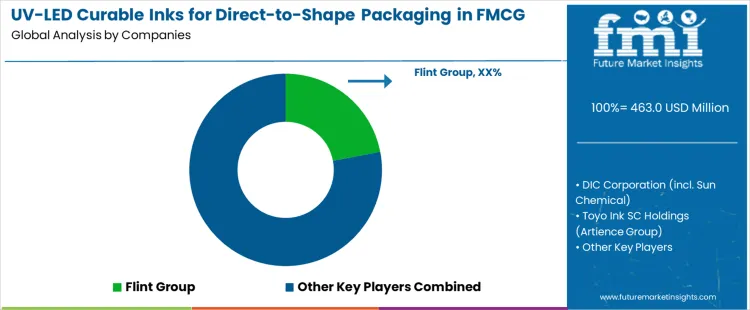
Competition in UV LED curable inks for direct to shape packaging is shaped by curing reliability on complex geometries rather than by ink chemistry alone. Flint Group and Siegwerk focus on ink systems that achieve full cure at low energy output, ensuring adhesion and scuff resistance on curved plastic, glass, and metal containers. Their strategies emphasize ink flexibility, low migration risk, and resistance to handling during filling and distribution. DIC Corporation, including Sun Chemical, positions UV LED inks around color stability and press consistency, supporting high speed decoration of bottles and containers without thermal distortion. Qualification is driven by cure margin, adhesion on low surface energy substrates, and consistency across short and long production runs.
A different competitive emphasis is evident among suppliers aligned with packaging line integration. Toyo Ink SC Holdings, operating under the Artience Group, prioritizes ink performance across diverse container shapes, focusing on dot control, gloss uniformity, and compatibility with inline inspection systems. INX International Ink Co. competes through operational robustness, offering UV LED inks designed to tolerate variation in lamp intensity, line speed, and container wall thickness. Across the market, suppliers invest in converter trials and joint validation with brand owners to reduce changeover risk. Competitive advantage is built through curing predictability, substrate versatility, and alignment with high throughput FMCG packaging lines rather than rapid color expansion or aggressive formulation change.
Key Players in the UV LED Curable Inks for Direct to Shape Packaging in FMCG Market
- Flint Group
- DIC Corporation (incl. Sun Chemical)
- Toyo Ink SC Holdings (Artience Group)
- INX International Ink Co.
- Siegwerk
Scope of the Report
| Items | Values |
|---|---|
| Quantitative Units | USD Million |
| Type | Process color (CMYK) UV-LED curable inks, white and opaque UV-LED inks, varnishes and overprint coatings, specialty and effect UV-LED inks |
| Application | Direct-to-shape printing on bottles, cans, tubes, jars and cups, other rigid FMCG containers |
| End User | FMCG brand owners, packaging converters, direct-to-shape printing service providers, beverage, personal care, home care, and food packaging manufacturers |
| Regions Covered | Asia Pacific, Europe, North America, Latin America, Middle East & Africa |
| Countries Covered | India, China, USA, Germany, Brazil, and other major FMCG packaging production markets |
| Key Companies Profiled | Flint Group, DIC Corporation (including Sun Chemical), Toyo Ink SC Holdings (Artience Group), INX International Ink Co., Siegwerk |
| Additional Attributes | Dollar sales by packaging format and FMCG category, regional adoption trends linked to UV-LED curing and high-speed direct-to-shape lines, competitive landscape based on curing reliability and substrate versatility, press qualification and color management requirements, integration with LED lamp systems and high-throughput FMCG filling lines |
UV LED Curable Inks for Direct to Shape Packaging in FMCG Market Segmentation
Packaging Format:
- Bottles
- Cans
- Tubes
- Jars & Cups
- Other Direct-to-Shape Formats
FMCG Category:
- Beverages
- Personal Care & Cosmetics
- Home Care & Cleaning
- Packaged Food & Dairy
- Other FMCG (OTC, Pet Care, etc.)
Ink Type:
- Process Colors (CMYK)
- White & Opaque Inks
- Varnishes & Overprints
- Specialty & Effect Inks
Region
- Asia Pacific
- China
- Japan
- South Korea
- India
- Australia & New Zealand
- ASEAN
- Rest of Asia Pacific
- Europe
- Germany
- United Kingdom
- France
- Italy
- Spain
- Nordic
- BENELUX
- Rest of Europe
- North America
- United States
- Canada
- Mexico
- Latin America
- Brazil
- Chile
- Rest of Latin America
- Middle East & Africa
- Kingdom of Saudi Arabia
- Other GCC Countries
- Turkey
- South Africa
- Other African Union
- Rest of Middle East & Africa
Frequently Asked Questions
How big is the uv-led curable inks for direct-to-shape packaging in fmcg market in 2026?
The global uv-led curable inks for direct-to-shape packaging in fmcg market is estimated to be valued at USD 463.0 million in 2026.
What will be the size of uv-led curable inks for direct-to-shape packaging in fmcg market in 2036?
The market size for the uv-led curable inks for direct-to-shape packaging in fmcg market is projected to reach USD 1,211.9 million by 2036.
How much will be the uv-led curable inks for direct-to-shape packaging in fmcg market growth between 2026 and 2036?
The uv-led curable inks for direct-to-shape packaging in fmcg market is expected to grow at a 10.1% CAGR between 2026 and 2036.
What are the key product types in the uv-led curable inks for direct-to-shape packaging in fmcg market?
The key product types in uv-led curable inks for direct-to-shape packaging in fmcg market are bottles, cans, tubes, jars & cups and other direct-to-shape formats.
Which fmcg category segment to contribute significant share in the uv-led curable inks for direct-to-shape packaging in fmcg market in 2026?
In terms of fmcg category, beverages segment to command 34.0% share in the uv-led curable inks for direct-to-shape packaging in fmcg market in 2026.
Preview the report firsthand - request a free sample
Get SampleGet the brochure for pricing and purchase details.
Get PDFTable of Content
- Executive Summary
- Global Market Outlook
- Demand-side Trends
- Supply-side Trends
- Technology Roadmap Analysis
- Analysis and Recommendations
- Market Overview
- Market Coverage / Taxonomy
- Market Definition / Scope / Limitations
- Market Background
- Market Dynamics
- Drivers
- Restraints
- Opportunity
- Trends
- Scenario Forecast
- Demand in Optimistic Scenario
- Demand in Likely Scenario
- Demand in Conservative Scenario
- Opportunity Map Analysis
- Product Life Cycle Analysis
- Supply Chain Analysis
- Investment Feasibility Matrix
- Value Chain Analysis
- PESTLE and Porter’s Analysis
- Regulatory Landscape
- Regional Parent Market Outlook
- Production and Consumption Statistics
- Import and Export Statistics
- Market Dynamics
- Global Market Analysis 2021 to 2025 and Forecast, 2026 to 2036
- Historical Market Size Value (USD Million) Analysis, 2021 to 2025
- Current and Future Market Size Value (USD Million) Projections, 2026 to 2036
- Y-o-Y Growth Trend Analysis
- Absolute $ Opportunity Analysis
- Global Market Pricing Analysis 2021 to 2025 and Forecast 2026 to 2036
- Global Market Analysis 2021 to 2025 and Forecast 2026 to 2036, By Packaging Format
- Introduction / Key Findings
- Historical Market Size Value (USD Million) Analysis By Packaging Format , 2021 to 2025
- Current and Future Market Size Value (USD Million) Analysis and Forecast By Packaging Format , 2026 to 2036
- Bottles
- Cans
- Tubes
- Jars & Cups
- Other Direct-to-Shape Formats
- Bottles
- Y-o-Y Growth Trend Analysis By Packaging Format , 2021 to 2025
- Absolute $ Opportunity Analysis By Packaging Format , 2026 to 2036
- Global Market Analysis 2021 to 2025 and Forecast 2026 to 2036, By FMCG Category
- Introduction / Key Findings
- Historical Market Size Value (USD Million) Analysis By FMCG Category, 2021 to 2025
- Current and Future Market Size Value (USD Million) Analysis and Forecast By FMCG Category, 2026 to 2036
- Beverages
- Personal Care & Cosmetics
- Home Care & Cleaning
- Packaged Food & Dairy
- Other FMCG (OTC, Pet Care, etc.)
- Beverages
- Y-o-Y Growth Trend Analysis By FMCG Category, 2021 to 2025
- Absolute $ Opportunity Analysis By FMCG Category, 2026 to 2036
- Global Market Analysis 2021 to 2025 and Forecast 2026 to 2036, By Ink Type
- Introduction / Key Findings
- Historical Market Size Value (USD Million) Analysis By Ink Type, 2021 to 2025
- Current and Future Market Size Value (USD Million) Analysis and Forecast By Ink Type, 2026 to 2036
- Process Colors (CMYK)
- White & Opaque Inks
- Varnishes & Overprints
- Specialty & Effect Inks
- Process Colors (CMYK)
- Y-o-Y Growth Trend Analysis By Ink Type, 2021 to 2025
- Absolute $ Opportunity Analysis By Ink Type, 2026 to 2036
- Global Market Analysis 2021 to 2025 and Forecast 2026 to 2036, By Region
- Introduction
- Historical Market Size Value (USD Million) Analysis By Region, 2021 to 2025
- Current Market Size Value (USD Million) Analysis and Forecast By Region, 2026 to 2036
- North America
- Latin America
- Western Europe
- Eastern Europe
- East Asia
- South Asia and Pacific
- Middle East & Africa
- Market Attractiveness Analysis By Region
- North America Market Analysis 2021 to 2025 and Forecast 2026 to 2036, By Country
- Historical Market Size Value (USD Million) Trend Analysis By Market Taxonomy, 2021 to 2025
- Market Size Value (USD Million) Forecast By Market Taxonomy, 2026 to 2036
- By Country
- USA
- Canada
- Mexico
- By Packaging Format
- By FMCG Category
- By Ink Type
- By Country
- Market Attractiveness Analysis
- By Country
- By Packaging Format
- By FMCG Category
- By Ink Type
- Key Takeaways
- Latin America Market Analysis 2021 to 2025 and Forecast 2026 to 2036, By Country
- Historical Market Size Value (USD Million) Trend Analysis By Market Taxonomy, 2021 to 2025
- Market Size Value (USD Million) Forecast By Market Taxonomy, 2026 to 2036
- By Country
- Brazil
- Chile
- Rest of Latin America
- By Packaging Format
- By FMCG Category
- By Ink Type
- By Country
- Market Attractiveness Analysis
- By Country
- By Packaging Format
- By FMCG Category
- By Ink Type
- Key Takeaways
- Western Europe Market Analysis 2021 to 2025 and Forecast 2026 to 2036, By Country
- Historical Market Size Value (USD Million) Trend Analysis By Market Taxonomy, 2021 to 2025
- Market Size Value (USD Million) Forecast By Market Taxonomy, 2026 to 2036
- By Country
- Germany
- UK
- Italy
- Spain
- France
- Nordic
- BENELUX
- Rest of Western Europe
- By Packaging Format
- By FMCG Category
- By Ink Type
- By Country
- Market Attractiveness Analysis
- By Country
- By Packaging Format
- By FMCG Category
- By Ink Type
- Key Takeaways
- Eastern Europe Market Analysis 2021 to 2025 and Forecast 2026 to 2036, By Country
- Historical Market Size Value (USD Million) Trend Analysis By Market Taxonomy, 2021 to 2025
- Market Size Value (USD Million) Forecast By Market Taxonomy, 2026 to 2036
- By Country
- Russia
- Poland
- Hungary
- Balkan & Baltic
- Rest of Eastern Europe
- By Packaging Format
- By FMCG Category
- By Ink Type
- By Country
- Market Attractiveness Analysis
- By Country
- By Packaging Format
- By FMCG Category
- By Ink Type
- Key Takeaways
- East Asia Market Analysis 2021 to 2025 and Forecast 2026 to 2036, By Country
- Historical Market Size Value (USD Million) Trend Analysis By Market Taxonomy, 2021 to 2025
- Market Size Value (USD Million) Forecast By Market Taxonomy, 2026 to 2036
- By Country
- China
- Japan
- South Korea
- By Packaging Format
- By FMCG Category
- By Ink Type
- By Country
- Market Attractiveness Analysis
- By Country
- By Packaging Format
- By FMCG Category
- By Ink Type
- Key Takeaways
- South Asia and Pacific Market Analysis 2021 to 2025 and Forecast 2026 to 2036, By Country
- Historical Market Size Value (USD Million) Trend Analysis By Market Taxonomy, 2021 to 2025
- Market Size Value (USD Million) Forecast By Market Taxonomy, 2026 to 2036
- By Country
- India
- ASEAN
- Australia & New Zealand
- Rest of South Asia and Pacific
- By Packaging Format
- By FMCG Category
- By Ink Type
- By Country
- Market Attractiveness Analysis
- By Country
- By Packaging Format
- By FMCG Category
- By Ink Type
- Key Takeaways
- Middle East & Africa Market Analysis 2021 to 2025 and Forecast 2026 to 2036, By Country
- Historical Market Size Value (USD Million) Trend Analysis By Market Taxonomy, 2021 to 2025
- Market Size Value (USD Million) Forecast By Market Taxonomy, 2026 to 2036
- By Country
- Kingdom of Saudi Arabia
- Other GCC Countries
- Turkiye
- South Africa
- Other African Union
- Rest of Middle East & Africa
- By Packaging Format
- By FMCG Category
- By Ink Type
- By Country
- Market Attractiveness Analysis
- By Country
- By Packaging Format
- By FMCG Category
- By Ink Type
- Key Takeaways
- Key Countries Market Analysis
- USA
- Pricing Analysis
- Market Share Analysis, 2025
- By Packaging Format
- By FMCG Category
- By Ink Type
- Canada
- Pricing Analysis
- Market Share Analysis, 2025
- By Packaging Format
- By FMCG Category
- By Ink Type
- Mexico
- Pricing Analysis
- Market Share Analysis, 2025
- By Packaging Format
- By FMCG Category
- By Ink Type
- Brazil
- Pricing Analysis
- Market Share Analysis, 2025
- By Packaging Format
- By FMCG Category
- By Ink Type
- Chile
- Pricing Analysis
- Market Share Analysis, 2025
- By Packaging Format
- By FMCG Category
- By Ink Type
- Germany
- Pricing Analysis
- Market Share Analysis, 2025
- By Packaging Format
- By FMCG Category
- By Ink Type
- UK
- Pricing Analysis
- Market Share Analysis, 2025
- By Packaging Format
- By FMCG Category
- By Ink Type
- Italy
- Pricing Analysis
- Market Share Analysis, 2025
- By Packaging Format
- By FMCG Category
- By Ink Type
- Spain
- Pricing Analysis
- Market Share Analysis, 2025
- By Packaging Format
- By FMCG Category
- By Ink Type
- France
- Pricing Analysis
- Market Share Analysis, 2025
- By Packaging Format
- By FMCG Category
- By Ink Type
- India
- Pricing Analysis
- Market Share Analysis, 2025
- By Packaging Format
- By FMCG Category
- By Ink Type
- ASEAN
- Pricing Analysis
- Market Share Analysis, 2025
- By Packaging Format
- By FMCG Category
- By Ink Type
- Australia & New Zealand
- Pricing Analysis
- Market Share Analysis, 2025
- By Packaging Format
- By FMCG Category
- By Ink Type
- China
- Pricing Analysis
- Market Share Analysis, 2025
- By Packaging Format
- By FMCG Category
- By Ink Type
- Japan
- Pricing Analysis
- Market Share Analysis, 2025
- By Packaging Format
- By FMCG Category
- By Ink Type
- South Korea
- Pricing Analysis
- Market Share Analysis, 2025
- By Packaging Format
- By FMCG Category
- By Ink Type
- Russia
- Pricing Analysis
- Market Share Analysis, 2025
- By Packaging Format
- By FMCG Category
- By Ink Type
- Poland
- Pricing Analysis
- Market Share Analysis, 2025
- By Packaging Format
- By FMCG Category
- By Ink Type
- Hungary
- Pricing Analysis
- Market Share Analysis, 2025
- By Packaging Format
- By FMCG Category
- By Ink Type
- Kingdom of Saudi Arabia
- Pricing Analysis
- Market Share Analysis, 2025
- By Packaging Format
- By FMCG Category
- By Ink Type
- Turkiye
- Pricing Analysis
- Market Share Analysis, 2025
- By Packaging Format
- By FMCG Category
- By Ink Type
- South Africa
- Pricing Analysis
- Market Share Analysis, 2025
- By Packaging Format
- By FMCG Category
- By Ink Type
- USA
- Market Structure Analysis
- Competition Dashboard
- Competition Benchmarking
- Market Share Analysis of Top Players
- By Regional
- By Packaging Format
- By FMCG Category
- By Ink Type
- Competition Analysis
- Competition Deep Dive
- Flint Group
- Overview
- Product Portfolio
- Profitability by Market Segments (Product/Age /Sales Channel/Region)
- Sales Footprint
- Strategy Overview
- Marketing Strategy
- Product Strategy
- Channel Strategy
- DIC Corporation (incl. Sun Chemical)
- Toyo Ink SC Holdings (Artience Group)
- INX International Ink Co.
- Siegwerk
- Flint Group
- Competition Deep Dive
- Assumptions & Acronyms Used
- Research Methodology


