

- Industry Size (2026)
- USD 390 Mn
- Forecast (2036)
- USD 881.8 Mn
- CAGR (2026 to 2036)
- 8.5%
High-Durability Direct-Print and Coding Inks for DPP-Compliant Packaging Market Forecast and Outlook 2026 to 2036
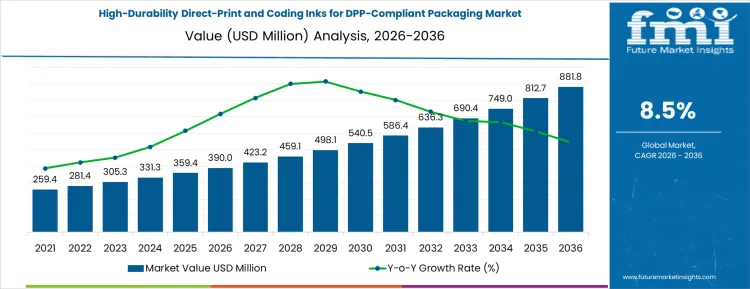
The high-durability direct-print and coding inks for DPP-compliant packaging market is expected to grow from USD 390 million in 2026 to USD 881.8 million by 2036, reflecting a compound annual growth rate (CAGR) of 8.5%. These inks are essential for packaging applications that require high durability, especially for direct printing and coding on packaging materials, in compliance with the requirements of Digital Printing Packaging (DPP). The market growth is driven by the increasing need for secure, legible, and tamper-resistant printing solutions, especially in sectors such as food, pharmaceuticals, and consumer goods, where packaging integrity is paramount.
The demand for these specialized inks is further fueled by the growing trend of e-commerce and direct-to-consumer sales, which require reliable and high-quality packaging for product identification and traceability. Additionally, technological advancements in ink formulations and printing technologies, as well as the increasing regulatory pressure on packaging standards, are expected to boost the adoption of high-durability direct-print and coding inks, supporting the market's expansion.
Quick Stats of the High-Durability Direct-Print and Coding Inks for DPP-Compliant Packaging Market
- High-Durability Direct-Print and Coding Inks for DPP-Compliant Packaging Market Value (2026): USD 390 million
- High-Durability Direct-Print and Coding Inks for DPP-Compliant Packaging Market Forecast Value (2036): USD 881.8 million
- High-Durability Direct-Print and Coding Inks for DPP-Compliant Packaging Market Global Forecast CAGR (2026-2036): 8.5%
- High-Durability Direct-Print and Coding Inks for DPP-Compliant Packaging Market Leading Segment: Direct coding (inkjet/laser) 45%
- Key Growth Regions in High-Durability Direct-Print and Coding Inks for DPP-Compliant Packaging Market: North America, Asia Pacific
- Top Players in High-Durability Direct-Print and Coding Inks for DPP-Compliant Packaging Market: Sun Chemical, Siegwerk, Hanghua Ink, Videojet, Markem-Imaje
What is the Growth Forecast for the High-Durability Direct-Print and Coding Inks for DPP-Compliant Packaging Market through 2036?
The acceleration and deceleration pattern for the high-durability direct-print and coding inks for DPP-compliant packaging market shows consistent growth, with moderate acceleration in the middle years and a gradual deceleration towards the end of the forecast period. Starting at USD 390 million in 2026, the market grows to USD 423.7 million in 2027 and USD 460.2 million in 2028, indicating steady growth as the adoption of these inks in various packaging applications begins to rise.
From 2028 to 2030, the market continues to accelerate, reaching USD 500.9 million in 2029 and USD 545.9 million in 2030, driven by increased demand for durable and secure packaging solutions. This period reflects a phase where the technology becomes more integrated into packaging practices across multiple industries, especially as e-commerce and digital printing continue to grow. Between 2030 and 2035, the market further accelerates, reaching USD 595.7 million in 2031, USD 650.5 million in 2032, and USD 711.7 million in 2033, as more companies invest in high-quality printing solutions to meet regulatory and consumer demands.
By 2035, the market is projected to reach USD 780.3 million, with the final market value of USD 881.8 million expected in 2036. The acceleration and deceleration pattern indicates that while the market sees steady growth in the early years, the pace of growth gradually decelerates towards the latter part of the forecast period as the technology matures and the market becomes more saturated. Despite this, demand for high-durability inks will continue to be supported by evolving packaging standards and growing regulatory requirements for traceability and security.
High-Durability Direct-Print and Coding Inks for DPP-Compliant Packaging Market Key Takeaways
| Metric | Value |
|---|---|
| Industry Sales Value (2026) | USD 390 million |
| Industry Forecast Value (2036) | USD 881.8 million |
| Industry Forecast CAGR (2026-2036) | 8.5% |
What Is Driving the Demand for High Durability Direct Print and Coding Inks for DPP Compliant Packaging in the US and Globally?
The demand for high durability direct print and coding inks for Digital Product Passport (DPP) compliant packaging is driven by the expanding requirements for traceability, regulatory transparency, and product authentication across supply chains. Digital Product Passports are being introduced in regions with evolving rules on sustainability and circularity, requiring products to carry machine readable information about origin, materials, and lifecycle data. Packaging must be marked with codes, identifiers, and digital links that remain legible throughout distribution, storage, and end use. High durability inks that adhere reliably to diverse substrates such as plastics, glass, metals, and coated papers are essential to support scanning and data retrieval from production line to point of sale. Manufacturers in food and beverage, pharmaceuticals, electronics, and consumer goods are replacing conventional coding solutions with inks that resist abrasion, moisture, temperature swings, and UV exposure because the quality of direct print affects both operational efficiency and compliance. At the same time, brand owners and regulators are emphasizing anti counterfeiting measures, making robust coding necessary where counterfeit risk is high. These drivers are supported by increasing adoption of digital printing technologies and automated inline marking systems, which demand ink formulations that deliver consistent performance at high throughput without impairing substrate integrity or recyclability.
Future demand for high durability direct print and coding inks for DPP compliant packaging is expected to grow as digital traceability frameworks and sustainability disclosure requirements become more prevalent. As jurisdictions in North America, Europe, and Asia refine mandates around product passports and lifecycle transparency, packaging ink systems that support persistent, high resolution codes will be critical. Technological improvements in ink chemistry-such as enhanced adhesion, rapid curing, and compatibility with variable data printing-will broaden application across packaging formats and manufacturing environments. Growth in ecommerce and global distribution networks also reinforces the need for inks that can withstand handling, scanning, and environmental stresses from shipping to retail shelves. Adoption will be influenced by integration with packaging lines, cost effectiveness relative to traditional marking solutions, and the ability of ink systems to align with recycling and sustainability criteria. As companies seek to meet regulatory obligations and consumer expectations for product information, robust direct print and coding ink solutions will play a central role in enabling compliant, durable marking across diverse packaging types.
What is the Segment Analysis for the High-Durability Direct-Print and Coding Inks for DPP-Compliant Packaging Market?
The high-durability direct-print and coding inks for DPP-compliant packaging market is driven by key segments based on end-use/application and packaging format/type. Among the end-use applications, FMCG on-pack printing holds the largest share, accounting for 42% of the market, followed by pharma & food packaging and e-commerce packaging. These applications require inks that can withstand various environmental factors such as moisture, abrasion, and temperature changes, ensuring product information remains legible throughout the supply chain. In terms of packaging formats, direct coding (inkjet/laser) leads the market, representing 45% of the share, followed by high-speed printing inks and digital print systems. The need for high-durability inks is driven by the increasing demand for compliance with regulations and the focus on sustainable packaging. With regions like North America and Europe pushing for more stringent packaging regulations, the market for high-durability inks is expected to grow. This segment's growth is supported by advancements in ink technologies and the shift towards more efficient, cost-effective coding and marking systems, making it an integral part of the modern packaging landscape.
What is Driving Growth in the FMCG On-Pack Printing Segment of the High-Durability Inks Market?
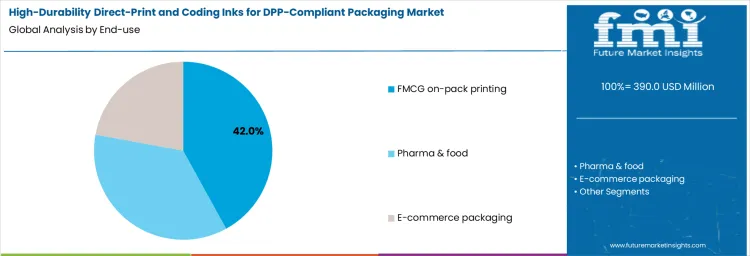
The FMCG on-pack printing segment is the largest end-use application in the high-durability direct-print and coding inks for DPP-compliant packaging market, accounting for 42% of the market share. This growth is primarily driven by the increasing demand for robust, reliable labeling and coding systems in the fast-moving consumer goods (FMCG) sector. Packaging in FMCG requires high-durability inks that can withstand handling, transportation, and exposure to various environmental conditions, ensuring that product labels and codes remain intact throughout the supply chain. The need for clear, legible product information such as batch numbers, expiration dates, and manufacturing details is critical for both compliance and consumer trust. As regulations around packaging and labeling continue to evolve, FMCG companies are increasingly turning to high-durability coding solutions that meet DPP (direct product printing) compliance requirements. Direct-print systems, including inkjet and laser technologies, offer significant advantages in terms of speed, accuracy, and long-lasting prints. As consumer preferences shift toward products that are both reliable and well-labeled, FMCG manufacturers are expected to continue investing in high-durability direct-print and coding inks, making this segment a key driver of market growth.
What is Contributing to the Growth of Direct Coding (Inkjet/Laser) Packaging Format in the Inks Market?
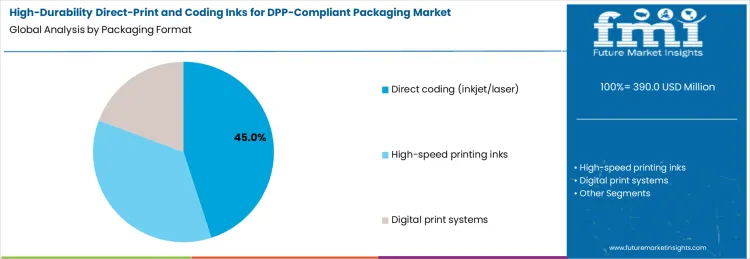
Direct coding (inkjet/laser) is the dominant packaging format in the high-durability direct-print and coding inks for DPP-compliant packaging market, representing 45% of the market share. The growth of this packaging format is largely driven by the increasing demand for efficient, high-speed, and high-quality printing solutions across various industries. Direct coding technologies, such as inkjet and laser printing, are preferred for their ability to produce sharp, high-resolution prints on a wide variety of packaging materials, including plastic, glass, and metal. These systems allow for precise marking of product codes, expiration dates, and batch numbers, which are crucial for compliance with industry regulations. Inkjet and laser printing technologies offer the advantage of high-speed operation, reducing downtime and increasing productivity in fast-paced manufacturing environments. Furthermore, these technologies are well-suited for a range of packaging formats, making them versatile for applications in FMCG, pharma, food, and e-commerce packaging. As businesses continue to prioritize operational efficiency and regulatory compliance, the demand for direct coding systems is expected to grow, driving the market forward. With advancements in ink technologies and printing systems, direct coding solutions will remain a key growth driver in the high-durability inks market.
What is the Summary of the Global High Durability Direct Print and Coding Inks for DPP Compliant Packaging Market?
The global high durability direct print and coding inks for Digital Product Passport (DPP) compliant packaging market is expanding as brands and converters invest in print and code systems that support product traceability, authentication and sustainability goals. These inks adhere strongly to diverse substrates and withstand handling, environmental stress, and supply chain scanning. Growth reflects regulatory focus on packaging transparency, rising adoption of digital labeling systems, and need for permanent marks that integrate with DPP frameworks. Demand spans food and beverage, pharmaceuticals, electronics and consumer goods where reliable print quality and data integrity matter.
What are the Key Drivers for the Global High Durability Direct Print and Coding Inks for DPP Compliant Packaging Market?
One driver is increasing regulatory emphasis on product traceability and transparency, including initiatives that require digital product passport information to be displayed on packaging. Manufacturers need inks that maintain code legibility throughout distribution and retail life cycles. Growth in global e commerce and omnichannel retail prompts use of high performance printing to support scanning at multiple touchpoints. Expansion of packaging automation and data driven quality systems encourages use of ink solutions that are compatible with high speed production lines. Rising demand for tamper evident and anti counterfeiting measures further motivates adoption of robust direct print and coding ink technologies.
What are the Restraints for the Global High Durability Direct Print and Coding Inks for DPP Compliant Packaging Market?
One restraint is the cost premium associated with specialised, high durability ink formulations compared to standard packaging inks, which can affect pricing in cost sensitive segments. Some converters and brand owners may delay upgrades until performance benefits are clear and aligned with internal quality metrics. Technical challenges in formulating inks that adhere reliably across all substrate types, including plastics, metals and coated papers, require extensive testing and validation. Supply chain constraints for advanced ink chemistries and raw materials can impact availability. Variation in global standardization for digital product passport implementation timing can also affect investment decisions and rollout pace.
What is the Key Trends in the Global High Durability Direct Print and Coding Inks for DPP Compliant Packaging Market?
A key trend is development of ink chemistries that balance durability with environmental considerations, including lower emissions and improved recyclability. Formulators are creating solutions tailored to specific substrates and process conditions that support consistent code quality and machine vision recognition. Integration of coding systems with enterprise data platforms helps brands link printed codes to digital product passports and supply chain records. Growth of smart packaging initiatives encourages use of high performance inks that support QR, barcodes and serialization at high production speeds. Collaboration among ink manufacturers, equipment OEMs and brand owners is increasing to optimize print performance and support broader adoption of DPP ready packaging solutions.
What are the Key Insights from the High-Durability Direct-Print and Coding Inks for DPP-Compliant Packaging Market Analysis?
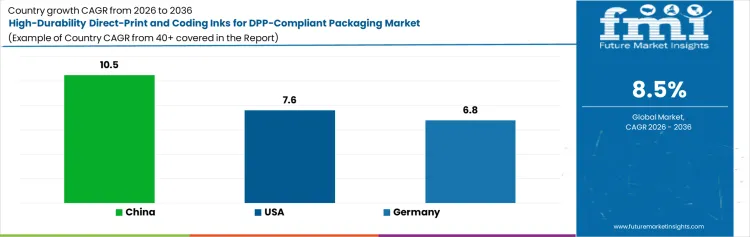
The high-durability direct-print and coding inks for DPP-compliant packaging market is expected to experience significant growth across various regions, driven by increasing demand for packaging solutions that ensure compliance with DPP (Direct Print and Coding) standards. These inks offer high durability, ensuring clear and long-lasting printing on packaging materials, which is crucial for industries like food, pharmaceuticals, and consumer goods. As global packaging regulations become more stringent, the demand for reliable and durable printing technologies is expected to rise. The market is also supported by the increasing need for tamper-proof packaging and product traceability. Key markets such as China and the United States are projected to see strong growth, with technological advancements and regulatory pressures driving adoption. Understanding regional growth trends will allow businesses to better align their offerings with the needs of these expanding markets.
| Country | CAGR (2026-2036) |
|---|---|
| USA | 7.6% |
| Germany | 6.8% |
| China | 10.5% |
What is the Growth Outlook for the High-Durability Direct-Print and Coding Inks for DPP-Compliant Packaging Market in the USA?
The high-durability direct-print and coding inks for DPP-compliant packaging market in the United States is expected to grow at a moderate pace, with a projected CAGR of 7.6%. The U.S. market benefits from its advanced manufacturing and packaging industries, which continue to adopt innovative printing solutions for compliance with increasing packaging regulations. The demand for high-durability inks is driven by industries such as food and beverages, pharmaceuticals, and consumer goods, which require clear and long-lasting product information and barcodes. The U.S. market is also influenced by stringent packaging laws and the growing focus on product traceability and tamper-proof packaging. As companies seek to comply with these standards, the adoption of direct-print and coding inks is expected to grow steadily, positioning the U.S. as a key market for high-durability packaging solutions.
What is the Market Outlook for the High-Durability Direct-Print and Coding Inks for DPP-Compliant Packaging Market in Germany?
The high-durability direct-print and coding inks for DPP-compliant packaging market in Germany is projected to grow at a moderate rate, with a CAGR of 6.8%. Germany, known for its strong manufacturing base and stringent regulatory environment, provides a solid foundation for the adoption of high-durability direct-print and coding inks. The demand for these inks is supported by the growing packaging sector, particularly in the food, beverage, and pharmaceutical industries, where compliance with regulatory standards is critical. Additionally, Germany’s emphasis on sustainability and environmental responsibility is driving demand for inks that provide long-lasting durability and clear print, ensuring that products meet both regulatory and consumer expectations. As these industries continue to prioritize compliance and traceability, Germany is expected to see steady growth in the adoption of DPP-compliant packaging solutions.
What is the Growth Forecast for the High-Durability Direct-Print and Coding Inks for DPP-Compliant Packaging Market in China?
The high-durability direct-print and coding inks for DPP-compliant packaging market in China is expected to experience the highest growth, with a projected CAGR of 10.5%. China’s rapidly expanding manufacturing sector, along with increasing consumer demand for traceable and tamper-proof packaging, is driving this growth. The country’s packaging industry is witnessing significant transformations as it responds to both domestic and international regulatory pressures, particularly in sectors such as food, healthcare, and consumer goods. China’s focus on enhancing product safety and compliance with global packaging standards further supports the growing adoption of high-durability direct-print and coding inks. With a large manufacturing base and the increasing need for advanced packaging solutions, China is set to lead the market growth in this sector.
What is the Competitive Landscape for the High-Durability Direct-Print and Coding Inks for DPP-Compliant Packaging Market?
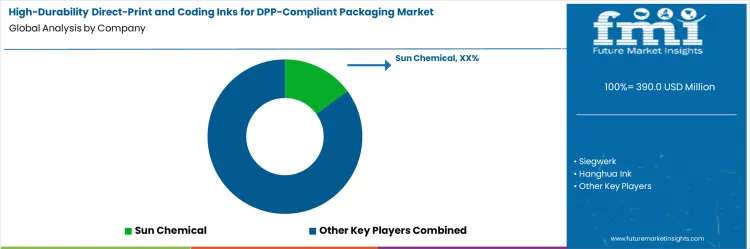
The high-durability direct-print and coding inks for DPP-compliant packaging market is growing as packaging industries demand more efficient and reliable ink solutions. Sun Chemical leads the market with its advanced ink technologies, offering high-durability inks that meet DPP (direct print and packaging) compliance standards. Their focus on innovation and sustainability positions them as a key player in this competitive space. Siegwerk, Hanghua Ink, and Videojet are major competitors, each offering specialized inks for direct-print applications. Siegwerk provides solutions that focus on print quality and durability for high-speed production environments, while Hanghua Ink offers cost-effective, high-quality inks suitable for various packaging types. Videojet delivers advanced coding technologies and ink solutions that ensure high-quality, reliable printing on DPP-compliant packaging.
Markem-Imaje rounds out the competitive landscape, offering innovative ink solutions that cater to high-durability, direct-print packaging applications. The company focuses on providing high-performance inks that are resistant to abrasion and environmental factors, ensuring legible and durable codes on packaging materials. These companies compete by focusing on ink performance, durability, compliance with regulatory standards, and their ability to support efficient and high-quality direct-print and coding processes in the packaging industry. Their strategies emphasize technological innovation and the delivery of reliable, sustainable solutions for DPP-compliant packaging.
Key Players of the High-Durability Direct-Print and Coding Inks for DPP-Compliant Packaging Market
- Sun Chemical
- Siegwerk
- Hanghua Ink
- Videojet
- Markem-Imaje
Scope of the Report
| Items | Values |
|---|---|
| Quantitative Units (2026) | USD Million |
| End-use / Application | FMCG On-Pack Printing, Pharma & Food, E-commerce Packaging |
| Packaging Format / Type | Direct Coding (Inkjet/Laser), High-Speed Printing Inks, Digital Print Systems |
| Material | UV-Curable & Water-Based Durable Inks, Low-Migration Inks, Cost-Optimised Durable Inks |
| Technology | High-Adhesion + Abrasion-Resistant Coding, Laser-Reactive Coatings, Thermal Inkjet Enhancements |
| Companies | Sun Chemical, Siegwerk, Hanghua Ink, Videojet, Markem-Imaje |
| Regions Covered | North America, Latin America, Western Europe, Eastern Europe, South Asia and Pacific, East Asia, Middle East & Africa |
| Countries Covered | United States, Canada, Mexico, Brazil, Argentina, Germany, France, United Kingdom, Italy, Spain, Netherlands, China, India, Japan, South Korea, ANZ, GCC Countries, South Africa |
| Additional Attributes | Dollar by sales by end-use/application, packaging format/type, material, technology, and region. Includes market trends in high-durability direct-print and coding inks, focusing on UV-curable, water-based, and low-migration inks. Highlights the role of high-adhesion, abrasion-resistant coding, laser-reactive coatings, and thermal inkjet enhancements in FMCG, pharma, food, and e-commerce packaging. Focus on cost-optimisation, regulatory compliance, market share, and competitive positioning of key companies. |
High-Durability Direct-Print and Coding Inks for DPP-Compliant Packaging Market Segmentation
End-use / Application
- FMCG on-pack printing
- Pharma & food
- E-commerce packaging
Packaging Format / Type
- Direct coding (inkjet/laser)
- High-speed printing inks
- Digital print systems
Material
- UV-curable & water-based durable inks
- Low-migration inks
- Cost-optimised durable inks
Technology
- High-adhesion + abrasion-resistant coding
- Laser-reactive coatings
- Thermal inkjet enhancements
Region
- Asia Pacific
- China
- Japan
- South Korea
- India
- Australia & New Zealand
- ASEAN
- Rest of Asia Pacific
- Europe
- Germany
- United Kingdom
- France
- Italy
- Spain
- Nordic
- BENELUX
- Rest of Europe
- North America
- United States
- Canada
- Mexico
- Latin America
- Brazil
- Chile
- Rest of Latin America
- Middle East & Africa
- Kingdom of Saudi Arabia
- Other GCC Countries
- Turkey
- South Africa
- Other African Union
- Rest of Middle East & Africa
Frequently Asked Questions
How big is the high-durability direct-print and coding inks for DPP-compliant packaging market in 2026?
The global high-durability direct-print and coding inks for DPP-compliant packaging market is estimated to be valued at USD 390.0 million in 2026.
What will be the size of high-durability direct-print and coding inks for DPP-compliant packaging market in 2036?
The market size for the high-durability direct-print and coding inks for DPP-compliant packaging market is projected to reach USD 881.8 million by 2036.
How much will be the high-durability direct-print and coding inks for DPP-compliant packaging market growth between 2026 and 2036?
The high-durability direct-print and coding inks for DPP-compliant packaging market is expected to grow at a 8.5% CAGR between 2026 and 2036.
What are the key product types in the high-durability direct-print and coding inks for DPP-compliant packaging market?
The key product types in high-durability direct-print and coding inks for DPP-compliant packaging market are FMCG on-pack printing, pharma & food and e-commerce packaging.
Which packaging format segment to contribute significant share in the high-durability direct-print and coding inks for DPP-compliant packaging market in 2026?
In terms of packaging format, direct coding (inkjet/laser) segment to command 45.0% share in the high-durability direct-print and coding inks for DPP-compliant packaging market in 2026.
Preview the report firsthand - request a free sample
Get SampleGet the brochure for pricing and purchase details.
Get PDFTable of Content
- Executive Summary
- Global Market Outlook
- Demand-side Trends
- Supply-side Trends
- Technology Roadmap Analysis
- Analysis and Recommendations
- Market Overview
- Market Coverage / Taxonomy
- Market Definition / Scope / Limitations
- Market Background
- Market Dynamics
- Drivers
- Restraints
- Opportunity
- Trends
- Scenario Forecast
- Demand in Optimistic Scenario
- Demand in Likely Scenario
- Demand in Conservative Scenario
- Opportunity Map Analysis
- Product Life Cycle Analysis
- Supply Chain Analysis
- Investment Feasibility Matrix
- Value Chain Analysis
- PESTLE and Porter’s Analysis
- Regulatory Landscape
- Regional Parent Market Outlook
- Production and Consumption Statistics
- Import and Export Statistics
- Market Dynamics
- Global Market Analysis 2021 to 2025 and Forecast, 2026 to 2036
- Historical Market Size Value (USD Million) Analysis, 2021 to 2025
- Current and Future Market Size Value (USD Million) Projections, 2026 to 2036
- Y-o-Y Growth Trend Analysis
- Absolute $ Opportunity Analysis
- Global Market Pricing Analysis 2021 to 2025 and Forecast 2026 to 2036
- Global Market Analysis 2021 to 2025 and Forecast 2026 to 2036, By End-use
- Introduction / Key Findings
- Historical Market Size Value (USD Million) Analysis By End-use , 2021 to 2025
- Current and Future Market Size Value (USD Million) Analysis and Forecast By End-use , 2026 to 2036
- FMCG on-pack printing
- Pharma & food
- E-commerce packaging
- Y-o-Y Growth Trend Analysis By End-use , 2021 to 2025
- Absolute $ Opportunity Analysis By End-use , 2026 to 2036
- Global Market Analysis 2021 to 2025 and Forecast 2026 to 2036, By Packaging Format
- Introduction / Key Findings
- Historical Market Size Value (USD Million) Analysis By Packaging Format, 2021 to 2025
- Current and Future Market Size Value (USD Million) Analysis and Forecast By Packaging Format, 2026 to 2036
- Direct coding (inkjet/laser)
- High-speed printing inks
- Digital print systems
- Y-o-Y Growth Trend Analysis By Packaging Format, 2021 to 2025
- Absolute $ Opportunity Analysis By Packaging Format, 2026 to 2036
- Global Market Analysis 2021 to 2025 and Forecast 2026 to 2036, By Material
- Introduction / Key Findings
- Historical Market Size Value (USD Million) Analysis By Material, 2021 to 2025
- Current and Future Market Size Value (USD Million) Analysis and Forecast By Material, 2026 to 2036
- UV-curable & water-based durable inks
- Low-migration inks
- Cost-optimised durable inks
- Y-o-Y Growth Trend Analysis By Material, 2021 to 2025
- Absolute $ Opportunity Analysis By Material, 2026 to 2036
- Global Market Analysis 2021 to 2025 and Forecast 2026 to 2036, By Technology
- Introduction / Key Findings
- Historical Market Size Value (USD Million) Analysis By Technology, 2021 to 2025
- Current and Future Market Size Value (USD Million) Analysis and Forecast By Technology, 2026 to 2036
- High-adhesion + abrasion-resistant coding
- Laser-reactive coatings
- Thermal inkjet enhancements
- Y-o-Y Growth Trend Analysis By Technology, 2021 to 2025
- Absolute $ Opportunity Analysis By Technology, 2026 to 2036
- Global Market Analysis 2021 to 2025 and Forecast 2026 to 2036, By Region
- Introduction
- Historical Market Size Value (USD Million) Analysis By Region, 2021 to 2025
- Current Market Size Value (USD Million) Analysis and Forecast By Region, 2026 to 2036
- North America
- Latin America
- Western Europe
- Eastern Europe
- East Asia
- South Asia and Pacific
- Middle East & Africa
- Market Attractiveness Analysis By Region
- North America Market Analysis 2021 to 2025 and Forecast 2026 to 2036, By Country
- Historical Market Size Value (USD Million) Trend Analysis By Market Taxonomy, 2021 to 2025
- Market Size Value (USD Million) Forecast By Market Taxonomy, 2026 to 2036
- By Country
- USA
- Canada
- Mexico
- By End-use
- By Packaging Format
- By Material
- By Technology
- By Country
- Market Attractiveness Analysis
- By Country
- By End-use
- By Packaging Format
- By Material
- By Technology
- Key Takeaways
- Latin America Market Analysis 2021 to 2025 and Forecast 2026 to 2036, By Country
- Historical Market Size Value (USD Million) Trend Analysis By Market Taxonomy, 2021 to 2025
- Market Size Value (USD Million) Forecast By Market Taxonomy, 2026 to 2036
- By Country
- Brazil
- Chile
- Rest of Latin America
- By End-use
- By Packaging Format
- By Material
- By Technology
- By Country
- Market Attractiveness Analysis
- By Country
- By End-use
- By Packaging Format
- By Material
- By Technology
- Key Takeaways
- Western Europe Market Analysis 2021 to 2025 and Forecast 2026 to 2036, By Country
- Historical Market Size Value (USD Million) Trend Analysis By Market Taxonomy, 2021 to 2025
- Market Size Value (USD Million) Forecast By Market Taxonomy, 2026 to 2036
- By Country
- Germany
- UK
- Italy
- Spain
- France
- Nordic
- BENELUX
- Rest of Western Europe
- By End-use
- By Packaging Format
- By Material
- By Technology
- By Country
- Market Attractiveness Analysis
- By Country
- By End-use
- By Packaging Format
- By Material
- By Technology
- Key Takeaways
- Eastern Europe Market Analysis 2021 to 2025 and Forecast 2026 to 2036, By Country
- Historical Market Size Value (USD Million) Trend Analysis By Market Taxonomy, 2021 to 2025
- Market Size Value (USD Million) Forecast By Market Taxonomy, 2026 to 2036
- By Country
- Russia
- Poland
- Hungary
- Balkan & Baltic
- Rest of Eastern Europe
- By End-use
- By Packaging Format
- By Material
- By Technology
- By Country
- Market Attractiveness Analysis
- By Country
- By End-use
- By Packaging Format
- By Material
- By Technology
- Key Takeaways
- East Asia Market Analysis 2021 to 2025 and Forecast 2026 to 2036, By Country
- Historical Market Size Value (USD Million) Trend Analysis By Market Taxonomy, 2021 to 2025
- Market Size Value (USD Million) Forecast By Market Taxonomy, 2026 to 2036
- By Country
- China
- Japan
- South Korea
- By End-use
- By Packaging Format
- By Material
- By Technology
- By Country
- Market Attractiveness Analysis
- By Country
- By End-use
- By Packaging Format
- By Material
- By Technology
- Key Takeaways
- South Asia and Pacific Market Analysis 2021 to 2025 and Forecast 2026 to 2036, By Country
- Historical Market Size Value (USD Million) Trend Analysis By Market Taxonomy, 2021 to 2025
- Market Size Value (USD Million) Forecast By Market Taxonomy, 2026 to 2036
- By Country
- India
- ASEAN
- Australia & New Zealand
- Rest of South Asia and Pacific
- By End-use
- By Packaging Format
- By Material
- By Technology
- By Country
- Market Attractiveness Analysis
- By Country
- By End-use
- By Packaging Format
- By Material
- By Technology
- Key Takeaways
- Middle East & Africa Market Analysis 2021 to 2025 and Forecast 2026 to 2036, By Country
- Historical Market Size Value (USD Million) Trend Analysis By Market Taxonomy, 2021 to 2025
- Market Size Value (USD Million) Forecast By Market Taxonomy, 2026 to 2036
- By Country
- Kingdom of Saudi Arabia
- Other GCC Countries
- Turkiye
- South Africa
- Other African Union
- Rest of Middle East & Africa
- By End-use
- By Packaging Format
- By Material
- By Technology
- By Country
- Market Attractiveness Analysis
- By Country
- By End-use
- By Packaging Format
- By Material
- By Technology
- Key Takeaways
- Key Countries Market Analysis
- USA
- Pricing Analysis
- Market Share Analysis, 2025
- By End-use
- By Packaging Format
- By Material
- By Technology
- Canada
- Pricing Analysis
- Market Share Analysis, 2025
- By End-use
- By Packaging Format
- By Material
- By Technology
- Mexico
- Pricing Analysis
- Market Share Analysis, 2025
- By End-use
- By Packaging Format
- By Material
- By Technology
- Brazil
- Pricing Analysis
- Market Share Analysis, 2025
- By End-use
- By Packaging Format
- By Material
- By Technology
- Chile
- Pricing Analysis
- Market Share Analysis, 2025
- By End-use
- By Packaging Format
- By Material
- By Technology
- Germany
- Pricing Analysis
- Market Share Analysis, 2025
- By End-use
- By Packaging Format
- By Material
- By Technology
- UK
- Pricing Analysis
- Market Share Analysis, 2025
- By End-use
- By Packaging Format
- By Material
- By Technology
- Italy
- Pricing Analysis
- Market Share Analysis, 2025
- By End-use
- By Packaging Format
- By Material
- By Technology
- Spain
- Pricing Analysis
- Market Share Analysis, 2025
- By End-use
- By Packaging Format
- By Material
- By Technology
- France
- Pricing Analysis
- Market Share Analysis, 2025
- By End-use
- By Packaging Format
- By Material
- By Technology
- India
- Pricing Analysis
- Market Share Analysis, 2025
- By End-use
- By Packaging Format
- By Material
- By Technology
- ASEAN
- Pricing Analysis
- Market Share Analysis, 2025
- By End-use
- By Packaging Format
- By Material
- By Technology
- Australia & New Zealand
- Pricing Analysis
- Market Share Analysis, 2025
- By End-use
- By Packaging Format
- By Material
- By Technology
- China
- Pricing Analysis
- Market Share Analysis, 2025
- By End-use
- By Packaging Format
- By Material
- By Technology
- Japan
- Pricing Analysis
- Market Share Analysis, 2025
- By End-use
- By Packaging Format
- By Material
- By Technology
- South Korea
- Pricing Analysis
- Market Share Analysis, 2025
- By End-use
- By Packaging Format
- By Material
- By Technology
- Russia
- Pricing Analysis
- Market Share Analysis, 2025
- By End-use
- By Packaging Format
- By Material
- By Technology
- Poland
- Pricing Analysis
- Market Share Analysis, 2025
- By End-use
- By Packaging Format
- By Material
- By Technology
- Hungary
- Pricing Analysis
- Market Share Analysis, 2025
- By End-use
- By Packaging Format
- By Material
- By Technology
- Kingdom of Saudi Arabia
- Pricing Analysis
- Market Share Analysis, 2025
- By End-use
- By Packaging Format
- By Material
- By Technology
- Turkiye
- Pricing Analysis
- Market Share Analysis, 2025
- By End-use
- By Packaging Format
- By Material
- By Technology
- South Africa
- Pricing Analysis
- Market Share Analysis, 2025
- By End-use
- By Packaging Format
- By Material
- By Technology
- USA
- Market Structure Analysis
- Competition Dashboard
- Competition Benchmarking
- Market Share Analysis of Top Players
- By Regional
- By End-use
- By Packaging Format
- By Material
- By Technology
- Competition Analysis
- Competition Deep Dive
- Sun Chemical
- Overview
- Product Portfolio
- Profitability by Market Segments (Product/Age /Sales Channel/Region)
- Sales Footprint
- Strategy Overview
- Marketing Strategy
- Product Strategy
- Channel Strategy
- Siegwerk
- Hanghua Ink
- Videojet
- Markem-Imaje
- Sun Chemical
- Competition Deep Dive
- Assumptions & Acronyms Used
- Research Methodology


