

- Industry Size (2026)
- USD 93 Mn
- Forecast (2036)
- USD 230.5 Mn
- CAGR (2026 to 2036)
- 9.5%
Low-Migration EB-Curable Food-Contact Flexo Inks Market Forecast and Outlook 2026 to 2036
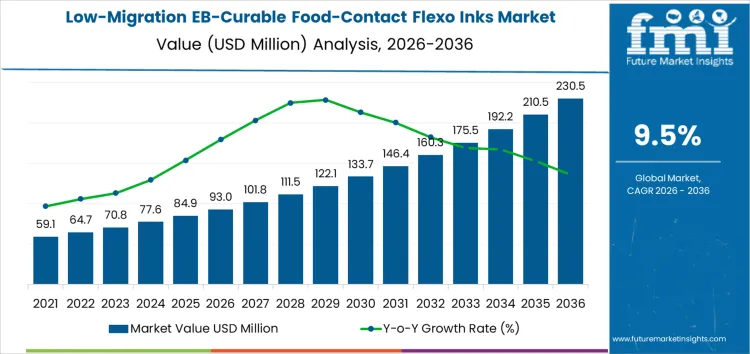
The low-migration EB-curable food-contact flexo inks market is valued at USD 93 million in 2026 and is projected to reach USD 230.5 million by 2036, reflecting a CAGR of 9.5%. Growth over this period is shaped by regulatory scrutiny, migration threshold compliance, and performance requirements on high-speed flexographic lines. Ink selection is governed by curing reliability, odor control, and compatibility with sensitive packaging substrates. Cost structures reflect formulation complexity, electron beam curing infrastructure, and extended validation protocols. Preference is given to inks demonstrating consistent migration performance across production runs. Procurement decisions emphasize compliance assurance over short-term unit cost considerations.
Between 2026 and 2036, adoption patterns are influenced by buyer risk aversion and packaging approval inertia. Food brand owners and converters prioritize inks with established compliance documentation and audit histories. Vendor lock-in is reinforced through press calibration, curing dose optimization, and customer qualification files. Switching costs remain elevated due to retesting expense and regulatory exposure. Fragmentation persists across packaging formats and regional compliance regimes, limiting full standardization. At the same time, concentration increases within large converter programs where repeat qualification supports scale efficiency. Market outcomes are shaped by regulatory confidence and process stability rather than aggressive price competition.
Quick Stats for Low Migration EB Curable Food Contact Flexo Inks Market
- Low Migration EB Curable Food Contact Flexo Inks Market Value (2026): USD 93 million
- Low Migration EB Curable Food Contact Flexo Inks Market Forecast Value (2036): USD 230.5 million
- Low Migration EB Curable Food Contact Flexo Inks Market Forecast CAGR (2026 to 2036): 9.5%
- Leading Product Type in Low Migration EB Curable Food Contact Flexo Inks Market: Free radical EB inks
- Key Growth Regions in Low Migration EB Curable Food Contact Flexo Inks Market: Asia Pacific, Europe, North America
- Top Players in Low Migration EB Curable Food Contact Flexo Inks Market: Siegwerk, Flint Group, Sun Chemical (DIC Corp), INX International, Hubergroup
What Is the Growth Forecast for Low Migration EB Curable Food Contact Flexo Inks Market through 2036?
Packaging safety requirements and ink migration control define the early growth phase of the low migration EB curable food contact flexo inks market between 2026 and 2031. During this period, the market expands from USD 93 million to USD 135 million, adding USD 42 million in value. Annual progression from USD 54 million to USD 93 million reflects increasing adoption in flexible packaging, labels, and primary food contact applications where contamination risk is tightly managed. Historical growth was limited by higher system costs and restricted access to EB curing infrastructure. Forward expansion in this phase is supported by improved curing efficiency, faster press speeds, and growing confidence among converters supplying regulated food packaging formats.
Process optimization and broader converter adoption drive growth from 2031 to 2036. Over this period, the market increases from USD 135 million to USD 232 million, adding USD 97 million and representing the stronger expansion window. Annual values rise from USD 148 million to USD 230.5 million, indicating accelerating year over year momentum. Earlier demand focused on premium and export oriented packaging, while future growth reflects wider use across mainstream food packaging lines. Higher throughput requirements, consistent low migration performance, and alignment with evolving food safety standards support sustained expansion as EB curable flexo inks become established solutions for food contact printing applications.
Low Migration EB Curable Food Contact Flexo Inks Market Key Takeaways
| Metric | Value |
|---|---|
| Market Value (2026) | USD 93 million |
| Forecast Value (2036) | USD 232 million |
| Forecast CAGR (2026 to 2036) | 9.5% |
What Is Driving Demand in the Low-Migration EB-Curable Food-Contact Flexo Inks Market?
Demand for low-migration electron beam curable flexo inks is shaped by regulatory safety requirements and material performance needs specific to food packaging rather than general ink adoption. In conventional flexographic printing, solvent-based or UV-curable inks can contain residual monomers or additives that migrate into food products through direct contact or headspace. Food safety authorities and brand owners observed instances where migration levels exceeded acceptable limits in barrier and primary packaging, posing compliance risk and potential health concerns.
Electron beam curing emerged as an alternative because it crosslinks polymers without photoinitiators, reducing residuals and lowering migration potential. Early adoption occurred in markets with stringent food contact standards where conventional systems struggled to deliver both performance and compliance.
Future growth will be influenced by formalised food safety criteria, expanded application requirements, and documented migration performance rather than incremental product preferences. Regulatory frameworks such as food contact material regulations are tightening thresholds for extractables and migrants, prompting converters and coating formulators to specify EB-curable systems that meet defined safety limits without compromising print quality. Advances in resin and additive design are improving wetting, adhesion, and resistance properties while ensuring low migrant profiles under shelf conditions. Demand will expand as food producers and packaging suppliers embed migration limits into procurement specifications, quality audits, and supply chain compliance programmes.
What Factors Are Affecting the Demand for Low Migration EB Curable Food Contact Flexo Inks Market in Terms of Product Type and Application?
The low migration EB curable flexo inks market is driven by food safety regulation, stricter migration limits, and the shift toward solvent free printing systems. Demand centers on ink technologies that deliver print performance while ensuring compliance with food contact standards. Adoption depends on curing reliability, substrate compatibility, and suitability for high speed flexographic presses. Market leadership reflects regulatory confidence, production efficiency, and consistency of curing rather than color range or decorative complexity.
What Is Driving Leadership by Product Type in the Low Migration EB Curable Flexo Inks Market?
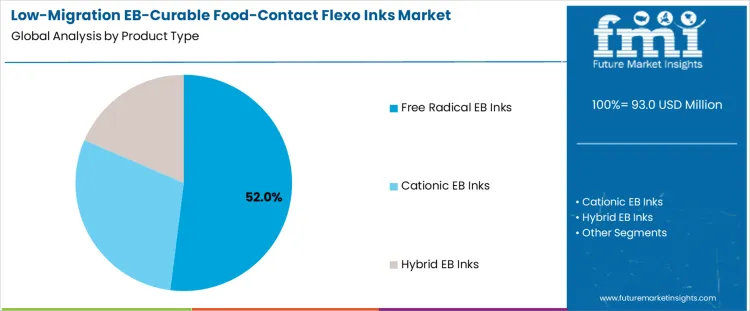
Free radical EB inks account for about 52% of demand because they provide reliable curing, broad substrate compatibility, and well established compliance pathways for food contact applications. These inks cure rapidly under electron beam exposure without photoinitiators, reducing migration risk. Printers favor free radical systems due to predictable polymerization behavior and ease of integration into existing EB curing lines. Their ability to achieve high ink density and abrasion resistance supports use in demanding packaging formats. Longstanding qualification data and regulatory familiarity reinforce confidence among brand owners and converters. As food packaging volumes grow, free radical EB inks remain the default choice for balancing safety, speed, and print durability.
Cationic and hybrid EB inks serve narrower roles. Cationic systems offer lower shrinkage and better adhesion on some substrates but cure more slowly and are sensitive to moisture. Hybrid EB inks balance properties but add formulation complexity. These options expand application flexibility but do not displace free radical systems. Product type leadership therefore reflects curing robustness, regulatory acceptance, and operational simplicity rather than niche performance advantages.
What Is Driving Leadership by Application in the Low Migration EB Curable Flexo Inks Market?
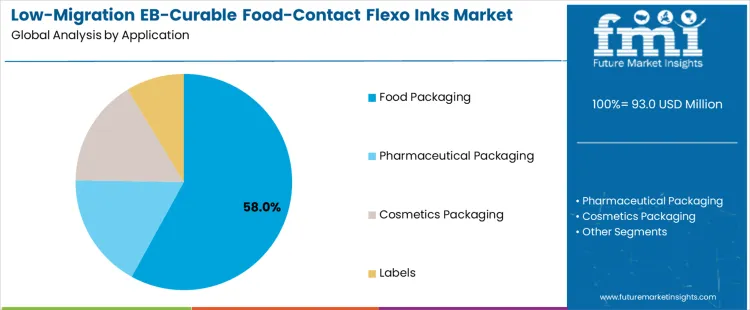
Food packaging accounts for about 58% of demand because it faces the strictest migration limits and the highest regulatory scrutiny. Flexible and paper based food packs require inks that maintain barrier integrity and do not contaminate contents during storage. EB curable inks support these needs by eliminating solvents and residual monomers. High packaging volumes and standardized designs drive consistent ink consumption. Brand owners prioritize proven low migration solutions to manage compliance risk across large product portfolios.
Pharmaceutical, cosmetics, and label applications contribute secondary demand. Pharmaceutical packaging applies similar safety standards but operates at lower volumes. Cosmetics packaging emphasizes appearance alongside safety. Labels require flexibility across substrates but use thinner ink films. These segments adopt EB inks selectively. Application leadership therefore reflects regulatory intensity, volume scale, and direct food contact exposure rather than diversity of printed products.
How Are Low-Migration EB-Curable Food-Contact Flexo Inks Being Applied Across Packaging Lines?
Use appears in food and beverage packaging where strict regulatory standards govern material safety. Manufacturers adopt low-migration electron-beam (EB) curable flexo inks to reduce transfer of potentially harmful substances into food. Converters integrate these inks in cartons, wrappers, and pouches, maintaining adhesion, print clarity, and color stability at high-speed flexographic lines. Applications reflect operational and safety priorities rather than purely aesthetic objectives, with adoption driven by compliance, consistent print performance, and the need for reliable, efficient packaging processes that protect consumer health.
What Operational and Material Conditions Support Adoption of Low-Migration EB-Curable Flexo Inks?
Selection aligns with substrates that can withstand EB curing, including coated paper, board, and flexible films. Ink formulations are optimized for low-migration monomers, rapid curing, and adhesion across diverse surfaces. Production lines monitor ink viscosity, layer thickness, curing dose, and substrate alignment to maintain uniform coverage and regulatory compliance. Quality control evaluates migration levels, durability, and print quality. These conditions emerge from operational efficiency, material compatibility, and safety requirements, ensuring that packaging meets FDA, EFSA, or local food-contact standards consistently in high-volume production workflows.
Which Practical Considerations Limit Wider Use of Low-Migration EB-Curable Flexo Inks?
High material cost and specialized EB curing equipment can limit adoption in smaller or low-margin facilities. Substrate compatibility must be verified, as coatings, laminates, or surface treatments may affect adhesion and curing. Process precision and operator training are required to prevent inconsistent curing or ink defects. Regulatory approvals differ across regions, adding complexity for global production. These factors lead to selective deployment where print quality, compliance, and food safety justify higher costs, careful process monitoring, and investment in controlled production and curing infrastructure.
What is the Demand for Low Migration EB Curable Food Contact Flexo Inks by Country?
| Country | CAGR (%) |
|---|---|
| Germany | 10.5% |
| Italy | 9.5% |
| USA | 9.0% |
| Japan | 8.5% |
| China | 11.0% |
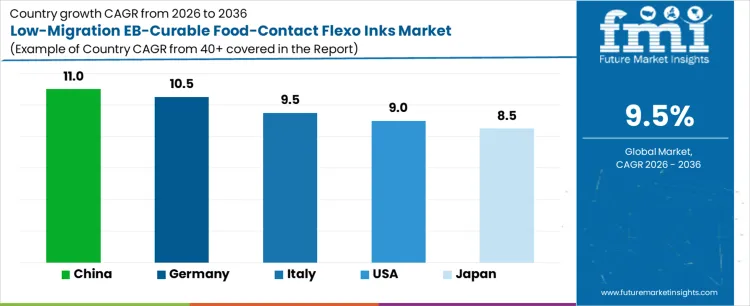
The demand for low migration EB curable food contact flexo inks varies across countries, driven by food packaging safety regulations, sustainable printing practices, and adoption in flexible packaging. China leads with an 11.0% CAGR, supported by large scale food and beverage packaging production and regulatory compliance for food contact materials. Germany follows at 10.5%, driven by strict food safety standards and widespread adoption of low migration inks. Italy records 9.5%, shaped by packaging modernization and consumer safety initiatives. The USA grows at 9.0%, reflecting adoption in food packaging and sustainable printing processes. Japan posts 8.5%, supported by regulatory compliance and mature packaging markets.
How are low-migration EB-curable food-contact flexo inks expanding applications in Germany?
In Germany, the low-migration EB-curable food-contact flexo inks market is growing at a CAGR of 10.5% through 2036, driven by rising demand for safe packaging in the food and beverage sector and strict EU food safety regulations. Manufacturers are adopting EB-curable inks to ensure low chemical migration, high print quality, and compliance with EFSA standards. Demand is concentrated in packaging printing hubs, industrial flexographic facilities, and food packaging plants. Compared to Italy, Germany emphasizes regulatory compliance and high-quality printing performance over volume. Domestic suppliers provide high-performance, food-safe inks suitable for recurring printing and packaging cycles.
- Packaging printing hubs, industrial flexographic facilities, and food packaging plants drive adoption
- Inks ensure low migration, high print quality, and EFSA compliance
- Domestic suppliers provide high-performance, food-safe solutions
- Recurring printing and packaging cycles sustain adoption
How are industrial packaging and regulatory compliance driving growth in Italy?
In Italy, revenue is growing at a CAGR of 9.5% through 2036, supported by growth in packaged foods, beverages, and specialty products requiring safe and durable printed surfaces. Manufacturers are integrating low-migration EB-curable inks to maintain compliance with EU food-contact standards, improve adhesion, and enhance print durability. Demand is concentrated in urban packaging hubs, flexographic printing facilities, and industrial food packaging plants. Compared to Germany, adoption emphasizes artisanal and medium-scale packaging production. Domestic suppliers provide high-quality, compliant inks suitable for recurring printing and finishing operations.
- Urban packaging hubs, flexographic facilities, and food packaging plants drive adoption
- Inks maintain EU food-contact compliance and improve adhesion
- Domestic suppliers provide high-quality, compliant solutions
- Recurring printing and finishing operations sustain adoption
How are consumer safety and packaging growth driving adoption in the United States?
In the United States, the market is expanding at a CAGR of 9% through 2036, driven by increasing demand for food safety, compliance with FDA regulations, and growth in flexible packaging for beverages and processed foods. Manufacturers are adopting low-migration EB-curable inks to minimize chemical transfer, ensure print durability, and enhance packaging aesthetics. Demand is concentrated in industrial flexographic facilities, food packaging plants, and specialty printing hubs. Compared to China, adoption emphasizes compliance and high-quality printing standards rather than large-scale volume. Domestic suppliers provide durable, food-safe inks suitable for recurring packaging and printing cycles.
- Industrial flexographic facilities, food packaging plants, and specialty printing hubs drive adoption
- Inks minimize chemical transfer and ensure print durability
- Domestic suppliers provide durable, food-safe solutions
- Recurring packaging and printing cycles sustain adoption
How are technological precision and food safety standards driving growth in Japan?
In Japan, revenue is growing at a CAGR of 8.5% through 2036, supported by stringent food safety standards, high-quality packaging requirements, and advanced flexographic printing technologies. Manufacturers are integrating low-migration EB-curable inks to improve adhesion, prevent contamination, and maintain aesthetic quality on flexible packaging substrates. Demand is concentrated in industrial flexographic facilities, food packaging hubs, and beverage production lines. Compared to Italy, adoption emphasizes precision, consistent performance, and small- to medium-scale production. Domestic suppliers provide high-performance, chemically stable inks suitable for recurring packaging and inspection cycles.
- Industrial flexographic facilities, food packaging hubs, and beverage lines drive adoption
- Inks improve adhesion, prevent contamination, and maintain aesthetics
- Domestic suppliers provide high-performance, chemically stable solutions
- Recurring packaging and inspection cycles sustain adoption
How are renewable packaging initiatives driving market growth in China?
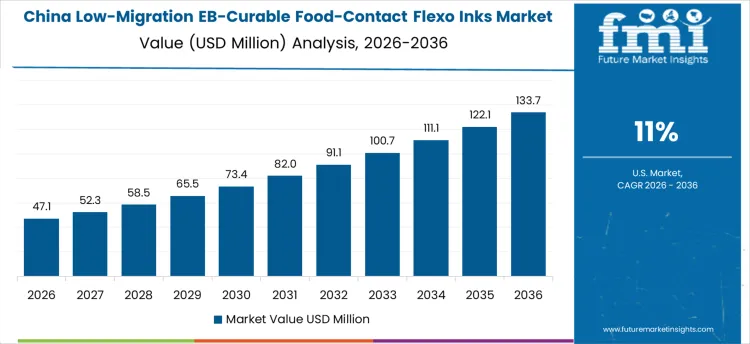
In China, the market is expanding at a CAGR of 11% through 2036, driven by growth in flexible packaging, environmental sustainability initiatives, and increasing adoption of EB-curable inks for food-contact safety. Manufacturers are adopting low-migration inks to ensure chemical compliance, high-quality printing, and durability for large-scale food and beverage packaging. Demand is concentrated in industrial flexographic printing hubs, packaging production zones, and beverage and food plants. Compared to Germany, adoption emphasizes high-volume production and rapid industrial integration. Domestic suppliers provide cost-effective, food-safe inks suitable for recurring printing and packaging operations.
- Industrial flexographic printing hubs, packaging production zones, and food plants drive adoption
- Inks ensure chemical compliance, print quality, and durability
- Domestic suppliers provide cost-effective, food-safe solutions
- Recurring printing and packaging operations sustain adoption
Which Strategic Approaches Define Competition in the Low Migration EB Curable Food Contact Flexo Inks Market under Packaging Safety Constraints?
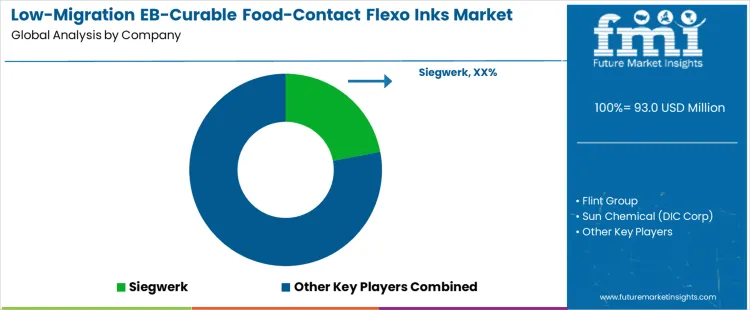
Competition in low migration EB curable food contact flexo inks is driven by risk control rather than print aesthetics alone. Ink suppliers are evaluated on how reliably formulations prevent unintended substance transfer into packaged food under varied storage and processing conditions. Siegwerk and Sun Chemical, part of DIC Corporation, anchor their strategies in compliance leadership, aligning EB curable ink systems with global food contact regulations and conservative migration thresholds. Their focus is on tightly controlled raw materials, validated curing behavior, and extensive testing across substrates and packaging formats.
Flint Group competes by integrating low migration EB inks into complete flexographic printing systems, emphasizing process stability, cure margin robustness, and compatibility with high speed presses used in flexible packaging.
A different strategic emphasis is visible among suppliers close to converters and printers. INX International positions EB curable inks around operational flexibility, supporting printers transitioning from conventional UV systems while maintaining food safety assurance. Hubergroup emphasizes formulation discipline and documentation depth, targeting applications where regulatory scrutiny and brand owner audits are stringent.
Across the market, competitive advantage depends on predictable curing under real press conditions, resistance to set off and odor formation, and long term compliance confidence. Success is defined by trust from brand owners and converters, consistent performance across print runs, and the ability to support conservative qualification processes rather than rapid color expansion or aggressive reformulation.
Key Players in the Low Migration EB Curable Food Contact Flexo Inks Market
- Siegwerk
- Flint Group
- Sun Chemical (DIC Corp)
- INX International
- Hubergroup
Scope of the Report
| Items | Values |
|---|---|
| Quantitative Units | USD million |
| Type | Free radical EB inks, cationic EB inks, hybrid EB curable ink systems |
| Application | Food packaging, pharmaceutical packaging, cosmetics packaging, labels |
| End User | Food and beverage brand owners, flexible packaging converters, flexographic printing companies, pharmaceutical and cosmetics packaging manufacturers |
| Regions Covered | Asia Pacific, Europe, North America, Latin America, Middle East & Africa |
| Countries Covered | China, Germany, Italy, USA, Japan, and other major food packaging and flexographic printing markets |
| Key Companies Profiled | Siegwerk, Flint Group, Sun Chemical (DIC Corp), INX International, Hubergroup |
| Additional Attributes | Dollar sales by product type and application, regional adoption trends across flexible food packaging and labels, competitive landscape based on migration compliance and curing reliability, regulatory alignment with FDA and EFSA food contact standards, EB curing infrastructure requirements and press integration considerations |
Low Migration EB Curable Food Contact Flexo Inks Market Segmentation
By Product Type:
- Free Radical EB Inks
- Cationic EB Inks
- Hybrid EB Inks
By Application:
- Food Packaging
- Pharmaceutical Packaging
- Cosmetics Packaging
- Labels
By End-use Food Category:
- Bakery, Snacks & Confectionery
- Dairy & Chilled Products
- Beverages (Non-alcoholic)
- Baby Food, Nutraceutical & Sensitive Foods
- Ready Meals & Convenience Foods
By Region:
- Asia Pacific
- China
- Japan
- South Korea
- India
- Australia & New Zealand
- ASEAN
- Rest of Asia Pacific
- Europe
- Germany
- United Kingdom
- France
- Italy
- Spain
- Nordic
- BENELUX
- Rest of Europe
- North America
- United States
- Canada
- Mexico
- Latin America
- Brazil
- Chile
- Rest of Latin America
- Middle East & Africa
- Kingdom of Saudi Arabia
- Other GCC Countries
- Turkey
- South Africa
- Other African Union
- Rest of Middle East & Africa
Frequently Asked Questions
How big is the low-migration eb-curable food-contact flexo inks market in 2026?
The global low-migration eb-curable food-contact flexo inks market is estimated to be valued at USD 93.0 million in 2026.
What will be the size of low-migration eb-curable food-contact flexo inks market in 2036?
The market size for the low-migration eb-curable food-contact flexo inks market is projected to reach USD 230.5 million by 2036.
How much will be the low-migration eb-curable food-contact flexo inks market growth between 2026 and 2036?
The low-migration eb-curable food-contact flexo inks market is expected to grow at a 9.5% CAGR between 2026 and 2036.
What are the key product types in the low-migration eb-curable food-contact flexo inks market?
The key product types in low-migration eb-curable food-contact flexo inks market are free radical eb inks, cationic eb inks and hybrid eb inks.
Which application segment to contribute significant share in the low-migration eb-curable food-contact flexo inks market in 2026?
In terms of application, food packaging segment to command 58.0% share in the low-migration eb-curable food-contact flexo inks market in 2026.
Preview the report firsthand - request a free sample
Get SampleGet the brochure for pricing and purchase details.
Get PDFTable of Content
- Executive Summary
- Global Market Outlook
- Demand-side Trends
- Supply-side Trends
- Technology Roadmap Analysis
- Analysis and Recommendations
- Market Overview
- Market Coverage / Taxonomy
- Market Definition / Scope / Limitations
- Market Background
- Market Dynamics
- Drivers
- Restraints
- Opportunity
- Trends
- Scenario Forecast
- Demand in Optimistic Scenario
- Demand in Likely Scenario
- Demand in Conservative Scenario
- Opportunity Map Analysis
- Product Life Cycle Analysis
- Supply Chain Analysis
- Investment Feasibility Matrix
- Value Chain Analysis
- PESTLE and Porter’s Analysis
- Regulatory Landscape
- Regional Parent Market Outlook
- Production and Consumption Statistics
- Import and Export Statistics
- Market Dynamics
- Global Market Analysis 2021 to 2025 and Forecast, 2026 to 2036
- Historical Market Size Value (USD Million) Analysis, 2021 to 2025
- Current and Future Market Size Value (USD Million) Projections, 2026 to 2036
- Y-o-Y Growth Trend Analysis
- Absolute $ Opportunity Analysis
- Global Market Pricing Analysis 2021 to 2025 and Forecast 2026 to 2036
- Global Market Analysis 2021 to 2025 and Forecast 2026 to 2036, By Product Type
- Introduction / Key Findings
- Historical Market Size Value (USD Million) Analysis By Product Type , 2021 to 2025
- Current and Future Market Size Value (USD Million) Analysis and Forecast By Product Type , 2026 to 2036
- Free Radical EB Inks
- Cationic EB Inks
- Hybrid EB Inks
- Free Radical EB Inks
- Y-o-Y Growth Trend Analysis By Product Type , 2021 to 2025
- Absolute $ Opportunity Analysis By Product Type , 2026 to 2036
- Global Market Analysis 2021 to 2025 and Forecast 2026 to 2036, By Application
- Introduction / Key Findings
- Historical Market Size Value (USD Million) Analysis By Application, 2021 to 2025
- Current and Future Market Size Value (USD Million) Analysis and Forecast By Application, 2026 to 2036
- Food Packaging
- Pharmaceutical Packaging
- Cosmetics Packaging
- Labels
- Food Packaging
- Y-o-Y Growth Trend Analysis By Application, 2021 to 2025
- Absolute $ Opportunity Analysis By Application, 2026 to 2036
- Global Market Analysis 2021 to 2025 and Forecast 2026 to 2036, By End-use Food Category
- Introduction / Key Findings
- Historical Market Size Value (USD Million) Analysis By End-use Food Category, 2021 to 2025
- Current and Future Market Size Value (USD Million) Analysis and Forecast By End-use Food Category, 2026 to 2036
- Bakery, Snacks & Confectionery
- Dairy & Chilled Products
- Beverages (Non-alcoholic)
- Baby Food, Nutraceutical & Sensitive Foods
- Ready Meals & Convenience Foods
- Bakery, Snacks & Confectionery
- Y-o-Y Growth Trend Analysis By End-use Food Category, 2021 to 2025
- Absolute $ Opportunity Analysis By End-use Food Category, 2026 to 2036
- Global Market Analysis 2021 to 2025 and Forecast 2026 to 2036, By Region
- Introduction
- Historical Market Size Value (USD Million) Analysis By Region, 2021 to 2025
- Current Market Size Value (USD Million) Analysis and Forecast By Region, 2026 to 2036
- North America
- Latin America
- Western Europe
- Eastern Europe
- East Asia
- South Asia and Pacific
- Middle East & Africa
- Market Attractiveness Analysis By Region
- North America Market Analysis 2021 to 2025 and Forecast 2026 to 2036, By Country
- Historical Market Size Value (USD Million) Trend Analysis By Market Taxonomy, 2021 to 2025
- Market Size Value (USD Million) Forecast By Market Taxonomy, 2026 to 2036
- By Country
- USA
- Canada
- Mexico
- By Product Type
- By Application
- By End-use Food Category
- By Country
- Market Attractiveness Analysis
- By Country
- By Product Type
- By Application
- By End-use Food Category
- Key Takeaways
- Latin America Market Analysis 2021 to 2025 and Forecast 2026 to 2036, By Country
- Historical Market Size Value (USD Million) Trend Analysis By Market Taxonomy, 2021 to 2025
- Market Size Value (USD Million) Forecast By Market Taxonomy, 2026 to 2036
- By Country
- Brazil
- Chile
- Rest of Latin America
- By Product Type
- By Application
- By End-use Food Category
- By Country
- Market Attractiveness Analysis
- By Country
- By Product Type
- By Application
- By End-use Food Category
- Key Takeaways
- Western Europe Market Analysis 2021 to 2025 and Forecast 2026 to 2036, By Country
- Historical Market Size Value (USD Million) Trend Analysis By Market Taxonomy, 2021 to 2025
- Market Size Value (USD Million) Forecast By Market Taxonomy, 2026 to 2036
- By Country
- Germany
- UK
- Italy
- Spain
- France
- Nordic
- BENELUX
- Rest of Western Europe
- By Product Type
- By Application
- By End-use Food Category
- By Country
- Market Attractiveness Analysis
- By Country
- By Product Type
- By Application
- By End-use Food Category
- Key Takeaways
- Eastern Europe Market Analysis 2021 to 2025 and Forecast 2026 to 2036, By Country
- Historical Market Size Value (USD Million) Trend Analysis By Market Taxonomy, 2021 to 2025
- Market Size Value (USD Million) Forecast By Market Taxonomy, 2026 to 2036
- By Country
- Russia
- Poland
- Hungary
- Balkan & Baltic
- Rest of Eastern Europe
- By Product Type
- By Application
- By End-use Food Category
- By Country
- Market Attractiveness Analysis
- By Country
- By Product Type
- By Application
- By End-use Food Category
- Key Takeaways
- East Asia Market Analysis 2021 to 2025 and Forecast 2026 to 2036, By Country
- Historical Market Size Value (USD Million) Trend Analysis By Market Taxonomy, 2021 to 2025
- Market Size Value (USD Million) Forecast By Market Taxonomy, 2026 to 2036
- By Country
- China
- Japan
- South Korea
- By Product Type
- By Application
- By End-use Food Category
- By Country
- Market Attractiveness Analysis
- By Country
- By Product Type
- By Application
- By End-use Food Category
- Key Takeaways
- South Asia and Pacific Market Analysis 2021 to 2025 and Forecast 2026 to 2036, By Country
- Historical Market Size Value (USD Million) Trend Analysis By Market Taxonomy, 2021 to 2025
- Market Size Value (USD Million) Forecast By Market Taxonomy, 2026 to 2036
- By Country
- India
- ASEAN
- Australia & New Zealand
- Rest of South Asia and Pacific
- By Product Type
- By Application
- By End-use Food Category
- By Country
- Market Attractiveness Analysis
- By Country
- By Product Type
- By Application
- By End-use Food Category
- Key Takeaways
- Middle East & Africa Market Analysis 2021 to 2025 and Forecast 2026 to 2036, By Country
- Historical Market Size Value (USD Million) Trend Analysis By Market Taxonomy, 2021 to 2025
- Market Size Value (USD Million) Forecast By Market Taxonomy, 2026 to 2036
- By Country
- Kingdom of Saudi Arabia
- Other GCC Countries
- Turkiye
- South Africa
- Other African Union
- Rest of Middle East & Africa
- By Product Type
- By Application
- By End-use Food Category
- By Country
- Market Attractiveness Analysis
- By Country
- By Product Type
- By Application
- By End-use Food Category
- Key Takeaways
- Key Countries Market Analysis
- USA
- Pricing Analysis
- Market Share Analysis, 2025
- By Product Type
- By Application
- By End-use Food Category
- Canada
- Pricing Analysis
- Market Share Analysis, 2025
- By Product Type
- By Application
- By End-use Food Category
- Mexico
- Pricing Analysis
- Market Share Analysis, 2025
- By Product Type
- By Application
- By End-use Food Category
- Brazil
- Pricing Analysis
- Market Share Analysis, 2025
- By Product Type
- By Application
- By End-use Food Category
- Chile
- Pricing Analysis
- Market Share Analysis, 2025
- By Product Type
- By Application
- By End-use Food Category
- Germany
- Pricing Analysis
- Market Share Analysis, 2025
- By Product Type
- By Application
- By End-use Food Category
- UK
- Pricing Analysis
- Market Share Analysis, 2025
- By Product Type
- By Application
- By End-use Food Category
- Italy
- Pricing Analysis
- Market Share Analysis, 2025
- By Product Type
- By Application
- By End-use Food Category
- Spain
- Pricing Analysis
- Market Share Analysis, 2025
- By Product Type
- By Application
- By End-use Food Category
- France
- Pricing Analysis
- Market Share Analysis, 2025
- By Product Type
- By Application
- By End-use Food Category
- India
- Pricing Analysis
- Market Share Analysis, 2025
- By Product Type
- By Application
- By End-use Food Category
- ASEAN
- Pricing Analysis
- Market Share Analysis, 2025
- By Product Type
- By Application
- By End-use Food Category
- Australia & New Zealand
- Pricing Analysis
- Market Share Analysis, 2025
- By Product Type
- By Application
- By End-use Food Category
- China
- Pricing Analysis
- Market Share Analysis, 2025
- By Product Type
- By Application
- By End-use Food Category
- Japan
- Pricing Analysis
- Market Share Analysis, 2025
- By Product Type
- By Application
- By End-use Food Category
- South Korea
- Pricing Analysis
- Market Share Analysis, 2025
- By Product Type
- By Application
- By End-use Food Category
- Russia
- Pricing Analysis
- Market Share Analysis, 2025
- By Product Type
- By Application
- By End-use Food Category
- Poland
- Pricing Analysis
- Market Share Analysis, 2025
- By Product Type
- By Application
- By End-use Food Category
- Hungary
- Pricing Analysis
- Market Share Analysis, 2025
- By Product Type
- By Application
- By End-use Food Category
- Kingdom of Saudi Arabia
- Pricing Analysis
- Market Share Analysis, 2025
- By Product Type
- By Application
- By End-use Food Category
- Turkiye
- Pricing Analysis
- Market Share Analysis, 2025
- By Product Type
- By Application
- By End-use Food Category
- South Africa
- Pricing Analysis
- Market Share Analysis, 2025
- By Product Type
- By Application
- By End-use Food Category
- USA
- Market Structure Analysis
- Competition Dashboard
- Competition Benchmarking
- Market Share Analysis of Top Players
- By Regional
- By Product Type
- By Application
- By End-use Food Category
- Competition Analysis
- Competition Deep Dive
- Siegwerk
- Overview
- Product Portfolio
- Profitability by Market Segments (Product/Age /Sales Channel/Region)
- Sales Footprint
- Strategy Overview
- Marketing Strategy
- Product Strategy
- Channel Strategy
- Flint Group
- Sun Chemical (DIC Corp)
- INX International
- Hubergroup
- Siegwerk
- Competition Deep Dive
- Assumptions & Acronyms Used
- Research Methodology


