

- Industry Size (2026):
- USD 243 Mn
- Forecast (2036)
- USD 671.6 Mn
- CAGR (2026 to 2036)
- 10.70%
rHDPE Recycling Capacity Expansion for European FMCG Packaging Market Forecast and Outlook 2026 to 2036
The rHDPE recycling capacity expansion for European FMCG packaging market is valued at USD 243 million in 2026 and is projected to reach USD 671.6 million by 2036, reflecting a CAGR of 10.70%. Growth is driven by concentrated investments in mechanical, chemical, and hybrid recycling processes across Western and Northern Europe. Cost structures vary by country, reflecting differences in labor, energy, and feedstock availability. Pricing power concentrates among operators with access to high quality post-consumer resin and the ability to meet food-grade certification standards. Margin concentration favors firms integrating sorting, compounding, and compliance services rather than those relying solely on throughput expansion.
Between 2026 and 2036, regional adoption remains uneven, influenced by national recycling mandates, incentive programs, and infrastructure readiness. Countries with established collection networks capture disproportionate value and attract complementary private investments. Operators aligning capacity growth with local FMCG demand benefit from optimized logistics and reduced operating costs. Firms with multi-country presence and flexible processing technologies maintain higher utilization rates and stronger margins. Competitive differentiation reflects regulatory compliance, feedstock security, and the ability to serve multiple packaging applications, while operators lacking scale or integration experience margin compression despite rising regional demand.
Quick Stats for rHDPE Recycling Capacity Expansion for European FMCG Packaging Market
- rHDPE Recycling Capacity Expansion for European FMCG Packaging Market Value (2026): USD 243 million
- rHDPE Recycling Capacity Expansion for European FMCG Packaging Market Forecast Value (2036): USD 671.6 million
- rHDPE Recycling Capacity Expansion for European FMCG Packaging Market Forecast CAGR (2026–2036): 10.70%
- Leading Process Technology in rHDPE Recycling Capacity Expansion Market: Mechanical recycling
- Key Growth Regions in rHDPE Recycling Capacity Expansion Market: Germany, France, Spain, Italy, UK
- Top Players in rHDPE Recycling Capacity Expansion for European FMCG Packaging Market: Veolia, ALPLA Group, Borealis, MBA Polymers, PreZero, Biffa, Paprec
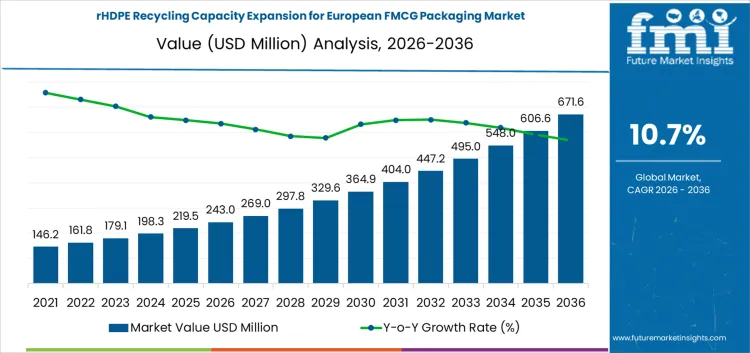
What Is the Growth Forecast for rHDPE Recycling Capacity Expansion for European FMCG Packaging Market through 2036?
The European rHDPE recycling capacity expansion for FMCG packaging market is valued at USD 243 million in 2026 and is projected to reach USD 671.6 million by 2036, reflecting a CAGR of 10.7%. Growth over this period is driven by regulatory mandates on recycled content in FMCG packaging, rising consumer demand for circular packaging, and investment in modern recycling facilities capable of delivering food-contact compliant rHDPE. Cost structures are influenced by feedstock collection, sorting, and advanced extrusion technologies. Value capture favors operators integrating feedstock sourcing, traceability, and quality certification rather than focusing on throughput alone.
Between 2026 and 2036, the market follows a typical maturity curve. Early adoption (2026–2031) accounts for 33% of total growth, driven by initial facility expansion and pilot-to-commercial scale implementation. Late adoption (2031–2036) accelerates as regulatory enforcement strengthens and recycled content adoption becomes standard among FMCG brands. Competitive advantage shifts toward operators controlling integrated collection-to-processing chains, validated food-grade output, and reliable supply contracts. Early entrants capture higher-margin volumes, while late movers focus on operational efficiency and modular capacity scaling to remain competitive.
rHDPE Recycling Capacity Expansion for European FMCG Packaging Market Key Takeaways
| Metric | Value |
|---|---|
| Market Value (2026) | USD 243 million |
| Forecast Value (2036) | USD 671.6 million |
| Forecast CAGR (2026–2036) | 10.70% |
What Is Driving rHDPE Recycling Capacity Expansion for European FMCG Packaging?
In Europe, rHDPE recycling capacity expansion is shaped by regulatory mandates, brand commitments to recycled content, and rising demand for sustainable FMCG packaging. Historically, recycling focused on bulk industrial applications, producing inconsistent resin for food contact. Current expansion emphasizes high throughput washing, deodorisation, and extrusion lines capable of delivering food grade rHDPE with controlled melt flow, color uniformity, and additive compliance. FMCG converters prioritize predictable resin properties to maintain packaging performance across dairy, beverages, and condiments. Investments also address seasonal feedstock variability, energy efficiency, and integration with collection networks. Operators demonstrating verified quality, traceability, and production reliability gain competitive advantage in European packaging supply chains.
Future growth in Europe reflects both enforcement of recycled content targets and retailer procurement policies rather than voluntary adoption. Compared with earlier incremental capacity additions, current projects integrate digital tracking, process automation, and modular plant designs to optimize throughput and reduce contamination risk. Margin concentration favors recyclers able to provide audited compliance documentation and reliable lot volumes. Cost sensitivity remains high due to energy inputs, bale quality, and yield loss. By 2036, expanded rHDPE recycling capacity underpins compliance with EU packaging regulations, strengthens FMCG supply chain resilience, and supports industrial scale production of high quality food grade packaging materials.
What Factors Are Influencing the Demand for rHDPE Recycling Capacity Expansion for European FMCG Packaging in Terms of Process Technology and End Use?
The demand for rHDPE recycling capacity expansion in European FMCG packaging is segmented by process technology and end use application. Process technology segmentation distinguishes mechanical recycling, chemical or advanced recycling, hybrid systems, and sorting and compounding services, each offering different purity, throughput, and regulatory compliance profiles. End use segmentation reflects how recycled HDPE is applied, including rigid bottles for food and beverages, closures and caps, household chemical containers, and industrial packaging. Segment structure is shaped by material quality requirements, production volumes, and European recycled content mandates. Adoption patterns prioritize scalable processes that align with brand and regulatory expectations rather than experimental output.
What Is Driving the Dominance of Mechanical Recycling in rHDPE Capacity Expansion for European FMCG Packaging?
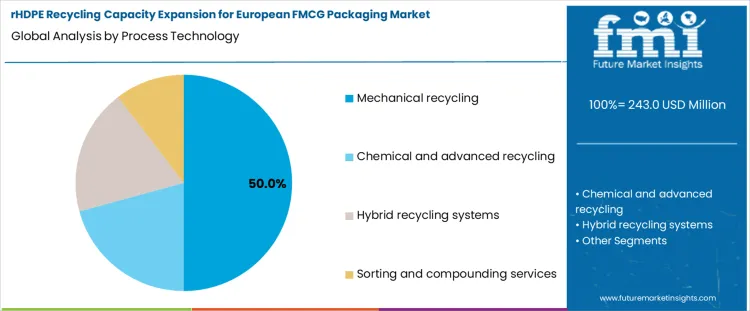
Mechanical recycling accounts for 50% of total process capacity expansion, making it the leading technology segment. This share reflects its established infrastructure, cost predictability, and high throughput suitability for post-consumer HDPE. Mechanical processes enable sorting, washing, and re-pelletizing without altering polymer chemistry, providing stable output for industrial conversion. Operators favor mechanical recycling where feedstock consistency is sufficient to meet rigid quality thresholds. Capacity expansion focuses on scaling throughput while improving contamination control and process efficiency to meet EU recycled content targets.
Demand for mechanical recycling is influenced by regulatory compliance and economic efficiency. Companies prioritize technologies that can integrate into existing production lines and supply chains. Scaling mechanical processes allows recyclers to maintain continuous output for high volume rigid bottles and closures. The segment benefits from predictable operational costs, established quality control practices, and compatibility with European collection schemes. Mechanical recycling maintains dominance because it balances volume, purity, and compliance requirements, enabling FMCG packaging manufacturers to meet EU rHDPE mandates without extensive process modifications.
Why Do Rigid Bottles for Food and Beverage Represent the Largest End Use Segment in European rHDPE Recycling Capacity Expansion?
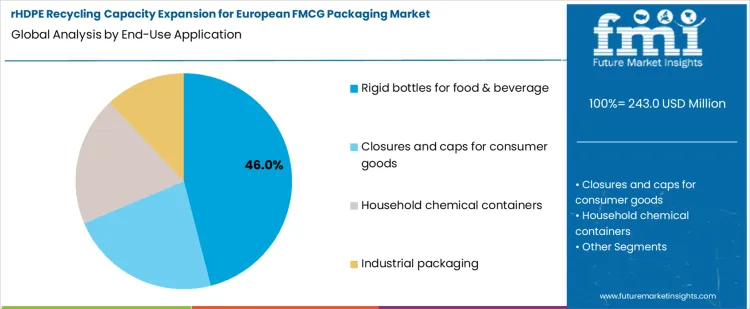
Rigid bottles for food and beverage account for 46% of total end use demand, making them the largest segment. This position reflects high consumption volumes and stringent recycled content regulations for food contact packaging. Manufacturers require consistent material quality and validated processing performance to meet regulatory and brand standards. Bottles provide predictable geometry and processing conditions, enabling higher recycled content integration with minimal risk.
Demand in rigid bottles is driven by regulatory compliance, supply chain integration, and throughput scalability. Producers focus expansion efforts on high volume packaging formats where recycled material can be systematically incorporated. Capacity growth emphasizes reliability, traceability, and material consistency to meet EU PPWR mandates. The segment leads because bottle production combines large scale, high regulatory scrutiny, and material demand, making it the focal point for industrial rHDPE recycling capacity expansion.
How is rHDPE recycling capacity expansion shaping supply stability for European FMCG packaging?
rHDPE recycling capacity expansion for European FMCG packaging is primarily driven by EU and country specific recycled content mandates. Investments target industrial scale decontamination, sorting, and extrusion to ensure consistent polymer quality and food contact compliance. Adoption is strongest in high volume FMCG segments such as dairy, beverages, and personal care, where supply reliability is critical. Procurement decisions prioritize compliance readiness, traceability, and batch consistency rather than cost alone. Growth reflects regulatory preparation rather than an increase in packaging demand. Operators capable of meeting audit requirements gain preferential access to brand owners seeking assured supply across European markets.
Why are national recycled content mandates driving rHDPE capacity expansion in Europe?
Capacity expansion is anchored in enforcement of EU directives and domestic recycled content obligations. FMCG brands operating locally must secure reliable rHDPE volumes to meet legal thresholds and avoid penalties. Industrial scale facilities provide consistent output that smaller recyclers cannot guarantee. Investments focus on process standardization, traceable feedstock sourcing, and certification alignment with local food safety authorities. Growth is concentrated in regions with clear enforcement timelines. The driver emphasizes regulatory alignment and operational certainty rather than cost reduction. Capacity expansion is often structured to support repeatable compliance performance across multiple European jurisdictions.
What operational and supply chain barriers limit rapid rHDPE capacity expansion for European FMCG packaging?
Feedstock variability, collection inefficiencies, and high capital requirements constrain expansion. Regional post consumer HDPE streams differ in quality, affecting yield and polymer consistency. Permitting and licensing timelines vary across EU member states, delaying plant commissioning. Smaller operators face financing challenges for industrial scale upgrades. Some existing filling lines require retrofitting to accommodate recycled resin behavior. These barriers slow uniform capacity growth, concentrating expansion in well-funded operators and integrated supply chains. Regulatory uncertainty in certain countries further discourages speculative investment despite EU-level recycled content mandates.
How are partnership models and technology trends shaping European rHDPE capacity expansion?
Trends show tighter integration between recyclers, converters, and FMCG brands to secure consistent feedstock and maintain certification. Modular processing units allow incremental scaling aligned with regulatory milestones. Investment increasingly incorporates real time quality monitoring, digital traceability, and audit support. Long term offtake agreements stabilize revenue and justify capital expenditure. Focus is shifting from maximum throughput to reliability and compliance readiness. Competitive advantage is increasingly determined by consistent delivery of certified rHDPE for food contact packaging rather than cost or volume alone.
What is the Demand for rHDPE Recycling Capacity Expansion for European FMCG Packaging by Country in Europe?
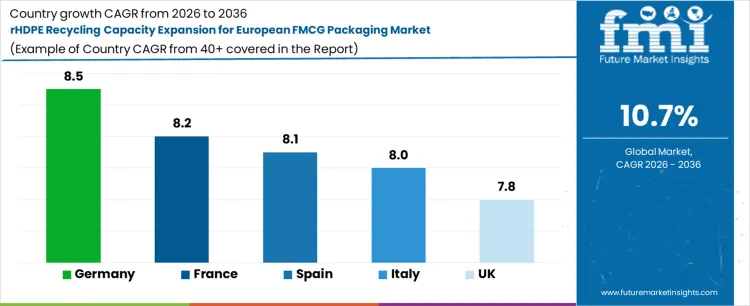
| Country | CAGR (%) |
|---|---|
| Germany | 8.5 |
| France | 8.2 |
| UK | 7.8 |
| Italy | 8.0 |
| Spain | 8.1 |
Demand for rHDPE recycling capacity expansion in European FMCG packaging is growing as brands seek reliable recycled HDPE supply for rigid packaging lines. Germany leads with an 8.5% CAGR, driven by extensive collection systems, investments in mechanical and solvent-based recycling, and high adoption by beverage and dairy producers. France follows at 8.2%, supported by national recycling mandates and FMCG brand commitments to increase recycled content. Spain records 8.1% growth as packaging producers scale capacity for both domestic and export requirements. Italy shows 8.0%, reflecting steady infrastructure upgrades and compliance with EU circular economy directives. The UK grows at 7.8%, shaped by incremental capacity additions, established recycling networks, and consistent demand from retail and private-label packaging segments.
How Is European FMCG Demand Driving rHDPE Recycling Capacity Expansion in Germany?
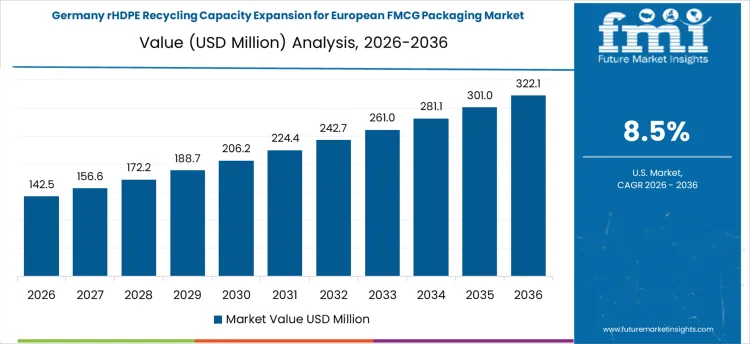
Germany is witnessing steady growth in the rHDPE recycling capacity expansion for European FMCG packaging market at a CAGR of 8.5%, driven by strong domestic recycling infrastructure and stringent EU recycled content mandates. Converters supplying multinational FMCG brands are scaling mechanical and solvent-based processes to meet food-grade and multilayer packaging standards. Investments prioritize throughput optimization, contamination control, and process reliability rather than new technology development. Demand is concentrated in industrial regions with established packaging hubs, where recyclers align closely with brand compliance requirements. Capacity expansion reflects strategic substitution of virgin resin with high-quality recycled material while maintaining operational efficiency.
- EU recycled content mandates shape capacity expansion priorities.
- Industrial regions with packaging hubs concentrate investment.
- Process reliability and contamination control guide upgrades.
- Adoption is focused on brand-aligned recycled resin supply.
Why Is Regulatory Alignment Supporting rHDPE Expansion in France?
In France, the rHDPE recycling capacity expansion for European FMCG packaging market is growing at a CAGR of 8.2%, supported by compliance with EU packaging regulations and national sustainability policies. Recycling operators are scaling solvent-cleaned and mechanical processes to supply verified recycled content for rigid packaging applications. Investments emphasize consistent quality, traceability, and process standardization to maintain alignment with multinational FMCG requirements. Growth is incremental, reflecting replacement and expansion within established production lines rather than new facility construction.
- Compliance with EU packaging rules drives capacity planning.
- Traceability and standardization support brand confidence.
- Focus on existing production lines ensures controlled expansion.
- Quality consistency underpins market adoption.
How Is Packaging Standardization Shaping Capacity Growth in the United Kingdom?
The United Kingdom rHDPE recycling capacity expansion for European FMCG packaging market is expanding at a CAGR of 7.8%, supported by converters integrating recycled content to meet European regulatory standards. Recycling operators are increasing throughput for both mechanical and solvent-based processes while maintaining food-grade quality. Demand is concentrated among firms supplying multinational FMCG brands. Investments prioritize quality assurance and process control rather than rapid greenfield expansion, reflecting careful alignment with compliance and procurement cycles.
- Regulatory alignment with EU standards drives capacity upgrades.
- Process control ensures food-grade and multilayer compliance.
- Incremental expansion aligns with procurement and brand requirements.
- Multinational FMCG supply chains shape adoption patterns.
Why Is Capacity Optimization Supporting rHDPE Expansion in Italy?
In Italy, rHDPE recycling capacity expansion for European FMCG packaging is growing at a CAGR of 8.0%, driven by domestic converters seeking to integrate recycled resin into food-grade packaging. Operators are enhancing mechanical and solvent-cleaned processes to ensure compliance with EU recycled content thresholds. Investments emphasize throughput efficiency, process reliability, and consistent quality rather than major new plant construction. Demand is focused in industrial regions with high packaging production for multinational FMCG brands, supporting incremental capacity scaling.
- EU compliance requirements drive process optimization.
- Throughput efficiency and reliability are investment priorities.
- Industrial packaging regions concentrate expansion.
- Incremental scaling dominates growth strategy.
How Is Regional Industrial Development Supporting rHDPE Expansion in Spain?
Spain is recording growth in rHDPE recycling capacity expansion for European FMCG packaging at a CAGR of 8.1%, supported by regional industrial clusters and increased demand for recycled content in food-grade packaging. Recycling operators are scaling mechanical and solvent-based lines to supply consistent, compliant rHDPE to converters. Investments focus on process quality, traceability, and contamination control. Demand is concentrated among firms serving multinational FMCG clients. Expansion remains measured, emphasizing replacement, incremental capacity, and compliance readiness over rapid greenfield plant development.
- Industrial clusters drive capacity expansion activity.
- Traceability and contamination control guide investments.
- Focus on replacement and incremental scaling supports compliance.
- Multinational FMCG demand shapes adoption patterns.
How Is rHDPE Recycling Capacity Expansion Supporting European FMCG Packaging Growth?
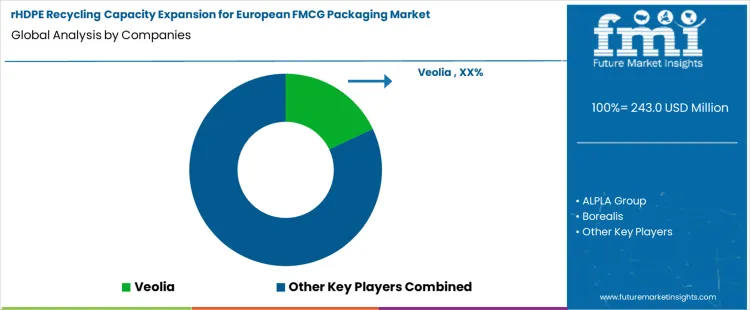
Expansion of rHDPE recycling capacity for European FMCG packaging is driven by regulatory recycled content mandates, brand circularity commitments, and growing demand for high quality food contact materials. Companies are upgrading sorting, washing, and extrusion operations to ensure polymer purity, melt stability, and consistent processing performance for rigid bottles and closures. Capacity expansion also addresses regional feedstock variability and strengthens traceability from collection to conversion. Firms such as Veolia and ALPLA Group integrate recycling operations with packaging conversion requirements, while Borealis supports quality management and feedstock scaling. Adoption reflects the need for reliable, compliant rHDPE supply across FMCG production lines.
The competitive landscape includes established recyclers, packaging manufacturers, and regional processors. MBA Polymers provides expertise in mixed rigid plastics handling, enhancing stable output for converters. PreZero and Paprec contribute regional collection networks and processing infrastructure. Biffa supports feedstock sourcing and operational continuity. Competitive differentiation arises from integration with brand packaging supply chains, audit readiness for recycled content compliance, and the ability to maintain high polymer quality across multiple FMCG applications. Operational reliability and traceable material streams are central to market positioning.
Key Players in the rHDPE Recycling Capacity Expansion for European FMCG Packaging Market
- Veolia
- ALPLA Group
- Borealis
- MBA Polymers
- PreZero
- Biffa
- Paprec
Scope of the Report
| Items | Values |
|---|---|
| Quantitative Units (2026) | USD million |
| Process Technology | Mechanical recycling, Chemical and advanced recycling, Hybrid recycling systems, Sorting and compounding services |
| End-Use Application | Rigid bottles for food & beverage, Closures and caps for consumer goods, Household chemical containers, Industrial packaging |
| Countries Covered | Germany, France, UK, Italy, Spain |
| Key Companies Profiled | Veolia, ALPLA Group, Borealis, MBA Polymers, PreZero, Biffa, Paprec |
| Additional Attributes | Dollar sales by process technology and end-use application, feedstock sourcing and quality, regulatory compliance and food-grade certification, traceability and documentation, integration with FMCG packaging supply chains, process standardization and operational efficiency, incremental and modular capacity expansion |
rHDPE Recycling Capacity Expansion for European FMCG Packaging Market Segmentation
Process Technology:
- Mechanical recycling
- Chemical and advanced recycling
- Hybrid recycling systems
- Sorting and compounding services
End-Use Application:
- Rigid bottles for food & beverage
- Closures and caps for consumer goods
- Household chemical containers
- Industrial packaging
Countries
- Germany
- France
- UK
- Italy
- Spain
Frequently Asked Questions
How big is the rHDPE recycling capacity expansion for European FMCG packaging market in 2026?
The global rHDPE recycling capacity expansion for the European FMCG packaging market is estimated to be valued at USD 243.0 million in 2026.
What will be the size of rHDPE recycling capacity expansion for European FMCG packaging market in 2036?
The market size for the rHDPE recycling capacity expansion for the European FMCG packaging market is projected to reach USD 671.6 million by 2036.
How much will be the rHDPE recycling capacity expansion for European FMCG packaging market growth between 2026 and 2036?
The rHDPE recycling capacity expansion for European fmcg packaging market is expected to grow at a 10.7% CAGR between 2026 and 2036.
What are the key process technology types in the rHDPE recycling capacity expansion for European FMCG packaging market?
The key process technology types in rHDPE recycling capacity expansion for the European FMCG packaging market are mechanical recycling, chemical and advanced recycling, hybrid recycling systems and sorting and compounding services.
Which end-use application segment will contribute significant share in the rHDPE recycling capacity expansion for European FMCG packaging market in 2026?
In terms of end-use application, rigid bottles for food & beverage segment to command 46.0% share in the rHDPE recycling capacity expansion for European FMCG packaging market in 2026.
Preview the report firsthand - request a free sample
Get SampleGet the brochure for pricing and purchase details.
Get PDFTable of Content
- Executive Summary
- Global Market Outlook
- Demand-side Trends
- Supply-side Trends
- Technology Roadmap Analysis
- Analysis and Recommendations
- Market Overview
- Market Coverage / Taxonomy
- Market Definition / Scope / Limitations
- Market Background
- Market Dynamics
- Drivers
- Restraints
- Opportunity
- Trends
- Scenario Forecast
- Demand in Optimistic Scenario
- Demand in Likely Scenario
- Demand in Conservative Scenario
- Opportunity Map Analysis
- Product Life Cycle Analysis
- Supply Chain Analysis
- Investment Feasibility Matrix
- Value Chain Analysis
- PESTLE and Porter’s Analysis
- Regulatory Landscape
- Regional Parent Market Outlook
- Production and Consumption Statistics
- Import and Export Statistics
- Market Dynamics
- Global Market Analysis 2021 to 2025 and Forecast, 2026 to 2036
- Historical Market Size Value (USD Million) Analysis, 2021 to 2025
- Current and Future Market Size Value (USD Million) Projections, 2026 to 2036
- Y-o-Y Growth Trend Analysis
- Absolute $ Opportunity Analysis
- Global Market Pricing Analysis 2021 to 2025 and Forecast 2026 to 2036
- Global Market Analysis 2021 to 2025 and Forecast 2026 to 2036, By Process Technology
- Introduction / Key Findings
- Historical Market Size Value (USD Million) Analysis By Process Technology , 2021 to 2025
- Current and Future Market Size Value (USD Million) Analysis and Forecast By Process Technology , 2026 to 2036
- Mechanical recycling
- Chemical and advanced recycling
- Hybrid recycling systems
- Sorting and compounding services
- Mechanical recycling
- Y-o-Y Growth Trend Analysis By Process Technology , 2021 to 2025
- Absolute $ Opportunity Analysis By Process Technology , 2026 to 2036
- Global Market Analysis 2021 to 2025 and Forecast 2026 to 2036, By End-Use Application
- Introduction / Key Findings
- Historical Market Size Value (USD Million) Analysis By End-Use Application, 2021 to 2025
- Current and Future Market Size Value (USD Million) Analysis and Forecast By End-Use Application, 2026 to 2036
- Rigid bottles for food & beverage
- Closures and caps for consumer goods
- Household chemical containers
- Industrial packaging
- Rigid bottles for food & beverage
- Y-o-Y Growth Trend Analysis By End-Use Application, 2021 to 2025
- Absolute $ Opportunity Analysis By End-Use Application, 2026 to 2036
- Global Market Analysis 2021 to 2025 and Forecast 2026 to 2036, By Region
- Introduction
- Historical Market Size Value (USD Million) Analysis By Region, 2021 to 2025
- Current Market Size Value (USD Million) Analysis and Forecast By Region, 2026 to 2036
- North America
- Latin America
- Western Europe
- Eastern Europe
- East Asia
- South Asia and Pacific
- Middle East & Africa
- Market Attractiveness Analysis By Region
- North America Market Analysis 2021 to 2025 and Forecast 2026 to 2036, By Country
- Historical Market Size Value (USD Million) Trend Analysis By Market Taxonomy, 2021 to 2025
- Market Size Value (USD Million) Forecast By Market Taxonomy, 2026 to 2036
- By Country
- USA
- Canada
- Mexico
- By Process Technology
- By End-Use Application
- By Country
- Market Attractiveness Analysis
- By Country
- By Process Technology
- By End-Use Application
- Key Takeaways
- Latin America Market Analysis 2021 to 2025 and Forecast 2026 to 2036, By Country
- Historical Market Size Value (USD Million) Trend Analysis By Market Taxonomy, 2021 to 2025
- Market Size Value (USD Million) Forecast By Market Taxonomy, 2026 to 2036
- By Country
- Brazil
- Chile
- Rest of Latin America
- By Process Technology
- By End-Use Application
- By Country
- Market Attractiveness Analysis
- By Country
- By Process Technology
- By End-Use Application
- Key Takeaways
- Western Europe Market Analysis 2021 to 2025 and Forecast 2026 to 2036, By Country
- Historical Market Size Value (USD Million) Trend Analysis By Market Taxonomy, 2021 to 2025
- Market Size Value (USD Million) Forecast By Market Taxonomy, 2026 to 2036
- By Country
- Germany
- UK
- Italy
- Spain
- France
- Nordic
- BENELUX
- Rest of Western Europe
- By Process Technology
- By End-Use Application
- By Country
- Market Attractiveness Analysis
- By Country
- By Process Technology
- By End-Use Application
- Key Takeaways
- Eastern Europe Market Analysis 2021 to 2025 and Forecast 2026 to 2036, By Country
- Historical Market Size Value (USD Million) Trend Analysis By Market Taxonomy, 2021 to 2025
- Market Size Value (USD Million) Forecast By Market Taxonomy, 2026 to 2036
- By Country
- Russia
- Poland
- Hungary
- Balkan & Baltic
- Rest of Eastern Europe
- By Process Technology
- By End-Use Application
- By Country
- Market Attractiveness Analysis
- By Country
- By Process Technology
- By End-Use Application
- Key Takeaways
- East Asia Market Analysis 2021 to 2025 and Forecast 2026 to 2036, By Country
- Historical Market Size Value (USD Million) Trend Analysis By Market Taxonomy, 2021 to 2025
- Market Size Value (USD Million) Forecast By Market Taxonomy, 2026 to 2036
- By Country
- China
- Japan
- South Korea
- By Process Technology
- By End-Use Application
- By Country
- Market Attractiveness Analysis
- By Country
- By Process Technology
- By End-Use Application
- Key Takeaways
- South Asia and Pacific Market Analysis 2021 to 2025 and Forecast 2026 to 2036, By Country
- Historical Market Size Value (USD Million) Trend Analysis By Market Taxonomy, 2021 to 2025
- Market Size Value (USD Million) Forecast By Market Taxonomy, 2026 to 2036
- By Country
- India
- ASEAN
- Australia & New Zealand
- Rest of South Asia and Pacific
- By Process Technology
- By End-Use Application
- By Country
- Market Attractiveness Analysis
- By Country
- By Process Technology
- By End-Use Application
- Key Takeaways
- Middle East & Africa Market Analysis 2021 to 2025 and Forecast 2026 to 2036, By Country
- Historical Market Size Value (USD Million) Trend Analysis By Market Taxonomy, 2021 to 2025
- Market Size Value (USD Million) Forecast By Market Taxonomy, 2026 to 2036
- By Country
- Kingdom of Saudi Arabia
- Other GCC Countries
- Turkiye
- South Africa
- Other African Union
- Rest of Middle East & Africa
- By Process Technology
- By End-Use Application
- By Country
- Market Attractiveness Analysis
- By Country
- By Process Technology
- By End-Use Application
- Key Takeaways
- Key Countries Market Analysis
- USA
- Pricing Analysis
- Market Share Analysis, 2025
- By Process Technology
- By End-Use Application
- Canada
- Pricing Analysis
- Market Share Analysis, 2025
- By Process Technology
- By End-Use Application
- Mexico
- Pricing Analysis
- Market Share Analysis, 2025
- By Process Technology
- By End-Use Application
- Brazil
- Pricing Analysis
- Market Share Analysis, 2025
- By Process Technology
- By End-Use Application
- Chile
- Pricing Analysis
- Market Share Analysis, 2025
- By Process Technology
- By End-Use Application
- Germany
- Pricing Analysis
- Market Share Analysis, 2025
- By Process Technology
- By End-Use Application
- UK
- Pricing Analysis
- Market Share Analysis, 2025
- By Process Technology
- By End-Use Application
- Italy
- Pricing Analysis
- Market Share Analysis, 2025
- By Process Technology
- By End-Use Application
- Spain
- Pricing Analysis
- Market Share Analysis, 2025
- By Process Technology
- By End-Use Application
- France
- Pricing Analysis
- Market Share Analysis, 2025
- By Process Technology
- By End-Use Application
- India
- Pricing Analysis
- Market Share Analysis, 2025
- By Process Technology
- By End-Use Application
- ASEAN
- Pricing Analysis
- Market Share Analysis, 2025
- By Process Technology
- By End-Use Application
- Australia & New Zealand
- Pricing Analysis
- Market Share Analysis, 2025
- By Process Technology
- By End-Use Application
- China
- Pricing Analysis
- Market Share Analysis, 2025
- By Process Technology
- By End-Use Application
- Japan
- Pricing Analysis
- Market Share Analysis, 2025
- By Process Technology
- By End-Use Application
- South Korea
- Pricing Analysis
- Market Share Analysis, 2025
- By Process Technology
- By End-Use Application
- Russia
- Pricing Analysis
- Market Share Analysis, 2025
- By Process Technology
- By End-Use Application
- Poland
- Pricing Analysis
- Market Share Analysis, 2025
- By Process Technology
- By End-Use Application
- Hungary
- Pricing Analysis
- Market Share Analysis, 2025
- By Process Technology
- By End-Use Application
- Kingdom of Saudi Arabia
- Pricing Analysis
- Market Share Analysis, 2025
- By Process Technology
- By End-Use Application
- Turkiye
- Pricing Analysis
- Market Share Analysis, 2025
- By Process Technology
- By End-Use Application
- South Africa
- Pricing Analysis
- Market Share Analysis, 2025
- By Process Technology
- By End-Use Application
- USA
- Market Structure Analysis
- Competition Dashboard
- Competition Benchmarking
- Market Share Analysis of Top Players
- By Regional
- By Process Technology
- By End-Use Application
- Competition Analysis
- Competition Deep Dive
- Veolia
- Overview
- Product Portfolio
- Profitability by Market Segments (Product/Age /Sales Channel/Region)
- Sales Footprint
- Strategy Overview
- Marketing Strategy
- Product Strategy
- Channel Strategy
- ALPLA Group
- Borealis
- MBA Polymers
- PreZero
- Biffa
- Paprec
- Veolia
- Competition Deep Dive
- Assumptions & Acronyms Used
- Research Methodology


