

- Industry Size (2026):
- USD 177 Mn
- Forecast (2036)
- USD 498.1 Mn
- CAGR (2026 to 2036)
- 10.9%
Solvent-Cleaned rHDPE Feedstock for Multilayer Packaging Applications Market Forecast and Outlook 2026 to 2036
The Solvent-Cleaned rHDPE feedstock for multilayer packaging applications market is valued at USD 177 million in 2026 and is projected to reach USD 498.1 million by 2036, reflecting a CAGR of 10.9%. Cost profiles are driven by solvent recovery efficiency, contaminant removal depth, and recurring certification expenses linked to multilayer food contact standards. Facilities operating optimized solvent loops reduce variable costs and stabilize output quality. Pricing leverage rests with suppliers meeting narrow impurity thresholds required by converters producing barrier packaging. Margin outcomes favor process consistency and documented compliance performance rather than sheer feedstock intake volumes across operations globally today.
From 2026 to 2036, value capture increasingly concentrates among processors aligning capacity expansion with committed multilayer packaging programs. Capital deployment remains selective because high purity requirements penalize operational variability. Margin strength improves when recyclers secure long term buyers prioritizing compliance assurance over short term price flexibility. Integration with packaging producers lowers demand volatility and protects utilization levels. Competitive advantage reflects disciplined growth pacing, solvent cost control, and robust documentation supporting multilayer approvals. Operators chasing throughput without contractual backing face weaker returns, while reliability focused models sustain pricing power and margin concentration through the forecast horizon for investors and stakeholders broadly.
Quick Stats for Solvent-Cleaned rHDPE Feedstock for Multilayer Packaging Applications Market
- Solvent-Cleaned rHDPE Feedstock for Multilayer Packaging Applications Market Value (2026): USD 177 million
- Solvent-Cleaned rHDPE Feedstock for Multilayer Packaging Applications Market Forecast Value (2036): USD 498.1 million
- Solvent-Cleaned rHDPE Feedstock for Multilayer Packaging Applications Market Forecast CAGR (2026-2036): 10.9%
- Leading Type in Solvent-Cleaned rHDPE Feedstock for Multilayer Packaging Applications Market: Solvent-purified post-consumer rHDPE
- Key Growth Regions in Solvent-Cleaned rHDPE Feedstock for Multilayer Packaging Applications Market: Asia Pacific, Europe, and North America
- Top Players in Solvent-Cleaned rHDPE Feedstock for Multilayer Packaging Applications Market: Veolia, SUEZ, ALPLA, APK AG, MBA Polymers
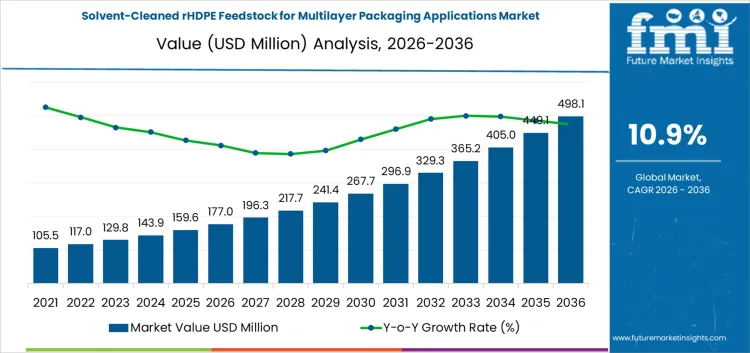
What Is the Growth Forecast for Solvent-Cleaned rHDPE Feedstock for Multilayer Packaging Applications Market through 2036?
Between 2026 and 2031, the solvent-cleaned rHDPE feedstock for multilayer packaging applications market is projected to grow from USD 177 million to USD 279 million, generating an absolute increase of USD 102 million and accounting for about 31.5% of total forecast expansion. This phase reflects early adoption of solvent-purified post-consumer rHDPE, which represents 46% of feedstock use, driven by food packaging layers holding a 44% application share. Cost structures center on solvent recovery efficiency, de-inking precision, and contamination control. Value capture favors processors supplying uniform feedstock suitable for multilayer structures rather than mixed-grade material streams.
From 2031 to 2036, the market is expected to expand from USD 279 million to USD 498.1 million, adding USD 222 million and representing roughly 68.5% of decade growth. This period is shaped by broader uptake across personal care, household, and industrial barrier packaging. Margins increasingly concentrate among operators integrating blended solvent-cleaned fractions with validated performance. Long-term supply arrangements strengthen pricing control. Competitive positioning favors firms such as Veolia, Suez, ALPLA, APK AG, and MBA Polymers that deliver consistency and multilayer compatibility rather than volume scale.
Solvent-Cleaned rHDPE Feedstock for Multilayer Packaging Applications Market Key Takeaways
| Metric | Value |
|---|---|
| Market Value (2026) | USD 177 million |
| Forecast Value (2036) | USD 498.1 million |
| Forecast CAGR (2026-2036) | 10.9% |
How Does Solvent-Cleaned rHDPE Enable Performance and Compliance in Multilayer Packaging Structures?
The Solvent-Cleaned rHDPE feedstock for multilayer packaging applications market develops as converters seek recycled content compatible with barrier and functional layer requirements. Historically, mechanically recycled HDPE showed odor retention, additive variability, and gel formation that limited use within multilayer structures. Solvent cleaning removes inks, adhesives, and low molecular contaminants, producing a narrower composition window suitable for tie layers and non-contact cores. Demand is driven by flexible and rigid packaging designs where recycled material must not interfere with adhesion, sealing, or barrier integrity. Converters value Solvent-Cleaned feedstock for predictable melt behavior and reduced defect rates. Early adoption focused on trials and downgauged layers. Current demand reflects process reliability rather than recycled content symbolism or messaging priorities.
Future growth depends on multilayer redesign timelines, regulatory clarity, and converter qualification cycles. As recycled content mandates tighten, multilayer packaging shifts from exemption driven strategies toward engineered inclusion of recycled polymers. Solvent-Cleaned rHDPE supports this transition by enabling thinner recycled layers without compromising performance. Compared with earlier experimentation, future uptake centers on supply stability, lot-to-lot consistency, and compatibility with co extrusion lines. Cost sensitivity remains high, since solvent processes add energy and recovery expenses. Value concentrates among suppliers offering validated impurity thresholds and documented process control. Packaging producers integrate these feedstocks where mechanical recycling fails performance tests. Over time, Solvent-Cleaned rHDPE becomes a functional enabler for maintaining multilayer formats under increasing recycled content obligations across regulated packaging categories.
What Factors Are Shaping the Demand for Solvent-Cleaned rHDPE Feedstock for Multilayer Packaging Applications in Terms of Feedstock Type and Multilayer Application?
The demand for Solvent-Cleaned rHDPE feedstock for multilayer packaging applications is structured by feedstock type and multilayer application requirements. Feedstock type segmentation reflects the origin and treatment depth of recycled HDPE streams, including solvent purified post-consumer material, Solvent-Cleaned post industrial waste, de inked colored streams, and blended solvent treated fractions. Multilayer application segmentation reflects where recycled layers are deployed within composite packaging structures. These include food packaging layers, personal care formats, household packs, and industrial barrier systems. Segment structure reflects how purity thresholds, odor control, and layer function influence material selection. Demand is shaped by compatibility with multilayer design rather than standalone packaging performance.
What Is Driving the Leading Use of Solvent Purified Post Consumer rHDPE Feedstock in Multilayer Packaging?
Solvent purified post-consumer rHDPE accounts for 46% of total feedstock demand, making it the leading feedstock category. This position reflects its ability to achieve high purity levels required for sensitive multilayer applications. Solvent purification removes inks, additives, and residual contaminants more effectively than mechanical routes. Converters favor this feedstock where recycled layers must meet defined safety and migration thresholds. Its performance consistency supports predictable layer behavior during co extrusion or lamination processes.
Demand for solvent purified post-consumer rHDPE is shaped by regulatory exposure and performance assurance. Food and personal care packaging require documented contaminant removal and traceability. Solvent purification enables recyclers to provide validated data on input streams and treatment outcomes. Multilayer structures rely on stable interlayer adhesion and controlled material behavior. This feedstock leads because it balances recycled content objectives with compliance and processing reliability across high sensitivity packaging formats.
Why Do Food Packaging Layers Represent the Largest Multilayer Application for Solvent-Cleaned rHDPE Feedstock?
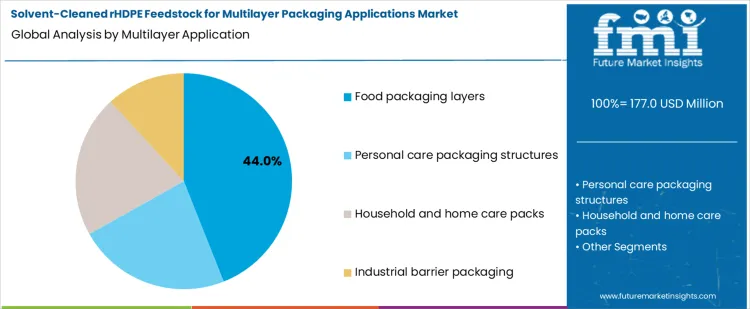
Food packaging layers represent 44% of total multilayer application demand, making them the largest application segment. This share reflects the extensive use of multilayer structures in rigid and flexible food packaging. Recycled rHDPE is commonly placed in non-food contact or protected layers to reduce virgin polymer usage. Solvent-Cleaned feedstock allows inclusion within these structures while maintaining safety margins. Demand concentrates where multilayer designs require controlled material quality.
Demand growth in food packaging layers is driven by compliance mandates and packaging redesign strategies. Brand owners prioritize recycled content integration in food packaging due to regulatory timelines and volume scale. Multilayer designs enable recycled material use without compromising barrier or functional layers. Solvent-Cleaned rHDPE provides predictable performance during co processing. The segment leads because food packaging combines high material throughput with structured pathways for recycled layer incorporation.
How is Solvent-Cleaned rHDPE feedstock positioning itself within multilayer packaging qualification pathways?
Solvent-Cleaned rHDPE feedstock for multilayer packaging applications is gaining relevance as converters seek compliant recycled content without direct food contact exposure. Use concentrates in barrier structures where recycled layers remain functionally isolated. Demand aligns with regions enforcing recycled content targets while permitting multilayer formats under defined separation rules. Buyers evaluate feedstock based on contaminant reduction consistency, odor neutrality, and compatibility with tie layers. Adoption reflects risk managed substitution rather than material replacement. Growth remains linked to regulatory interpretation and packaging design constraints, not expansion of multilayer packaging volumes.
Why do locally enforced recycled content thresholds drive demand for Solvent-Cleaned rHDPE feedstock?
Demand is driven by national packaging rules requiring recycled content while allowing functional barriers in multilayer structures. Brand owners operating locally use Solvent-Cleaned rHDPE to meet thresholds without requalifying food contact layers. Recycling processors tailor solvent systems to domestic waste profiles, improving acceptance by local converters. The driver rests on compliance efficiency within existing packaging architectures. Facilities supplying verified feedstock reduce approval friction for converters. This local regulatory alignment sustains repeat purchasing and prioritizes process reliability over experimentation with alternative recycled polymers.
What limits broader adoption of Solvent-Cleaned rHDPE feedstock in multilayer packaging systems?
Adoption is constrained by cost premiums linked to solvent processing and feedstock preparation. Not all regions permit multilayer exemptions, reducing addressable demand. Converter hesitation persists where recycling claims face scrutiny from enforcement agencies. Process yields vary with input quality, affecting pricing stability. Some multilayer structures require redesign to accommodate recycled layers without performance loss. These barriers restrict uptake to jurisdictions with clear regulatory guidance and established multilayer packaging supply chains, slowing broader penetration.
How are packaging design and feedstock qualification trends evolving around Solvent-Cleaned rHDPE?
Trends show closer coordination between recyclers and multilayer film designers. Feedstock specifications increasingly align with defined layer functions rather than generic resin grades. Solvent processes are optimized to target odor and migration risks relevant to non-contact layers. Documentation and traceability systems strengthen converter confidence during audits. Some suppliers focus on standardized feedstock batches to support repeatable extrusion performance. The trend emphasizes design compatibility and regulatory defensibility over volume expansion.
What is the Demand for Solvent-Cleaned rHDPE Feedstock for Multilayer Packaging Applications by Country?
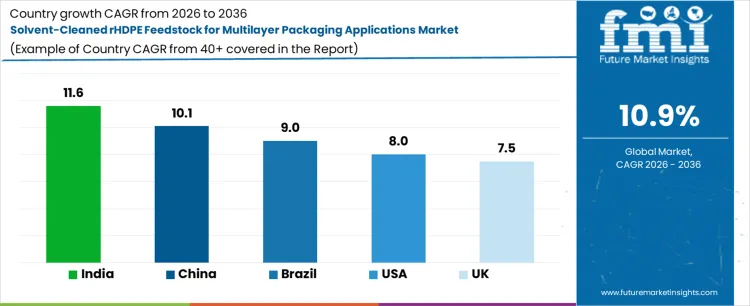
| Country | CAGR (%) |
|---|---|
| USA | 8.0% |
| UK | 7.5% |
| China | 10.1% |
| India | 11.6% |
| Brazil | 9.0% |
Demand for solvent-cleaned rHDPE feedstock in multilayer packaging applications is expanding in line with recycled content mandates and rising multilayer film production volumes. India shows the highest CAGR at 11.6%, supported by rapid growth in flexible food packaging, increased installation of solvent purification units, and rising domestic use of recycled barrier-compatible polymers. China follows at 10.1%, driven by large-scale multilayer packaging output and higher recycled content inclusion in food and personal care laminates. Brazil records 9.0% growth, reflecting strong packaged food consumption and growing use of recycled HDPE in structural layers. The USA grows at 8.0%, supported by qualification of solvent-cleaned rHDPE for multilayer bottles and pouches. The UK posts 7.5%, reflecting slower capacity additions and reliance on imported high-purity recycled feedstock.
How Is Multilayer Packaging Qualification Expanding Demand for Solvent-Cleaned rHDPE Feedstock in the United States?
In the United States, the solvent-cleaned rHDPE feedstock market for multilayer packaging applications is advancing at a CAGR of 8.0%, driven by qualification programs for recycled content within barrier structures. Packaging producers are validating solvent-cleaned rHDPE for use in non-contact and encapsulated layers where odor, migration control, and melt stability are critical. Investment focuses on feedstock purity, residual solvent management, and lot-to-lot consistency rather than throughput expansion. Demand is concentrated among converters supplying food, personal care, and household products that require documented performance within multilayer designs. Growth reflects substitution into specific layer functions rather than broad material replacement.
- Multilayer qualification protocols define acceptance thresholds.
- Feedstock purity and odor control guide purchasing decisions.
- Encapsulated layer use supports early adoption.
- Documentation requirements shape supplier selection.
Why Is Packaging Structure Optimization Supporting Adoption in the United Kingdom?
Across the United Kingdom, the solvent-cleaned rHDPE feedstock market for multilayer packaging applications is growing at a CAGR of 7.5%, supported by efforts to optimize packaging structures while integrating recycled content. Converters are testing solvent-cleaned rHDPE in intermediate layers to maintain barrier performance and processing stability. Feedstock suppliers prioritize consistency and traceability to meet converter validation requirements. Procurement remains measured, with preference for suppliers demonstrating repeatable results across multiple packaging formats. Growth is steady, reflecting gradual integration within established multilayer designs.
- Structural optimization drives selective material integration.
- Intermediate layer applications reduce performance risk.
- Traceability supports converter qualification processes.
- Incremental adoption aligns with cautious procurement cycles.
How Is Export-Oriented Packaging Manufacturing Accelerating Demand in China?
China is recording strong expansion in the solvent-cleaned rHDPE feedstock market for multilayer packaging applications, with growth at a CAGR of 10.1%, driven by export-oriented packaging manufacturing. Converters supplying regulated international markets are adopting solvent-cleaned feedstock to meet recycled content and quality expectations. Demand emphasizes contamination control, color neutrality, and process stability within co-extrusion systems. Feedstock adoption is concentrated in coastal manufacturing clusters serving multinational brand owners. Growth is shaped by external compliance requirements rather than domestic packaging regulation.
- Export market standards influence feedstock specifications.
- Multinational buyers shape quality benchmarks.
- Co-extrusion compatibility drives adoption decisions.
- Manufacturing hubs concentrate demand growth.
Why Is Rapid Packaging Scale-Up Fueling Market Expansion in India?
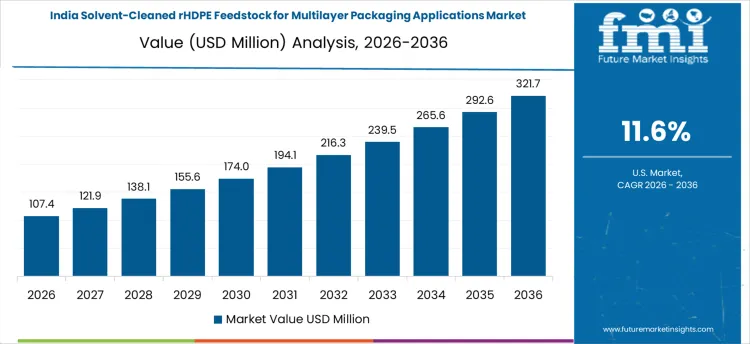
India shows the fastest growth in the solvent-cleaned rHDPE feedstock market for multilayer packaging applications, expanding at a CAGR of 11.6%, reflecting rapid scale-up of packaged food and consumer goods production. Converters are integrating solvent-cleaned rHDPE into multilayer structures to align with global sourcing expectations. Feedstock suppliers focus on stable melt behavior and contaminant reduction to support high-speed processing. Demand is strongest among organized packaging producers supplying multinational brands. Growth reflects both rising packaging volumes and widening acceptance of recycled layers.
- Packaged goods expansion increases multilayer material demand.
- Global brand requirements accelerate feedstock qualification.
- Processing stability supports high-speed line integration.
- Organized converters lead early adoption.
How Is Packaging Industry Integration Sustaining Growth in Brazil?
Brazil is experiencing steady growth in the solvent-cleaned rHDPE feedstock market for multilayer packaging applications at a CAGR of 9.0%, supported by closer integration between recyclers and packaging converters. Adoption focuses on intermediate layers where solvent-cleaned feedstock can deliver consistency without affecting barrier performance. Investment priorities include feedstock preparation and contamination control rather than rapid capacity additions. Demand is linked to converters supplying international consumer goods brands operating locally. Growth remains selective, centered on applications with clear qualification pathways.
- Recycler-converter integration supports feedstock adoption.
- Intermediate layer use reduces performance constraints.
- Preparation quality drives investment decisions.
- International brand supply chains influence demand patterns.
How Is Solvent-Cleaned rHDPE Feedstock Enabling Multilayer Packaging Applications?
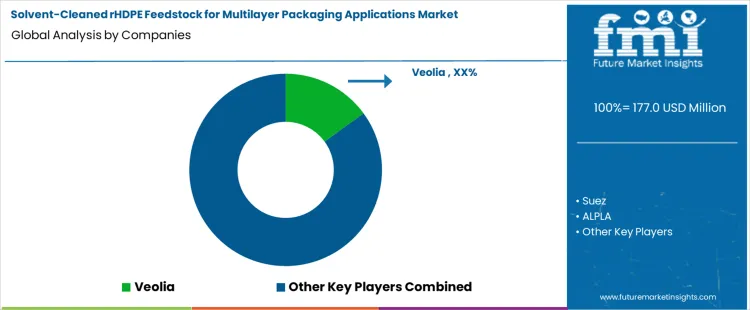
Demand for Solvent-Cleaned rHDPE feedstock in multilayer packaging is shaped by material purity requirements and barrier structure compatibility. Multilayer formats used in food and household packaging require recycled polymers with low residual contaminants, stable rheology, and predictable adhesion behavior. Solvent based cleaning enables removal of inks, additives, and absorbed compounds that interfere with layer bonding. Process adoption reflects the need to integrate recycled content without compromising seal integrity or shelf life performance. Operators increasingly evaluate Solvent-Cleaned rHDPE for use in inner or core layers where mechanical properties remain critical. Firms such as Veolia and SUEZ influence adoption through controlled feedstock preparation and compliance aligned processing designed for complex packaging structures.
Competitive positioning reflects process reliability, polymer consistency, and integration with multilayer conversion systems. APK AG focuses on selective dissolution methods that isolate target polymers while maintaining molecular integrity suited for layered formats. ALPLA evaluates Solvent-Cleaned rHDPE to align recycled content with proprietary multilayer bottle and container designs. MBA Polymers contributes feedstock conditioning expertise that stabilizes downstream solvent cleaning outcomes. Smaller regional processors support niche applications through contract supply. Competitive differentiation is driven by certification readiness, compatibility testing with multilayer films, and repeatable performance across variable post-consumer input streams.
Key Players in the Solvent-Cleaned rHDPE Feedstock for Multilayer Packaging Applications Market
- Veolia
- Suez
- ALPLA
- APK AG
- MBA Polymers
Scope of the Report
| Items | Values |
|---|---|
| Quantitative Units (2026) | USD million |
| Feedstock Type | Solvent-purified post-consumer rHDPE, Solvent-cleaned post-industrial rHDPE, De-inked colored rHDPE streams, Blended solvent-cleaned rHDPE fractions |
| Multilayer Application | Food packaging layers, Personal care packaging structures, Household and home care packs, Industrial barrier packaging |
| Regions Covered | Asia Pacific, Europe, North America, Latin America, Middle East & Africa |
| Countries Covered | United States, United Kingdom, Germany, France, Italy, Spain, China, India, Japan, South Korea, Brazil, and other multilayer packaging economies |
| Key Companies Profiled | Veolia, SUEZ, ALPLA, APK AG, MBA Polymers |
| Additional Attributes | Dollar sales by feedstock type and multilayer application, solvent recovery efficiency and contaminant removal depth benchmarks, multilayer qualification and certification requirements, compatibility with co-extrusion and lamination processes, documentation and traceability expectations for barrier packaging, integration with converter validation programs and long-term supply agreements |
Solvent-Cleaned rHDPE Feedstock for Multilayer Packaging Applications Market Segmentation
Feedstock Type:
- Solvent-purified post-consumer rHDPE
- Solvent-cleaned post-industrial rHDPE
- De-inked colored rHDPE streams
- Blended solvent-cleaned rHDPE fractions
Multilayer Application:
- Food packaging layers
- Personal care packaging structures
- Household and home care packs
- Industrial barrier packaging
Region
Asia Pacific
- China
- Japan
- South Korea
- India
- Australia & New Zealand
- ASEAN
- Rest of Asia Pacific
Europe
- Germany
- United Kingdom
- France
- Italy
- Spain
- Nordic
- BENELUX
- Rest of Europe
North America
- United States
- Canada
- Mexico
Latin America
- Brazil
- Chile
- Rest of Latin America
Middle East & Africa
- Kingdom of Saudi Arabia
- Other GCC Countries
- Turkey
- South Africa
- Other African Union
- Rest of Middle East & Africa
Frequently Asked Questions
How big is the solvent-cleaned rHDPE feedstock for multilayer packaging applications market in 2026?
The global solvent-cleaned rHDPE feedstock for multilayer packaging applications market is estimated to be valued at USD 177.0 million in 2026.
What will be the size of solvent-cleaned rHDPE feedstock for multilayer packaging applications market in 2036?
The market size for the solvent-cleaned rHDPE feedstock for multilayer packaging applications market is projected to reach USD 498.1 million by 2036.
How much will be the solvent-cleaned rHDPE feedstock for multilayer packaging applications market growth between 2026 and 2036?
The solvent-cleaned rHDPE feedstock for multilayer packaging applications market is expected to grow at a 10.9% CAGR between 2026 and 2036.
What are the key feedstock types in the solvent-cleaned rHDPE feedstock for multilayer packaging applications market?
The key feedstock types in solvent-cleaned rHDPE feedstock for multilayer packaging applications market are solvent-purified post-consumer rHDPE, solvent-cleaned post-industrial rHDPE, de-inked colored rHDPE streams, and blended solvent-cleaned rHDPE fractions.
Which multilayer application segment will contribute significant share in the solvent-cleaned rHDPE feedstock for multilayer packaging applications market in 2026?
In terms of multilayer application, food packaging layers segment to command 44.0% share in the solvent-cleaned rHDPE feedstock for multilayer packaging applications market in 2026.
Preview the report firsthand - request a free sample
Get SampleGet the brochure for pricing and purchase details.
Get PDFTable of Content
- Executive Summary
- Global Market Outlook
- Demand-side Trends
- Supply-side Trends
- Technology Roadmap Analysis
- Analysis and Recommendations
- Market Overview
- Market Coverage / Taxonomy
- Market Definition / Scope / Limitations
- Market Background
- Market Dynamics
- Drivers
- Restraints
- Opportunity
- Trends
- Scenario Forecast
- Demand in Optimistic Scenario
- Demand in Likely Scenario
- Demand in Conservative Scenario
- Opportunity Map Analysis
- Product Life Cycle Analysis
- Supply Chain Analysis
- Investment Feasibility Matrix
- Value Chain Analysis
- PESTLE and Porter’s Analysis
- Regulatory Landscape
- Regional Parent Market Outlook
- Production and Consumption Statistics
- Import and Export Statistics
- Market Dynamics
- Global Market Analysis 2021 to 2025 and Forecast, 2026 to 2036
- Historical Market Size Value (USD Million) Analysis, 2021 to 2025
- Current and Future Market Size Value (USD Million) Projections, 2026 to 2036
- Y-o-Y Growth Trend Analysis
- Absolute $ Opportunity Analysis
- Global Market Pricing Analysis 2021 to 2025 and Forecast 2026 to 2036
- Global Market Analysis 2021 to 2025 and Forecast 2026 to 2036, By Feedstock Type
- Introduction / Key Findings
- Historical Market Size Value (USD Million) Analysis By Feedstock Type , 2021 to 2025
- Current and Future Market Size Value (USD Million) Analysis and Forecast By Feedstock Type , 2026 to 2036
- Solvent-purified post-consumer rHDPE
- Solvent-cleaned post-industrial rHDPE
- De-inked colored rHDPE streams
- Blended solvent-cleaned rHDPE fractions
- Solvent-purified post-consumer rHDPE
- Y-o-Y Growth Trend Analysis By Feedstock Type , 2021 to 2025
- Absolute $ Opportunity Analysis By Feedstock Type , 2026 to 2036
- Global Market Analysis 2021 to 2025 and Forecast 2026 to 2036, By Multilayer Application
- Introduction / Key Findings
- Historical Market Size Value (USD Million) Analysis By Multilayer Application, 2021 to 2025
- Current and Future Market Size Value (USD Million) Analysis and Forecast By Multilayer Application, 2026 to 2036
- Food packaging layers
- Personal care packaging structures
- Household and home care packs
- Industrial barrier packaging
- Food packaging layers
- Y-o-Y Growth Trend Analysis By Multilayer Application, 2021 to 2025
- Absolute $ Opportunity Analysis By Multilayer Application, 2026 to 2036
- Global Market Analysis 2021 to 2025 and Forecast 2026 to 2036, By Region
- Introduction
- Historical Market Size Value (USD Million) Analysis By Region, 2021 to 2025
- Current Market Size Value (USD Million) Analysis and Forecast By Region, 2026 to 2036
- North America
- Latin America
- Western Europe
- Eastern Europe
- East Asia
- South Asia and Pacific
- Middle East & Africa
- Market Attractiveness Analysis By Region
- North America Market Analysis 2021 to 2025 and Forecast 2026 to 2036, By Country
- Historical Market Size Value (USD Million) Trend Analysis By Market Taxonomy, 2021 to 2025
- Market Size Value (USD Million) Forecast By Market Taxonomy, 2026 to 2036
- By Country
- USA
- Canada
- Mexico
- By Feedstock Type
- By Multilayer Application
- By Country
- Market Attractiveness Analysis
- By Country
- By Feedstock Type
- By Multilayer Application
- Key Takeaways
- Latin America Market Analysis 2021 to 2025 and Forecast 2026 to 2036, By Country
- Historical Market Size Value (USD Million) Trend Analysis By Market Taxonomy, 2021 to 2025
- Market Size Value (USD Million) Forecast By Market Taxonomy, 2026 to 2036
- By Country
- Brazil
- Chile
- Rest of Latin America
- By Feedstock Type
- By Multilayer Application
- By Country
- Market Attractiveness Analysis
- By Country
- By Feedstock Type
- By Multilayer Application
- Key Takeaways
- Western Europe Market Analysis 2021 to 2025 and Forecast 2026 to 2036, By Country
- Historical Market Size Value (USD Million) Trend Analysis By Market Taxonomy, 2021 to 2025
- Market Size Value (USD Million) Forecast By Market Taxonomy, 2026 to 2036
- By Country
- Germany
- UK
- Italy
- Spain
- France
- Nordic
- BENELUX
- Rest of Western Europe
- By Feedstock Type
- By Multilayer Application
- By Country
- Market Attractiveness Analysis
- By Country
- By Feedstock Type
- By Multilayer Application
- Key Takeaways
- Eastern Europe Market Analysis 2021 to 2025 and Forecast 2026 to 2036, By Country
- Historical Market Size Value (USD Million) Trend Analysis By Market Taxonomy, 2021 to 2025
- Market Size Value (USD Million) Forecast By Market Taxonomy, 2026 to 2036
- By Country
- Russia
- Poland
- Hungary
- Balkan & Baltic
- Rest of Eastern Europe
- By Feedstock Type
- By Multilayer Application
- By Country
- Market Attractiveness Analysis
- By Country
- By Feedstock Type
- By Multilayer Application
- Key Takeaways
- East Asia Market Analysis 2021 to 2025 and Forecast 2026 to 2036, By Country
- Historical Market Size Value (USD Million) Trend Analysis By Market Taxonomy, 2021 to 2025
- Market Size Value (USD Million) Forecast By Market Taxonomy, 2026 to 2036
- By Country
- China
- Japan
- South Korea
- By Feedstock Type
- By Multilayer Application
- By Country
- Market Attractiveness Analysis
- By Country
- By Feedstock Type
- By Multilayer Application
- Key Takeaways
- South Asia and Pacific Market Analysis 2021 to 2025 and Forecast 2026 to 2036, By Country
- Historical Market Size Value (USD Million) Trend Analysis By Market Taxonomy, 2021 to 2025
- Market Size Value (USD Million) Forecast By Market Taxonomy, 2026 to 2036
- By Country
- India
- ASEAN
- Australia & New Zealand
- Rest of South Asia and Pacific
- By Feedstock Type
- By Multilayer Application
- By Country
- Market Attractiveness Analysis
- By Country
- By Feedstock Type
- By Multilayer Application
- Key Takeaways
- Middle East & Africa Market Analysis 2021 to 2025 and Forecast 2026 to 2036, By Country
- Historical Market Size Value (USD Million) Trend Analysis By Market Taxonomy, 2021 to 2025
- Market Size Value (USD Million) Forecast By Market Taxonomy, 2026 to 2036
- By Country
- Kingdom of Saudi Arabia
- Other GCC Countries
- Turkiye
- South Africa
- Other African Union
- Rest of Middle East & Africa
- By Feedstock Type
- By Multilayer Application
- By Country
- Market Attractiveness Analysis
- By Country
- By Feedstock Type
- By Multilayer Application
- Key Takeaways
- Key Countries Market Analysis
- USA
- Pricing Analysis
- Market Share Analysis, 2025
- By Feedstock Type
- By Multilayer Application
- Canada
- Pricing Analysis
- Market Share Analysis, 2025
- By Feedstock Type
- By Multilayer Application
- Mexico
- Pricing Analysis
- Market Share Analysis, 2025
- By Feedstock Type
- By Multilayer Application
- Brazil
- Pricing Analysis
- Market Share Analysis, 2025
- By Feedstock Type
- By Multilayer Application
- Chile
- Pricing Analysis
- Market Share Analysis, 2025
- By Feedstock Type
- By Multilayer Application
- Germany
- Pricing Analysis
- Market Share Analysis, 2025
- By Feedstock Type
- By Multilayer Application
- UK
- Pricing Analysis
- Market Share Analysis, 2025
- By Feedstock Type
- By Multilayer Application
- Italy
- Pricing Analysis
- Market Share Analysis, 2025
- By Feedstock Type
- By Multilayer Application
- Spain
- Pricing Analysis
- Market Share Analysis, 2025
- By Feedstock Type
- By Multilayer Application
- France
- Pricing Analysis
- Market Share Analysis, 2025
- By Feedstock Type
- By Multilayer Application
- India
- Pricing Analysis
- Market Share Analysis, 2025
- By Feedstock Type
- By Multilayer Application
- ASEAN
- Pricing Analysis
- Market Share Analysis, 2025
- By Feedstock Type
- By Multilayer Application
- Australia & New Zealand
- Pricing Analysis
- Market Share Analysis, 2025
- By Feedstock Type
- By Multilayer Application
- China
- Pricing Analysis
- Market Share Analysis, 2025
- By Feedstock Type
- By Multilayer Application
- Japan
- Pricing Analysis
- Market Share Analysis, 2025
- By Feedstock Type
- By Multilayer Application
- South Korea
- Pricing Analysis
- Market Share Analysis, 2025
- By Feedstock Type
- By Multilayer Application
- Russia
- Pricing Analysis
- Market Share Analysis, 2025
- By Feedstock Type
- By Multilayer Application
- Poland
- Pricing Analysis
- Market Share Analysis, 2025
- By Feedstock Type
- By Multilayer Application
- Hungary
- Pricing Analysis
- Market Share Analysis, 2025
- By Feedstock Type
- By Multilayer Application
- Kingdom of Saudi Arabia
- Pricing Analysis
- Market Share Analysis, 2025
- By Feedstock Type
- By Multilayer Application
- Turkiye
- Pricing Analysis
- Market Share Analysis, 2025
- By Feedstock Type
- By Multilayer Application
- South Africa
- Pricing Analysis
- Market Share Analysis, 2025
- By Feedstock Type
- By Multilayer Application
- USA
- Market Structure Analysis
- Competition Dashboard
- Competition Benchmarking
- Market Share Analysis of Top Players
- By Regional
- By Feedstock Type
- By Multilayer Application
- Competition Analysis
- Competition Deep Dive
- Veolia
- Overview
- Product Portfolio
- Profitability by Market Segments (Product/Age /Sales Channel/Region)
- Sales Footprint
- Strategy Overview
- Marketing Strategy
- Product Strategy
- Channel Strategy
- Suez
- ALPLA
- APK AG
- MBA Polymers
- Veolia
- Competition Deep Dive
- Assumptions & Acronyms Used
- Research Methodology


