

- Industry Size (2026)
- USD 199 Mn
- Forecast (2036):
- USD 540.1 Mn
- CAGR (2026 to 2036)
- 10.5%
rHDPE Recycling Processes Tailored to PPWR 2030 Requirements Market Forecast and Outlook 2026 to 2036
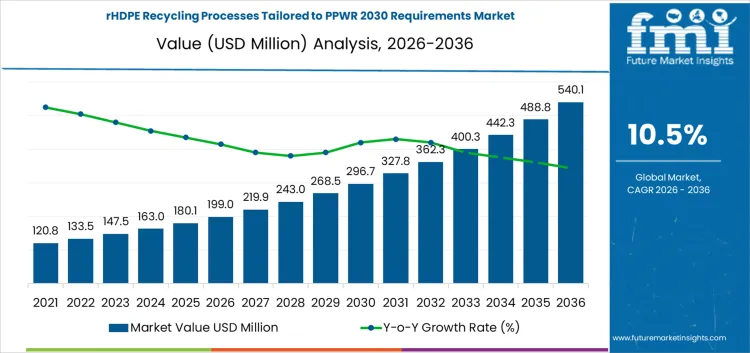
The rHDPE recycling processes tailored to PPWR 2030 requirements market is valued at USD 199 million in 2026 and is projected to reach USD 540.1 million by 2036, reflecting a CAGR of 10.5%. Cost structures are shaped by sorting precision, food-grade decontamination steps, and certification expenses tied to regulatory alignment. Facilities investing early in advanced washing and traceability systems achieve lower rejection rates and steadier yields. Pricing control concentrates among operators supplying compliant resin grades to brand owners facing mandatory recycled content thresholds. Margin performance favors processors converting regulatory complexity into standardized output rather than maximizing material intake volumes.
Between 2026 and 2036, value capture increasingly shifts toward recyclers securing long-term contracts with packaging producers exposed to PPWR enforcement risk. Capital intensity limits rapid capacity expansion, protecting pricing where certified output remains constrained. Margin concentration strengthens around plants achieving consistent food contact approvals across multiple product lines. Cost pass through improves when recyclers provide documentation, audit support, and supply continuity assurances. Volume growth alone delivers weaker returns without compliance credibility. Performance leadership reflects operational yield discipline, feedstock sourcing control, and the ability to lock customers into multi-year supply agreements aligned with regulatory timelines and enforcement compliance milestones.
Quick Stats for rHDPE Recycling Processes Tailored to PPWR 2030 Requirements Market
- rHDPE Recycling Processes Tailored to PPWR 2030 Requirements Market Value (2026): USD 199 million
- rHDPE Recycling Processes Tailored to PPWR 2030 Requirements Market Forecast Value (2036): USD 540.1 million
- rHDPE Recycling Processes Tailored to PPWR 2030 Requirements Market Forecast CAGR (2026–2036): 10.5%
- Leading Type in rHDPE Recycling Processes Tailored to PPWR 2030 Requirements Market: Mechanical recycling
- Key Growth Regions in rHDPE Recycling Processes Tailored to PPWR 2030 Requirements Market: Europe, Asia Pacific, and North America
- Top Players in rHDPE Recycling Processes Tailored to PPWR 2030 Requirements Market: Veolia, SUEZ, ALPLA, MBA Polymers, Berry Global
What Is the Growth Forecast for rHDPE Recycling Processes Tailored to PPWR 2030 Requirements Market through 2036?
Between 2026 and 2031, the rHDPE recycling processes tailored to PPWR 2030 requirements market is projected to grow from USD 199 million to USD 321 million, delivering an absolute increase of USD 122 million and representing about 35.8% of total forecast expansion. This phase reflects early compliance driven investment as converters and brand owners align recycling processes with recycled content thresholds and traceability rules. Cost structures are shaped by sorting precision, wash line upgrades, and quality stabilization systems. Value capture concentrates among operators able to supply consistent food contact rHDPE with documented compliance rather than those focused on bulk mechanical recycling volume alone.
From 2031 to 2036, the market is expected to expand from USD 321 million to USD 540.1 million, adding USD 219 million and accounting for roughly 64.2% of total decade growth. This period is defined by full-scale regulatory enforcement and broader adoption of advanced recycling configurations. Margins increasingly favor processors controlling feedstock sourcing, digital traceability, and contamination reduction. Long-term contracts with packaging producers strengthen pricing power. Growth shifts toward integrated recycling platforms offering verified compliance, stable output quality, and alignment with circular packaging mandates rather than incremental capacity additions.
rHDPE Recycling Processes Tailored to PPWR 2030 Requirements Market Key Takeaways
| Metric | Value |
|---|---|
| Market Value (2026) | USD 199 million |
| Forecast Value (2036) | USD 540.1 million |
| Forecast CAGR (2026–2036) | 10.5% |
What Regulatory and Process Factors Are Reshaping rHDPE Recycling Aligned with PPWR 2030 Requirements?
The rHDPE recycling processes tailored to PPWR 2030 requirements market develops as packaging producers prepare for mandatory recycled content thresholds and design for recyclability rules in the European Union. Historically, rHDPE recycling focused on downcycling into non packaging applications, with limited food contact suitability and inconsistent quality control. PPWR requirements shift demand toward advanced sorting, washing, deodorisation, and extrusion processes that deliver traceable, high purity recyclate. Investments concentrate on near infrared sorting, hot caustic washing, and melt filtration to remove inks, multilayer residues, and odours. Process validation, batch level documentation, and compliance testing gain importance. Brand owners and converters increasingly specify recycled resin performance windows, pushing recyclers to standardise output characteristics rather than maximise throughput alone across regulated packaging streams.
Future growth is driven by enforcement timelines, pricing penalties, and procurement commitments tied directly to PPWR compliance rather than voluntary sustainability targets. Packaging producers prioritise secure rHDPE supply contracts to mitigate exposure to non-compliance fines and supply disruptions. This shifts value toward recyclers capable of long-term volume guarantees, consistent melt flow, and documented recycling yields. Compared with earlier growth based on waste availability, future expansion depends on capital intensity, permitting speed, and cross-border feedstock logistics. Cost structures remain sensitive to energy pricing and contamination rates, while margins concentrate among operators achieving food-grade approvals. As 2030 approaches, tailored rHDPE recycling processes become infrastructure assets embedded within regulated packaging value chains across Europe and associated compliance ecosystems networks.
What Factors Are Affecting the Demand for rHDPE Recycling Processes Tailored to PPWR 2030 Requirements in Terms of Process Type and End Use Application?
The demand for rHDPE recycling processes tailored to PPWR 2030 requirements is segmented by process type and end use application. Process type segmentation reflects the technical pathways used to recover, purify, and upgrade post-consumer HDPE into compliant recycled material. These include mechanical recycling, solvent based or dissolution recycling, chemical depolymerization routes, and additive or compatibilizer treatments. End use application segmentation reflects where compliant rHDPE is absorbed, including food-grade packaging, non-food rigid packaging, industrial components, and construction systems. Each segment reflects different regulatory thresholds, purity expectations, and performance requirements that shape investment, capacity allocation, and adoption priorities across the recycling value chain in Europe and aligned export markets.
What Is Driving the Dominance of Mechanical Recycling in rHDPE Recycling Processes Tailored to PPWR 2030 Requirements?
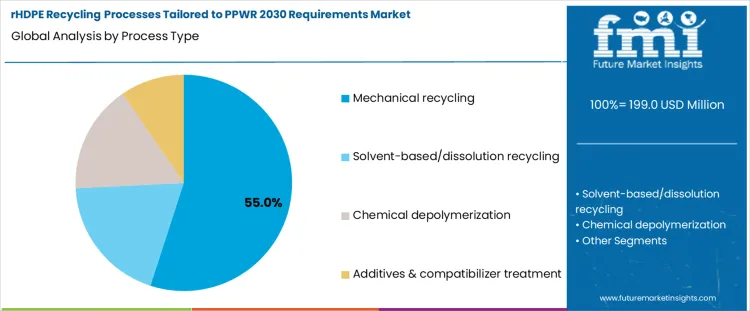
Mechanical recycling accounts for approximately 55% of total process adoption, making it the leading recycling route within PPWR aligned rHDPE systems. This dominance reflects its established infrastructure, predictable cost structure, and scalability across post-consumer HDPE streams. Mechanical processes allow sorting, washing, grinding, and re pelletizing without altering polymer chemistry. Operators leverage existing assets while upgrading sorting precision and contamination control to meet regulatory thresholds. The process supports steady output volumes suitable for packaging and industrial applications.
Demand for mechanical recycling is driven by throughput efficiency and compliance economics. Recyclers prioritize processes that balance yield stability with incremental capital investment. Mechanical recycling integrates smoothly with deposit return schemes and municipal collection systems. Brand owners benefit from traceable recycled content at controlled costs. While purity limits restrict some applications, continuous improvements in sorting and washing expand usable output. The segment maintains leadership due to operational familiarity and faster deployment timelines.
Why Does Food-grade rHDPE Represent the Largest End Use Application Segment Under PPWR 2030 Requirements?
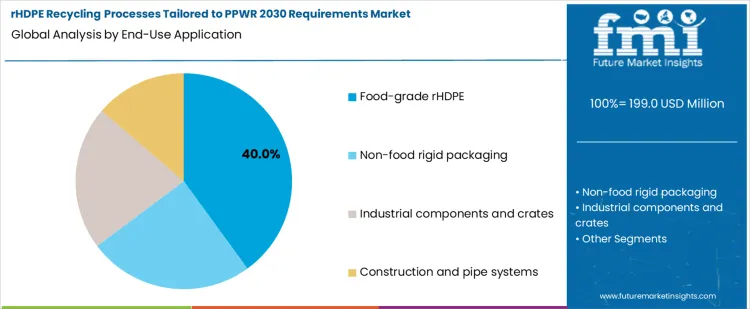
Food-grade rHDPE represents around 40% of total end use demand, making it the largest application segment. This share reflects regulatory mandates for recycled content in food contact packaging and the scale of rigid food packaging consumption. Achieving food-grade approval requires strict control of input streams, decontamination performance, and documentation. Recyclers allocate premium output volumes toward food applications due to higher value realization and long-term offtake agreements.
Demand growth in food-grade rHDPE is shaped by compliance obligations rather than discretionary adoption. Packaging producers require certified recycled content to meet PPWR targets for bottles, containers, and closures. Supply contracts emphasize consistency, auditability, and risk mitigation. Investments in advanced washing, odor removal, and quality assurance concentrate output toward food uses. The segment leads because regulatory exposure is highest in food packaging, driving early and sustained material uptake.
How is the rHDPE Recycling Processes Tailored to PPWR 2030 Requirements Market being shaped by compliance led material conversion strategies?
The rHDPE recycling processes tailored to PPWR 2030 requirements market is shaped by regulatory alignment rather than discretionary adoption. Activity concentrates around food contact packaging, household containers, and transport packaging exposed to mandatory recycled content thresholds. Process investments focus on traceability, contamination control, and batch consistency needed for audit readiness. Growth is concentrated in regions where enforcement timelines are clear and penalties are specified. Purchasing decisions prioritise verified compliance pathways over experimental technologies. Market momentum reflects preparation for regulatory scrutiny rather than expansion of overall plastic consumption volumes across end use sectors.
Why are national PPWR implementation pathways driving process level investment in rHDPE recycling capacity?
Demand is driven by country specific transposition of PPWR obligations into enforceable procurement and packaging rules. Brand owners operating locally require certified rHDPE streams that meet defined recycled content ratios and food contact safety benchmarks. Recycling operators invest in advanced washing, sorting, and deodorisation processes to qualify output for regulated packaging uses. Local authorities increasingly restrict non-compliant packaging formats, forcing converters to secure approved rHDPE supply. The driver is compliance certainty within national enforcement frameworks. Facilities aligned with domestic audit protocols gain preferred supplier status, reinforcing capacity utilisation and long-term offtake agreements at the regional level.
What operational and structural barriers limit rapid scaling of PPWR aligned rHDPE recycling processes?
Scaling is constrained by feedstock variability and uneven collection systems across regions. Many local waste streams lack consistent sorting quality, increasing processing cost and yield loss. Capital requirements for food-grade compliant lines remain high, limiting participation to larger operators. Certification timelines slow commissioning and delay revenue realization. Smaller recyclers face difficulty securing long-term contracts without proven PPWR alignment. In some countries, enforcement clarity remains incomplete, discouraging early investment. These barriers create uneven capacity growth and regional imbalances, slowing broad based rollout of compliant rHDPE recycling processes despite regulatory deadlines approaching.
How are process design and certification trends evolving ahead of PPWR 2030 enforcement milestones?
Trends show a shift toward closed loop recycling systems serving defined packaging categories. Operators prioritize traceable input sourcing, digital batch documentation, and third party verification frameworks. Process layouts increasingly separate food contact and non-food streams to simplify compliance audits. Investments favor modular upgrades rather than full plant rebuilds, allowing staged alignment with evolving guidance. Partnerships between recyclers and packaging converters deepen to lock specifications early. The trend reflects risk management over experimentation. Success increasingly depends on demonstrating repeatable compliance performance rather than maximum throughput or lowest cost processing alone.
What is the Demand for rHDPE Recycling Processes Tailored to PPWR 2030 Requirements in USA, UK, China, India, and Brazil?
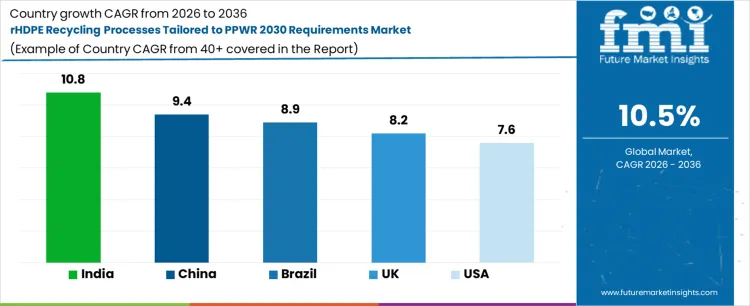
| Country | CAGR (%) |
|---|---|
| USA | 7.6 |
| UK | 8.2 |
| China | 9.4 |
| India | 10.8 |
| Brazil | 8.9 |
The demand for rHDPE recycling processes aligned with PPWR 2030 requirements is strengthening across key packaging and plastics economies as compliance timelines draw closer. India records the fastest expansion, supported by rapid capacity additions in rigid packaging recycling and policy driven pressure on converters to secure compliant recycled feedstock. China follows, driven by large scale reprocessing infrastructure upgrades focused on higher purity output for packaging reuse. Brazil shows solid growth as consumer goods producers integrate locally recycled HDPE to meet evolving packaging standards. The USA reflects steady adoption as recyclers invest in sorting, washing, and decontamination systems to supply compliant rHDPE grades. The UK shows moderate growth, shaped by regulatory alignment, stable collection systems, and incremental process optimization within existing recycling networks.
How Are PPWR Compliance Targets Reshaping rHDPE Recycling Process Demand in the United States?
The United States rHDPE recycling processes tailored to PPWR 2030 requirements market is expanding at a CAGR of 7.6%, shaped by tightening recycled content targets and growing pressure from brand owners supplying regulated export markets. Recycling operators are adjusting sorting, washing, and decontamination processes to achieve consistent food and non-food-grade outputs aligned with European compliance thresholds. Investment activity focuses on advanced separation systems and traceability protocols rather than volume expansion. Demand is concentrated among recyclers supplying multinational packaging producers that require documented compliance across global supply chains. Process upgrades are driven more by specification alignment and quality assurance than by domestic regulatory mandates.
- Export-oriented packaging supply chains are driving compliance-focused process investments.
- Traceability and contamination control are becoming central procurement requirements.
- Capital allocation favors process refinement over capacity expansion.
- Brand-led recycled content commitments influence recycler technology choices.
Why Is Regulatory Alignment Accelerating rHDPE Process Upgrades in the United Kingdom?
The United Kingdom rHDPE recycling processes tailored to PPWR 2030 requirements market is growing at a CAGR of 8.2%, supported by early regulatory alignment with European packaging standards. Domestic recyclers are prioritizing process consistency, color management, and food-contact readiness to meet future compliance thresholds. Investment activity centers on wash-line optimization and quality monitoring rather than new collection infrastructure. Demand is strongest among recyclers supplying rigid packaging for household, personal care, and food applications. Policy clarity around extended producer responsibility reinforces long-term process planning and encourages early compliance positioning.
- Alignment with European packaging rules is accelerating process standardization.
- Food-contact compliance requirements shape technology investment priorities.
- Extended producer responsibility frameworks support predictable demand.
- Quality-focused upgrades outweigh capacity-driven expansion strategies.
How Is Export-Oriented Packaging Manufacturing Driving Process Demand in China?
China rHDPE recycling processes tailored to PPWR 2030 requirements are expanding at a CAGR of 9.4%, driven by the country’s role as a major packaging manufacturing base serving regulated international markets. Recyclers supplying export-focused converters are upgrading sorting accuracy and decontamination systems to meet destination market specifications. Process investments emphasize output consistency and batch traceability to support compliance documentation. Domestic policy pressure plays a secondary role compared with requirements imposed by overseas brand owners and packaging buyers. Demand clusters around industrial regions with high concentrations of packaging conversion activity.
- Export-linked compliance requirements drive process modernization priorities.
- Packaging manufacturers influence recycler quality specifications.
- Traceability systems are gaining importance in recycled resin supply.
- Regional manufacturing hubs concentrate investment activity.
Why Are Packaging Compliance Pressures Accelerating Adoption in India?
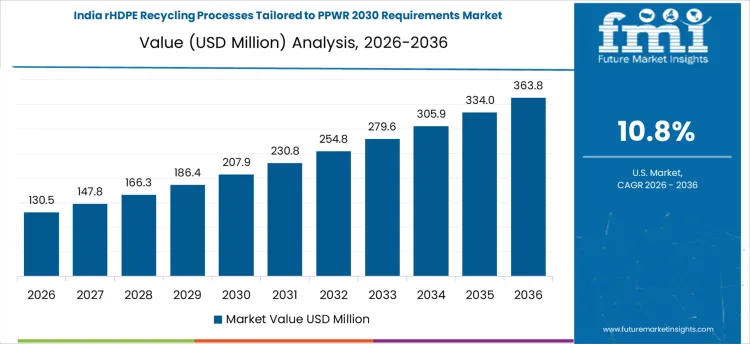
India rHDPE recycling processes tailored to PPWR 2030 requirements are growing at a CAGR of 10.8%, reflecting rapid alignment with international packaging compliance expectations. Recycling operators serving export-oriented converters are investing in advanced washing, odor removal, and contamination control systems. Demand is shaped by global brand sourcing strategies rather than domestic packaging regulation. Process upgrades focus on enabling consistent recycled content integration into rigid packaging applications. Growth is concentrated among organized recyclers capable of meeting documentation and quality verification requirements demanded by multinational customers.
- Export-driven packaging supply chains shape recycler investment decisions.
- Quality assurance capabilities differentiate organized recycling operators.
- Process consistency supports integration into regulated packaging formats.
- Multinational brand requirements influence technology adoption timing.
How Is Packaging Industry Modernization Supporting Market Expansion in Brazil?
Brazil rHDPE recycling processes tailored to PPWR 2030 requirements are expanding at a CAGR of 8.9%, supported by gradual modernization of the domestic packaging sector and rising participation in global supply chains. Recyclers are upgrading processing systems to improve output uniformity and contamination control for regulated applications. Demand is linked to converters supplying international consumer goods brands with compliance obligations. Investment activity remains selective, focusing on retrofit upgrades rather than full-scale facility replacement. Adoption is strongest among recyclers integrated with packaging producers.
- International brand sourcing standards influence process upgrade decisions.
- Retrofit investments dominate over greenfield capacity additions.
- Packaging converter relationships guide recycler quality targets.
- Compliance readiness supports access to higher-value applications.
What Is Driving the Demand for rHDPE Recycling Processes Aligned with PPWR 2030 Requirements?
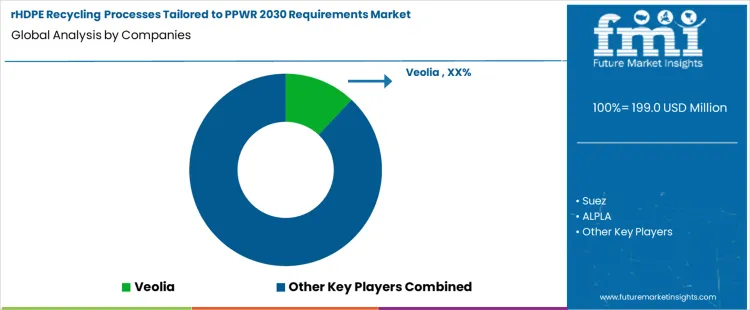
Demand for rHDPE recycling processes aligned with PPWR 2030 requirements is shaped by regulatory thresholds on recycled content, traceability mandates, and food contact compliance in packaging. Converters and brand owners operating in the European Union are restructuring procurement around verified mechanical recycling routes that deliver consistent polymer quality. Process selection prioritizes decontamination efficiency, color management, and melt flow stability to meet packaging performance standards. Collection system fragmentation across member states influences feedstock availability and process economics. Technology choices increasingly reflect compatibility with closed loop packaging applications rather than downcycling. Firms such as Veolia and SUEZ shape system design through integrated collection, sorting, and reprocessing capabilities aligned with compliance documentation requirements.
Competitive structure reflects a mix of pan European recyclers and packaging linked processors with country level infrastructure depth. ALPLA operates recycling assets tightly linked to its packaging conversion footprint, enabling material control and design for recycling alignment. MBA Polymers contributes process know how in mixed rigid plastics separation, supporting consistent rHDPE output across variable waste streams. Berry Global integrates recycled material into packaging production, reinforcing demand pull for compliant rHDPE grades within Europe. Smaller regional recyclers across Germany, France, and Benelux retain relevance through local collection access and contract based supply. Competitive differentiation centers on regulatory readiness, audit transparency, and long-term feedstock security rather than capacity scale alone.
Key Players in the rHDPE Recycling Processes Tailored to PPWR 2030 Requirements Market
- Veolia
- SUEZ
- ALPLA
- MBA Polymers
- Berry Global
Scope of the Report
| Items | Values |
|---|---|
| Quantitative Units (2026) | USD million |
| Type | Mechanical recycling, Solvent-based or dissolution recycling, Chemical depolymerization, Additives and compatibilizer treatment |
| Application | Food-grade packaging, Non-food rigid packaging, Industrial components and crates, Construction and pipe systems |
| End User | Packaging producers, Consumer goods brand owners, Industrial plastics users, Construction materials manufacturers |
| Regions Covered | Europe, Asia Pacific, North America, Latin America, Middle East & Africa |
| Countries Covered | Germany, United Kingdom, France, Italy, Spain, United States, Canada, Mexico, China, India, Japan, South Korea, Brazil, and other regulated and export-oriented packaging economies |
| Key Companies Profiled | Veolia, SUEZ, ALPLA, MBA Polymers, Berry Global |
| Additional Attributes | Dollar sales by process type and end use application, compliance-driven adoption patterns under PPWR enforcement timelines, regulatory certification and audit readiness requirements, food-contact approval pathways, traceability and documentation systems, feedstock sourcing constraints, integration with packaging producer supply agreements and closed-loop recycling models |
rHDPE Recycling Processes Tailored to PPWR 2030 Requirements Market Segmentation
Process Type:
- Mechanical recycling
- Solvent-based or dissolution recycling
- Chemical depolymerization
- Additives and compatibilizer treatment
End-Use Application:
- Food-grade rHDPE
- Non-food rigid packaging
- Industrial components and crates
- Construction and pipe systems
Region:
Asia Pacific:
- China
- Japan
- South Korea
- India
- Australia & New Zealand
- ASEAN
- Rest of Asia Pacific
Europe:
- Germany
- United Kingdom
- France
- Italy
- Spain
- Nordic
- BENELUX
- Rest of Europe
North America:
- United States
- Canada
- Mexico
Latin America:
- Brazil
- Chile
- Rest of Latin America
Middle East & Africa:
- Kingdom of Saudi Arabia
- Other GCC Countries
- Turkey
- South Africa
- Other African Union
- Rest of Middle East & Africa
Frequently Asked Questions
How big is the rHDPE recycling processes tailored to PPWR 2030 requirements market in 2026?
The global rHDPE recycling processes tailored to PPWR 2030 requirements market is estimated to be valued at USD 199.0 million in 2026.
What will be the size of rHDPE recycling processes tailored to PPWR 2030 requirements market in 2036?
The market size for the rHDPE recycling processes tailored to PPWR 2030 requirements market is projected to reach USD 540.1 million by 2036.
How much will be the rHDPE recycling processes tailored to PPWR 2030 requirements market growth between 2026 and 2036?
The rHDPE recycling processes tailored to PPWR 2030 requirements market is expected to grow at a 10.5% CAGR between 2026 and 2036.
What are the key process types in the rHDPE recycling processes tailored to PPWR 2030 requirements market?
The key process types in rHDPE recycling processes tailored to PPWR 2030 requirements market are mechanical recycling, solvent-based/dissolution recycling, chemical depolymerization and additives & compatibilizer treatment.
Which end-use application segment to contribute significant share in the rHDPE recycling processes tailored to PPWR 2030 requirements market in 2026?
In terms of end-use application, food-grade rHDPE segment to command 40.0% share in the rHDPE recycling processes tailored to PPWR 2030 requirements market in 2026.
Preview the report firsthand - request a free sample
Get SampleGet the brochure for pricing and purchase details.
Get PDFTable of Content
- Executive Summary
- Global Market Outlook
- Demand-side Trends
- Supply-side Trends
- Technology Roadmap Analysis
- Analysis and Recommendations
- Market Overview
- Market Coverage / Taxonomy
- Market Definition / Scope / Limitations
- Market Background
- Market Dynamics
- Drivers
- Restraints
- Opportunity
- Trends
- Scenario Forecast
- Demand in Optimistic Scenario
- Demand in Likely Scenario
- Demand in Conservative Scenario
- Opportunity Map Analysis
- Product Life Cycle Analysis
- Supply Chain Analysis
- Investment Feasibility Matrix
- Value Chain Analysis
- PESTLE and Porter’s Analysis
- Regulatory Landscape
- Regional Parent Market Outlook
- Production and Consumption Statistics
- Import and Export Statistics
- Market Dynamics
- Global Market Analysis 2021 to 2025 and Forecast, 2026 to 2036
- Historical Market Size Value (USD Million) Analysis, 2021 to 2025
- Current and Future Market Size Value (USD Million) Projections, 2026 to 2036
- Y-o-Y Growth Trend Analysis
- Absolute $ Opportunity Analysis
- Global Market Pricing Analysis 2021 to 2025 and Forecast 2026 to 2036
- Global Market Analysis 2021 to 2025 and Forecast 2026 to 2036, By Process Type
- Introduction / Key Findings
- Historical Market Size Value (USD Million) Analysis By Process Type , 2021 to 2025
- Current and Future Market Size Value (USD Million) Analysis and Forecast By Process Type , 2026 to 2036
- Mechanical recycling
- Solvent-based/dissolution recycling
- Chemical depolymerization
- Additives & compatibilizer treatment
- Mechanical recycling
- Y-o-Y Growth Trend Analysis By Process Type , 2021 to 2025
- Absolute $ Opportunity Analysis By Process Type , 2026 to 2036
- Global Market Analysis 2021 to 2025 and Forecast 2026 to 2036, By End-Use Application
- Introduction / Key Findings
- Historical Market Size Value (USD Million) Analysis By End-Use Application, 2021 to 2025
- Current and Future Market Size Value (USD Million) Analysis and Forecast By End-Use Application, 2026 to 2036
- Food-grade rHDPE
- Non-food rigid packaging
- Industrial components and crates
- Construction and pipe systems
- Food-grade rHDPE
- Y-o-Y Growth Trend Analysis By End-Use Application, 2021 to 2025
- Absolute $ Opportunity Analysis By End-Use Application, 2026 to 2036
- Global Market Analysis 2021 to 2025 and Forecast 2026 to 2036, By Region
- Introduction
- Historical Market Size Value (USD Million) Analysis By Region, 2021 to 2025
- Current Market Size Value (USD Million) Analysis and Forecast By Region, 2026 to 2036
- North America
- Latin America
- Western Europe
- Eastern Europe
- East Asia
- South Asia and Pacific
- Middle East & Africa
- Market Attractiveness Analysis By Region
- North America Market Analysis 2021 to 2025 and Forecast 2026 to 2036, By Country
- Historical Market Size Value (USD Million) Trend Analysis By Market Taxonomy, 2021 to 2025
- Market Size Value (USD Million) Forecast By Market Taxonomy, 2026 to 2036
- By Country
- USA
- Canada
- Mexico
- By Process Type
- By End-Use Application
- By Country
- Market Attractiveness Analysis
- By Country
- By Process Type
- By End-Use Application
- Key Takeaways
- Latin America Market Analysis 2021 to 2025 and Forecast 2026 to 2036, By Country
- Historical Market Size Value (USD Million) Trend Analysis By Market Taxonomy, 2021 to 2025
- Market Size Value (USD Million) Forecast By Market Taxonomy, 2026 to 2036
- By Country
- Brazil
- Chile
- Rest of Latin America
- By Process Type
- By End-Use Application
- By Country
- Market Attractiveness Analysis
- By Country
- By Process Type
- By End-Use Application
- Key Takeaways
- Western Europe Market Analysis 2021 to 2025 and Forecast 2026 to 2036, By Country
- Historical Market Size Value (USD Million) Trend Analysis By Market Taxonomy, 2021 to 2025
- Market Size Value (USD Million) Forecast By Market Taxonomy, 2026 to 2036
- By Country
- Germany
- UK
- Italy
- Spain
- France
- Nordic
- BENELUX
- Rest of Western Europe
- By Process Type
- By End-Use Application
- By Country
- Market Attractiveness Analysis
- By Country
- By Process Type
- By End-Use Application
- Key Takeaways
- Eastern Europe Market Analysis 2021 to 2025 and Forecast 2026 to 2036, By Country
- Historical Market Size Value (USD Million) Trend Analysis By Market Taxonomy, 2021 to 2025
- Market Size Value (USD Million) Forecast By Market Taxonomy, 2026 to 2036
- By Country
- Russia
- Poland
- Hungary
- Balkan & Baltic
- Rest of Eastern Europe
- By Process Type
- By End-Use Application
- By Country
- Market Attractiveness Analysis
- By Country
- By Process Type
- By End-Use Application
- Key Takeaways
- East Asia Market Analysis 2021 to 2025 and Forecast 2026 to 2036, By Country
- Historical Market Size Value (USD Million) Trend Analysis By Market Taxonomy, 2021 to 2025
- Market Size Value (USD Million) Forecast By Market Taxonomy, 2026 to 2036
- By Country
- China
- Japan
- South Korea
- By Process Type
- By End-Use Application
- By Country
- Market Attractiveness Analysis
- By Country
- By Process Type
- By End-Use Application
- Key Takeaways
- South Asia and Pacific Market Analysis 2021 to 2025 and Forecast 2026 to 2036, By Country
- Historical Market Size Value (USD Million) Trend Analysis By Market Taxonomy, 2021 to 2025
- Market Size Value (USD Million) Forecast By Market Taxonomy, 2026 to 2036
- By Country
- India
- ASEAN
- Australia & New Zealand
- Rest of South Asia and Pacific
- By Process Type
- By End-Use Application
- By Country
- Market Attractiveness Analysis
- By Country
- By Process Type
- By End-Use Application
- Key Takeaways
- Middle East & Africa Market Analysis 2021 to 2025 and Forecast 2026 to 2036, By Country
- Historical Market Size Value (USD Million) Trend Analysis By Market Taxonomy, 2021 to 2025
- Market Size Value (USD Million) Forecast By Market Taxonomy, 2026 to 2036
- By Country
- Kingdom of Saudi Arabia
- Other GCC Countries
- Turkiye
- South Africa
- Other African Union
- Rest of Middle East & Africa
- By Process Type
- By End-Use Application
- By Country
- Market Attractiveness Analysis
- By Country
- By Process Type
- By End-Use Application
- Key Takeaways
- Key Countries Market Analysis
- USA
- Pricing Analysis
- Market Share Analysis, 2025
- By Process Type
- By End-Use Application
- Canada
- Pricing Analysis
- Market Share Analysis, 2025
- By Process Type
- By End-Use Application
- Mexico
- Pricing Analysis
- Market Share Analysis, 2025
- By Process Type
- By End-Use Application
- Brazil
- Pricing Analysis
- Market Share Analysis, 2025
- By Process Type
- By End-Use Application
- Chile
- Pricing Analysis
- Market Share Analysis, 2025
- By Process Type
- By End-Use Application
- Germany
- Pricing Analysis
- Market Share Analysis, 2025
- By Process Type
- By End-Use Application
- UK
- Pricing Analysis
- Market Share Analysis, 2025
- By Process Type
- By End-Use Application
- Italy
- Pricing Analysis
- Market Share Analysis, 2025
- By Process Type
- By End-Use Application
- Spain
- Pricing Analysis
- Market Share Analysis, 2025
- By Process Type
- By End-Use Application
- France
- Pricing Analysis
- Market Share Analysis, 2025
- By Process Type
- By End-Use Application
- India
- Pricing Analysis
- Market Share Analysis, 2025
- By Process Type
- By End-Use Application
- ASEAN
- Pricing Analysis
- Market Share Analysis, 2025
- By Process Type
- By End-Use Application
- Australia & New Zealand
- Pricing Analysis
- Market Share Analysis, 2025
- By Process Type
- By End-Use Application
- China
- Pricing Analysis
- Market Share Analysis, 2025
- By Process Type
- By End-Use Application
- Japan
- Pricing Analysis
- Market Share Analysis, 2025
- By Process Type
- By End-Use Application
- South Korea
- Pricing Analysis
- Market Share Analysis, 2025
- By Process Type
- By End-Use Application
- Russia
- Pricing Analysis
- Market Share Analysis, 2025
- By Process Type
- By End-Use Application
- Poland
- Pricing Analysis
- Market Share Analysis, 2025
- By Process Type
- By End-Use Application
- Hungary
- Pricing Analysis
- Market Share Analysis, 2025
- By Process Type
- By End-Use Application
- Kingdom of Saudi Arabia
- Pricing Analysis
- Market Share Analysis, 2025
- By Process Type
- By End-Use Application
- Turkiye
- Pricing Analysis
- Market Share Analysis, 2025
- By Process Type
- By End-Use Application
- South Africa
- Pricing Analysis
- Market Share Analysis, 2025
- By Process Type
- By End-Use Application
- USA
- Market Structure Analysis
- Competition Dashboard
- Competition Benchmarking
- Market Share Analysis of Top Players
- By Regional
- By Process Type
- By End-Use Application
- Competition Analysis
- Competition Deep Dive
- Veolia
- Overview
- Product Portfolio
- Profitability by Market Segments (Product/Age /Sales Channel/Region)
- Sales Footprint
- Strategy Overview
- Marketing Strategy
- Product Strategy
- Channel Strategy
- Suez
- ALPLA
- MBA Polymers
- Berry Global
- Veolia
- Competition Deep Dive
- Assumptions & Acronyms Used
- Research Methodology


