

- Industry Size (2026)
- USD 144 Mn
- Forecast (2036)
- USD 405.2 Mn
- CAGR (2026 to 2036)
- 10.9%
Licensing Platforms for Solvent Based rHDPE Recycling Processes Market Forecast and Outlook 2026 to 2036
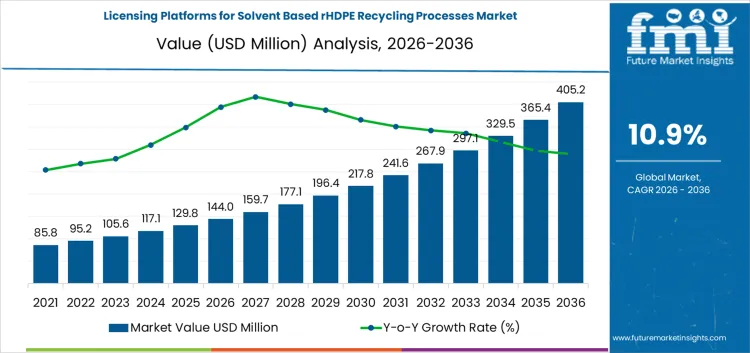
The licensing platforms for solvent based rHDPE recycling processes market is valued at USD 144 million in 2026 and is projected to reach USD 405.2 million by 2036, reflecting a CAGR of 10.9%. Cost structures are asset light for licensors, with expenses concentrated in process validation, intellectual property protection, and technical support teams. Pricing control rests with platform owners able to standardize performance guarantees across licensees. Margins concentrate where licensors embed upgrade pathways, certification support, and solvent recovery benchmarks into contracts. Value accrues through recurring fees and milestone payments rather than equipment volume or plant throughput exposure over time horizons.
Between 2026 and 2036, expansion is shaped by selective licensing rather than rapid diffusion. Capital efficiency attracts investors seeking exposure without construction risk or operating volatility. Return timelines depend on license adoption rates, enforcement of process fidelity, and downstream regulatory acceptance. Platforms limiting license density protect pricing integrity and long term margins. Value capture strengthens when licensors control data feedback, audits, and software layers governing solvent performance. Competitive differentiation reflects credibility with regulators and brand owners. Firms emphasizing disciplined partner selection outperform those prioritizing license counts, as dilution pressure weakens bargaining power and compresses recurring revenue quality over time horizons.
Quick Stats for Licensing Platforms for Solvent Based rHDPE Recycling Processes Market
- Licensing Platforms for Solvent Based rHDPE Recycling Processes Market Value (2026): USD 144 million
- Licensing Platforms for Solvent Based rHDPE Recycling Processes Market Forecast Value (2036): USD 405.2 million
- Licensing Platforms for Solvent Based rHDPE Recycling Processes Market Forecast CAGR (2026 to 2036): 10.9%
- Leading Type in Licensing Platforms for Solvent Based rHDPE Recycling Processes Market: Process technology licensing
- Key Growth Regions in Licensing Platforms for Solvent Based rHDPE Recycling Processes Market: Asia Pacific, Europe, and North America
- Top Players in Licensing Platforms for Solvent Based rHDPE Recycling Processes Market: APK AG, PureCycle Technologies, Fraunhofer IVV, Sulzer, Veolia
What Is the Growth Forecast for Licensing Platforms for Solvent Based rHDPE Recycling Processes Market through 2036?
Between 2026 and 2031, the licensing platforms for solvent-based rHDPE recycling processes market is projected to expand from USD 144 million to USD 232 million, delivering an absolute increase of USD 88 million and accounting for about 33.1% of total forecast growth. This phase is shaped by early licensing uptake as recyclers and packaging groups seek rapid access to proven solvent-based process configurations. Cost structures emphasize intellectual property validation, pilot demonstration support, and engineering customization rather than physical asset deployment. Value capture concentrates among licensors offering standardized process packages with documented performance, regulatory readiness, and scalable replication pathways across multiple regional installations.
From 2031 to 2036, the market is expected to grow from USD 232 million to USD 405.2 million, adding USD 180 million and representing roughly 66.9% of decade expansion. Growth accelerates as regulatory pressure and recycled content mandates favor faster rollout through licensing rather than in-house development. Margins increasingly favor platforms controlling process know-how, solvent recovery design, and compliance documentation. Long-term licensing agreements, royalties, and technical service contracts strengthen pricing power. Competitive positioning shifts toward licensors enabling consistent food-grade rHDPE output across diverse feedstock conditions, prioritizing reliability and replication efficiency over standalone technology ownership.
Licensing Platforms for Solvent Based rHDPE Recycling Processes Market Key Takeaways
| Metric | Value |
|---|---|
| Market Value (2026) | USD 144 million |
| Forecast Value (2036) | USD 405.2 million |
| Forecast CAGR (2026 to 2036) | 10.9% |
How Do Licensing Platforms Shape Deployment and Control of Solvent Based rHDPE Recycling Technologies?
Licensing platforms for solvent based rHDPE recycling processes emerge around intellectual property control rather than physical capacity expansion. Early development relied on vertically integrated pilots, limiting diffusion due to capital intensity and technical risk. Licensing structures now package solvent selection, process parameters, contamination thresholds, and safety protocols into transferable frameworks. Licensees include polymer producers, waste management firms, and regional recyclers seeking faster compliance pathways. Demand reflects the need to replicate validated processes without repeating multiyear development cycles. Revenue models combine upfront access fees, throughput based royalties, and technical support contracts. Control of process know how, continuous improvement updates, and audit rights define platform value. Standardisation reduces qualification friction with food contact regulators and brand owners, shifting focus toward scale.
Future adoption of licensing platforms depends on regulatory timelines, capital availability, and regional waste stream characteristics. Unlike asset ownership models, licensing lowers balance sheet exposure while accelerating market entry. Food grade rHDPE requirements elevate the importance of documented change management and version control across license networks. Platform providers retain leverage through ongoing technical audits and solvent performance benchmarks. Licensees evaluate platforms based on yield stability, energy intensity, and compatibility with existing extrusion assets. As more jurisdictions mandate recycled content, licensing enables rapid replication across multiple sites. Risks include uneven operator execution and reputational spillover from non-compliant plants. Successful platforms enforce strict governance, data reporting discipline, and continuous training, ensuring process fidelity as solvent recycling scales globally under licensing frameworks.
What Factors Are Shaping the Demand for Licensing Platforms for Solvent Based rHDPE Recycling Processes in Terms of Licensing Model and End Use Licensee?
The demand for licensing platforms for solvent based rHDPE recycling processes is structured by licensing model and end use licensee profile. Licensing model segmentation reflects how technology rights, operational know how, and scale parameters are transferred, including process technology licensing, joint development agreements, regional exclusivity, and turnkey plant packages. End use licensee segmentation reflects the type of operator adopting licensed systems, ranging from packaging recyclers to integrated producers, waste management firms, and polymer processors. Segment structure highlights how risk allocation, capital intensity, and deployment speed shape licensing preferences. Demand patterns are driven by regulatory alignment, time to market considerations, and the need to standardize solvent recycling performance across multiple sites.
What Is Driving the Dominance of Process Technology Licensing in Solvent Based rHDPE Recycling Platforms?
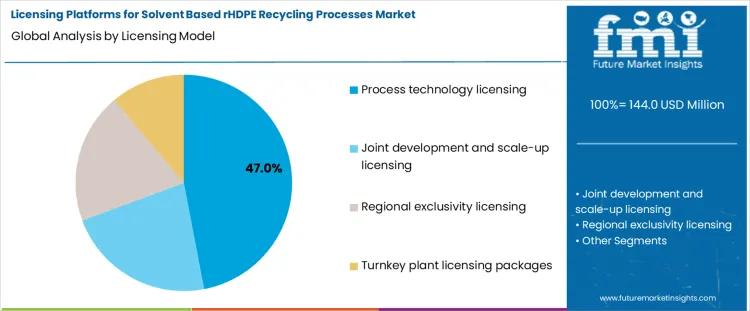
Process technology licensing accounts for approximately 47% of total licensing model adoption, making it the leading licensing structure. This share reflects licensee’s preference for acquiring core process rights while retaining control over plant design and operations. Packaging recyclers and polymer processors favor this model to integrate solvent recycling into existing assets. Process licensing provides access to validated dissolution, purification, and solvent recovery steps without mandating full system replication. Licensees can adapt layouts to local feedstock and regulatory conditions.
Demand for process technology licensing is shaped by flexibility and capital control. Licensees avoid bundled commitments tied to equipment sourcing or construction partners. Technology providers benefit from faster deal closure and broader geographic reach. Process licenses support phased scale up, allowing operators to expand capacity incrementally. Documentation and operating manuals support compliance audits and replication. The segment leads because it balances intellectual property access with operational autonomy, which suits diverse recycling operators pursuing PPWR aligned capacity expansion.
Why Do Packaging Recyclers Represent the Largest End Use Licensee Segment for Solvent Based rHDPE Recycling Platforms?
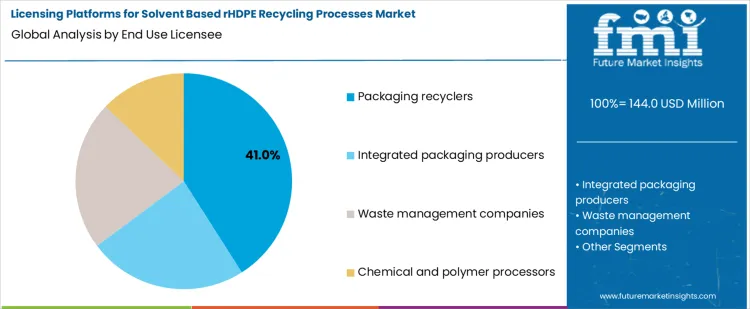
Packaging recyclers represent approximately 41% of total end use license demand, making them the largest licensee group. This position reflects their direct exposure to recycled content mandates and material offtake requirements. Packaging recyclers require solvent based processes to upgrade post-consumer HDPE into higher purity output suitable for food and non-food applications. Licensing allows rapid adoption without extended internal development cycles.
Demand from packaging recyclers is driven by competitive positioning and supply security. Licensed solvent processes enable recyclers to differentiate output quality and secure long term contracts with brand owners. Recyclers prioritize technologies with proven performance data and clear compliance pathways. Licensing reduces technical risk while accelerating deployment timelines. Multi-site operators benefit from standardized process replication across regions. The segment leads because packaging recyclers face immediate regulatory and commercial pressure to deliver compliant rHDPE at industrial scale.
How are licensing platforms reshaping deployment strategies for solvent based rHDPE recycling processes?
Licensing platforms for solvent based rHDPE recycling processes are emerging as control points for regulated technology diffusion. Their role centers on enabling standardized replication of approved processes across jurisdictions with differing waste inputs and enforcement practices. License models prioritize process integrity, operating discipline, and documentation consistency rather than rapid capacity expansion. Adoption is strongest where regulators recognize licensed systems as lower risk during audits. Market activity reflects demand for predictable approval pathways and reduced technical uncertainty. Growth follows regulatory pressure to scale compliant recycling without fragmenting process performance across multiple independently engineered facilities.
Why do local regulatory scrutiny and permitting complexity drive demand for licensed solvent recycling platforms? The key driver is country specific regulatory scrutiny applied to solvent based recycling technologies. Operators face complex permitting, safety reviews, and food contact assessments that vary by jurisdiction. Licensing platforms provide pre validated process designs and operating parameters aligned with local approval expectations. Brand owners and recyclers use licensed systems to reduce regulatory interpretation risk. Authorities often view licensed processes as more controllable due to defined change management rules. This local compliance assurance accelerates approvals and lowers project risk, making licensing attractive where enforcement is strict and timelines are commercially critical.
What constrains wider adoption of licensing platforms in solvent based rHDPE recycling?
Barriers stem from licensing costs, contractual rigidity, and reduced process flexibility. Smaller operators may resist recurring fees and performance obligations tied to licensed systems. Local waste stream variability can conflict with fixed process envelopes defined by licensors. Some regions lack clear regulatory incentives for licensed adoption, weakening the value proposition. Technology lock in concerns also deter adoption where future rule changes remain uncertain. These constraints limit uptake to operators prioritizing regulatory certainty over customization, slowing penetration in fragmented recycling markets with diverse operational conditions.
How are licensing models and technology governance evolving in solvent based rHDPE recycling?
Trends indicate a shift toward modular licensing structures allowing controlled process adjustments within defined limits. Licensors increasingly embed digital monitoring and audit support into agreements to maintain oversight. Training, commissioning support, and compliance documentation are becoming core license components. Some platforms offer tiered access aligned with end use targets such as food contact or non-food packaging. Partnerships with engineering firms expand reach without diluting control. The trend favors governance and repeatability, positioning licensing platforms as compliance infrastructure rather than pure technology transfer mechanisms.
What is the Demand for Licensing Platforms for Solvent Based rHDPE Recycling Processes by Country?
| Country | CAGR (%) |
|---|---|
| USA | 8.2 |
| UK | 7.6 |
| China | 10.3 |
| India | 11.9 |
| Brazil | 9.2 |
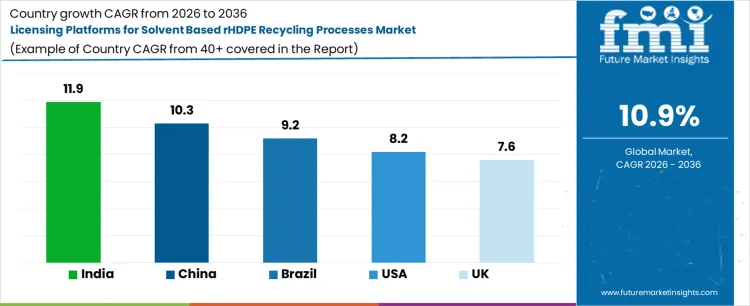
Demand for licensing platforms for solvent based rHDPE recycling processes is rising as recyclers and converters prioritize faster scale-up over in-house technology development. India leads at an 11.9% CAGR, driven by rapid capacity expansion targets and preference for licensed, pre-validated solvent purification flowsheets that reduce approval timelines. China follows at 10.3%, supported by state-backed recycling parks adopting licensed solvent systems to standardize output quality and meet food-contact specifications. Brazil records 9.2% growth as regional recyclers license solvent processes to supply multinational brand owners operating rigid and flexible packaging lines. The USA grows at 8.2%, reflecting demand for licensing models that lower capital risk and accelerate compliance. The UK posts 7.6%, shaped by selective licensing adoption within established recycling operators and limited greenfield capacity development.
How Are Technology Ownership Models Driving Licensing Demand in the United States?
In the United States, the licensing platforms for solvent-based rHDPE recycling processes market is expanding at a CAGR of 8.2%, shaped by recycler preference for proven technology ownership models over in-house development. Licensing allows operators to deploy validated solvent purification processes while limiting technical risk and development timelines. Demand is concentrated among mid to large recycling firms seeking food-grade or multilayer packaging compliance without building proprietary chemistry capabilities. Licensing agreements emphasize process guarantees, performance benchmarks, and technical support rather than equipment supply alone. Growth reflects strategic adoption of external process know-how to meet brand and packaging converter qualification requirements.
- Risk mitigation drives preference for licensed recycling technologies.
- Performance guarantees influence licensing selection criteria.
- Technical support provisions add value to platform agreements.
- Compliance-oriented recyclers dominate early adoption.
Why Is Regulatory Readiness Supporting Licensing Uptake in the United Kingdom?
Across the United Kingdom, the licensing platforms for solvent-based rHDPE recycling processes market is growing at a CAGR of 7.6%, supported by recycler focus on regulatory readiness and documented process control. Licensing platforms provide standardized operating frameworks aligned with packaging compliance expectations. Recycling operators favor licensed solutions to accelerate qualification with packaging converters and brand owners. Demand centers on platforms offering robust documentation, traceability tools, and operator training. Growth remains measured, reflecting careful evaluation of licensing costs against long-term compliance benefits.
- Regulatory alignment increases demand for standardized process platforms.
- Documentation and traceability strengthen licensing appeal.
- Operator training is a key licensing differentiator.
- Measured adoption reflects disciplined capital planning.
How Is Export-Driven Packaging Manufacturing Accelerating Licensing Demand in China?
China is recording strong growth in the licensing platforms for solvent-based rHDPE recycling processes market, with expansion at a CAGR of 10.3%, driven by export-oriented packaging manufacturing. Recycling firms supplying international converters are adopting licensed solvent technologies to meet external quality and compliance benchmarks. Licensing offers rapid deployment of proven purification methods without extended development cycles. Demand clusters in industrial regions serving multinational packaging supply chains. Growth is driven more by overseas buyer requirements than domestic policy pressure.
- Export compliance expectations accelerate licensing adoption.
- Proven process credibility supports international buyer acceptance.
- Reduced development timelines favor licensed solutions.
- Industrial clusters concentrate licensing activity.
Why Is Rapid Capability Building Fueling Licensing Growth in India?
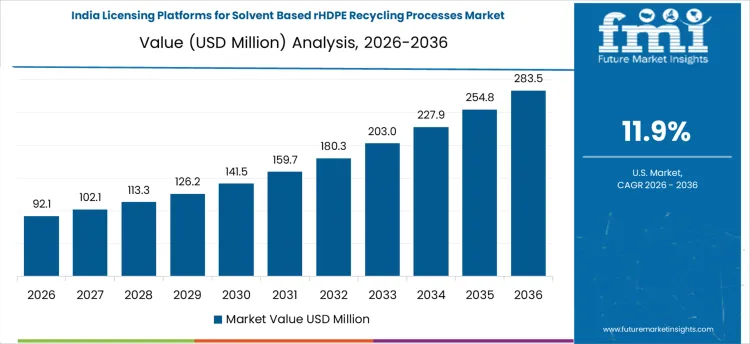
India shows the fastest expansion in the licensing platforms for solvent-based rHDPE recycling processes market, growing at a CAGR of 11.9%, reflecting recycler urgency to build solvent recycling capability quickly. Licensing enables firms to bypass early-stage experimentation while aligning with multinational brand requirements. Demand is strongest among organized recyclers targeting food-grade and multilayer packaging applications. Licensing agreements emphasize scalability, operational guidance, and performance validation. Growth reflects strategic outsourcing of process expertise to accelerate market participation.
- Speed-to-capability drives licensing preference.
- Multinational brand standards influence platform selection.
- Scalability features enhance licensing attractiveness.
- Organized recyclers lead early uptake.
How Is Packaging Supply Chain Integration Sustaining Licensing Demand in Brazil?
Brazil is experiencing steady growth in the licensing platforms for solvent-based rHDPE recycling processes market at a CAGR of 9.2%, supported by increasing integration between recyclers and packaging converters. Licensing platforms provide structured pathways to meet quality expectations for regulated applications. Recycling operators favor licensing to improve process consistency while managing capital exposure. Demand is concentrated among firms supplying international consumer goods brands. Growth remains selective, centered on partnerships where licensing supports long-term supply agreements.
- Converter quality expectations guide licensing decisions.
- Structured process frameworks reduce operational variability.
- Capital discipline favors licensed over proprietary development.
- International brand supply chains sustain demand momentum.
How Are Licensing Platforms Shaping Solvent Based rHDPE Recycling Processes Across the Industry?
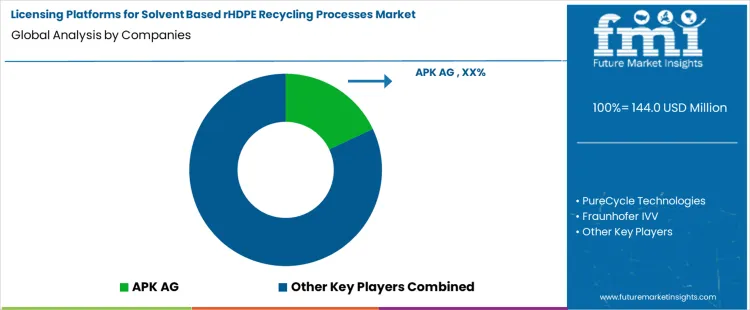
Licensing platforms for solvent based rHDPE recycling processes vary in terms of intellectual property control, process transparency, and operational reproducibility. APK AG emphasizes selective polymer recovery and protection of proprietary steps. PureCycle Technologies provides standardized purification approaches suitable for multiple licensees with limited adjustments. Fraunhofer IVV focuses on research validation, joint development, and technology transfer rather than exclusive ownership. Process documentation, clarity on operational boundaries, and regulatory readiness strongly influence adoption decisions, allowing operators to implement solvent recycling with minimized uncertainty.
Support and integration differentiate platform providers in practical deployment. Sulzer complements its licensing with separation equipment, solvent recovery systems, and commissioning guidance, enabling smoother plant operation. Veolia leverages operational experience and regulatory alignment to assist licensees in scaling processes reliably. Differences appear in training, troubleshooting access, and adaptability to variable feedstocks. Operators prioritize platforms that deliver consistent polymer quality, maintain compliance with food contact standards, and provide structured technical support. Platforms that combine process reliability with flexible guidance for feedstock variability achieve stronger adoption across regional recycling initiatives.
Key Players in the Licensing Platforms for Solvent Based rHDPE Recycling Processes Market
- APK AG
- PureCycle Technologies
- Fraunhofer IVV
- Sulzer
- Veolia
Scope of the Report
| Items | Values |
|---|---|
| Quantitative Units (2026) | USD million |
| Licensing Model | Process technology licensing, Joint development and scale-up licensing, Regional exclusivity licensing, Turnkey plant licensing packages |
| End Use Licensee | Packaging recyclers, Integrated packaging producers, Waste management companies, Chemical and polymer processors |
| Regions Covered | Asia Pacific, Europe, North America, Latin America, Middle East & Africa |
| Countries Covered | United States, United Kingdom, Germany, France, Italy, Spain, China, India, Japan, South Korea, Brazil, and other key recycling and packaging economies |
| Key Companies Profiled | APK AG, PureCycle Technologies, Fraunhofer IVV, Sulzer, Veolia |
| Additional Attributes | Dollar sales by licensing model and end use licensee, regulatory readiness and compliance support, process validation and intellectual property protection, technical support and training provisions, licensing fee structures, replication and scalability of solvent-based rHDPE recycling processes across multiple sites |
Licensing Platforms for Solvent Based rHDPE Recycling Processes Market Segmentation
Licensing Model:
- Process technology licensing
- Joint development and scale-up licensing
- Regional exclusivity licensing
- Turnkey plant licensing packages
End Use Licensee:
- Packaging recyclers
- Integrated packaging producers
- Waste management companies
- Chemical and polymer processors
Region
- Asia Pacific
- China
- Japan
- South Korea
- India
- Australia & New Zealand
- ASEAN
- Rest of Asia Pacific
- Europe
- Germany
- United Kingdom
- France
- Italy
- Spain
- Nordic
- BENELUX
- Rest of Europe
- North America
- United States
- Canada
- Mexico
- Latin America
- Brazil
- Chile
- Rest of Latin America
- Middle East & Africa
- Kingdom of Saudi Arabia
- Other GCC Countries
- Turkey
- South Africa
- Other African Union
- Rest of Middle East & Africa
Frequently Asked Questions
How big is the licensing platforms for solvent based rhdpe recycling processes market in 2026?
The global licensing platforms for solvent based rhdpe recycling processes market is estimated to be valued at USD 144.0 million in 2026.
What will be the size of licensing platforms for solvent based rhdpe recycling processes market in 2036?
The market size for the licensing platforms for solvent based rhdpe recycling processes market is projected to reach USD 405.2 million by 2036.
How much will be the licensing platforms for solvent based rhdpe recycling processes market growth between 2026 and 2036?
The licensing platforms for solvent based rhdpe recycling processes market is expected to grow at a 10.9% CAGR between 2026 and 2036.
What are the key product types in the licensing platforms for solvent based rhdpe recycling processes market?
The key product types in licensing platforms for solvent based rhdpe recycling processes market are process technology licensing, joint development and scale-up licensing, regional exclusivity licensing and turnkey plant licensing packages.
Which end use licensee segment to contribute significant share in the licensing platforms for solvent based rhdpe recycling processes market in 2026?
In terms of end use licensee, packaging recyclers segment to command 41.0% share in the licensing platforms for solvent based rhdpe recycling processes market in 2026.
Preview the report firsthand - request a free sample
Get SampleGet the brochure for pricing and purchase details.
Get PDFTable of Content
- Executive Summary
- Global Market Outlook
- Demand-side Trends
- Supply-side Trends
- Technology Roadmap Analysis
- Analysis and Recommendations
- Market Overview
- Market Coverage / Taxonomy
- Market Definition / Scope / Limitations
- Market Background
- Market Dynamics
- Drivers
- Restraints
- Opportunity
- Trends
- Scenario Forecast
- Demand in Optimistic Scenario
- Demand in Likely Scenario
- Demand in Conservative Scenario
- Opportunity Map Analysis
- Product Life Cycle Analysis
- Supply Chain Analysis
- Investment Feasibility Matrix
- Value Chain Analysis
- PESTLE and Porter’s Analysis
- Regulatory Landscape
- Regional Parent Market Outlook
- Production and Consumption Statistics
- Import and Export Statistics
- Market Dynamics
- Global Market Analysis 2021 to 2025 and Forecast, 2026 to 2036
- Historical Market Size Value (USD Million) Analysis, 2021 to 2025
- Current and Future Market Size Value (USD Million) Projections, 2026 to 2036
- Y-o-Y Growth Trend Analysis
- Absolute $ Opportunity Analysis
- Global Market Pricing Analysis 2021 to 2025 and Forecast 2026 to 2036
- Global Market Analysis 2021 to 2025 and Forecast 2026 to 2036, By Licensing Model
- Introduction / Key Findings
- Historical Market Size Value (USD Million) Analysis By Licensing Model , 2021 to 2025
- Current and Future Market Size Value (USD Million) Analysis and Forecast By Licensing Model , 2026 to 2036
- Process technology licensing
- Joint development and scale-up licensing
- Regional exclusivity licensing
- Turnkey plant licensing packages
- Process technology licensing
- Y-o-Y Growth Trend Analysis By Licensing Model , 2021 to 2025
- Absolute $ Opportunity Analysis By Licensing Model , 2026 to 2036
- Global Market Analysis 2021 to 2025 and Forecast 2026 to 2036, By End Use Licensee
- Introduction / Key Findings
- Historical Market Size Value (USD Million) Analysis By End Use Licensee, 2021 to 2025
- Current and Future Market Size Value (USD Million) Analysis and Forecast By End Use Licensee, 2026 to 2036
- Packaging recyclers
- Integrated packaging producers
- Waste management companies
- Chemical and polymer processors
- Packaging recyclers
- Y-o-Y Growth Trend Analysis By End Use Licensee, 2021 to 2025
- Absolute $ Opportunity Analysis By End Use Licensee, 2026 to 2036
- Global Market Analysis 2021 to 2025 and Forecast 2026 to 2036, By Region
- Introduction
- Historical Market Size Value (USD Million) Analysis By Region, 2021 to 2025
- Current Market Size Value (USD Million) Analysis and Forecast By Region, 2026 to 2036
- North America
- Latin America
- Western Europe
- Eastern Europe
- East Asia
- South Asia and Pacific
- Middle East & Africa
- Market Attractiveness Analysis By Region
- North America Market Analysis 2021 to 2025 and Forecast 2026 to 2036, By Country
- Historical Market Size Value (USD Million) Trend Analysis By Market Taxonomy, 2021 to 2025
- Market Size Value (USD Million) Forecast By Market Taxonomy, 2026 to 2036
- By Country
- USA
- Canada
- Mexico
- By Licensing Model
- By End Use Licensee
- By Country
- Market Attractiveness Analysis
- By Country
- By Licensing Model
- By End Use Licensee
- Key Takeaways
- Latin America Market Analysis 2021 to 2025 and Forecast 2026 to 2036, By Country
- Historical Market Size Value (USD Million) Trend Analysis By Market Taxonomy, 2021 to 2025
- Market Size Value (USD Million) Forecast By Market Taxonomy, 2026 to 2036
- By Country
- Brazil
- Chile
- Rest of Latin America
- By Licensing Model
- By End Use Licensee
- By Country
- Market Attractiveness Analysis
- By Country
- By Licensing Model
- By End Use Licensee
- Key Takeaways
- Western Europe Market Analysis 2021 to 2025 and Forecast 2026 to 2036, By Country
- Historical Market Size Value (USD Million) Trend Analysis By Market Taxonomy, 2021 to 2025
- Market Size Value (USD Million) Forecast By Market Taxonomy, 2026 to 2036
- By Country
- Germany
- UK
- Italy
- Spain
- France
- Nordic
- BENELUX
- Rest of Western Europe
- By Licensing Model
- By End Use Licensee
- By Country
- Market Attractiveness Analysis
- By Country
- By Licensing Model
- By End Use Licensee
- Key Takeaways
- Eastern Europe Market Analysis 2021 to 2025 and Forecast 2026 to 2036, By Country
- Historical Market Size Value (USD Million) Trend Analysis By Market Taxonomy, 2021 to 2025
- Market Size Value (USD Million) Forecast By Market Taxonomy, 2026 to 2036
- By Country
- Russia
- Poland
- Hungary
- Balkan & Baltic
- Rest of Eastern Europe
- By Licensing Model
- By End Use Licensee
- By Country
- Market Attractiveness Analysis
- By Country
- By Licensing Model
- By End Use Licensee
- Key Takeaways
- East Asia Market Analysis 2021 to 2025 and Forecast 2026 to 2036, By Country
- Historical Market Size Value (USD Million) Trend Analysis By Market Taxonomy, 2021 to 2025
- Market Size Value (USD Million) Forecast By Market Taxonomy, 2026 to 2036
- By Country
- China
- Japan
- South Korea
- By Licensing Model
- By End Use Licensee
- By Country
- Market Attractiveness Analysis
- By Country
- By Licensing Model
- By End Use Licensee
- Key Takeaways
- South Asia and Pacific Market Analysis 2021 to 2025 and Forecast 2026 to 2036, By Country
- Historical Market Size Value (USD Million) Trend Analysis By Market Taxonomy, 2021 to 2025
- Market Size Value (USD Million) Forecast By Market Taxonomy, 2026 to 2036
- By Country
- India
- ASEAN
- Australia & New Zealand
- Rest of South Asia and Pacific
- By Licensing Model
- By End Use Licensee
- By Country
- Market Attractiveness Analysis
- By Country
- By Licensing Model
- By End Use Licensee
- Key Takeaways
- Middle East & Africa Market Analysis 2021 to 2025 and Forecast 2026 to 2036, By Country
- Historical Market Size Value (USD Million) Trend Analysis By Market Taxonomy, 2021 to 2025
- Market Size Value (USD Million) Forecast By Market Taxonomy, 2026 to 2036
- By Country
- Kingdom of Saudi Arabia
- Other GCC Countries
- Turkiye
- South Africa
- Other African Union
- Rest of Middle East & Africa
- By Licensing Model
- By End Use Licensee
- By Country
- Market Attractiveness Analysis
- By Country
- By Licensing Model
- By End Use Licensee
- Key Takeaways
- Key Countries Market Analysis
- USA
- Pricing Analysis
- Market Share Analysis, 2025
- By Licensing Model
- By End Use Licensee
- Canada
- Pricing Analysis
- Market Share Analysis, 2025
- By Licensing Model
- By End Use Licensee
- Mexico
- Pricing Analysis
- Market Share Analysis, 2025
- By Licensing Model
- By End Use Licensee
- Brazil
- Pricing Analysis
- Market Share Analysis, 2025
- By Licensing Model
- By End Use Licensee
- Chile
- Pricing Analysis
- Market Share Analysis, 2025
- By Licensing Model
- By End Use Licensee
- Germany
- Pricing Analysis
- Market Share Analysis, 2025
- By Licensing Model
- By End Use Licensee
- UK
- Pricing Analysis
- Market Share Analysis, 2025
- By Licensing Model
- By End Use Licensee
- Italy
- Pricing Analysis
- Market Share Analysis, 2025
- By Licensing Model
- By End Use Licensee
- Spain
- Pricing Analysis
- Market Share Analysis, 2025
- By Licensing Model
- By End Use Licensee
- France
- Pricing Analysis
- Market Share Analysis, 2025
- By Licensing Model
- By End Use Licensee
- India
- Pricing Analysis
- Market Share Analysis, 2025
- By Licensing Model
- By End Use Licensee
- ASEAN
- Pricing Analysis
- Market Share Analysis, 2025
- By Licensing Model
- By End Use Licensee
- Australia & New Zealand
- Pricing Analysis
- Market Share Analysis, 2025
- By Licensing Model
- By End Use Licensee
- China
- Pricing Analysis
- Market Share Analysis, 2025
- By Licensing Model
- By End Use Licensee
- Japan
- Pricing Analysis
- Market Share Analysis, 2025
- By Licensing Model
- By End Use Licensee
- South Korea
- Pricing Analysis
- Market Share Analysis, 2025
- By Licensing Model
- By End Use Licensee
- Russia
- Pricing Analysis
- Market Share Analysis, 2025
- By Licensing Model
- By End Use Licensee
- Poland
- Pricing Analysis
- Market Share Analysis, 2025
- By Licensing Model
- By End Use Licensee
- Hungary
- Pricing Analysis
- Market Share Analysis, 2025
- By Licensing Model
- By End Use Licensee
- Kingdom of Saudi Arabia
- Pricing Analysis
- Market Share Analysis, 2025
- By Licensing Model
- By End Use Licensee
- Turkiye
- Pricing Analysis
- Market Share Analysis, 2025
- By Licensing Model
- By End Use Licensee
- South Africa
- Pricing Analysis
- Market Share Analysis, 2025
- By Licensing Model
- By End Use Licensee
- USA
- Market Structure Analysis
- Competition Dashboard
- Competition Benchmarking
- Market Share Analysis of Top Players
- By Regional
- By Licensing Model
- By End Use Licensee
- Competition Analysis
- Competition Deep Dive
- APK AG
- Overview
- Product Portfolio
- Profitability by Market Segments (Product/Age /Sales Channel/Region)
- Sales Footprint
- Strategy Overview
- Marketing Strategy
- Product Strategy
- Channel Strategy
- PureCycle Technologies
- Fraunhofer IVV
- Sulzer
- Veolia
- APK AG
- Competition Deep Dive
- Assumptions & Acronyms Used
- Research Methodology


