

- Industry Size (2026)
- USD 7.6 Bn
- Forecast (2036)
- USD 13.0 Bn
- CAGR (2026 to 2036)
- 5.5%
Solvent-Free Laminates Market Size, Market Forecast and Outlook By FMI
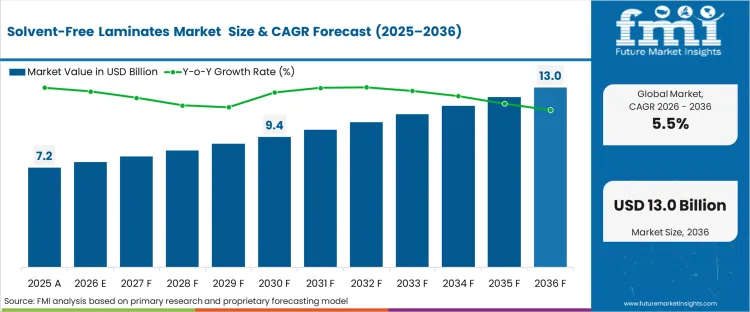
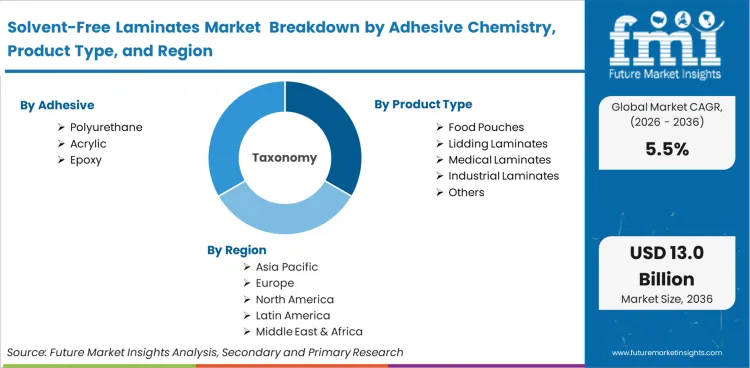
The solvent-free laminates market was valued at USD 7.2 billion in 2025. The market is projected to reach USD 7.6 billion in 2026 and USD 13.0 billion by 2036, expanding at a CAGR of 5.5% during the forecast period. The Polyurethane segment leads adhesive chemistry with a 58.1% share in 2026. The Food Pouches segment is projected to remain the leading product type segment with a 34.9% share in 2026. The Food & Beverage segment is expected to lead end-use demand with a 49.6% share in 2026.
Key Drivers
- Drying-step elimination: Solvent-free lamination avoids energy-intensive solvent drying and appeals to converters managing cost and emissions.
- Food-safety scrutiny: Low-migration and food-contact requirements are supporting better-engineered solventless adhesive systems.
- Flexible-pack scale: Large laminate volumes in food and healthcare keep the addressable base for solventless conversion substantial.
Key Segments Analyzed in the Report
- adhesive chemistry: polyurethane, acrylic, epoxy, and others
- product type: food pouches, lidding laminates, medical laminates, industrial laminates, and others
- end use industry: food & beverage, healthcare, personal care, industrial, and others
- region: north america, latin america, europe, asia pacific, and middle east & africa
Analyst Opinion
- Ismail Sutaria, Senior Consultant at Future Market Insights says, "Solvent-free laminates are increasingly judged through factory economics as much as sustainability. The format gains where converters can remove drying energy, hold bond performance, and meet food-safety expectations without sacrificing line speed. That makes process reliability the real competitive moat."
Solvent-Free Laminates Market Definition
The solvent-free laminates market comprises laminate structures produced with solventless adhesive systems for flexible packaging and selected industrial applications. It includes polyurethane, acrylic, epoxy, and related solvent-free chemistries used in food pouches, lidding, medical laminates, and industrial laminates. These structures are adopted where converters want to lower emissions, reduce drying energy, improve plant safety, and maintain high bond performance across packaging formats that still require laminated construction.
Solvent-Free Laminates Market Inclusions
- Laminated packaging and industrial structures produced with solvent-free adhesive systems.
- Revenue from food, healthcare, personal care, and industrial laminate applications.
- Demand across North America, Latin America, Europe, Asia Pacific, and the Middle East & Africa.
Solvent-Free Laminates Market Exclusions
- Solvent-based laminates except as a performance benchmark.
- Finished consumer products sold in laminated packaging.
- Unlaminated mono-web films and coatings without a laminate conversion step.
Solvent-Free Laminates Market Research Methodology
This study evaluates the solvent-free laminates market across adhesive chemistry, product type, end use industry, and region, using 2025 as the base year and 2026 to 2036 as the forecast period. Market value is expressed in USD billion. Evidence inputs include food-contact and packaging regulations, first-party adhesive launches, laminator company materials, converter process documentation, and flexible-packaging technical sources. Triangulation combines end-use demand, pack conversion intensity, barrier-function value density, material substitution rates, and supplier positioning to derive the segment and regional estimates.
Key Drivers, Restraints, and Trends in Solvent-Free Laminates Market
Drivers
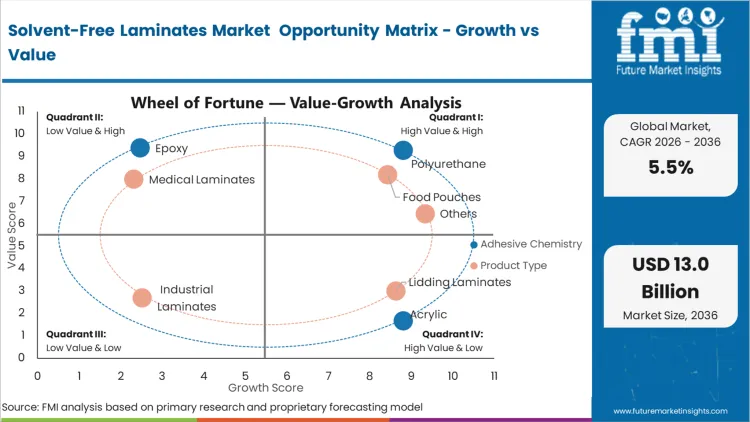
Solvent-free laminates gain demand because converters are under pressure to improve both plant efficiency and packaging compliance. Solventless systems remove the drying stage required by solvent-based lamination, which cuts energy demand and simplifies emissions management. That becomes commercially important in food and medical packaging, where laminate volumes are large and line economics are tightly watched. At the same time, improved solvent-free adhesive formulations are allowing converters to address more demanding applications, including retort and high thermal stress uses. The result is a market that grows on process economics as much as on environmental positioning.
Restraints
Processing discipline remains critical. Solvent-free systems can be less forgiving in mixing, coat-weight control, and curing management. Some high-performance applications still rely on solvent-based systems because converters trust their established process window. Equipment suitability can also restrict adoption in smaller plants. Qualification is especially strict in food and medical packaging, where bond integrity, migration risk, and sterilisation performance matter. Raw-material cost swings add another layer of pressure for converters operating on thin margins.
Trends
The market is trending toward higher-performance solventless systems rather than simple replacement of low-spec solvent-based lamination. Adhesive suppliers are targeting retort, high thermal stress, and safer food-contact applications, which lifts the value profile of the category. Equipment makers are also pushing solventless laminators with better productivity and digital monitoring. The commercial emphasis is shifting from compliance alone to a broader productivity argument that combines energy, plant safety, and throughput.
Segmental Analysis
Solvent-Free Laminates Analysis by Adhesive Chemistry
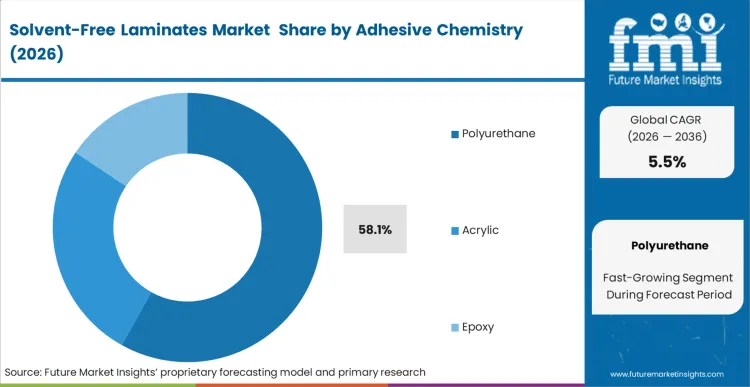
The Polyurethane segment is expected to lead the adhesive chemistry segment with a 58.1% share in 2026. Polyurethane leads because it offers the broadest balance of bond strength, flexibility, and application range in solventless flexible packaging. It remains the reference chemistry for converters trying to scale solvent-free lamination beyond basic structures. Henkel's 2025 solvent-free adhesive launch for high thermal stress packaging illustrates how polyurethane-based solventless systems are being pushed into more demanding retort-oriented applications.
Solvent-Free Laminates Analysis by Product Type
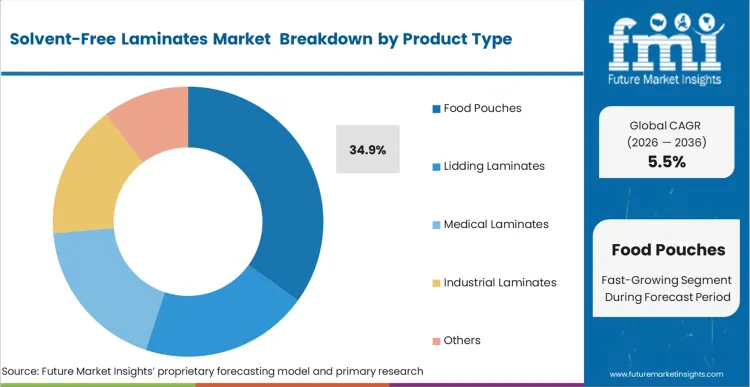
The Food Pouches segment is expected to lead the product type segment with a 34.9% share in 2026. Food pouches dominate because they account for a very large share of laminated packaging demand and because even small improvements in lamination efficiency matter at their production scale. Pouches also face intense scrutiny on food safety, migration, and total cost. Bostik's flexible packaging adhesive portfolio and Henkel's Liofol developments reinforce why food laminates remain the anchor market for solvent-free systems.
Competitive Aligners for Market Players
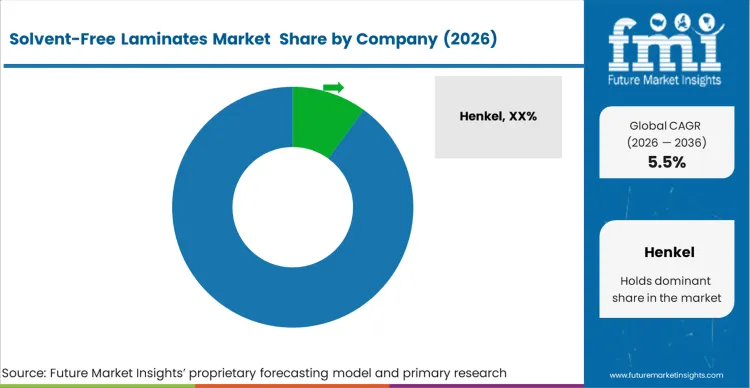
Competition in solvent-free laminates can be understood through a tiered structure rather than through individual company mentions.Tier 1 players compete across the full conversion chain. Their advantage does not come from adhesive chemistry alone, but from the ability to combine bond performance, food-contact confidence, thermal resistance, and line productivity into one integrated value proposition. These suppliers tend to operate with strong formulation capability, application support, and close alignment with converter requirements. At the premium end of the market, this is where leadership is formed.
Tier 2 players are typically strong in one part of the value chain but less comprehensive in execution. Some compete through adhesive-system capability, while others are stronger in converting support or process know-how. They remain relevant where customers prioritize specific technical outcomes, but they are less able to shape the full commercial specification across performance, compliance, and productivity at the same time.
Tier 3 players usually compete on narrower application scope, regional reach, or price. Their presence is strongest in less demanding laminating requirements where premium performance is not the main buying criterion. However, in high-specification packaging applications, pure price competition becomes less effective because buyers place greater importance on bond integrity, food-safety fit, and operational reliability.
Key Players in Solvent-Free Laminates Market
- Henkel
- Bostik
- Coim Group
- H.B. Fuller
- Arkema
- BOBST
- Nordmeccanica
- Uflex
- DIC Corporation
- Flint Group
Strategic Outlook by FMI on Solvent-Free Laminates Market
FMI expects solvent-free laminates to deepen their role in flexible packaging because they address energy, compliance, and process-efficiency concerns at the same time. Growth will be strongest where solventless systems prove they can handle more demanding food and medical structures without narrowing converter productivity. The market will reward players that pair chemistry performance with equipment know-how and application support.
Scope of the Report
| Metric | Value |
|---|---|
| Market Value | USD 7.2 billion in 2025 to USD 13.0 billion by 2036 |
| CAGR | 5.5% from 2026 to 2036 |
| Base Year | 2025 |
| Forecast Period | 2026 to 2036 |
| Adhesive Chemistry Segmentation | Polyurethane, Acrylic, Epoxy, Others |
| Product Type Segmentation | Food Pouches, Lidding Laminates, Medical Laminates, Industrial Laminates, Others |
| End Use Industry Segmentation | Food & Beverage, Healthcare, Personal Care, Industrial, Others |
| Regions Covered | North America, Latin America, Europe, Asia Pacific, Middle East & Africa |
Bibliography
- European Parliament and Council. 2025. Regulation (EU) 2025/40 on packaging and packaging waste.
- Henkel. 2025. Henkel launches solvent-free adhesive system for safe and sustainable high-performance packaging.
- Bostik. 2026. Laminate adhesive, flexible packaging adhesive.
- BOBST. 2026. Laminating process.
- BOBST. 2026. NOVALAM MW, solventless laminator overview.
- BOBST. 2026. Laminating machines.
Frequently Asked Questions
What is the projected size of the Solvent-Free Laminates market by 2036? The
solvent-free laminates market is projected to reach USD 13.0 billion by 2036.
What is the CAGR of the Solvent-Free Laminates market from 2026 to 2036? The
solvent-free laminates market is projected to expand at a CAGR of 5.5% from 2026 to 2036.
Which adhesive chemistry segment leads the Solvent-Free Laminates market? The
Polyurethane segment leads the solvent-free laminates market with a 58.1% share in 2026.
Which product type segment dominates the Solvent-Free Laminates market? The
Food Pouches segment holds the leading position in the solvent-free laminates market with a 34.9% share in 2026.
Which end use industry leads the Solvent-Free Laminates market? The Food &
Beverage segment is expected to account for the largest share of the solvent-free laminates market at 49.6% in 2026.
Who are the key companies in the Solvent-Free Laminates market? Key companies
active in the solvent-free laminates market include Henkel, Bostik, Coim Group, H.B. Fuller, Arkema, and other packaging-material and converter specialists.
What is driving demand in the Solvent-Free Laminates market?
Demand in the solvent-free laminates market is being driven by packaging redesign toward better recyclability, stronger barrier performance, and improved line economics.
Preview the report firsthand - request a free sample
Get SampleGet the brochure for pricing and purchase details.
Get PDFTable of Content
- Executive Summary
- Global Market Outlook
- Demand-side Trends
- Supply-side Trends
- Technology Roadmap Analysis
- Analysis and Recommendations
- Market Overview
- Market Coverage / Taxonomy
- Market Definition / Scope / Limitations
- Research Methodology
- Chapter Orientation
- Analytical Lens and Working Hypotheses
- Market Structure, Signals, and Trend Drivers
- Benchmarking and Cross-market Comparability
- Market Sizing, Forecasting, and Opportunity Mapping
- Research Design and Evidence Framework
- Desk Research Programme (Secondary Evidence)
- Company Annual and Sustainability Reports
- Peer-reviewed Journals and Academic Literature
- Corporate Websites, Product Literature, and Technical Notes
- Earnings Decks and Investor Briefings
- Statutory Filings and Regulatory Disclosures
- Technical White Papers and Standards Notes
- Trade Journals, Industry Magazines, and Analyst Briefs
- Conference Proceedings, Webinars, and Seminar Materials
- Government Statistics Portals and Public Data Releases
- Press Releases and Reputable Media Coverage
- Specialist Newsletters and Curated Briefings
- Sector Databases and Reference Repositories
- FMI Internal Proprietary Databases and Historical Market Datasets
- Subscription Datasets and Paid Sources
- Social Channels, Communities, and Digital Listening Inputs
- Additional Desk Sources
- Expert Input and Fieldwork (Primary Evidence)
- Primary Modes
- Qualitative Interviews and Expert Elicitation
- Quantitative Surveys and Structured Data Capture
- Blended Approach
- Why Primary Evidence is Used
- Field Techniques
- Interviews
- Surveys
- Focus Groups
- Observational and In-context Research
- Social and Community Interactions
- Stakeholder Universe Engaged
- C-suite Leaders
- Board Members
- Presidents and Vice Presidents
- R&D and Innovation Heads
- Technical Specialists
- Domain Subject-matter Experts
- Scientists
- Physicians and Other Healthcare Professionals
- Governance, Ethics, and Data Stewardship
- Research Ethics
- Data Integrity and Handling
- Primary Modes
- Tooling, Models, and Reference Databases
- Desk Research Programme (Secondary Evidence)
- Data Engineering and Model Build
- Data Acquisition and Ingestion
- Cleaning, Normalisation, and Verification
- Synthesis, Triangulation, and Analysis
- Quality Assurance and Audit Trail
- Market Background
- Market Dynamics
- Drivers
- Restraints
- Opportunity
- Trends
- Scenario Forecast
- Demand in Optimistic Scenario
- Demand in Likely Scenario
- Demand in Conservative Scenario
- Opportunity Map Analysis
- Product Life Cycle Analysis
- Supply Chain Analysis
- Investment Feasibility Matrix
- Value Chain Analysis
- PESTLE and Porter’s Analysis
- Regulatory Landscape
- Regional Parent Market Outlook
- Production and Consumption Statistics
- Import and Export Statistics
- Market Dynamics
- Global Market Analysis 2021 to 2025 and Forecast, 2026 to 2036
- Historical Market Size Value (USD Million) Analysis, 2021 to 2025
- Current and Future Market Size Value (USD Million) Projections, 2026 to 2036
- Y-o-Y Growth Trend Analysis
- Absolute $ Opportunity Analysis
- Global Market Pricing Analysis 2021 to 2025 and Forecast 2026 to 2036
- Global Market Analysis 2021 to 2025 and Forecast 2026 to 2036, By Adhesive Chemistry
- Introduction / Key Findings
- Historical Market Size Value (USD Million) Analysis By Adhesive Chemistry , 2021 to 2025
- Current and Future Market Size Value (USD Million) Analysis and Forecast By Adhesive Chemistry , 2026 to 2036
- Polyurethane
- Acrylic
- Epoxy
- Polyurethane
- Y-o-Y Growth Trend Analysis By Adhesive Chemistry , 2021 to 2025
- Absolute $ Opportunity Analysis By Adhesive Chemistry , 2026 to 2036
- Global Market Analysis 2021 to 2025 and Forecast 2026 to 2036, By Product Type
- Introduction / Key Findings
- Historical Market Size Value (USD Million) Analysis By Product Type, 2021 to 2025
- Current and Future Market Size Value (USD Million) Analysis and Forecast By Product Type, 2026 to 2036
- Food Pouches
- Lidding Laminates
- Medical Laminates
- Industrial Laminates
- Others
- Food Pouches
- Y-o-Y Growth Trend Analysis By Product Type, 2021 to 2025
- Absolute $ Opportunity Analysis By Product Type, 2026 to 2036
- Global Market Analysis 2021 to 2025 and Forecast 2026 to 2036, By Region
- Introduction
- Historical Market Size Value (USD Million) Analysis By Region, 2021 to 2025
- Current Market Size Value (USD Million) Analysis and Forecast By Region, 2026 to 2036
- North America
- Latin America
- Western Europe
- Eastern Europe
- East Asia
- South Asia and Pacific
- Middle East & Africa
- Market Attractiveness Analysis By Region
- North America Market Analysis 2021 to 2025 and Forecast 2026 to 2036, By Country
- Historical Market Size Value (USD Million) Trend Analysis By Market Taxonomy, 2021 to 2025
- Market Size Value (USD Million) Forecast By Market Taxonomy, 2026 to 2036
- By Country
- USA
- Canada
- Mexico
- By Adhesive Chemistry
- By Product Type
- By Country
- Market Attractiveness Analysis
- By Country
- By Adhesive Chemistry
- By Product Type
- Key Takeaways
- Latin America Market Analysis 2021 to 2025 and Forecast 2026 to 2036, By Country
- Historical Market Size Value (USD Million) Trend Analysis By Market Taxonomy, 2021 to 2025
- Market Size Value (USD Million) Forecast By Market Taxonomy, 2026 to 2036
- By Country
- Brazil
- Chile
- Rest of Latin America
- By Adhesive Chemistry
- By Product Type
- By Country
- Market Attractiveness Analysis
- By Country
- By Adhesive Chemistry
- By Product Type
- Key Takeaways
- Western Europe Market Analysis 2021 to 2025 and Forecast 2026 to 2036, By Country
- Historical Market Size Value (USD Million) Trend Analysis By Market Taxonomy, 2021 to 2025
- Market Size Value (USD Million) Forecast By Market Taxonomy, 2026 to 2036
- By Country
- Germany
- UK
- Italy
- Spain
- France
- Nordic
- BENELUX
- Rest of Western Europe
- By Adhesive Chemistry
- By Product Type
- By Country
- Market Attractiveness Analysis
- By Country
- By Adhesive Chemistry
- By Product Type
- Key Takeaways
- Eastern Europe Market Analysis 2021 to 2025 and Forecast 2026 to 2036, By Country
- Historical Market Size Value (USD Million) Trend Analysis By Market Taxonomy, 2021 to 2025
- Market Size Value (USD Million) Forecast By Market Taxonomy, 2026 to 2036
- By Country
- Russia
- Poland
- Hungary
- Balkan & Baltic
- Rest of Eastern Europe
- By Adhesive Chemistry
- By Product Type
- By Country
- Market Attractiveness Analysis
- By Country
- By Adhesive Chemistry
- By Product Type
- Key Takeaways
- East Asia Market Analysis 2021 to 2025 and Forecast 2026 to 2036, By Country
- Historical Market Size Value (USD Million) Trend Analysis By Market Taxonomy, 2021 to 2025
- Market Size Value (USD Million) Forecast By Market Taxonomy, 2026 to 2036
- By Country
- China
- Japan
- South Korea
- By Adhesive Chemistry
- By Product Type
- By Country
- Market Attractiveness Analysis
- By Country
- By Adhesive Chemistry
- By Product Type
- Key Takeaways
- South Asia and Pacific Market Analysis 2021 to 2025 and Forecast 2026 to 2036, By Country
- Historical Market Size Value (USD Million) Trend Analysis By Market Taxonomy, 2021 to 2025
- Market Size Value (USD Million) Forecast By Market Taxonomy, 2026 to 2036
- By Country
- India
- ASEAN
- Australia & New Zealand
- Rest of South Asia and Pacific
- By Adhesive Chemistry
- By Product Type
- By Country
- Market Attractiveness Analysis
- By Country
- By Adhesive Chemistry
- By Product Type
- Key Takeaways
- Middle East & Africa Market Analysis 2021 to 2025 and Forecast 2026 to 2036, By Country
- Historical Market Size Value (USD Million) Trend Analysis By Market Taxonomy, 2021 to 2025
- Market Size Value (USD Million) Forecast By Market Taxonomy, 2026 to 2036
- By Country
- Kingdom of Saudi Arabia
- Other GCC Countries
- Turkiye
- South Africa
- Other African Union
- Rest of Middle East & Africa
- By Adhesive Chemistry
- By Product Type
- By Country
- Market Attractiveness Analysis
- By Country
- By Adhesive Chemistry
- By Product Type
- Key Takeaways
- Key Countries Market Analysis
- USA
- Pricing Analysis
- Market Share Analysis, 2025
- By Adhesive Chemistry
- By Product Type
- Canada
- Pricing Analysis
- Market Share Analysis, 2025
- By Adhesive Chemistry
- By Product Type
- Mexico
- Pricing Analysis
- Market Share Analysis, 2025
- By Adhesive Chemistry
- By Product Type
- Brazil
- Pricing Analysis
- Market Share Analysis, 2025
- By Adhesive Chemistry
- By Product Type
- Chile
- Pricing Analysis
- Market Share Analysis, 2025
- By Adhesive Chemistry
- By Product Type
- Germany
- Pricing Analysis
- Market Share Analysis, 2025
- By Adhesive Chemistry
- By Product Type
- UK
- Pricing Analysis
- Market Share Analysis, 2025
- By Adhesive Chemistry
- By Product Type
- Italy
- Pricing Analysis
- Market Share Analysis, 2025
- By Adhesive Chemistry
- By Product Type
- Spain
- Pricing Analysis
- Market Share Analysis, 2025
- By Adhesive Chemistry
- By Product Type
- France
- Pricing Analysis
- Market Share Analysis, 2025
- By Adhesive Chemistry
- By Product Type
- India
- Pricing Analysis
- Market Share Analysis, 2025
- By Adhesive Chemistry
- By Product Type
- ASEAN
- Pricing Analysis
- Market Share Analysis, 2025
- By Adhesive Chemistry
- By Product Type
- Australia & New Zealand
- Pricing Analysis
- Market Share Analysis, 2025
- By Adhesive Chemistry
- By Product Type
- China
- Pricing Analysis
- Market Share Analysis, 2025
- By Adhesive Chemistry
- By Product Type
- Japan
- Pricing Analysis
- Market Share Analysis, 2025
- By Adhesive Chemistry
- By Product Type
- South Korea
- Pricing Analysis
- Market Share Analysis, 2025
- By Adhesive Chemistry
- By Product Type
- Russia
- Pricing Analysis
- Market Share Analysis, 2025
- By Adhesive Chemistry
- By Product Type
- Poland
- Pricing Analysis
- Market Share Analysis, 2025
- By Adhesive Chemistry
- By Product Type
- Hungary
- Pricing Analysis
- Market Share Analysis, 2025
- By Adhesive Chemistry
- By Product Type
- Kingdom of Saudi Arabia
- Pricing Analysis
- Market Share Analysis, 2025
- By Adhesive Chemistry
- By Product Type
- Turkiye
- Pricing Analysis
- Market Share Analysis, 2025
- By Adhesive Chemistry
- By Product Type
- South Africa
- Pricing Analysis
- Market Share Analysis, 2025
- By Adhesive Chemistry
- By Product Type
- USA
- Market Structure Analysis
- Competition Dashboard
- Competition Benchmarking
- Market Share Analysis of Top Players
- By Regional
- By Adhesive Chemistry
- By Product Type
- Competition Analysis
- Competition Deep Dive
- Henkel
- Overview
- Product Portfolio
- Profitability by Market Segments (Product/Age /Sales Channel/Region)
- Sales Footprint
- Strategy Overview
- Marketing Strategy
- Product Strategy
- Channel Strategy
- Bostik
- Coim Group
- H.B. Fuller
- Arkema
- BOBST
- Nordmeccanica
- Uflex
- DIC Corporation
- Flint Group
- Henkel
- Competition Deep Dive
- Assumptions & Acronyms Used


