

- Industry Size (2026)
- USD 2.8 Bn
- Forecast (2036)
- USD 5.8 Bn
- CAGR (2026 to 2036)
- 7.5%
Mono-PE Laminates Market Size, Market Forecast and Outlook By FMI
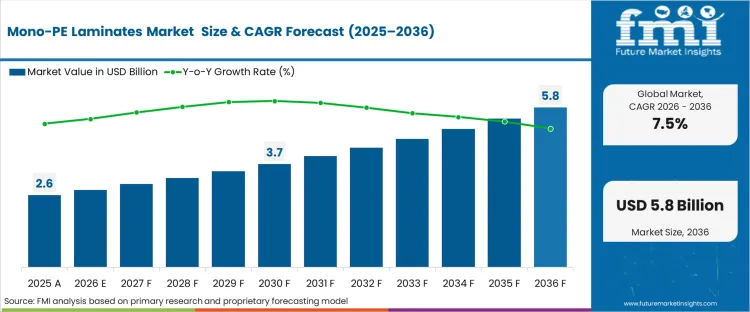
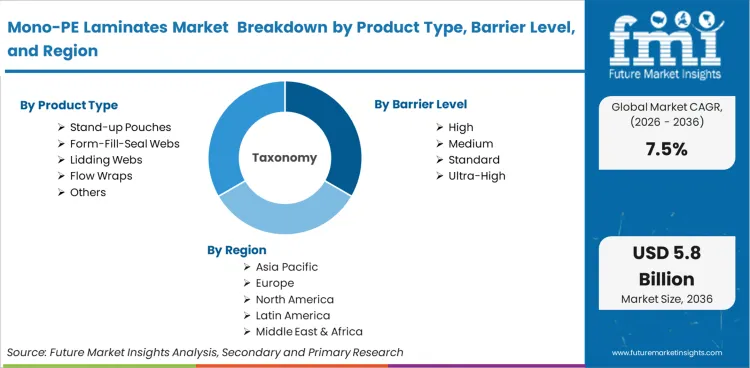
The mono-pe laminates market was valued at USD 2.6 billion in 2025. The market is projected to reach USD 2.8 billion in 2026 and USD 5.8 billion by 2036, expanding at a CAGR of 7.5% during the forecast period. The Stand-up Pouches segment leads product type with a 34.1% share in 2026. The High segment is projected to remain the leading barrier level segment with a 37.2% share in 2026. The Food & Beverage segment is expected to lead end-use demand with a 55.6% share in 2026.
Key Drivers
- PE-stream alignment: Design for recycling guidelines continue to favour structures that remain substantially within the polyethylene family.
- Pouch redesign cycle: A large share of innovation work in flexible packaging is focused on replacing mixed-material pouches with mono-PE alternatives.
- Converter confidence: Commercial case studies are showing that mono-PE can now address more categories without a major loss in pack performance.
Key Segments Analyzed in the Report
- Product Type: Stand-up Pouches, Form-fill-seal Webs, Lidding Webs, Flow Wraps, and Others
- Barrier Level: Standard, Medium, High, and Ultra-high
- End Use Industry: Food & Beverage, Home Care, Healthcare, Pet Food, and Others
- Region: North America, Latin America, Europe, Asia Pacific, and Middle East & Africa
Analyst Opinion
- Ismail Sutaria, Senior Consultant at Future Market Insights says, "Mono-PE laminates are judged on whether they can preserve barrier and seal performance while entering the PE recovery stream with fewer compromises. That puts the premium on film architecture, not on polyethylene content alone."
Mono-PE Laminates Market Definition
The mono-PE laminates market covers flexible packaging laminates built primarily within the polyethylene family for improved recyclability in PE film streams. It includes stand-up pouch webs, flow-wrap laminates, lidding webs, form-fill-seal structures, and related mono-PE packaging solutions with standard to high barrier performance. These laminates are used across food, home care, healthcare, and pet-food packaging where brand owners want to replace mixed-material flexible packs with PE-centred structures that maintain sealing, stiffness, optics, and shelf-life protection.
Mono-PE Laminates Market Inclusions
- Mono-PE laminate structures sold for pouches, lidding, flow wraps, and form-fill-seal packaging.
- Revenue from high-PE flexible packaging applications across food, home care, healthcare, and related sectors.
- Demand across North America, Latin America, Europe, Asia Pacific, and the Middle East & Africa.
Mono-PE Laminates Market Exclusions
- Mixed-material laminates where polyethylene is not the dominant material family.
- Finished consumer products packed in mono-PE laminates.
- Commodity PE films used without laminate functionality or barrier intent.
Mono-PE Laminates Market Research Methodology
This study evaluates the mono-pe laminates market across product type, barrier level, end use industry, and region, using 2025 as the base year and 2026 to 2036 as the forecast period. Market value is expressed in USD billion. Evidence inputs include APR and RecyClass guidelines, first-party packaging launches, technical laminate pages, CEFLEX circularity work, and company case studies on mono-PE performance. Triangulation combines end-use demand, pack conversion intensity, barrier-function value density, material substitution rates, and supplier positioning to derive the segment and regional estimates.
Key Drivers, Restraints, and Trends in Mono-PE Laminates Market
Drivers
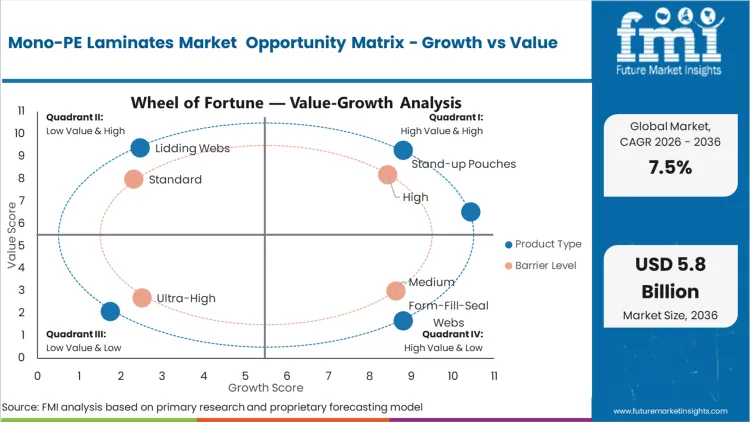
Mono-PE laminates are expanding because flexible packaging redesign has moved from concept work into commercial conversion. Brand owners, retailers, and recyclability frameworks are pushing converters toward structures that can fit the polyethylene stream more cleanly than conventional mixed laminates. This creates a wide opportunity in snack packs, dairy, pet food, household products, and selected medical formats. PE remains attractive because it brings seal integrity, process familiarity, and availability at scale. As barrier inserts, orientation, and sealant technology improve, mono-PE laminates can move into applications that were once treated as out of reach for recycle-ready formats.
Restraints
Performance trade-offs still set the market boundary. Some applications need higher stiffness, clarity, or oxygen barrier than mono-PE can deliver economically. Recyclability claims also depend on the full structure, not only the base film. Zippers, inks, barrier layers, and adhesives can weaken stream compatibility. Qualification cycles remain long in regulated or shelf-life-sensitive uses. Cost pressure persists when converters compare mono-PE formats with entrenched legacy laminates that have already been optimized for speed and yield.
Trends
The most visible trend is the shift from pilot launches to repeatable category expansion. Mono-PE is moving beyond dry foods and into dairy, household goods, thermoforming webs, and selected healthcare applications. Suppliers are also pushing higher recycled content into mono-PE structures where performance allows. The market narrative is becoming more precise, with players using APR, RecyClass, and third-party recyclability approvals as commercial proof points. That is raising the credibility threshold for everyone in the space.
Segmental Analysis
Mono-PE Laminates Analysis by Product Type
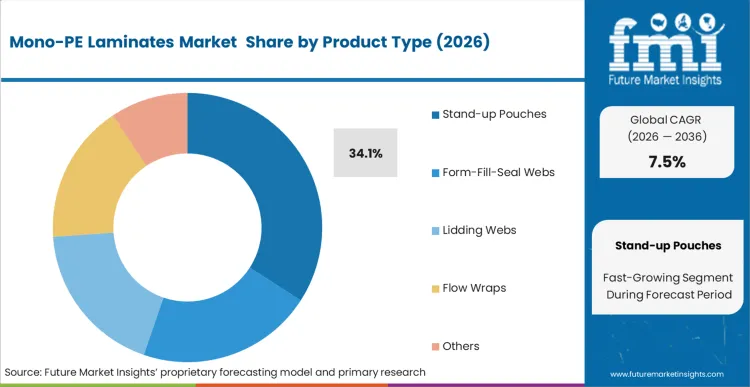
The Stand-up Pouches segment is expected to lead the product type segment with a 34.1% share in 2026. Stand-up pouches lead because they are the most visible target for laminate redesign and one of the largest consumers of complex multi-material flexible packaging. Replacing these packs with mono-PE delivers a clear circularity story without requiring the category to abandon lightweight flexible formats. Amcor's recycle-ready laminate developments and healthcare mono-PE initiatives show how stand-up and pouch-style architectures remain the primary commercial test bed for mono-PE innovation.
Mono-PE Laminates Analysis by Barrier Level
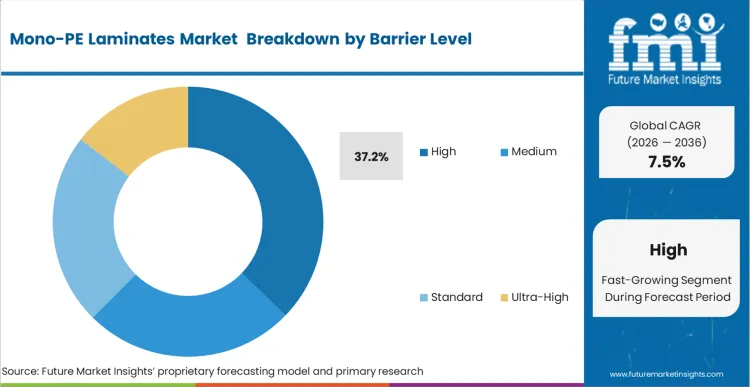
The High segment is expected to lead the barrier level segment with a 37.2% share in 2026. High-barrier laminates hold the largest barrier-level share because the market is being driven by replacement of more complex incumbent packs, not by low-spec commodity film demand. Customers are paying for mono-PE mainly when it solves a difficult redesign problem. ExxonMobil's high-PE barrier-packaging case study supports the view that the market's value lies in performance-intensive mono-PE structures, not basic single-web polyethylene film.
Competitive Aligners for Market Players
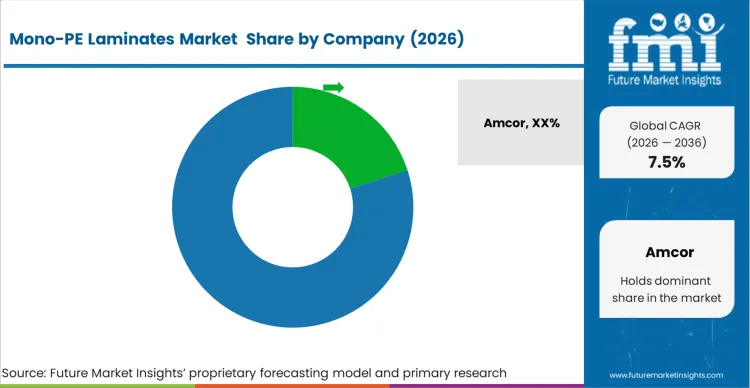
Competitive intensity in mono-PE laminates is separating along three axes: structure design capability, qualification support, and end-market execution. Players with strength across all three are moving into the top tier of the market.
The first group consists of companies that can translate mono-material claims into commercial performance. Their advantage lies not in PE content alone, but in the ability to deliver seal integrity, puncture resistance, machinability, and recyclability fit within one structure. This is where the market’s premium is forming.
A second group competes through material and technology enablement. These firms play an important role in helping converters redesign laminate architecture, improve processing performance, and de-risk transition. Their influence is significant, but it is strongest when paired with converter or brand-owner execution.
A third group remains active at the application level, serving specific formats or regional markets. Their position depends less on platform leadership and more on customer intimacy, speed, and niche qualification support.
Key Players in Mono-PE Laminates Market
- Amcor
- Constantia Flexibles
- Mondi Group
- Dow
- ExxonMobil
- Berry Global
- Coveris
- Sealed Air
- Borealis
- Jindal Films
Strategic Outlook by FMI on Mono-PE Laminates Market
FMI expects mono-PE laminates to remain one of the most active redesign spaces in flexible packaging through 2036. The market will be shaped by how far suppliers can push barrier, stiffness, and downgauging while preserving PE-stream compatibility. The strongest performers will be converters and material suppliers that bring proof-backed, application-specific mono-PE structures to large-volume categories.
Scope of the Report
| Metric | Value |
|---|---|
| Market Value | USD 2.6 billion in 2025 to USD 5.8 billion by 2036 |
| CAGR | 7.5% from 2026 to 2036 |
| Base Year | 2025 |
| Forecast Period | 2026 to 2036 |
| Product Type Segmentation | Stand-up Pouches, Form-Fill-Seal Webs, Lidding Webs, Flow Wraps, Others |
| Barrier Level Segmentation | Standard, Medium, High, Ultra-high |
| End Use Industry Segmentation | Food & Beverage, Home Care, Healthcare, Pet Food, Others |
| Regions Covered | North America, Latin America, Europe, Asia Pacific, Middle East & Africa |
Bibliography
- CEFLEX. 2022. CEFLEX Quality Recycling Process.
- Amcor. 2026. Amcor enables commercialization of recycle-ready packaging for largest dairy cooperative in Canada.
- Amcor. Amcor HealthCare Recycle-Ready Medical Laminates.
- ExxonMobil. Case study: 95% PE-based barrier packaging with improved recyclability potential and uncompromising package functionality.
Frequently Asked Questions
What is the projected size of the Mono-PE Laminates market by 2036? The
mono-pe laminates market is projected to reach USD 5.8 billion by 2036.
What is the CAGR of the Mono-PE Laminates market from 2026 to 2036? The
mono-pe laminates market is projected to expand at a CAGR of 7.5% from 2026 to 2036.
Which product type segment leads the Mono-PE Laminates market? The
Stand-up Pouches segment leads the mono-pe laminates market with a 34.1% share in 2026.
Which barrier level segment dominates the Mono-PE Laminates market? The
High segment holds the leading position in the mono-pe laminates market with a 37.2% share in 2026.
Which end use industry leads the Mono-PE Laminates market? The Food &
Beverage segment is expected to account for the largest share of the mono-pe laminates market at 55.6% in 2026.
Who are the key companies in the Mono-PE Laminates market? Key
companies active in the mono-pe laminates market include Amcor, Constantia Flexibles, Mondi Group, Dow, ExxonMobil, and other packaging-material and converter specialists.
What is driving demand in the Mono-PE Laminates market? Demand in the
mono-pe laminates market is being driven by packaging redesign toward better recyclability, stronger barrier performance, and improved line economics.
Preview the report firsthand - request a free sample
Get SampleGet the brochure for pricing and purchase details.
Get PDFTable of Content
- Executive Summary
- Global Market Outlook
- Demand-side Trends
- Supply-side Trends
- Technology Roadmap Analysis
- Analysis and Recommendations
- Market Overview
- Market Coverage / Taxonomy
- Market Definition / Scope / Limitations
- Research Methodology
- Chapter Orientation
- Analytical Lens and Working Hypotheses
- Market Structure, Signals, and Trend Drivers
- Benchmarking and Cross-market Comparability
- Market Sizing, Forecasting, and Opportunity Mapping
- Research Design and Evidence Framework
- Desk Research Programme (Secondary Evidence)
- Company Annual and Sustainability Reports
- Peer-reviewed Journals and Academic Literature
- Corporate Websites, Product Literature, and Technical Notes
- Earnings Decks and Investor Briefings
- Statutory Filings and Regulatory Disclosures
- Technical White Papers and Standards Notes
- Trade Journals, Industry Magazines, and Analyst Briefs
- Conference Proceedings, Webinars, and Seminar Materials
- Government Statistics Portals and Public Data Releases
- Press Releases and Reputable Media Coverage
- Specialist Newsletters and Curated Briefings
- Sector Databases and Reference Repositories
- FMI Internal Proprietary Databases and Historical Market Datasets
- Subscription Datasets and Paid Sources
- Social Channels, Communities, and Digital Listening Inputs
- Additional Desk Sources
- Expert Input and Fieldwork (Primary Evidence)
- Primary Modes
- Qualitative Interviews and Expert Elicitation
- Quantitative Surveys and Structured Data Capture
- Blended Approach
- Why Primary Evidence is Used
- Field Techniques
- Interviews
- Surveys
- Focus Groups
- Observational and In-context Research
- Social and Community Interactions
- Stakeholder Universe Engaged
- C-suite Leaders
- Board Members
- Presidents and Vice Presidents
- R&D and Innovation Heads
- Technical Specialists
- Domain Subject-matter Experts
- Scientists
- Physicians and Other Healthcare Professionals
- Governance, Ethics, and Data Stewardship
- Research Ethics
- Data Integrity and Handling
- Primary Modes
- Tooling, Models, and Reference Databases
- Desk Research Programme (Secondary Evidence)
- Data Engineering and Model Build
- Data Acquisition and Ingestion
- Cleaning, Normalisation, and Verification
- Synthesis, Triangulation, and Analysis
- Quality Assurance and Audit Trail
- Market Background
- Market Dynamics
- Drivers
- Restraints
- Opportunity
- Trends
- Scenario Forecast
- Demand in Optimistic Scenario
- Demand in Likely Scenario
- Demand in Conservative Scenario
- Opportunity Map Analysis
- Product Life Cycle Analysis
- Supply Chain Analysis
- Investment Feasibility Matrix
- Value Chain Analysis
- PESTLE and Porter’s Analysis
- Regulatory Landscape
- Regional Parent Market Outlook
- Production and Consumption Statistics
- Import and Export Statistics
- Market Dynamics
- Global Market Analysis 2021 to 2025 and Forecast, 2026 to 2036
- Historical Market Size Value (USD Million) Analysis, 2021 to 2025
- Current and Future Market Size Value (USD Million) Projections, 2026 to 2036
- Y-o-Y Growth Trend Analysis
- Absolute $ Opportunity Analysis
- Global Market Pricing Analysis 2021 to 2025 and Forecast 2026 to 2036
- Global Market Analysis 2021 to 2025 and Forecast 2026 to 2036, By Product Type
- Introduction / Key Findings
- Historical Market Size Value (USD Million) Analysis By Product Type , 2021 to 2025
- Current and Future Market Size Value (USD Million) Analysis and Forecast By Product Type , 2026 to 2036
- Stand-up Pouches
- Form-Fill-Seal Webs
- Lidding Webs
- Flow Wraps
- Others
- Stand-up Pouches
- Y-o-Y Growth Trend Analysis By Product Type , 2021 to 2025
- Absolute $ Opportunity Analysis By Product Type , 2026 to 2036
- Global Market Analysis 2021 to 2025 and Forecast 2026 to 2036, By Barrier Level
- Introduction / Key Findings
- Historical Market Size Value (USD Million) Analysis By Barrier Level, 2021 to 2025
- Current and Future Market Size Value (USD Million) Analysis and Forecast By Barrier Level, 2026 to 2036
- High
- Medium
- Standard
- Ultra-High
- High
- Y-o-Y Growth Trend Analysis By Barrier Level, 2021 to 2025
- Absolute $ Opportunity Analysis By Barrier Level, 2026 to 2036
- Global Market Analysis 2021 to 2025 and Forecast 2026 to 2036, By Region
- Introduction
- Historical Market Size Value (USD Million) Analysis By Region, 2021 to 2025
- Current Market Size Value (USD Million) Analysis and Forecast By Region, 2026 to 2036
- North America
- Latin America
- Western Europe
- Eastern Europe
- East Asia
- South Asia and Pacific
- Middle East & Africa
- Market Attractiveness Analysis By Region
- North America Market Analysis 2021 to 2025 and Forecast 2026 to 2036, By Country
- Historical Market Size Value (USD Million) Trend Analysis By Market Taxonomy, 2021 to 2025
- Market Size Value (USD Million) Forecast By Market Taxonomy, 2026 to 2036
- By Country
- USA
- Canada
- Mexico
- By Product Type
- By Barrier Level
- By Country
- Market Attractiveness Analysis
- By Country
- By Product Type
- By Barrier Level
- Key Takeaways
- Latin America Market Analysis 2021 to 2025 and Forecast 2026 to 2036, By Country
- Historical Market Size Value (USD Million) Trend Analysis By Market Taxonomy, 2021 to 2025
- Market Size Value (USD Million) Forecast By Market Taxonomy, 2026 to 2036
- By Country
- Brazil
- Chile
- Rest of Latin America
- By Product Type
- By Barrier Level
- By Country
- Market Attractiveness Analysis
- By Country
- By Product Type
- By Barrier Level
- Key Takeaways
- Western Europe Market Analysis 2021 to 2025 and Forecast 2026 to 2036, By Country
- Historical Market Size Value (USD Million) Trend Analysis By Market Taxonomy, 2021 to 2025
- Market Size Value (USD Million) Forecast By Market Taxonomy, 2026 to 2036
- By Country
- Germany
- UK
- Italy
- Spain
- France
- Nordic
- BENELUX
- Rest of Western Europe
- By Product Type
- By Barrier Level
- By Country
- Market Attractiveness Analysis
- By Country
- By Product Type
- By Barrier Level
- Key Takeaways
- Eastern Europe Market Analysis 2021 to 2025 and Forecast 2026 to 2036, By Country
- Historical Market Size Value (USD Million) Trend Analysis By Market Taxonomy, 2021 to 2025
- Market Size Value (USD Million) Forecast By Market Taxonomy, 2026 to 2036
- By Country
- Russia
- Poland
- Hungary
- Balkan & Baltic
- Rest of Eastern Europe
- By Product Type
- By Barrier Level
- By Country
- Market Attractiveness Analysis
- By Country
- By Product Type
- By Barrier Level
- Key Takeaways
- East Asia Market Analysis 2021 to 2025 and Forecast 2026 to 2036, By Country
- Historical Market Size Value (USD Million) Trend Analysis By Market Taxonomy, 2021 to 2025
- Market Size Value (USD Million) Forecast By Market Taxonomy, 2026 to 2036
- By Country
- China
- Japan
- South Korea
- By Product Type
- By Barrier Level
- By Country
- Market Attractiveness Analysis
- By Country
- By Product Type
- By Barrier Level
- Key Takeaways
- South Asia and Pacific Market Analysis 2021 to 2025 and Forecast 2026 to 2036, By Country
- Historical Market Size Value (USD Million) Trend Analysis By Market Taxonomy, 2021 to 2025
- Market Size Value (USD Million) Forecast By Market Taxonomy, 2026 to 2036
- By Country
- India
- ASEAN
- Australia & New Zealand
- Rest of South Asia and Pacific
- By Product Type
- By Barrier Level
- By Country
- Market Attractiveness Analysis
- By Country
- By Product Type
- By Barrier Level
- Key Takeaways
- Middle East & Africa Market Analysis 2021 to 2025 and Forecast 2026 to 2036, By Country
- Historical Market Size Value (USD Million) Trend Analysis By Market Taxonomy, 2021 to 2025
- Market Size Value (USD Million) Forecast By Market Taxonomy, 2026 to 2036
- By Country
- Kingdom of Saudi Arabia
- Other GCC Countries
- Turkiye
- South Africa
- Other African Union
- Rest of Middle East & Africa
- By Product Type
- By Barrier Level
- By Country
- Market Attractiveness Analysis
- By Country
- By Product Type
- By Barrier Level
- Key Takeaways
- Key Countries Market Analysis
- USA
- Pricing Analysis
- Market Share Analysis, 2025
- By Product Type
- By Barrier Level
- Canada
- Pricing Analysis
- Market Share Analysis, 2025
- By Product Type
- By Barrier Level
- Mexico
- Pricing Analysis
- Market Share Analysis, 2025
- By Product Type
- By Barrier Level
- Brazil
- Pricing Analysis
- Market Share Analysis, 2025
- By Product Type
- By Barrier Level
- Chile
- Pricing Analysis
- Market Share Analysis, 2025
- By Product Type
- By Barrier Level
- Germany
- Pricing Analysis
- Market Share Analysis, 2025
- By Product Type
- By Barrier Level
- UK
- Pricing Analysis
- Market Share Analysis, 2025
- By Product Type
- By Barrier Level
- Italy
- Pricing Analysis
- Market Share Analysis, 2025
- By Product Type
- By Barrier Level
- Spain
- Pricing Analysis
- Market Share Analysis, 2025
- By Product Type
- By Barrier Level
- France
- Pricing Analysis
- Market Share Analysis, 2025
- By Product Type
- By Barrier Level
- India
- Pricing Analysis
- Market Share Analysis, 2025
- By Product Type
- By Barrier Level
- ASEAN
- Pricing Analysis
- Market Share Analysis, 2025
- By Product Type
- By Barrier Level
- Australia & New Zealand
- Pricing Analysis
- Market Share Analysis, 2025
- By Product Type
- By Barrier Level
- China
- Pricing Analysis
- Market Share Analysis, 2025
- By Product Type
- By Barrier Level
- Japan
- Pricing Analysis
- Market Share Analysis, 2025
- By Product Type
- By Barrier Level
- South Korea
- Pricing Analysis
- Market Share Analysis, 2025
- By Product Type
- By Barrier Level
- Russia
- Pricing Analysis
- Market Share Analysis, 2025
- By Product Type
- By Barrier Level
- Poland
- Pricing Analysis
- Market Share Analysis, 2025
- By Product Type
- By Barrier Level
- Hungary
- Pricing Analysis
- Market Share Analysis, 2025
- By Product Type
- By Barrier Level
- Kingdom of Saudi Arabia
- Pricing Analysis
- Market Share Analysis, 2025
- By Product Type
- By Barrier Level
- Turkiye
- Pricing Analysis
- Market Share Analysis, 2025
- By Product Type
- By Barrier Level
- South Africa
- Pricing Analysis
- Market Share Analysis, 2025
- By Product Type
- By Barrier Level
- USA
- Market Structure Analysis
- Competition Dashboard
- Competition Benchmarking
- Market Share Analysis of Top Players
- By Regional
- By Product Type
- By Barrier Level
- Competition Analysis
- Competition Deep Dive
- Amcor
- Overview
- Product Portfolio
- Profitability by Market Segments (Product/Age /Sales Channel/Region)
- Sales Footprint
- Strategy Overview
- Marketing Strategy
- Product Strategy
- Channel Strategy
- Constantia Flexibles
- Mondi Group
- Dow
- ExxonMobil
- Berry Global
- Coveris
- Sealed Air
- Borealis
- Jindal Films
- Amcor
- Competition Deep Dive
- Assumptions & Acronyms Used


