

- Industry Size (2026)
- USD 1.1 Bn
- Forecast (2036)
- USD 2.5 Bn
- CAGR (2026 to 2036)
- 8.6%
Liquid-Phase Barrier Laminates Market Forecast and Outlook 2026 to 2036
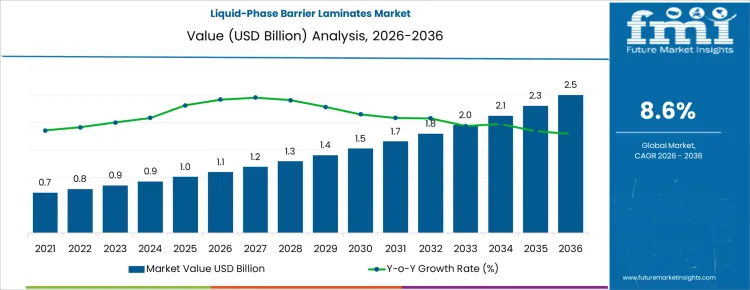
The Liquid-Phase Barrier Laminates market is expected to grow from USD 1.1 billion in 2026 to USD 2.5 billion by 2036, at a CAGR of 8.6%. Growth is driven by increasing demand for high-performance liquid packaging in beverages, dairy, and RTD products. Rising consumer awareness of product safety, longer shelf life, and contamination prevention are key factors. Adoption of advanced barrier technologies, multi-layer laminates, and improved extrusion and coating processes supports this expansion, particularly in regions with growing beverage and dairy consumption.
Carton and pouch laminates dominate packaging formats, with materials such as paper/PE, EVOH-based laminates, and multi-layer composites being widely used. Key technologies include liquid-tight extrusion, high-speed coating, and aseptic barrier engineering. The market is concentrated in dairy, juice, RTD beverages, and premium liquid products. Companies prioritize enhancing barrier performance, reducing costs, and complying with food safety and sustainability standards to maintain competitive advantage globally.
Quick Stats of the Liquid-Phase Barrier Laminates Market:
- Liquid-Phase Barrier Laminates Market Value (2026): USD 1.1 billion
- Liquid-Phase Barrier Laminates Forecast Value (2036): USD 2.5 billion
- Liquid-Phase Barrier Laminates Market Forecast CAGR (2026 to 2036): 8.6%
- Leading Packaging Format in the Market: Carton & Pouch Laminates (45%)
- Key Growth Regions in the Market: India, China, USA, Brazil, Germany
- Top Players in the Market: Tetra Pak, Mondi, Greatview, UFlex, Klabin, Toyo Seikan, SIG, Amcor, Elopak, Xinjufeng
What is the Growth Forecast for the Liquid-Phase Barrier Laminates Market through 2036?
From 2026 to 2031, the liquid-phase barrier laminates market grows from USD 1.1 billion to approximately USD 1.6 billion, representing the early adoption phase. Annual value additions increase from USD 0.1 billion in 2026 to USD 0.18 billion in 2031. Growth is driven by applications in food and beverage packaging, pharmaceuticals, and personal care products where barrier performance against moisture, oxygen, and aromas is critical. Early adoption is concentrated in North America and Europe, accounting for roughly 60% of market value, with pilot programs validating laminate adhesion, process compatibility, and material performance in high-speed converting lines.
Between 2031 and 2036, the market expands from roughly USD 1.6 billion to USD 2.5 billion, illustrating the late adoption phase characterized by broader commercialization and structural penetration. Annual increments rise from USD 0.18 billion to USD 0.18-0.2 billion, driven by multi-region deployment, portfolio-wide adoption across SKUs, and repeat procurement. Growth is reinforced by regulatory mandates for food safety, increased demand for sustainable packaging solutions, and integration into automated packaging systems. Early growth relied on selective high-value applications, while later expansion is driven by normalized adoption and scaling across global packaging production.
Liquid Phase Barrier Laminates Market Key Takeaways
| Metric | Value |
|---|---|
| Market Value (2026) | USD 1.1 billion |
| Forecast Value (2036) | USD 2.5 billion |
| Forecast CAGR (2026 to 2036) | 8.6% |
What Is Shaping Demand for Liquid-Phase Barrier Laminates?
Demand for liquid-phase barrier laminates initially emerged from the need to contain liquids without failure in early flexible packaging formats for beverages, sauces, and liquid detergents. Early multilayer laminates combined polymer films with foil or metallised layers to block oxygen, moisture, and aroma diffusion. Performance failures began to appear in distribution tests where conventional films allowed seepage or swelling, prompting targeted material upgrades. Food processors, bottlers, and converters adopted barrier laminates to protect product integrity, maintain flavour profiles, and reduce leakage claims. Uptake was driven by observed package failures in transport and storage, not by formalised sustainability or recyclability goals, and was concentrated in applications where liquid containment directly affected quality and liability.
Future demand for liquid-phase barrier laminates will be influenced by changing material standards, regulatory expectations, and lifecycle performance requirements rather than by containment performance alone. As packaging waste policies tighten and recyclability criteria become part of procurement specifications, formulators are re-engineering barrier structures to balance functional performance with end-of-life behaviour. New approaches are emerging that replace traditional non-recyclable barriers with compatible polymer-based systems while maintaining or improving liquid hold-out and aroma retention. Packaging designers now treat barrier laminates as part of circular design requirements, integrating barrier performance with processing and recovery pathways. Growth will reflect broader acceptance of high-performance recyclable and recyclable-friendly laminates in food, beverage, and consumer products where barrier failure previously drove material choice, repositioning liquid-phase barrier laminates from niche containment solutions toward defined components in compliant packaging portfolios.
What Factors Are Affecting the Demand for Liquid Phase Barrier Laminates Market in Terms of End Use Application and Packaging Format and Type?
Demand for liquid phase barrier laminates is segmented by end use application and packaging format and type across packaged beverage and liquid food systems. Beverages and liquid foods account for about 40% of total demand, making this the leading end use segment. Dairy and juice, RTD beverages, milk and value beverages, juices and dairy overlaps, and premium liquids represent additional applications without disclosed share splits. These segments differ in oxygen sensitivity, shelf life targets, and filling conditions. Packaging format and type determine barrier performance and process compatibility. Carton and pouch laminates account for about 45% of demand, followed by aseptic carton laminates, pouches and cartons, sachets and cartons, and other formats. Together, these segments explain demand formation shaped by liquid containment integrity and barrier reliability rather than total beverage volumes.
What Drives Demand by End Use Application in the Liquid Phase Barrier Laminates Market?
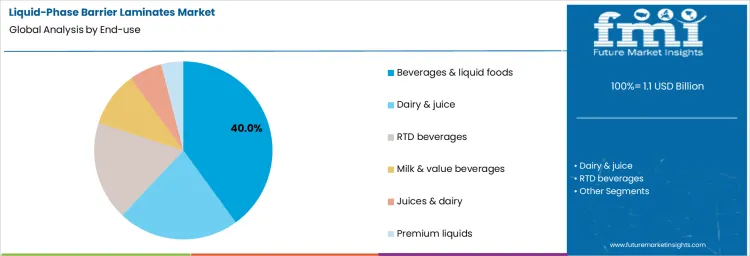
Beverages and liquid foods lead demand with a 40% share because these products require consistent protection against oxygen ingress and moisture loss. Barrier laminates support shelf stability without refrigeration in many applications. Dairy and juice packaging adopts liquid phase barriers to manage spoilage risk and flavor preservation. RTD beverages rely on laminates to maintain carbonation and aroma. Milk and value beverages apply cost balanced barrier structures to extend distribution reach. Premium liquids maintain stricter barrier specifications to protect product quality. End use demand therefore reflects sensitivity to oxidation and contamination rather than consumption growth alone.
Application driven demand remains stable because barrier requirements are embedded in product formulation and filling processes. Beverage producers qualify laminate structures through extended shelf testing. Dairy and juice segments adopt standardized barrier designs. RTD formats scale gradually based on brand positioning. Premium liquids adopt selectively. These patterns limit short term volatility. End use segmentation highlights reliance on validated barrier performance rather than experimentation with new laminate structures.
How Does Packaging Format and Type Shape Demand for Liquid Phase Barrier Laminates Market?
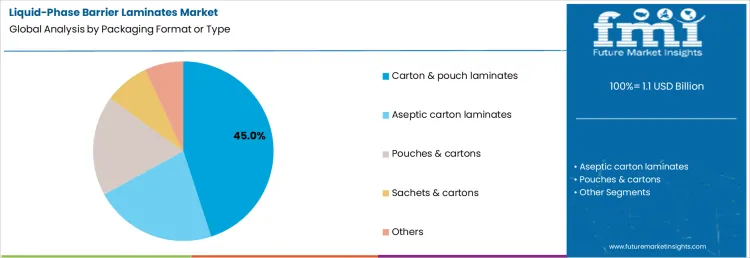
Carton and pouch laminates account for about 45% of total demand, making them the leading packaging format. Their dominance reflects compatibility with high speed filling lines and multilayer barrier integration. Aseptic carton laminates are used where extended shelf life is required without refrigeration. Pouches and cartons support flexible and rigid hybrid formats for RTD beverages. Sachets and cartons serve value focused liquid products with portion control needs. Other formats address niche premium or specialty liquids. Packaging format selection depends on filling method, barrier layer complexity, and distribution conditions. Demand follows process compatibility and barrier reliability rather than packaging design novelty.
Carton based laminates maintain leadership due to established infrastructure and scalability. Pouch formats grow where flexibility and weight reduction are prioritized. Sachets remain relevant in value segments. Producers avoid altering formats once filling systems are validated. This stabilizes format driven demand. Packaging format and type therefore reinforces concentration in carton and pouch laminate systems for liquid containment.
How Are Liquid-Phase Barrier Laminates Being Applied Across Packaging and Industrial Applications?
Use appears in flexible and rigid packaging where protection against moisture, oxygen, or chemical permeation is critical. Food and beverage producers incorporate liquid-phase barrier laminates in pouches, trays, and multi-layer films to extend shelf life of perishable products. Pharmaceutical and nutraceutical packaging uses them to maintain stability of sensitive compounds. Industrial applications, including chemical and electronic component packaging, adopt laminates to prevent corrosion or moisture ingress. These applications reflect operational and barrier performance priorities rather than decorative purposes, with adoption driven by product preservation, regulatory compliance, and material integrity.
What Operational and Material Conditions Support Adoption of Liquid-Phase Barrier Laminates?
Selection aligns with multi-layer film structures requiring uniform coating, adhesion, and flexibility. Manufacturers optimize resin composition, coating thickness, and curing parameters to achieve desired barrier properties without compromising mechanical strength. Converting lines must maintain precision in lamination, sealing, and cutting to prevent delamination or leaks. Packaging engineers select laminates compatible with existing filling, forming, and sealing equipment. These conditions emerge from operational reliability, barrier efficacy, and process integration priorities in structured packaging workflows.
Which Practical Considerations Limit Wider Use of Liquid-Phase Barrier Laminates?
Performance is sensitive to layer uniformity, coating defects, and process variability. Cost per unit may be higher than mono-material films, influencing adoption in low-margin products. Compatibility with printing, labeling, or sealing processes must be ensured. Recycling and end-of-life handling can be complex due to multi-material composition. These factors lead to selective deployment where barrier performance, product protection, and regulatory compliance justify incremental material and operational investment.
What is the Demand for Liquid Phase Barrier Laminates by Country?
| Country | CAGR (%) |
|---|---|
| USA | 7.8% |
| Germany | 6.9% |
| China | 10.8% |
| India | 11.8% |
| Brazil | 7.8% |
The demand for liquid phase barrier laminates varies across countries, driven by food and beverage packaging, liquid retention requirements, and adoption of high performance barrier materials. India leads with an 11.8% CAGR, supported by growing processed food and beverage sectors, increasing packaged liquid consumption, and adoption of advanced laminate technologies. China follows at 10.8%, driven by large scale packaging operations and rising demand for extended shelf life solutions. The USA grows at 7.8%, reflecting steady adoption in beverages, dairy, and liquid food packaging. Brazil records 7.8%, shaped by organized packaging and distribution sectors. Germany posts 6.9%, supported by mature packaging markets and stringent quality standards.
How Is Liquid-Phase Barrier Technology Driving Growth in the United States?
In the United States, revenue from the Liquid-Phase Barrier Laminates Market is expanding at a CAGR of 7.8% through 2036, driven by adoption of multi-layer laminates that provide enhanced barrier protection against moisture, oxygen, and contaminants for packaging applications. Manufacturers are integrating liquid-phase barrier laminates in food, beverage, and pharmaceutical packaging to extend shelf life and maintain product quality. Demand is concentrated in food and beverage packaging, medical packaging, and industrial applications. Domestic suppliers provide high-performance, processing-compatible laminates suitable for extrusion, coating, and lamination processes. Regulatory compliance, recurring packaging production, and quality standards are sustaining predictable procurement nationwide.
- Food and beverage packaging, medical packaging, and industrial applications drive adoption
- Laminates provide barrier protection against moisture, oxygen, and contaminants
- Domestic suppliers provide processing-compatible, high-performance laminates
- Recurring packaging production sustains predictable procurement
How Are Barrier Standards Supporting Growth in Germany?
Germany continues to record steady growth in the Liquid-Phase Barrier Laminates Market at a CAGR of 6.9% through 2036, supported by strict packaging and food safety regulations. Manufacturers are adopting liquid-phase barrier laminates to protect food, pharmaceuticals, and industrial products from degradation, contamination, and moisture. Demand is concentrated in food and beverage packaging, medical device films, and industrial applications. Domestic suppliers provide high-performance laminates compatible with coating, extrusion, and lamination processes. Compliance with barrier standards, hygiene regulations, and recurring production cycles is sustaining measured adoption nationwide.
- Food and beverage packaging, medical films, and industrial applications anchor demand
- Laminates protect products from contamination, moisture, and degradation
- Domestic suppliers provide processing-compatible, high-performance laminates
- Recurring production cycles sustain steady adoption
How Is Industrial and Packaging Expansion Accelerating Adoption in China?
In China, revenue from the Liquid-Phase Barrier Laminates Market is growing at a CAGR of 10.8% through 2036, driven by increasing use of barrier laminates in food, pharmaceutical, and industrial packaging. Manufacturers are integrating laminates to improve shelf life, maintain product quality, and ensure regulatory compliance. Demand is strong across food and beverage packaging, medical device films, and industrial products. Domestic suppliers are scaling production of high-performance, processing-compatible laminates suitable for extrusion, coating, and lamination operations. Expanding packaging infrastructure and recurring production cycles are sustaining rapid adoption nationwide.
- Food and beverage packaging, medical films, and industrial products drive adoption
- Laminates improve shelf life, maintain quality, and ensure compliance
- Domestic suppliers scale high-performance, processing-compatible laminates
- Recurring production cycles sustain consistent adoption
How Is Food-Grade and Industrial Packaging Supporting Growth in India?
In India, revenue from the Liquid-Phase Barrier Laminates Market is expanding at a CAGR of 11.8% through 2036, supported by increasing adoption in food packaging, pharmaceuticals, and industrial applications. Manufacturers are adopting liquid-phase barrier laminates to prevent moisture ingress, oxygen penetration, and contamination while maintaining material integrity. Demand is concentrated in food and beverage packaging, medical packaging, and industrial films. Domestic suppliers provide high-performance laminates compatible with extrusion, coating, and lamination processes. Growth in packaging infrastructure, recurring production cycles, and quality standards are sustaining robust adoption nationwide.
- Food and beverage packaging, medical packaging, and industrial films drive adoption
- Laminates prevent moisture, oxygen, and contamination
- Domestic suppliers provide processing-compatible, high-performance laminates
- Recurring production cycles sustain robust adoption
How Is Packaging Expansion Supporting Adoption in Brazil?
Brazil is seeing strong growth in the Liquid-Phase Barrier Laminates Market at a CAGR of 7.8% through 2036, supported by increased use of barrier laminates in food, pharmaceutical, and industrial packaging. Manufacturers are integrating liquid-phase barrier laminates to extend shelf life, maintain product quality, and ensure compliance with regulatory standards. Demand is concentrated in food and beverage packaging, medical device films, and industrial applications. Domestic suppliers are expanding production of high-performance, processing-compatible laminates suitable for extrusion, coating, and lamination operations. Recurring packaging production and quality compliance are sustaining robust procurement nationwide.
- Food and beverage packaging, medical films, and industrial applications drive adoption
- Laminates extend shelf life and maintain product quality
- Domestic suppliers expand processing-compatible, high-performance laminates
- Recurring production cycles sustain robust procurement
Which Companies Shape Competition in The Liquid Phase Barrier Laminates Market Through Filling System Dependency and Shelf Stability Requirements?
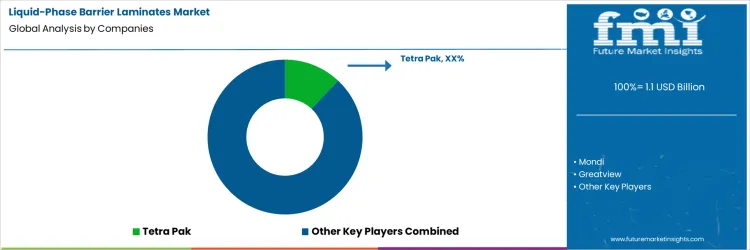
Liquid phase barrier laminates are selected primarily on their interaction with filling, sealing, and sterilisation systems rather than on standalone material attributes. Tetra Pak, SIG, Elopak, and Greatview influence this market because their laminate structures are engineered to function within proprietary or semi proprietary aseptic and fresh filling platforms. Material choice is therefore constrained by machine compatibility, seal integrity under thermal stress, and long term resistance to moisture and oxygen ingress. Mondi and Amcor participate through flexible and carton based laminate solutions adapted to non-aseptic or alternative filling configurations. Acceptance is driven by shelf life performance, migration control, and predictable behavior during high speed forming and sealing operations rather than laminate composition alone.
Execution and regional supply capability determine competitive outcomes beyond core system suppliers. Toyo Seikan contributes through container and laminate engineering aligned with beverage and liquid food packaging in Japan and adjacent markets. UFlex and Xinjufeng support cost sensitive and export oriented applications by supplying laminates compatible with localized filling lines and regional material standards. Klabin participates through fibre based components integrated into liquid packaging structures rather than complete laminate systems. Local converters and brand owners influence material selection by balancing barrier performance with recyclability pathways and supply continuity. Competitive positioning depends on qualification within filling ecosystems, consistency across production batches, and the ability to support customers through long approval cycles rather than rapid material substitution.
Key Players in the Liquid Phase Barrier Laminates Market
- Tetra Pak
- Mondi
- Greatview
- UFlex
- Klabin
- Toyo Seikan
- SIG
- Amcor
- Elopak
- Xinjufeng
Scope of the Report
| Items | Values |
|---|---|
| Quantitative Units (2026) | USD billion |
| End-use / Application | Beverages & liquid foods, Dairy & juice, RTD beverages, Milk & value beverages, Juices & dairy, Premium liquids |
| Packaging Format / Type | Carton & pouch laminates, Aseptic carton laminates, Pouches & cartons, Sachets & cartons, Others |
| Material | Paper/PE & EVOH-based laminates, Paperboard + barrier layers, PE/EVOH blends, PE-based laminates, Others |
| Technology | Liquid-tight extrusion & coating, Aseptic barrier engineering, High-speed lamination, Cost-optimised coating, Others |
| Region | Asia Pacific (China, Japan, South Korea, India, Australia & New Zealand, ASEAN, Rest of Asia Pacific), Europe (Germany, United Kingdom, France, Italy, Spain, Nordic, BENELUX, Rest of Europe), North America (United States, Canada, Mexico), Latin America (Brazil, Chile, Rest of Latin America), Middle East & Africa (KSA, Other GCC Countries, Turkey, South Africa, Other African Union, Rest of Middle East & Africa) |
| Key Companies Profiled | Tetra Pak, Mondi, Greatview, UFlex, Klabin, Toyo Seikan, SIG, Amcor, Elopak, Xinjufeng |
| Additional Attributes | Dollar by sales by end-use application, Dollar by sales by packaging format, Dollar by sales by material, Dollar by sales by technology, Dollar by sales by region, Barrier integrity under distribution conditions, Shelf life performance, Filling system compatibility, Recyclability and end-of-life handling, Compliance with food safety regulations |
Liquid Phase Barrier Laminates Market Segmentation
End-use / Application:
- Beverages & liquid foods
- Dairy & juice
- RTD beverages
- Milk & value beverages
- Juices & dairy
- Premium liquids
Packaging Format / Type:
- Carton & pouch laminates
- Aseptic carton laminates
- Pouches & cartons
- Sachets & cartons
- Others
Material:
- Paper/PE, EVOH-based laminates
- Paperboard + barrier layers
- PE/EVOH blends
- PE-based laminates
- Others
Technology:
- Liquid-tight extrusion & coating
- Aseptic barrier engineering
- High-speed lamination
- Cost-optimised coating
- Others
Region
- Asia Pacific
- China
- Japan
- South Korea
- India
- Australia & New Zealand
- ASEAN
- Rest of Asia Pacific
- Europe
- Germany
- United Kingdom
- France
- Italy
- Spain
- Nordic
- BENELUX
- Rest of Europe
- North America
- United States
- Canada
- Mexico
- Latin America
- Brazil
- Chile
- Rest of Latin America
- Middle East & Africa
- Kingdom of Saudi Arabia
- Other GCC Countries
- Turkey
- South Africa
- Other African Union
- Rest of Middle East & Africa
Frequently Asked Questions
How big is the liquid-phase barrier laminates market in 2026?
The global liquid-phase barrier laminates market is estimated to be valued at USD 1.1 billion in 2026.
What will be the size of liquid-phase barrier laminates market in 2036?
The market size for the liquid-phase barrier laminates market is projected to reach USD 2.5 billion by 2036.
How much will be the liquid-phase barrier laminates market growth between 2026 and 2036?
The liquid-phase barrier laminates market is expected to grow at a 8.6% CAGR between 2026 and 2036.
What are the key product types in the liquid-phase barrier laminates market?
The key product types in liquid-phase barrier laminates market are beverages & liquid foods, dairy & juice, rtd beverages, milk & value beverages, juices & dairy and premium liquids.
Which packaging format or type segment to contribute significant share in the liquid-phase barrier laminates market in 2026?
In terms of packaging format or type, carton & pouch laminates segment to command 45.0% share in the liquid-phase barrier laminates market in 2026.
Preview the report firsthand - request a free sample
Get SampleGet the brochure for pricing and purchase details.
Get PDFTable of Content
- Executive Summary
- Global Market Outlook
- Demand-side Trends
- Supply-side Trends
- Technology Roadmap Analysis
- Analysis and Recommendations
- Market Overview
- Market Coverage / Taxonomy
- Market Definition / Scope / Limitations
- Market Background
- Market Dynamics
- Drivers
- Restraints
- Opportunity
- Trends
- Scenario Forecast
- Demand in Optimistic Scenario
- Demand in Likely Scenario
- Demand in Conservative Scenario
- Opportunity Map Analysis
- Product Life Cycle Analysis
- Supply Chain Analysis
- Investment Feasibility Matrix
- Value Chain Analysis
- PESTLE and Porter’s Analysis
- Regulatory Landscape
- Regional Parent Market Outlook
- Production and Consumption Statistics
- Import and Export Statistics
- Market Dynamics
- Global Market Analysis 2021 to 2025 and Forecast, 2026 to 2036
- Historical Market Size Value (USD Million) Analysis, 2021 to 2025
- Current and Future Market Size Value (USD Million) Projections, 2026 to 2036
- Y-o-Y Growth Trend Analysis
- Absolute $ Opportunity Analysis
- Global Market Pricing Analysis 2021 to 2025 and Forecast 2026 to 2036
- Global Market Analysis 2021 to 2025 and Forecast 2026 to 2036, By End-use
- Introduction / Key Findings
- Historical Market Size Value (USD Million) Analysis By End-use , 2021 to 2025
- Current and Future Market Size Value (USD Million) Analysis and Forecast By End-use , 2026 to 2036
- Beverages & liquid foods
- Dairy & juice
- RTD beverages
- Milk & value beverages
- Juices & dairy
- Premium liquids
- Y-o-Y Growth Trend Analysis By End-use , 2021 to 2025
- Absolute $ Opportunity Analysis By End-use , 2026 to 2036
- Global Market Analysis 2021 to 2025 and Forecast 2026 to 2036, By Packaging Format or Type
- Introduction / Key Findings
- Historical Market Size Value (USD Million) Analysis By Packaging Format or Type, 2021 to 2025
- Current and Future Market Size Value (USD Million) Analysis and Forecast By Packaging Format or Type, 2026 to 2036
- Carton & pouch laminates
- Aseptic carton laminates
- Pouches & cartons
- Sachets & cartons
- Others
- Y-o-Y Growth Trend Analysis By Packaging Format or Type, 2021 to 2025
- Absolute $ Opportunity Analysis By Packaging Format or Type, 2026 to 2036
- Global Market Analysis 2021 to 2025 and Forecast 2026 to 2036, By Material
- Introduction / Key Findings
- Historical Market Size Value (USD Million) Analysis By Material, 2021 to 2025
- Current and Future Market Size Value (USD Million) Analysis and Forecast By Material, 2026 to 2036
- Paper/PE, EVOH-based laminates
- Paperboard + barrier layers
- PE/EVOH blends
- PE-based laminates
- Others
- Y-o-Y Growth Trend Analysis By Material, 2021 to 2025
- Absolute $ Opportunity Analysis By Material, 2026 to 2036
- Global Market Analysis 2021 to 2025 and Forecast 2026 to 2036, By Technology
- Introduction / Key Findings
- Historical Market Size Value (USD Million) Analysis By Technology, 2021 to 2025
- Current and Future Market Size Value (USD Million) Analysis and Forecast By Technology, 2026 to 2036
- Liquid-tight extrusion & coating
- Aseptic barrier engineering
- High-speed lamination
- Cost-optimised coating
- Others
- Y-o-Y Growth Trend Analysis By Technology, 2021 to 2025
- Absolute $ Opportunity Analysis By Technology, 2026 to 2036
- Global Market Analysis 2021 to 2025 and Forecast 2026 to 2036, By Region
- Introduction
- Historical Market Size Value (USD Million) Analysis By Region, 2021 to 2025
- Current Market Size Value (USD Million) Analysis and Forecast By Region, 2026 to 2036
- North America
- Latin America
- Western Europe
- Eastern Europe
- East Asia
- South Asia and Pacific
- Middle East & Africa
- Market Attractiveness Analysis By Region
- North America Market Analysis 2021 to 2025 and Forecast 2026 to 2036, By Country
- Historical Market Size Value (USD Million) Trend Analysis By Market Taxonomy, 2021 to 2025
- Market Size Value (USD Million) Forecast By Market Taxonomy, 2026 to 2036
- By Country
- USA
- Canada
- Mexico
- By End-use
- By Packaging Format or Type
- By Material
- By Technology
- By Country
- Market Attractiveness Analysis
- By Country
- By End-use
- By Packaging Format or Type
- By Material
- By Technology
- Key Takeaways
- Latin America Market Analysis 2021 to 2025 and Forecast 2026 to 2036, By Country
- Historical Market Size Value (USD Million) Trend Analysis By Market Taxonomy, 2021 to 2025
- Market Size Value (USD Million) Forecast By Market Taxonomy, 2026 to 2036
- By Country
- Brazil
- Chile
- Rest of Latin America
- By End-use
- By Packaging Format or Type
- By Material
- By Technology
- By Country
- Market Attractiveness Analysis
- By Country
- By End-use
- By Packaging Format or Type
- By Material
- By Technology
- Key Takeaways
- Western Europe Market Analysis 2021 to 2025 and Forecast 2026 to 2036, By Country
- Historical Market Size Value (USD Million) Trend Analysis By Market Taxonomy, 2021 to 2025
- Market Size Value (USD Million) Forecast By Market Taxonomy, 2026 to 2036
- By Country
- Germany
- UK
- Italy
- Spain
- France
- Nordic
- BENELUX
- Rest of Western Europe
- By End-use
- By Packaging Format or Type
- By Material
- By Technology
- By Country
- Market Attractiveness Analysis
- By Country
- By End-use
- By Packaging Format or Type
- By Material
- By Technology
- Key Takeaways
- Eastern Europe Market Analysis 2021 to 2025 and Forecast 2026 to 2036, By Country
- Historical Market Size Value (USD Million) Trend Analysis By Market Taxonomy, 2021 to 2025
- Market Size Value (USD Million) Forecast By Market Taxonomy, 2026 to 2036
- By Country
- Russia
- Poland
- Hungary
- Balkan & Baltic
- Rest of Eastern Europe
- By End-use
- By Packaging Format or Type
- By Material
- By Technology
- By Country
- Market Attractiveness Analysis
- By Country
- By End-use
- By Packaging Format or Type
- By Material
- By Technology
- Key Takeaways
- East Asia Market Analysis 2021 to 2025 and Forecast 2026 to 2036, By Country
- Historical Market Size Value (USD Million) Trend Analysis By Market Taxonomy, 2021 to 2025
- Market Size Value (USD Million) Forecast By Market Taxonomy, 2026 to 2036
- By Country
- China
- Japan
- South Korea
- By End-use
- By Packaging Format or Type
- By Material
- By Technology
- By Country
- Market Attractiveness Analysis
- By Country
- By End-use
- By Packaging Format or Type
- By Material
- By Technology
- Key Takeaways
- South Asia and Pacific Market Analysis 2021 to 2025 and Forecast 2026 to 2036, By Country
- Historical Market Size Value (USD Million) Trend Analysis By Market Taxonomy, 2021 to 2025
- Market Size Value (USD Million) Forecast By Market Taxonomy, 2026 to 2036
- By Country
- India
- ASEAN
- Australia & New Zealand
- Rest of South Asia and Pacific
- By End-use
- By Packaging Format or Type
- By Material
- By Technology
- By Country
- Market Attractiveness Analysis
- By Country
- By End-use
- By Packaging Format or Type
- By Material
- By Technology
- Key Takeaways
- Middle East & Africa Market Analysis 2021 to 2025 and Forecast 2026 to 2036, By Country
- Historical Market Size Value (USD Million) Trend Analysis By Market Taxonomy, 2021 to 2025
- Market Size Value (USD Million) Forecast By Market Taxonomy, 2026 to 2036
- By Country
- Kingdom of Saudi Arabia
- Other GCC Countries
- Turkiye
- South Africa
- Other African Union
- Rest of Middle East & Africa
- By End-use
- By Packaging Format or Type
- By Material
- By Technology
- By Country
- Market Attractiveness Analysis
- By Country
- By End-use
- By Packaging Format or Type
- By Material
- By Technology
- Key Takeaways
- Key Countries Market Analysis
- USA
- Pricing Analysis
- Market Share Analysis, 2025
- By End-use
- By Packaging Format or Type
- By Material
- By Technology
- Canada
- Pricing Analysis
- Market Share Analysis, 2025
- By End-use
- By Packaging Format or Type
- By Material
- By Technology
- Mexico
- Pricing Analysis
- Market Share Analysis, 2025
- By End-use
- By Packaging Format or Type
- By Material
- By Technology
- Brazil
- Pricing Analysis
- Market Share Analysis, 2025
- By End-use
- By Packaging Format or Type
- By Material
- By Technology
- Chile
- Pricing Analysis
- Market Share Analysis, 2025
- By End-use
- By Packaging Format or Type
- By Material
- By Technology
- Germany
- Pricing Analysis
- Market Share Analysis, 2025
- By End-use
- By Packaging Format or Type
- By Material
- By Technology
- UK
- Pricing Analysis
- Market Share Analysis, 2025
- By End-use
- By Packaging Format or Type
- By Material
- By Technology
- Italy
- Pricing Analysis
- Market Share Analysis, 2025
- By End-use
- By Packaging Format or Type
- By Material
- By Technology
- Spain
- Pricing Analysis
- Market Share Analysis, 2025
- By End-use
- By Packaging Format or Type
- By Material
- By Technology
- France
- Pricing Analysis
- Market Share Analysis, 2025
- By End-use
- By Packaging Format or Type
- By Material
- By Technology
- India
- Pricing Analysis
- Market Share Analysis, 2025
- By End-use
- By Packaging Format or Type
- By Material
- By Technology
- ASEAN
- Pricing Analysis
- Market Share Analysis, 2025
- By End-use
- By Packaging Format or Type
- By Material
- By Technology
- Australia & New Zealand
- Pricing Analysis
- Market Share Analysis, 2025
- By End-use
- By Packaging Format or Type
- By Material
- By Technology
- China
- Pricing Analysis
- Market Share Analysis, 2025
- By End-use
- By Packaging Format or Type
- By Material
- By Technology
- Japan
- Pricing Analysis
- Market Share Analysis, 2025
- By End-use
- By Packaging Format or Type
- By Material
- By Technology
- South Korea
- Pricing Analysis
- Market Share Analysis, 2025
- By End-use
- By Packaging Format or Type
- By Material
- By Technology
- Russia
- Pricing Analysis
- Market Share Analysis, 2025
- By End-use
- By Packaging Format or Type
- By Material
- By Technology
- Poland
- Pricing Analysis
- Market Share Analysis, 2025
- By End-use
- By Packaging Format or Type
- By Material
- By Technology
- Hungary
- Pricing Analysis
- Market Share Analysis, 2025
- By End-use
- By Packaging Format or Type
- By Material
- By Technology
- Kingdom of Saudi Arabia
- Pricing Analysis
- Market Share Analysis, 2025
- By End-use
- By Packaging Format or Type
- By Material
- By Technology
- Turkiye
- Pricing Analysis
- Market Share Analysis, 2025
- By End-use
- By Packaging Format or Type
- By Material
- By Technology
- South Africa
- Pricing Analysis
- Market Share Analysis, 2025
- By End-use
- By Packaging Format or Type
- By Material
- By Technology
- USA
- Market Structure Analysis
- Competition Dashboard
- Competition Benchmarking
- Market Share Analysis of Top Players
- By Regional
- By End-use
- By Packaging Format or Type
- By Material
- By Technology
- Competition Analysis
- Competition Deep Dive
- Tetra Pak
- Overview
- Product Portfolio
- Profitability by Market Segments (Product/Age /Sales Channel/Region)
- Sales Footprint
- Strategy Overview
- Marketing Strategy
- Product Strategy
- Channel Strategy
- Mondi
- Greatview
- UFlex
- Klabin
- Toyo Seikan
- SIG
- Amcor
- Tetra Pak
- Competition Deep Dive
- Assumptions & Acronyms Used
- Research Methodology


