

- Market Size (2026)
- USD 3.5 Bn
- Forecast (2036)
- USD 4.8 Bn
- CAGR (2026 to 2036)
- 3.2%
Barrier Coated Paper Industry Analysis in Europe Size, Market Forecast and Outlook By FMI
The barrier coated paper industry analysis in europe was valued at USD 3.4 billion in 2025. The market is set to reach USD 3.5 billion by 2026-end and grow at a CAGR of 3.2% between 2026-2036 to reach USD 4.8 billion by 2036. Plastic will dominate with a 32.0% share.
Summary of the Barrier Coated Paper Industry Analysis in Europe
- Demand and Growth Drivers
- The demand for barrier coated paper industry analysis in Europe is focused on downstream manufacturing, construction and industrial processing applications.
- Growth is a function of capacity expansion in the Netherlands and France and tighter quality specifications from end-use industries.
- Procurement decisions are expected to be impacted by raw material cost fluctuations and supply chain diversification strategies until 2036.
- Product and Segment View
- Plastic is projected to represent 32.0% of the material segment in 2026, consistent with present demand trends.
- The water based coating segment contributes 46.0% share to the coating type segment, driven by end-use requirements and compliance specifications.
- The product mix is shifting to higher specification versions with premium segments increasing faster than commodity versions.
- Geography and Competitive Outlook
- We expect the Netherlands to lead growth at a CAGR of 3.8%, helped by the concentration of the chemical industry and logistics infrastructure.
- France (3.7%) reflects EU rules and concentration of industrial demand.
- Companies with established distribution networks and product breadth across multiple segments are well-positioned to capture incremental demand.
- Analyst Opinion
- The barrier coated paper industry analysis in europe is transitioning from volume-led growth toward value-driven procurement, where product performance, compliance, and cost efficiency determine supplier selection.
- Adoption is increasing due to structural demand from primary end-use sectors, with procurement budgets reflecting longer planning cycles and specification requirements.
- Stora Enso Oyj maintains the leading position, with competitive advantages in product breadth and geographic reach.
- Companies that can balance cost competitiveness with technical performance across Netherlands and France are positioned to strengthen market share over the forecast period.
- Capital allocation toward capacity expansion and downstream integration is expected to define competitive positioning through 2036.
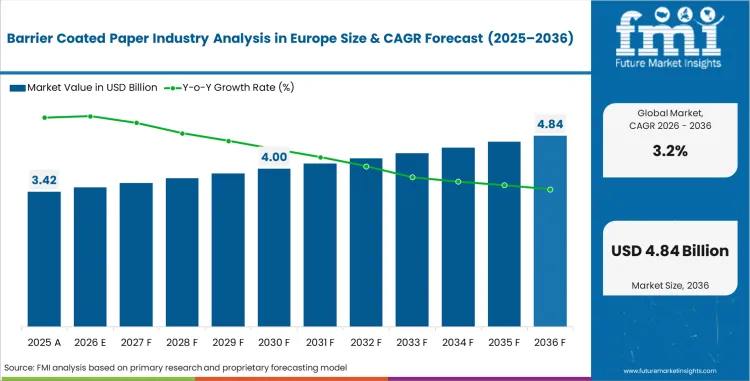
Key Takeaways, Market Size, and Forecast
| Metric | Value |
|---|---|
| Market Size (2025) | USD 3.4 Billion |
| Market Size (2036) | USD 4.8 Billion |
| CAGR (2026–2036) | 3.2% |
| Incremental Opportunity (2026–2036) | USD 1.31 Billion |
| Leading Material (2026) | Plastic |
| Plastic Share (2026) | 32.0% |
| Fastest-Growing Country | Netherlands |
| Netherlands CAGR | 3.8% |
| 2nd Fastest-Growing Country | France |
| France CAGR | 3.7% |
Barrier Coated Paper Industry Analysis in Europe Definition
Barrier coated paper Market in Europe The market analysis of barrier coated paper in Europe includes the commercially traded products and solutions segmented by material, coating type, application, end use, end use function. Market Scope The market scope includes the revenue generated from manufacturing, distribution, and end-use procurement of barrier coated paper industry analysis in europe across all regions for the forecast period 2026 to 2036.
Barrier Coated Paper Industry Analysis in Europe Inclusions
The market scope covers all commercially traded barrier coated paper industry analysis in europe products by material, coating type, application, end use, end use function. Revenue is tracked from 2026-2036 across Netherlands, France, Germany, Spain, UK, Italy, Russia and 30+ additional countries.
Barrier Coated Paper Industry Analysis in Europe Exclusions
Not covered are raw materials in unprocessed form, internal consumption not commercially transacted and products categorized in adjacent market categories. Production in captivity used as part of vertically integrated operations is excluded unless sold commercially.
Barrier Coated Paper Industry Analysis in Europe Research Methodology
- Primary Research: FMI analysts interviewed manufacturers, distributors and end use procurement teams across Netherlands, France and other key markets.
- Desk Research: Pulled together data from trade associations, regulatory databases, trade publications, manufacturer disclosures.
- Market Sizing and Forecasting: Bottom-up aggregation from product, end-use and regional adoption curves, triangulated with top-down industry benchmarks.
- Data Validation: Quarterly cross-check against production data, trade statistics and manufacturer financial disclosures.
Why is the Barrier Coated Paper Industry Analysis in Europe Growing?
- Barrier coated paper industry analysis in europe products are supported by volume growth due to downstream industrial demand and infrastructure construction across major economies.
- Netherlands is the leader with a 3.8% CAGR, driven by growth in manufacturing capacity and domestic consumption.
- The move to higher grade products is being driven by tightening quality specifications and regulatory compliance requirements.
The barrier coated paper industry analysis in europe is growing with the increasing production capacity of the downstream industrial sectors and the increasing material specifications. Manufacturing of construction, automotive and electronics products in Netherlands and France is driving volume demand, and quality and performance requirements are shifting product mix to higher grade offerings.
Supply chain diversification strategies are affecting sourcing decisions, with buyers looking at suppliers on delivery reliability, specification consistency and cost competitiveness. Structural margin pressures remain from raw material price volatility and energy costs. The market is expected to expand at a 3.2% CAGR from 2026-2036, indicating sustained industrial demand.
Market Segmentation Analysis
- Plastics accounted for 32.0% of the material segment, reflecting the concentrated nature of end-use demand patterns.
- Coating Type Segment (Supported by specification requirements from primary buyers) Water Based Coating 46.0%
- Segmentation: By Material, By Coating Type, By Application, By End Use, By End Use Function, Revenue 2026-2036
The barrier coated paper market analysis in europe is segmented into material, coating type, application, end use and end use function. Each segmentation dimension reflects different procurement patterns and end-use requirements influencing the competitive dynamics and revenue share.
Insights into the Plastic Material Segment
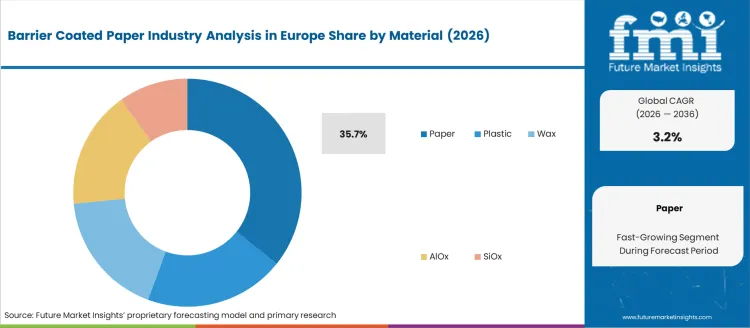
We expect plastics to account for 32.0% of the material segment in 2026. The demand is concentrated in the traditional end-use applications, where plastic products meet both specification requirements and procurement standards. Performance expectations and cost sensitivity are key drivers of buying behavior in this segment, with purchasing cycles tied to end-use industry investment patterns.
The remaining market share is comprised of other segments like pe, pp, pvdc. The growth in these segments is a reflection of the diversification in end-use applications and specification requirements that favor specialized product variants over standard alternatives.
Insights into the Water Based Coating Coating Type Segment
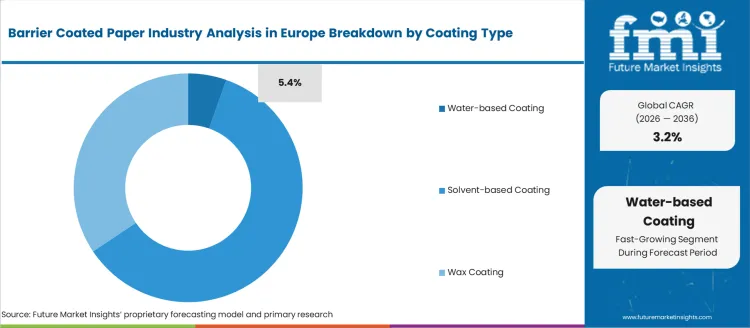
Coating type segment, 2026, water based coating is expected to contribute 46.0% share. Demand is concentrated in established end-use applications where water based coating products meet specification requirements and standards for procurement. The buyers of this segment also have performance expectations, cost sensitivity and buying cycles are associated with the investment patterns of the end-use industry.
Other segments like solvent based coating, wax coating makes up the rest of market share. The growth in these segments is driven by the diversification of end use applications and specification requirements favoring specialized product variants over standard alternatives.
Barrier Coated Paper Industry Analysis in Europe Drivers, Restraints, and Opportunities
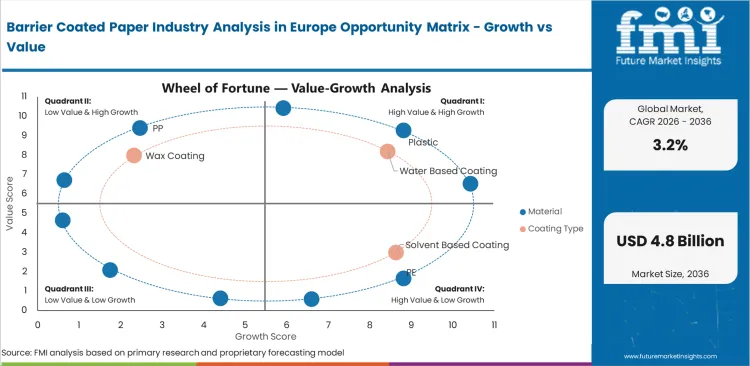
- Europe Barrier Coated Paper Industry Analysis: Structural Demand from Primary End-Use Industries and Regulatory Compliance Requirements Supporting Adoption of Products Across Key Markets
- Smaller suppliers still face constraints regarding cost competitiveness against other solutions and scalability of production capacity.
- The baseline consumption patterns are augmented by incremental demand resulting from government investment programs in Netherlands and France.
European barrier coated paper analysis considers demand-side structural drivers, supply-side constraints, and the market attractiveness of barrier coated papers. These forces play out across segments and geographies resulting in a CAGR growth of 3.2% from 2026 to 2036.
Downstream Industrial Demand
Capacity expansion in construction, automotive and electronics manufacturing drives growth. Downstream specification requirements are propelling procurement towards higher-grade barrier coated paper industry analysis in europe products, which meet standards of performance and compliance.
Raw Material and Energy Cost Pressures
Structural margins were under pressure from input cost volatility and energy prices. Producers with feedstock and energy cost advantages are well placed relative to higher cost operators.
Supply Chain Diversification
Buyers are diversifying supplier portfolios to reduce concentration risk. This creates opportunity for second-tier producers in Netherlands and France to capture share from established suppliers.
Quality Specification Tightening
End-use industry requirements are tightening, with procurement specifications increasingly demanding certified and tested materials. This shifts the product mix toward premium grades and creates barriers for commodity-focused producers.
Analysis of Barrier Coated Paper Industry Analysis in Europe By Key Countries
.webp "Top Country Growth Comparison Barrier Coated Paper Industry Analysis In Europe Cagr (2026 2036)")
| Country | CAGR |
|---|---|
| Netherlands | 3.8% |
| France | 3.7% |
| Germany | 3.4% |
| Spain | 3.3% |
| UK | 3.2% |
| Italy | 2.5% |
| Russia | 1.9% |
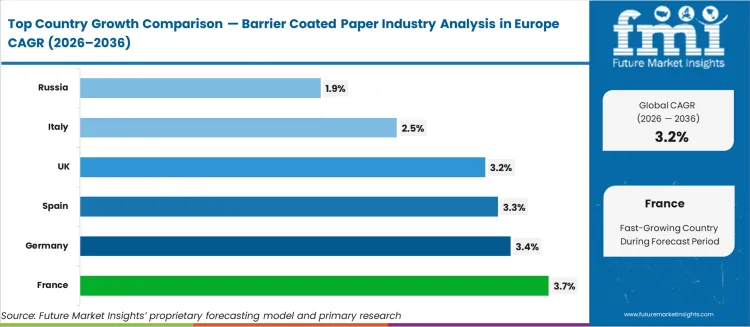
- Netherlands at 3.8% CAGR reflects chemical industry concentration and logistics infrastructure.
- France at 3.7% CAGR reflects EU regulations and industrial demand concentration.
- Germany at 3.4% CAGR reflects DIN and EU performance standards alongside energy cost pressures on sourcing decisions.
- Spain at 3.3% CAGR reflects EU regulations and construction sector recovery.
The global barrier coated paper industry analysis in europe is estimated at USD 3.53 billion in 2026 and is projected to expand at 3.2% CAGR from 2026 to 2036. The analysis covers more than 30 countries, with key markets detailed below.
Demand Outlook for Barrier Coated Paper Industry Analysis in Europe in Netherlands
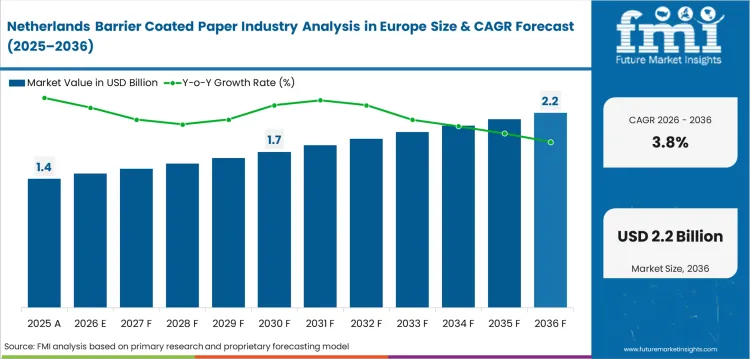
Netherlands is projected to expand at 3.8% CAGR through 2036. Growth is supported by chemical industry concentration and logistics infrastructure.
- Chemical industry concentration generates downstream demand for specialty inputs.
- Logistics infrastructure supports efficient distribution across European markets.
- Port and refinery infrastructure creates demand for industrial-grade materials.
Future Outlook for Barrier Coated Paper Industry Analysis in Europe in France
France is projected to expand at 3.7% CAGR through 2036. Growth is supported by EU regulations and industrial demand concentration.
- EU regulations and industrial demand concentration drive specification compliance.
- Energy transition programs create demand for advanced material grades.
- Chemical industry base generates downstream demand for specialty inputs.
Opportunity Analysis of Barrier Coated Paper Industry Analysis in Europe in Germany
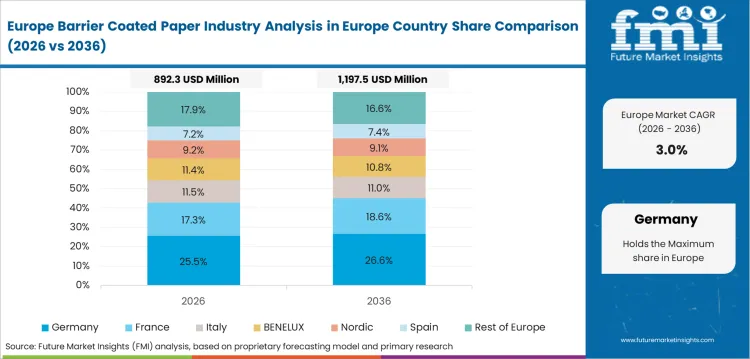
Germany is projected to expand at 3.4% CAGR through 2036. Growth is supported by DIN and EU performance standards alongside energy cost pressures on sourcing decisions.
- DIN and EU performance standards drive specification compliance requirements for suppliers.
- Energy cost pressures influence sourcing decisions toward cost-efficient supply chains.
- Circular economy mandates are reshaping material selection and end-of-life requirements.
In-depth Analysis of Barrier Coated Paper Industry Analysis in Europe in Spain
Spain is projected to expand at 3.3% CAGR through 2036. Growth is supported by EU regulations and construction sector recovery.
- EU regulations and construction sector recovery support material demand.
- Renewable energy installation growth creates new end-use applications.
- Export-oriented manufacturing creates demand for specification-grade materials.
Sales Analysis of Barrier Coated Paper Industry Analysis in Europe in UK
UK is projected to expand at 3.2% CAGR through 2036. Growth is supported by updated building regulations and energy performance targets.
- Updated building regulations and energy performance targets drive material specification changes.
- Commercial and institutional modernization creates replacement demand cycles.
- Import dependency for specialty grades creates freight cost sensitivity.
Growth Dynamics for Barrier Coated Paper Industry Analysis in Europe in Italy
Italy is projected to expand at 2.5% CAGR through 2036. Growth is supported by industrial demand and EU regulatory compliance.
- Industrial demand from manufacturing and construction sectors supports procurement.
- EU regulatory compliance drives specification tightening.
- Design and quality focus in consumer goods creates premium material demand.
Competitive Landscape and Strategic Positioning
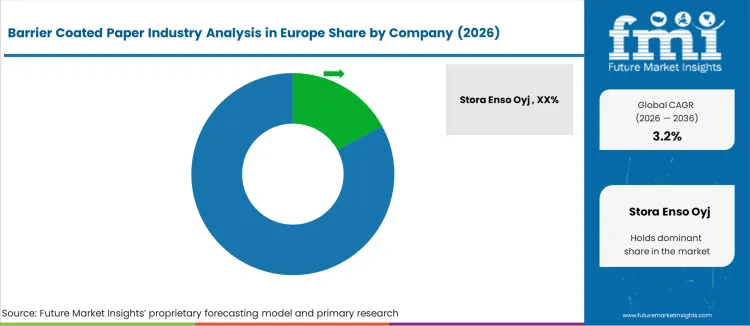
- Stora Enso Oyj is one of the leading players in the barrier coated paper market in europe with a broad product portfolio and wide geographic presence.
- Competition is among the top 5 to 7 companies and the rest of the share is divided among the specialized and regional players.
- New entrants are focusing on niche applications and un-served geographies to gain a foothold in the market.
Stora Enso Oyj’s strong positions with integrated product portfolios and established end-use relationships The company’s distribution footprint across Netherlands, France and other key markets provides structural advantages in procurement access.
Second tier players compete on the basis of regional strength, specialized product capabilities and cost positioning. Where companies have strong positions in specific end-use segments or geographies, they have viable competitive positions, even with small overall share.
Barriers to entry include product qualification requirements, development of a distribution network, regulatory approval time and established buyer-supplier relationships. Cost reduction, geographic expansion and product portfolio broadening are strategic priorities for market participants.
Key Companies in the Barrier Coated Paper Industry Analysis in Europe
Key global companies leading the barrier coated paper industry analysis in europe include:
- Stora Enso Oyj, UPM-Kymmene Oyj, Mondi Group, Sappi Global hold leading positions through broad product portfolios and established end-use relationships.
- Ahlstrom-Munksjö Oyj, WestRock Company, BillerudKorsnas AB maintain regional strength through specialized product capabilities and local market knowledge.
- Nippon Paper Industries Co., Ltd., Oji Holdings Corporation, Mitsubishi Paper Mills Limited represent emerging participants targeting niche applications and growth segments.
Competitive Benchmarking: Barrier Coated Paper Industry Analysis in Europe
| Company | Product Breadth | Geographic Reach | End-Use Access | Technology Capability |
|---|---|---|---|---|
| Stora Enso Oyj | High | Strong | Strong | High |
| UPM-Kymmene Oyj | High | Strong | Strong | High |
| Mondi Group | High | Strong | Strong | High |
| Sappi Global | Medium | Moderate | Moderate | Medium |
| Ahlstrom-Munksjö Oyj | Medium | Moderate | Moderate | Medium |
| WestRock Company | Medium | Moderate | Moderate | Medium |
| BillerudKorsnas AB | Medium | Moderate | Low | Medium |
| Nippon Paper Industries Co., Ltd. | Medium | Moderate | Low | Medium |
| Oji Holdings Corporation | Medium | Moderate | Low | Medium |
| Mitsubishi Paper Mills Limited | Medium | Moderate | Low | Medium |
Source: Future Market Insights competitive analysis, 2026.
Key Developments in Barrier Coated Paper Market in Europe
- In 2025, Mondi plc expanded its recyclable barrier coated paper portfolio for food and consumer goods packaging applications across European markets.
- In 2025, Stora Enso Oyj increased investment in fiber-based barrier packaging solutions to support rising demand for sustainable paper packaging across Europe.
Key Players in the Barrier Coated Paper Industry Analysis in Europe:
Major Global Players
- Stora Enso Oyj
- UPM-Kymmene Oyj
- Mondi Group
- Sappi Global
- Ahlstrom-Munksjö Oyj
- WestRock Company
- BillerudKorsnas AB
Emerging Players/Startups
- Nippon Paper Industries Co., Ltd.
- Oji Holdings Corporation
- Mitsubishi Paper Mills Limited
- Gascogne Groupe
- Feldmuehle GmbH
- Nordic Paper AS
- Toppan Printing Co., Ltd
- Hansol Paper Ltd.
- MetPro Group
- PG Paper Company Ltd.
Report Scope and Coverage
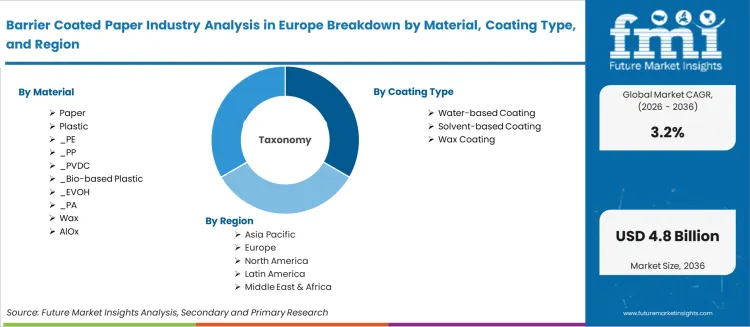
| Parameter | Details |
|---|---|
| Quantitative Units | USD 3.5 billion to USD 4.8 billion, at a CAGR of 3.2% |
| Market Definition | The barrier coated paper industry analysis in europe encompasses commercially traded products and solutions across material, coating type, application, end use, end use function. |
| Regions Covered | North America, Latin America, Europe, East Asia, South Asia and Pacific, Middle East and Africa |
| Countries Covered | Netherlands, France, Germany, Spain, UK, Italy, Russia, 30 plus countries |
| Key Companies Profiled | Stora Enso Oyj, UPM-Kymmene Oyj, Mondi Group, Sappi Global, Ahlstrom-Munksjö Oyj, WestRock Company, BillerudKorsnas AB, Nippon Paper Industries Co., Ltd., Oji Holdings Corporation, Mitsubishi Paper Mills Limited, Gascogne Groupe, Feldmuehle GmbH |
| Forecast Period | 2026 to 2036 |
| Approach | Hybrid bottom-up and top-down methodology starting with verified transaction data, projecting adoption velocity across segments and regions. |
Segmentation
Barrier Coated Paper Industry Analysis in Europe Market Segmented by Material:
- Plastic
- Conventional Plastic Substrates
- Flexible Packaging Films
- Rigid Packaging Materials
- Barrier Enhanced Plastics
- Moisture Resistant Films
- Oxygen Barrier Packaging
- Conventional Plastic Substrates
- PE
- LDPE Based Films
- Flexible Packaging Layers
- Food Grade Packaging
- HDPE Based Films
- Rigid Packaging Applications
- Industrial Packaging Use
- LDPE Based Films
- PP
- BOPP Films
- High Clarity Packaging
- Snack Packaging Films
- CPP Films
- Heat Seal Layers
- Laminated Structures
- BOPP Films
- PVDC
- PVDC Coated Films
- High Barrier Packaging
- Pharmaceutical Packaging
- Food Preservation Films
- PVDC Coated Films
- Bio Based Plastic
- Bio Polymer Films
- Sustainable Packaging Solutions
- Compostable Barrier Layers
- Renewable Feedstock Plastics
- Eco Friendly Alternatives
- Green Packaging Materials
- Bio Polymer Films
- Polysaccharides
- Natural Polymer Coatings
- Edible Coatings
- Food Protection Layers
- Cellulose Based Films
- Biodegradable Barrier Materials
- Natural Polymer Coatings
- PLA
- Polylactic Acid Films
- Compostable Packaging
- Food Contact Materials
- Bio Based Rigid PLA
- Cup And Tray Applications
- Eco Packaging Solutions
- Polylactic Acid Films
- PHA
- Polyhydroxyalkanoates
- Fully Biodegradable Films
- Marine Safe Packaging
- High Performance Bio Polymers
- Polyhydroxyalkanoates
- EVOH
- Ethylene Vinyl Alcohol
- High Oxygen Barrier Layers
- Food Preservation Packaging
- Multilayer Film Structures
- Ethylene Vinyl Alcohol
- PA
- Polyamide Films
- High Strength Packaging
- Mechanical Barrier Layers
- Industrial Food Packaging
- Polyamide Films
- Wax
- Natural Wax Coatings
- Moisture Barrier Layers
- Paper Coating Applications
- Synthetic Wax Coatings
- Grease Resistance
- Food Packaging Protection
- Natural Wax Coatings
- AlOx
- Aluminum Oxide Coatings
- Ultra High Barrier Films
- Transparent Packaging Solutions
- Sputtered Coatings
- Advanced Packaging Layers
- Electronics Packaging Use
- Aluminum Oxide Coatings
- SiOx
- Silicon Oxide Coatings
- High Performance Barrier Films
- Oxygen And Moisture Protection
- Thin Film Coatings
- Premium Packaging Applications
- Medical Grade Packaging
- Silicon Oxide Coatings
- Paper
- Coated Paper Substrates
- Food Packaging Paper
- Industrial Wrapping Paper
- Biodegradable Paper Solutions
- Compostable Packaging Paper
- Eco Friendly Applications
- Coated Paper Substrates
Barrier Coated Paper Industry Analysis in Europe Market Segmented by Coating Type:
- Water Based Coating
- Aqueous Barrier Coatings
- Food Safe Packaging
- Eco Friendly Solutions
- Acrylic Based Coatings
- Moisture Resistance Layers
- Paper And Film Coating
- Aqueous Barrier Coatings
- Solvent Based Coating
- Solvent Polymer Coatings
- High Performance Barrier Layers
- Industrial Packaging Use
- Advanced Chemical Coatings
- Oxygen And Oil Resistance
- Solvent Polymer Coatings
- Wax Coating
- Natural Wax Coatings
- Grease Barrier Protection
- Paper Based Packaging
- Synthetic Wax Coatings
- Moisture Resistance
- Flexible Packaging Use
- Natural Wax Coatings
Barrier Coated Paper Industry Analysis in Europe Market Segmented by Application:
- Packaging
- Flexible Packaging
- Pouches And Wraps
- Food Preservation Films
- Rigid Packaging
- Containers And Bottles
- Trays And Lids
- Flexible Packaging
- Cups And Lids
- Paper Cups With Coating
- Hot And Cold Beverage Cups
- Disposable Lids
- Plastic Cups With Barrier
- Leak Proof Designs
- Food Service Applications
- Paper Cups With Coating
- Trays
- Food Trays
- Fresh Food Packaging
- Ready Meal Containers
- Industrial Trays
- Bulk Food Packaging
- Retail Display Use
- Food Trays
- Boxes And Cartons
- Corrugated Cartons
- Shipping Protection
- Food Grade Cartons
- Folding Cartons
- Retail Packaging
- Premium Product Packaging
- Corrugated Cartons
- Pouches And Sachets
- Single Serve Pouches
- Convenience Packaging
- Food And Beverage Use
- Multi Layer Sachets
- Extended Shelf Life
- Condiment Packaging
- Single Serve Pouches
- Labels
- Food Labels
- Moisture Resistant Labels
- Branding Applications
- Industrial Labels
- Chemical And Pharma Use
- Durable Labeling Solutions
- Food Labels
- Blisters And Clamshells
- Thermoformed Packaging
- Pharmaceutical Blisters
- Retail Packaging Protection
- Clear Clamshell Packs
- Consumer Goods Display
- Tamper Evident Packaging
- Thermoformed Packaging
- Wraps
- Food Wrap Films
- Fresh Food Protection
- Bakery Wrapping
- Industrial Wraps
- Pallet And Product Wrapping
- Protective Layers
- Food Wrap Films
- Tapes
- Adhesive Packaging Tapes
- Sealing Applications
- Logistics Packaging
- Barrier Coated Tapes
- Moisture Protection
- Industrial Use
- Adhesive Packaging Tapes
- Printing
- Printed Packaging Films
- Branding And Graphics
- Product Information Layers
- Protective Printed Coatings
- Security And Authentication
- Anti Counterfeit Packaging
- Printed Packaging Films
Barrier Coated Paper Industry Analysis in Europe Market Segmented by End Use:
- Food
- Food Packaging Industry
- Fresh Food Preservation
- Shelf Life Extension
- Food Packaging Industry
- Bakery
- Bakery Packaging
- Bread And Pastry Wrapping
- Moisture Control Packaging
- Bakery Packaging
- Confectionery
- Chocolate And Candy Packaging
- Barrier Protection Films
- Premium Wrapping
- Chocolate And Candy Packaging
- Snacks
- Snack Food Packaging
- Oil And Grease Resistance
- Flexible Film Use
- Snack Food Packaging
- Dairy
- Milk And Yogurt Packaging
- Aseptic Barrier Packaging
- Cold Chain Protection
- Milk And Yogurt Packaging
- Spices And Condiments
- Seasoning Packaging
- Aroma Retention Films
- Moisture Barrier Packs
- Seasoning Packaging
- Sauces
- Liquid Food Packaging
- Leak Proof Pouches
- Shelf Stable Packaging
- Liquid Food Packaging
- Beverages
- Beverage Packaging
- Juice And Soft Drink Bottles
- Barrier Lined Containers
- Beverage Packaging
- Cosmetic And Personal Care
- Skincare Packaging
- Cream And Lotion Tubes
- Moisture Barrier Containers
- Personal Care Products
- Shampoo And Hygiene Packs
- Premium Packaging Solutions
- Skincare Packaging
- Pharmaceuticals
- Drug Packaging
- Blister Packs And Sachets
- Sterile Barrier Packaging
- Drug Packaging
- Building And Construction
- Construction Material Packaging
- Cement And Chemical Bags
- Protective Wrapping
- Construction Material Packaging
- Electrical And Electronics
- Electronic Component Packaging
- Anti Static Protection
- Moisture Sensitive Packaging
- Electronic Component Packaging
- Others
- Agriculture Packaging
- Seed And Fertilizer Bags
- Protective Storage
- Tobacco Packaging
- Moisture Control Wrapping
- Shelf Stability Packaging
- Agriculture Packaging
Barrier Coated Paper Industry Analysis in Europe Market Segmented by End Use Function:
- Oxygen Barrier
- High Oxygen Resistance Coatings
- Fresh Food Preservation
- Oxidation Prevention Layers
- Food Shelf Life Extension
- Modified Atmosphere Packaging
- Long Duration Storage
- High Oxygen Resistance Coatings
- Moisture Barrier
- Water Vapor Resistance Layers
- Dry Food Protection
- Humidity Control Packaging
- Hygienic Packaging Solutions
- Pharmaceutical Stability
- Cosmetic Protection Packaging
- Water Vapor Resistance Layers
- Grease And Oil Barrier
- Fat Resistant Coatings
- Snack Food Packaging
- Bakery And Fried Foods
- Oil Proof Packaging Layers
- Fast Food Wrapping
- Takeaway Packaging Solutions
- Fat Resistant Coatings
- Aroma And Flavor Barrier
- Scent Retention Coatings
- Spices And Condiments Packaging
- Coffee And Tea Packaging
- Flavor Preservation Layers
- Premium Food Packaging
- Aromatherapy Products
- Scent Retention Coatings
- Mechanical Protection
- Scratch Resistant Coatings
- Transit Packaging Protection
- Durability Enhancement
- Abrasion Resistant Layers
- Industrial Packaging Use
- Heavy Duty Shipping Materials
- Scratch Resistant Coatings
Barrier Coated Paper Industry Analysis in Europe Market by Region:
- North America
- USA
- Canada
- Mexico
- Latin America
- Brazil
- Chile
- Rest of Latin America
- Western Europe
- Germany
- UK
- Italy
- Spain
- France
- Nordic
- BENELUX
- Rest of Western Europe
- Eastern Europe
- Russia
- Poland
- Hungary
- Balkan & Baltic
- Rest of Eastern Europe
- East Asia
- China
- Japan
- South Korea
- South Asia and Pacific
- India
- ASEAN
- Australia & New Zealand
- Rest of South Asia and Pacific
- Middle East & Africa
- Kingdom of Saudi Arabia
- Other GCC Countries
- Turkiye
- South Africa
- Other African Union
- Rest of Middle East & Africa
Research Sources and Bibliography
- 1. World Bank. (2025). World Bank Commodity Markets Outlook. World Bank.
- 2. International Energy Agency. (2025). IEA Energy Technology Perspectives. IEA.
- 3. United Nations Industrial Development Organization. (2025). UNIDO Industrial Statistics Database. UNIDO.
- 4. Organisation for Economic Co-operation and Development. (2025). OECD Science, Technology and Industry Outlook. OECD.
- 5. International Organization for Standardization. (2025). ISO Standards Catalogue. ISO.
- 6. European Commission. (2025). EU Industrial Policy Database. EC.
This bibliography is provided for reader reference. The full Future Market Insights report contains the complete reference list with publication dates, URLs, and supporting data for all cited works.
This Report Answers
- Estimating the size of the market and revenue projections from 2026 to 2036.
- Segmentation by material, coating type, application, end use, end use function.
- Insights across more than 30 regional markets.
- Technology and product analysis across key segments.
- Assessment of the competitive landscape and company positioning.
- Identification of investment opportunities across material, coating type, application categories.
- Supply chain tracking and procurement pattern analysis.
- Delivery of data in PDF and Excel formats.
Frequently Asked Questions
What is the global market demand for Barrier Coated Paper Industry Analysis in Europe in 2026?
In 2026, the global barrier coated paper industry analysis in europe is estimated at USD 3.5 billion.
How big will the Barrier Coated Paper Industry Analysis in Europe be in 2036?
By 2036, the barrier coated paper industry analysis in europe is projected to reach USD 4.8 billion.
How much is demand for Barrier Coated Paper Industry Analysis in Europe expected to grow between 2026 and 2036?
Between 2026 and 2036, the barrier coated paper industry analysis in europe is projected to expand at a CAGR of 3.2%.
Which material segment is expected to lead in the Barrier Coated Paper Industry Analysis in Europe in 2026?
Plastic is expected to hold 32.0% of the material segment in 2026, reflecting concentrated end-use demand.
What is causing demand to rise in Netherlands?
Netherlands is expected to grow at 3.8% CAGR through 2036, supported by chemical industry concentration and logistics infrastructure.
What is causing demand to rise in France?
France is expected to grow at 3.7% CAGR through 2036, supported by EU regulations and industrial demand concentration.
What does this report mean by Barrier Coated Paper Industry Analysis in Europe definition?
The barrier coated paper industry analysis in europe includes all commercially traded products and solutions categorized by material, coating type, application, end use, end use function, covering manufacturing, distribution, and end-use procurement across the 2026 to 2036 forecast period.
How does FMI make the Barrier Coated Paper Industry Analysis in Europe forecast and validate it?
Forecasting models use a hybrid bottom-up and top-down approach, starting with verified transaction data and validating against global production statistics and manufacturer disclosures.
Preview the report firsthand - request a free sample
Get SampleGet the brochure for pricing and purchase details.
Get PDFTable of Content
- Executive Summary
- Global Market Outlook
- Demand-side Trends
- Supply-side Trends
- Technology Roadmap Analysis
- Analysis and Recommendations
- Market Overview
- Market Coverage / Taxonomy
- Market Definition / Scope / Limitations
- Research Methodology
- Chapter Orientation
- Analytical Lens and Working Hypotheses
- Market Structure, Signals, and Trend Drivers
- Benchmarking and Cross-market Comparability
- Market Sizing, Forecasting, and Opportunity Mapping
- Research Design and Evidence Framework
- Desk Research Programme (Secondary Evidence)
- Company Annual and Sustainability Reports
- Peer-reviewed Journals and Academic Literature
- Corporate Websites, Product Literature, and Technical Notes
- Earnings Decks and Investor Briefings
- Statutory Filings and Regulatory Disclosures
- Technical White Papers and Standards Notes
- Trade Journals, Industry Magazines, and Analyst Briefs
- Conference Proceedings, Webinars, and Seminar Materials
- Government Statistics Portals and Public Data Releases
- Press Releases and Reputable Media Coverage
- Specialist Newsletters and Curated Briefings
- Sector Databases and Reference Repositories
- FMI Internal Proprietary Databases and Historical Market Datasets
- Subscription Datasets and Paid Sources
- Social Channels, Communities, and Digital Listening Inputs
- Additional Desk Sources
- Expert Input and Fieldwork (Primary Evidence)
- Primary Modes
- Qualitative Interviews and Expert Elicitation
- Quantitative Surveys and Structured Data Capture
- Blended Approach
- Why Primary Evidence is Used
- Field Techniques
- Interviews
- Surveys
- Focus Groups
- Observational and In-context Research
- Social and Community Interactions
- Stakeholder Universe Engaged
- C-suite Leaders
- Board Members
- Presidents and Vice Presidents
- R&D and Innovation Heads
- Technical Specialists
- Domain Subject-matter Experts
- Scientists
- Physicians and Other Healthcare Professionals
- Governance, Ethics, and Data Stewardship
- Research Ethics
- Data Integrity and Handling
- Primary Modes
- Tooling, Models, and Reference Databases
- Desk Research Programme (Secondary Evidence)
- Data Engineering and Model Build
- Data Acquisition and Ingestion
- Cleaning, Normalisation, and Verification
- Synthesis, Triangulation, and Analysis
- Quality Assurance and Audit Trail
- Market Background
- Market Dynamics
- Drivers
- Restraints
- Opportunity
- Trends
- Scenario Forecast
- Demand in Optimistic Scenario
- Demand in Likely Scenario
- Demand in Conservative Scenario
- Opportunity Map Analysis
- Product Life Cycle Analysis
- Supply Chain Analysis
- Investment Feasibility Matrix
- Value Chain Analysis
- PESTLE and Porter’s Analysis
- Regulatory Landscape
- Regional Parent Market Outlook
- Production and Consumption Statistics
- Import and Export Statistics
- Market Dynamics
- Global Market Analysis 2021 to 2025 and Forecast, 2026 to 2036
- Historical Market Size Value (USD Million) Analysis, 2021 to 2025
- Current and Future Market Size Value (USD Million) Projections, 2026 to 2036
- Y-o-Y Growth Trend Analysis
- Absolute $ Opportunity Analysis
- Global Market Pricing Analysis 2021 to 2025 and Forecast 2026 to 2036
- Global Market Analysis 2021 to 2025 and Forecast 2026 to 2036, By Material
- Introduction / Key Findings
- Historical Market Size Value (USD Million) Analysis By Material , 2021 to 2025
- Current and Future Market Size Value (USD Million) Analysis and Forecast By Material , 2026 to 2036
- Plastic
- Conventional Plastic Substrates
- Flexible Packaging Films
- Rigid Packaging Materials
- Barrier Enhanced Plastics
- Moisture Resistant Films
- Oxygen Barrier Packaging
- PE
- LDPE Based Films
- Flexible Packaging Layers
- Food Grade Packaging
- HDPE Based Films
- Rigid Packaging Applications
- PP
- BOPP Films
- High Clarity Packaging
- Snack Packaging Films
- CPP Films
- Heat Seal Layers
- PVDC
- PVDC Coated Films
- High Barrier Packaging
- Pharmaceutical Packaging
- Food Preservation Films
- Bio Based Plastic
- Bio Polymer Films
- Sustainable Packaging Solutions
- Compostable Barrier Layers
- Renewable Feedstock Plastics
- Eco Friendly Alternatives
- Polysaccharides
- Natural Polymer Coatings
- Edible Coatings
- Food Protection Layers
- Cellulose Based Films
- Biodegradable Barrier Materials
- PLA
- Polylactic Acid Films
- Compostable Packaging
- Food Contact Materials
- Bio Based Rigid PLA
- Cup And Tray Applications
- PHA
- Polyhydroxyalkanoates
- Fully Biodegradable Films
- Marine Safe Packaging
- High Performance Bio Polymers
- EVOH
- Ethylene Vinyl Alcohol
- High Oxygen Barrier Layers
- Food Preservation Packaging
- Multilayer Film Structures
- PA
- Polyamide Films
- High Strength Packaging
- Mechanical Barrier Layers
- Industrial Food Packaging
- Wax
- Natural Wax Coatings
- Moisture Barrier Layers
- Paper Coating Applications
- Synthetic Wax Coatings
- Grease Resistance
- Plastic
- Y-o-Y Growth Trend Analysis By Material , 2021 to 2025
- Absolute $ Opportunity Analysis By Material , 2026 to 2036
- Global Market Analysis 2021 to 2025 and Forecast 2026 to 2036, By Coating Type
- Introduction / Key Findings
- Historical Market Size Value (USD Million) Analysis By Coating Type, 2021 to 2025
- Current and Future Market Size Value (USD Million) Analysis and Forecast By Coating Type, 2026 to 2036
- Water Based Coating
- Aqueous Barrier Coatings
- Food Safe Packaging
- Eco Friendly Solutions
- Acrylic Based Coatings
- Moisture Resistance Layers
- Paper And Film Coating
- Solvent Based Coating
- Solvent Polymer Coatings
- High Performance Barrier Layers
- Industrial Packaging Use
- Advanced Chemical Coatings
- Oxygen And Oil Resistance
- Wax Coating
- Natural Wax Coatings
- Grease Barrier Protection
- Paper Based Packaging
- Synthetic Wax Coatings
- Moisture Resistance
- Water Based Coating
- Y-o-Y Growth Trend Analysis By Coating Type, 2021 to 2025
- Absolute $ Opportunity Analysis By Coating Type, 2026 to 2036
- Global Market Analysis 2021 to 2025 and Forecast 2026 to 2036, By Application
- Introduction / Key Findings
- Historical Market Size Value (USD Million) Analysis By Application, 2021 to 2025
- Current and Future Market Size Value (USD Million) Analysis and Forecast By Application, 2026 to 2036
- Packaging
- Flexible Packaging
- Pouches And Wraps
- Food Preservation Films
- Rigid Packaging
- Containers And Bottles
- Trays And Lids
- Cups And Lids
- Paper Cups With Coating
- Hot And Cold Beverage Cups
- Disposable Lids
- Plastic Cups With Barrier
- Leak Proof Designs
- Trays
- Food Trays
- Fresh Food Packaging
- Ready Meal Containers
- Industrial Trays
- Bulk Food Packaging
- Boxes And Cartons
- Corrugated Cartons
- Shipping Protection
- Food Grade Cartons
- Folding Cartons
- Retail Packaging
- Pouches And Sachets
- Single Serve Pouches
- Convenience Packaging
- Food And Beverage Use
- Multi Layer Sachets
- Extended Shelf Life
- Labels
- Food Labels
- Moisture Resistant Labels
- Branding Applications
- Industrial Labels
- Chemical And Pharma Use
- Blisters And Clamshells
- Thermoformed Packaging
- Pharmaceutical Blisters
- Retail Packaging Protection
- Clear Clamshell Packs
- Consumer Goods Display
- Wraps
- Food Wrap Films
- Fresh Food Protection
- Bakery Wrapping
- Industrial Wraps
- Pallet And Product Wrapping
- Tapes
- Adhesive Packaging Tapes
- Sealing Applications
- Logistics Packaging
- Barrier Coated Tapes
- Moisture Protection
- Printing
- Printed Packaging Films
- Branding And Graphics
- Product Information Layers
- Protective Printed Coatings
- Security And Authentication
- Packaging
- Y-o-Y Growth Trend Analysis By Application, 2021 to 2025
- Absolute $ Opportunity Analysis By Application, 2026 to 2036
- Global Market Analysis 2021 to 2025 and Forecast 2026 to 2036, By End Use
- Introduction / Key Findings
- Historical Market Size Value (USD Million) Analysis By End Use, 2021 to 2025
- Current and Future Market Size Value (USD Million) Analysis and Forecast By End Use, 2026 to 2036
- Food
- Food Packaging Industry
- Fresh Food Preservation
- Shelf Life Extension
- Bakery
- Bakery Packaging
- Bread And Pastry Wrapping
- Moisture Control Packaging
- Confectionery
- Chocolate And Candy Packaging
- Barrier Protection Films
- Premium Wrapping
- Snacks
- Snack Food Packaging
- Oil And Grease Resistance
- Flexible Film Use
- Dairy
- Milk And Yogurt Packaging
- Aseptic Barrier Packaging
- Cold Chain Protection
- Spices And Condiments
- Seasoning Packaging
- Aroma Retention Films
- Moisture Barrier Packs
- Sauces
- Liquid Food Packaging
- Leak Proof Pouches
- Shelf Stable Packaging
- Beverages
- Beverage Packaging
- Juice And Soft Drink Bottles
- Barrier Lined Containers
- Cosmetic And Personal Care
- Skincare Packaging
- Cream And Lotion Tubes
- Moisture Barrier Containers
- Personal Care Products
- Shampoo And Hygiene Packs
- Pharmaceuticals
- Drug Packaging
- Blister Packs And Sachets
- Sterile Barrier Packaging
- Building And Construction
- Construction Material Packaging
- Cement And Chemical Bags
- Protective Wrapping
- Food
- Y-o-Y Growth Trend Analysis By End Use, 2021 to 2025
- Absolute $ Opportunity Analysis By End Use, 2026 to 2036
- Global Market Analysis 2021 to 2025 and Forecast 2026 to 2036, By End Use Function
- Introduction / Key Findings
- Historical Market Size Value (USD Million) Analysis By End Use Function, 2021 to 2025
- Current and Future Market Size Value (USD Million) Analysis and Forecast By End Use Function, 2026 to 2036
- Oxygen Barrier
- High Oxygen Resistance Coatings
- Fresh Food Preservation
- Oxidation Prevention Layers
- Food Shelf Life Extension
- Modified Atmosphere Packaging
- Long Duration Storage
- Moisture Barrier
- Water Vapor Resistance Layers
- Dry Food Protection
- Humidity Control Packaging
- Hygienic Packaging Solutions
- Pharmaceutical Stability
- Grease And Oil Barrier
- Fat Resistant Coatings
- Snack Food Packaging
- Bakery And Fried Foods
- Oil Proof Packaging Layers
- Fast Food Wrapping
- Aroma And Flavor Barrier
- Scent Retention Coatings
- Spices And Condiments Packaging
- Coffee And Tea Packaging
- Flavor Preservation Layers
- Premium Food Packaging
- Mechanical Protection
- Scratch Resistant Coatings
- Transit Packaging Protection
- Durability Enhancement
- Abrasion Resistant Layers
- Industrial Packaging Use
- Oxygen Barrier
- Y-o-Y Growth Trend Analysis By End Use Function, 2021 to 2025
- Absolute $ Opportunity Analysis By End Use Function, 2026 to 2036
- Global Market Analysis 2021 to 2025 and Forecast 2026 to 2036, By Region
- Introduction
- Historical Market Size Value (USD Million) Analysis By Region, 2021 to 2025
- Current Market Size Value (USD Million) Analysis and Forecast By Region, 2026 to 2036
- North America
- Latin America
- Western Europe
- Eastern Europe
- East Asia
- South Asia and Pacific
- Middle East & Africa
- Market Attractiveness Analysis By Region
- North America Market Analysis 2021 to 2025 and Forecast 2026 to 2036, By Country
- Historical Market Size Value (USD Million) Trend Analysis By Market Taxonomy, 2021 to 2025
- Market Size Value (USD Million) Forecast By Market Taxonomy, 2026 to 2036
- By Country
- USA
- Canada
- Mexico
- By Material
- By Coating Type
- By Application
- By End Use
- By End Use Function
- By Country
- Market Attractiveness Analysis
- By Country
- By Material
- By Coating Type
- By Application
- By End Use
- By End Use Function
- Key Takeaways
- Latin America Market Analysis 2021 to 2025 and Forecast 2026 to 2036, By Country
- Historical Market Size Value (USD Million) Trend Analysis By Market Taxonomy, 2021 to 2025
- Market Size Value (USD Million) Forecast By Market Taxonomy, 2026 to 2036
- By Country
- Brazil
- Chile
- Rest of Latin America
- By Material
- By Coating Type
- By Application
- By End Use
- By End Use Function
- By Country
- Market Attractiveness Analysis
- By Country
- By Material
- By Coating Type
- By Application
- By End Use
- By End Use Function
- Key Takeaways
- Western Europe Market Analysis 2021 to 2025 and Forecast 2026 to 2036, By Country
- Historical Market Size Value (USD Million) Trend Analysis By Market Taxonomy, 2021 to 2025
- Market Size Value (USD Million) Forecast By Market Taxonomy, 2026 to 2036
- By Country
- Germany
- UK
- Italy
- Spain
- France
- Nordic
- BENELUX
- Rest of Western Europe
- By Material
- By Coating Type
- By Application
- By End Use
- By End Use Function
- By Country
- Market Attractiveness Analysis
- By Country
- By Material
- By Coating Type
- By Application
- By End Use
- By End Use Function
- Key Takeaways
- Eastern Europe Market Analysis 2021 to 2025 and Forecast 2026 to 2036, By Country
- Historical Market Size Value (USD Million) Trend Analysis By Market Taxonomy, 2021 to 2025
- Market Size Value (USD Million) Forecast By Market Taxonomy, 2026 to 2036
- By Country
- Russia
- Poland
- Hungary
- Balkan & Baltic
- Rest of Eastern Europe
- By Material
- By Coating Type
- By Application
- By End Use
- By End Use Function
- By Country
- Market Attractiveness Analysis
- By Country
- By Material
- By Coating Type
- By Application
- By End Use
- By End Use Function
- Key Takeaways
- East Asia Market Analysis 2021 to 2025 and Forecast 2026 to 2036, By Country
- Historical Market Size Value (USD Million) Trend Analysis By Market Taxonomy, 2021 to 2025
- Market Size Value (USD Million) Forecast By Market Taxonomy, 2026 to 2036
- By Country
- China
- Japan
- South Korea
- By Material
- By Coating Type
- By Application
- By End Use
- By End Use Function
- By Country
- Market Attractiveness Analysis
- By Country
- By Material
- By Coating Type
- By Application
- By End Use
- By End Use Function
- Key Takeaways
- South Asia and Pacific Market Analysis 2021 to 2025 and Forecast 2026 to 2036, By Country
- Historical Market Size Value (USD Million) Trend Analysis By Market Taxonomy, 2021 to 2025
- Market Size Value (USD Million) Forecast By Market Taxonomy, 2026 to 2036
- By Country
- India
- ASEAN
- Australia & New Zealand
- Rest of South Asia and Pacific
- By Material
- By Coating Type
- By Application
- By End Use
- By End Use Function
- By Country
- Market Attractiveness Analysis
- By Country
- By Material
- By Coating Type
- By Application
- By End Use
- By End Use Function
- Key Takeaways
- Middle East & Africa Market Analysis 2021 to 2025 and Forecast 2026 to 2036, By Country
- Historical Market Size Value (USD Million) Trend Analysis By Market Taxonomy, 2021 to 2025
- Market Size Value (USD Million) Forecast By Market Taxonomy, 2026 to 2036
- By Country
- Kingdom of Saudi Arabia
- Other GCC Countries
- Turkiye
- South Africa
- Other African Union
- Rest of Middle East & Africa
- By Material
- By Coating Type
- By Application
- By End Use
- By End Use Function
- By Country
- Market Attractiveness Analysis
- By Country
- By Material
- By Coating Type
- By Application
- By End Use
- By End Use Function
- Key Takeaways
- Key Countries Market Analysis
- USA
- Pricing Analysis
- Market Share Analysis, 2025
- By Material
- By Coating Type
- By Application
- By End Use
- By End Use Function
- Canada
- Pricing Analysis
- Market Share Analysis, 2025
- By Material
- By Coating Type
- By Application
- By End Use
- By End Use Function
- Mexico
- Pricing Analysis
- Market Share Analysis, 2025
- By Material
- By Coating Type
- By Application
- By End Use
- By End Use Function
- Brazil
- Pricing Analysis
- Market Share Analysis, 2025
- By Material
- By Coating Type
- By Application
- By End Use
- By End Use Function
- Chile
- Pricing Analysis
- Market Share Analysis, 2025
- By Material
- By Coating Type
- By Application
- By End Use
- By End Use Function
- Germany
- Pricing Analysis
- Market Share Analysis, 2025
- By Material
- By Coating Type
- By Application
- By End Use
- By End Use Function
- UK
- Pricing Analysis
- Market Share Analysis, 2025
- By Material
- By Coating Type
- By Application
- By End Use
- By End Use Function
- Italy
- Pricing Analysis
- Market Share Analysis, 2025
- By Material
- By Coating Type
- By Application
- By End Use
- By End Use Function
- Spain
- Pricing Analysis
- Market Share Analysis, 2025
- By Material
- By Coating Type
- By Application
- By End Use
- By End Use Function
- France
- Pricing Analysis
- Market Share Analysis, 2025
- By Material
- By Coating Type
- By Application
- By End Use
- By End Use Function
- India
- Pricing Analysis
- Market Share Analysis, 2025
- By Material
- By Coating Type
- By Application
- By End Use
- By End Use Function
- ASEAN
- Pricing Analysis
- Market Share Analysis, 2025
- By Material
- By Coating Type
- By Application
- By End Use
- By End Use Function
- Australia & New Zealand
- Pricing Analysis
- Market Share Analysis, 2025
- By Material
- By Coating Type
- By Application
- By End Use
- By End Use Function
- China
- Pricing Analysis
- Market Share Analysis, 2025
- By Material
- By Coating Type
- By Application
- By End Use
- By End Use Function
- Japan
- Pricing Analysis
- Market Share Analysis, 2025
- By Material
- By Coating Type
- By Application
- By End Use
- By End Use Function
- South Korea
- Pricing Analysis
- Market Share Analysis, 2025
- By Material
- By Coating Type
- By Application
- By End Use
- By End Use Function
- Russia
- Pricing Analysis
- Market Share Analysis, 2025
- By Material
- By Coating Type
- By Application
- By End Use
- By End Use Function
- Poland
- Pricing Analysis
- Market Share Analysis, 2025
- By Material
- By Coating Type
- By Application
- By End Use
- By End Use Function
- Hungary
- Pricing Analysis
- Market Share Analysis, 2025
- By Material
- By Coating Type
- By Application
- By End Use
- By End Use Function
- Kingdom of Saudi Arabia
- Pricing Analysis
- Market Share Analysis, 2025
- By Material
- By Coating Type
- By Application
- By End Use
- By End Use Function
- Turkiye
- Pricing Analysis
- Market Share Analysis, 2025
- By Material
- By Coating Type
- By Application
- By End Use
- By End Use Function
- South Africa
- Pricing Analysis
- Market Share Analysis, 2025
- By Material
- By Coating Type
- By Application
- By End Use
- By End Use Function
- USA
- Market Structure Analysis
- Competition Dashboard
- Competition Benchmarking
- Market Share Analysis of Top Players
- By Regional
- By Material
- By Coating Type
- By Application
- By End Use
- By End Use Function
- Competition Analysis
- Competition Deep Dive
- Stora Enso Oyj
- Overview
- Product Portfolio
- Profitability by Market Segments (Product/Age /Sales Channel/Region)
- Sales Footprint
- Strategy Overview
- Marketing Strategy
- Product Strategy
- Channel Strategy
- UPM-Kymmene Oyj
- Mondi Group
- Sappi Global
- Ahlstrom-Munksjö Oyj
- WestRock Company
- BillerudKorsnas AB
- Nippon Paper Industries Co., Ltd.
- Oji Holdings Corporation
- Mitsubishi Paper Mills Limited
- Gascogne Groupe
- Feldmuehle GmbH
- Nordic Paper AS
- Toppan Printing Co., Ltd
- Hansol Paper Ltd.
- MetPro Group
- PG Paper Company Ltd.
- Others
- Stora Enso Oyj
- Competition Deep Dive
- Assumptions & Acronyms Used


