

- Industry Size (2026)
- USD 5.59 Bn
- Forecast (2036)
- USD 7.30 Bn
- CAGR (2026 to 2036)
- 2.7%
Barrier Packaging Industry Analysis in Europe Size, Market Forecast and Outlook By FMI
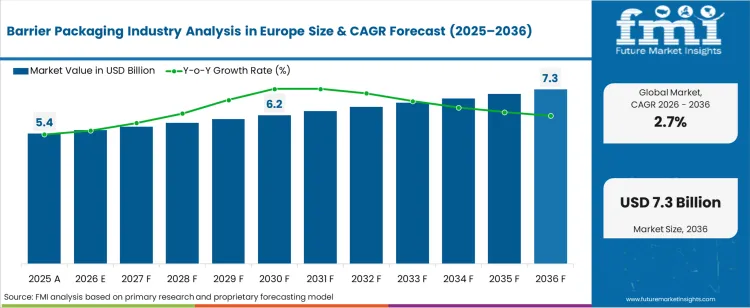
The barrier packaging industry analysis in europe was valued at USD 5.44 billion in 2025, projected to reach USD 5.59 billion in 2026, and is forecast to expand to USD 7.30 billion by 2036 at a 2.7% CAGR. European food safety legislation and pharmaceutical packaging integrity standards sustain demand for barrier packaging that protects contents from oxygen, moisture, aroma, and microbial ingress. The Packaging and Packaging Waste Regulation is simultaneously tightening recyclability requirements, which forces converters to reformulate barrier structures using mono-material or compatible-material designs that pass recycling stream sorting and reprocessing tests. Cold chain infrastructure expansion in eastern Europe and growing e-commerce food delivery volumes are creating new barrier packaging consumption channels.
Summary of Barrier Packaging Industry Analysis in Europe
- Market Snapshot
- The barrier packaging industry analysis in europe is valued at USD 5.44 billion in 2025 and is projected to reach USD 7.30 billion by 2036.
- The industry is expected to grow at a 2.7% CAGR from 2026 to 2036, creating an incremental opportunity of USD 1.71 billion.
- The market operates at the intersection of food safety compliance and packaging sustainability regulation in Europe, where barrier performance certification, recyclability qualification, and brand owner shelf-life specifications define supplier selection.
- Demand and Growth Drivers
- Demand is sustained by food safety regulations that mandate barrier performance levels for perishable product categories, creating non-discretionary procurement requirements for converters and co-packers.
- Mono-material barrier packaging reformulation is accelerating as PPWR recyclability mandates disqualify traditional multi-material laminate structures from compliant packaging categories.
- E-commerce food delivery expansion and cold chain infrastructure growth in eastern European markets are creating new consumption channels for barrier packaging in last-mile distribution.
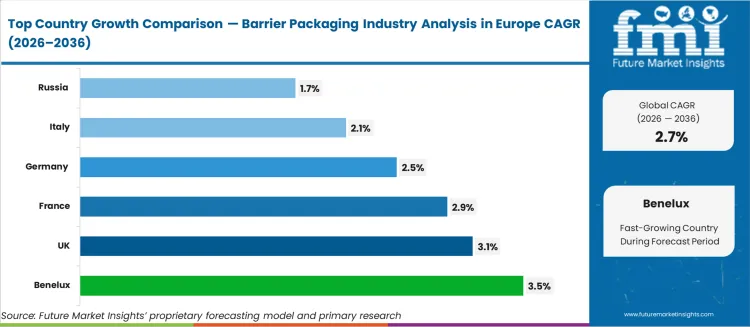
- As per FMI, among countries tracked, Benelux leads at 3.5% CAGR, followed by UK at 3.1%, France at 2.9%, Germany at 2.5%, and Italy at 2.1%.
- Product and Segment View
- The market covers flexible and semi-rigid barrier packaging in formats ranging from stand-up pouches and retort pouches to vacuum bags, blister packs, and bag-in-box systems.
- Applications span oxygen barrier, aroma barrier, and oil/grease barrier functions serving food, healthcare, electronics, agriculture, chemicals, and cosmetics end-use sectors.
- Based on FMI's barrier packaging industry analysis in europe report, Stand-up Pouches leads by Packaging Format with 3.9% share in 2026.
- Low Barrier leads by Barrier Type with 28.6% share in 2026.
- The scope includes market scope includes all barrier packaging formats across low, medium, moderate, high, and ultra-high barrier levels within europe. coverage spans re. Excluded are non-barrier packaging without functional barrier properties is excluded.
- Geography and Competitive Outlook
- Benelux and UK are the fastest-growing markets, while Russia and Italy remain mature demand bases with replacement-cycle purchasing patterns.
- Competition is shaped by manufacturing scale, distribution networks, and compliance capabilities, with key players including Amcor Plc, Berry Global Group, Inc, Sealed Air Corp, Mondi Plc, Tetra Pak.
- Analyst Opinion at FMI
- Ismail Sutaria, Principal Consultant for Packaging at FMI, opines: 'In my analysis, I have observed that European barrier packaging converters face a narrowing technology window where multi-material laminate structures are being regulated out of compliant categories while mono-material alternatives have not yet achieved performance parity across all barrier grades. Converters who invest in mono-material barrier extrusion and coating capability before the 2028 specification lock-in period will secure multi-year supply positions with brand owners. Those who delay face capacity exclusion as specification-compliant supply tightens against regulatory-driven demand.'
- Strategic Implications / Executive Takeaways
- Converters must invest in mono-material barrier extrusion and coating lines to qualify for brand owner specifications ahead of PPWR recyclability compliance deadlines.
- Food processors should dual-qualify barrier packaging suppliers to ensure continuity during the multi-material to mono-material transition period.
- Resin producers must expand EVOH and barrier polymer capacity in Europe to serve the reformulation demand driven by packaging recyclability mandates.
FMI analysts observe that the European barrier packaging industry is transitioning from traditional multi-material laminate structures toward mono-material barrier solutions that maintain shelf-life performance while meeting recyclability mandates. Converters that historically combined polyamide, EVOH, and polyethylene in barrier films must now qualify alternative structures using compatibilized mono-PE or mono-PP designs with integrated barrier layers. This reformulation cycle increases development costs and extends qualification timelines with brand owner customers.
Country-level growth trajectories vary based on local regulatory frameworks and industrial maturity. Benelux leads the expansion at 3.5% CAGR, followed by UK at 3.1%, France at 2.9%, Germany at 2.5%, Italy at 2.1%, Russia at 1.7%. Mature markets such as Russia and Italy continue to generate steady replacement demand while Benelux and UK benefit from expanding capacity and industrial investment.
Barrier Packaging Industry Analysis in Europe Key Takeaways
| Metric | Details |
|---|---|
| Industry Size (2026) | USD 5.59 billion |
| Industry Value (2036) | USD 7.30 billion |
| CAGR (2026-2036) | 2.7% |
Source: Future Market Insights, 2026
Barrier Packaging Industry Analysis in Europe Definition
Barrier packaging encompasses flexible and semi-rigid packaging formats engineered to prevent the transmission of oxygen, moisture, aroma, oil, or grease through the package wall. Formats include stand-up pouches, retort pouches, vacuum bags, flow wraps, lidding films, sachets, blister packs, shrink wraps, pillow packs, gusseted bags, spouted pouches, and bag-in-box systems. Barrier levels range from low to ultra-high depending on product shelf-life and storage requirements.
Barrier Packaging Industry Analysis in Europe Inclusions
Market scope includes all barrier packaging formats across low, medium, moderate, high, and ultra-high barrier levels within Europe. Coverage spans regional market sizes, forecast period 2026 to 2036, segmentation by packaging format, barrier type, application, end use, and country.
Barrier Packaging Industry Analysis in Europe Exclusions
Non-barrier packaging without functional barrier properties is excluded. Rigid containers such as glass bottles, metal cans, and rigid plastics without barrier coatings fall outside the scope. Primary paper packaging without integrated barrier layers is omitted.
Barrier Packaging Industry Analysis in Europe Research Methodology
- Primary Research: Analysts engaged with procurement managers, manufacturing engineers, and supply chain directors to map the decision triggers driving product upgrades and supplier qualification cycles in the barrier packaging industry analysis in europe space.
- Desk Research: Data collection aggregated regulatory filings, trade statistics, industry standards ratification schedules, and publicly available financial disclosures from leading participants.
- Market-Sizing and Forecasting: Baseline values derive from a bottom-up aggregation of production volumes and trade flows, applying region-specific adoption curves to project future demand velocity.
- Data Validation and Update Cycle: Projections are tested against publicly reported capital expenditure guidance and production capacity announcements from leading industry participants.
Barrier Packaging Industry Analysis in Europe Drivers, Restraints, Opportunities
Future Market Insights analysis identifies the European barrier packaging market as structurally driven by the dual regulatory forces of food safety compliance and packaging sustainability legislation. The market exists at its current scale because perishable food, pharmaceutical, and chemical products require engineered barrier protection that uncoated substrates cannot provide, while recycling mandates are simultaneously forcing the reformulation of how that barrier is achieved.
The tension in this market lies between the performance requirements of high-barrier packaging and the recyclability requirements of EU packaging regulation. Multi-material laminates that achieve the best barrier performance are the most difficult to recycle. Converters that develop mono-material barrier structures matching multi-material performance will capture the specification advantage as brand owners face regulatory compliance deadlines. Those that cannot will lose category access in regulated markets.
- PPWR material compliance: The Packaging and Packaging Waste Regulation mandates that flexible packaging meet material-specific recyclability criteria by compliance deadlines. Multi-material barrier laminates that cannot be sorted and reprocessed in existing recycling infrastructure face market exclusion, which drives converter investment in mono-material barrier alternatives.
- Pharmaceutical serialization requirements: EU Falsified Medicines Directive compliance requires tamper-evident and barrier-certified packaging for pharmaceutical products. FMI is of the opinion that blister pack and sachet barrier specifications are tightening as temperature-sensitive biologics and specialty pharmaceuticals enter European distribution channels.
- Protein shelf-life extension: Meat, seafood, and dairy processors across Europe are extending modified atmosphere packaging adoption to reduce food waste and meet retailer shelf-life specifications. High-barrier and ultra-high-barrier vacuum and retort packaging formats are displacing overwrap and tray-based alternatives in these categories.
Barrier Packaging Industry Analysis in Europe Key Takeaways
Power in the European barrier packaging value chain concentrates at the resin and film manufacturer level, where producers of barrier polymers such as EVOH and polyamide control the functional performance layer that differentiates high-barrier from standard packaging. Converters who lack in-house extrusion capability depend on these suppliers for their core barrier component.
Pricing asymmetry separates commodity low-barrier packaging, where pricing follows polyethylene resin markets, from high-barrier and ultra-high-barrier formats, where specialty polymer content and multi-layer processing costs support premiums of 40% to 100% above standard flexible packaging.
Sourcing fragility exists in EVOH supply concentration, where a limited number of Asian and European producers control global capacity. Periodic force majeure events at EVOH plants create allocation shortages that cascade through the European barrier packaging supply chain.
Brand and compliance risks center on the shelf-life validation process. Barrier packaging that fails accelerated shelf-life testing with a specific food product must be reformulated and re-qualified, which extends time-to-market and increases development costs. Recyclability certification adds a second qualification gate that compounds this risk.
Geographic leverage within Europe varies by regulatory maturity and food industry structure. The United Kingdom and Benelux regions drive the highest growth through advanced food packaging specifications and aggressive sustainability targets. Germany anchors volume through its large food processing sector. France and Italy maintain steady demand through traditional food culture and growing ready-meal adoption. Russia represents a lower-growth market with less regulatory pressure on packaging recyclability.
For C-suite executives, European barrier packaging is a market where regulatory compliance is simultaneously increasing technical complexity and limiting material options. The strategic imperative is to invest in mono-material barrier development before multi-material structures are regulated out of compliant packaging categories, while maintaining the shelf-life performance that food safety and pharmaceutical regulations require.
Top Dynamics and Industry Trends Shaping the Europe Barrier Packaging Market
Premiumization of Food and Beverage Products in Europe
Advanced barrier packaging is on rise due to the growth of consumer preference for premium products in Europe. Premium products in food and beverage require sophisticated protection in order to keep them fresh, extend their shelf life, and protect them from contaminants. There is quite a high demand for barrier packaging in food and beverage market, particularly in the Western Europe markets of France, Germany, and Italy.
The consumers here tend to emphasize more on quality, taste, and food safety. The growth in the organic, artisanal, and gourmet product categories has also fueled a demand for premium barrier packaging since such products are associated with high performance barriers that have to prevent the ingress of oxygen and moisture to preserve the delicate nature of contents.
Having better visual designs, premium packaging materials also meet the demand for branding luxury products. Increasing emphasis on product integrity and brand image in premium segments will continue innovation and demand for superior barrier packaging solutions.
Rising Demand for High-Performance Packaging in Healthcare and Pharmaceuticals
The healthcare and pharmaceutical industry is expanding in Europe largely due to the aging population and increasing healthcare needs. This is creating an opportunity for barrier packaging companies to capitalize on the strict requirements for packaging in the healthcare and pharmaceutical industries, in which protection from contamination, moisture, oxygen, and light must be ensured.
They innovate by making advanced barrier materials that extend the shelf life of pharmaceutical products, protect sensitive medications, and ensure conformity with EU regulations on medical packaging. Although new drugs, biologics, and vaccines comes into the market, and appropriate packaging is needed for maintaining the stability of a product during supply chain.
Thus in this market segment, specialized barrier solutions for medical devices and pharmaceuticals manufactured under strict safety standards can provide a growth opportunity for the manufacturer.
High Production Cost of Barrier Packaging Limits Expansion
A major problem facing the market for barrier packaging is that these packages require advanced materials like multilayer films, aluminum foils, or specialized polymers like EVOH that are expensive. These material provide greater resistance to moisture, oxygen, and other gases but demand more complicated processes to manufacture hence being costlier.
The production cost of high barrier packaging tends to be more elevated compared to regular packaging. This is going to be challenge to manufacturer operating in cost sensitive markets from adopting such packaging. This will limit its application especially in lower margin products where price should be extremely competitive. As a result, end user will find less expensive alternatives in such situations.
Comparison of Historical vs Future Outlook on Changing Consumer Trends for Europe Barrier Packaging Industry
The Europe barrier packaging market witnessed a steady growth in historic period driven by increasing demand for longer shelf life products along with an increase in consumer awareness of food safety and quality. The market have a strong demand from the food and beverage sector, contributing the leading segment due to growing popularity of ready to eat meals and packaged fresh food.
Pharmaceutical industry also grew and contributes in market growth to a great extent especially after pandemic as delivery of vaccines and medications increased. This has generated the demand for secure and tamper evident packaging solutions. But sustainability concerns emerged as one of the main issues as many European countries began enforcing strict rules on packaging waste.
Thus producers were compelled to work creatively with recyclable or compostable high barrier materials. Overall, the market reflected a moderate growth rate with demand of advanced packaging material.
In forecast period, market growth for the Europe barrier packaging is expected to flourish due to increasing focus on high barrier packaging solutions. The barrier packaging market in Europe is expected to grow in future supported by the European Union sustainability regulations that motivate the use of biodegradable, compostable, and recyclable barrier packaging solutions.
Reducing the usage of plastics material has become more important issue and it being replaced by with new materials such as paper based, bio based, and mono material packaging. The key sectors will be food and beverage, pharmaceutical, and personal care which stimulate the market growth. An aging population would have a stimulating effect on the demand for medical packaging.
Also, an increasing e-commerce sector requiring strong packaging solutions will boost the market sales. Technological advances and innovations in nanotechnology based coatings and smart packaging that improve barrier properties without compromised environment goals will be creating traction in market.
Key Europe Barrier Packaging Market Players and Concentration
Tier 1 companies in the European barrier packaging industry include Mondi Plc, Constantia Flexibles, Clondalkin Group, and RKW Group with market revenue above USD 100 million. These manufacturers are market leaders in barrier packaging within Europe having extensive production capacity, different product offerings, and extensive manufacturing expertise. These companies are capturing around 25% to 30% of Europe's market share in the barrier packaging industry.
Tier 2 of the Europe barrier packaging industry incorporates companies Sealed Air Corporation, Sonoco Products Company, Taghleef industries and Schur Flexibles with revenue of USD 50 to 100 million. They have limited presence, and well-maintained knowledge but may not have expertise and advanced manufacturing technology.
Tier 3 category in the Europe barrier packaging market includes the small-scale players of the region with revenue below USD 50 million. These companies fulfil the local market demand and are recognized as an unorganized market. They have a country level presence, limited manufacturing facilities, and expertise in local market needs.
Analysis of Top Countries Manufacturing, Certifying, and Using Barrier Packaging Solutions in Europe
The section below covers the future forecast for barrier packaging market in terms of countries.
.webp "Top Country Growth Comparison Barrier Packaging Industry Analysis In Europe Cagr (2026 2036)")
| Countries | Value CAGR (2026 to 2036) |
|---|---|
| Germany | 2.5% |
| UK | 3.1% |
| Italy | 2.1% |
| France | 2.9% |
| Benelux | 3.5% |
| Russia | 1.7% |
Rise in Cardiovascular Disease among Consumers in the UK to Drive the Market
The data published by the British Heart Foundation states that heart and circulatory diseases affect around 7.6 million people in the UK. It is estimated that more than half of the population in the UK will get a heart or circulatory condition lifetime. It will raise the demand for medical devices and pharmaceuticals and require secure and reliable packaging solutions.
With more and more people needing medications such as blood pressure drugs, statins, and other treatments, pharmaceutical companies will need high-barrier packaging for product stability, safety and extended shelf life. This will increase the demand for blister packs, vials, and other barrier packages in the healthcare industries.
Additionally, the increased need for health and safety might spill over into food packaging because consumers will be demanding fresh foods and heart-healthy products that continue to protect food quality, hence supporting the growth of the barrier package market in UK. UK is anticipated to grow at 3.1% of growth rate in forecast years.
E-commerce Growth in Germany Create Lucrative Demand
Germany is anticipated to reach 22.4% of the value share in 2036. As per the International Trade Administration, USA Department of Commerce, the market for e-commerce in Germany is blooming. The total sales of e-commerce was USD 141.2 billion in 2022 which is around 11% growth as compared to 2021.
With the rise of online purchases for food, medicine, and other consumer goods, the demand for appropriate packaging is increasing that will prevent damage to products while in transport to ensure they reach consumers in a good condition. In particular, for grocery, and fragile products like drugs, high-barrier packaging protects them from the loss of freshness, a deterioration in quality, and safeguard the products.
With the emergence of e-commerce, more and more retailers strive to meet consumer demands regarding product safety and quality by requiring durable and advanced barrier packaging solutions.
Europe Barrier Packaging Industry Analysis by Top Investment Segments
The section contains information about the leading segments in the industry.
Oxygen Barrier is Critical Application
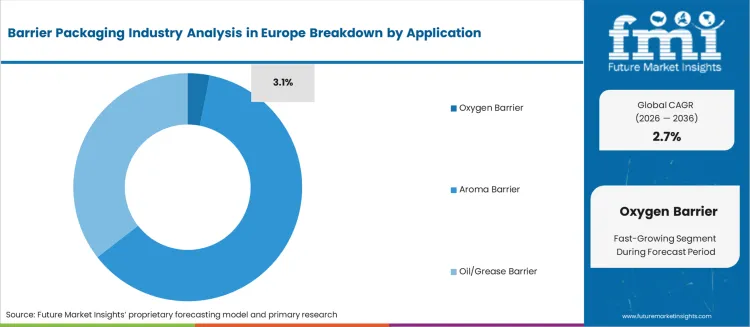
| Application | Oxygen Barrier |
|---|---|
| Value CAGR (2036) | 3.1% |
Oxygen barrier leads in the application of barrier packaging with more than 55.4% value share in 2026. Oxygen barrier packaging is the most advanced among all types of barrier packaging, as it is playing a very crucial role in extending the shelf life of perishable food products.
Oxygen is one of the major contributors to food spoilage and degradation, and efficient oxygen barriers significantly minimize oxidative reactions that cause food to deteriorate. Due to this, such packaging is most essential for the food and beverages industries to ensure that their products remain fresh and do not degrade.
With growing pharmaceutical applications where drugs under protection are sensitive to oxidation, a growing need for oxygen barrier solutions has been emerging. With increasing consumer awareness regarding food safety and quality, the demand for oxygen barrier packaging is increasing day by day across most industries.
Stand Up Pouches to Gain Impetus
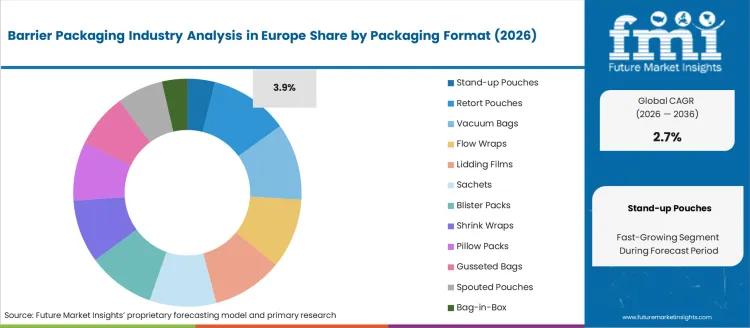
| Packaging Format | Stand-up Pouches |
|---|---|
| Value CAGR (2036) | 3.9% |
Stand up pouches is one of the leading segment with optimum growth rate and it is anticipated to hold around 25.7% value share in 2036. Stand-up pouches are increasingly used and in demand as they are easy to carry and flexible. The pouch is attractive in appearance on shelves and thus grabs attention. The pouch is light in weight that reduces shipping costs. Advanced barrier materials guard against moisture, oxygen, and light, hence, the shelf life of several products is ensured.
Consumer demand, over the past few years, has been driving innovation in making recyclable and biodegradable options available for packaging. Increased consumption of on-the-go products with a growing percentage of the population turning to e-commerce make stand-up pouches a propitious segment for the near future.
Key Europe Barrier Packaging Market Players and Concentration
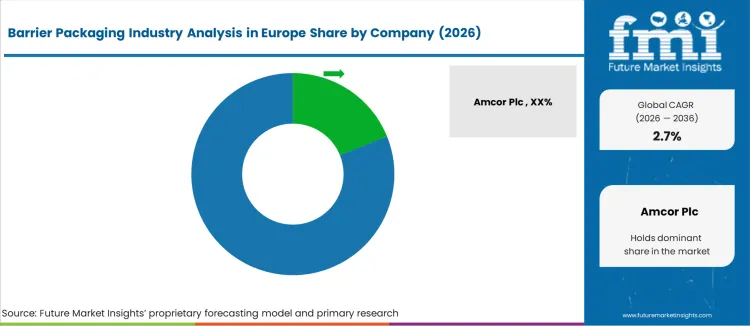
Key players of Europe barrier packaging industry are developing and launching new products in the market. They are integrating with different firms and extending their geographical presence. Few of them are also collaborating and partnering with local brands and start-up companies for new product development.
Scope of the Report
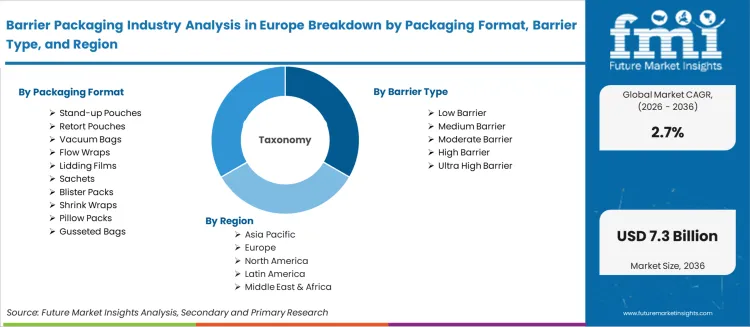
| Metric | Value |
|---|---|
| Quantitative Units | USD 5.59 billion to USD 7.30 billion, at a CAGR of 2.7% |
| Market Definition | Barrier packaging encompasses flexible and semi-rigid packaging formats engineered to prevent the transmission of oxygen, moisture, aroma, oil, or grease through the package wall. Formats include stand-up pouches, retort pouches, vacuum bags, flow wraps, lidding films, sachets, blister packs, shrink wraps, pillow packs, gusseted bags, spouted pouches, and bag-in-box systems. Barrier levels range from low to ultra-high depending on product shelf-life and storage requirements. |
| Segmentation | Packaging Format: Stand-up Pouches, Retort Pouches, Vacuum Bags, Flow Wraps, Lidding Films, Sachets, Blister Packs, Shrink Wraps, Pillow Packs, Gusseted Bags, Spouted Pouches, Bag-in-Box; Barrier Type: Low Barrier, Medium Barrier, Moderate Barrier, High Barrier, Ultra High Barrier; Application: Oxygen Barrier, Aroma Barrier, Oil/Grease Barrier; End Use: Food, _Meat, Seafood and Poultry, _Baby Food, _Snacks, _Bakery and Confectionery, _Pet Food, _Dairy Food, _Ready to Eat Meals, _Other Food, Healthcare, Electrical & Electronic, Agriculture, Chemicals, Cosmetics, Other Industrial |
| Regions Covered | North America, Latin America, Europe, East Asia, South Asia, Oceania, Middle East & Africa |
| Countries Covered | Benelux, UK, France, Germany, Italy, Russia, and 40 plus countries |
| Key Companies Profiled | Amcor Plc, Berry Global Group, Inc, Sealed Air Corp, Mondi Plc, Tetra Pak, Pact Group Holdings Limited, Constantia Flexibles Group Gmbh, Sonoco Products Company, Uflex Limited, Proampac Llc, Innovia Films, Schur Flexibles Holding Gesmbh, Taghleef Industries Llc, Sappi Europe Sa, Ahlstrom Holding, Huhtamäki Oyj, Sig Group Ag, Toppan Europe Gmbh, Novolex Holdings Llc, Coveris, Clondalkin Group Holdings B.V, Trioworld, The Interplast Group, Futamura Group, Rkw Group |
| Forecast Period | 2026 to 2036 |
| Approach | Forecasting models apply a bottom-up methodology starting with global installed base metrics and projecting conversion rates to specialized applications. Cross-validation uses publicly reported expenditure guidance from leading industry participants. |
Top Segments Studied in the Europe Barrier Packaging Market Report
By Packaging Format:
Packaging formats in barrier packaging market include stand-up pouches, retort pouches, vacuum bags, flow wraps, lidding films, sachets, blister packs, shrink wraps, pillow packs, gusseted bags, spouted pouches, and bag-in-box.
By Barrier Type:
The barrier packaging market is divided into low barrier (OTR100cc/m2*day), medium barrier (OTR20-50 cc/m2*day), moderate barrier (OTR<10cc/m2*day), high barrier (OTR <1cc/m2*day), and ultra-high barrier (OTR<0.1cc/m2*day).
By Material:
The barrier packaging materials are categorized including metal film, plastic, biodegradable, and paper. Metal film is divided into aluminum foil, and metalized Film. Plastic is divide into polyethylene, polypropylene, polyethylene terephthalate (PET), polyvinylidene chloride (PVDC), ethylene vinyl alcohol (EVOH), and nylon (Polyamide).
By Application:
The barrier packaging applications are categorized including oxygen barrier, aroma barrier, and oil/grease barrier.
By End Use:
The barrier packaging end use are categorized including food, healthcare, electrical & electronic, agriculture, chemicals, cosmetics, and other industrial.
By Country:
Key countries of Europe such as Germany, Spain, France, Italy, BENELUX, Nordic, Russia, Poland, Israel, and Rest of Europe are covered.
Bibliography
- 1. European Commission, Directorate-General for Environment. (2024). Packaging and Packaging Waste Regulation (PPWR) final text. European Commission.
- 2. European Food Safety Authority. (2024). Guidance on food contact materials: Barrier packaging assessment. EFSA.
- 3. European Parliament and Council. (2011). Directive 2011/62/EU on falsified medicinal products. EUR-Lex.
- 4. Flexible Packaging Europe. (2024). Design for recyclability guidelines for flexible packaging. FPE.
- 5. Organisation for Economic Co-operation and Development. (2024). Extended producer responsibility for packaging: Updated guidance. OECD.
- 6. CEFLEX. (2024). Designing for a circular economy: Guidelines for mono-material flexible packaging. CEFLEX.
This bibliography is provided for reader reference. The full Future Market Insights report contains the complete reference list with primary research documentation.
Frequently Asked Questions
How large is the demand for Barrier Packaging Industry Analysis in Europe in the global market in 2026?
Demand for barrier packaging industry analysis in europe in the global market is estimated to be valued at USD 5.59 billion in 2026.
What will be the market size of Barrier Packaging Industry Analysis in Europe in the global market by 2036?
Market size for barrier packaging industry analysis in europe is projected to reach USD 7.30 billion by 2036.
What is the expected demand growth for Barrier Packaging Industry Analysis in Europe in the global market between 2026 and 2036?
Demand for barrier packaging industry analysis in europe is expected to grow at a CAGR of 2.7% between 2026 and 2036.
Which Packaging Format is poised to lead global sales by 2026?
Stand-up Pouches accounts for 3.9% in 2026 based on versatile shelf-presence format with growing adoption in food, pet food, and personal care applications requiring moisture and oxygen barrier protection.
How is the role of Low Barrier in driving Barrier Packaging Industry Analysis in Europe adoption in 2026?
Low Barrier holds 28.6% of Barrier Type share in 2026, driven by the largest volume segment serving general food packaging where basic moisture and grease protection requirements drive commodity-grade demand.
What is driving demand in Benelux?
Benelux leads growth at 3.5% CAGR, supported by advanced packaging sustainability regulation and food industry specification leadership creating early demand for mono-material barrier solutions.
What is UK's growth outlook in this report?
UK is projected to grow at a CAGR of 3.1% during 2026 to 2036.
What is Barrier Packaging Industry Analysis in Europe and what is it mainly used for?
Barrier packaging encompasses flexible and semi-rigid packaging formats engineered to prevent the transmission of oxygen, moisture, aroma, oil, or grease through the package wall. Formats include stand-up pouches, retort pouches, vacuum bags, flow wraps, lidding films, sachets, blister packs, shrink wraps, pillow packs, gusseted bags, spouted pouches, and bag-in-box systems.
Preview the report firsthand - request a free sample
Get SampleGet the brochure for pricing and purchase details.
Get PDFTable of Content
- Executive Summary
- Global Market Outlook
- Demand-side Trends
- Supply-side Trends
- Technology Roadmap Analysis
- Analysis and Recommendations
- Market Overview
- Market Coverage / Taxonomy
- Market Definition / Scope / Limitations
- Research Methodology
- Chapter Orientation
- Analytical Lens and Working Hypotheses
- Market Structure, Signals, and Trend Drivers
- Benchmarking and Cross-market Comparability
- Market Sizing, Forecasting, and Opportunity Mapping
- Research Design and Evidence Framework
- Desk Research Programme (Secondary Evidence)
- Company Annual and Sustainability Reports
- Peer-reviewed Journals and Academic Literature
- Corporate Websites, Product Literature, and Technical Notes
- Earnings Decks and Investor Briefings
- Statutory Filings and Regulatory Disclosures
- Technical White Papers and Standards Notes
- Trade Journals, Industry Magazines, and Analyst Briefs
- Conference Proceedings, Webinars, and Seminar Materials
- Government Statistics Portals and Public Data Releases
- Press Releases and Reputable Media Coverage
- Specialist Newsletters and Curated Briefings
- Sector Databases and Reference Repositories
- FMI Internal Proprietary Databases and Historical Market Datasets
- Subscription Datasets and Paid Sources
- Social Channels, Communities, and Digital Listening Inputs
- Additional Desk Sources
- Expert Input and Fieldwork (Primary Evidence)
- Primary Modes
- Qualitative Interviews and Expert Elicitation
- Quantitative Surveys and Structured Data Capture
- Blended Approach
- Why Primary Evidence is Used
- Field Techniques
- Interviews
- Surveys
- Focus Groups
- Observational and In-context Research
- Social and Community Interactions
- Stakeholder Universe Engaged
- C-suite Leaders
- Board Members
- Presidents and Vice Presidents
- R&D and Innovation Heads
- Technical Specialists
- Domain Subject-matter Experts
- Scientists
- Physicians and Other Healthcare Professionals
- Governance, Ethics, and Data Stewardship
- Research Ethics
- Data Integrity and Handling
- Primary Modes
- Tooling, Models, and Reference Databases
- Desk Research Programme (Secondary Evidence)
- Data Engineering and Model Build
- Data Acquisition and Ingestion
- Cleaning, Normalisation, and Verification
- Synthesis, Triangulation, and Analysis
- Quality Assurance and Audit Trail
- Market Background
- Market Dynamics
- Drivers
- Restraints
- Opportunity
- Trends
- Scenario Forecast
- Demand in Optimistic Scenario
- Demand in Likely Scenario
- Demand in Conservative Scenario
- Opportunity Map Analysis
- Product Life Cycle Analysis
- Supply Chain Analysis
- Investment Feasibility Matrix
- Value Chain Analysis
- PESTLE and Porter’s Analysis
- Regulatory Landscape
- Regional Parent Market Outlook
- Production and Consumption Statistics
- Import and Export Statistics
- Market Dynamics
- Global Market Analysis 2021 to 2025 and Forecast, 2026 to 2036
- Historical Market Size Value (USD Million) Analysis, 2021 to 2025
- Current and Future Market Size Value (USD Million) Projections, 2026 to 2036
- Y-o-Y Growth Trend Analysis
- Absolute $ Opportunity Analysis
- Global Market Pricing Analysis 2021 to 2025 and Forecast 2026 to 2036
- Global Market Analysis 2021 to 2025 and Forecast 2026 to 2036, By Packaging Format
- Introduction / Key Findings
- Historical Market Size Value (USD Million) Analysis By Packaging Format , 2021 to 2025
- Current and Future Market Size Value (USD Million) Analysis and Forecast By Packaging Format , 2026 to 2036
- Stand-up Pouches
- Retort Pouches
- Vacuum Bags
- Flow Wraps
- Lidding Films
- Sachets
- Blister Packs
- Shrink Wraps
- Pillow Packs
- Gusseted Bags
- Spouted Pouches
- Stand-up Pouches
- Y-o-Y Growth Trend Analysis By Packaging Format , 2021 to 2025
- Absolute $ Opportunity Analysis By Packaging Format , 2026 to 2036
- Global Market Analysis 2021 to 2025 and Forecast 2026 to 2036, By Barrier Type
- Introduction / Key Findings
- Historical Market Size Value (USD Million) Analysis By Barrier Type, 2021 to 2025
- Current and Future Market Size Value (USD Million) Analysis and Forecast By Barrier Type, 2026 to 2036
- Low Barrier
- Medium Barrier
- Moderate Barrier
- High Barrier
- Ultra High Barrier
- Low Barrier
- Y-o-Y Growth Trend Analysis By Barrier Type, 2021 to 2025
- Absolute $ Opportunity Analysis By Barrier Type, 2026 to 2036
- Global Market Analysis 2021 to 2025 and Forecast 2026 to 2036, By Application
- Introduction / Key Findings
- Historical Market Size Value (USD Million) Analysis By Application, 2021 to 2025
- Current and Future Market Size Value (USD Million) Analysis and Forecast By Application, 2026 to 2036
- Oxygen Barrier
- Aroma Barrier
- Oil/Grease Barrier
- Oxygen Barrier
- Y-o-Y Growth Trend Analysis By Application, 2021 to 2025
- Absolute $ Opportunity Analysis By Application, 2026 to 2036
- Global Market Analysis 2021 to 2025 and Forecast 2026 to 2036, By End Use
- Introduction / Key Findings
- Historical Market Size Value (USD Million) Analysis By End Use, 2021 to 2025
- Current and Future Market Size Value (USD Million) Analysis and Forecast By End Use, 2026 to 2036
- Food
- Meat, Seafood and Poultry
- Baby Food
- Snacks
- Bakery and Confectionery
- Pet Food
- Dairy Food
- Ready to Eat Meals
- Other Food
- Healthcare
- Electrical & Electronic
- Agriculture
- Chemicals
- Cosmetics
- Other Industrial
- Food
- Y-o-Y Growth Trend Analysis By End Use, 2021 to 2025
- Absolute $ Opportunity Analysis By End Use, 2026 to 2036
- Global Market Analysis 2021 to 2025 and Forecast 2026 to 2036, By Region
- Introduction
- Historical Market Size Value (USD Million) Analysis By Region, 2021 to 2025
- Current Market Size Value (USD Million) Analysis and Forecast By Region, 2026 to 2036
- North America
- Latin America
- Western Europe
- Eastern Europe
- East Asia
- South Asia and Pacific
- Middle East & Africa
- Market Attractiveness Analysis By Region
- North America Market Analysis 2021 to 2025 and Forecast 2026 to 2036, By Country
- Historical Market Size Value (USD Million) Trend Analysis By Market Taxonomy, 2021 to 2025
- Market Size Value (USD Million) Forecast By Market Taxonomy, 2026 to 2036
- By Country
- USA
- Canada
- Mexico
- By Packaging Format
- By Barrier Type
- By Application
- By End Use
- By Country
- Market Attractiveness Analysis
- By Country
- By Packaging Format
- By Barrier Type
- By Application
- By End Use
- Key Takeaways
- Latin America Market Analysis 2021 to 2025 and Forecast 2026 to 2036, By Country
- Historical Market Size Value (USD Million) Trend Analysis By Market Taxonomy, 2021 to 2025
- Market Size Value (USD Million) Forecast By Market Taxonomy, 2026 to 2036
- By Country
- Brazil
- Chile
- Rest of Latin America
- By Packaging Format
- By Barrier Type
- By Application
- By End Use
- By Country
- Market Attractiveness Analysis
- By Country
- By Packaging Format
- By Barrier Type
- By Application
- By End Use
- Key Takeaways
- Western Europe Market Analysis 2021 to 2025 and Forecast 2026 to 2036, By Country
- Historical Market Size Value (USD Million) Trend Analysis By Market Taxonomy, 2021 to 2025
- Market Size Value (USD Million) Forecast By Market Taxonomy, 2026 to 2036
- By Country
- Germany
- UK
- Italy
- Spain
- France
- Nordic
- BENELUX
- Rest of Western Europe
- By Packaging Format
- By Barrier Type
- By Application
- By End Use
- By Country
- Market Attractiveness Analysis
- By Country
- By Packaging Format
- By Barrier Type
- By Application
- By End Use
- Key Takeaways
- Eastern Europe Market Analysis 2021 to 2025 and Forecast 2026 to 2036, By Country
- Historical Market Size Value (USD Million) Trend Analysis By Market Taxonomy, 2021 to 2025
- Market Size Value (USD Million) Forecast By Market Taxonomy, 2026 to 2036
- By Country
- Russia
- Poland
- Hungary
- Balkan & Baltic
- Rest of Eastern Europe
- By Packaging Format
- By Barrier Type
- By Application
- By End Use
- By Country
- Market Attractiveness Analysis
- By Country
- By Packaging Format
- By Barrier Type
- By Application
- By End Use
- Key Takeaways
- East Asia Market Analysis 2021 to 2025 and Forecast 2026 to 2036, By Country
- Historical Market Size Value (USD Million) Trend Analysis By Market Taxonomy, 2021 to 2025
- Market Size Value (USD Million) Forecast By Market Taxonomy, 2026 to 2036
- By Country
- China
- Japan
- South Korea
- By Packaging Format
- By Barrier Type
- By Application
- By End Use
- By Country
- Market Attractiveness Analysis
- By Country
- By Packaging Format
- By Barrier Type
- By Application
- By End Use
- Key Takeaways
- South Asia and Pacific Market Analysis 2021 to 2025 and Forecast 2026 to 2036, By Country
- Historical Market Size Value (USD Million) Trend Analysis By Market Taxonomy, 2021 to 2025
- Market Size Value (USD Million) Forecast By Market Taxonomy, 2026 to 2036
- By Country
- India
- ASEAN
- Australia & New Zealand
- Rest of South Asia and Pacific
- By Packaging Format
- By Barrier Type
- By Application
- By End Use
- By Country
- Market Attractiveness Analysis
- By Country
- By Packaging Format
- By Barrier Type
- By Application
- By End Use
- Key Takeaways
- Middle East & Africa Market Analysis 2021 to 2025 and Forecast 2026 to 2036, By Country
- Historical Market Size Value (USD Million) Trend Analysis By Market Taxonomy, 2021 to 2025
- Market Size Value (USD Million) Forecast By Market Taxonomy, 2026 to 2036
- By Country
- Kingdom of Saudi Arabia
- Other GCC Countries
- Turkiye
- South Africa
- Other African Union
- Rest of Middle East & Africa
- By Packaging Format
- By Barrier Type
- By Application
- By End Use
- By Country
- Market Attractiveness Analysis
- By Country
- By Packaging Format
- By Barrier Type
- By Application
- By End Use
- Key Takeaways
- Key Countries Market Analysis
- USA
- Pricing Analysis
- Market Share Analysis, 2025
- By Packaging Format
- By Barrier Type
- By Application
- By End Use
- Canada
- Pricing Analysis
- Market Share Analysis, 2025
- By Packaging Format
- By Barrier Type
- By Application
- By End Use
- Mexico
- Pricing Analysis
- Market Share Analysis, 2025
- By Packaging Format
- By Barrier Type
- By Application
- By End Use
- Brazil
- Pricing Analysis
- Market Share Analysis, 2025
- By Packaging Format
- By Barrier Type
- By Application
- By End Use
- Chile
- Pricing Analysis
- Market Share Analysis, 2025
- By Packaging Format
- By Barrier Type
- By Application
- By End Use
- Germany
- Pricing Analysis
- Market Share Analysis, 2025
- By Packaging Format
- By Barrier Type
- By Application
- By End Use
- UK
- Pricing Analysis
- Market Share Analysis, 2025
- By Packaging Format
- By Barrier Type
- By Application
- By End Use
- Italy
- Pricing Analysis
- Market Share Analysis, 2025
- By Packaging Format
- By Barrier Type
- By Application
- By End Use
- Spain
- Pricing Analysis
- Market Share Analysis, 2025
- By Packaging Format
- By Barrier Type
- By Application
- By End Use
- France
- Pricing Analysis
- Market Share Analysis, 2025
- By Packaging Format
- By Barrier Type
- By Application
- By End Use
- India
- Pricing Analysis
- Market Share Analysis, 2025
- By Packaging Format
- By Barrier Type
- By Application
- By End Use
- ASEAN
- Pricing Analysis
- Market Share Analysis, 2025
- By Packaging Format
- By Barrier Type
- By Application
- By End Use
- Australia & New Zealand
- Pricing Analysis
- Market Share Analysis, 2025
- By Packaging Format
- By Barrier Type
- By Application
- By End Use
- China
- Pricing Analysis
- Market Share Analysis, 2025
- By Packaging Format
- By Barrier Type
- By Application
- By End Use
- Japan
- Pricing Analysis
- Market Share Analysis, 2025
- By Packaging Format
- By Barrier Type
- By Application
- By End Use
- South Korea
- Pricing Analysis
- Market Share Analysis, 2025
- By Packaging Format
- By Barrier Type
- By Application
- By End Use
- Russia
- Pricing Analysis
- Market Share Analysis, 2025
- By Packaging Format
- By Barrier Type
- By Application
- By End Use
- Poland
- Pricing Analysis
- Market Share Analysis, 2025
- By Packaging Format
- By Barrier Type
- By Application
- By End Use
- Hungary
- Pricing Analysis
- Market Share Analysis, 2025
- By Packaging Format
- By Barrier Type
- By Application
- By End Use
- Kingdom of Saudi Arabia
- Pricing Analysis
- Market Share Analysis, 2025
- By Packaging Format
- By Barrier Type
- By Application
- By End Use
- Turkiye
- Pricing Analysis
- Market Share Analysis, 2025
- By Packaging Format
- By Barrier Type
- By Application
- By End Use
- South Africa
- Pricing Analysis
- Market Share Analysis, 2025
- By Packaging Format
- By Barrier Type
- By Application
- By End Use
- USA
- Market Structure Analysis
- Competition Dashboard
- Competition Benchmarking
- Market Share Analysis of Top Players
- By Regional
- By Packaging Format
- By Barrier Type
- By Application
- By End Use
- Competition Analysis
- Competition Deep Dive
- Amcor Plc
- Overview
- Product Portfolio
- Profitability by Market Segments (Product/Age /Sales Channel/Region)
- Sales Footprint
- Strategy Overview
- Marketing Strategy
- Product Strategy
- Channel Strategy
- Berry Global Group, Inc
- Sealed Air Corp
- Mondi Plc
- Tetra Pak
- Pact Group Holdings Limited
- Constantia Flexibles Group Gmbh
- Sonoco Products Company
- Uflex Limited
- Proampac Llc
- Innovia Films
- Schur Flexibles Holding Gesmbh
- Taghleef Industries Llc
- Sappi Europe Sa
- Ahlstrom Holding
- Huhtamäki Oyj
- Sig Group Ag
- Toppan Europe Gmbh
- Novolex Holdings Llc
- Coveris
- Amcor Plc
- Competition Deep Dive
- Assumptions & Acronyms Used


