

- Industry Size (2026)
- USD 77.4 Bn
- Forecast (2036)
- USD 105.8 Bn
- CAGR (2026 to 2036)
- 3.2%
Europe Corrugated Packaging Market Forecast and Outlook By FMI
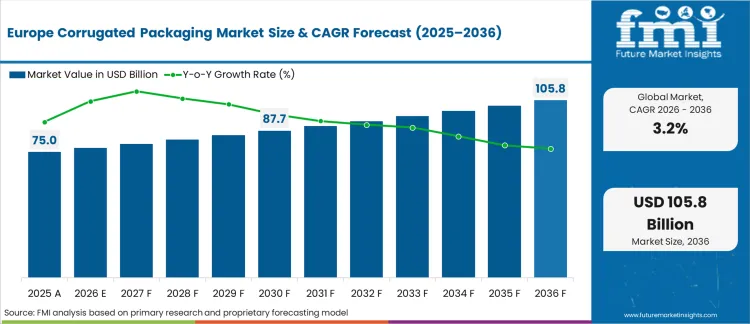
In 2025, the Europe corrugated packaging market was valued at USD 75.3 billion. Based on Future Market Insights' analysis, demand for corrugated packaging is estimated to grow to USD 77.4 billion in 2026 and USD 105.8 billion by 2036. FMI projects a CAGR of 3.2% during the forecast period.
The market is expected to generate an absolute dollar growth of USD 28.4 billion between 2026 and 2036. This reflects steady, logistics- and food-driven expansion rather than rapid structural change, as corrugated packaging is already deeply integrated across retail, industrial, and e-commerce supply chains. Growth is supported by rising online retail shipments, demand for sustainable fiber-based alternatives, and increased use in fresh produce and processed food distribution. However, energy-intensive paper production, recycled fiber price volatility, and environmental compliance costs continue to moderate margin expansion.
“Corrugated packaging doesn’t just deliver environmental benefits, it drives efficiency, reduces costs, and supports more sustainable supply chains,” said Bob McIlvaine, President of the Fibre Box Association and Executive Director of the Corrugated Packaging Alliance.
Summary of Europe Corrugated Packaging Market
- Europe Corrugated Packaging Market Definition
- The Europe corrugated packaging market includes containerboard-based boxes, cartons, trays, and structural formats used for product protection, storage, and transportation across industrial and consumer sectors.
- Demand Drivers in the Market
- Growth in e-commerce and cross-border retail shipments is driving sustained demand for durable corrugated boxes and protective inserts.
- Rising consumption of fresh produce, processed food, and beverages is increasing the need for moisture-resistant and food-grade corrugated packaging.
- Sustainability regulations across the European Union are accelerating the shift toward recycled containerboard and circular fiber sourcing models.
- Key Segments Analyzed in the FMI Report
- By Board Type: Single wall board dominates usage due to its cost efficiency and suitability for FMCG, retail, and logistics applications.
- By Material: Recycled containerboard accounts for a major share supported by Europe’s advanced recycling infrastructure and environmental mandates.
- By Geography: Germany, the United Kingdom, and France represent leading markets driven by strong manufacturing output and retail logistics networks.
- Analyst Opinion at FMI
- Ismail Sutaria, Principal Consultant for Packaging Industry at Future Market Insights, opines, ‘CXOs will find in this report strategic clarity on how recycling mandates, e-commerce growth, and supply chain resilience are reshaping investment priorities in the European corrugated packaging market.’
- Strategic Implications / Executive Takeaways
- Invest in lightweight high-strength board grades to optimize shipping efficiency.
- Expand recycled fiber integration to meet EU sustainability compliance targets.
- Strengthen automation in box converting operations to manage labor and cost pressures.
- Methodology
- Market estimates were validated through interviews with corrugated converters and containerboard suppliers.
- Secondary research included European trade data and packaging industry reports.
- Forecasts were developed using retail, food production, and logistics demand modeling.
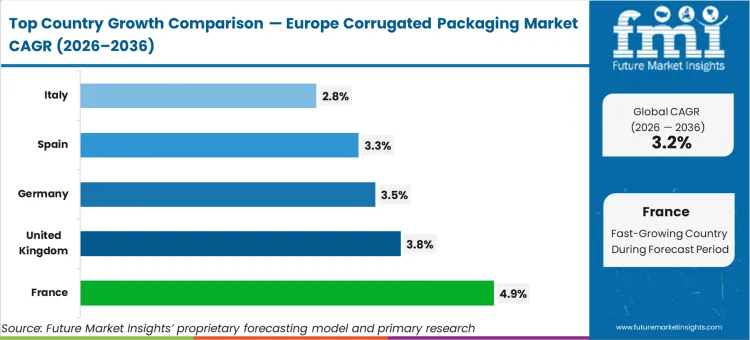
France (4.9%) is projected to record the fastest growth, supported by strong food exports and retail distribution networks. The United Kingdom (3.8%) follows, driven by e-commerce and FMCG demand. Germany (3.5%) and Spain (3.3%) show steady expansion tied to industrial and consumer goods logistics. Italy (3.0%) reflects a mature but stable market where growth is largely replacement-driven and constrained by established packaging penetration levels rather than rapid capacity expansion.
Europe Corrugated Packaging Market Definition
The Europe corrugated packaging market refers to the production and supply of corrugated fiberboard packaging used for protection, storage, and transport of goods. Corrugated packaging is made from linerboard and fluting medium combined to create single face, single wall, double wall, or triple wall board structures. These materials provide strength, cushioning, and stacking performance. Common products include boxes, cartons, trays, pallets, crates, inserts, and point-of-purchase displays. The primary function of corrugated packaging is to protect goods during handling and distribution while remaining lightweight and recyclable. Key end users include food and beverage companies, e-commerce retailers, industrial manufacturers, healthcare suppliers, and consumer goods producers across Europe.
Europe Corrugated Packaging Market Inclusions
The report provides Europe market size estimates for 2025 and 2026, with forecasts through 2036 and CAGR analysis. It includes segmentation by board type, product type, grade type, material composition, end use industry, and country. The study covers value-based sizing, recycled versus virgin fiber trends, country-level demand comparisons, e-commerce growth impact, and production capacity analysis across European markets.
Europe Corrugated Packaging Market Exclusions
The scope excludes paper packaging formats that do not use corrugated structures, such as folding cartons and flexible paper packaging. It does not include plastic crates, wooden pallets, or metal transport containers. Finished consumer goods are excluded, as the study focuses strictly on corrugated board production, conversion into packaging formats, and supply within Europe.
Europe Corrugated Packaging Market Research Methodology
- Primary Research: Interviews were conducted with corrugated board manufacturers, containerboard producers, converters, recyclers, and packaging buyers across major European countries. Containerboard suppliers clarified virgin and recycled fiber pricing dynamics, while converters validated demand patterns across food, e-commerce, and industrial sectors.
- Desk Research: Eurostat trade statistics, national packaging association reports, FAO fiber data, and company annual disclosures were reviewed to benchmark production volumes and regional trade flows.
- Market-Sizing and Forecasting: A hybrid top-down and bottom-up approach was applied. Demand was reconstructed from industrial output and retail shipment volumes and validated against corrugated production capacity.
- Data Validation and Update Cycle: Data was cross-verified across trade datasets, production statistics, and stakeholder inputs, followed by structured expert review before final release.
Segment Analysis
Europe Corrugated Packaging Market Analysis by Board Type
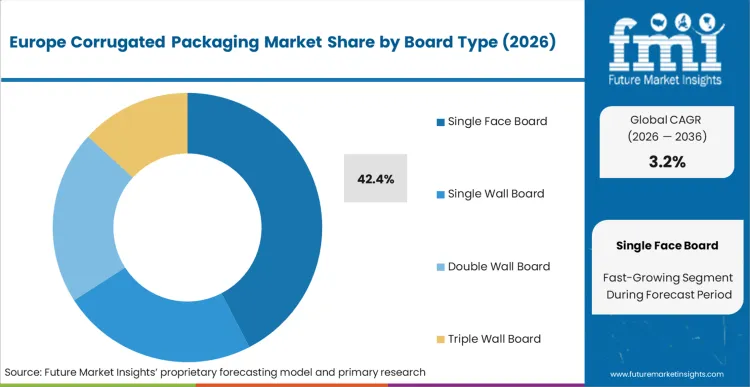
Based on FMI's Europe Corrugated Packaging market report, consumption of Single Wall Board is estimated to hold 42.4% share in 2026. Single wall board dominates due to its balance between strength, cost efficiency, and lightweight structure, making it suitable for a broad range of retail and industrial packaging applications. It addresses buyer priorities including stacking performance, cushioning protection, and optimized material usage. The format is widely used in food distribution, e-commerce shipments, and consumer goods packaging where moderate load-bearing capacity is sufficient.
- Cost-Performance Balance: Single wall board offers adequate compression strength at lower material cost compared to double and triple wall configurations, supporting large-volume FMCG usage.
- E-commerce Alignment: Growth in online retail across Europe increases demand for standardized corrugated boxes that protect goods during parcel delivery.
- Sustainability Focus: High recyclability rates and strong fiber recovery systems across Europe reinforce adoption of single wall corrugated packaging.
Europe Corrugated Packaging Market Analysis by End Use
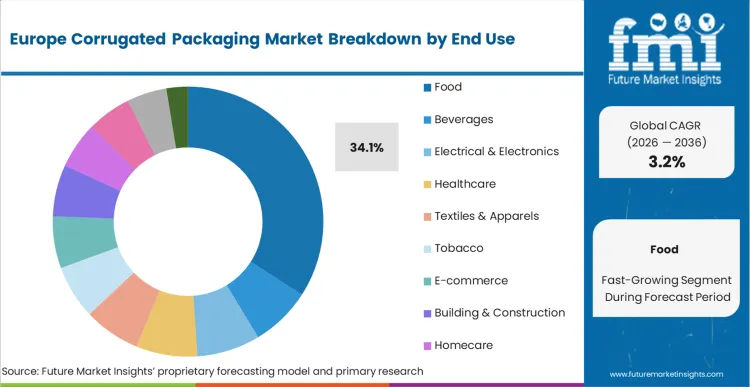
Based on FMI's Europe Corrugated Packaging market report, consumption of Food applications is estimated to hold 34.1% share in 2026. The food segment leads due to strong demand for fresh produce cartons, processed food boxes, and bulk transport packaging. Corrugated solutions address critical requirements including ventilation, product protection, and compliance with food safety regulations.
- Retail Supply Chains: Expansion of supermarket and discounter networks supports high-volume corrugated usage for perishable and packaged foods.
- Export Packaging Needs: Cross-border food trade within the EU drives demand for durable corrugated transit packaging.
- Sustainability Regulations: European circular economy policies and packaging waste directives strengthen preference for recyclable corrugated materials in food distribution systems.
Europe Corrugated Packaging Market : Drivers, Restraints, and Opportunities
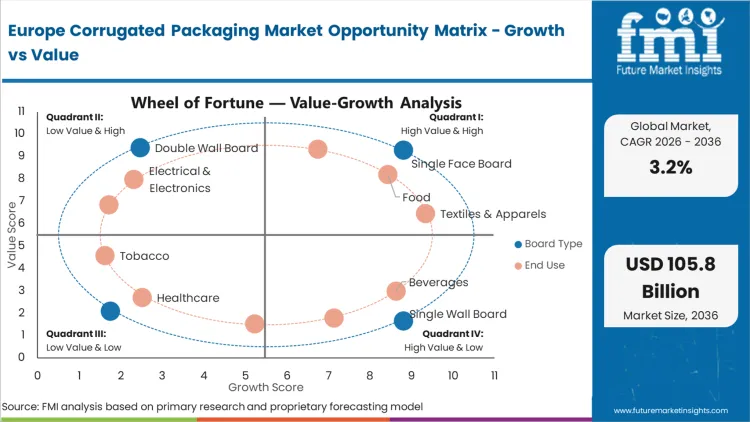
Future Market Insights analysis indicates that the Europe corrugated packaging market is structurally mature yet steadily expanding, supported by its deep integration into retail logistics, food distribution, and industrial supply chains. The market exists at its current scale because corrugated boxes remain the backbone of European transport packaging, offering strength, stackability, and recyclability across FMCG, e-commerce, and manufacturing sectors. Historical growth has followed retail modernization and cross-border trade within the EU, while recent momentum is increasingly shaped by sustainability regulation and circular economy mandates.
FMI analysts observe a transition from standard brown corrugated boxes toward lightweight, high-performance, and recyclable-optimized board structures. While traditional transport cases continue to dominate volume, growth is concentrated in shelf-ready packaging, high-graphic printed boxes, and right-sized e-commerce formats. Advanced flute designs and reduced grammage boards help lower material usage and transportation emissions, although they require improved design precision and testing standards. Despite moderate tonnage growth in mature Western European markets, value expansion is supported by customization, print enhancement, and compliance-driven redesign.
- Circular Economy Regulation:
- The EU Packaging and Packaging Waste Regulation (PPWR) reinforces recyclability, recycled content targets, and waste reduction requirements. Corrugated packaging benefits from strong recycling infrastructure, strengthening its competitive position against less recyclable alternatives.
- E-Commerce Optimization:
- Rising parcel volumes across Germany, France, and the Nordics are driving demand for right-sized, lightweight corrugated boxes that reduce void fill and shipping costs.
- Retail Shelf-Ready Packaging:
- Growth in supermarket private labels and discount retail formats is increasing demand for high-graphic, easy-display corrugated solutions that combine transport and in-store presentation functions.
Regional Analysis
.webp "Top Country Growth Comparison Europe Corrugated Packaging Market Cagr (2026 2036)")
The Europe corrugated packaging market is segmented across France, the United Kingdom, Germany, Spain, and Italy. Growth variations reflect differences in e-commerce penetration, industrial production, recycling infrastructure, and circular economy regulation. The full report provides detailed country-level market attractiveness analysis.
| Country | CAGR(2026-2036) |
|---|---|
| France | 4.9% |
| United Kingdom | 3.8% |
| Germany | 3.5% |
| Spain | 3.3% |
| Italy | 3.0% |
Source: Future Market Insights (FMI) analysis, based on proprietary forecasting model and primary research
Western Europe - Circular Economy and E-commerce Anchor
Western Europe serves as the circular economy and e-commerce anchor of the corrugated packaging market. Demand is supported by strong recycling systems, retail distribution networks, and export-oriented manufacturing. Key regional players include Smurfit WestRock, DS Smith plc, Mondi Group, and Stora Enso, all operating integrated containerboard and corrugated box facilities across multiple European countries.
France
Demand for corrugated packaging in France is projected to rise at 4.9% CAGR through 2036. Growth is driven by strong e-commerce expansion and food distribution modernization. In 2024, France continued implementation of its Anti-Waste for a Circular Economy Law, reinforcing packaging recyclability and waste reduction obligations for producers. Extended Producer Responsibility requirements for packaging have encouraged brands to adopt recyclable corrugated formats over plastic alternatives. Growth in grocery delivery and omnichannel retail operations further increases demand for durable and lightweight corrugated shipping boxes. Additionally, France’s agricultural and processed food export sector supports steady use of corrugated transit packaging. Regulatory alignment with EU circular economy targets sustains long-term structural demand.
United Kingdom
Demand for corrugated packaging in the United Kingdom is projected to rise at 3.8% CAGR through 2036. Growth is shaped by e-commerce logistics and sustainability regulation. In 2024, the UK government advanced Extended Producer Responsibility reforms for packaging, increasing cost accountability for non-recyclable materials. The Plastic Packaging Tax framework continues to incentivize substitution toward fiber-based packaging solutions. Expansion of parcel delivery networks and online grocery platforms supports demand for corrugated boxes optimized for last-mile delivery. Industrial manufacturing and export packaging needs also contribute to stable consumption. While economic fluctuations may influence retail volumes, sustainability mandates reinforce corrugated adoption.
Germany
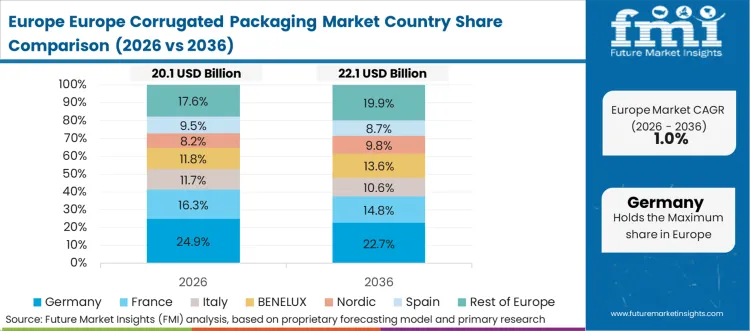
Demand for corrugated packaging in Germany is projected to rise at 3.5% CAGR through 2036. The market benefits from Germany’s strong industrial base and export-oriented manufacturing sector. The Packaging Act requires producer registration and recycling compliance, with reinforced reporting requirements maintained through 2024 by the Central Packaging Register. Germany’s high recycling rates and established waste collection systems support circular fiber flows. Growth in automotive components, machinery exports, and e-commerce fulfillment centers sustains steady demand for durable corrugated solutions. Although the market is mature, industrial strength and regulatory alignment support consistent expansion.
Spain
Demand for corrugated packaging in Spain is projected to rise at 3.3% CAGR through 2036. Growth is supported by expansion in food exports, agriculture, and retail distribution. In 2024, Spain continued enforcement of its Waste and Contaminated Soils Law, which aligns with EU circular economy objectives and strengthens packaging waste management obligations. Rising fruit and vegetable exports require corrugated packaging for transit and storage. Growth in online retail platforms and supermarket chains also contributes to steady box consumption. While domestic industrial output remains moderate compared to Germany, agricultural exports provide stable demand drivers.
Italy
Demand for corrugated packaging in Italy is projected to rise at 3.0% CAGR through 2036. The market is supported by food processing, luxury goods exports, and industrial packaging demand. Italy continues to align with EU packaging waste directives and recycling targets, reinforcing corrugated material usage. In 2024, national recovery and resilience investments supported modernization of logistics and distribution infrastructure, indirectly strengthening packaging demand. Italy’s strong manufacturing base in fashion, machinery, and specialty foods sustains need for protective transit packaging. Growth remains moderate due to market maturity but is supported by export activity and sustainability compliance.
FMI's analysis of Europe corrugated packaging market consists of country-wise assessment that includes France, the United Kingdom, Germany, Spain, and Italy. Readers can find insights on circular economy regulation, recycling performance, industrial packaging demand, and e-commerce expansion trends.
Competitive Aligners for Market Players
The Europe corrugated packaging market is moderately consolidated, led by large vertically integrated paper and packaging groups with extensive containerboard and box plant networks across the region. Companies such as Smurfit WestRock, International Paper Company, DS Smith plc, Mondi Group, Stora Enso, Billerud (BillerudKorsnäs), Rengo Co., Ltd., VPK Packaging Group, and Dunapack Packaging account for a significant share of European corrugated capacity. These players operate integrated mill-to-box models, supplying FMCG, food & beverage, e-commerce, and industrial customers. Regional converters such as SAPRIL s.r.o. compete through localized service, customized box solutions, and proximity to customers. Competition is primarily driven by scale efficiency, recycled fiber integration, lightweight board innovation, and pan-European supply capabilities.
Structural advantages are strongest among companies with upstream pulp and containerboard production, captive recycled fiber systems, and cross-border converting footprints. Smurfit WestRock, Mondi, Stora Enso, DS Smith, and International Paper benefit from vertically integrated operations that provide raw material security and cost control. Firms with strong recycled fiber collection systems and energy-efficient mills are better positioned amid tightening EU sustainability and carbon regulations. Geographic diversification across Western, Central, and Eastern Europe also provides insulation against regional demand fluctuations and logistics disruptions.
Buyer leverage in the European corrugated market is significant, particularly among multinational FMCG, beverage, and e-commerce customers. Large buyers negotiate multi-year supply agreements often linked to published containerboard indices and frequently implement dual-sourcing strategies. However, switching suppliers can be constrained by plant proximity, packaging design integration, and supply chain coordination. Sustainability mandates under EU packaging and waste directives increasingly influence procurement decisions, favoring suppliers with certified fiber sourcing, high recycled content, and carbon reduction initiatives.
Recent Developments
- In September 2025, Smurfit Westrock plc reported its third quarter 2025 financial results, highlighting strong net sales of $8,003 million and improved operational performance. The company emphasized continued focus on value over volume in corrugated operations, ongoing system optimization, and positioning for improved demand in Europe and other regions as it enters 2026.
- In April 2025, VPK Group completed the acquisition of Open Imballaggi, an Italian corrugated sheet plant near Bergamo, Lombardy, strengthening VPK’s presence in Italy and enhancing its production capacity for corrugated board and packaging solutions in Southern Europe.
Key Players
- Smurfit WestRock
- International Paper Company
- DS Smith plc
- Mondi Group
- Billerud Korsnäs
- Rengo Co. Ltd
- SAPRIL s.r.o.
- Stora Enso
- VPK Packaging Group
- Dunapack Packaging
Scope of Report
| Metric | Value |
|---|---|
| Quantitative Units | USD 75.3 billion (2025); USD 77.4 billion (2026) to USD 105.8 billion (2036), at a CAGR of 3.2% |
| Market Definition | The Europe corrugated packaging market comprises the production and conversion of corrugated containerboard into boxes, cartons, displays, and protective transit solutions used across food, beverage, industrial, healthcare, and e-commerce sectors, driven by sustainable fiber sourcing and recycling infrastructure across the region. |
| Form Segmentation | Single Face Board; Single Wall Board; Double Wall Board; Triple Wall Board |
| End Use Segmentation | Food & Beverages; Electrical & Electronics; Industrial & Consumer Goods; Healthcare; Textiles & Apparels; E-commerce; Building & Construction; Automotive; Chemicals & Fertilizers |
| Application Coverage | Processed Food & Fresh Produce Packaging; Beverage Multipacks; Pharmaceutical & Medical Device Shipping; Retail-Ready & POP Displays; E-commerce Transit Packaging; Automotive Component Handling; Industrial Bulk Transport |
| Regions Covered | Europe |
| Countries Covered | Germany; United Kingdom; France; Italy; Spain; Nordics; Benelux; Austria; Russia; Hungary; Rest of Europe |
| Key Companies Profiled | Smurfit WestRock; DS Smith plc; Mondi Group; Stora Enso; International Paper Company; Others |
| Forecast Period | 2026 to 2036 |
| Approach | Hybrid top-down and bottom-up market modeling validated through primary interviews with corrugated board producers, converters, and brand owners, supported by containerboard capacity benchmarking, recycling rate analysis, trade flow assessment, and sustainability compliance tracking across European packaging regulations. |
Europe Corrugated Packaging Market by Segments
By Board Type
- Single Face Board
- Single Wall Board
- Double Wall Board
- Triple Wall Board
By Product Type
- Boxes
- Cartons
- POP Display
- Pallets
- Crates
- Trays
- Bin
- Inserts and Dividers
By Grade Type
- Liner
- Kraftliner
- Bleached
- Unbleached
- Kraftliner
- Testliner
- Bleached
- Unbleached
- Fluting Medium
- Semi-Chemical Fluting
- Recycled Fluting
By Material
- Virgin Containerboard
- Recycled Containerboard
By End Use
- Food
- Processed Food
- Fresh Produce
- Dairy Products
- Food Grains
- Confectionery & Bakery
- Other Foods
- Beverages
- Alcoholic
- Non Alcoholic
- Electrical & Electronics
- Industrial
- Consumer
- Healthcare
- Pharmaceutical
- Medical devices
- Textiles & Apparels
- Tobacco
- E-commerce
- Building & Construction
- Homecare
- Automotive & Allied Industries
- Personal Care & Cosmetics
- Chemicals & Fertilizers
By Country
- Germany
- United Kingdom
- France
- Italy
- Spain
- Nordics
- Benelux
- Austria
- Russia
- Hungary
- Rest of Europe
Bibliography
- European Federation of Corrugated Board Manufacturers (FEFCO), European Corrugated Board Industry Statistics 2023, October 2024.
- Confederation of European Paper Industries (Cepi), Key Statistics 2023 - European Pulp and Paper Industry Data, July 2024.
- European Parliament and Council, Regulation (EU) 2024/1781 on Packaging and Packaging Waste (PPWR), April 2024.
- Eurostat, Packaging Waste Statistics - Recycling and Recovery Rates (Updated 2024 Dataset), November 2024.
- European Committee for Standardization (CEN), EN 13430: Packaging - Requirements for Packaging Recoverable by Material Recycling, Active Edition 2023.
- ASTM International, ASTM D4727-23 - Standard Specification for Corrugated and Solid Fiberboard Sheet Stock (Container Grade) and Cut Shapes, April 2023.
- International Organization for Standardization (ISO), ISO 18601:2013 Packaging and the Environment - General Requirements (Confirmed 2023 Review), September 2023.
European Environment Agency (EEA), Waste Prevention in Europe - 2024 Update, December 2024.
This Report Addresses
- Strategic market intelligence supporting capacity planning and portfolio optimization across Europe’s integrated containerboard and corrugated converting ecosystem.
- Europe market size estimation with 2026–2036 revenue forecasts validated through containerboard capacity, recycling rates, and box plant output benchmarking.
- Growth opportunity mapping across single wall, double wall, and triple wall boards aligned with e-commerce and food logistics demand.
- Product segmentation analysis covering boxes, cartons, trays, displays, pallets, and structural transit packaging formats.
- Material mix assessment across virgin and recycled containerboard reflecting EU circular economy and PPWR compliance targets.
- End-use demand evaluation across food, beverages, e-commerce, healthcare, industrial, automotive, and consumer goods sectors.
- Regulatory impact analysis addressing EU Packaging and Packaging Waste Regulation, recycling mandates, and carbon reduction objectives.
- Competitive benchmarking of leading European producers based on fiber integration, lightweighting innovation, recycling capability, and pan-European supply networks.
Frequently Asked Questions
How large is the Europe Corrugated Packaging Market in 2026?
The Europe Corrugated Packaging Market is valued at 77.4 Bn in 2026.
What was the market size of the Europe Corrugated Packaging Market in 2025?
The market was valued at 75.3 Bn in 2025.
What will be the market size of the Europe Corrugated Packaging Market by 2036?
The market is projected to reach 105.8 Bn by 2036.
What is the expected CAGR of the Europe Corrugated Packaging Market between 2026 and 2036?
The market is expected to grow at a CAGR of 3.2% during the forecast period.
Which board type holds the largest share in the Europe Corrugated Packaging Market?
Single Wall Board leads the market with a 42.4% share, followed by Double Wall Board at 31.0%, Triple Wall Board at 14.8%, and Single Face Board at 11.8%.
Which product type dominates the Europe Corrugated Packaging Market?
Boxes dominate the market with a 39.7% share, followed by Cartons at 26.6% and POP Displays at 9.2%.
How significant is the food segment in driving corrugated packaging demand in Europe?
The Food segment accounts for 34.1% of total demand, making it the largest end-use category in the region.
Which European countries are projected to grow the fastest?
France leads with a 4.9% CAGR, followed by the United Kingdom at 3.8%, Germany at 3.5%, Spain at 3.3%, and Italy at 3.0% between 2026 and 2036.
Preview the report firsthand - request a free sample
Get SampleGet the brochure for pricing and purchase details.
Get PDFTable of Content
- Europe Market Outlook
- Demand-side Trends
- Supply-side Trends
- Market Overview
- Market Coverage / Taxonomy
- Market Definition / Scope / Limitations
- Research Methodology
- Chapter Orientation
- Analytical Lens and Working Hypotheses
- Market Structure, Signals, and Trend Drivers
- Benchmarking and Cross-market Comparability
- Market Sizing, Forecasting, and Opportunity Mapping
- Research Design and Evidence Framework
- Desk Research Programme (Secondary Evidence)
- Company Annual and Sustainability Reports
- Peer-reviewed Journals and Academic Literature
- Corporate Websites, Product Literature, and Technical Notes
- Earnings Decks and Investor Briefings
- Statutory Filings and Regulatory Disclosures
- Technical White Papers and Standards Notes
- Expert Input and Fieldwork (Primary Evidence)
- Primary Modes
- Qualitative Interviews and Expert Elicitation
- Quantitative Surveys and Structured Data Capture
- Blended Approach
- Why Primary Evidence is Used
- Field Techniques
- Interviews
- Surveys
- Focus Groups
- Observational and In-context Research
- Social and Community Interactions
- Stakeholder Universe Engaged
- C-suite Leaders
- Board Members
- Presidents and Vice Presidents
- R&D and Innovation Heads
- Technical Specialists
- Domain Subject-matter Experts
- Scientists
- Physicians and Other Healthcare Professionals
- Governance, Ethics, and Data Stewardship
- Research Ethics
- Data Integrity and Handling
- Primary Modes
- Tooling, Models, and Reference Databases
- Data Engineering and Model Build
- Data Acquisition and Ingestion
- Cleaning, Normalisation, and Verification
- Synthesis, Triangulation, and Analysis
- Quality Assurance and Audit Trail
- Desk Research Programme (Secondary Evidence)
- Market Background
- Market Dynamics
- Drivers
- Restraints
- Opportunity
- Trends
- Scenario Forecast
- Demand in Optimistic Scenario
- Demand in Likely Scenario
- Demand in Conservative Scenario
- Opportunity Map Analysis
- Product Life Cycle Analysis
- Supply Chain Analysis
- Investment Feasibility Matrix
- Value Chain Analysis
- PESTLE and Porter’s Analysis
- Regulatory Landscape
- Regional Parent Market Outlook
- Production and Consumption Statistics
- Import and Export Statistics
- Market Dynamics
- Europe Market Analysis 2021 to 2025 and Forecast, 2026 to 2036
- Historical Market Size Value (USD Million) Analysis, 2021 to 2025
- Current and Future Market Size Value (USD Million) Projections, 2026 to 2036
- Y-o-Y Growth Trend Analysis
- Absolute $ Opportunity Analysis
- Europe Market Pricing Analysis 2021 to 2025 and Forecast 2026 to 2036
- Europe Market Analysis 2021 to 2025 and Forecast 2026 to 2036, By Board Type
- Introduction / Key Findings
- Historical Market Size Value (USD Million) Analysis By Board Type , 2021 to 2025
- Current and Future Market Size Value (USD Million) Analysis and Forecast By Board Type , 2026 to 2036
- Single Wall Board
- Single Face Board
- Double Wall Board
- Triple Wall Board
- Y-o-Y Growth Trend Analysis By Board Type , 2021 to 2025
- Absolute $ Opportunity Analysis By Board Type , 2026 to 2036
- Europe Market Analysis 2021 to 2025 and Forecast 2026 to 2036, By End Use
- Introduction / Key Findings
- Historical Market Size Value (USD Million) Analysis By End Use, 2021 to 2025
- Current and Future Market Size Value (USD Million) Analysis and Forecast By End Use, 2026 to 2036
- Food
- Beverages
- Electrical & Electronics
- Healthcare
- Textiles & Apparels
- Tobacco
- E-commerce
- Building & Construction
- Homecare
- Automotive & Allied Industries
- Personal Care & Cosmetics
- Y-o-Y Growth Trend Analysis By End Use, 2021 to 2025
- Absolute $ Opportunity Analysis By End Use, 2026 to 2036
- Europe Market Analysis 2021 to 2025 and Forecast 2026 to 2036, By Region
- Introduction
- Historical Market Size Value (USD Million) Analysis By Region, 2021 to 2025
- Current Market Size Value (USD Million) Analysis and Forecast By Region, 2026 to 2036
- Market Attractiveness Analysis By Region
- Market Structure Analysis
- Competition Dashboard
- Competition Benchmarking
- Market Share Analysis of Top Players
- By Regional
- By Board Type
- By End Use
- Competition Analysis
- Competition Deep Dive
- Smurfit WestRock
- Overview
- Product Portfolio
- Profitability by Market Segments (Product/Age /Sales Channel/Region)
- Sales Footprint
- Strategy Overview
- Marketing Strategy
- Product Strategy
- Channel Strategy
- International Paper Company
- DS Smith plc
- Mondi Group
- Billerud Korsnäs
- Rengo Co. Ltd
- SAPRIL s.r.o.
- Stora Enso
- VPK Packaging Group
- Dunapack Packaging
- Smurfit WestRock
- Competition Deep Dive
- Assumptions & Acronyms Used


