

- Industry Size (2026)
- USD 1.0 Bn
- Forecast (2036)
- USD 1.7 Bn
- CAGR (2026 to 2036)
- 6.2%
Barrier Nonwoven Fiber for Breathable Surgical Gowns Market Size, Market Forecast and Outlook By FMI
The barrier nonwoven fiber for breathable surgical gowns market was valued at USD 0.9 billion in 2025. Industry is estimated to reach USD 1.0 billion in 2026 at a CAGR of 6.2% during the forecast period. Sustained investment in single-use infection control protocols carries total valuation to USD 1.7 billion through 2036 as global surgical procedure volume scales alongside stricter AAMI compliance mandates.
Procurement executives managing major hospital systems face a significant and challenging dilemma: the absolute requirement for stringent, zero-tolerance infection control measures often conflicts directly with the crucial need to maintain surgical staff thermal comfort. Prolonged and intense surgical procedures, particularly in specialized fields like orthopedics or cardiovascular surgery, can induce severe heat stress, which is known to degrade the surgeon's concentration and performance. Consequently, material science suppliers are under pressure to innovate and engineer specialized barrier fabrics that not only meet demanding criteria for hydrostatic resistance, such as Level 3 or Level 4 standards, but also critically preserve excellent air permeability. A failure to strike this delicate balance forces healthcare facilities into expensive, ongoing investments in AI accelerator thermal test platforms and continuous vendor switching, which ultimately inflates their annual consumable supply budgets unnecessarily.
Summary of Barrier Nonwoven Fiber for Breathable Surgical Gowns Market
- Barrier Nonwoven Fiber for Breathable Surgical Gowns Market Definition
- Engineered synthetic textiles providing precise fluid resistance and vapor transmission for regulated surgical garments, combining pathogen protection with thermal comfort.
- Demand Drivers in the Market
- Strict AAMI compliance mandates compel hospital procurement teams to abandon legacy reusable textiles.
- Operating room heat stress metrics force surgical department heads to demand higher air permeability materials.
- Growing complex procedure volumes push infection control committees toward specialized Level 4 protective requirements.
- Key Segments Analyzed in the FMI Report
- Polypropylene: This segment is expected to garner 68.0% share in 2026, delivering optimal cost-to-barrier performance through mature extrusion infrastructure.
- SMS: This segment is anticipated to lead demand, balancing strike-through prevention with commercial viability.
- Level 3: This segment is projected to capture 42.0% share, functioning as defensive baseline protection across diverse surgical categories.
- Hospitals: This segment is poised to hold 71.0% volume, driven by high-intensity orthopedic and cardiovascular procedural concentration.
- China: China records 7.1% compound growth, reflecting aggressive domestic nonwoven conversion capacity expansion securing localized supply chains.
- Analyst Opinion at FMI
- Sabyasachi Ghosh, Principal Analyst, Healthcare, at FMI, notes that, "Standard hydrostatic pressure metrics accurately capture static fluid resistance, yet completely ignore dynamic physical stress during six-hour orthopedic cases. Procurement directors frequently select fabrics based on pristine lab data, only to face immediate backlash from surgical teams experiencing micro-tears during high-mobility procedures. True material valuation happens at this intersection: fabrics surviving mechanical fatigue while maintaining thermal vapor transmission command premium pricing regardless of baseline AAMI ratings."
- Strategic Implications / Executive Takeaways
- Polymer extrusion operators face immediate pressure to upgrade SMMS lines optimizing thinner meltblown layers.
- Hospital procurement directors must balance strict AAMI compliance against mounting per-procedure consumable budgets.
- OEM converters risk margin compression unless locking long-term resin pricing contracts ahead of supply shocks.
- Methodology
- Primary Research: Direct consultation with hospital procurement heads and nonwoven extrusion engineers.
- Desk Research: Aggregation of FDA device clearances and ASTM consensus standard testing results.
- Market-Sizing and Forecasting: Global surgery volume metrics anchoring baseline square-meter fabric consumption.
- Data Validation and Update Cycle: Extrusion machinery order logs cross-referencing projected capacity expansion.
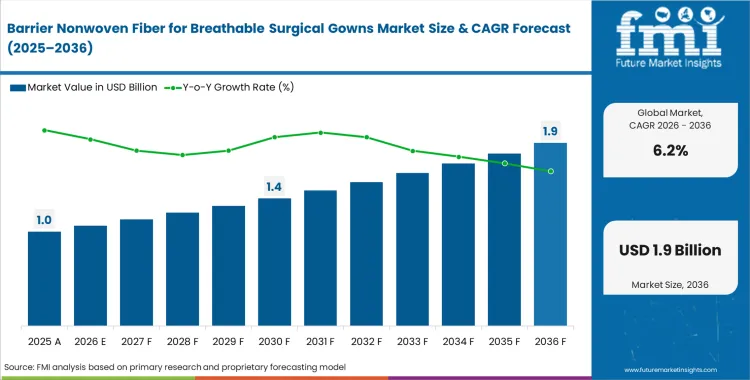
Barrier Nonwoven Fiber for Breathable Surgical Gowns Market Key Takeaways
| Metric | Details |
|---|---|
| Industry Size (2026) | USD 1.0 billion |
| Industry Value (2036) | USD 1.7 billion |
| CAGR (2026 to 2036) | 6.2% |
Source: Future Market Insights (FMI) analysis, based on proprietary forecasting model and primary research
The pivotal moment occurs when a manufacturer successfully attains AAMI Level 3 fluid resistance while simultaneously ensuring the material maintains air permeability exceeding 30 cfm. This crucial combination is the crossing point that prompts infection control committees to mandate immediate, facility-wide conversion to the new standard. This rapid adoption leads to the obsolescence of secondary reinforcement layers and is immediately followed by a significant consolidation within the supply chain.
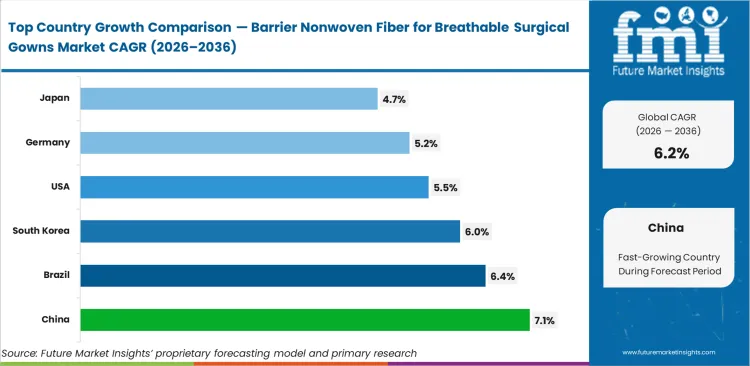
China advances at 7.1% driven by aggressive domestic nonwoven conversion capacity expansion. Brazil scales at 6.4% on steady hospital modernization initiatives. South Korea expands at 6.0% reflecting stringent regional infection standards. The United States records 5.5% as mature adoption limits new baseline expansion. Germany registers 5.2% tied to high existing penetration rates. Japan posts 4.7% through incremental mix upgrades toward premium laminates. divergence separates emerging regions building baseline capacity from mature geographies optimizing specific barrier properties.
Barrier Nonwoven Fiber for Breathable Surgical Gowns Market Definition
The barrier nonwoven fiber for breathable surgical gowns market comprises engineered synthetic or cellulosic textiles manufactured specifically to provide combined fluid resistance and vapor transmission during surgical procedures. Product architecture relies heavily on spunbond and meltblown extrusion techniques creating complex physical barriers against bloodborne pathogens. Functional performance requires passing established regulatory metrics for hydrostatic pressure and impact penetration alongside measurable thermal comfort.
Barrier Nonwoven Fiber for Breathable Surgical Gowns Market Inclusions
Scope encompasses primary roll goods engineered for surgical gown conversion. Polypropylene, polyester, polyethylene, and cellulosic variants fall within analytical boundaries. Extruded architectures including SMS, SMMS, and spunlace materials represent core tracking categories. Regulated automated test equipment grades covering AAMI Level 1 through Level 4 constitute measured output.
Barrier Nonwoven Fiber for Breathable Surgical Gowns Market Exclusions
General apparel textiles remain outside analysis parameters. Reusable woven fabrics requiring laundering sit beyond current tracking limits. Surgical drapes, sterilization wraps, and industrial protective clothing are excluded. Raw polymer resin trading volumes do not factor into final fabric valuation metrics.
Barrier Nonwoven Fiber for Breathable Surgical Gowns Market Research Methodology
- Primary Research: Procurement directors, infection control heads, and textile extrusion plant managers.
- Desk Research: FDA 510(k) clearances, ASTM F2407 testing registries, and hospital procurement contract archives.
- Market-Sizing and Forecasting: Global surgical procedure volume baseline intersecting gown-use intensity per surgery.
- Data Validation and Update Cycle: Polymer resin consumption data cross-validating final nonwoven square-meter output.
Segmental Analysis
Barrier Nonwoven Fiber for Breathable Surgical Gowns Market Analysis by Fiber Type
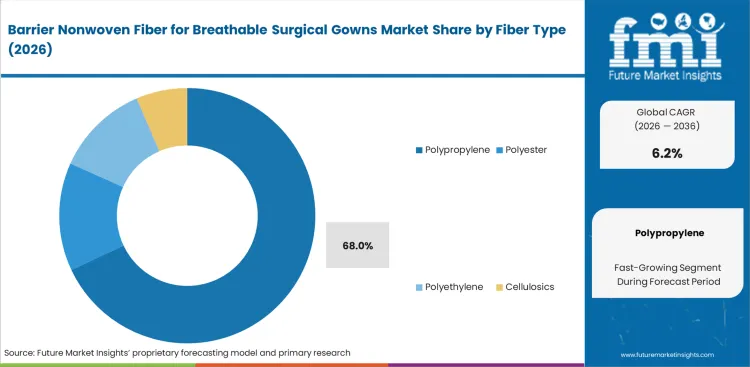
The economics of extrusion fundamentally determine the initial material choice across global converter networks. Polypropylene segment holds a 68.0% market share, driven by its superior melt-flow properties that allow for the production of extremely fine denier and rapid capacity scaling. Fabric quality assurance for hospital purchasing agents is as critical as the scrutiny applied in semiconductor assembly and testing services. Spunbond-Meltblown-Spunbond (SMS) structures, primarily using polypropylene, achieve an optimal balance of tensile strength and resistance to hydrostatic pressure. However, relying solely on high market share overlooks significant supply chain weaknesses.
Localized shortages in petrochemicals can instantly halt nonwoven production, revealing extreme fragility. Current extruder setups cannot easily accommodate alternative resins without extensive and costly retooling. Converters that delay strategies for polymer diversification are highly susceptible to catastrophic stock-outs during regional disruptions. FMI analysis indicates that facilities focused purely on minimizing cost often fail to recognize these fundamental systemic continuity risks.
- Resin flow dynamics: Polypropylene characteristics allow superior meltblown web uniformity. Extrusion engineers achieve tighter pore size distribution improving fluid holdout.
- Sterilization compatibility: Material withstands standard EtO processing cycles without severe degradation. Sterile processing managers avoid compromised garment integrity during final packaging.
- Petrochemical dependency: Overreliance on single feedstock exposes production to global oil volatility. Supply chain officers must build strategic resin buffers preventing sudden line stoppages.
Barrier Nonwoven Fiber for Breathable Surgical Gowns Market Analysis by Fabric Structure
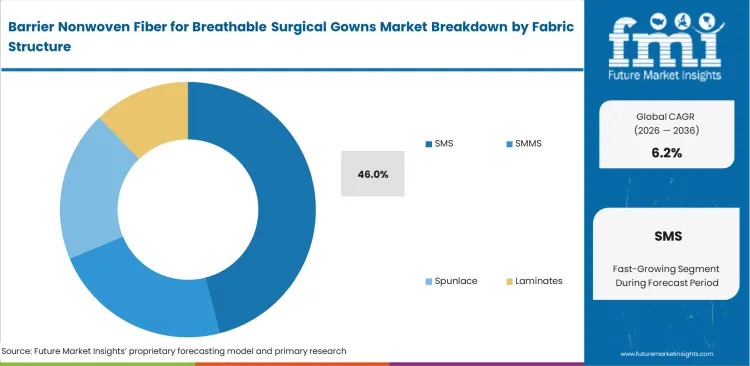
The demand for higher performance drives the development of multi-layered composite architectures in protective fabrics. Maintaining consistent web thickness across large master rolls requires sophisticated tracking, comparable to complex wafer testing services. SMS segment commands a 46.0% market share, because it is an ideal balance of tensile strength and continuous strike-through protection, even during prolonged clinical use. Consequently, infection control committees widely accept SMS as the standard protective measure against moderate fluid exposure. However, a crucial trade-off is often overlooked: while adding extra meltblown layers enhances barrier protection (e.g., SMMS or SMMMS), it rapidly compromises the fabric's drape. This loss of flexibility severely restricts arm mobility, leading to immediate resistance and rejection from surgical staff. FMI estimates emphasize that adoption success in the operating room hinges entirely on the material's drape characteristics, overriding pure barrier performance data. Manufacturers must therefore modify the base polymer's flexibility to ensure acceptance when increasing layer counts.
- Tear resistance baseline: Spunbond outer layers provide critical mechanical strength during procedural movement. Scrub nurses avoid catastrophic mid-surgery garment failure.
- Meltblown filtration: Internal micro-fiber arrays block liquid penetration under sustained pressure. Surgeons maintain sterile fields during heavy fluid irrigation cases.
- Drape stiffness tradeoff: Increasing barrier layers inherently stiffens final textile products. Product designers must utilize advanced thermal bonding preventing excessive rigidity.
Barrier Nonwoven Fiber for Breathable Surgical Gowns Market Analysis by Barrier Level
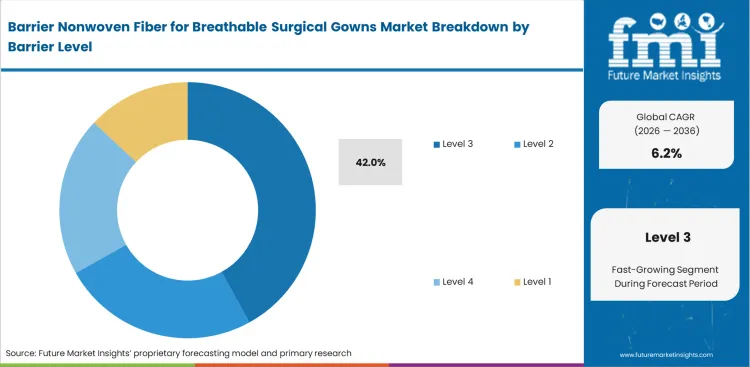
The complexity of a surgery determines the minimum protection standards required by governing bodies. Level 3 segment accounts for a 42.0% market share in 2026, because it serves as a universal defensive baseline suitable for unpredictable surgical settings and growing orthopedic procedure volumes. Materials management directors frequently prioritize Level 3 procurement, often deliberately using these gowns for cases that only require Level 2 protection. This proactive approach prevents hurried gown exchanges if unexpected bleeding occurs during an operation. An assessment by FMI, utilizing aggressive integrated photonics test and reliability systems for fabric testing, validates hydrostatic limits. However, the genuine risk to facilities exists outside controlled laboratory conditions. Dynamic mechanical stress experienced during joint replacements can cause micro-fractures in the barrier layers, which are often missed by standard AAMI tests. Hospitals that mismatch procedure types with the true dynamic stress limits face a higher number of exposure incidents, even when they strictly follow regulatory purchasing guidelines.
- Defensive upgrading: Facilities utilize higher-rated garments for lower-risk procedures ensuring safety margins. Supply directors simplify inventory management through SKU consolidation.
- Hydrostatic threshold: Fabric resists fluid pressure reaching specific minimum regulatory parameters. Operating teams trust barrier integrity during moderate arterial exposure.
- Dynamic failure risk: Standard tests ignore physical stretching occurring during active surgery. Risk managers must evaluate real-world flexibility alongside static barrier numbers.
Barrier Nonwoven Fiber for Breathable Surgical Gowns Market Analysis by End User
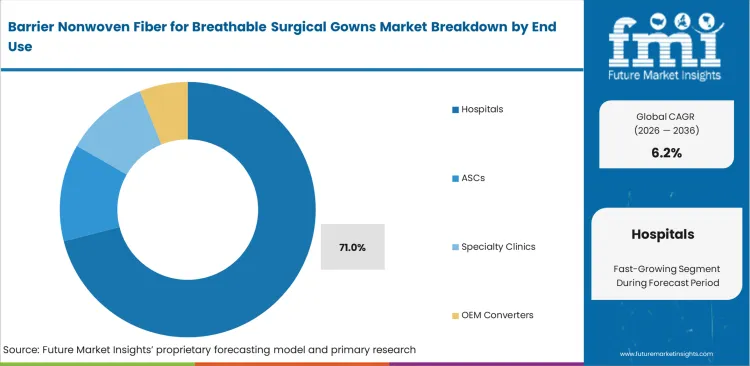
High-demand sectors like intensive cardiovascular and orthopedic surgery consolidate substantial requirements within specialized clinical environments. Operating room directors must manage logistics comparable to intense high speed memory signal integrity test standards, overseeing vast supply chains. However, volume alone does not account for hospital dominance. Complex surgical procedures necessitate high GSM materials with superior tensile properties that are not available in the lighter variants used in outpatient settings.Hospitals segment holds a majority of 71.0% market share in 2026, driven by the huge daily turnover of consumables and stringent requirements for high-GSM (grams per square meter) protective materials. Ambulatory surgical centers, which prioritize cost-per-case efficiency, typically purchase lighter fabrics that are entirely unsuitable for the demanding, extended-duration hospital trauma environments. FMI's analysis suggests that suppliers who fail to differentiate the tensile strength of their products based on the specific clinical setting risk major contract cancellations.
- High-intensity consumption: Major trauma centers burn through thousands of sterile units daily. Logistics managers require flawless just-in-time delivery preventing procedure cancellations.
- Complex procedure demands: Orthopedic cases involve power tools creating unpredictable fluid spray. Surgeons need maximum reinforcement zoning protecting vulnerable chest areas.
- Outpatient cost pressure: ASCs optimize per-procedure spending using minimal acceptable barrier levels. Financial directors aggressively benchmark consumable costs against facility reimbursements.
Barrier Nonwoven Fiber for Breathable Surgical Gowns Market Analysis by GSM Range
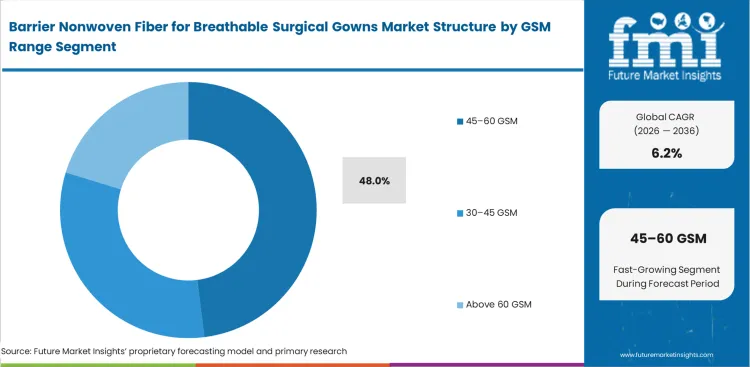
Weight directly impacts both the physical protection offered and the thermal burden on the wearer. The 45-60 GSM range accounts for 48.0% of the market share, driven by its ability to meet demanding tear-resistance requirements without needing extra plastic reinforcement panels. Textile engineers use AI inference hardware benchmarking test tracking systems to precisely monitor polymer distribution across moving webs. Merely looking at total weight metrics, however, fails to capture crucial performance differences. A poorly distributed 50 GSM fabric performs worse than a very uniform 40 GSM material. Inconsistent meltblown distribution creates microscopic weak points vulnerable to sudden fluid penetration. Manufacturers who depend solely on total weight specifications instead of uniform distribution metrics create garments highly prone to catastrophic failure.
- Weight-to-strength ratio: Optimized mass provides necessary tensile strength preventing accidental rips. Staff maintain sterile boundaries moving around complex operating equipment.
- Thermal burden calculation: Heavier materials trap body heat causing accelerated staff fatigue. Department heads must balance protection mandates against physical endurance limits.
- Web uniformity monitoring: Advanced laser scanning ensures consistent polymer laydown across entire rolls. Quality officers reject variable master rolls preventing defective final garments.
Barrier Nonwoven Fiber for Breathable Surgical Gowns Market Drivers, Restraints, and Opportunities
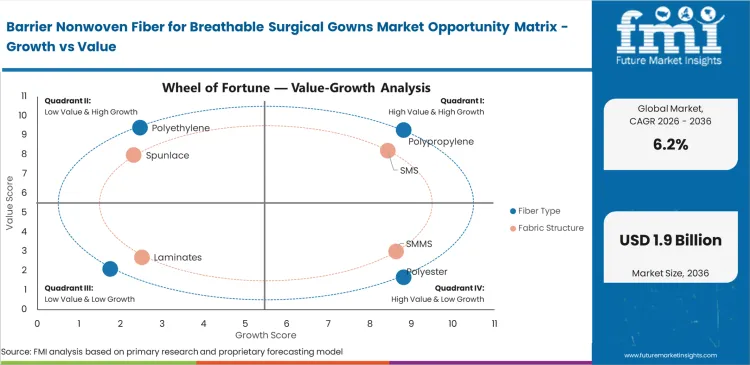
Rigorous enforcement of AAMI (Association for the Advancement of Medical Instrumentation) compliance is now pressuring hospital procurement departments to immediately phase out outdated reusable textile inventory. Procurement directors overseeing major healthcare networks are facing significant legal and financial liability risks by continuing to deploy compromised or degraded woven cotton fabrics, especially during high-fluid surgical procedures. Any delay in the transition toward modern, engineered synthetic materials dramatically increases the potential for catastrophic exposure incidents. This risk is actively driving aggressive, facility-wide conversion timelines. Furthermore, the surging volume of specialized orthopedic procedures is amplifying this pressure, compelling clinical directors to mandate the exclusive use of Level 3 and Level 4 barrier fabrics. An objective evaluation of baseline United States automated test equipment standards provides undeniable, evidence-based justification for the superior protective capabilities of single-use nonwoven alternatives.
The global instability and volatility in polymer costs are severely undermining and fracturing existing multi-year fixed-price procurement agreements. Sourcing directors are experiencing considerable difficulty in securing stable, predictable pricing for primary polypropylene feedstock, a struggle directly attributable to petrochemical market instability. This friction is compounded by the fact that alternative resin materials require entirely different extrusion temperatures, effectively preventing rapid shifts to new suppliers. Consequently, contract manufacturers who attempt to implement temporary price surcharges are meeting substantial and organized resistance from hospital purchasing groups striving to maintain cost control.
Opportunities in the Barrier Nonwoven Fiber for Breathable Surgical Gowns Market
- Bicomponent fiber extrusion: Engineering fibers combining a strong core with softer external sheaths. R&D directors achieve unprecedented drape flexibility without sacrificing tensile strength.
- Zoned breathability architectures: Integrating United Kingdom automated test equipment composite laydowns targeting thermal exhaust at specific back panels. Product designers resolve heat stress complaints while maintaining front-facing barrier integrity.
- Bio-based polymer integration: Developing PLA or PHA nonwovens meeting strict regulatory requirements. Sustainability officers secure premium hospital contracts demanding reduced fossil fuel dependence.
Regional Analysis
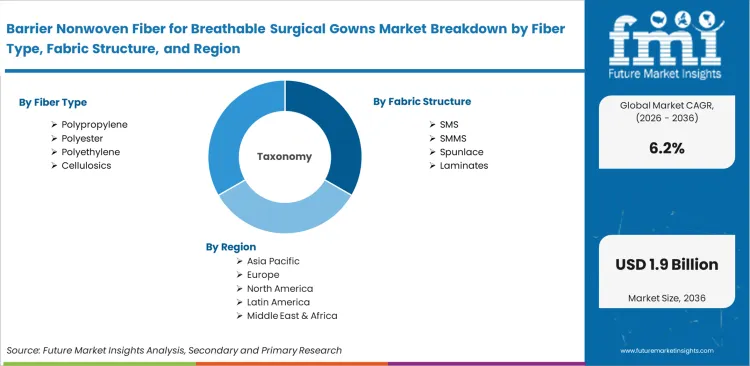
Based on regional analysis, the barrier nonwoven fiber for breathable surgical gowns market is segmented into North America, Europe, Asia Pacific, Latin America, and Middle East & Africa across 40 plus countries.
.webp "Top Country Growth Comparison Barrier Nonwoven Fiber For Breathable Surgical Gowns Market Cagr (2026 2036)")
| Country | CAGR (2026 to 2036) |
|---|---|
| China | 7.1% |
| Brazil | 6.4% |
| South Korea | 6.0% |
| United States | 5.5% |
| Germany | 5.2% |
| Japan | 4.7% |
Source: Future Market Insights (FMI) analysis, based on proprietary forecasting model and primary research
Asia Pacific Barrier Nonwoven Fiber for Breathable Surgical Gowns Market Analysis
Rapid domestic expansion of nonwoven conversion capacity is fundamentally altering regional export markets. Significant government investment in polymer extrusion infrastructure is directing high-quality medical textiles into local hospital systems. Stricter regulations are compelling clinical directors to abandon traditional woven protective wear. According to FMI analysts, the swift adoption of power board tester equivalents ensures consistent web quality across expansive production lines. Regional technical specifications are increasingly aligning with stringent international AAMI standards, establishing a substantial baseline level of consumption.
- China: Immense production volumes are lowering unit costs for advanced SMMS materials. Export managers, alongside surging domestic hospital demand, dominate the global supply. Demand outlook is witnessing expansion at a 7.1% CAGR, supported by continuous state hospital tender acquisitions that guarantee long-term capacity utilization. Procurement teams are securing localized supply chains, completely bypassing international shipping instability. Facilities that established early vendor relationships are locking in favorable pricing structures despite global polymer volatility.
- South Korea: Rigorous national infection control protocols necessitate premium Level 4 fabrics for complex surgical procedures. Clinical directors prioritize staff safety over pure cost savings, rejecting lower-grade materials. Industry is rising at a CAGR of 6.0%, driven by strict local testing protocols required before vendor qualification. Advanced manufacturing capabilities afford domestic producers tight quality control over intricate multi-layer architectures. Hospital networks heavily penalize suppliers who fail strict dynamic stress testing criteria.
- Japan: The aging population is leading to frequent, complex surgical interventions that require longer procedural times. Materials managers are prioritizing ultra-breathable laminates to comply with strict staff comfort regulations. Medical institutions demand zero defects, pushing domestic converters toward fully automated optical inspection systems that validate every square meter. Revenue is rising by 4.7% CAGR, sustained by the absolute need for superior vapor transmission rates during cardiovascular cases.
North America Barrier Nonwoven Fiber for Breathable Surgical Gowns Market Analysis
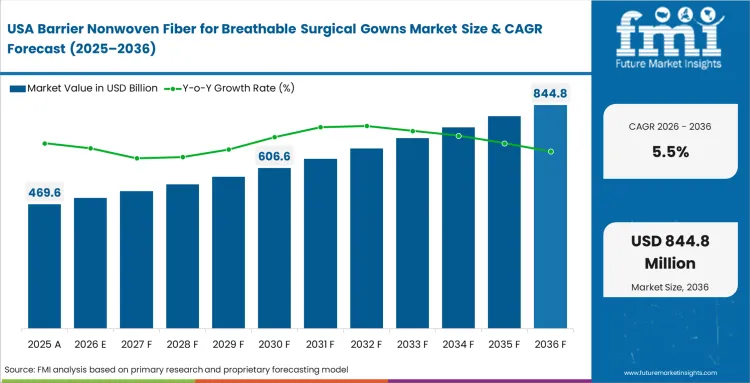
Mature market adoption limits opportunities for new baseline expansion, shifting competition entirely toward premium feature differentiation. Large hospital Group Purchasing Organizations (GPOs) enforce stringent cost control while simultaneously demanding strict adherence to AAMI Level 4 compliance. Quality control officers maintain rigorous oversight of incoming fabric shipments by evaluating complex modular instrumentation platform metrics. FMI believes that supplier margins will decline unless proprietary thermal comfort technologies are offered. High industry consolidation necessitates rigid operational standards.
- United States: Across major regional health networks, absolute AAMI compliance is a prerequisite for market entry, not a competitive advantage. Sourcing directors exert immense negotiating leverage due to the consolidated purchasing volume across hundreds of affiliated facilities. The market revenue continues to expand at 5.5% CAGR, driven by sustained growth in procedural volume and an unwavering commitment to barrier integrity. Securing inclusion in GPO contracts is essential for the survival of large nonwoven converters operating domestically. Suppliers who fail to meet supply continuity benchmarks face immediate, multi-year blacklisting from top-tier institutional purchasers.
Latin America Barrier Nonwoven Fiber for Breathable Surgical Gowns Market Analysis
Ongoing hospital modernization initiatives are gradually replacing older, reusable systems in urban medical centers. Procurement directors must weigh the demands for better infection control against the significant currency fluctuation risks associated with imported materials. FMI's analysis suggests that suppliers who establish local conversion partnerships are better protected from sudden increases in import tariffs. Adopting quality tracking standards, similar to those used in semiconductor capital equipment, distinguishes premium local manufacturers from generic importers.
- Brazil: Private healthcare networks are quickly adopting global surgical standards, setting new benchmarks for procurement. Infection control managers are now requiring specific fluid resistance levels, which were previously overlooked in routine procedures. Market revenue is registering a 6.4% CAGR, driven by local converters who meet international quality standards and command a significant price premium. Regional extruders that construct specialized SMMS lines completely avoid high international shipping costs. Supply chain directors are successfully localizing procurement, which insulates hospital budgets from extreme fluctuations in the dollar exchange rate.
Europe Barrier Nonwoven Fiber for Breathable Surgical Gowns Market Analysis
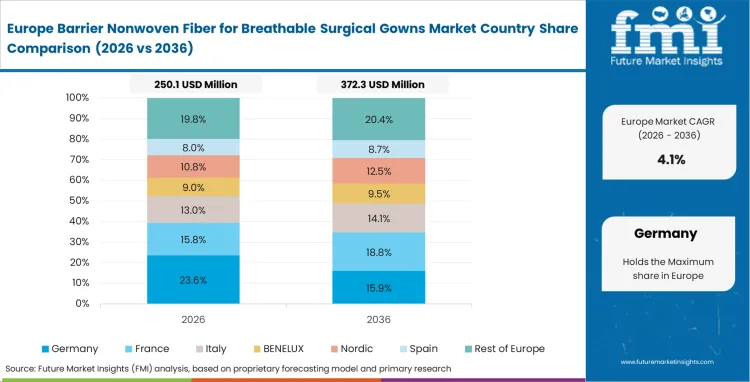
High current polymer penetration necessitates a shift in focus towards sustainable sourcing and end-of-life disposal strategies. Stringent environmental regulations are pressuring hospital administrators regarding the huge volume of clinical waste generated. Extrusion engineers, utilizing RF test equipment equivalents, are optimizing thinner materials to decrease the overall plastic footprint. Textiles made purely from fossil fuels face increasing bureaucratic obstacles during tender processes across major national health systems.
- Germany: Elite surgical centers demand impeccable performance alongside documented sustainability tracking for all disposable garments. Purchasing managers heavily penalize suppliers who lack clear environmental impact data or credible recycling solutions. Baseline growth reaches 5.2%, supported by facilities that successfully reduce the total plastic weight per procedure, leading to substantial waste disposal cost savings. Advanced material science hubs are leading the way in bio-based polymer integration, meeting strict federal carbon reduction mandates without compromising essential Level 3 protection.
FMI's report includes detailed analysis for the United Kingdom, France, Italy, Spain, Canada, Mexico, Argentina, and GCC Countries. Complex local regulatory interpretations heavily influence specific fabric architectures demanded within these smaller national frameworks.
Competitive Aligners for Market Players
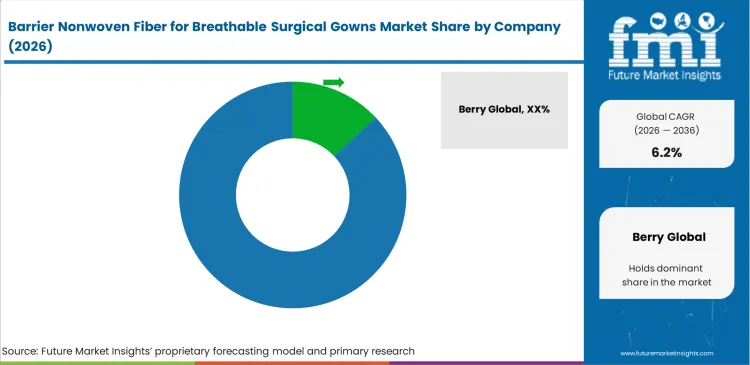
Extreme capital expenditure requirements for multi-beam SMMS extrusion lines create insurmountable barriers preventing small entrants from challenging Berry Global or Ahlstrom. Securing reliable medical-grade polypropylene resin allocations dictates survival during supply chain shocks. Procurement directors explicitly evaluate supplier resin continuity plans before signing massive multi-year hospital contracts. Massive players utilize extensive telecom power reliability test platforms style monitoring ensuring zero production downtime across global facilities.
Incumbent manufacturers possess deep institutional knowledge regarding critical FDA 510(k) submission pathways and ASTM testing methodologies. Freudenberg Performance Materials leverages decades of precise polymer manipulation data, instantly modifying meltblown web geometry following regulatory standard shifts. Challengers struggle replicating this regulatory agility, frequently stalling during complex qualification phases. Mastering standard high precision power analyzers fluid resistance testing separates validated medical suppliers from generic industrial textile producers.
Major healthcare group purchasing organizations brutally consolidate supplier rosters, demanding global delivery capabilities alongside rigid price locks. Avgol and Fitesa respond by decentralizing regional conversion sites, shortening final supply chains directly to major hospital clusters. Buying syndicates deliberately split contracts across multiple primary extruders, neutralizing vendor leverage during contract renewals. Suppliers incapable of localized rapid response face immediate exclusion from premier hospital networks. Integration of package testing silicone rubber socket equivalent calibration ensures consistent component performance. Advanced facilities deploy data center accelerator level tracking software monitoring global resin pipelines. Engineers execute high performance computing logistics modeling simulating instant supply chain pivots. Regional extruders deploying edge ai high bandwidth memory chips level precision capture lucrative specialized clinical contracts.
Key Players in Barrier Nonwoven Fiber for Breathable Surgical Gowns Market
- Berry Global
- Ahlstrom
- Freudenberg Performance Materials
- Avgol
- Mitsui Chemicals Asahi Life Materials
- Fitesa
- Mogul
Scope of the Report
| Metric | Value |
|---|---|
| Quantitative Units | USD 1.0 billion to USD 1.7 billion, at a CAGR of 6.2% |
| Market Definition | The barrier nonwoven fiber for breathable surgical gowns market comprises engineered synthetic textiles providing precise fluid resistance and vapor transmission for regulated surgical garments, combining pathogen protection with thermal comfort. |
| Segmentation | Fiber Type, Fabric Structure, Barrier Level, End User, GSM Range, and Region |
| Regions Covered | North America, Europe, Asia Pacific, Latin America, Middle East & Africa |
| Countries Covered | United States, Canada, Germany, United Kingdom, France, Italy, Spain, China, Japan, South Korea, Taiwan, Singapore, Brazil, Mexico, Argentina, GCC Countries, South Africa, Israel |
| Key Companies Profiled | Berry Global, Ahlstrom, Freudenberg Performance Materials, Avgol, Mitsui Chemicals Asahi Life Materials, Fitesa, Mogul |
| Forecast Period | 2026 to 2036 |
| Approach | Global surgical procedure volume baseline intersecting gown-use intensity per surgery. |
Source: Future Market Insights (FMI) analysis, based on proprietary forecasting model and primary research
Barrier Nonwoven Fiber for Breathable Surgical Gowns Market Analysis by Segments
Fiber Type
- Polypropylene
- Polyester
- Polyethylene
- Cellulosics
Fabric Structure
- SMS
- SMMS
- Spunlace
- Laminates
Barrier Level
- Level 3
- Level 2
- Level 4
- Level 1
End User
- Hospitals
- ASCs
- Specialty Clinics
- OEM Converters
GSM Range
- 30-45 GSM
- 45-60 GSM
- Above 60 GSM
Region
- North America
- United States
- Canada
- Europe
- Germany
- United Kingdom
- France
- Italy
- Spain
- Asia Pacific
- China
- Japan
- South Korea
- Taiwan
- Singapore
- Latin America
- Brazil
- Mexico
- Argentina
- Middle East & Africa
- GCC Countries
- South Africa
- Israel
- Rest of Middle East & Africa
Bibliography
- Centers for Disease Control and Prevention (CDC). (2024, December). Protective clothing standards and barrier performance for healthcare workers.
- Xiong, Y., Wu, Z., & Chen, Z. (2024). Advances in nonwoven composite materials for medical protective clothing applications. Industrial Crops and Products (Elsevier).
- Liu, W., Chen, Z., & Zhang, Y. (2024). Design and performance optimization of nonwoven medical protective fabrics. Sustainability (MDPI).
- USA Food and Drug Administration. (2024, January). Medical Gowns.
- Angelopoulos, N., et al. (2025, February). A narrative review of personal protective equipment gowns: Infection control, antimicrobial approaches, and sustainability.
This bibliography is provided for reader reference. The full FMI report contains the complete reference list with primary source documentation.
This Report Addresses
- Procurement strategies for Level 4 materials during severe localized petrochemical shortages.
- Extrusion machinery upgrades necessary for achieving strict AAMI compliance protocols.
- Thermal burden calculations influencing fabric selection across major hospital networks.
- Vendor qualification requirements mandated by massive healthcare group purchasing organizations.
- Dynamic failure risks associated with high mobility orthopedic interventions.
- Regional variations tracking single-use protocol adoption across emerging clinical hubs.
- Fabric drape stiffness tradeoffs directly impacting surgical team physical endurance.
- Bicomponent fiber developments reducing final garment plastic weight footprints.
Frequently Asked Questions
What is the projected value of the barrier nonwoven fiber for breathable surgical gowns market in 2026?
Revenue is poised to cross USD 1.0 billion in 2026. Consistent expansion across global surgical networks establishes strong foundational demand for advanced single-use textiles.
What drives Polypropylene dominance?
Polypropylene characteristics allow superior meltblown web uniformity. Extrusion engineers achieve tighter pore size distribution improving overall fluid holdout dramatically.
Why does SMS architecture lead adoption?
SMS captures 46.0% share precisely because it sits at an optimal intersection of strength and strike-through prevention without excessive drape rigidity.
How do Level 3 materials maintain high share?
Materials management directors routinely over-index Level 3 procurement, deliberately deploying these garments for cases only requiring Level 2, avoiding frantic intra-operative gown swaps.
What friction delays upgrades?
Global polymer cost volatility severely fractures multi-year fixed-price procurement contracts. Sourcing directors struggle securing stable pricing when primary polypropylene feedstock fluctuates wildly.
Why do hospitals dominate consumption?
Intensive cardiovascular and orthopedic surgery concentrations centralize bulk demand. Complex procedures demand high GSM materials featuring superior tensile properties unavailable in lighter outpatient variants.
What makes China grow faster than the United States?
China tracks at 7.1% as aggressive domestic nonwoven conversion capacity expansion secures localized supply chains. United States mature adoption limits new baseline expansion, constraining overall volume growth.
How do manufacturers improve fabric comfort?
Integrating composite laydowns targets thermal exhaust at specific back panels. Product designers resolve heat stress complaints while maintaining front-facing barrier integrity.
Why is web uniformity critical?
Poorly distributed 50 GSM fabric performs worse than highly uniform 40 GSM material. Uneven meltblown distribution creates microscopic weak points vulnerable to sudden fluid strike-through.
What risk do pure cost metrics hide?
Relying purely on share percentage masks hidden supply chain vulnerabilities. Regional petrochemical shortages instantly paralyze nonwoven output because alternative resins require massive retooling.
Why do ASCs prefer lower GSM materials?
Ambulatory surgical centers operating purely on cost-per-case metrics procure lighter fabrics entirely suitable for brief outpatient environments avoiding heavy trauma protection costs.
How do European sustainability rules impact purchasing?
Elite surgical centers demand flawless performance metrics alongside documented sustainability tracking. Purchasing managers heavily penalize suppliers lacking clear environmental impact data.
What defines the 45–60 GSM category advantage?
Optimized mass provides necessary tensile strength preventing accidental rips. Staff maintain sterile boundaries moving around complex operating equipment without requiring secondary plastic reinforcement panels.
How do incumbents maintain market control?
Extreme capital expenditure requirements for multi-beam SMMS extrusion lines create insurmountable barriers preventing small entrants from challenging established global producers directly.
Why does stiffness cause product rejection?
Increasing barrier layers inherently stiffens final textile products. Manufacturers pushing SMMS constructions without modifying base polymer flexibility face immediate rejection from operating room personnel.
How do GPOs control the supply chain?
Massive hospital group purchasing organizations enforce ruthless cost containment while demanding zero compromise on AAMI Level 4 compliance, dictating basic survival for major nonwoven converters.
What role does dynamic testing play?
Standard AAMI tests ignore physical stretching occurring during active surgery. Risk managers must evaluate real-world flexibility alongside static barrier numbers avoiding unexpected clinical failures.
How do Asian producers impact global supply?
Colossal production scale drives down unit costs for advanced SMMS materials. Export managers dominate global supply while simultaneously feeding exploding domestic hospital demand seamlessly.
Why is vendor agility important?
Incumbent manufacturers possess deep institutional knowledge regarding critical FDA submission pathways, instantly modifying meltblown web geometry when regulatory standards shift unexpectedly.
What forces continuous consumable budget inflation?
Failing thermal balance forces facilities into continuous vendor rotations. Surgeons rejecting uncomfortable garments drive erratic purchasing patterns destroying planned annual expenditure limits.
How do bio-based polymers fit into procurement?
Developing PLA or PHA nonwovens meeting strict regulatory requirements allows sustainability officers to secure premium hospital contracts demanding reduced fossil fuel dependence.
Why do local converters succeed in Brazil?
Procurement directors balance upgraded infection control mandates against severe currency fluctuation risks. Securing local conversion partnerships insulates facilities against sudden import tariff spikes.
Preview the report firsthand - request a free sample
Get SampleGet the brochure for pricing and purchase details.
Get PDFTable of Content
- Executive Summary
- Global Market Outlook
- Demand-side Trends
- Supply-side Trends
- Technology Roadmap Analysis
- Analysis and Recommendations
- Market Overview
- Market Coverage / Taxonomy
- Market Definition / Scope / Limitations
- Research Methodology
- Chapter Orientation
- Analytical Lens and Working Hypotheses
- Market Structure, Signals, and Trend Drivers
- Benchmarking and Cross-market Comparability
- Market Sizing, Forecasting, and Opportunity Mapping
- Research Design and Evidence Framework
- Desk Research Programme (Secondary Evidence)
- Company Annual and Sustainability Reports
- Peer-reviewed Journals and Academic Literature
- Corporate Websites, Product Literature, and Technical Notes
- Earnings Decks and Investor Briefings
- Statutory Filings and Regulatory Disclosures
- Technical White Papers and Standards Notes
- Trade Journals, Industry Magazines, and Analyst Briefs
- Conference Proceedings, Webinars, and Seminar Materials
- Government Statistics Portals and Public Data Releases
- Press Releases and Reputable Media Coverage
- Specialist Newsletters and Curated Briefings
- Sector Databases and Reference Repositories
- FMI Internal Proprietary Databases and Historical Market Datasets
- Subscription Datasets and Paid Sources
- Social Channels, Communities, and Digital Listening Inputs
- Additional Desk Sources
- Expert Input and Fieldwork (Primary Evidence)
- Primary Modes
- Qualitative Interviews and Expert Elicitation
- Quantitative Surveys and Structured Data Capture
- Blended Approach
- Why Primary Evidence is Used
- Field Techniques
- Interviews
- Surveys
- Focus Groups
- Observational and In-context Research
- Social and Community Interactions
- Stakeholder Universe Engaged
- C-suite Leaders
- Board Members
- Presidents and Vice Presidents
- R&D and Innovation Heads
- Technical Specialists
- Domain Subject-matter Experts
- Scientists
- Physicians and Other Healthcare Professionals
- Governance, Ethics, and Data Stewardship
- Research Ethics
- Data Integrity and Handling
- Primary Modes
- Tooling, Models, and Reference Databases
- Desk Research Programme (Secondary Evidence)
- Data Engineering and Model Build
- Data Acquisition and Ingestion
- Cleaning, Normalisation, and Verification
- Synthesis, Triangulation, and Analysis
- Quality Assurance and Audit Trail
- Market Background
- Market Dynamics
- Drivers
- Restraints
- Opportunity
- Trends
- Scenario Forecast
- Demand in Optimistic Scenario
- Demand in Likely Scenario
- Demand in Conservative Scenario
- Opportunity Map Analysis
- Product Life Cycle Analysis
- Supply Chain Analysis
- Investment Feasibility Matrix
- Value Chain Analysis
- PESTLE and Porter’s Analysis
- Regulatory Landscape
- Regional Parent Market Outlook
- Production and Consumption Statistics
- Import and Export Statistics
- Market Dynamics
- Global Market Analysis 2021 to 2025 and Forecast, 2026 to 2036
- Historical Market Size Value (USD Million) Analysis, 2021 to 2025
- Current and Future Market Size Value (USD Million) Projections, 2026 to 2036
- Y-o-Y Growth Trend Analysis
- Absolute $ Opportunity Analysis
- Global Market Pricing Analysis 2021 to 2025 and Forecast 2026 to 2036
- Global Market Analysis 2021 to 2025 and Forecast 2026 to 2036, By Fiber Type
- Introduction / Key Findings
- Historical Market Size Value (USD Million) Analysis By Fiber Type , 2021 to 2025
- Current and Future Market Size Value (USD Million) Analysis and Forecast By Fiber Type , 2026 to 2036
- Polypropylene
- Polyester
- Polyethylene
- Cellulosics
- Polypropylene
- Y-o-Y Growth Trend Analysis By Fiber Type , 2021 to 2025
- Absolute $ Opportunity Analysis By Fiber Type , 2026 to 2036
- Global Market Analysis 2021 to 2025 and Forecast 2026 to 2036, By Fabric Structure
- Introduction / Key Findings
- Historical Market Size Value (USD Million) Analysis By Fabric Structure, 2021 to 2025
- Current and Future Market Size Value (USD Million) Analysis and Forecast By Fabric Structure, 2026 to 2036
- SMS
- SMMS
- Spunlace
- Laminates
- SMS
- Y-o-Y Growth Trend Analysis By Fabric Structure, 2021 to 2025
- Absolute $ Opportunity Analysis By Fabric Structure, 2026 to 2036
- Global Market Analysis 2021 to 2025 and Forecast 2026 to 2036, By Barrier Level
- Introduction / Key Findings
- Historical Market Size Value (USD Million) Analysis By Barrier Level, 2021 to 2025
- Current and Future Market Size Value (USD Million) Analysis and Forecast By Barrier Level, 2026 to 2036
- Level 3
- Level 2
- Level 4
- Level 1
- Level 3
- Y-o-Y Growth Trend Analysis By Barrier Level, 2021 to 2025
- Absolute $ Opportunity Analysis By Barrier Level, 2026 to 2036
- Global Market Analysis 2021 to 2025 and Forecast 2026 to 2036, By End Use
- Introduction / Key Findings
- Historical Market Size Value (USD Million) Analysis By End Use, 2021 to 2025
- Current and Future Market Size Value (USD Million) Analysis and Forecast By End Use, 2026 to 2036
- Hospitals
- ASCs
- Specialty Clinics
- OEM Converters
- Hospitals
- Y-o-Y Growth Trend Analysis By End Use, 2021 to 2025
- Absolute $ Opportunity Analysis By End Use, 2026 to 2036
- Global Market Analysis 2021 to 2025 and Forecast 2026 to 2036, By GSM Range
- Introduction / Key Findings
- Historical Market Size Value (USD Million) Analysis By GSM Range, 2021 to 2025
- Current and Future Market Size Value (USD Million) Analysis and Forecast By GSM Range, 2026 to 2036
- 45-60 GSM
- 30-45 GSM
- Above 60 GSM
- 45-60 GSM
- Y-o-Y Growth Trend Analysis By GSM Range, 2021 to 2025
- Absolute $ Opportunity Analysis By GSM Range, 2026 to 2036
- Global Market Analysis 2021 to 2025 and Forecast 2026 to 2036, By Region
- Introduction
- Historical Market Size Value (USD Million) Analysis By Region, 2021 to 2025
- Current Market Size Value (USD Million) Analysis and Forecast By Region, 2026 to 2036
- North America
- Latin America
- Western Europe
- Eastern Europe
- East Asia
- South Asia and Pacific
- Middle East & Africa
- Market Attractiveness Analysis By Region
- North America Market Analysis 2021 to 2025 and Forecast 2026 to 2036, By Country
- Historical Market Size Value (USD Million) Trend Analysis By Market Taxonomy, 2021 to 2025
- Market Size Value (USD Million) Forecast By Market Taxonomy, 2026 to 2036
- By Country
- USA
- Canada
- Mexico
- By Fiber Type
- By Fabric Structure
- By Barrier Level
- By End Use
- By GSM Range
- By Country
- Market Attractiveness Analysis
- By Country
- By Fiber Type
- By Fabric Structure
- By Barrier Level
- By End Use
- By GSM Range
- Key Takeaways
- Latin America Market Analysis 2021 to 2025 and Forecast 2026 to 2036, By Country
- Historical Market Size Value (USD Million) Trend Analysis By Market Taxonomy, 2021 to 2025
- Market Size Value (USD Million) Forecast By Market Taxonomy, 2026 to 2036
- By Country
- Brazil
- Chile
- Rest of Latin America
- By Fiber Type
- By Fabric Structure
- By Barrier Level
- By End Use
- By GSM Range
- By Country
- Market Attractiveness Analysis
- By Country
- By Fiber Type
- By Fabric Structure
- By Barrier Level
- By End Use
- By GSM Range
- Key Takeaways
- Western Europe Market Analysis 2021 to 2025 and Forecast 2026 to 2036, By Country
- Historical Market Size Value (USD Million) Trend Analysis By Market Taxonomy, 2021 to 2025
- Market Size Value (USD Million) Forecast By Market Taxonomy, 2026 to 2036
- By Country
- Germany
- UK
- Italy
- Spain
- France
- Nordic
- BENELUX
- Rest of Western Europe
- By Fiber Type
- By Fabric Structure
- By Barrier Level
- By End Use
- By GSM Range
- By Country
- Market Attractiveness Analysis
- By Country
- By Fiber Type
- By Fabric Structure
- By Barrier Level
- By End Use
- By GSM Range
- Key Takeaways
- Eastern Europe Market Analysis 2021 to 2025 and Forecast 2026 to 2036, By Country
- Historical Market Size Value (USD Million) Trend Analysis By Market Taxonomy, 2021 to 2025
- Market Size Value (USD Million) Forecast By Market Taxonomy, 2026 to 2036
- By Country
- Russia
- Poland
- Hungary
- Balkan & Baltic
- Rest of Eastern Europe
- By Fiber Type
- By Fabric Structure
- By Barrier Level
- By End Use
- By GSM Range
- By Country
- Market Attractiveness Analysis
- By Country
- By Fiber Type
- By Fabric Structure
- By Barrier Level
- By End Use
- By GSM Range
- Key Takeaways
- East Asia Market Analysis 2021 to 2025 and Forecast 2026 to 2036, By Country
- Historical Market Size Value (USD Million) Trend Analysis By Market Taxonomy, 2021 to 2025
- Market Size Value (USD Million) Forecast By Market Taxonomy, 2026 to 2036
- By Country
- China
- Japan
- South Korea
- By Fiber Type
- By Fabric Structure
- By Barrier Level
- By End Use
- By GSM Range
- By Country
- Market Attractiveness Analysis
- By Country
- By Fiber Type
- By Fabric Structure
- By Barrier Level
- By End Use
- By GSM Range
- Key Takeaways
- South Asia and Pacific Market Analysis 2021 to 2025 and Forecast 2026 to 2036, By Country
- Historical Market Size Value (USD Million) Trend Analysis By Market Taxonomy, 2021 to 2025
- Market Size Value (USD Million) Forecast By Market Taxonomy, 2026 to 2036
- By Country
- India
- ASEAN
- Australia & New Zealand
- Rest of South Asia and Pacific
- By Fiber Type
- By Fabric Structure
- By Barrier Level
- By End Use
- By GSM Range
- By Country
- Market Attractiveness Analysis
- By Country
- By Fiber Type
- By Fabric Structure
- By Barrier Level
- By End Use
- By GSM Range
- Key Takeaways
- Middle East & Africa Market Analysis 2021 to 2025 and Forecast 2026 to 2036, By Country
- Historical Market Size Value (USD Million) Trend Analysis By Market Taxonomy, 2021 to 2025
- Market Size Value (USD Million) Forecast By Market Taxonomy, 2026 to 2036
- By Country
- Kingdom of Saudi Arabia
- Other GCC Countries
- Turkiye
- South Africa
- Other African Union
- Rest of Middle East & Africa
- By Fiber Type
- By Fabric Structure
- By Barrier Level
- By End Use
- By GSM Range
- By Country
- Market Attractiveness Analysis
- By Country
- By Fiber Type
- By Fabric Structure
- By Barrier Level
- By End Use
- By GSM Range
- Key Takeaways
- Key Countries Market Analysis
- USA
- Pricing Analysis
- Market Share Analysis, 2025
- By Fiber Type
- By Fabric Structure
- By Barrier Level
- By End Use
- By GSM Range
- Canada
- Pricing Analysis
- Market Share Analysis, 2025
- By Fiber Type
- By Fabric Structure
- By Barrier Level
- By End Use
- By GSM Range
- Mexico
- Pricing Analysis
- Market Share Analysis, 2025
- By Fiber Type
- By Fabric Structure
- By Barrier Level
- By End Use
- By GSM Range
- Brazil
- Pricing Analysis
- Market Share Analysis, 2025
- By Fiber Type
- By Fabric Structure
- By Barrier Level
- By End Use
- By GSM Range
- Chile
- Pricing Analysis
- Market Share Analysis, 2025
- By Fiber Type
- By Fabric Structure
- By Barrier Level
- By End Use
- By GSM Range
- Germany
- Pricing Analysis
- Market Share Analysis, 2025
- By Fiber Type
- By Fabric Structure
- By Barrier Level
- By End Use
- By GSM Range
- UK
- Pricing Analysis
- Market Share Analysis, 2025
- By Fiber Type
- By Fabric Structure
- By Barrier Level
- By End Use
- By GSM Range
- Italy
- Pricing Analysis
- Market Share Analysis, 2025
- By Fiber Type
- By Fabric Structure
- By Barrier Level
- By End Use
- By GSM Range
- Spain
- Pricing Analysis
- Market Share Analysis, 2025
- By Fiber Type
- By Fabric Structure
- By Barrier Level
- By End Use
- By GSM Range
- France
- Pricing Analysis
- Market Share Analysis, 2025
- By Fiber Type
- By Fabric Structure
- By Barrier Level
- By End Use
- By GSM Range
- India
- Pricing Analysis
- Market Share Analysis, 2025
- By Fiber Type
- By Fabric Structure
- By Barrier Level
- By End Use
- By GSM Range
- ASEAN
- Pricing Analysis
- Market Share Analysis, 2025
- By Fiber Type
- By Fabric Structure
- By Barrier Level
- By End Use
- By GSM Range
- Australia & New Zealand
- Pricing Analysis
- Market Share Analysis, 2025
- By Fiber Type
- By Fabric Structure
- By Barrier Level
- By End Use
- By GSM Range
- China
- Pricing Analysis
- Market Share Analysis, 2025
- By Fiber Type
- By Fabric Structure
- By Barrier Level
- By End Use
- By GSM Range
- Japan
- Pricing Analysis
- Market Share Analysis, 2025
- By Fiber Type
- By Fabric Structure
- By Barrier Level
- By End Use
- By GSM Range
- South Korea
- Pricing Analysis
- Market Share Analysis, 2025
- By Fiber Type
- By Fabric Structure
- By Barrier Level
- By End Use
- By GSM Range
- Russia
- Pricing Analysis
- Market Share Analysis, 2025
- By Fiber Type
- By Fabric Structure
- By Barrier Level
- By End Use
- By GSM Range
- Poland
- Pricing Analysis
- Market Share Analysis, 2025
- By Fiber Type
- By Fabric Structure
- By Barrier Level
- By End Use
- By GSM Range
- Hungary
- Pricing Analysis
- Market Share Analysis, 2025
- By Fiber Type
- By Fabric Structure
- By Barrier Level
- By End Use
- By GSM Range
- Kingdom of Saudi Arabia
- Pricing Analysis
- Market Share Analysis, 2025
- By Fiber Type
- By Fabric Structure
- By Barrier Level
- By End Use
- By GSM Range
- Turkiye
- Pricing Analysis
- Market Share Analysis, 2025
- By Fiber Type
- By Fabric Structure
- By Barrier Level
- By End Use
- By GSM Range
- South Africa
- Pricing Analysis
- Market Share Analysis, 2025
- By Fiber Type
- By Fabric Structure
- By Barrier Level
- By End Use
- By GSM Range
- USA
- Market Structure Analysis
- Competition Dashboard
- Competition Benchmarking
- Market Share Analysis of Top Players
- By Regional
- By Fiber Type
- By Fabric Structure
- By Barrier Level
- By End Use
- By GSM Range
- Competition Analysis
- Competition Deep Dive
- Berry Global
- Overview
- Product Portfolio
- Profitability by Market Segments (Product/Age /Sales Channel/Region)
- Sales Footprint
- Strategy Overview
- Marketing Strategy
- Product Strategy
- Channel Strategy
- Ahlstrom
- Freudenberg Performance Materials
- Avgol
- Mitsui Chemicals Asahi Life Materials
- Fitesa
- Mogul
- Berry Global
- Competition Deep Dive
- Assumptions & Acronyms Used


