

- Industry Size (2026)
- USD 255.0 Mn
- Forecast (2036)
- USD 431.5 Mn
- CAGR (2026 to 2036)
- 5.4%
Surgical Collagen Powders Market Size, Market Forecast and Outlook By FMI
In 2026, the surgical collagen powders market was valued at USD 255.0 million. Based on Future Market Insights analysis, demand for surgical collagen powders is estimated to grow to USD 431.5 million by 2036. FMI projects a CAGR of 5.4% during the forecast period.
Absolute dollar growth of USD 176.5 million over the decade points to measured expansion rather than a broad procedural shift. As per FMI, demand is expected to be maintained by steady use of collagen-based hemostatic adjuncts in open and specialty surgeries, product substitution controls, and price sensitivity in routine cases are expected to keep conversion gradual across lower-acuity settings. "Our new collagen kit program allows us to support providers in a way that reduces clinic workload, increases patient adherence, and expands access to high-quality collagen wound care nationwide, We're removing barriers so patients can continue healing between visits with the same clinical-grade collagen they receive in the office.” said Marissa Ransdell, MBA, WCSP, Marketing Director at MPM Medical.[1]
Summary of Surgical Collagen Powders Market
- Market Definition
- The market covers collagen-based powder and related collagen hemostatic formats used during surgical procedures to support bleeding control, tissue management, and operative field visibility across hospital and outpatient settings. These products are used in general surgery, cardiovascular and thoracic procedures, orthopedic and spine interventions, neurosurgery, and other specialty areas where surgeons require reliable absorbable hemostatic support that fits routine procedural workflows.
- Demand Drivers in the Market
- Increasing volumes in general, cardiovascular, orthopedic, and neurosurgeries are driving the market for collagen-based hemostatic agents to help manage bleeding.
- Surgeons are increasingly choosing to use easily applied, conformable, and integratable absorbable hemostatic agents to manage bleeding.
- Hospitals remain the primary center for procurement for collagen powders and similar formats, as increasing volumes and breadth of specialty support create ongoing need for reliable hemostatic agents.
- Key Segments Analyzed in the FMI Report
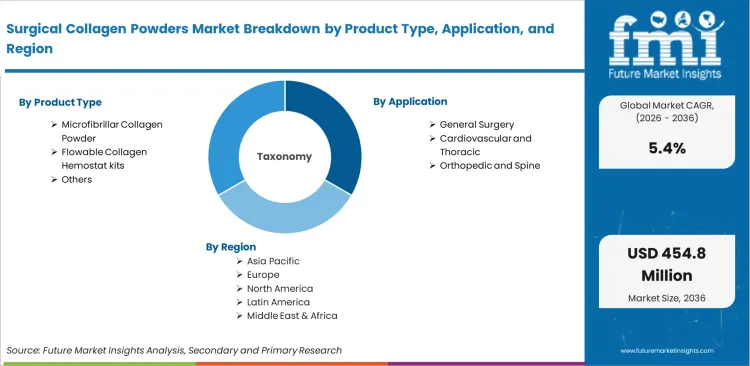
- By Product Type: Microfibrillar Collagen Powder at 42.0% share in 2026, followed by flowable collagen hemostat kits at 24.0% share.
- By Application: General Surgery leads at 31.0% share in 2026, followed by orthopedic and spine at 21.0% share.
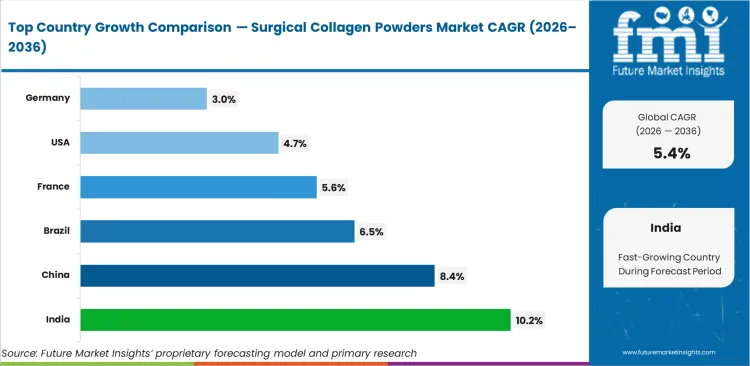
- Geography: India and China show the fastest growth at 10.2% and 8.4% CAGR, supported by rising surgical procedure volumes, broader hospital expansion, and improving access to advanced hemostatic products.
- Analyst Opinion at FMI
- Sabyasachi Ghosh, Principal Consultant at Future Market Insights, opines, “Buyer preference is increasingly being shaped by application ease, dependable hemostatic performance, and procedural versatility, as surgical teams seek collagen-based products that can control bleeding efficiently without adding complexity to already time-sensitive operating room workflows.”
- Strategic Implications and Executive Takeaways
- Build commercial positioning around fast application, operative field control, and broad procedural usability, especially in hospital-led surgical environments.
- Prioritize microfibrillar collagen powder and general surgery opportunities, where procedural frequency and routine hemostatic need create stronger recurring demand.
- Expand growth plans in high-procedure emerging markets where hospital infrastructure is growing and surgical teams are adopting more advanced adjunctive products.
- Methodology
- As per FMI, sizing and splits were reconciled using company-level product mapping, procedure-level demand allocation, and end-user usage assessment across major surgical specialties.
- Segment shares were validated by linking product type preference with handling characteristics, specialty-specific hemostatic needs, and procedural intensity.
- Pricing sensitivity was stress tested under product mix and application mix shifts to confirm revenue response under realistic surgical procurement and utilization scenarios.
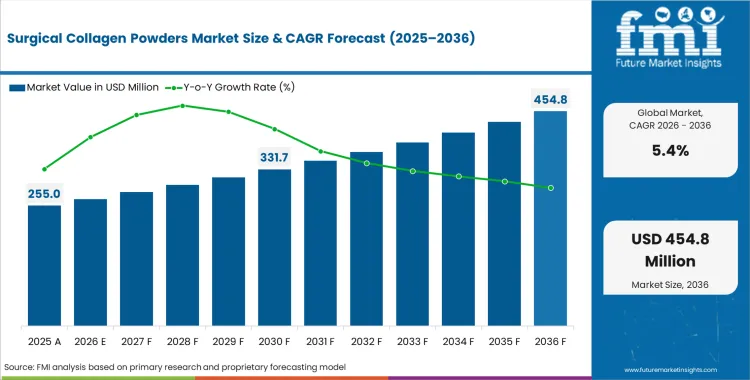
Procurement is being shaped by surgeon familiarity, shelf readiness, and case-by-case hemostatic preference, with buyers giving weight to handling profile, preparation time, and suitability across different bleeding scenarios. Hospitals remain the main demand center because higher-complexity cases and broader specialty coverage are concentrated there, while ambulatory surgery centers are expanding use where procedure efficiency and simplified hemostatic workflow matter more.
India (10.2% CAGR, supported by rising surgical volumes and broader hospital expansion) and China (8.4% CAGR, driven by higher procedure throughput and growing specialty care capacity) are expected to lead growth. Brazil (6.5% CAGR) is expected to expand through improving access to surgical care and stronger adoption of adjunctive hemostatic materials. The USA (4.7% CAGR) is expected to remain the largest market due to broad procedure volume and established use in hospital settings. Mature markets including France (5.6%) and Germany (3.0%) are expected to contribute more through replacement purchases and selective specialty uptake, constrained by committee review cycles and pricing discipline.
Surgical Collagen Powders Market Definition
The market ranges from collagen-based hemostatic agents utilized in surgical procedures to help control and manage bleeding and tissue management. Products include microfibrillar collagen powder/flour, flowable collagen hemostat kits, collagen sponge/sheet adjuncts, and combination collagen matrices, which are utilized in general surgery, cardiovascular and thoracic surgery, orthopedic and spine, neurosurgery, and ENT or other specialties, among others. The market is influenced by hospitals, ambulatory surgery centers, and other specialty clinics that utilize collagen-based adjuncts where control of a procedure and localized control of bleeding are required.
Surgical Collagen Powders Market Inclusions
The report includes global and regional market sizing and a 10-year forecast for 2026 to 2036. Segment-level sizing is provided by product type, application, and end user, with country-level CAGR comparisons across key markets. Coverage also includes assessment of replacement demand, specialty procedure mix, and procurement priorities such as handling ease, preparation simplicity, and procedure-specific use, alongside competitive positioning of major suppliers active in collagen-based surgical hemostatic categories, based on FMI analysis.
Surgical Collagen Powders Market Exclusions
The scope excludes non-collagen hemostatic agents, fibrin sealants, oxidized regenerated cellulose products, and synthetic sealants sold as separate categories. It also omits sutures, surgical sponges, barrier films, and implantable collagen products that do not serve as surgical powder or closely related collagen hemostatic adjuncts within the stated category. Procedure fees, hospital service revenue, and postoperative care are excluded unless directly tied to product value capture. The focus remains on surgical collagen powder and related collagen-based adjunct products aligned to the listed product types, applications, end users, and supplier participation.
Surgical Collagen Powders Market Research Methodology
- Primary Research: Interviews were carried out with surgeons across general and specialty procedures, operating room decision-makers, hospital procurement, ambulatory surgery center management, and supplier commercial.
- Desk Research: Public data was collected from various sources like regulators, surgical society references, clinical publications, standards sources, and company primary disclosure to benchmark product placement, specialty usage patterns, and supplier activity.
- Market-Sizing and Forecasting: A hybrid bottom-up model and top-down approach was employed, consisting of surgical procedures, adjunctive hemostatic procedures, and utilization rates, and then cross-reconciled to segments using product-type and application segments.
- Data Validation and Update Cycle: The results were validated through consistency review, including total segments and country growth rates, and variance checks before finalization.
Segmental Analysis
Surgical Collagen Powders Market Analysis by Product Type
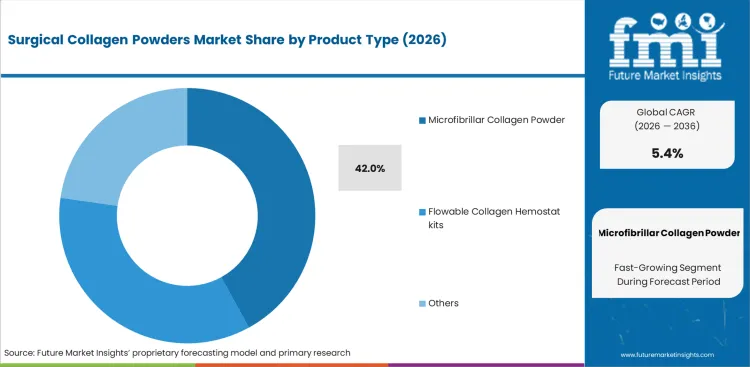
Based on FMI’s report, microfibrillar collagen powder/flour is estimated to hold 42.0% share in 2026. This lead position is supported by its broad procedural familiarity, straightforward intraoperative use, and strong fit in surgeries where surgeons need rapid, localized hemostatic support. Flowable collagen hemostat kits account for 24.0% share, collagen sponge or sheet adjuncts represent 20.0%, and combination collagen matrices contribute 14.0%. Microfibrillar collagen powder/flour remains the leading segment because it is widely recognized as a practical, flexible hemostatic format that can be used across a broad range of bleeding scenarios without requiring highly specialized deployment.
- Fast, direct hemostatic action in diffuse surface bleeding: Recent surgical reviews describe microfibrillar collagen powder as a topical matrix that directly activates platelets on contact and can be applied straight to broad bleeding surfaces, making it highly practical where rapid local control is needed. Powder forms are specifically noted as being placed directly on the bleeding site, supporting their routine intraoperative value. [2]
- Broad usability across multiple surgical specialties: A systematic literature review on microfibrillar collagen hemostat reported use across a wide range of procedures, including hepatic, orthopedic, splenic, oral, and otolaryngologic surgery, with favorable hemostatic outcomes and safety across many settings. That wider procedural relevance supports a larger demand base than more specialized collagen formats. [3]
- Strong fit in cost-conscious surgical practice: Microfibrillar collagen powder/flour remains attractive because it supports effective hemostatic use in a format that is often perceived as more practical for routine adoption than more advanced or bundled adjunct systems. This makes it better suited to hospitals and surgical centers that prefer products with broad usability and easier integration into standard procurement and operating room protocols.
Surgical Collagen Powders Market Analysis by Application
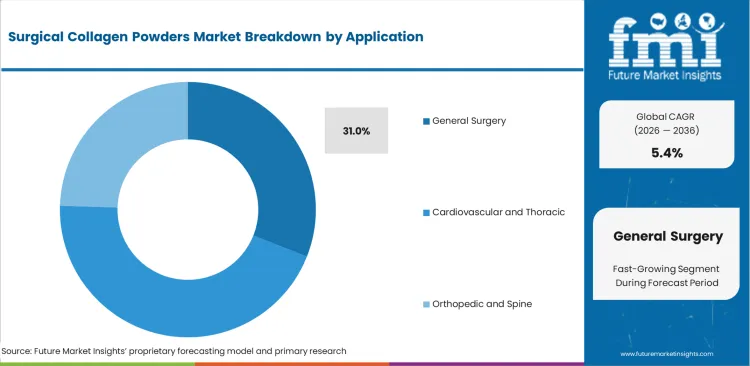
General surgery accounts for 31.0% share in 2026, based on FMI’s report, reflecting its position as the largest application segment in the market. This leadership is supported by the high volume and wide variety of procedures performed under general surgery, where collagen-based hemostatic support is often needed for routine bleeding management and cleaner operative control. Orthopedic and spine contribute 21.0% share, cardiovascular and thoracic account for 18.0%, neurosurgery holds 17.0%, and ENT or other specialties represent 13.0%. General surgery leads because it combines high procedure frequency with broad hemostatic need, creating a larger recurring demand base than more specialized application areas.
- Broad clinical relevance supported by biomaterial performance advantages: A 2025 review on biomaterial-based hemostasis shows that topical hemostats remain highly relevant because they combine reliable bleeding control, ease of handling, and adaptability across tissue types, making them particularly well suited to the broad procedural demands of general surgery. [4]
- Stronger alignment with varied surgical wound contexts: The review emphasizes that collagen-based products should be selected based on clinical context, intended use, and wound-healing needs, while also noting their broad applicability across wound care settings. This supports general surgery’s lead because it involves a wider mix of tissue conditions and operative scenarios where collagen powders can be used repeatedly as a practical adjunct. [5]
- Wider fit in standard hospital surgical workflows: General surgery remains the leading application because collagen powders are better suited to routine hospital use where products must perform consistently across a broad mix of commonly performed procedures, supporting stronger repeat usage than in more specialized surgical areas.
Surgical Collagen Powders Market Drivers, Restraints, and Opportunities
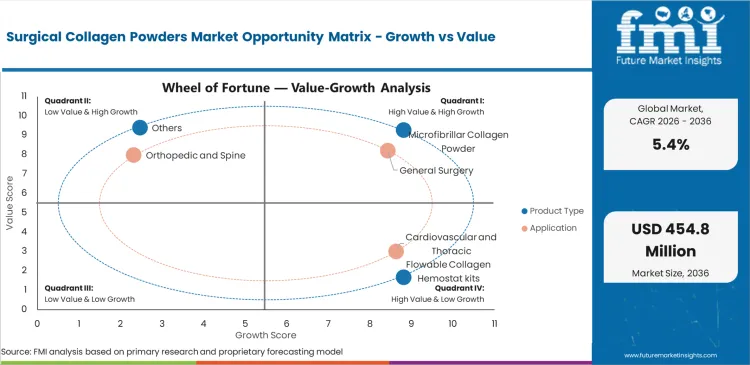
Future Market Insights analysis indicates that this market is developing as surgical teams continue to prioritize dependable hemostatic control, smoother operative workflows, and products that can be used across a broad range of specialties. Estimated valuation in 2026 is being supported by stable demand from hospitals, rising procedure volumes in both conventional and specialty surgeries, and growing preference for absorbable adjuncts that reduce procedural disruption. Demand is increasingly being shaped by the need for products that offer quick handling, consistent surgical utility, and broad usability in routine as well as complex procedures.
At the same time, market expansion is being moderated by pricing pressure in hospital procurement, competition from alternative hemostatic technologies, and variability in product selection by surgeon preference and procedure type. Even so, forecast growth remains supported by hospital expansion in developing markets, increasing specialty surgery volumes, and stronger demand for efficient bleeding control products that fit standard operating room practice. Based on FMI’s report, the outlook reflects a market where product format influences adoption ease, general surgery remains the leading application, and supplier advantage increasingly depends on usability and procedural relevance rather than portfolio breadth alone.
- Procedure-volume Demand: Demand is being supported as rising surgical case volumes continue to increase the routine need for collagen-based hemostatic support.
- Procurement Pressure: Adoption can be moderated where hospital purchasing teams place strong emphasis on price and compare collagen formats against alternative hemostatic options.
- Specialty Expansion: Demand is being supported as more specialty procedures adopt advanced, easy-to-handle hemostatic adjuncts for better operative control.
Regional Analysis
Based on the regional analysis, surgical collagen powders market is segmented into North America, Latin America, East Asia, South Asia & Pacific, and Western Europe across 40+ countries. Regional performance is interpreted through procedure mix, surgeon preference for collagen-based hemostatic formats, and institutional purchasing across hospitals, ambulatory surgery centers, and specialty clinics, as per FMI. The full report also offers market attractiveness analysis based on regional trends.
.webp "Top Country Growth Comparison Surgical Collagen Powders Market Cagr (2026 2036)")
| Country | CAGR |
|---|---|
| United States | 4.7% |
| Brazil | 6.5% |
| China | 8.4% |
| India | 10.2% |
| Germany | 3.0% |
| France | 5.6% |
Source: Future Market Insights (FMI) analysis and primary research
North America Surgical Collagen Powders Market Analysis
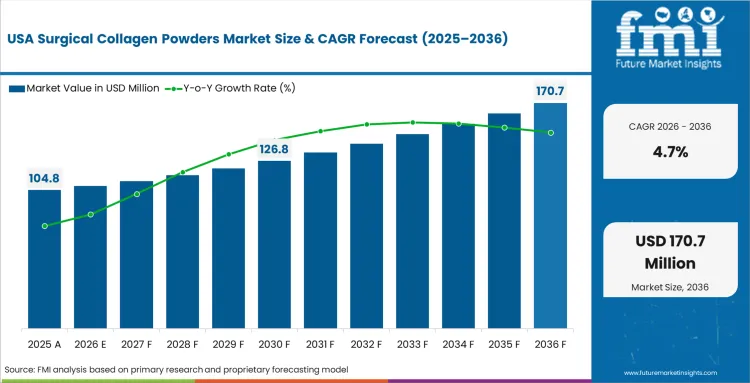
North America remains a clinically established market, where collagen-based hemostatic powders and adjunct formats are used across broad surgical settings and evaluated through hospital formulary discipline. Becton, Dickinson and Company holds a strong position through recognized hemostatic portfolios and deep hospital access. Baxter International remains relevant in procedure support categories where surgeons value familiar adjunctive materials and dependable supply. Johnson & Johnson MedTech also retains visibility in operating room ecosystems where hemostatic product choice is tied to broader surgical workflow preference. FMI analysts note that hospitals remain the principal end users, while ambulatory surgery centers contribute mainly in selected lower-complexity procedures.
- United States: In the USA, surgical collagen powders are expected to advance at 4.7% CAGR through 2036, supported by steady procedural demand in general surgery and continued use of collagen-based hemostatic materials where local bleeding control and handling familiarity remain important.
FMI’s report includes a detailed analysis of the growth in the North American region, along with a country-wise assessment that includes the USA, Canada and Mexico. Readers can also find regional trends, regulations, and market growth based on different segments and countries in the North America region.
Latin America Surgical Collagen Powders Market Analysis
Latin America is expanding through a mix of public and private surgical demand, where collagen hemostatic usage is influenced by hospital purchasing discipline, procedure growth, and distributor-led product reach. Baxter International and Johnson & Johnson MedTech remain important through established surgical channel presence, while broader market development still depends heavily on access, pricing, and surgeon familiarity. FMI is of the opinion that the region is moving from selective use toward broader adoption in high-volume urban centers.
- Brazil: Brazil is expected to witness a growth rate of 6.5% CAGR from 2021 to 2036, with drivers of this growth including an increase in the use of collagen-based hemostats in general surgeries, cardiovascular surgeries, and orthopedic surgeries. Hospitals dominate the use of collagen-based hemostats, while ambulatory surgery centers are an additional outlet in surgeries where collagen powders and kits are utilized in a shorter, more controlled manner.
The report consists of a detailed analysis for the market in Brazil, Argentina and Rest of Latin America. Readers can find detailed information about several factors, such as the pricing analysis and regional trends, which are impacting growth in the Latin America region.
East Asia Surgical Collagen Powders Market Analysis
East Asia is developing through rising surgical volume, increasing familiarity with adjunctive hemostatic materials, and broader hospital capability in higher-acuity procedures. Becton, Dickinson and Company and Johnson & Johnson MedTech remain visible where hospitals adopt internationally established surgical products, while other participants gain traction through distribution reach and specialty alignment. FMI analysts note that growth is increasingly tied to procedure expansion in major hospitals rather than to isolated product substitution alone.
- China: China is forecast to grow at 8.4% CAGR through 2036, driven by rising surgery volumes and improved use of adjunctive hemostatic materials in large public hospitals. Orthopedic and spine procedures are contributing significantly, but general surgery and cardiovascular procedures continue to provide the broadest procedural base.
FMI’s report includes a detailed analysis of the growth in the East Asia region, along with a country-wise assessment that includes China, Japan and South Korea. Readers can also find regional trends, regulations, and market growth based on different segments and countries in the East Asia region.
South Asia & Pacific Surgical Collagen Powders Market Analysis
South Asia & Pacific is emerging as a faster-growth opportunity, where wider access to surgery, growing hospital networks, and increasing procedural complexity are improving the case for collagen-based hemostatic support. Market development remains strongest in urban institutions that perform higher volumes and have more consistent access to advanced adjunctive materials. FMI opines that the regional opportunity is being shaped by both procedure growth and broader clinician familiarity with collagen-based hemostatic products.
- India: India is forecast at 10.2% CAGR through 2036, the highest rate among the countries compared. Growth is being driven by rising surgical case volumes and increasing use of hemostatic support materials in complex procedures, including neurosurgery, orthopedic interventions, and general surgery.
FMI’s report includes a detailed analysis of the growth in the South Asia & Pacific region, along with a country-wise assessment that includes India, ASEAN Countries, Australia & New Zealand and Rest of South Asia. Readers can also find regional trends, regulations, and market growth based on different segments and countries in the South Asia & Pacific region.
Western Europe Surgical Collagen Powders Market Analysis
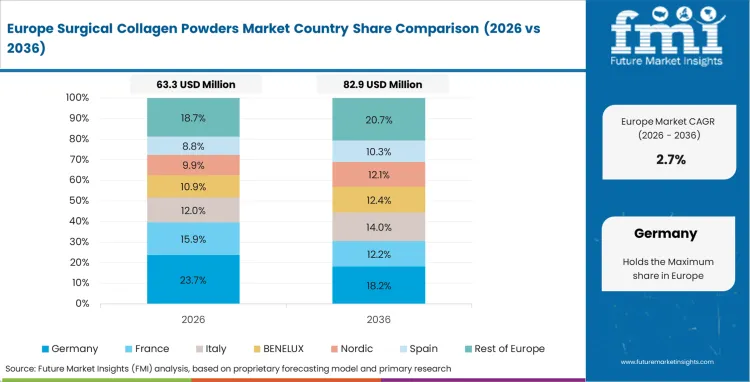
Western Europe continues to be an organized and procurement-driven market for collagen-based hemostatic agents, in which these products are introduced through clinically set processes and are closely measured in terms of handling, familiarity, and cost-effectiveness. B. Braun and Integra LifeSciences continue to be important players through their hospital-focused presence in the surgical segment, and traditional multinational players continue to benefit from surgeon familiarity and long-standing relationships with medical establishments. FMI analysts comment that the market in this region continues to be steady in nature, with the introduction and acceptance of these products being closely linked to formal processes.
- Germany: Germany continues to grow at a steady 3.0% CAGR through to 2036 for surgical collagen powders, as it represents a developed market in which growth tends to be more substitution and procedure-driven. Microfibrillar collagen tends to be the most developed form in this segment as it tends to be more aligned to traditional and familiar processes in surgery in general and specialty procedures in particular.
- France: France is expected to rise at 5.6% CAGR through 2036, supported by broader use of collagen-based hemostatic products across general surgery and selected specialty procedures.
FMI’s analysis of surgical collagen powders market in Western Europe consists of country-wise assessment that includes Germany, UK, France, Italy, Spain, BENELUX, Nordic Countries and Rest of Western Europe. Readers can know various regulations and latest trends in the regional market.
Competitive Aligners for Market Players
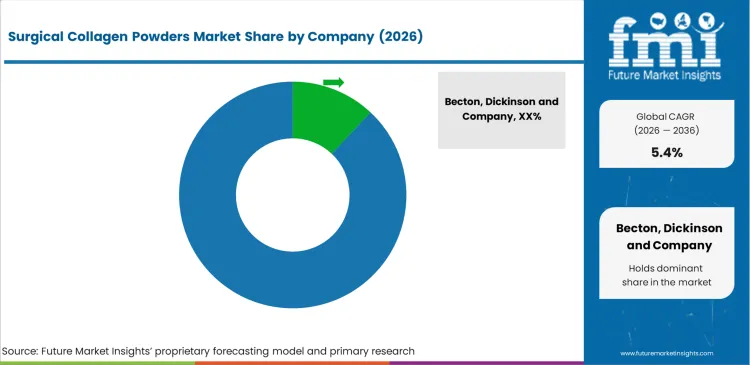
Market structure remains fragmented, yet practical competition is concentrated among a limited set of surgical hemostasis suppliers that can meet hospital-scale demand, maintain consistent collagen processing quality, and support contracting with dependable availability. FMI analysis indicates a clear scale leader, followed by diversified surgical consumables manufacturers in the next tier. The main competitive factor is predictable clinical handling and supply continuity inside contracted purchasing, not short-cycle price movement, because product selection is reinforced through OR standardisation and repeat ordering cycles, as per FMI.
Companies with structural advantages tend to combine broad hemostasis portfolios with strong hospital access and field support that shapes adoption at the service-line level. Suppliers that can provide multiple collagen powder formats and adjacent adjuncts can fit different surgeon preferences and procedure needs without forcing hospitals to manage many vendors. Scale and quality systems matter because hospitals screen for sterility assurance, consistent particle and flow behavior, and kit completeness, and they penalise backorders that disrupt case scheduling. Vendors with established education and in-servicing programs also retain share because application technique affects perceived performance, based on FMI’s report.
Customer concentration reinforces buyer leverage. Hospitals are the primary buyers and typically manage supplier dependency through approved alternates, committee-led value analysis reviews, and periodic tender rebids that keep net pricing disciplined. Ambulatory surgery centers apply tighter budget control and standardise to fewer SKUs where case mix is predictable, while specialty clinics often follow surgeon preference yet still keep backups to avoid procedure disruption. This purchasing behavior limits pricing power for routine use, while measured premiums are retained mainly where workflow ease and dependable intraoperative performance reduce rework risk and save OR time, Future Market Insights analysis.
Recent Developments
The report includes full coverage of key trends from competitive benchmarking. Some of the recent developments covered in the reports:
- In December 2025, MPM Medical, a USA leader in advanced wound care and manufacturer of American-made 100% bovine collagen, announced the launch of its new TripleHelix Wound Care Collagen At-Home Patient Care Kits. This new product line is backed with patient care technology designed to expand access, improve patient compliance, and support providers offering post-operative or ongoing wound care. [1]
- In October 2024, Royal Wound-X, a division of Royal Biologics, showcased two cutting-edge products includes the launch of Peak Powder Collagen Matrix, a next-generation collagen-based wound care solution designed to enhance healing in both surgical and non-surgical wounds. Composed of 100% bovine Type 1 collagen, Peak Powder optimizes the wound environment, supports tissue regeneration, and significantly speeds up the healing process. [6]
- In 2026, TAICEND is set to launch its Collagen Dressing, featuring high-purity fish collagen derived via patented low-temperature extraction. This sterile powder formulation enhances absorption, biocompatibility, and ease of use. Preserving the triple-helix structure, it supports cellular repair and accelerates healing, particularly for chronic wounds such as pressure ulcers and diabetic foot ulcers.
Key Players in Surgical Collagen Powders Market
- Becton, Dickinson and Company
- Baxter International Inc.
- Johnson & Johnson
- Integra LifeSciences Holdings Corporation
- B. Braun Melsungen AG
Scope of the Report
| Metric | Value |
|---|---|
| Quantitative Units | USD 255.0 Mn (2026) to USD 431.5 Mn (2036), at a CAGR of 5.4% |
| Market Definition | The surgical collagen powders market comprises global production and trade of collagen-based hemostatic powders and related adjunct formats used in surgical fields to support bleeding control and local wound management, where demand is shaped by procedure volume, surgeon preference for powder versus sheet formats, and hospital protocol selection for hemostasis and adjunct use. |
| Product Type Segmentation | Microfibrillar collagen powder or flour, Flowable collagen hemostat kits, Collagen sponge or sheet adjuncts, Combination collagen matrices |
| Application Coverage | General surgery, Cardiovascular and thoracic, Orthopedic and spine, Neurosurgery, ENT or other specialties |
| End User Coverage | Hospitals, Ambulatory surgery centers, Specialty clinics |
| Regions Covered | North America, Latin America, East Asia, South Asia & Pacific, Western Europe, Eastern Europe, and Middle East & Africa. |
| Countries Covered | United States, Canada, Mexico, Brazil, Argentina, Germany, France, United Kingdom, Italy, Spain, China, India, Japan, South Korea, Indonesia, Australia and 40+ countries |
| Key Companies Profiled | Becton, Dickinson and Company, Baxter International Inc., Johnson & Johnson, Integra LifeSciences Holdings Corporation, B. Braun Melsungen AG |
| Forecast Period | 2026 to 2036 |
| Approach | Hybrid top down and bottom up market modeling validated through primary interviews with surgeons, OR materials managers, and suppliers, supported by procedure volume triangulation and product use mapping, as per FMI. |
Surgical Collagen Powders Market Analysis by Segments
Product Type
- Microfibrillar collagen powder or flour
- Flowable collagen hemostat kits
- Collagen sponge or sheet adjuncts
- Combination collagen matrices
Application
- General surgery
- Cardiovascular and thoracic
- Orthopedic and spine
- Neurosurgery
- ENT or other specialties
End User
- Hospitals
- Ambulatory surgery centers
- Specialty clinics
Region
- North America
- USA
- Canada
- Mexico
- Latin America
- Brazil
- Argentina
- Rest of Latin America
- East Asia
- China
- Japan
- South Korea
- South Asia & Pacific
- India
- ASEAN Countries
- Australia & New Zealand
- Rest of South Asia
- Western Europe
- Germany
- UK
- France
- Italy
- Spain
- BENELUX
- Nordic Countries
- Rest of Western Europe
- Eastern Europe
- Russia
- Hungary
- Poland
- Rest of Eastern Europe
- Middle East & Africa
- Saudi Arabia
- Türkiye
- South Africa
- Other African Union
- Rest of Middle East & Africa
Bibliography
- [1] MPM Medical (2025). MPM Medical Launches New Collagen At-Home Wound Care Kits and Proprietary Wound Care Portal to Improve Patient Compliance and Access.
- [2] PubMed Central (2023). Topical haemostatic agents in surgery.
- [3] PubMed Central (2021). Avitene Microfibrillar Collagen Hemostat for Adjunctive Hemostasis in Surgical Procedures: A Systematic Literature Review
- [4] PubMed Central (2025). Biomaterial-Based Hemostasis: A Review of the Clinical and Functional Versatility of Oxidized Regenerated Cellulose
- [5] PubMed Central (2025). Collagen-Based Products in Wound, Skin, and Health Care
- [6] Royal Wound-X (2024). Royal Wound-X to Launch and Showcase New Cutting-Edge Technologies at SAWC 2024
This bibliography is provided for reader reference and is not exhaustive. The full report contains the complete reference list and detailed citations.
This Report Addresses
- Market intelligence to enable structured decision making across surgical hemostasis protocol selection and OR procurement planning
- Market size estimation and 10-year revenue forecasts from 2026 to 2036 for surgical collagen powder demand
- Growth opportunity mapping across product types, applications, and end user purchasing pools
- Segment and regional revenue forecasts aligned to the stated taxonomy and covered geographies
- Competition strategy assessment including portfolio positioning, clinical fit, and hospital channel coverage benchmarking
- Product and compliance tracking focused on sterile use expectations, labeling discipline, and procurement documentation requirements
- Regulatory impact analysis covering medical device approval expectations and facility protocol alignment affecting adoption planning
- Market report delivery in PDF, Excel, PPT, and interactive dashboard formats for executive and operational use
Frequently Asked Questions
How large is the demand for Surgical Collagen Powders in the global market in 2026?
Demand for Surgical Collagen Powders in the global market is estimated to be valued at USD 255.0 Mn in 2026, as per FMI.
What will be the market size of Surgical Collagen Powders in the global market by 2036?
Market size for Surgical Collagen Powders is projected to reach USD 431.5 Mn by 2036.
What is the expected demand growth for Surgical Collagen Powders in the global market between 2026 and 2036?
Demand for Surgical Collagen Powders in the global market is expected to grow at a CAGR of 5.4% between 2026 and 2036.
Which product type is poised to lead global demand by 2026?
Microfibrillar collagen powder or flour is expected to lead, capturing 42.0% share in 2026.
Which application is expected to account for the largest share in 2026?
General surgery is expected to hold the highest share at 31.0% in 2026.
How significant is hospital demand in the 2026 end user mix?
Hospitals are projected to account for 74.0% share of end user demand in 2026.
Preview the report firsthand - request a free sample
Get SampleGet the brochure for pricing and purchase details.
Get PDFTable of Content
- Executive Summary
- Global Market Outlook
- Demand-side Trends
- Supply-side Trends
- Technology Roadmap Analysis
- Analysis and Recommendations
- Market Overview
- Market Coverage / Taxonomy
- Market Definition / Scope / Limitations
- Research Methodology
- Chapter Orientation
- Analytical Framework
- Market Structure, Signals, and Trend Drivers
- Benchmarking and Cross-market Comparability
- Market Sizing, Forecasting, and Opportunity Mapping
- Research Design and Evidence Framework
- Desk Research Programme (Secondary Evidence)
- Company Annual and Sustainability Reports
- Peer-reviewed Journals and Academic Literature
- Corporate Websites, Product Literature, and Technical Notes
- Earnings Decks and Investor Briefings
- Statutory Filings and Regulatory Disclosures
- Technical White Papers and Standards Notes
- Additional Desk Sources
- Expert Input and Fieldwork (Primary Evidence)
- Primary Modes
- Qualitative Interviews and Expert Elicitation
- Quantitative Surveys and Structured Data Capture
- Blended Approach
- Why Primary Evidence is Used
- Field Techniques
- Interviews
- Surveys
- Focus Groups
- Observational and In-context Research
- Social and Community Interactions
- Stakeholder Universe Engaged
- C-suite Leaders
- Board Members
- Presidents and Vice Presidents
- R&D and Innovation Heads
- Technical Specialists
- Domain Subject-matter Experts
- Scientists
- Physicians and Other Healthcare Professionals
- Governance, Ethics, and Data Stewardship
- Research Ethics
- Data Integrity and Handling
- Primary Modes
- Research Methods and Reference Sources
- Desk Research Programme (Secondary Evidence)
- Market Data Analysis and Forecast Development
- Data Collection
- Data Review and Validation
- Synthesis, Triangulation, and Analysis
- Research Quality and Validation
- Market Background
- Market Dynamics
- Drivers
- Restraints
- Opportunity
- Trends
- Scenario Forecast
- Demand in Optimistic Scenario
- Demand in Likely Scenario
- Demand in Conservative Scenario
- Opportunity Map Analysis
- Product Life Cycle Analysis
- Supply Chain Analysis
- Investment Feasibility Matrix
- Value Chain Analysis
- PESTLE and Porter’s Analysis
- Regulatory Landscape
- Regional Parent Market Outlook
- Production and Consumption Statistics
- Import and Export Statistics
- Market Dynamics
- Global Market Analysis 2021 to 2025 and Forecast, 2026 to 2036
- Historical Market Size Value (USD Million) Analysis, 2021 to 2025
- Current and Future Market Size Value (USD Million) Projections, 2026 to 2036
- Y-o-Y Growth Trend Analysis
- Absolute $ Opportunity Analysis
- Global Market Pricing Analysis 2021 to 2025 and Forecast 2026 to 2036
- Global Market Analysis 2021 to 2025 and Forecast 2026 to 2036, By Product Type
- Introduction / Key Findings
- Historical Market Size Value (USD Million) Analysis By Product Type , 2021 to 2025
- Current and Future Market Size Value (USD Million) Analysis and Forecast By Product Type , 2026 to 2036
- Microfibrillar Collagen Powder
- Flowable Collagen Hemostat kits
- Others
- Microfibrillar Collagen Powder
- Y-o-Y Growth Trend Analysis By Product Type , 2021 to 2025
- Absolute $ Opportunity Analysis By Product Type , 2026 to 2036
- Global Market Analysis 2021 to 2025 and Forecast 2026 to 2036, By Application
- Introduction / Key Findings
- Historical Market Size Value (USD Million) Analysis By Application, 2021 to 2025
- Current and Future Market Size Value (USD Million) Analysis and Forecast By Application, 2026 to 2036
- General Surgery
- Cardiovascular and Thoracic
- Orthopedic and Spine
- General Surgery
- Y-o-Y Growth Trend Analysis By Application, 2021 to 2025
- Absolute $ Opportunity Analysis By Application, 2026 to 2036
- Global Market Analysis 2021 to 2025 and Forecast 2026 to 2036, By Region
- Introduction
- Historical Market Size Value (USD Million) Analysis By Region, 2021 to 2025
- Current Market Size Value (USD Million) Analysis and Forecast By Region, 2026 to 2036
- North America
- Latin America
- Western Europe
- Eastern Europe
- East Asia
- South Asia and Pacific
- Middle East & Africa
- Market Attractiveness Analysis By Region
- North America Market Analysis 2021 to 2025 and Forecast 2026 to 2036, By Country
- Historical Market Size Value (USD Million) Trend Analysis By Market Taxonomy, 2021 to 2025
- Market Size Value (USD Million) Forecast By Market Taxonomy, 2026 to 2036
- By Country
- USA
- Canada
- Mexico
- By Product Type
- By Application
- By Country
- Market Attractiveness Analysis
- By Country
- By Product Type
- By Application
- Key Takeaways
- Latin America Market Analysis 2021 to 2025 and Forecast 2026 to 2036, By Country
- Historical Market Size Value (USD Million) Trend Analysis By Market Taxonomy, 2021 to 2025
- Market Size Value (USD Million) Forecast By Market Taxonomy, 2026 to 2036
- By Country
- Brazil
- Chile
- Rest of Latin America
- By Product Type
- By Application
- By Country
- Market Attractiveness Analysis
- By Country
- By Product Type
- By Application
- Key Takeaways
- Western Europe Market Analysis 2021 to 2025 and Forecast 2026 to 2036, By Country
- Historical Market Size Value (USD Million) Trend Analysis By Market Taxonomy, 2021 to 2025
- Market Size Value (USD Million) Forecast By Market Taxonomy, 2026 to 2036
- By Country
- Germany
- UK
- Italy
- Spain
- France
- Nordic
- BENELUX
- Rest of Western Europe
- By Product Type
- By Application
- By Country
- Market Attractiveness Analysis
- By Country
- By Product Type
- By Application
- Key Takeaways
- Eastern Europe Market Analysis 2021 to 2025 and Forecast 2026 to 2036, By Country
- Historical Market Size Value (USD Million) Trend Analysis By Market Taxonomy, 2021 to 2025
- Market Size Value (USD Million) Forecast By Market Taxonomy, 2026 to 2036
- By Country
- Russia
- Poland
- Hungary
- Balkan & Baltic
- Rest of Eastern Europe
- By Product Type
- By Application
- By Country
- Market Attractiveness Analysis
- By Country
- By Product Type
- By Application
- Key Takeaways
- East Asia Market Analysis 2021 to 2025 and Forecast 2026 to 2036, By Country
- Historical Market Size Value (USD Million) Trend Analysis By Market Taxonomy, 2021 to 2025
- Market Size Value (USD Million) Forecast By Market Taxonomy, 2026 to 2036
- By Country
- China
- Japan
- South Korea
- By Product Type
- By Application
- By Country
- Market Attractiveness Analysis
- By Country
- By Product Type
- By Application
- Key Takeaways
- South Asia and Pacific Market Analysis 2021 to 2025 and Forecast 2026 to 2036, By Country
- Historical Market Size Value (USD Million) Trend Analysis By Market Taxonomy, 2021 to 2025
- Market Size Value (USD Million) Forecast By Market Taxonomy, 2026 to 2036
- By Country
- India
- ASEAN
- Australia & New Zealand
- Rest of South Asia and Pacific
- By Product Type
- By Application
- By Country
- Market Attractiveness Analysis
- By Country
- By Product Type
- By Application
- Key Takeaways
- Middle East & Africa Market Analysis 2021 to 2025 and Forecast 2026 to 2036, By Country
- Historical Market Size Value (USD Million) Trend Analysis By Market Taxonomy, 2021 to 2025
- Market Size Value (USD Million) Forecast By Market Taxonomy, 2026 to 2036
- By Country
- Kingdom of Saudi Arabia
- Other GCC Countries
- Turkiye
- South Africa
- Other African Union
- Rest of Middle East & Africa
- By Product Type
- By Application
- By Country
- Market Attractiveness Analysis
- By Country
- By Product Type
- By Application
- Key Takeaways
- Key Countries Market Analysis
- USA
- Pricing Analysis
- Market Share Analysis, 2025
- By Product Type
- By Application
- Canada
- Pricing Analysis
- Market Share Analysis, 2025
- By Product Type
- By Application
- Mexico
- Pricing Analysis
- Market Share Analysis, 2025
- By Product Type
- By Application
- Brazil
- Pricing Analysis
- Market Share Analysis, 2025
- By Product Type
- By Application
- Chile
- Pricing Analysis
- Market Share Analysis, 2025
- By Product Type
- By Application
- Germany
- Pricing Analysis
- Market Share Analysis, 2025
- By Product Type
- By Application
- UK
- Pricing Analysis
- Market Share Analysis, 2025
- By Product Type
- By Application
- Italy
- Pricing Analysis
- Market Share Analysis, 2025
- By Product Type
- By Application
- Spain
- Pricing Analysis
- Market Share Analysis, 2025
- By Product Type
- By Application
- France
- Pricing Analysis
- Market Share Analysis, 2025
- By Product Type
- By Application
- India
- Pricing Analysis
- Market Share Analysis, 2025
- By Product Type
- By Application
- ASEAN
- Pricing Analysis
- Market Share Analysis, 2025
- By Product Type
- By Application
- Australia & New Zealand
- Pricing Analysis
- Market Share Analysis, 2025
- By Product Type
- By Application
- China
- Pricing Analysis
- Market Share Analysis, 2025
- By Product Type
- By Application
- Japan
- Pricing Analysis
- Market Share Analysis, 2025
- By Product Type
- By Application
- South Korea
- Pricing Analysis
- Market Share Analysis, 2025
- By Product Type
- By Application
- Russia
- Pricing Analysis
- Market Share Analysis, 2025
- By Product Type
- By Application
- Poland
- Pricing Analysis
- Market Share Analysis, 2025
- By Product Type
- By Application
- Hungary
- Pricing Analysis
- Market Share Analysis, 2025
- By Product Type
- By Application
- Kingdom of Saudi Arabia
- Pricing Analysis
- Market Share Analysis, 2025
- By Product Type
- By Application
- Turkiye
- Pricing Analysis
- Market Share Analysis, 2025
- By Product Type
- By Application
- South Africa
- Pricing Analysis
- Market Share Analysis, 2025
- By Product Type
- By Application
- USA
- Market Structure Analysis
- Competition Dashboard
- Competition Benchmarking
- Market Share Analysis of Top Players
- By Regional
- By Product Type
- By Application
- Competition Analysis
- Competition Deep Dive
- Becton, Dickinson and Company
- Overview
- Product Portfolio
- Profitability by Market Segments (Product/Age /Sales Channel/Region)
- Sales Footprint
- Strategy Overview
- Marketing Strategy
- Product Strategy
- Channel Strategy
- Baxter International Inc.
- Johnson & Johnson
- Integra LifeSciences Holdings Corporation
- B. Braun Melsungen AG
- Becton, Dickinson and Company
- Competition Deep Dive
- Assumptions & Acronyms Used


